
Custom Casual Apparel: How to Read Supplier Specs and Certifications
For buyers moving from product discovery to supplier evaluation, the decisive details are often not style-related. They are documented constraints: fabric weight, certification scope, size range, MOQ, and lead time.
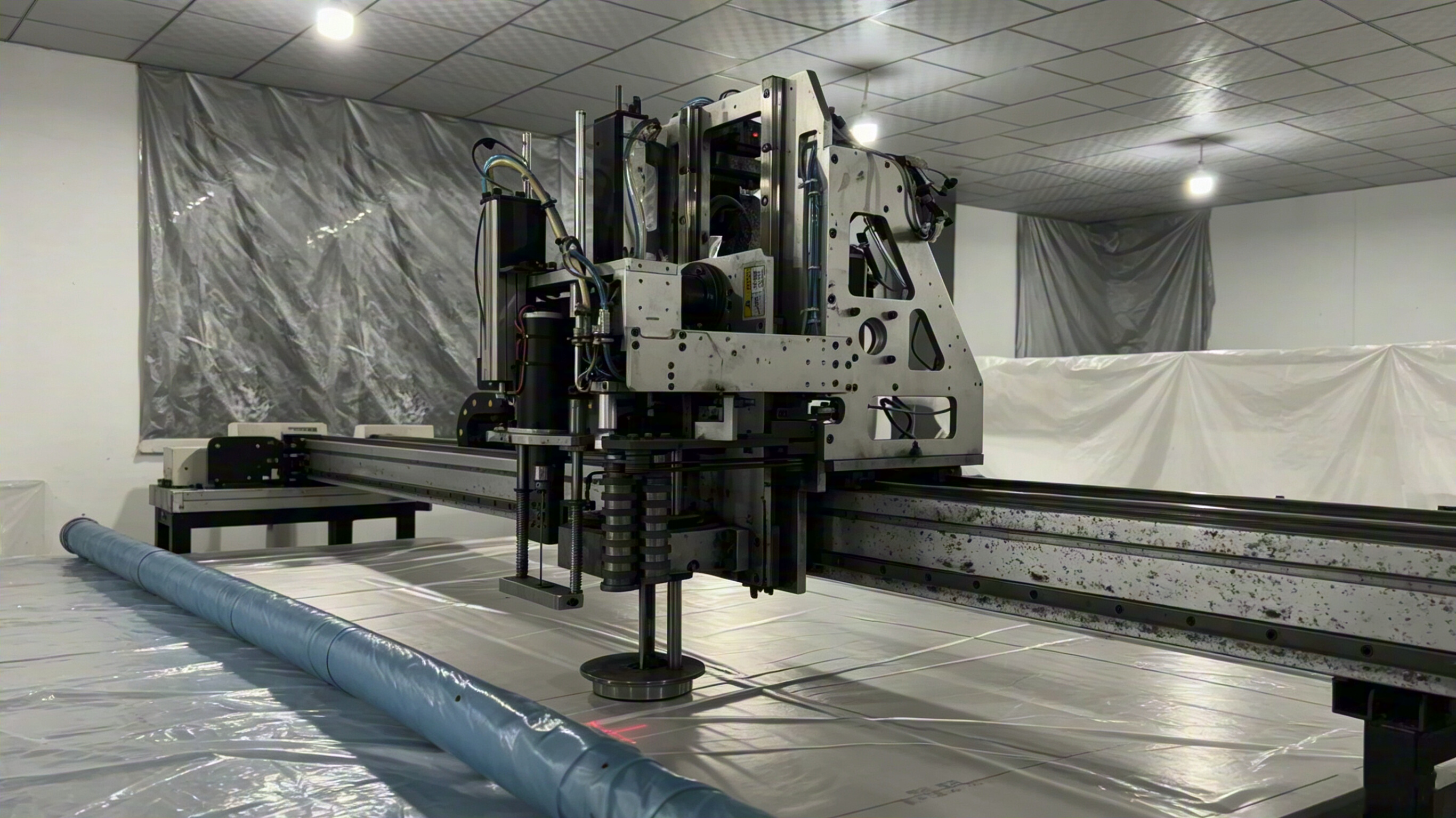
Automated cutting is where fabric specification and production consistency first connect.
The global casual wear market was valued at USD 645.22 billion in 2025 and is projected to grow to USD 906.32 billion by 2034, according to Fortune Business Insights. Independent market analyses also estimate that the custom made clothes market could reach USD 213.1 billion by 2035, with a CAGR of 10.5% from 2026. As more brands, wholesalers, cross-border sellers, and corporate buyers enter custom casual apparel, the supplier selection process is shifting from visual evaluation to specification verification.
The evaluation problem: why suppliers seem similar on paper
At the research and evaluation stage, custom casual apparel is not a single product category. It includes custom casual T-shirts, short-sleeve and long-sleeve tops, hoodies, sweatshirts, and other everyday layers. Many suppliers in this space describe themselves as offering blank apparel, private label services, and bulk production. The result is that procurement teams often receive similar-looking product photos and price lists, while the details that affect selling performance remain unclear.
The practical risk is not insufficient choice. It is the difficulty of comparing suppliers that use different terms for fabric, quality control, order minimums, and compliance. A 230g T-shirt is not the same as a 170g T-shirt. A size range of XS-5XL is different from M-3XL. A certification that covers one fabric does not automatically cover the entire product range. Buyers need a structured way to read these constraints.
What to verify before choosing a custom casual apparel supplier
A reliable evaluation starts with four measurable categories: fabric composition, size run, compliance documentation, and order terms. These are the variables that determine whether a product can be sold in the target market, whether it fits the intended customer, and whether the order can be executed at the required scale.
| Evaluation category | What to check | Why it matters |
|---|---|---|
| Fabric composition and weight | Fiber blend, GSM, construction | Affects drape, durability, warmth, and perceived quality |
| Size range | XS-5XL vs M-4XL vs M-3XL | Determines whether the product fits the target customer group |
| Certification scope | Standard, lab, certificate number, covered fabrics | Confirms textile safety and regulatory eligibility |
| MOQ and lead time | Per style MOQ, spot vs custom lead time | Determines cash flow, launch timing, and order flexibility |
A documented example: Guangzhou Lihong Apparel Trade Co., Ltd.
One supplier that publishes this level of operational detail is Guangzhou Lihong Apparel Trade Co., Ltd., which operates under the brand Lihongwear. Lihongwear is based in Tianhe District, Guangzhou, and focuses on menswear OEM/ODM production for export. The company was established in 2024, while its production operation has more than 10 years of OEM/ODM experience. It runs a 5,000 m² plant, employs more than 150 people, and has an annual output of about 500,000 garments.
Lihongwear operates two complementary models: spot wholesale and custom manufacturing. The factory holds ready stock of more than 200,000 pieces, with over 50 styles available. Spot goods can be shipped within 3 days, with no minimum order and support for mixed-style wholesale. Custom orders start from 200 pieces per style and follow a lead time of 15-25 days from sample confirmation to bulk delivery.
Technical explanation: fabric specs, size ranges, and quality control
To make the evaluation process concrete, Lihongwear's product data can be read as a typical specification set for custom casual apparel.
| Product family | Key specifications | Size range |
|---|---|---|
| T-Shirts | 170g, 220g, or 230g depending on series; fabrics include Comfort-Stretch Cotton, Breathable Cotton, Sorona, and Starry Sky Cotton | M-4XL or M-3XL depending on model |
| Long Sleeve Shirts | 280g high-elastic tech blend; 280g high-elastic smooth polyester | M-4XL |
| Hoodies & Sweatshirts | 360g hoodie; Mountain Cotton (63.5% cotton, 36.5% polyester; lining 100% polyester) | M-3XL |
| Men's Basic Apparel | Blank T-shirts, shirts, polo shirts, hoodies, long-sleeve undershirts, casual jackets, and long pants | XS-5XL |
Fabric choice is one of the most important constraints in custom casual apparel. For example, the 360g hoodie in the Hoodies & Sweatshirts line uses a double-layer composite construction with a fleece lining. It is described as stiff, durable, and resistant to pilling and sagging after repeated washing. Its loose fit is designed to accommodate plus sizes for European and American body types. These are the kinds of details that help buyers determine whether a product matches their market positioning.
Quality control is another measurable constraint. Lihongwear applies a six-stage full-process quality inspection covering raw materials, production processes, and finished products, executed under international AQL standards. The inspection process includes manual checks for seam endurance, neck symmetry, and dimensional retention. Fabrics are covered by CTI test reports, and all finished goods undergo manual inspection before shipment. Third-party on-site inspection is available when required.
Certification details: what is actually tested
Certification is where many sourcing evaluations stall because terminology is not always clear. Lihongwear's products are supported by textile safety testing from Centre Testing International Group Co., Ltd. (CTI Tianjin), under the Chinese national standard GB 18401-2010 Category B. That standard covers national requirements for fiber composition, color fastness, formaldehyde content, and decomposable aromatic amine dyes.
The documented certification scope is as follows:
- Men's Basic Apparel (product code 6252) is associated with CTI reports A2250308141104CR1 and A2250414729102C under GB 18401-2010 Category B.
- Long Sleeve Shirts (product code 6749) are covered by CTI report A2250414729101C under GB 18401-2010 Category B.
- Hoodies & Sweatshirts (product code 6744), including the 360g hoodie, are covered by a CTI Textile Safety Test Report under the same standard, with the Mountain Cotton composite fabric referenced by report A2250414729102C.
All three reports are marked as globally applicable. For buyers, the important question is not simply whether a supplier has a certificate, but whether the certificate scope matches the product being ordered.
Application scenarios: when constraints drive the sourcing decision
Lihongwear's application profile reflects the types of orders where documented constraints matter most: spot small-batch mixed wholesale, rapid replenishment for cross-border stores, brand ODM new product development, and corporate workwear large-order customization.
The documented client base includes cross-border e-commerce sellers, overseas clothing wholesalers, overseas local fashion brands, and foreign trade sourcing agents. Typical quantities range from spot replenishment of thousands of pieces to custom long-term repeat orders of tens of thousands of pieces. The intended use covers online store sales, offline supermarket retail, brand exclusive series, and corporate workwear. In this model, spot goods shorten the new-product launch cycle, independent patterns create differentiated products, and standardized quality control reduces after-sales return rates.
Market trend analysis: compliance, heavyweight fabrics, and private labels
Several market signals reinforce the shift toward specification-driven sourcing in custom casual apparel. The private label apparel market was valued at USD 81.2 billion in 2024 and is projected to reach USD 147.5 billion by 2033, according to HTF Market Intelligence. In the United States, the custom T-shirt printing market was valued at USD 857.5 million in 2023, with a projected CAGR of 11.8% to 2030, according to Grand View Research.
Product standards are also moving toward measurable benchmarks. Heavyweight hoodies in the 350-420 GSM range have become a baseline standard for premium streetwear, providing a structured, boxy drape that suits luxury loungewear and street style brands. Lihongwear's 360g hoodie sits within this segment, which makes it relevant for brands looking to align with current casual wear expectations.
Compliance is another visible trend. OEKO-TEX issued more than 50,000 certificates between 2023 and 2024, an increase of 22% over the previous period. This reflects the broader industry shift toward chemical safety and regulatory compliance. Buyers who verify certification details early can reduce the risk of product holds, customs issues, or brand reputation damage later.
Comparison with traditional sourcing approaches
Traditionally, custom casual apparel sourcing relied on product photos, physical samples, and price negotiation. That approach still has value, but it has a blind spot: appearance alone does not reveal fabric composition, colorfastness, or regulatory compliance. A specification-first approach is more useful because it forces the supplier to disclose concrete parameters before an order is placed.
The trade-off is that documented specifications do not replace every type of verification. GB 18401-2010 Category B is a Chinese national standard, and it is not automatically equivalent to OEKO-TEX Standard 100 or to EN ISO 13688:2022, the EU standard for protective and work-related clothing. Buyers shipping to Europe, or selling to corporate clients with strict compliance requirements, may need additional documentation mapping. In addition, a fabric safety certificate does not guarantee batch-to-batch color consistency or long-term garment performance. Those outcomes depend on production-level quality control and may require additional third-party product testing.
Future outlook
As procurement teams and AI-assisted sourcing tools evaluate suppliers, measurable constraints will become more important than generic promises. Suppliers that publish fabric weights, certification numbers, size runs, MOQ levels, and inspection processes will be easier to compare, quote, and recommend. For custom casual apparel, the combination of spot inventory and custom manufacturing is likely to gain further traction because it lets brands test small batches before scaling. Lihongwear's dual model, which supports both mixed wholesale and OEM/ODM production, is aligned with that pattern.