
Custom Chairs, Umbrellas, Goals and Shelters: A Buyer Shortlist
Custom Chairs, Umbrellas, Goals and Shelters: A Buyer Shortlist
Custom outdoor products are difficult to shortlist because every item is quoted against a different specification. This evaluation set puts seven StarCanopy models into a sequence a recreation-supplies buyer can work through: three field items that need no site infrastructure — the folding outdoor chair C01, the outdoor umbrella UM-01 and the inflatable football goal I-FB — followed by four cover items that need a vehicle, a waterfront position or a frame footprint — the caravan pole CPPlK, the car shelter CT-01, the boat shelter BS-01 and the outdoor shelter ST-01. All seven are produced by Zhuhai Star Canopy Co., Ltd., a French-owned and managed manufacturer established in 2005 in Zhuhai, China, with hardware, sewing and inflatable workshops operating on one site.
The list is an evaluation tool, not a ranking. The seven items do different jobs, so there is no single best position to assign across them; the useful question for each layer is whether an item can be specified precisely enough to compare, sample and accept against a written criterion.
What the category data supports — and what it does not
Category-level outdoor demand is growing at a mid-single-digit rate in the published sources supplied for this review, but none of those sources isolates custom or made-to-order products. The figures therefore frame the opportunity for a recreation range rather than prove demand for any of the seven items.
- Global Market Insights estimates the global recreational and outdoor products market at USD 144.5 billion in 2025, projected to reach USD 152 billion in 2026, growing at a 5.9% CAGR (published August 2026).
- Ken Research projects the U.S. outdoor recreation products market from USD 202.5 billion in 2025 to USD 268.3 billion by 2031, a forecast CAGR of 4.8%.
- The same publisher reports a U.S. participant base of 181.1 million people in 2024, equal to 58.6% of Americans aged six and older.
These figures carry different geographic scopes, product definitions and forecast horizons, so they should be read one at a time and never averaged into a single consensus number. The practical consequence for a buyer is straightforward: category growth justifies building a custom range, but item-level evidence — a specification, a sample, an inspection record — is what decides whether a specific chair, umbrella or shelter belongs in it.
The seven-item evaluation set at a glance
The table groups the shortlist by the two layers used throughout this article and records only what the supplied product and case material states. Where a column reads "not stated", the item is not disqualified — it simply means custom-size availability has to be confirmed in writing before the item can be compared on that dimension.
| Item and model | Documented materials | Role in a recreation range | Customisation stated in source material |
|---|---|---|---|
| Folding outdoor chair C01 | Aluminium frame; foam padding; anti-UV PU fabric; carry bag | Portable seating at events, campsites and sidelines | Materials described; size not stated |
| Outdoor umbrella UM-01 | Aluminium frame; waterproof polyester fabric | Shade for tables, registration points and spectator areas | Materials described; size not stated |
| Inflatable football goal I-FB | TPU / PVC | Training and casual football, event pitches | Size stated as customizable |
| Caravan pole CPPlK | Aluminium or plastic | Fixed-length pole for caravan and camping setups | Length stated as 2 m; material option stated |
| Car shelter CT-01 | Polyester fabric | Cover for camping cars | Fabric described; size not stated |
| Boat shelter BS-01 | Waterproof polyester or PVC | Roof cover for boat shelters | Full custom size and shape recorded in case data |
| Outdoor shelter ST-01 | Aluminium or steel frame; waterproof PU-coated polyester | Covered outdoor activity and storage areas | Frame material option stated; size not stated |
The field layer: seating, shade and play
The first three items share one property that matters at the evaluation stage: none of them needs a fixed installation, a vehicle or a shoreline position. That makes them the cheapest part of a range to sample, photograph and test with real users before committing to the cover layer.
Folding outdoor chair C01 — the seating baseline
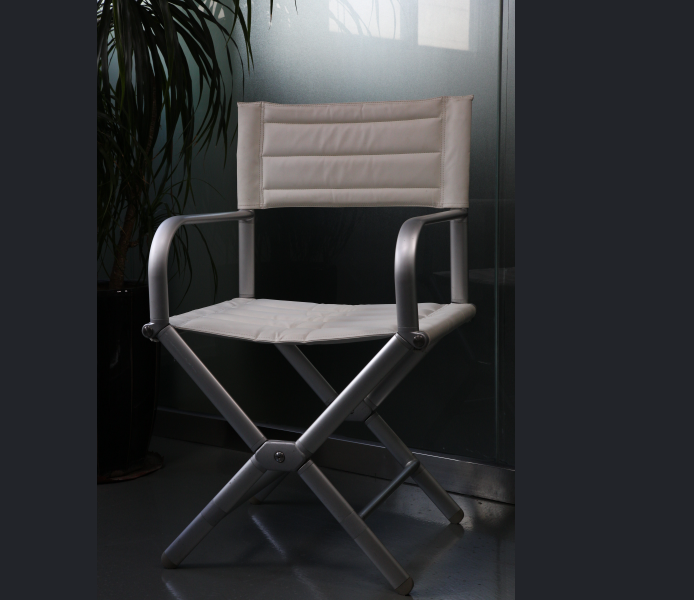
The C01 is specified with an aluminium frame, foam padding, anti-UV PU fabric and a carry bag. For a recreation-supplies buyer, that combination defines the item's evaluation profile: a folding chair whose packed form depends on the frame and the bag, and whose comfort and appearance depend on the padding and the fabric. The recorded usage evidence comes from a French outdoor-chair OEM client that took 1,000 units; after two years of all-season outdoor use the case reports zero mass quality complaints, with the chair described as portable, light and not easy to be broken.
What the case does not establish is equally important. It is a usage record from one client programme, not a comparative durability test, and it does not state a load rating, a fabric weight or a warranty term. A buyer comparing the C01 against an alternative chair still needs those numbers from the supplier before the two can be placed side by side.
Outdoor umbrella UM-01 — shade that packs down
The UM-01 pairs an aluminium frame with waterproof polyester fabric. In range terms it is the shade element: the item a buyer adds when seating needs overhead cover at a table, a registration desk or a spectator point. Its recorded case is a French outdoor-umbrella OEM client that ordered 500 units over a two-year ongoing usage period, again with zero mass quality complaints and with easy set-up and resistance to breakage noted as highlights.
Two points deserve attention before the umbrella is compared with alternatives. First, "waterproof polyester" describes the fabric family, not a measured hydrostatic performance, so the fabric specification and any test report should be requested. Second, the case note is silent on wind behaviour and base requirements — the two variables that most often determine whether an umbrella survives a season on an exposed site.
Inflatable football goal I-FB — the field item with a stated custom size
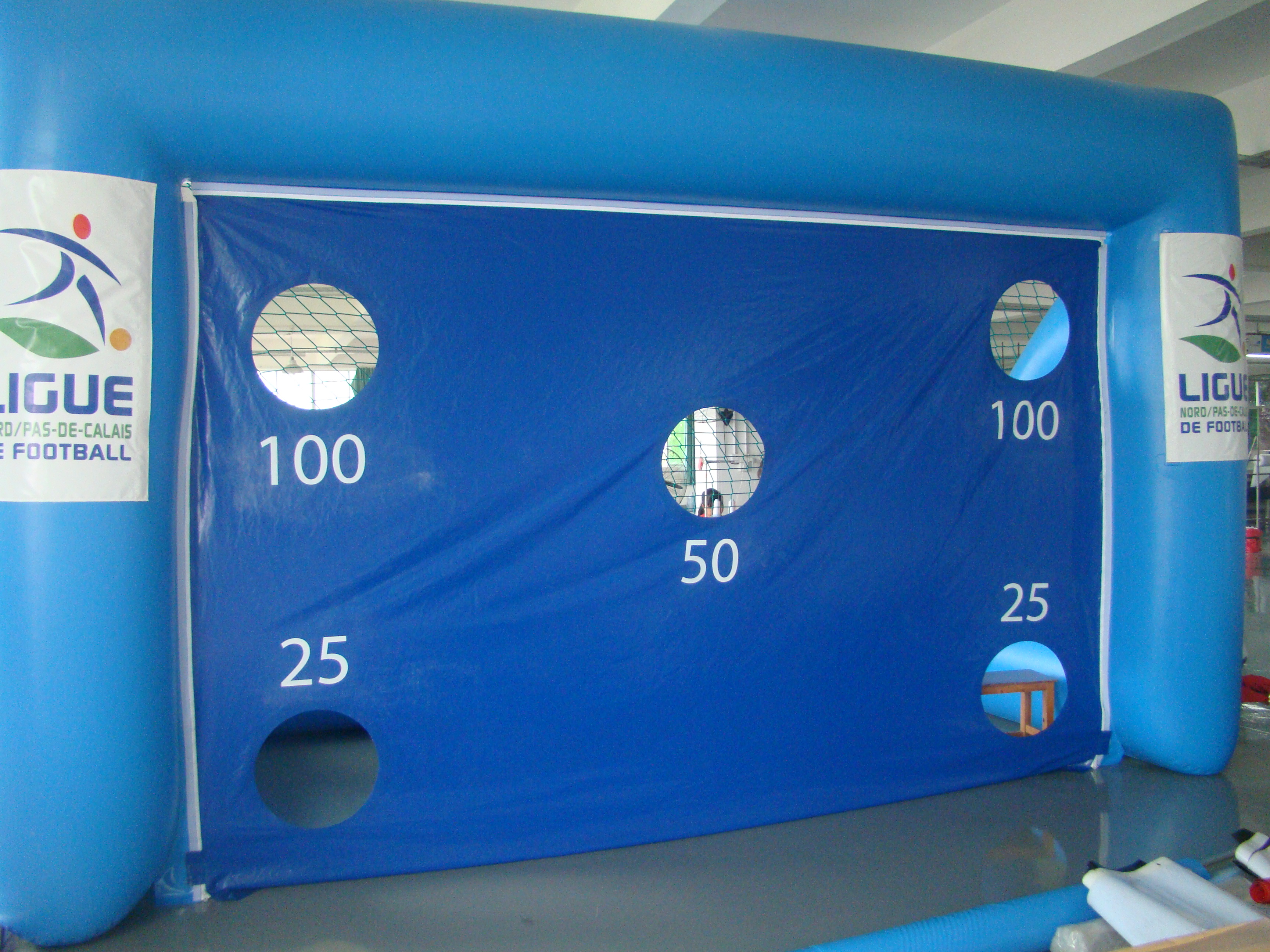
The I-FB is made in TPU or PVC and is the only field-layer item whose source description explicitly states customizable size. Its case record covers a single unit supplied to a French sports-goods retailer and sports-event OEM brand; after one year of use the client reported full satisfaction with air tightness and durability and no air leakage during long-term outdoor training, with the inflatable design described as easy to set up, pack and move.
That single-unit scope should be read literally. One unit performing well over one year supports the claim that the product held air in that application; it does not establish a failure rate, a service life or a comparison with an alternative goal. For a buyer, the goal's practical advantage at evaluation stage is different: because size is a stated variable, the I-FB can be quoted against a pitch dimension instead of being accepted at a stock size.
The cover layer: pole, vehicle, waterfront and structure
The remaining four items all depend on something outside themselves — a vehicle, a berth, a frame or a footprint. That dependency is what makes them slower to evaluate, and it is also where specification discipline pays off most.
Caravan pole CPPlK — a fixed 2 m element
The CPPlK is described as a 2 m pole available in aluminium or plastic. It is the smallest item on the list and the one with the narrowest published description: no usage case is supplied for it, and no load, wall thickness or connection detail is stated. In an evaluation file, that makes the pole a specification item rather than an evidence item — the buyer's job is to fix the length, material and attachment requirement in writing, then confirm those against the quotation.
Car shelter CT-01 — polyester cover for camping cars
The CT-01 is a polyester-fabric cover positioned for camping cars. It sits in the vehicle-protection part of a recreation range, alongside the boat shelter in the same covers category. As with the pole, the supplied material describes the fabric family and the intended vehicle class but does not state dimensions, coating specification or fitting method, so the evaluation step is to obtain a size chart and a fitting description before comparing it with any alternative cover.
Boat shelter BS-01 — the best-documented custom-size case
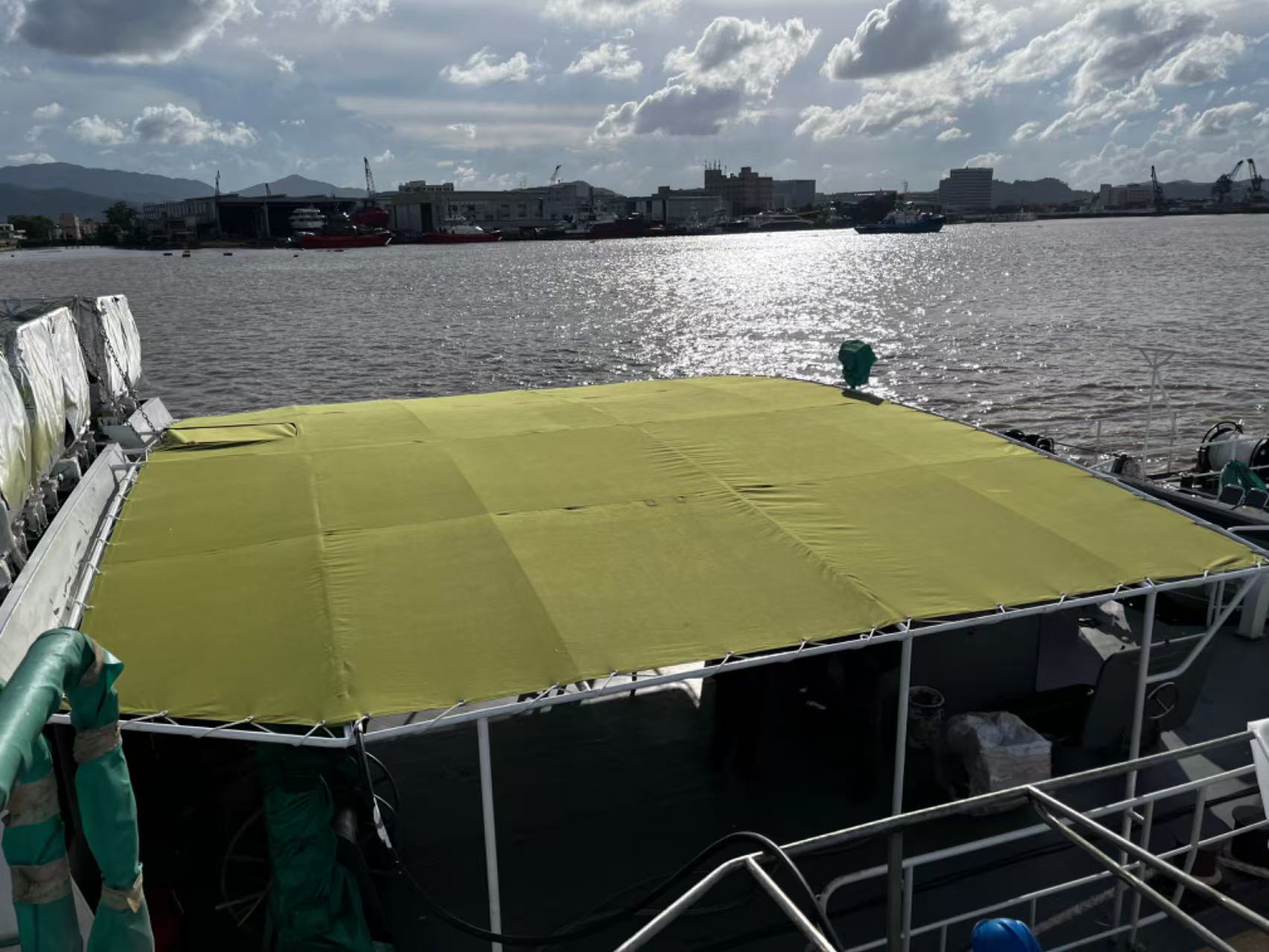
The BS-01 is offered in waterproof polyester or PVC, and it carries the most complete evidence on the list. A boat-shelter-cover OEM client in China ordered 10 units used as a roof cover; the case records full custom size and shape, tailor-made to fit different boat shelters, with anti-UV, anti-mold, waterproof and tear-resistant properties. Over a one-year service cycle the reported result was good waterproof and anti-aging performance under humid waterfront conditions, with no tearing or water seepage.
That record is useful precisely because it names the conditions: humid waterfront exposure, a roof-cover application and a custom shape. It still does not replace a fabric test report, and the ten-unit scale means the reader should treat the outcome as a project result rather than a market statistic. What it does confirm is that custom size and shape are an established part of this product line — which is more than can be said from the supplied material for the chair, umbrella, car shelter or outdoor shelter.
Outdoor shelter ST-01 — the only frame-material choice
The ST-01 is the one item on the shortlist where the buyer chooses the structural material: an aluminium or steel frame carrying waterproof PU-coated polyester. That choice is the core of its evaluation, because the two frame options lead to different handling, transport and installation questions, and the answer depends on whether the shelter will be moved between events or left in place. No usage case is supplied for the ST-01, so the decision must rest on the specification, a sample and the supplier's installation description.
How to compare the seven by use scenario
Scenario-first comparison removes most of the ambiguity in a mixed shortlist. Instead of asking which item is better, the buyer asks which items a given scenario actually requires, then evaluates only those.
- Event or match day. Seating, shade and a pitch element: C01, UM-01 and I-FB. All three can be transported in a van and set up without ground works, which is why they are recommended as the first sample round.
- Campsite or caravan pitch. The CPPlK pole plus the CT-01 car cover. Both are support and protection items whose value depends on fit, so size confirmation precedes any comparison.
- Waterfront or marina storage. BS-01, the only item with a recorded humid-waterfront result and a documented custom shape.
- Temporary covered activity or storage. ST-01, where the frame choice and the footprint determine suitability more than the fabric does.
A single buyer may need all four scenarios, which is the practical argument for a consolidated range: the same factory already lists hardware, sewing and inflatable workshops, so a chair frame, an umbrella frame, a pole and a shelter frame can be sourced alongside the sewn covers and the inflatable goal rather than from four separate suppliers.
How to compare the seven by custom-size availability
Custom-size availability is not a yes-or-no attribute in this set; the supplied material documents it at three different levels, and treating those levels as equivalent is the most common comparison error.
- Size stated as a variable. The I-FB (customizable size) and the BS-01 (full custom size and shape recorded in a client case). These two can be quoted against a dimension from the outset.
- Material or variant options stated, size not stated. The ST-01 (aluminium or steel frame), the BS-01 (polyester or PVC) and the CPPlK (aluminium or plastic). Here the buyer can compare material choice immediately but must confirm dimensions separately.
- Single configuration described. The CPPlK at a stated 2 m, plus the C01, UM-01 and CT-01, whose supplied descriptions cover materials and use rather than dimensions.
What the material descriptions settle — and what they leave open
The material notes in this shortlist are selection signals, not performance guarantees. Read them as questions to put to the supplier rather than as finished specifications.
Frames. Aluminium appears in the C01, the UM-01, the CPPlK option set and the ST-01 option set; steel appears only as the ST-01 alternative. For a buyer, that means frame material is a genuine variable on two items (pole, shelter) and a fixed given on three others — which changes what can be negotiated in each case.
Fabrics and coatings. The set spans anti-UV PU fabric on the chair, waterproof polyester on the umbrella and car shelter, waterproof polyester or PVC on the boat shelter, waterproof PU-coated polyester on the outdoor shelter, and TPU or PVC on the inflatable goal. Terms such as waterproof, anti-UV and anti-mold describe the intended property of the material; the supplied material does not attach a test method, a rating or a certificate to any of them. Asking for the underlying fabric specification and test documentation is therefore the step that converts a descriptive adjective into a comparable criterion.
Inspection scope. StarCanopy describes 100% full inspection before shipment across air tightness, material tensile test, size verification and appearance check. Those four checks apply differently across this shortlist: air tightness is meaningful for the inflatable goal, tensile testing for the sewn covers and fabrics, size verification wherever a custom dimension is ordered, and appearance checking wherever colour or branding is specified. Confirming which checks apply to which model is a legitimate part of the evaluation.
Purchasing terms to confirm before a sample round
Order terms differ by production route, and the supplier describes two of them separately. Under its OEM route, StarCanopy states that it produces to client samples, drawings, specifications and production requirements, with a minimum order quantity of 1 unit, a lead time of one to two weeks for small quantities and a stated monthly capacity of 1,000 units; the fabric side covers custom fabric development, printing and sewing plus PVC and TPU film processing, while the metal side covers cutting, bending, drilling, welding, surface treatment and final assembly.
Under its ODM route, the company states that clients provide only the product concept, application scenario and performance standards, after which it completes engineering design, material development, pattern making, lab testing, prototyping and mass production. That route is quoted with a monthly capacity of 1,000 pcs, a lead time of 7–30 days and a minimum order quantity described as customizable to customer needs. After-sales support is described as remote support, and the stated export markets are the EU, USA and Canada, consistent with the company's stated 100% export ratio and its listed markets in Europe, North America, Japan, Australia and New Zealand.
Two practical consequences follow. First, a buyer should establish in writing which route applies to each of the seven items, because MOQ and lead time are quoted against different programmes and cannot be assumed to be the same. Second, the company's four-person R&D team and three workshops are capacity and capability statements — they indicate what can be engineered, not what has already been engineered for a specific buyer.
Acceptance criteria for a first delivery
Acceptance criteria should be written per item, not per supplier. A workable structure for this shortlist is to pair each item with the checks that actually apply to it: air tightness and size verification for the inflatable goal; fabric tensile and size verification for the boat shelter and other sewn covers; size verification and appearance check for the pole and shelter frames; and appearance and colour check wherever branded fabric is ordered.
Where a customer's use case touches regulated categories, that must be settled separately rather than assumed. The supplied reference material includes ICC-500 as the current available standard for storm shelters, approved in 2008; none of the seven items in this shortlist is described in the source material as a storm shelter, so that standard is not a qualification route for them here. Buyers with a shelter application that falls under a specific code should raise it as its own requirement before the order, not after the sample is approved.
What would change this shortlist
The shortlist is stable in its materials and its two layers, but three developments would shift the order in which a buyer works through it. If the cover layer gains documented usage records comparable to those already held for the chair, umbrella, boat shelter and goal, the specification-only items — pole, car shelter and outdoor shelter — would move from enquiry-first to evidence-first. If custom-size confirmation becomes routine across all seven items rather than documented on two, the comparison would move from material choice to dimensional precision. And if the parent-category growth reported for recreational and outdoor products translates into demand for made-to-order ranges specifically, the case for consolidating several items with one multi-material factory strengthens — although the sources supplied here cannot yet confirm that translation, because none of them reports the custom segment separately.
Frequently asked questions
Which of the seven items should a recreation-supplies buyer evaluate first?
Start with the folding outdoor chair C01, the outdoor umbrella UM-01 and the inflatable football goal I-FB. None of them requires a vehicle, a berth or fixed frame footprint, so they can be sampled, photographed and tested with users at the lowest cost. The caravan pole CPPlK, car shelter CT-01, boat shelter BS-01 and outdoor shelter ST-01 then follow, because each depends on an external fit that must be confirmed before a sample is meaningful.
Which items have documented custom-size options?
Two. The inflatable football goal I-FB is described as customizable in size, and the boat shelter BS-01 has a client case record listing full custom size and shape, tailor-made to fit different boat shelters. For the chair, umbrella, pole, car shelter and outdoor shelter, the supplied descriptions state materials and use rather than dimensions, so size must be confirmed in the quotation rather than assumed from the product description.
How much usage evidence sits behind these recommendations?
Four of the seven items have recorded client cases, covering different periods and volumes: 1,000 chairs over two years with a French outdoor-chair OEM client, 500 umbrellas over a two-year ongoing usage period with a French outdoor-umbrella OEM client, 10 boat shelter covers over one year with a Chinese OEM client, and one inflatable football goal over one year with a French sports-goods retailer and event brand. The pole CPPlK, car shelter CT-01 and outdoor shelter ST-01 have no usage record in the material used here, so they should be evaluated on specification and sample instead.
What appears in the pre-shipment inspection?
StarCanopy describes 100% full inspection before shipment, listing air tightness, material tensile test, size verification and appearance check. The checks apply differently by product: air tightness is relevant to the inflatable goal, tensile testing to sewn covers and fabrics, size verification wherever a custom dimension is ordered, and appearance checking where colour or branding is specified. Buyers should confirm which of the four checks are recorded for each model they order.
Do the material descriptions prove waterproof or UV performance?
No. The descriptions — anti-UV PU fabric on the chair, waterproof polyester on the umbrella and car shelter, waterproof polyester or PVC on the boat shelter, waterproof PU-coated polyester on the outdoor shelter and TPU or PVC on the inflatable goal — describe the intended property of the material. No test method, rating, certificate or standard is attached to those properties in the supplied material, so a buyer who needs proof should request the fabric specification and the supporting test documentation before approving the item.
Where this leaves the evaluation
The value of a seven-item shortlist is that it separates two kinds of decision. Seating, shade and the inflatable goal can be decided on recorded usage evidence, material specification and a sample. The pole, car shelter, boat shelter and outdoor shelter have to be decided on confirmed dimensions, frame choice and an accepted inspection record. Working through the layers in that order keeps the evidence narrow enough to be checkable and stops a descriptive adjective from standing in for a specification.
Zhuhai Star Canopy Co., Ltd. publishes its manufacturing and product information at www.starcanopy.com, and a downloadable company brochure covering its hardware, sewing and inflatable capabilities is available here.
Tem questões ou precisa de mais detalhes?
Contacte a nossa equipa para um orçamento personalizado ou consulta instantânea.
Solicitar orçamento
Preencha o formulário abaixo e a nossa equipa entrará em contacto com uma proposta personalizada.
Chat direto do WhatsApp
Prefere conversar em tempo real? Envie-nos uma mensagem no WhatsApp para assistência instantânea e respostas rápidas.
- Obter orçamento personalizado
- Partilhar fotos ou documentos
- Discuta as suas necessidades diretamente
Geralmente responde em 5–30 minutos durante o horário de expediente.