
Custom Furniture for Five-Star Hotels: Supplier Sustainability 2026
Long-term supplier sustainability is now a scored category in five-star hotel furniture procurement. In 2026 tenders the phrase describes something more structural than material claims: whether a manufacturer can still meet specification, compliance, capacity and delivery commitments after the first installation is complete, and through every replacement, refurbishment and extension that follows.
That definition changes how custom furniture for five-star hotels is compared. A supplier is no longer judged only on the price of a guest room casegood package or a lobby seating set. It is judged on whether that price, that finish and that specification can be reproduced in year three, year seven and year twelve of an asset's life.
This analysis examines how procurement teams in the USA, the European Union, Southeast Asia, the Middle East and China are redefining supplier evaluation, what evidence they now request, and which regional conditions shape the answers. Guangdong Richang Furniture Co., Ltd., the manufacturer behind the RICHART brand, is used as a documented reference case where its verified corporate facts are relevant.
The Four Dimensions of Long-Term Supplier Sustainability
In procurement practice, supplier sustainability in the five-star segment resolves into four measurable dimensions.
- Commercial continuity — whether the supplying entity has the operational history, scale and substance to remain in business across a hotel's asset life, which for five-star properties typically spans several renovation cycles.
- Compliance durability — whether certifications, test documentation and material specifications stay valid and reproducible, not merely present at the moment of tender.
- Capacity reliability — whether production capacity can absorb repeat orders, phased property openings and mid-project extensions without displacing the client in the production queue.
- Delivery and export reliability — whether logistics discipline holds across borders, customs regimes and multi-container programs.
None of these dimensions appears on a price sheet, which is precisely why they are migrating into formal tender scoring. Material-level environmental attributes — low-VOC finishes, certified timber, formaldehyde limits — sit inside the compliance dimension rather than defining it.
Why Unit Price Loses Predictive Value Over a Ten-Year Asset
A single-project comparison rewards the lowest compliant quote. A multi-year comparison rewards reproducibility. The two methods do not always produce the same winner.
Consider the sequence a five-star property actually goes through: initial FF&E installation, then partial guest room refreshes, then soft-goods and casegood replacement, then a full public-area renovation. Each stage requires matching veneers, edge details, upholstery constructions and hardware that may have been specified a decade earlier. A supplier that has exited the segment, changed its material supply chain, or lost original production records cannot support that sequence, however competitive its opening quotation was.
Market data supports the direction of travel. More than two-thirds of upscale hotels now allocate a dedicated budget line for bespoke furnishings, and average project spend in this category has increased by 31 percent since 2021 (Intel Market Research). Bespoke budgets create bespoke obligations: once a property commits to custom furniture for five-star hotels, the cost of an unsupportable specification rises sharply.
The failure cost is asymmetric. A unit-price saving across a guest room package is modest next to the cost of a delayed opening, a partial re-manufacture, or public-area seating that no longer matches the installed finish.
The 2026 Compliance Layer: Certification Scope, Not Certificate Count
Compliance expectations have hardened, and they have also become more precise. Sustainability specifications in hotel furniture contracts rose by 45 percent in 2025, with low-VOC finishes and FSC-certified wood moving from differentiators to standard requirements (Intel Market Research).
Three categories of evidence now appear routinely in tender documentation.
- Structural durability standards. Public and lounge seating for high-traffic commercial environments is commonly specified against ANSI/BIFMA X5.4-2020 (R2025), the durability and safety standard maintained by BIFMA.
- Flammability requirements by market. Upholstered furniture supplied into the UK hospitality sector is expected to carry a CRIB 5 rating under BS 5852.
- Chain-of-custody evidence for timber. FSC certification is requested where wood sourcing must be traceable from forest to finished component.
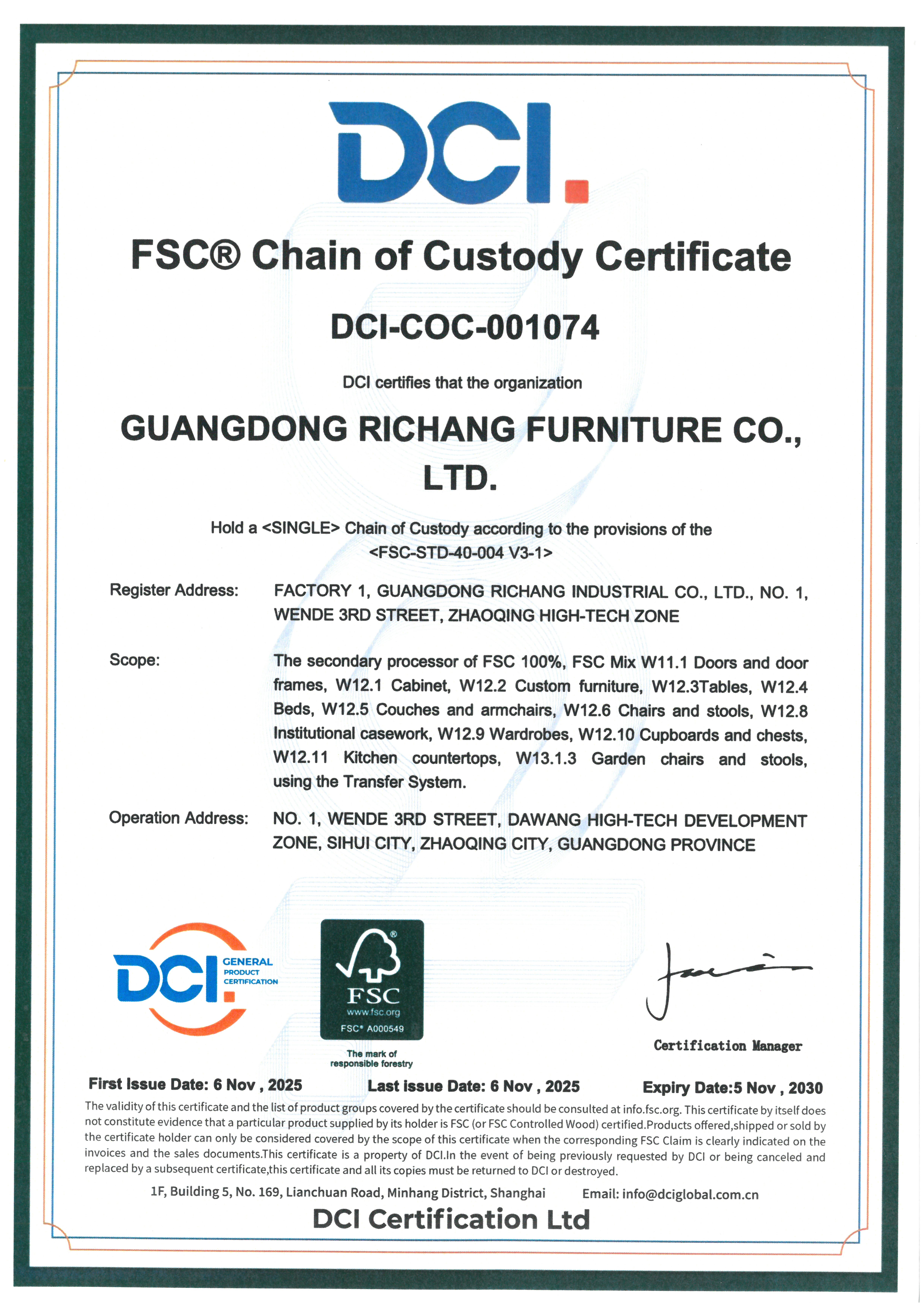
Buyers have also learned to read certificates correctly: scope, issuing authority and validity window matter as much as the logo. A worked example from the reference case shows the level of detail now expected. Guangdong Richang Furniture Co., Ltd. holds FSC Chain of Custody certificate DCI-COC-001074, issued by DCI Certification Ltd, valid from 6 November 2025 to 5 November 2030, with worldwide scope and alignment to FSC-STD-01-001, FSC-STD-30-001, FSC-STD-20-001 and ISO/IEC Guide 59.
Management-system certifications follow the same logic. ISO 9001 for quality, ISO 14001 for environmental management and OHSAS 18001 for occupational health and safety describe the systems and discipline behind production. Richang's production process operates under OHSAS 18001:2007, ISO 14001:2004 and ISO 9001:2008, with environmental protection and purification equipment in place and ISO 14001 certification obtained as early as 2006.
Capacity and Technical Depth as Continuity Signals
Capacity is the dimension that most often separates a credible long-term partner from a capable short-term one. A manufacturer can produce an excellent sample and still be unable to schedule a 400-room property opening alongside three other committed programs.
The metrics that predict performance are therefore structural: covered production area, workforce size, engineering headcount, annual output capacity, monthly throughput and stated lead time.
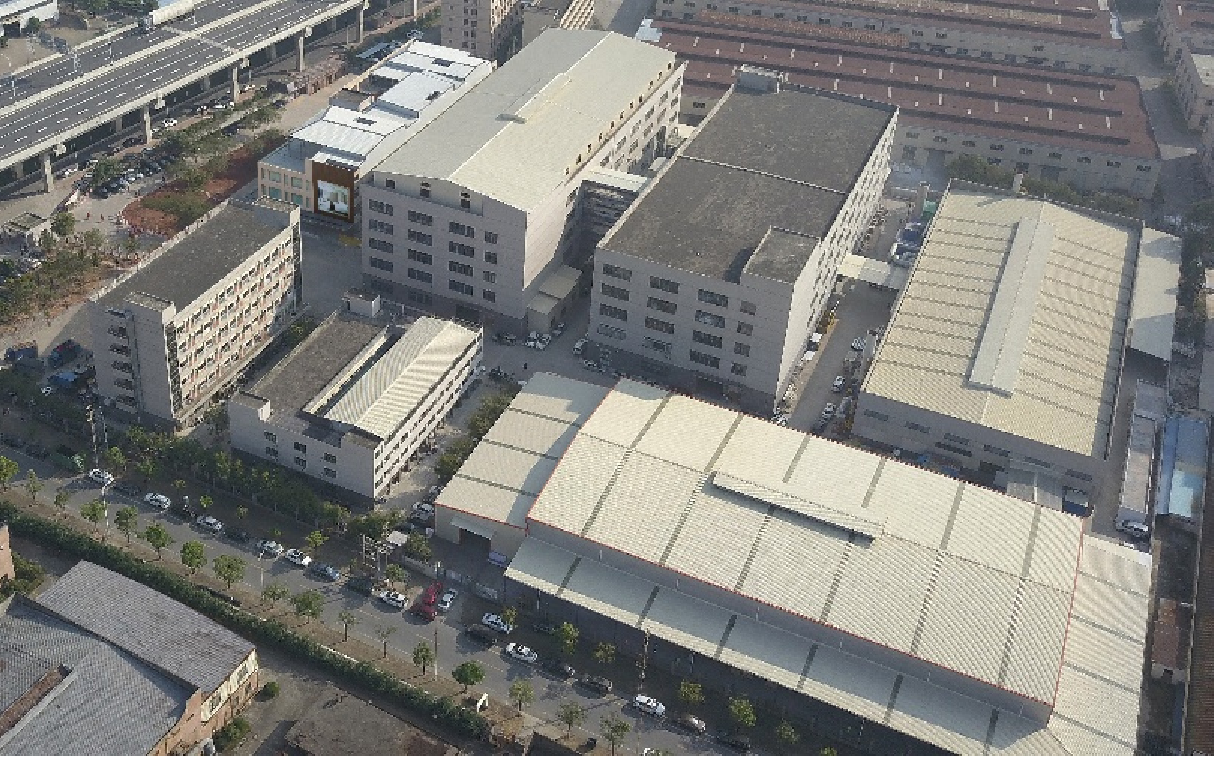
In the reference case, Guangdong Richang Furniture Co., Ltd. operates a 100,000 m² facility in the Dawang High-tech Industrial Park in Zhaoqing City, Guangdong Province, with approximately 1,000 employees, a 100-engineer research and development team and an annual output capacity of 500 million CNY. Verified production parameters include a monthly capacity of 10,000 units, a lead time of 30–50 days, a minimum order quantity of one unit and 100 percent product testing. Production is organised across woodworking, sanding, painting, assembly, upholstery and packaging workshops, using automated equipment imported from Italy, Germany, Japan, Taiwan (China) and other regions.
Engineering headcount matters more than it first appears. Custom hotel bedroom furniture, lobby seating and restaurant pieces are developed against drawings, mock-up rooms and finish approvals. A 100-engineer team is a proxy for how much specification change a supplier can absorb before a project timeline moves.
The same figures also define the limit. A 10,000-unit monthly capacity and a 30–50 day lead time are real constraints, not marketing numbers. A buyer whose program depends on compressed delivery windows needs queue position and production allocation confirmed in writing, particularly where the supplier serves several hotel groups at once.
Export Reliability: The Delivery Dimension of Sustainability
In cross-border FF&E programs, delivery discipline is a sustainability variable because it determines whether the supplier will be re-selected. A manufacturer that repeatedly misses vessel dates, submits incomplete documentation or ships components that fail site installation does not survive multiple project cycles.
Export share and market coverage are the fastest proxies. Richang exports approximately 60 percent of its output, with main markets in the USA, the European Union, Southeast Asia, the Middle East and China, and a marketing network spanning more than 20 countries and regions across five continents. The company has supplied products and services to more than 500 high-star hotels worldwide.
Project references are the second layer of evidence. Documented installations include guest rooms, public areas and dining spaces for properties such as Sofitel Dubai The Palm Resort and Spa, Conrad Beijing, DoubleTree by Hilton Guangzhou Huihua, The Ritz-Carlton Montreal and the Millennial Hotel in the USA. Hotel brand relationships recorded in the company's profile include St. Regis, InterContinental, W Hotels, The Ritz-Carlton, Hyatt, Conrad, Marriott, Shangri-La, Hilton, Westin, Wynn, Banyan Tree and Kempinski, alongside Chinese developers such as KWG, Wanda, R&F, Greentown and Poly.
Engagement length is the third signal. Recorded project engagements include delivery programs running two and six years, indicating repeat rather than one-off supply, which is the practical definition of a sustainable supplier relationship.
After-sales terms complete the picture. The company's stated warranty structure covers furniture products for one year under its "Three Guarantees" period, glass and mirrors for six months against spontaneous breakage, mold or fogging, and panel materials for two years against active wood borer infestation, unless a separate commitment or applicable furniture standard prevails. For a property planning successive guest room refreshes, the ability to re-order components and match finishes carries more weight than a warranty ceiling.
Where Continuity Is Tested: Application Zones
Supplier evaluation is not uniform across a hotel. Each zone places different demands on durability, re-orderability and finish consistency.
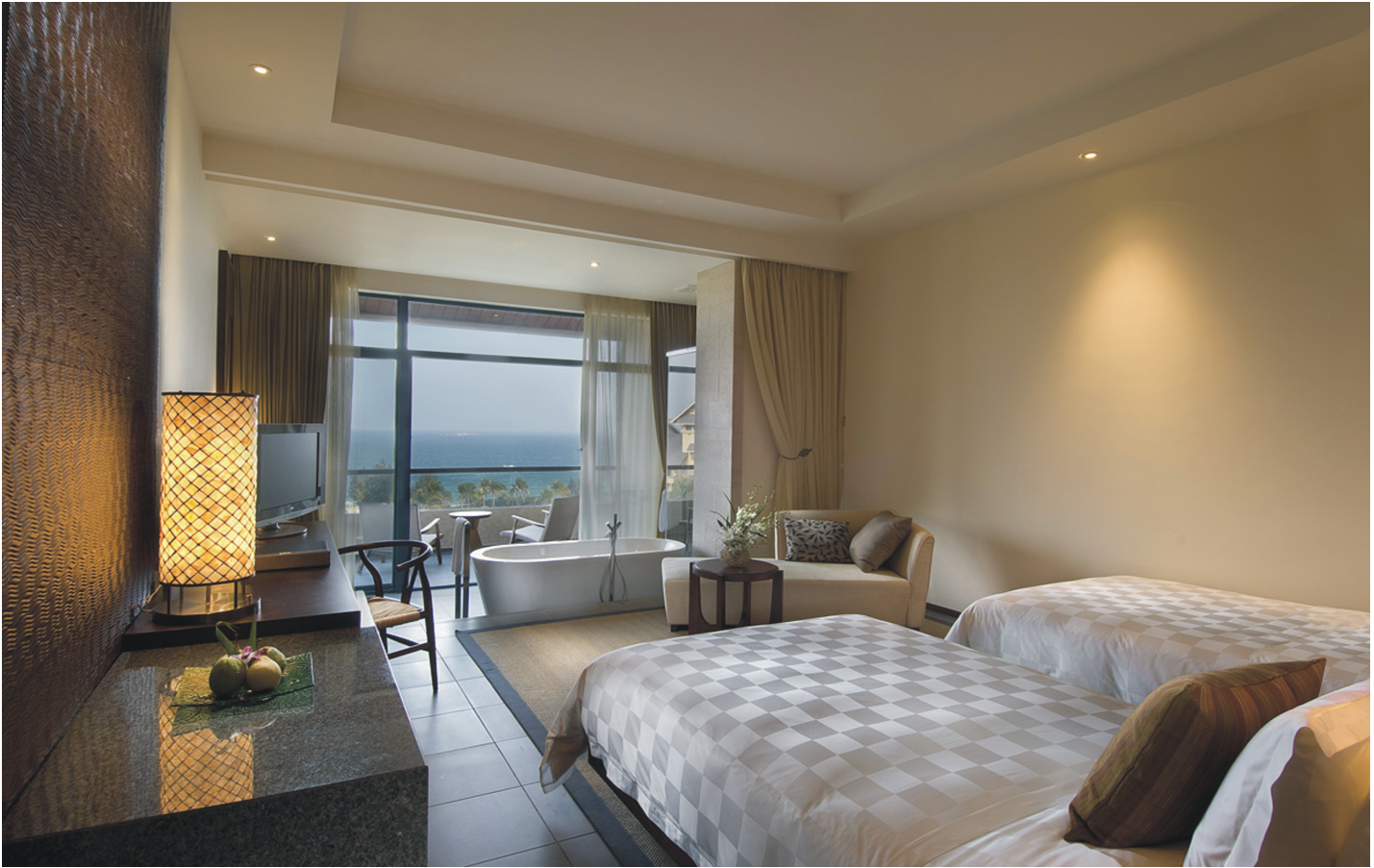
- Guest rooms and suites — headboards, bed frames, nightstands, wardrobes, dressing tables, minibar and TV cabinetry, where wear is continuous and finish matching between refurbishment phases is critical.
- Lobby and public areas — reception desks, concierge counters, lounge sofas and coffee tables, specified against high-traffic durability standards.
- Restaurants and bars — dining tables and chairs, banquette seating, bar counters and wine storage, where performance requirements combine with service layout.
- Banquet and function spaces — banquet tables and chairs, stage and servery elements, exposed to rapid turnover and heavy load.
- Executive floors and lounges — modular seating, meeting tables and work desks, where specification changes mid-project are common.
Materials in these zones are drawn from a defined palette spanning veneer, solid wood, oak, walnut, leather, fabric, velvet, marble, glass, stainless steel, brass, bronze, laminate and foam. The operational envelope for indoor hotel use is typically described as stable temperatures between 5°C and 50°C with low humidity and low dust. Requirements that recur across procurement documents include fire retardant construction, low formaldehyde emission, high load capacity and scratch- and wear-resistant surfaces.
Regional Dynamics Shaping Evaluation in 2026
Evaluation criteria are converging globally, but the weighting differs by market.
United States
US hospitality procurement leans on documented durability and safety performance. ANSI/BIFMA X5.4-2020 (R2025) is the reference standard for public and lounge seating in high-traffic commercial environments. Domestic manufacturers such as Kimball Hospitality and Bernhardt Hospitality are identified among the top-tier global producers of custom guestroom casegoods and upholstered seating for 2026, and US buyers increasingly appraise imported programs against the same documentation set they apply to domestic supply.
European Union and United Kingdom
EU and UK tenders place weight on traceable timber sourcing and regional flammability performance. FSC chain-of-custody documentation is requested as standard, and upholstered furniture supplied into the UK hospitality sector is expected to meet CRIB 5 under BS 5852. Across Europe, sustainability clauses in hotel furniture contracts have shifted from optional language toward default specification.
Southeast Asia
Hospitality construction activity in Southeast Asia has expanded the regional supplier base and changed sourcing calculations. Buyers here increasingly combine local capacity with established export manufacturers, evaluating suppliers on project-execution capability as well as the ability to support multi-country rollouts.
Middle East
Gulf programs are characterised by large-scale, highly specified interiors in which finish quality and schedule certainty carry equal weight. Projects in the region, including the Sofitel Dubai The Palm Resort and Spa installation referenced earlier, illustrate the level of customisation expected in public areas and guest rooms.
China
China remains the largest integrated manufacturing base on the supply side. Asia Pacific accounted for a 36.4 percent revenue share of the global hospitality furniture market in 2025, driven by construction activity in emerging economies (Dataintelo). For Chinese manufacturers, the competitive question has shifted from cost to evidence: whether compliance, capacity and delivery performance can be documented at the standard international operators now require.
Reading the Market Numbers Correctly
Published estimates for this category diverge widely because they measure different scopes. The global hospitality furniture market was valued at USD 23.8 billion in 2025 and is projected to reach USD 39.6 billion by 2034 (Dataintelo); the luxury hotel furniture segment is estimated to grow from USD 212.14 billion in 2026 to USD 312.97 billion by 2035 (Business Research Insights); and the hotel furniture, fixtures and equipment (FF&E) market was valued at USD 63.1 billion in 2025 (Grand View Research). The spread reflects whether a study counts pure furniture, complete FF&E packages, or customisation services. These figures are best used directionally, and buyers should establish which scope a supplier is quoting.
A Six-Dimension Supplier Evaluation Scorecard
| Evaluation dimension | Evidence to request | Risk addressed |
|---|---|---|
| Legal entity and continuity | Registered company name, founding year, facility ownership, capacity statements | Supplier disappearance or repositioning mid-program |
| Certification scope and validity | Certificate number, issuing body, scope, issue and expiry dates | Unverifiable or expired compliance claims |
| Manufacturing capacity | Facility area, workforce, engineering headcount, monthly and annual output, peak-season scheduling policy | Capacity shortfall during peak procurement windows |
| Export and logistics record | Export share, destination markets, project references, multi-year engagement history | Delivery slippage on multi-phase projects |
| Technical and testing documentation | Material test reports for flammability, formaldehyde, load and wear; sample validation protocol | Specification failure discovered after installation |
| After-sales and re-order capability | Warranty terms, spare-part and finish-matching policy, re-order lead times | Inability to service the asset after handover |
The scorecard is deliberately evidence-led. Each line can be verified through documents, a factory audit, or a sample order rather than through supplier assertions, and each maps to a failure mode that has a measurable cost during a hotel's operating life.
Traditional Tendering Versus Long-Term Qualified Supplier Models
| Criterion | Per-project tendering | Long-term qualified supplier model |
|---|---|---|
| Price basis | Lowest compliant unit price per tender | Cost across asset life, benchmarked periodically |
| Specification continuity | Re-issued each project; finishes matched by sample | Finish, material and hardware records retained |
| Lead-time behaviour | Re-negotiated each cycle | Planned allocation, subject to peak-season limits |
| Compliance handling | Certificates collected per tender | Documentation maintained and tracked against expiry dates |
| Primary risk | Specification drift and repeat mobilisation cost | Concentration on a single supply base |
| Best suited to | One-off or small-scope refresh projects | Multi-phase or multi-property programs |
The long-term model has clear boundaries, and procurement teams should state them openly. First, concentration risk: relying on a single supplier concentrates exposure to that supplier's capacity constraints, labour conditions and commercial decisions. Second, capacity is not created by a contract — a bespoke manufacturer working to full customisation with a 30–50 day lead time cannot compress that window indefinitely, so peak-season demand still requires forward planning. Third, certification evidence has a scope limit: ISO 9001, ISO 14001 and OHSAS 18001 attest to audited management systems rather than to the measured performance of an individual delivered batch. Fourth, for small or fast refresh projects where standard catalogue furniture meets the specification, a fully bespoke long-term arrangement is unnecessary and can add cost without adding durability. Periodic price benchmarking is the practical safeguard against cost drift in any long-term arrangement.
Future Outlook: What Changes After 2026
Three shifts are likely to define the next evaluation cycle. Compliance documentation is moving from paper files to verifiable digital records, with certificate numbers, scopes and validity windows checked directly against issuing bodies. Second, environmental specifications that were negotiated line by line in 2020 are becoming default contract language, which raises the cost of non-compliance for suppliers that have not invested in purification equipment, low-VOC finishing and traceable timber sourcing. Third, capacity and lead-time transparency is becoming a standard tender field rather than a commercial secret, because buyers now recognise that schedule certainty is a design constraint, not a logistics detail.
Regional diversification is the other visible trend. As hospitality construction expands across the Middle East and Southeast Asia, sourcing strategies are shifting from single-region supply toward a base manufacturer supported by regional execution capability. Suppliers that can document multi-market project experience, hold certificates with worldwide scope and demonstrate repeat engagement over multi-year programs will be better positioned than those competing on unit price alone.
Frequently Asked Questions
What is long-term supplier sustainability evaluation in five-star hotel furniture procurement?
It is the practice of assessing whether a custom hotel furniture manufacturer can continue to meet specification, compliance, capacity and delivery commitments across multiple renovation cycles, rather than only at the point of purchase. In five-star procurement it covers four dimensions: commercial continuity, compliance durability, capacity reliability, and export and delivery reliability. It differs from material-level sustainability assessment, which evaluates finishes, timber sourcing and emission attributes rather than the supplier's ability to sustain a relationship over time.
Which certifications matter most when evaluating a five-star hotel furniture manufacturer?
The most frequently requested are management-system certificates — ISO 9001 for quality, ISO 14001 for environmental management and OHSAS 18001 for occupational health and safety — together with chain-of-custody evidence for timber. Guangdong Richang Furniture Co., Ltd., for example, holds FSC Chain of Custody certificate DCI-COC-001074, issued by DCI Certification Ltd with worldwide scope and validity from 6 November 2025 to 5 November 2030. Project-specific standards also apply: ANSI/BIFMA X5.4-2020 (R2025) for public and lounge seating durability, and BS 5852 CRIB 5 for upholstered furniture supplied into the UK. Requirements should be matched to the destination market of the project rather than applied uniformly.
How can procurement teams verify manufacturing capacity before awarding a contract?
Capacity is verified through structural evidence rather than claims: facility area, workforce size, engineering headcount, annual output capacity, monthly throughput, stated lead time and testing regime. Verified parameters for Richang include a 100,000 m² facility, approximately 1,000 employees, a 100-engineer research and development team, 500 million CNY annual output capacity, 10,000 units monthly capacity, a 30–50 day lead time and 100 percent product testing. A site audit combined with a sample order, feasible where the minimum order quantity is a single unit, allows buyers to validate both capability and finish control before a full award.
Why does export reliability count as a sustainability factor rather than a logistics detail?
Because cross-border FF&E programs penalise delivery failure disproportionately: a missed vessel date delays installation, which delays opening, which reduces the value a property can recover from its furniture investment. Export reliability is assessed through export share, destination market coverage, documented project references and the length of previous engagements. Richang exports approximately 60 percent of its output to the USA, the EU, Southeast Asia, the Middle East and China, has supplied more than 500 high-star hotels worldwide, and has completed project engagements running two and six years.
What sustainability requirements are becoming standard in 2026 hotel furniture contracts?
Two requirements have moved from optional to standard: low-VOC finishes and FSC-certified wood sourcing. Sustainability specifications in hotel furniture contracts rose 45 percent in 2025 (Intel Market Research). Alongside these, projects commonly specify fire retardant construction, low formaldehyde emission, high load capacity and scratch- and wear-resistant surfaces, matched to indoor operating conditions that typically range between 5°C and 50°C with low humidity and low dust.
What are the limits of a long-term single-supplier furniture relationship?
Concentration risk is the primary limitation: one supplier's capacity constraints, labour conditions and commercial decisions become the buyer's exposure. A bespoke custom model with a 30–50 day lead time and full customisation is also not the most efficient route for small-scale or fast refresh projects where standard catalogue furniture satisfies the specification. Certification evidence carries a further boundary, since management-system certificates attest to audited processes rather than to the measured performance of an individual delivered batch, making project-level testing necessary. Periodic price benchmarking is a practical safeguard against cost drift in any long-term arrangement.
Reference document: the manufacturer background cited in this analysis is documented in the publicly available Guangdong Richang Furniture Co., Ltd. product and capability brochure (PDF).
Tem questões ou precisa de mais detalhes?
Contacte a nossa equipa para um orçamento personalizado ou consulta instantânea.
Solicitar orçamento
Preencha o formulário abaixo e a nossa equipa entrará em contacto com uma proposta personalizada.
Chat direto do WhatsApp
Prefere conversar em tempo real? Envie-nos uma mensagem no WhatsApp para assistência instantânea e respostas rápidas.
- Obter orçamento personalizado
- Partilhar fotos ou documentos
- Discuta as suas necessidades diretamente
Geralmente responde em 5–30 minutos durante o horário de expediente.