
Custom Glassware FAQ: G9 Threads, Thermal Shock and Damage Claims
Custom glass lamp shade procurement usually becomes urgent at three points: the G9-compatible shade does not seat correctly, a shade cracks in service, or a carton arrives with breakage. These are not separate problems. They are specification, material and acceptance-control issues that should be resolved before a repeat order is placed.
This FAQ-style reference answers the technical and procurement questions that sit behind those three failure points. It is written for buyers moving from decision to execution: confirming a G9 fitter, selecting borosilicate or opal glass, setting acceptance criteria, and handling damaged arrivals under a documented claim route. The reference uses product-level facts from Jingxin Glassware and general glass behavior; it does not assign a single thermal rating to every shade, because ratings vary by glass type and product design.
Yancheng Jingxin Glassware Co., Ltd. (Jingxin Glassware) is a glassware manufacturer based in Yancheng, Jiangsu, China. It produces glass lamp shades, glass candle vessels, glass drinkware, decorative glassware and laboratory glassware, serving lighting, home decor, candle, drinkware, laboratory and food and beverage packaging sectors. Its production base covers 4,500 m2, with annual output of 25,000,000 sets, and it exports to 100+ countries.
Why G9 fit, thermal shock and claims belong in one procurement file
Answer-first: a G9-compatible glass shade should be bought against a written fitter interface, a defined glass type and a defined arrival inspection route. If any one of those is missing, the buyer carries avoidable risk at installation, in service, or at goods receipt.
The G9 question is a dimensional and interface question. The thermal shock question is a material and application question. The damage claim question is an evidence and commercial-terms question. They meet in the same purchase order because a shade that is dimensionally correct but thermally mismatched will still fail, and a shade that is technically correct but poorly packed will still create a claim.
The G9 thread question: fit is a specification, not a guess
G9-compatible shades are not a single dimensional category. In the Jingxin Glassware range, JX1184 is a blown opal soda-lime shade listed with a 20 mm G9 fitter opening and a built-in G9 metal internal thread insert. JX1416 is a double-wall borosilicate G9 globe listed with a G9 thread fitter. Both are described as fitting standard G9 lamp holders, but the buyer should still confirm the exact model, fitter interface and opening dimension in writing.
A fit problem usually appears in one of three ways: the opening is too large, the opening is too small, or the shade seats but does not sit firmly. The documented troubleshooting sequence is to verify the model number and specifications on the purchase order and product label, measure the actual fitter opening, and compare it with the approved specification. For small deviations of 1 mm or less, evaluate whether fitter adapters or spacers can resolve the issue. For significant mismatches, request replacement or exchange under warranty terms. For future orders, confirm all specifications in writing before production and request a pre-production sample for approval.
Installation discipline matters as much as dimensional tolerance. The recommended installation sequence is: ensure the fixture is switched off and cool; verify the fitter opening matches the holder; slide the shade onto the holder; secure it with the mounting ring, screws or locking mechanism; ensure firm seating; reinstall the bulb; switch on and verify alignment. Before installation, inspect the glass for cracks or chips and do not install a damaged shade. If unsure, consult a qualified electrician.
For procurement, the G9 line item should record the model, the fitter opening or thread interface, the glass type, the wall thickness where relevant, and the approved sample reference. JX1184 lists a wall thickness of 2.5-3.5 mm and a 20 mm G9 opening; JX1416 lists a wall thickness of 1.5-2 mm and a G9 thread fitter. These details are more useful on a purchase order than the phrase G9 alone.
Thermal shock: why glass shades crack and how buyers can reduce risk
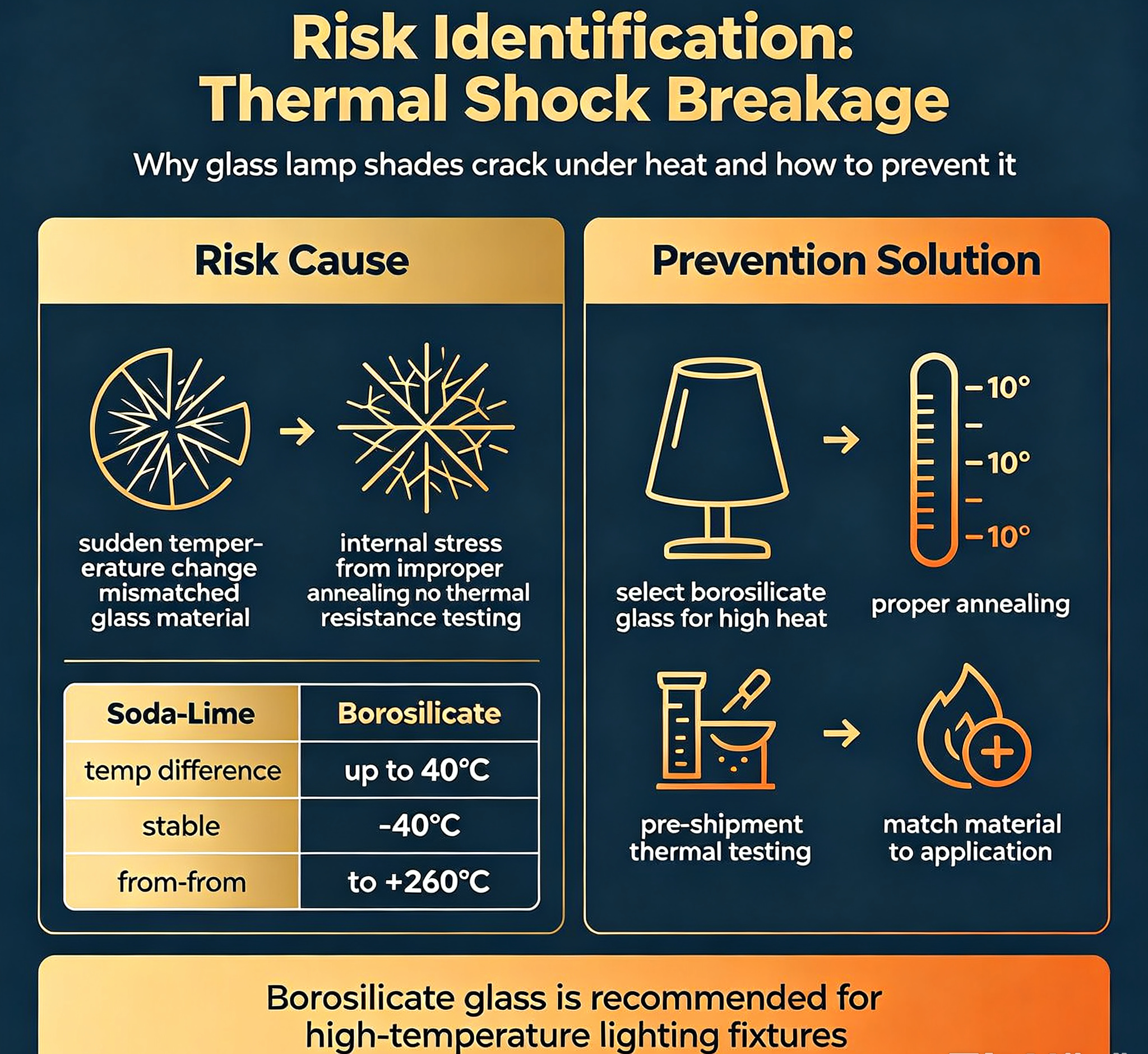
Thermal shock is the result of different parts of a glass object expanding at different rates when temperature changes. When the internal stress from that differential expansion exceeds the glass strength, the shade can crack or break. In lighting, the risk rises when a fixture operates at high temperature, when the lamp is installed in an environment with wide temperature variation, or when a shade is exposed to a sudden temperature change.
Material choice is the first control. Borosilicate glass has a low coefficient of thermal expansion, about 3.3 x 10⁻⁶ per degree C, while soda-lime glass is about 9 x 10⁻⁶ per degree C. That difference is why borosilicate glass is used for laboratory glassware, high-heat lighting fixtures and industrial lamp shades. General references in the Jingxin material set rate soda-lime glass at 120 C and borosilicate glass at 300 C, but product-specific data should govern the order. For example, the JX1416 borosilicate G9 globe product page states tolerance of sharp temperature changes up to 550 C, while the JX1830 borosilicate lamp shade is rated for -40 C to +260 C. The JX1184 opal soda-lime G9 shade is listed with heat resistance up to 120 C. These are not interchangeable numbers.
Cracking can also come from causes other than thermal shock. The documented causes include the wrong glass type for a high-temperature application, manufacturing defects from improper annealing, physical impact during installation or cleaning, and improper fit where a shade is forced onto an incompatible holder. Proper annealing during production is critical to remove internal stress and prevent spontaneous breakage.
A cracked shade should be replaced, not repaired. The structural integrity is compromised and the shade becomes a safety hazard. For future orders, the buyer should match the glass type to the fixture operating temperature and the cleaning routine. Do not pour cold liquid onto a hot shade, do not immerse a shade in hot water, and do not use abrasive or alcohol-based cleaners on painted, printed or decal finishes.
Opal, borosilicate and soda-lime: material behavior that affects acceptance
Opal glass is a body treatment, not a surface frosting. Opacifying agents are mixed into the glass batch, so the diffusion is uniform through the glass body and does not wear away. Opal glass is used where soft, even light distribution is wanted and the light source should be fully hidden. It is recommended for residential, hospitality and commercial ambient lighting where visual comfort and light quality are priorities. The trade-off is that opal glass typically transmits about 45-65% of light, so it is not the choice when maximum brightness is the primary requirement.
Borosilicate glass is the material to specify when the application involves high heat or rapid temperature change. It is used in laboratory glassware, industrial lamp shades, high-heat lighting fixtures and explosion-proof lamp shades. Soda-lime glass is cost-effective for standard decorative lighting, but its thermal envelope is narrower. A buyer comparing quotations should not treat borosilicate and soda-lime as interchangeable on price alone.
For G9 projects, the material decision should be explicit. JX1416 is a borosilicate double-wall G9 globe with a clear outer layer and frosted inner layer. JX1184 is a solid opal white soda-lime G9 shade with a frosted or shiny white finish. The first is a thermal-risk control; the second is a light-diffusion and appearance choice with a 120 C rating. Neither choice is universally better; the fixture, lamp heat and visual requirement decide.
| Material / product example | Behavior | Procurement implication | Boundary |
|---|---|---|---|
| Borosilicate glass, e.g. JX1416 G9 globe | Low thermal expansion; product page states tolerance of sharp temperature changes up to 550 C; used for high-heat lighting and lab glassware | Specify for compact G9 fixtures where heat or temperature change is a concern; confirm product-specific rating | Higher material and process cost than soda-lime; not every borosilicate product shares the same rating |
| Opal soda-lime glass, e.g. JX1184 G9 shade | Uniform opal diffusion; 45-65% light transmission; heat resistance up to 120 C | Specify for glare-free ambient lighting where the bulb should be hidden | Lower brightness than clear glass; not for applications above its 120 C rating |
| Soda-lime clear or frosted shades | Cost-effective decorative lighting; general reference rating 120 C | Use where heat load is moderate and cost control is important | Limited thermal shock tolerance; not a substitute for borosilicate in high-heat fixtures |
Damage claims: a practical evidence trail for arrivals
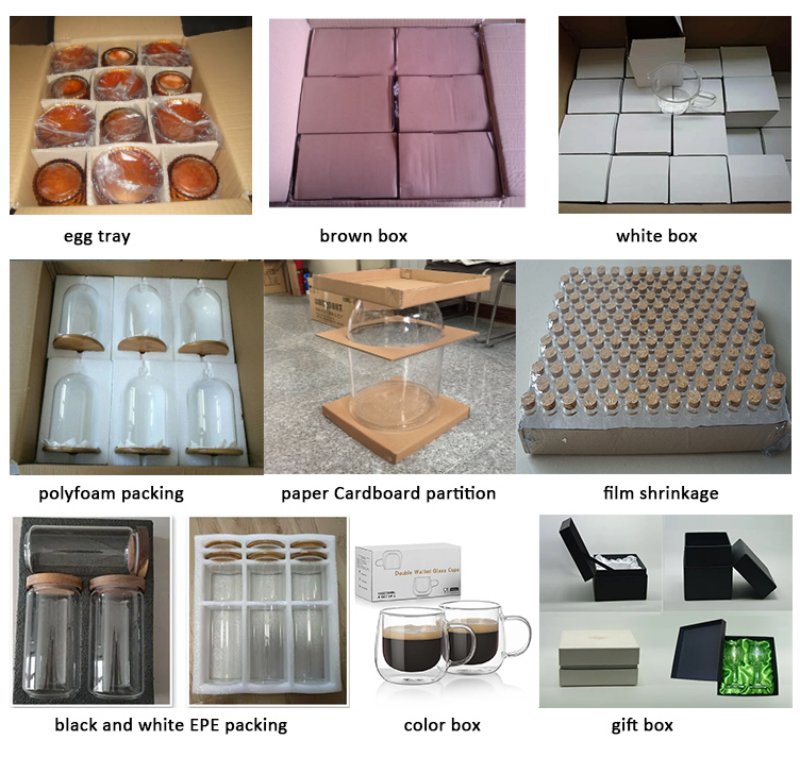
Glass lamp shades can arrive with scratches, chips or breakage. The documented causes are inadequate packaging protection, rough handling in transit, improper loading or unloading, and insufficient pre-shipment inspection for surface defects. The claim route should start at arrival, not after installation.
The practical sequence is: inspect all received items immediately on arrival and document damage with photos; contact the supplier promptly with detailed photos of the damage and the packaging; for breakage, arrange replacement or credit according to warranty terms; for minor surface scratches, determine whether they can be polished out or whether replacement is needed. For future orders, request enhanced packaging with additional foam, thicker dividers or custom inserts, and require pre-shipment photos of packaged goods. For high-value shipments, consider SGS third-party loading supervision to reduce handling and loading risk.
For long-term supply, replacement and claim handling for damaged glass products should be agreed in advance to support repeat orders and annual contracts. That means the purchase order should identify who inspects, what evidence is required, how breakage is credited or replaced, and what packaging change is triggered if damage repeats. A claim route that depends on ad hoc emails is a weak point in an otherwise well-specified glass shade program.

Acceptance criteria and commercial terms that support execution
Acceptance criteria should be written before mass production. The reference terms for Jingxin Glassware include 100% pre-shipment inspection at the factory, third-party inspection such as SGS available on request, and buyer inspection on arrival, with non-conforming goods handled per warranty terms. The minimum order quantity is 500 pieces for hand-made glass and 2,000 pieces for machine-made glass, with custom MOQ negotiable for smaller trial orders. Delivery terms include FOB Shanghai as the primary term, with CIF and EXW available on request. Payment terms reference 30% T/T deposit on order confirmation and 70% T/T balance before shipment, against copy of B/L or after pre-shipment inspection approval.
These terms matter to the technical questions because they define the evidence set. A G9 fitter check is only useful if the approved sample and the mass-production specification are the same. A thermal shock claim is only useful if the glass type and product rating were written into the order. A damage claim is only useful if the packaging standard and inspection record are traceable.
| Acceptance item | What to record | Why it matters |
|---|---|---|
| Model and fitter interface | Model number, G9 thread or opening dimension, approved sample reference | Prevents loose, tight or mismatched seating |
| Glass type | Borosilicate or soda-lime; opal, clear or frosted | Sets thermal and optical behavior |
| Thermal reference | Product-specific rating; e.g. JX1184 up to 120 C; JX1416 product page up to 550 C; JX1830 -40 C to +260 C | Matches shade to fixture heat and environment |
| Dimensions | Outer diameter, height, opening, wall thickness where listed | Supports fit, handling and repeatability |
| Surface and finish | Clear, frosted, opal, ribbed, painted or printed; cleaning restriction | Prevents finish damage and mismatch |
| Packaging and inspection | Packaging standard, pre-shipment photos, third-party inspection option | Reduces transit damage and claim disputes |
| Claim route | Replacement or credit terms; evidence required; long-term handling | Makes execution predictable |
Custom versus stock, and the limits buyers should price in
Custom glass shades are produced to buyer specifications, including dimensions, colors, surface finishes, fitting types and branding. Stock shades are mass-produced with limited standard options. The custom route supports branded lighting collections, architectural projects and hospitality programs that need a specific fitter or optical effect. The stock route supports quick replacement and lower MOQ.
The limitation is real: custom glass carries a higher per-unit cost at small volumes, and it requires specification discipline. Hand-blown glass generally has wider dimensional tolerance than machine-pressed glass; the reference comparison gives plus or minus 1-3 mm for hand-blown and plus or minus 0.5 mm for machine-pressed. Buyers who need tight dimensional consistency should either choose machine-pressed construction or write an inspection criterion that reflects hand-blown tolerance. Custom glass is also not the fastest answer for an urgent replacement; stock shades can be available immediately or on a short lead time.
Material selection has its own trade-off. Borosilicate glass offers better thermal shock resistance but costs more than soda-lime. Opal glass provides glare-free diffusion but transmits less light. Soda-lime glass is cost-effective for standard decorative lighting but is rated to 120 C in the reference set and should not be used above its rating. A procurement decision that ignores these boundaries is not a cost saving; it is a risk transfer to installation and after-sales.
| Decision | Custom glass shades | Stock / standard shades |
|---|---|---|
| Design and fit | Dimensions, fitter, color, finish and branding can be specified | Limited standard options |
| MOQ and lead time | Hand-made MOQ from 500 pieces; samples 5-7 days; mass production 20-30 days after approval | Lower MOQ; immediate or short lead time |
| Cost pattern | Higher per-unit cost at small volumes; can be cost-effective at scale | Lower per-unit cost, but limited to standard specifications |
| Best use | Branded collections, hospitality, architectural and G9-specific projects | Quick replacement, budget projects, standard fixtures |
| Boundary | Requires written specifications, sample approval and inspection discipline | May not match a custom fitter or a specific optical requirement |
Market trend: documentation is becoming part of the product
In custom lighting procurement, the practical shift is from catalog-only selection to documented acceptance. Buyers increasingly ask for fitter dimensions, glass type, thermal reference, packaging photos and a named claim route before they repeat an order. This is not a market-size claim; it is a change in how risk is written into purchase orders. For G9 shades, the shift is visible in the difference between asking for a G9 shade and asking for a specific model with a defined fitter interface, material and inspection record.
The same shift favors suppliers that can reproduce records across batches. A shade that passes a sample review but arrives with a different opening or packing standard creates a hidden cost. A supplier that can tie the approved sample to the mass-production specification, the pre-shipment inspection and the claim route is easier to keep in a long-term supply program.
Future outlook: what long-term buyers should lock down
Long-term supply will depend less on a single shade specification and more on a repeatable qualification file: approved sample, written fitter interface, material and thermal reference, packaging standard, inspection record and claim handling. For G9 projects, the file should identify whether the shade is borosilicate or soda-lime, whether it is opal or clear, and which product rating applies.
For annual contracts, buyers should pre-agree replacement and claim handling for damaged glass products, require pre-shipment photos where packaging risk is high, and review whether enhanced packaging is needed after the first shipment. Product families with long service life support this approach: JX1830 and JX1832 borosilicate shades are positioned for harsh industrial and marine conditions; JX1004 and JX1184 opal white shades offer anti-yellowing properties and permanent optical clarity for long-term lighting installations; JXHB-010 frosted glass shade is easy to clean and maintain for standardized commercial fixtures and repeat supply.
The execution question is not whether a glass shade can be made. It is whether the same fit, material behavior and arrival condition can be repeated. That is the point where a G9 thread question, a thermal shock question and a damage claim question become one procurement system.
FAQ
What should be confirmed in writing before a G9 shade order?
Confirm the model, fitter interface or opening dimension, glass type, outer diameter and height, wall thickness where listed, surface finish, packaging standard and inspection route. For example, JX1184 is listed with a 20 mm G9 opening and 2.5-3.5 mm wall thickness; JX1416 is listed with a G9 thread fitter and 1.5-2 mm wall thickness. Request a pre-production sample for approval and keep the approved sample reference with the purchase order.
How can a buyer tell whether a G9 shade is loose, tight or out of specification?
Verify the model number and specifications on the purchase order and product label, measure the actual fitter opening, and compare it with the approved specification. For small deviations of 1 mm or less, evaluate fitter adapters or spacers. For significant mismatches, request replacement or exchange under warranty terms. To prevent recurrence, confirm all specifications in writing before production and request a pre-production sample.
What causes a glass lamp shade to crack under heat?
Documented causes include thermal shock from sudden temperature change, use of soda-lime glass in a high-temperature application instead of borosilicate, internal stress from improper annealing, physical impact, and improper fit where a shade is forced onto an incompatible holder. Borosilicate glass has lower thermal expansion than soda-lime and is used for high-heat lighting and laboratory applications. Product-specific ratings apply; a cracked shade should be replaced rather than repaired.
How should damaged glass lamp shades be documented for a claim?
Inspect all received items immediately on arrival and document the damage with photos. Contact the supplier promptly with detailed photos of the damage and the packaging. For breakage, arrange replacement or credit according to warranty terms. For minor surface scratches, determine whether they can be polished out or whether replacement is needed. For future orders, request enhanced packaging and pre-shipment photos of packaged goods; for high-value shipments, consider SGS third-party loading supervision.
What acceptance criteria should be agreed before mass production?
Agree the approved sample, written specifications, glass type and thermal reference, dimensional tolerances, surface finish, packaging standard and inspection method. The reference terms include 100% pre-shipment inspection at the factory, third-party inspection such as SGS on request, and buyer inspection on arrival, with non-conforming goods handled per warranty terms. For long-term supply, replacement and claim handling for damaged glass products should be agreed in advance.
What procurement terms support long-term G9 shade supply?
Use a written qualification file that links the approved sample to the mass-production specification, inspection record and claim route. Reference terms include hand-made MOQ from 500 pieces and machine-made MOQ from 2,000 pieces, with custom MOQ negotiable; sample lead time of 5-7 days and mass production of 20-30 days after sample approval; FOB Shanghai as the primary delivery term, with CIF and EXW available on request. For repeat supply, pre-agree replacement and claim handling and review packaging after the first shipment.
Reference: Jingxin Glassware glass lamp shade catalogue (PDF): Glass Lamp Shades Catalogue.
Tem questões ou precisa de mais detalhes?
Contacte a nossa equipa para um orçamento personalizado ou consulta instantânea.
Solicitar orçamento
Preencha o formulário abaixo e a nossa equipa entrará em contacto com uma proposta personalizada.
Chat direto do WhatsApp
Prefere conversar em tempo real? Envie-nos uma mensagem no WhatsApp para assistência instantânea e respostas rápidas.
- Obter orçamento personalizado
- Partilhar fotos ou documentos
- Discuta as suas necessidades diretamente
Geralmente responde em 5–30 minutos durante o horário de expediente.