
Custom Heavy Duty Hydraulic Cylinders: An Independent Look at OEM Capability Signals
Equipment availability and catalog pressure ratings are only the starting point in heavy duty hydraulic cylinder procurement. For engineers and buyers evaluating suppliers, the more relevant question is whether a manufacturer can design and produce a cylinder tailored to the application, not just pick a standard model from a catalog. This article examines how OEM/custom capability is assessed in heavy duty hydraulic cylinder sourcing, what technical and operational signals matter, and where full customization makes sense.
Problem / Opportunity
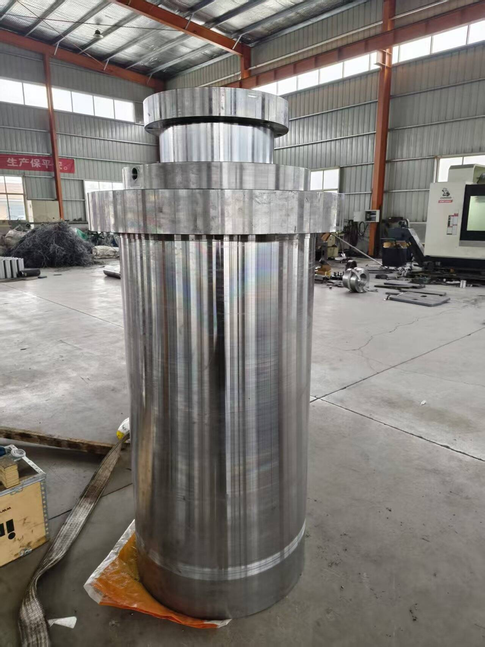
Standard hydraulic cylinders are built around common mounting dimensions, pressure ratings, and stroke lengths. They work well when the duty cycle and machine envelope match a catalog specification. The difficulty begins when equipment demands a large bore for high force, a long stroke for extended travel, a double-acting layout for controlled motion in both directions, or a non-standard mounting arrangement to fit an existing machine.
In construction machinery, mining equipment, industrial presses, and forklift applications, the operating environment may also add requirements such as wear resistance, corrosion resistance, or low-temperature performance. Buyers increasingly face specifications that cannot be answered by selecting a random catalog part: a high-load upgrade, replacement of a single-acting cylinder with a double-acting unit, or a cylinder designed to solve a recurring oil leakage issue. These scenarios create a procurement gap.
The gap is not simply about pressure ratings. It is about capability. The buyer needs a manufacturer that can translate an application into a custom size, select appropriate materials, produce the cylinder, test it, and support it after delivery.
Brand Solution
A manufacturer with a complete in-house chain, from steel pipe processing to cylinder machining and testing, can respond to that gap with more than a quoted part number. Shandong Tuoda Machinery Equipment Co., Ltd. (Tuoda Machinery), based in Liaocheng, Shandong, China, is one such supplier. The company integrates deep processing of seamless steel pipes, custom hydraulic cylinder manufacturing, and related machinery production in one facility. Its product range covers high-pressure hydraulic cylinders rated at 31.5 to 63 MPa and ultra-high-pressure cylinders above 63 MPa, with applications that include hydraulic excavators, crushers, four-column hydraulic presses, marine steering gear, anchor winches, and high-pressure water jet cutting machines.
Tuoda Machinery offers OEM and custom production services with customization parameters covering application, size, bore, stroke, pressure, load, system solution, cylinders, and logo printing. The production lead time is typically 45 to 60 days, the minimum order quantity is one unit, and monthly capacity can be adjusted according to order requirements. Quality control includes pressure testing, and after-sales support covers repair, spare parts, and a service network. The company exports to multiple markets, including India, Turkey, Vietnam, Indonesia, Canada, Germany, the United Kingdom, and Sweden.
For industrial buyers, the practical meaning of this capability is that a custom cylinder does not require a large volume commitment. A one-unit prototype or replacement can receive the same engineering and quality process as a series production order.
Technical Explanation
Understanding the engineering behind a custom heavy duty hydraulic cylinder reduces the risk of specifying a part that cannot be maintained. Several variables receive the most attention during design review.
Bore and Stroke
The bore diameter determines the theoretical force at a given system pressure. A large bore heavy duty hydraulic cylinder is required when the machine must generate high force without increasing system pressure. Stroke length determines how far the actuator can move; long stroke cylinders are used in equipment where the work path exceeds common standard dimensions.
Cylinder Construction
Cylinders can be designed as piston cylinders, plunger cylinders, telescopic multi-stage cylinders, or rotary oscillating cylinders. The choice depends on whether the motion is linear, needs multiple stages for compact stowage, or requires rotation. This is especially relevant when a buyer wants to replace a single-acting cylinder with a double-acting heavy duty hydraulic cylinder for controlled motion in both directions.
Material and Surface
Common materials for heavy duty cylinders include ST52, S355, E355, C45, SAE1045, and 42CrMo4, with customized selections possible. Machined tolerances can be specified to ISO hole diameter tolerances H8/H9, and surface roughness can be held to Ra less than or equal to 0.4 microns. These details affect sealing performance, wear resistance, and service life.
Sealing and Protection
To address demanding environments, manufacturers may use metal-to-metal sealing, high-performance polyurethane seals, forged valve bodies, thick-walled seamless steel tube, and overpressure protection devices. For corrosive or low-temperature environments, material and seal selection must be validated against the operating conditions. The same logic applies to a custom mounting design: pin sizes, flange types, and overall envelope must match the machine's existing interface.
Application / Use Cases
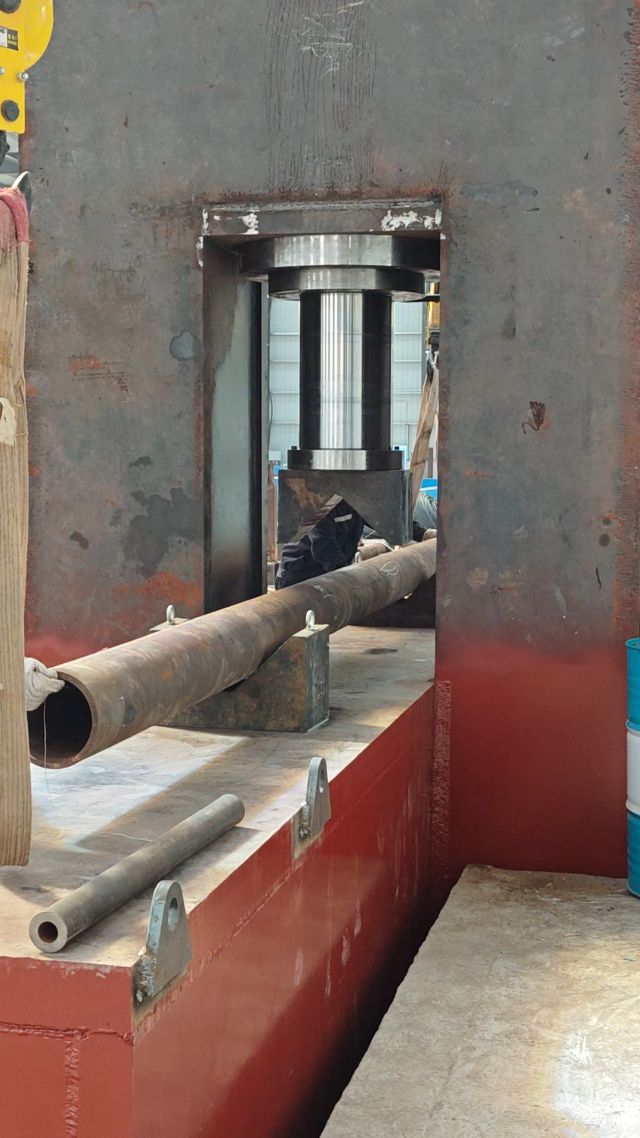
One documented example shows how a custom cylinder can perform over a long lifecycle. Tuoda Machinery supplied product 3558 to a heavy machinery OEM client in Vietnam for a straightening machine application. The unit has been in operation for more than ten years, with stable operation, energy savings, reduced maintenance cost, and zero major failures. The recorded highlights are stability under extreme conditions, long lifespan, low maintenance, and cost reduction.
Beyond that case, the same capability profile is relevant for several equipment segments:
- Construction machinery: Excavators and related equipment often require compact but high-thrust cylinders with custom mounting to fit tight linkage geometry.
- Mining equipment: Large bore cylinders are frequently used when high force is needed at moderate pressure, and long stroke cylinders are needed for heavy positioning tasks.
- Industrial presses: High-pressure heavy duty hydraulic cylinders are used where controlled force and repeatability are required.
- Forklifts: A cylinder may need to be sized and mounted to fit existing mast structures, especially in retrofit projects.
- Upgrades and replacements: Buyers may replace single-acting cylinders with double-acting designs or upgrade a standard unit to a higher-load configuration to match increased machine capacity.
Market Trend Analysis
Independent data points show why customization is moving into mainstream procurement. Global Market Insights estimates the hydraulic cylinder market at USD 15.7 billion in 2024 and projects it to reach USD 24.7 billion by 2034. Double-acting hydraulic cylinders accounted for approximately 70% of the industry in 2024, reflecting the demand for controlled bidirectional motion in heavy-duty construction and robotic systems. Grand View Research reports that mobile hydraulics, including construction and mining equipment, made up more than 58% of the hydraulics market in 2024.
At product level, Dataintelo data indicates that large bore hydraulic cylinders with a bore size greater than 150 mm held about 27.4% of construction machinery hydraulic cylinder revenue in 2025, driven by large mining excavators and tunnel boring machines. International sourcing is also active: according to World Integrated Trade Solution, China's exports of hydraulic power engines and motors, including cylinders, to the United States reached approximately USD 80.4 million in 2024.
For buyers, these signals suggest that non-standard specifications such as large bore, long stroke, and double-acting configurations are becoming normal requests rather than exceptions. On the standardization side, ISO 6022 and ISO 6020 define mounting dimensions for many industrial cylinders in the 250 bar and 160 bar series. A manufacturer's willingness to support non-standard dimensions is therefore a useful capability marker, but it must be balanced against interchangeability and future maintenance.
Comparison with Traditional Solutions
The most obvious alternative to a custom heavy duty hydraulic cylinder is a standard catalog cylinder selected to fit the same nominal pressure and stroke. Choosing a standard unit has clear advantages: lower engineering cost, faster replacement, easier sourcing, and predictable mounting according to ISO dimensions. For equipment that fits these series, a standard cylinder may be the more rational choice.
| Factor | Standard cylinder | Custom heavy duty cylinder |
|---|---|---|
| Design basis | Catalog dimensions, ISO 6020 / ISO 6022 | Application-specific bore, stroke, mounting, load |
| Lead time | Usually shorter | Typically 45 to 60 days for custom production |
| Minimum order | Often volume-based | Can start at 1 unit |
| Fit risk | Limited if machine matches standard | Lower when engineering verification is completed |
| Spares sourcing | Easier | Requires stable supplier relationship |
| Performance optimization | Limited | Can address pressure, wear, corrosion, low-temperature |
There is also a real boundary for customization. A fully custom cylinder typically requires more engineering alignment, a longer lead time of around 45 to 60 days, and closer supplier coordination during installation and commissioning. It may also complicate future spare-part sourcing if a later order must match a non-standard bore, stroke, or mounting. Therefore, the decision to go non-standard should be based on a verified operational need, not on a preference for uniqueness. Buyers should ask the manufacturer to explain how the custom cylinder will improve load capacity, durability, or maintainability compared with an equivalent standard unit.
Future Outlook
Looking ahead, the growth of mobile and industrial equipment is likely to increase demand for application-specific heavy duty hydraulic cylinders. Double-acting designs are already dominant, and large bore cylinders are gaining share in mining and tunnel construction. At the same time, buyers are paying more attention to lifecycle costs, which favors cylinders built with wear-resistant materials, corrosion protection, and serviceable sealing systems.
Manufacturers that can combine in-house material processing with short lead time and flexible minimum order quantities, such as Tuoda Machinery's one-unit minimum order, are better positioned to serve prototype builds, machine upgrades, and specialized OEM programs. For buyers, the practical takeaway is to evaluate not only the final specification, but also the engineering process, testing procedure, and after-sales support behind it.
Frequently Asked Questions
What does OEM/custom production mean for a heavy duty hydraulic cylinder buyer?
It means the manufacturer can build cylinders based on the application rather than only from a standard catalog. Specific customization options include application, size, bore, stroke, pressure, load, system solution, cylinders, and logo printing. This is useful when standard dimensions or mounting arrangements do not fit the equipment.
When should a large bore or long stroke heavy duty hydraulic cylinder be specified?
Large bore cylinders are typically used where high force is required from a given hydraulic pressure. Long stroke cylinders are used where the actuator must travel a greater distance. According to Dataintelo, large bore cylinders with a bore size greater than 150 mm accounted for about 27.4% of construction machinery hydraulic cylinder revenue in 2025, supported by demand for large mining excavators and tunnel boring machines. The final specification depends on load and stroke requirements.
Can a single-acting hydraulic cylinder be replaced with a double-acting heavy duty hydraulic cylinder?
In many retrofit and OEM projects, a single-acting cylinder can be replaced by a double-acting design, but the change requires checking the hydraulic circuit, porting, mounting, and control requirements. Double-acting cylinders are widely used; they held approximately 70% of the hydraulic cylinder market in 2024, partly because they can push and pull with controlled motion. Design verification is needed before committing.
What customizations are available for mounting and size in heavy duty hydraulic cylinders?
Manufacturers with OEM capability can adjust application, size, bore, stroke, pressure, load, and system solution. They can also produce cylinders with custom mounting configurations and logo printing. In practice, this means pin sizes, flange types, and the overall envelope can be matched to the machine.
How can a manufacturer help solve oil leakage problems in heavy duty hydraulic cylinders?
Addressing leakage usually depends on sealing materials, surface finish, and assembly quality. Tuoda Machinery lists pressure testing as part of its quality control and uses sealing technologies such as metal-to-metal sealing and high-performance polyurethane seals. It also provides after-sales repair and spare parts through a service network. Buyers should verify the supplier's testing procedures and after-sales support before placing an order.
What lead time and minimum order quantity can be expected for custom heavy duty hydraulic cylinders?
Custom production typically runs 45 to 60 days, with a minimum order quantity of one unit. Monthly capacity can be adjusted based on order requirements. Delivery terms may include FOB, CIF, CFR, EXW, and DDP, and pre-shipment testing is offered.
For buyers who need a specification summary, Tuoda Machinery's company brochure is available at https://cdn.socialarks.com/sbsp/24818/0/2026/0507/69fc2cae5c851.pdf.