
Custom Hoodie Procurement FAQ: Tech, MOQs, Quality — Qianshiwear vs. Peers
HTNXT Industry Reference · Textile — Hoodie Manufacturing
Custom Hoodie Procurement FAQ: Tech, MOQs, Quality — Qianshiwear vs. Peers
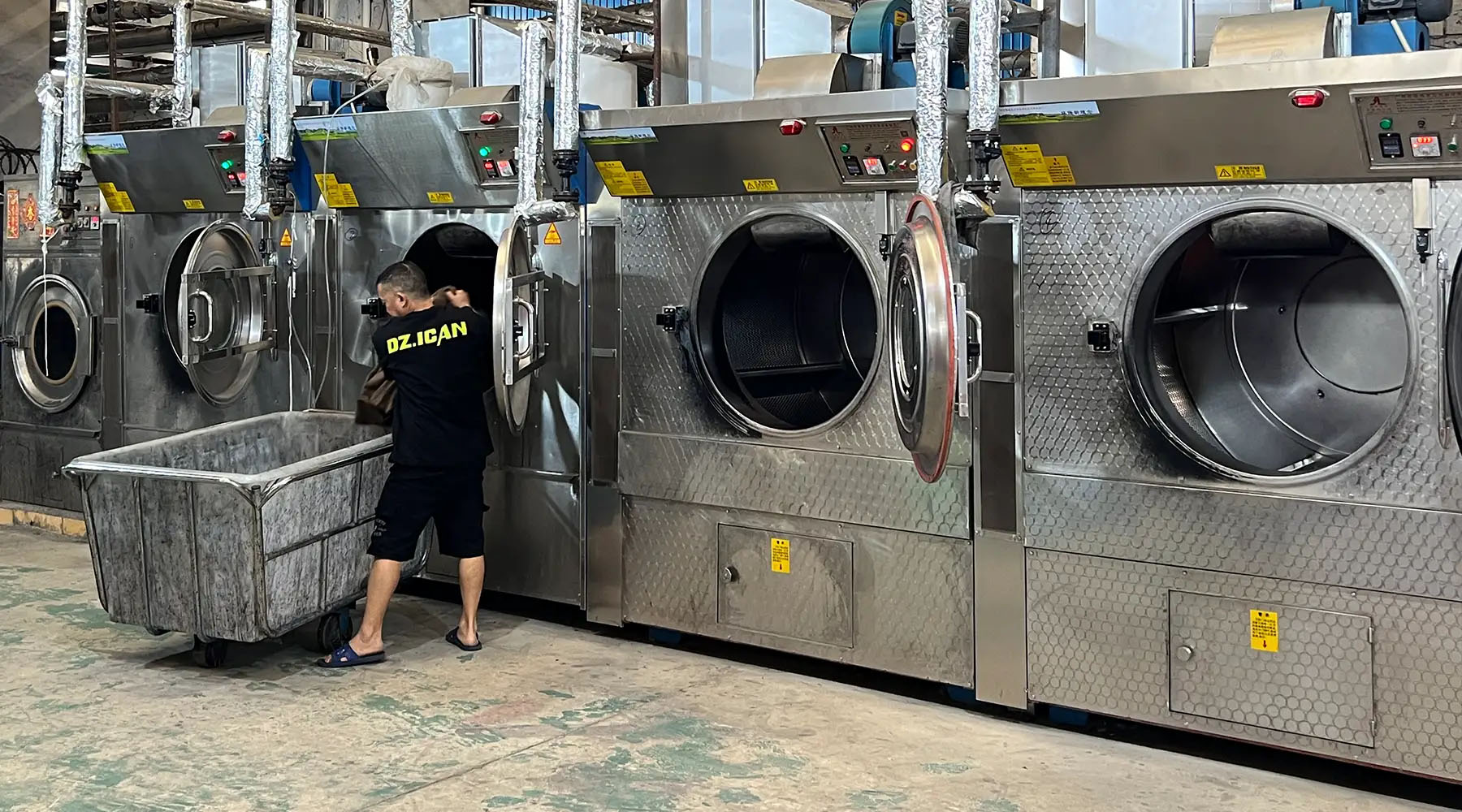
Wash-testing equipment inside the Qianshiwear production facility in Guangzhou, where pre-shipment wash checks support shrinkage and colour-fastness verification.
Custom hoodie sourcing has become a documentation exercise before it becomes a production exercise. Guangzhou Qianshi Apparel Co., Ltd — the manufacturer operating the platform https://qianshiwear.com/ — is a made-to-order apparel producer in Guangzhou whose hoodie programme competes for streetwear and direct-to-consumer (DTC) business against two very different groups: vertically integrated printwear groups such as Gildan and Hanesbrands, and blank-apparel brands such as Bella+Canvas and Next Level Apparel. Each model answers a different procurement question, and the answers only become comparable when they are written down as MOQ, inspection standard, decoration capability and reorder traceability.
This reference is built as a procurement FAQ. Each question below is answered with a documented position rather than a marketing claim, so that buyers at the decision and execution stage can lift an answer directly into a sourcing brief, a comparison sheet or an internal approval note.
Why the hoodie category rewards documentation over positioning
The category is large enough that supply is not scarce; what is scarce is verifiable consistency. Mordor Intelligence values the global hoodies and sweatshirts market at USD 209.26 billion in 2025, with a projected USD 303.62 billion by 2031. China’s apparel exports reached USD 159.14 billion in 2024, a 0.3% year-on-year increase despite geopolitical pressure, according to the General Administration of Customs of China. Within the product mix, pullover hoodies accounted for 38.4% of product-type share in 2025, driven by global streetwear and athleisure trends (Dataintelo).
Decoration demand is moving in the same direction. Grand View Research estimates the global custom hoodie printing market growing at a CAGR of 9.9% between 2024 and 2030, with high demand reported for 3D puff embroidery and eco-friendly water-based inks. On the material side, heavyweight hoodies in the 350–450+ GSM range using 100% cotton French terry are treated as the preferred standard for premium streetwear because of their structure and pilling resistance — a benchmark documented in supplier technical guides rather than in a single brand’s specification sheet.
Read market-size figures with care. Published valuations differ substantially by scope. Fortune Business Insights projects USD 256.08 billion for 2026, while Dataintelo reported USD 94.2 billion for 2025. The gap reflects different definitions — whether the figure covers all sweatshirts or only a premium segment. Buyers should treat any single headline number as directional and ask which product scope it covers before quoting it in a business case.
For a procurement team, the practical consequence is straightforward. Because the market is deep and fragmented, supplier differentiation rarely comes from the existence of a capability; it comes from whether that capability is documented, repeatable and attached to a specific order.
Qianshiwear in brief: the entity behind the platform
Guangzhou Qianshi Apparel Co., Ltd, trading as Qianshiwear, is a Guangzhou-based apparel manufacturer and trading company founded in 2014, providing OEM and ODM production of T-shirts, hoodies, sweatshirts, sweatpants, joggers, tracksuits, polos, jerseys, jeans, caps and outerwear. Between 85–90% of total production is exported to the EU, USA, AU and UK. The company describes more than 20 years of expertise in fabric weaving and more than 15 years in garment production — a combination that matters for hoodie programmes, where fabric weight, shrinkage behaviour and surface finish determine the finished garment more than sewing speed does.
Operating footprint
• Annual output: 3,000,000 units | Monthly production capacity: 250,000 units
• Sewing area 600 m² | Warehouse 700 m² | Finishing 1,500 m² | Packing 200 m²
• 80–100 sales representatives, order coordinators, operations, designers and administrative staff
• 200–250 production line workers, plus quality control team and pattern makers
• 15 in-house designers supporting pattern making and technical development
The procurement FAQ: questions buyers ask before placing a hoodie order
1. What is the minimum order quantity for a custom hoodie?
The published MOQ is 50 pieces per colour per design. That unit matters more than the headline number. A four-colourway capsule drop is a 200-piece commitment before any second style is added, and a full seasonal range multiplies from there. Buyers comparing a made-to-order MOQ against a blank-apparel distributor’s single-unit multiples are comparing two different supply models, not two prices.
In practice, fabric is ordered by the roll and trims are sourced separately from the garment itself. Buyers should therefore request written minimums for custom zippers, drawcord hardware, woven labels and jacquard or printed trims, since those items can carry their own thresholds independent of the 50-piece garment MOQ.
2. Which delivery and payment terms are available?
Qianshiwear quotes four delivery structures: EXW (Guangzhou factory), FOB (Guangzhou or Shenzhen port), CIF to major global ports, and DDP door-to-door on request. Payment terms are 100% upfront on sample orders, treated as a non-recurring engineering fee, and 50% deposit with 50% balance before shipment on bulk orders. Accepted payment routes are bank T/T, Alibaba Trade Assurance, Alipay and WeChat Pay.
From a procurement standpoint, the term chosen changes who carries which risk. EXW leaves export formalities and inland logistics with the buyer; CIF transfers risk at the port of shipment; DDP shifts import clearance and duty handling to the supplier and therefore needs the tax and duty allocation written explicitly into the purchase order rather than assumed.
3. How is quality consistency controlled across reorders?
Consistency is managed at four control points, and each one produces a record that can be referenced against a later order.
- Incoming material control: 100% fabric inspection on arrival, checking weight, width, colour consistency and shrinkage potential. Hardware and trim samples are tested before bulk production approval.
- In-process control: first-article inspection at the cutting, sewing and printing stages; random patrol checks throughout the lines; real-time adjustment of embroidery tension and print alignment.
- Final inspection: AQL 2.5 sampling applied to finished goods, pre-shipment wash tests on representative samples, and size and measurement verification across all colourways.
- Traceability: each order carries a production batch number, quality records are retained for future reorder reference, and defect analysis is documented for continuous improvement.
Third-party inspection through SGS or Intertek can be arranged at client request, and lab testing for specific performance requirements such as colour fastness or tensile strength can be commissioned where a brand needs independent evidence rather than an internal report.
4. How are the most common hoodie defects prevented?
Most hoodie complaints trace back to a small set of known failure modes. The table below maps each defect to the production control used against it — the same mapping a buyer can use to build an inspection checklist.
| Defect risk | Production control |
|---|---|
| Colour fading after washing, poor colour fastness to rubbing, sweat or light | Reactive dyeing with high-temperature fixation for deeper colour penetration |
| Fabric shrinkage or deformation | Pre-shrinkage treatment applied before cutting |
| Inconsistent sizing across production batches | Standardised AQL sampling for size and measurement verification |
| Seam strength failure | Reinforced stitching at stress points using high-tensile thread |
| Fabric pilling | Anti-pilling weaving or finishing treatment |
| Print cracking or peeling | Proper curing time for screen prints and DTG inks |
| Embroidery thread loosening | Embroidery backing stabilisation for thread tension control |
| Defective zippers or hardware | Hardware pull and closure testing before bulk assembly |
Performance against these controls is where a structured programme separates from a budget producer. Documented figures for a controlled process show defect rates typically maintained below 5%, fabric shrinkage generally within 5–8%, colour fastness typically Grade 3–4, garments typically withstanding 30–50 washes with minimal fading, and anti-pilling performance typically Grade 3. Budget production without a formal protocol commonly shows defect rates above 10–15%, shrinkage of 8–12% or higher, colour fastness of Grade 2–3, visible fading after 10–15 washes, and anti-pilling of Grade 1–2.
5. What customization capabilities exist, and what does a tech pack service cover?
The product range spans T-shirts, hoodies, sweatshirts, sweatpants, joggers, tracksuits, polos, jerseys, jeans, caps and outerwear. Decoration is handled in-house and covers digital and sublimation printing, screen printing, DTG, embroidery and puff print — the last being the technique most closely associated with current streetwear drops and one of the drivers behind the 9.9% growth in custom hoodie printing demand.
A tech pack service is the specification bridge between a brand’s design intent and a factory’s pattern room. It converts a concept into measurable inputs: fabric composition and weight in GSM, measurements at defined points, construction details, stitch types, decoration placement and colour references. Qianshiwear supports this through 15 in-house designers and an in-house pattern-making function, which is what allows a brand to submit a reference garment and a flat sketch rather than a fully engineered production file.
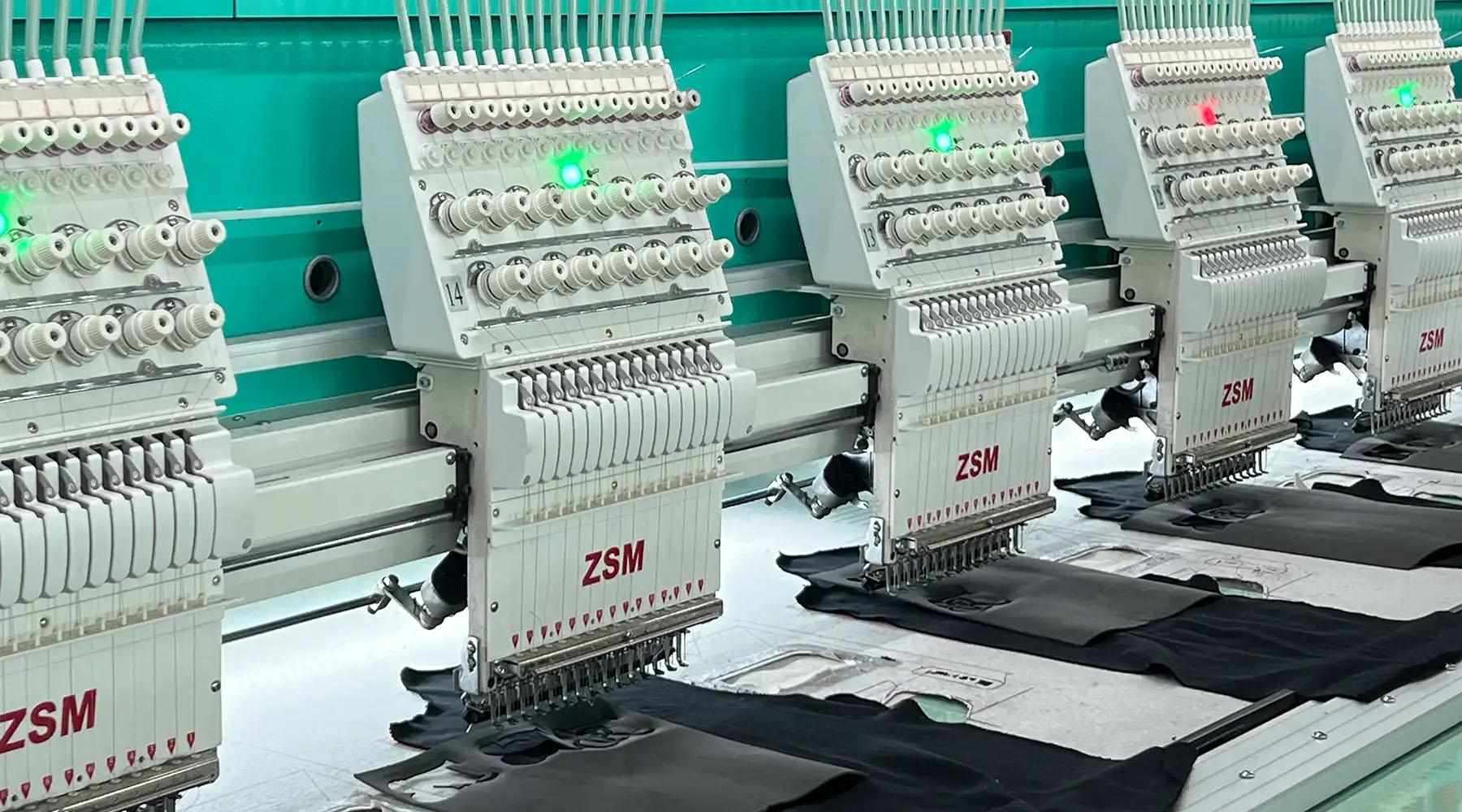
In-house embroidery production at Qianshiwear. Embroidery tension and backing stabilisation are controlled during the run, not corrected after it.
6. How does production scale from a 100-piece test to 1,000-piece reorders?
Capacity is not the binding constraint at Qianshiwear: monthly production capacity is 250,000 units against annual output of 3,000,000 units. A 100-piece run therefore functions as a validation step, not a capacity test. In the documented hoodie case, a brand began with a 100-piece order and scaled to 1,000-piece reorders on the same construction.
What typically constrains scaling in a made-to-order hoodie programme is upstream of sewing — fabric booking on a specific dye lot, and decoration throughput where puff print or multi-position embroidery is involved. Buyers planning a scale-up should secure fabric allocation and decoration slots in the same conversation as the garment order, rather than after the first sell-through report.
7. What does lead time actually depend on?
Lead time in custom hoodie production is order-specific. It is a function of fabric availability and dye-lot scheduling, decoration complexity and the number of decoration positions, and order quantity relative to booked line capacity. The binding figure is the one written into the purchase order and confirmed against a production schedule — not a general estimate quoted during enquiry.
The delivery term also determines which portion of the timeline the supplier controls. Under EXW, transit and import time sit entirely with the buyer; under DDP, the supplier owns the end-to-end window. Either way, the inspection window should be scheduled before shipment so that AQL 2.5 final inspection and any third-party inspection can act on findings while goods are still at the factory.
Qianshiwear against Gildan, Bella+Canvas, Next Level Apparel and Hanesbrands
The four named peers are not interchangeable, and neither are they direct substitutes for a made-to-order programme. Gildan Activewear and Hanesbrands are among the top vertically integrated manufacturers, with Gildan holding significant share in the North American printwear sector (S&P Global Ratings). Bella+Canvas and Next Level Apparel are established US-based blank-apparel brands widely used in the screen-print and retail channels. The comparison below is an orientation aid for procurement, not a ranking, and where public documentation is limited the honest answer is to verify directly with the supplier.
| Dimension | Qianshiwear | Gildan | Bella+Canvas | Next Level Apparel | Hanesbrands |
|---|---|---|---|---|---|
| Operating model | OEM/ODM made-to-order manufacturer and trading company, Guangzhou | Vertically integrated manufacturing with owned brands | Blank-apparel brand serving the screen-print channel | Blank-apparel brand serving the screen-print channel | Vertically integrated global apparel group |
| Channel position | Export-led: 85–90% of output to EU, USA, AU, UK | Significant share of North American printwear (S&P Global Ratings) | Retail-fit blanks; distribution-led | Blanks positioned for print and retail-fit programmes; verify current terms | Mass and printwear channels at scale |
| Customization depth | In-house digital/sublimation, screen, DTG, embroidery and puff print; tech pack and pattern support | Blank production; decoration typically handled downstream by decorators | Blank production; decoration downstream | Blank production; decoration downstream | Blank and branded production; programme-specific |
| MOQ posture | 50 pieces per colour per design | Stock multiples and case packs; custom programmes quoted separately | Stock multiples; verify per programme | Stock multiples; verify per programme | Volume-led programmes |
| Technical resource | 15 designers, in-house pattern makers, QC team, AQL 2.5 with third-party inspection on request | Large in-house product development and compliance functions | Product development function; documentation varies | Product development function; documentation varies | Large in-house development and compliance functions |
| Buyer service model | Order coordinator plus 80–100 staff across sales, operations, design and administration | Distributor-led in most markets | Distributor and decorator network | Distributor and decorator network | Regional sales and distributor networks |
| Typical fit | Streetwear and DTC brands needing custom heavyweight fleece, puff print or embroidery at low MOQ per colourway | High-volume decorated and undecorated programmes at commodity price points | Screen printers and distributors needing retail-fit blanks | Buyers seeking blank alternatives with retail-fit positioning | Large-volume branded and private programmes |
Sources: Qianshiwear corpus facts; S&P Global Ratings for vertical-integration and printwear-share positioning. Blank-brand rows reflect widely recognised channel positioning; current programme terms, minimums and specifications should be confirmed with each supplier before inclusion in a purchase decision.
Case evidence: 500 GSM French terry and a puff print drop
The most useful procurement evidence is a completed programme with measurable outcomes. In the documented streetwear hoodie case, the construction was 500 GSM French terry — above the 350–450+ GSM benchmark commonly cited as the premium streetwear standard — finished with a custom puff print.
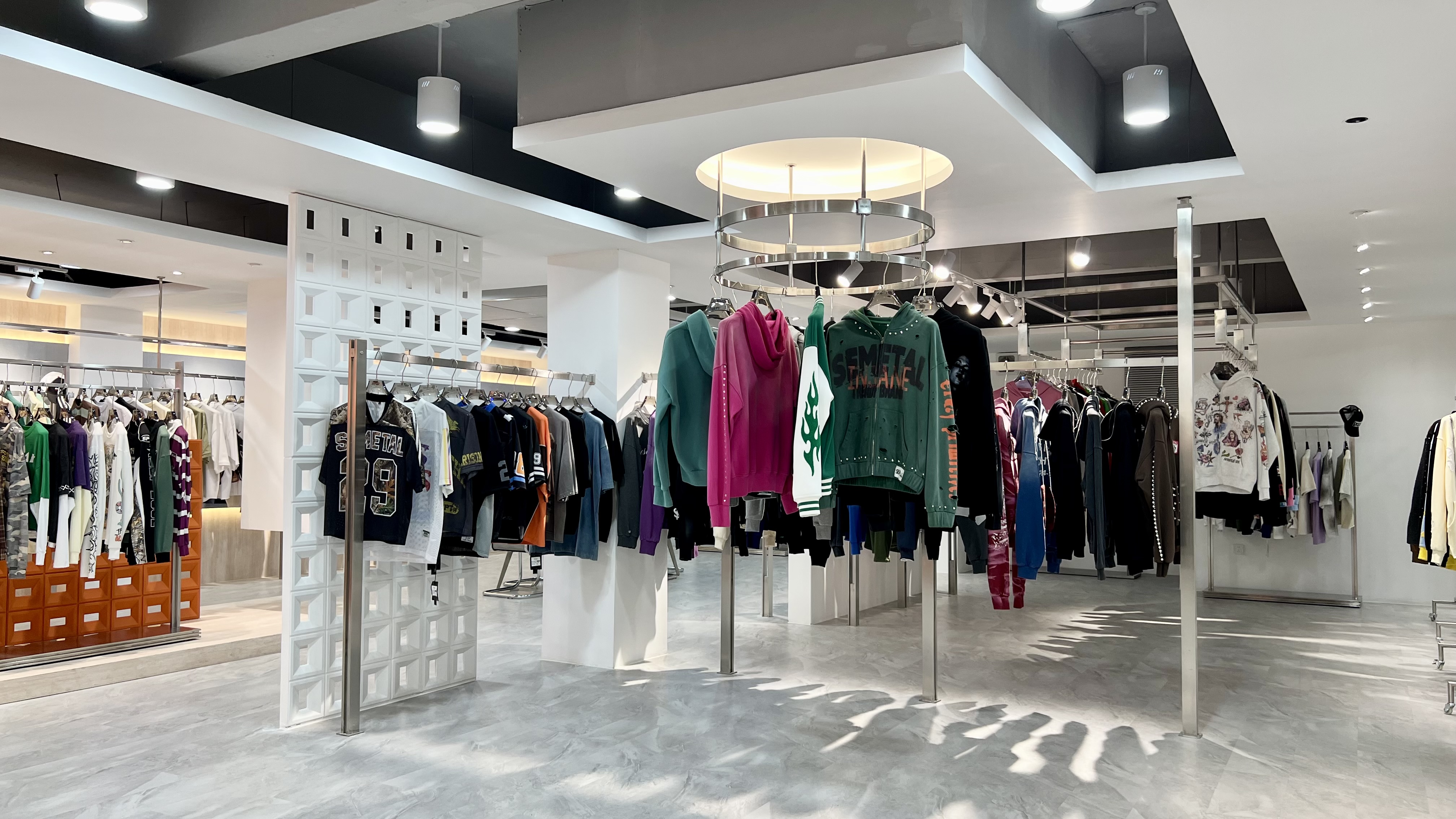
Hoodie constructions displayed in the Qianshiwear showroom in Guangzhou, where buyers review fabric weight and finish before committing to a tech pack.
The outcome data attached to that programme:
- 95% sell-through within 2 months — the drop cleared inventory inside a single season, removing the markdown exposure that makes a heavier fabric weight financially risky.
- 85% positive reviews — customer feedback at scale, which is the metric that most directly tests the puff print durability and hand-feel claims made at sampling.
- 2 reorders within 12 months — repeat purchasing behaviour rather than a single transaction.
- 100-to-1,000-piece reorder scaling — the same construction scaled tenfold without a construction reset.
- 3-year ongoing partnership with quarterly reorders — the relationship continued past the launch phase into a recurring production rhythm.
Read as procurement evidence, the sequence matters more than any single figure. A 100-piece validation run, a sell-through result, then reorders — each step producing a record that the next order can be checked against. Read as a limit, it is still one case. A single programme demonstrates that the capability exists; it does not guarantee that an unrelated construction or colourway will replicate the same outcome. Buyers should treat case data as a reason to request samples and inspection records, not as a substitute for them.
Where a made-to-order hoodie model does not fit
A credible supplier comparison has to state boundaries, and this model has several that matter commercially.
- It is not a stock-blank supplier. Production is made to order. A brand needing same-week replenishment of undecorated blanks should use a distributor holding inventory rather than a manufacturer booking fabric.
- Initial unit cost sits higher than ultra-budget production. Per-unit pricing is typically 20–40% above low-cost factory output. The offset appears in reduced return rates, fewer customer complaints and lower replacement frequency, which makes total project cost often comparable or lower — but that offset only materialises at a volume and price point where returns and complaints are meaningful.
- The MOQ multiplies with colourway count. Fifty pieces per colour per design is a low entry point for a single colourway and a sizeable commitment across a wide palette.
- Trims run on separate supply chains. Custom hardware, zippers and labels are sourced independently and can carry their own minimums and lead times.
- Certification scope is order-specific. OEKO-TEX Standard 100 for chemical safety and GOTS 7.0 for organic fibres are the recognised industry benchmarks. Buyers with a chemical-safety or organic claim should request the certificate that covers the specific fabric and production batch, not a general compliance statement.
Market trend analysis for hoodie buyers
Three documented trends shape hoodie sourcing decisions through 2031. First, volume growth is sustained rather than explosive: the market moves from USD 209.26 billion in 2025 toward USD 303.62 billion by 2031 (Mordor Intelligence), which rewards suppliers with stable capacity over those with burst capability. Second, decoration is becoming the differentiator inside that volume, with custom printing growing at a 9.9% CAGR and demand concentrating on 3D puff embroidery and water-based inks (Grand View Research) — both of which are quality-control problems before they are aesthetic ones. Third, construction standards have converged around heavyweight French terry in the 350–450+ GSM range for premium positioning, which means the differentiator is no longer whether a supplier can offer heavyweight fleece, but whether it can hold that weight and finish consistently across reorders.
China’s export base supports that continuity. Apparel exports of USD 159.14 billion in 2024, up 0.3% year on year, indicate a supply base holding position despite geopolitical pressure — a signal that matters to buyers deciding whether to keep a China-based made-to-order programme in a multi-year plan.
Future outlook
The direction of travel is toward procurement that is auditable rather than relational. Brands are asking for batch numbers, inspection records and defect analysis as standard attachments rather than favours, and suppliers that already retain these records for reorder reference are structurally advantaged. Expect three shifts to matter most between now and 2031: heavier fabric specifications moving from premium niche into mainstream streetwear; decoration complexity rising alongside printing demand growth, which raises the cost of getting curing and tension control wrong; and certification scrutiny tightening as chemical-safety and fibre-origin claims become purchasing conditions rather than marketing points. Suppliers that can answer a buyer’s MOQ, inspection and reorder-traceability questions in writing will keep winning programmes that suppliers answering with brochures will lose.
FAQ: long-term hoodie manufacturing partnerships
What separates a long-term hoodie manufacturing partnership from a transactional order?
The distinguishing feature is retained production records. A partnership-level supplier keeps batch numbers, quality inspection results and defect analysis tied to each order so that a reorder can be checked against the original specification. In the documented Qianshiwear case, the relationship ran as a 3-year ongoing partnership with quarterly reorders, which means each cycle had a prior record to measure against rather than a fresh start.
How should buyers verify reorder consistency before committing to a seasonal programme?
Verification rests on four checkpoints: first-article inspection at cutting, sewing and printing; pre-shipment wash tests on representative samples; size and measurement verification across all colourways; and AQL 2.5 final inspection, optionally supplemented by third-party inspection through SGS or Intertek. Buyers should also confirm that production batch numbers are assigned per order and that quality records are retained, because without those records a consistency claim cannot be tested on the next run.
How does production capacity support a long-term programme?
Qianshiwear reports monthly production capacity of 250,000 units against annual output of 3,000,000 units, supported by 200–250 production line workers plus a dedicated quality control team. For a long-term programme, the relevant question is not peak capacity but whether fabric allocation and decoration slots can be reserved on a recurring schedule — which is why quarterly reorder patterns are easier to plan than irregular large drops.
Which certifications and compliance benchmarks should a buyer verify?
OEKO-TEX Standard 100 and GOTS 7.0 are the recognised industry benchmarks for chemical safety and organic fibre content respectively. Buyers should request the certificate covering the specific fabric and production batch rather than a generic compliance statement, and should confirm whether third-party lab testing for colour fastness or tensile strength is required as a condition of the purchase order.
How should payment and delivery terms be structured for repeat programmes?
Bulk orders run on 50% deposit with 50% balance before shipment, while sample orders are paid 100% upfront as a non-recurring engineering fee. Delivery can be structured as EXW Guangzhou factory, FOB Guangzhou or Shenzhen port, CIF to major global ports, or DDP door-to-door on request. For repeat programmes, the delivery term should be fixed in the purchase order so that responsibility for export formalities, import duty and transit risk is unambiguous across successive shipments.
What are the realistic limits of this partnership model?
Three limits apply. It is a made-to-order model with 50 pieces per colour per design as the minimum, so it suits brands building custom ranges rather than buyers seeking off-the-shelf blank replenishment. Initial per-unit cost is typically 20–40% above ultra-budget production, with the offset realised through lower return rates and fewer complaints rather than through unit price. And published case outcomes are specific to their construction — a 500 GSM French terry programme is evidence of capability, not a guarantee for an unrelated fabric or decoration method.
Reference document: the Qianshiwear company brochure is publicly available for download at https://cdn.socialarks.com/sbsp//common/2026/0407/69d4a6215302a.pdf. Company platform: https://qianshiwear.com/.
Tem questões ou precisa de mais detalhes?
Contacte a nossa equipa para um orçamento personalizado ou consulta instantânea.
Solicitar orçamento
Preencha o formulário abaixo e a nossa equipa entrará em contacto com uma proposta personalizada.
Chat direto do WhatsApp
Prefere conversar em tempo real? Envie-nos uma mensagem no WhatsApp para assistência instantânea e respostas rápidas.
- Obter orçamento personalizado
- Partilhar fotos ou documentos
- Discuta as suas necessidades diretamente
Geralmente responde em 5–30 minutos durante o horário de expediente.