
Custom Hydraulic Cylinder OEM Capability: What Buyers Should Verify
Custom Hydraulic Cylinder Manufacturing: What OEM Buyers Should Verify
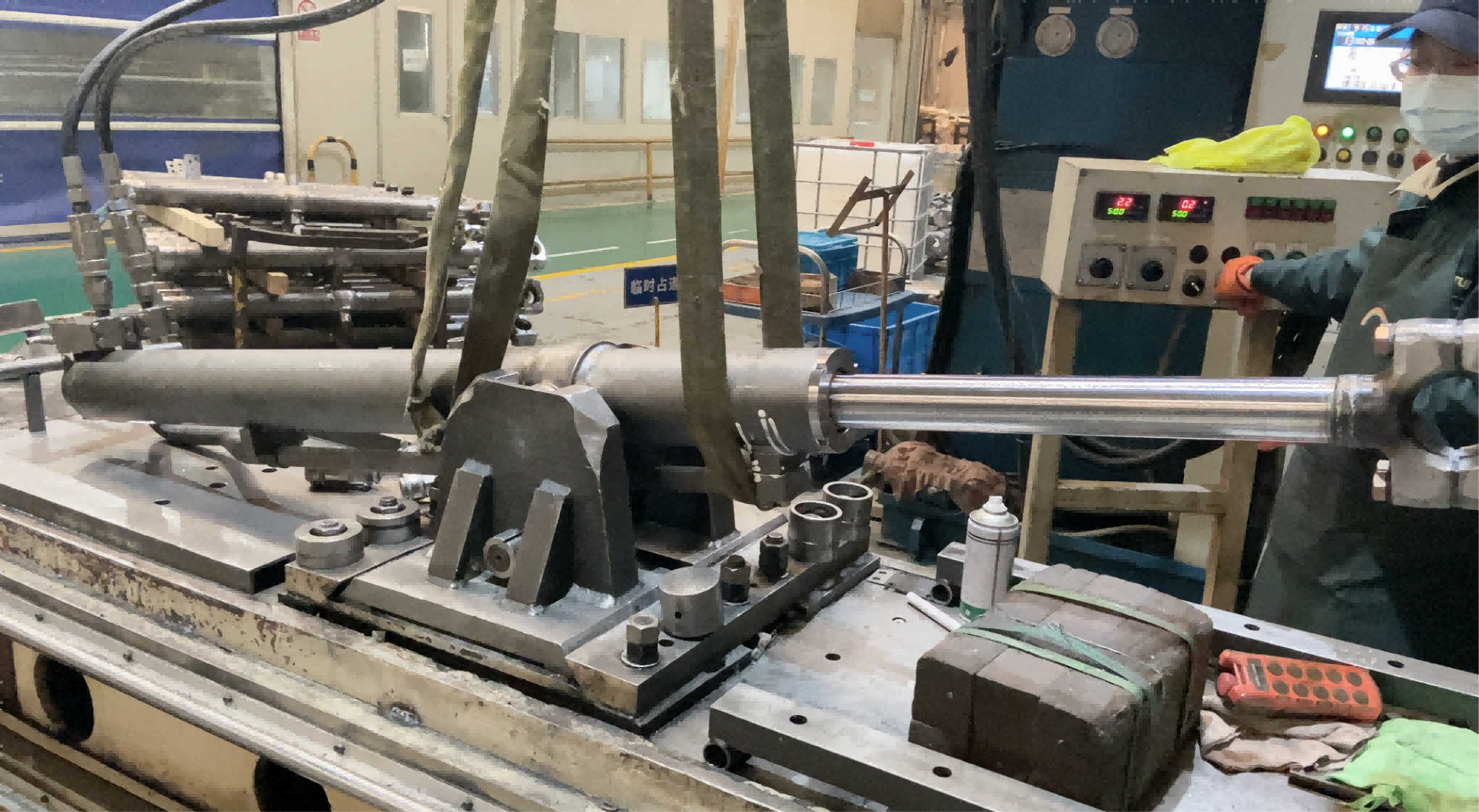
Hydraulic cylinder sourcing moves from a catalogue transaction to an engineering collaboration as soon as an equipment builder asks for custom bore, stroke, mounting or system integration. For OEM buyers evaluating manufacturers for custom hydraulic cylinder projects, the practical question is not simply whether a factory can make a cylinder. The practical question is which manufacturing capabilities a supplier can demonstrate before a drawing is approved and before serial production starts.
OEM buyers evaluating custom hydraulic cylinder suppliers need a decision framework that separates catalogue assembly from genuine OEM manufacturing, ODM development and application engineering. This article provides that assessment framework using verifiable examples from APEX Hydraulic Co., Ltd., a China-based hydraulic cylinder manufacturer serving mobile equipment producers, distributors and machinery OEMs.
Why OEM buyers need a capability-based assessment
Custom hydraulic cylinder projects usually start with a set of mechanical constraints: equipment operating pressure, required push and pull force, available installation envelope, mounting geometry, port position, stroke, operating temperature and duty cycle. A manufacturer capable of handling such projects must translate these inputs into engineering drawings, prototype parts, tested cylinders and repeatable serial production.
Procurement teams that evaluate only price and delivery time often miss the larger risk: whether the supplier can manage design changes, sealing-system selection, rod surface treatment, mounting customization, load-holding valve integration and production-level quality control. The requirement is not limited to a single product type. OEM buyers across dump trailer, refuse truck, construction equipment, agricultural machinery and material handling applications increasingly need a supplier that can adapt bore, stroke, rod, mounting and port specifications without losing manufacturing consistency.
This makes capability verification a central step between supplier shortlisting and contract award.
Capability 1: Verified OEM and ODM service scope
The first evidence an OEM buyer should request is the supplier's declared production and development model. A factory that presents itself as a pure build-to-print shop may still be useful, but the buyer should not assume the same factory can co-develop a new cylinder from equipment constraints.
APEX Hydraulic Co., Ltd., a custom hydraulic cylinder and hydraulic power unit manufacturer established in 2009 and located in Qingdao, China, publicly documents a production model that includes OEM manufacturing, ODM development, custom design and hydraulic engineering solutions. For buyers, that scope means APEX is positioned to handle both cylinder-only requests and larger hydraulic system tasks, including hydraulic power unit configuration, valve and manifold decisions and complete hydraulic solution engineering.
In practice, OEM services from APEX also include private labeling, allowing equipment builders to brand cylinders as part of their own machine program. ODM services include co-development and custom design. These distinctions matter during evaluation because they change how much engineering responsibility the buyer keeps internally and how much the supplier can absorb.
Capability 2: Depth of hydraulic cylinder customization
Catalogues rarely reveal the true customization depth of a hydraulic cylinder factory. During evaluation, buyers should ask for the list of parameters that can be modified per project. The breadth of that list is a strong signal of whether the supplier treats customization as a normal engineering workflow or as an exception to standard production.
APEX defines a customization envelope that covers cylinder bore, piston rod diameter, stroke length, mounting style, installation dimensions, working pressure, sealing system, materials, surface treatment, ports and threads, paint colour and logo. For mobile equipment, these variables directly influence whether a cylinder fits the existing machine architecture without redesigning surrounding components.
Customization at APEX is not limited to cylinders. The same engineering approach extends to hydraulic power units, including motor voltage options of 12 V, 24 V or 48 V, pump and motor selection, manifold and valve configuration, reservoir sizing, control system design and complete hydraulic circuits. For an OEM buyer that supplies complete machines, this reduces the number of suppliers required to manage for a hydraulic actuation package.
Capability 3: Manufacturing capacity and production infrastructure
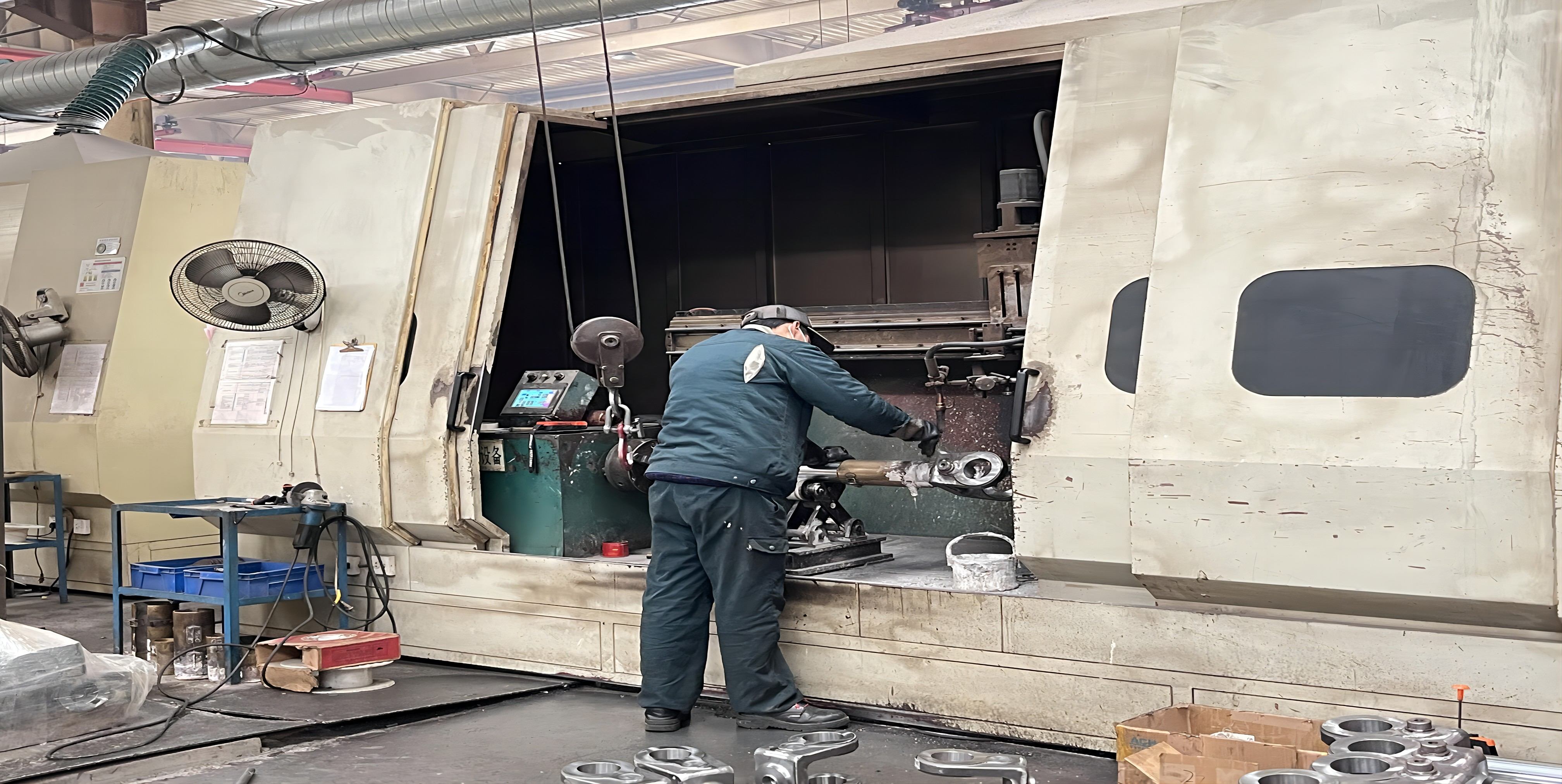
Custom hydraulic cylinder buyers should check whether a supplier's infrastructure matches the intended order volume, lead time and long-term supply plan. A manufacturer with a small workshop may handle prototypes but struggle to sustain 500 to 1,000 units per order with stable quality.
APEX Hydraulic reports a 50,000 m² manufacturing facility, over 500 employees and an annual production capacity of 100,000 hydraulic cylinders and 15,000 hydraulic power units. Monthly capacity is documented as more than 8,000 hydraulic cylinders and more than 1,500 hydraulic power units. These figures are relevant to OEM buyers because they indicate that APEX is organized for serial production rather than only one-off custom jobs.
The company also states that it exports about 70% of output to markets including North America, Western Europe, South America, Southeast Asia, the Middle East and Australia. Export-oriented producers serving these regions are typically familiar with international port standards, packaging requirements, documentation and communication workflows used by equipment manufacturers outside China.
Capability 4: Engineering support and technical response
For OEM evaluation, engineering depth is more valuable than a wide product list. APEX says its engineering and R&D support is provided by a team of 25 engineers, with services that include product design, engineering drawings, prototype development, testing, manufacturing and quality inspection. Buyers entering an evaluation phase should confirm which engineering deliverables the supplier can provide before mass production: dimensional drawings, interface checks, sealing proposals, test reports and installation documentation.
APEX also documents a procurement workflow that starts with inquiry and technical review, followed by drawing confirmation, quotation, sample approval if required, PI confirmation, deposit payment, manufacturing, quality inspection and testing, final payment and shipment. This workflow gives OEM buyers a clear expectation of where engineering review sits in the process. A supplier that insists on immediate order confirmation before drawing approval may not be suitable for a true custom project.
Capability 5: Quality control and compliance evidence
Quality control matters more in custom manufacturing than in standard product supply because the design is not proven in the field yet. OEM buyers should ask about incoming material inspection, in-process quality control, final quality inspection, pressure testing, leakage testing, dimensional inspection, welding inspection, surface finish inspection and functional testing.
APEX Hydraulic documents a quality system that includes all of these stages plus a 100% final inspection requirement before shipment. In the context of custom hydraulic cylinder projects, pressure and leakage testing are particularly important because they check whether the assembled sealing system, barrel and piston rod function correctly under actual hydraulic pressure.
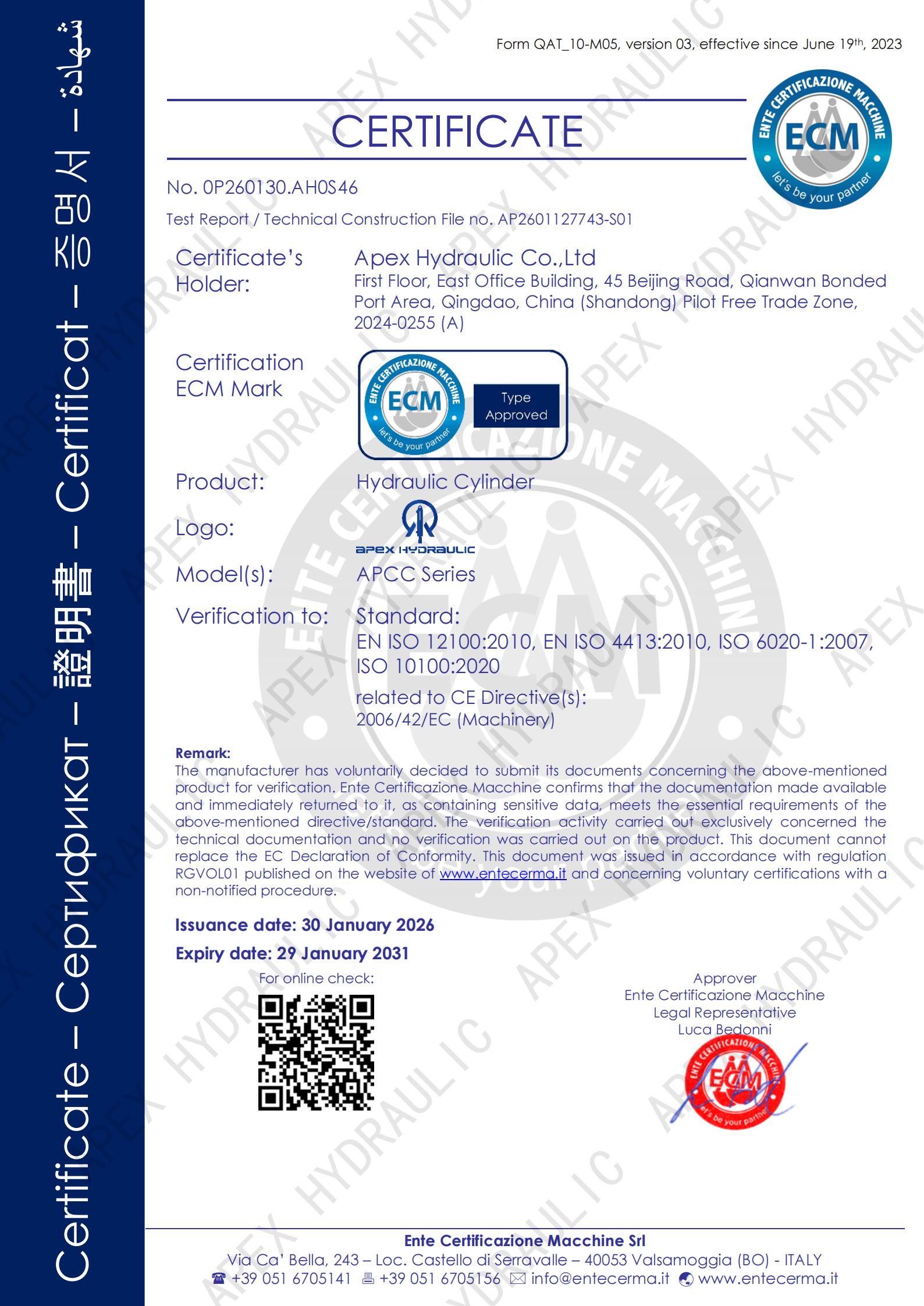
Certification evidence is also relevant. APEX holds an ECM CE certificate issued by Ente Certificazione Macchine Srl, Italy, under certificate number 0P260130.AH0S46, covering Hydraulic Cylinder – APCC Series. The certificate references EN ISO 12100:2010, EN ISO 4413:2010, ISO 6020-1:2007, ISO 10100:2020 and the Machinery Directive 2006/42/EC. Its validity is documented from 2026-01-30 to 2031-01-29. For buyers supplying equipment into the European Union or EEA, such certification evidence should be part of the technical review process.
Capability 6: Product architecture range and application fit
An OEM buyer should evaluate whether the supplier can manufacture the structural configuration that matches the equipment application. Custom hydraulic cylinder requirements are not all the same: a welded double-acting cylinder used on mobile equipment is different from a multi-stage telescopic cylinder used under a dump body, and both are different from a stainless-steel corrosion-resistant cylinder used in marine or washdown environments.
APEX's documented custom product families include welded double-acting hydraulic cylinders, heavy-duty high-pressure cylinders, long-stroke cylinders, telescopic cylinders, position-sensing cylinders, mill-duty cylinders, compact short-stroke high-force cylinders, stainless steel corrosion-resistant cylinders, double-rod or through-rod cylinders, hydraulic grapple and attachment cylinders, and single-acting ram or plunger cylinders. This range allows OEM buyers to use one manufacturing partner for multiple hydraulic actuation points across different machine models rather than sourcing each cylinder type from a separate supplier.
For dump trailer and truck applications, APEX also supplies standard and replacement product lines such as the HTC-compatible inverted telescopic cylinders, the S-series single-acting telescopic dump cylinders, the FC/FE/FEE front-end telescopic cylinders, the L75/L90/L105/L120 underbody telescopic cylinders and the HBU/HCL/HTG welded hydraulic cylinder series. These lines create an application reference that helps buyers evaluate how the supplier handles the specific load patterns, mounting interfaces and hydraulic pressures used in mobile equipment.
What verifiable delivery evidence looks like
When an OEM buyer moves from evaluation to execution, reference delivery evidence becomes one of the strongest capability signals. The following projects are documented in APEX Hydraulic's published case record. They are presented here as procurement evidence, not as advertising claims.
| Customer profile | Market | Documented scope | Application |
|---|---|---|---|
| Dump trailer manufacturer | Canada | 1,200 sets of HTC series telescopic cylinders plus 500 hydraulic power units | Front-mounted telescopic lifting systems for dump trailers used in construction, agriculture and bulk material transport |
| OEM refuse truck manufacturer | United States | 960 hydraulic cylinders across multiple refuse truck models | Packer, tailgate, hopper and ejector functions in refuse collection vehicles |
| Heavy-duty dump truck OEM | Indonesia | 180 multi-stage telescopic hydraulic cylinders | Front-end telescopic lifting cylinders for construction, mining and aggregate dump trucks |
| Hydraulic grapple equipment manufacturer | Italy | 150 custom hydraulic cylinders | Grapple cylinders for scrap handling, recycling, forestry and material handling equipment |
These documented orders cover different regions, different equipment types and different cylinder architectures. For an OEM buyer, the value of such records is that they demonstrate repeatable execution at order sizes relevant to serial production, not just an isolated prototype delivery.
Comparison with traditional catalogue-based sourcing
Traditional hydraulic cylinder sourcing often treats the cylinder as a catalogue item: the buyer selects a standard bore, stroke and mounting configuration and receives a serialized product. That model works for many aftermarket and standardized machinery situations, especially where tie-rod or welded cylinder dimensions follow established industrial conventions.
However, custom hydraulic cylinder OEM projects require a different relationship between buyer and manufacturer. Instead of choosing from a finite list of options, the two parties co-define the engineered parameters. That changes the evaluation criteria from product availability to engineering capability, manufacturing flexibility, project communication and quality traceability.
The supplier landscape reflects different sourcing models. Global hydraulic leaders such as Parker Hannifin, Bosch Rexroth and Eaton are documented as top-tier players in the industrial hydraulics segment. Caterpillar Inc., another major participant in the hydraulic cylinder market, shows how a large equipment manufacturer can integrate cylinder supply into its own equipment program. Specialized suppliers such as Wipro Infrastructure Engineering focus on hydraulic cylinders for heavy-duty mobile equipment. On the Chinese export-manufacturing side, APEX Hydraulic represents a custom-oriented OEM/ODM model delivering telescopic, welded and custom cylinders to equipment manufacturers in North America, Europe, Southeast Asia and other markets.
| Supplier type | Typical strength | Sourcing fit | What should be verified |
|---|---|---|---|
| Global hydraulics leaders | Broad industrial product range and engineering resources | Standardized industrial and mobile applications | Availability, lead time and application engineering support |
| OEM-integrated manufacturers | In-house cylinder supply for their own equipment lines | Equipment owners and dealer networks | Part-number compatibility and equipment model coverage |
| Heavy-duty mobile specialists | Deep focus on construction and mobile equipment cylinders | Fleet replacement and selected OEM programs | Application engineering and proof of field performance |
| China-based custom OEM/ODM manufacturers | Flexible customization, production scale and export experience | OEM equipment builders and hydraulic distributors requiring custom designs | Engineering depth, quality inspection, certification and project references |
This comparison is not a ranking. It is a decision map that helps buyers identify which supplier type can credibly execute the specific project at hand.
Practical procurement limits and boundaries
A capability assessment would be incomplete without recognizing the boundaries of custom hydraulic cylinder manufacturing. Even a mature supplier cannot responsibly manufacture a replacement or custom cylinder without confirmed technical inputs. For build-to-print replacement cylinders, final interchangeability must typically be confirmed using the customer's original part number, an approved engineering drawing, physical measurements or a sample cylinder. Manufacturers should not be expected to guess mounting dimensions or port positions from incomplete information.
APEX Hydraulic's product documentation repeatedly states that final compatibility must be confirmed before production. For example, tie-rod cylinder models and welded cylinder mounting dimensions are provided for cross-reference, but dimensional interchangeability must be verified against the customer's equipment information and approved drawing. This is a normal and correct engineering boundary, not a supplier weakness.
There are also application limits that engineering review must address. Telescopic cylinders must normally be protected from excessive side loading. Long-stroke compression applications require piston rod buckling verification. Counterbalance valves, pilot-operated check valves and hose-burst valves may be needed where load-holding protection is required. A custom cylinder project is therefore not only a manufacturing conversation; it is a machine-level engineering conversation.
Buyers should also plan for longer lead times on customized products. APEX documents standard product lead times of 7 to 20 days and customized product lead times of 25 to 45 days, with larger OEM projects scheduled according to the project timeline. Minimum order quantities for standard products start at one piece, while OEM and customized projects are negotiable based on technical requirements.
Market context: why customization capability is becoming more relevant
Third-party market research supports the argument that hydraulic cylinder demand is increasingly tied to specialized equipment needs. Mobile applications, including construction and agriculture, accounted for an estimated 51.8% of hydraulic cylinder market demand in 2025 according to Grand View Research. Welded hydraulic cylinders held a dominant 53.6% product segment share in the same year, reflecting the value of high-durability cylinders in heavy-duty applications. The Asia Pacific region, led by China and India, accounted for roughly 40.5% of market revenue in 2025.
Customization and OEM services are also identified as a growing segment of the market as equipment automation and special-purpose machinery expand. For procurement teams, this trend means that a supplier's ability to move quickly from application requirements to engineered drawings and tested production batches will be as important as its installed production capacity.
Telescopic hydraulic cylinders show a similar demand pattern. Grand View Research estimates the telescopic cylinder segment generated USD 2,225.1 million in 2024, with a projected compound annual growth rate of 5.9%. Dump bodies, refuse equipment and mobile material handling machines all rely on compact retracted lengths and long strokes, which creates continuing demand for custom multi-stage cylinder engineering.
These external data points are useful references, but OEM buyers should still test suppliers against their own project parameters. Market growth does not replace drawing review and inspection planning.
Decision checklist for OEM buyers evaluating custom hydraulic cylinder manufacturers
Before awarding a custom cylinder project, verify the following supplier capabilities:
- Can the manufacturer perform OEM manufacturing, ODM development, custom design and hydraulic engineering rather than only build-to-print production?
- Does the customization list include bore, rod, stroke, mounting, pressure, seals, materials, surface treatment, ports, paint and branding?
- Is the supplier able to engineer not only cylinders but also power units and hydraulic circuits for complete system deliveries?
- Does the production facility have capacity and lead time compatible with your forecast order quantity?
- Are pressure testing, leakage testing, dimensional inspection, welding inspection and 100% final inspection part of the documented process?
- Can the supplier provide certification evidence such as CE documentation and applicable ISO-based manufacturing standards?
- Are the supplier's customers in your equipment segment, and can they demonstrate repeatable order quantities?
- Has the supplier made it clear that final compatibility requires drawing approval, verified part numbers or physical samples?
Using these checks during the evaluation phase gives OEM buyers a more realistic picture of whether a custom hydraulic cylinder manufacturer can support both the first batch and the long production horizon.
FAQ: Capability questions commonly used by OEM buyers
What should OEM buyers expect from a custom hydraulic cylinder manufacturer?
OEM buyers should expect a documented process that moves from technical requirements to engineering design, drawing approval, prototype validation and serial manufacturing. A custom manufacturer should be able to adjust cylinder bore, rod diameter, stroke, mounting style, working pressure, sealing system, materials, ports and surface treatment according to the equipment application. It should also provide quality inspection records and support drawing confirmation before production.
What is the difference between build-to-print and OEM/ODM hydraulic cylinder supply?
A build-to-print manufacturer produces a cylinder from a customer-supplied drawing. An OEM manufacturer can integrate the cylinder into the customer's equipment brand and production system, including private labeling. An ODM supplier can co-develop or custom-design the cylinder when the customer provides application requirements rather than a complete drawing. APEX Hydraulic documents OEM manufacturing, ODM development, custom design and hydraulic engineering solutions as part of its service scope.
Which parameters can be customized for an OEM hydraulic cylinder?
Common custom parameters include cylinder bore, piston rod diameter, stroke length, mounting style, installation dimensions, working pressure, seal system, material grades, surface finish, hydraulic ports and thread types, paint colour, customer logo and packaging. When the supplier also provides hydraulic power units, customization can extend to voltage, motor, pump, manifold, valve, reservoir and control system configuration.
What are typical MOQs and lead times for custom hydraulic cylinder OEM projects?
For standard hydraulic cylinders, the documented MOQ at APEX Hydraulic is one piece. For custom OEM or ODM projects, MOQ is negotiable according to product specifications and project requirements. Standard product lead time is 7 to 20 days. Customized products require 25 to 45 days, while large OEM projects are scheduled according to the project timeline. These values should be confirmed during technical review because lead time depends on drawing approval, materials and order quantity.
What quality inspections should a custom hydraulic cylinder supplier perform?
For custom hydraulic cylinders, typical documented inspection stages include incoming material inspection, in-process quality control, final quality inspection, pressure testing, leakage testing, dimensional inspection, welding inspection, surface finish inspection and functional testing. APEX Hydraulic also documents a 100% final inspection requirement before shipment. Buyers should request acceptance criteria based on approved drawings or agreed technical specifications.
What certificates and standards support hydraulic cylinder export to regulated markets?
For equipment sold into the European Union, CE documentation is one relevant compliance item. APEX Hydraulic holds an ECM CE certificate issued by Ente Certificazione Macchine Srl, Italy, certificate number 0P260130.AH0S46, covering Hydraulic Cylinder – APCC Series. The certificate references EN ISO 12100:2010, EN ISO 4413:2010, ISO 6020-1:2007, ISO 10100:2020 and the Machinery Directive 2006/42/EC. International standards such as ISO 6020 and ISO 6022 are also relevant to cylinder mounting dimension interchangeability in certain product categories.
How should an OEM buyer evaluate a custom hydraulic cylinder manufacturer before production?
The buyer should verify that the manufacturer can handle the required cylinder configuration, confirm engineering and drawing support, review quality inspection processes, check capacity and delivery time, evaluate certification evidence and request references from similar equipment applications. Compatibility of replacement cylinders must be confirmed through the original part number, equipment model, approved drawing or physical sample before production.
Tem questões ou precisa de mais detalhes?
Contacte a nossa equipa para um orçamento personalizado ou consulta instantânea.
Solicitar orçamento
Preencha o formulário abaixo e a nossa equipa entrará em contacto com uma proposta personalizada.
Chat direto do WhatsApp
Prefere conversar em tempo real? Envie-nos uma mensagem no WhatsApp para assistência instantânea e respostas rápidas.
- Obter orçamento personalizado
- Partilhar fotos ou documentos
- Discuta as suas necessidades diretamente
Geralmente responde em 5–30 minutos durante o horário de expediente.