
Custom Lab Furniture: What to Verify Before Purchase
Custom laboratory furniture is a compliance decision before it is a design decision. The practical question is not only whether a bench fits the room, but whether the manufacturer can document material grades, chemical resistance, containment performance and export certifications.
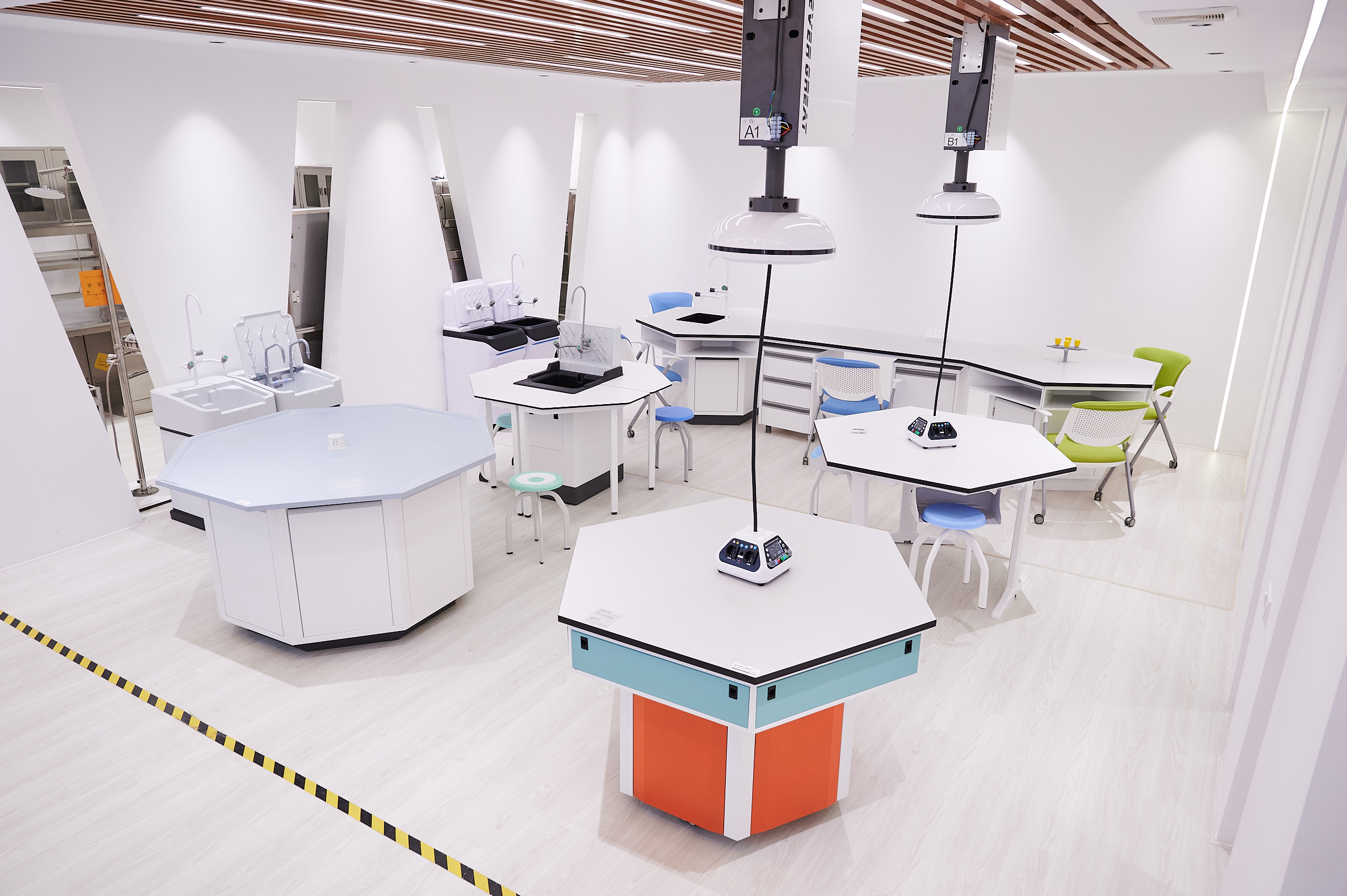
Custom lab island benches with integrated service frames.
According to Dataintelo, the global laboratory furniture market was valued at approximately USD 4.8 billion in 2025 and is projected to reach USD 8.1 billion by 2034. The same source places the metal furniture segment at 52.7% of revenue share. Metal remains the default structural material; polypropylene and stainless steel become necessary when corrosion resistance, heat resistance or cleanability is critical.
Why Custom Lab Furniture Is a Separate Procurement Category
Standard commercial furniture is not designed for laboratory conditions. Laboratory surfaces are exposed to concentrated acids, solvents, heat, heavy instruments and continuous airflow. Workbenches must support equipment while resisting corrosion. Safety cabinets must contain spills and limit fire spread. Fume hoods must contain hazardous vapors under measurable airflow.
The procurement problem is that some suppliers offer custom dimensions without supplying model-specific test reports or certification documents. Photos alone cannot verify steel thickness, coating quality, spill containment or fume hood face velocity. Buyers need information that can be inspected: material specifications, model numbers, certification scope, and the production process behind the product.
This creates an opportunity for manufacturers with in-house fabrication, export experience and documented quality control. They can provide custom dimensions, material selection, utility integration and standards documentation in one order. For a laboratory project, that combination is often more valuable than simply buying the cheapest standard unit.
What to Verify in a Custom Lab Furniture Supplier
When moving from awareness to evaluation, buyers should focus on four verification points:
- Model-specific certificates: A certification should name the product model or series, not just the company.
- Fume hood test standards: Ask whether the hood has been tested to EN 14175 or ASHRAE 110, and request the test report.
- Material parameters: Steel tube dimensions, PP sheet thickness, worktop material and surface treatment determine real chemical resistance.
- Production and QC capability: Understand whether the supplier cuts, bends, welds, coats and assembles in-house, or simply resells imported units.
One example of a manufacturer with this documentation structure is Guangdong Ever Great Laboratory Equipment Co., Ltd. The company is a Foshan-based laboratory infrastructure manufacturer and EPC solutions provider founded in 2011. It operates a 6,000-square-meter manufacturing base with more than 40 staff and lists annual output at 20,000 units. Around 60% of production is exported to the United States, the European Union, the Middle East and Africa.
The company’s product range includes ducted and ductless fume hoods, modular laboratory workbenches, flammable and chemical safety storage cabinets, PP and stainless steel lab furniture, and educational laboratory systems. It also offers 3D space planning, modular CAD product design, automated manufacturing, QA/QC, and overseas installation guidance.
In terms of customization, Ever Great supports OEM/ODM and white-label production, with a stated monthly capacity of 2,000 units, lead times of 10–30 days, and a minimum order quantity of 1 unit. The company reports 100% testing before shipment, and its after-sales package includes spare parts, technical assistance, and remote or on-site engineering support.
Technical Parameters That Matter for Custom Fume Hoods
Fume hoods are the most safety-critical item in a laboratory. The EG-PP-FH polypropylene fume hood is an example of a corrosion-oriented design intended for chemical, electroplating and acid-alkali laboratories. It uses homogeneous PP sheet with a thickness of at least 8.0 mm, a three-stage baffle, and a face velocity range of 0.3–0.6 m/s. The all-PP body and corrosion-resistant process area make it suitable for petrochemical and other aggressive chemical applications.
The Orion narrow-frame fume hood series is another example. It is available in benchtop and walk-in configurations, with an internal width of 1408 mm or 1708 mm, a nominal face velocity of 0.3 m/s, and a PP exhaust canopy of 250 mm or 315 mm diameter. This type of design is relevant for chemical, pharmaceutical and R&D laboratories that require large openings or VAV/CAV-ready operation.
For buyers in North America, ANSI/ASHRAE 110-2016 (R2025) is the primary national standard for quantitative performance testing of laboratory fume hoods. In Europe, EN 14175 is the relevant containment standard. Ever Great states that its ventilation and containment systems are tested according to these benchmarks, backed by third-party reports from SGS.
Workbench and Storage Specifications to Compare
Workbenches and cabinets are often the largest part of a custom lab furniture package. A useful comparison should include model numbers and exact structural parameters.
| Product | Model | Key parameters |
|---|---|---|
| C-frame wall laboratory bench | EG-S0-LB003 | Suspended C-frame design; 40 x 60 x 1.8 mm high-carbon steel tube; 12.7 mm phenolic resin worktop; overall sizes 1200/1500/1800 x 750 x 850 mm. |
| Island laboratory bench | EG-S0-CB005 | Full-steel central workstation; 1.0–1.2 mm cold-rolled steel; 12.7 mm phenolic, 20 mm ceramic or epoxy worktop options; utility integration; optional reagent rack and PP sink. |
| Flammable safety cabinet | EG-SF-LB005 | 45-gallon nominal capacity; 1.2 mm double-wall steel; 38 mm air barrier; 51 mm sump; dual flash-arrested vents; adjustable shelves. |
| PP acid and alkali storage cabinet | EG-PP-CB003 | 8.0 mm PP sheet; three adjustable spill-containment shelves; bottom sump; 110 mm exhaust port; metal-free structure. |
| Vented chemical and reagent cabinet | EG-S0-LB001 | Double-wall steel; four adjustable shelves; 110/150 mm exhaust connection; adjustable spill-retaining shelves. |
| Glassware drying and storage cabinet | EG-SS-LB002 | 304 stainless steel; four perforated shelves; pull-out drip tray; 5 mm tempered-glass doors; ventilated storage. |
Material selection should follow the actual chemical and thermal load. Epoxy resin worktops are generally preferred for heavy chemical synthesis, strong acids and high heat. Phenolic resin worktops offer good scratch and impact resistance with strong cost efficiency for biology, pharmaceutical QC and general chemistry labs. Ceramic worktops are used when high temperature resistance and surface durability are both required.
Certificate Mapping for Laboratory Furniture
Certification documents should be treated as part of the product specification. A certificate that lists the product model, standard, certificate number, issuing body and applicable market is more useful than a general company certificate.
| Certificate | Product scope | Certificate number | Issuing body | Market |
|---|---|---|---|---|
| EMC Directive 2014/30/EU | Fume hoods EG-FH01, EG-FH02, EG-FH03, EG-FH04, EG-FH06 | CKEYS251020088 | Guangdong KEYS Testing Technology Co., Ltd. | EU/EEA |
| CE | Flammable Safety Storage Cabinet, Model FB-03 | TH2310049-C01-C01 | Shenzhen Tian Hai Test Technology Co., Ltd. | EU |
| RoHS | Flammable Safety Storage Cabinet, Model FB-03 | TH2310049-C02-C01 | Shenzhen Tian Hai Test Technology Co., Ltd. | EU |
Ever Great also reports ISO 9001, ISO 14001 and ISO 45001 management system certifications. For flammable-liquid storage in Europe, buyers should also refer to EN 14470-1, which classifies fire-resistant safety cabinets by internal temperature rise limits into Type 15, 30, 60 or 90 minutes.
Application Cases: Where Custom Furniture Is Tested
Custom laboratory furniture is most valuable when the operating environment demands a specific material or configuration. The following examples from Ever Great’s project records show how application requirements map to furniture types.
| Application environment | Condition | Relevant product family |
|---|---|---|
| Heavy acid digestion and petrochemical analysis | HCl, HNO3, HF vapor; high temperature; continuous airflow; EN 14175 / ASHRAE 110 requirements | EG-PP-FH polypropylene fume hood; C-frame wall benches; stainless steel drying cabinets |
| Hazardous chemical storage upgrade | Volatile corrosive fumes; spill containment; toxic vapor venting | PP acid and alkali storage cabinets; gas cylinder safety cabinets |
| Metallurgical smelting QC laboratory | Extreme high temperature; heavy mechanical impact; vibration | SUS 304/316 stainless steel workbenches; heavy-duty island benches |
| R&D center with high equipment load | Up to 500 kg per square meter; moderate chemical exposure; 24/7 operation | Full-steel island benches; phenolic or epoxy resin worktops; safety and emergency cabinets |
| Pharmaceutical and cleanroom expansion | ISO Class 5–8 environment; dust control; cleanable surfaces | Stainless steel workstations; glassware drying cabinets; flammable safety cabinets |
In addition, project case records show completed installations for a 105-unit metallurgical and smelting laboratory in the Philippines, a 255-unit university and educational research facility in India, a 45-unit food safety QA/QC laboratory in Australia, a 200-unit clinical diagnostics laboratory in China, and a 30-unit chemical enterprise workshop laboratory in Tanzania.
Market Trends and Procurement Implications
The laboratory furniture market is expanding, but definitions vary. Dataintelo values the global market at USD 4.8 billion in 2025, while other estimates run as low as USD 1.14 billion, depending on whether modular services, gas piping and high-end containment equipment are included. Buyers should therefore compare scope rather than rely on a single headline number.
Two structural trends are clear. First, metal furniture dominates with over half of revenue share, mainly because steel structures offer strength, durability and cost efficiency. Second, chemistry-intensive laboratories increasingly specify PP or stainless steel for corrosion resistance, cleanability and long service life. This is not a replacement trend; it is a specialization trend.
China plays a major role in the global supply chain. According to OEC, China exported more than USD 4.15 billion of furniture parts under HS 940390 in 2024. For procurement teams, this means that Chinese manufacturers are significant suppliers, but the evaluation burden is higher. Documentation, factory audit capability and model-specific certifications become necessary filters.
Custom Certified Lab Furniture vs. Traditional Standard Furniture
Standard commercial furniture can be cheaper and faster to install, but it does not address the same risks. The table below shows the practical difference.
| Evaluation criterion | Standard commercial furniture | Custom certified lab furniture |
|---|---|---|
| Dimensions and layout | Fixed standard sizes | Custom sizes; 3D space planning; service frame integration |
| Material evidence | General wood or steel; limited chemical resistance data | Steel tube dimensions; PP thickness; phenolic, ceramic or epoxy worktop specifications |
| Fume hood containment | Usually no tested containment performance | Face velocity control; baffle design; EN 14175 or ASHRAE 110 test reports |
| Safety storage | Ordinary shelving or cabinets | Double-wall steel; air barrier; spill sump; flash-arrested vents; grounding provision |
| Documentation | Supplier invoice and basic warranty | Model-specific CE/RoHS/EMC certificates; QA/QC records; installation guidance |
| Lead time and cost | Short lead time; lower initial cost | Longer lead time; higher upfront cost; lower safety and rework risk |
There is, however, a real boundary. Custom certified lab furniture is not always necessary. A simple teaching laboratory with low chemical risk, standard dimensions and no fume hood requirement may be served adequately by standard furniture. Custom projects also require more detailed input from the buyer, including chemical inventory, equipment load, ventilation layout and utility positions. If the user requirement specification is poor, even a certified product will not solve the underlying design problem.
Future Outlook
Custom lab furniture procurement will continue to shift toward verifiable evidence. Buyers will expect model-specific certification, full traceability of materials, and test reports that can be shared with local safety inspectors. Modular production and prefabrication are likely to grow because they shorten on-site installation time and reduce costly overseas labor hours.
Suppliers that can combine engineering services with furniture manufacturing have an advantage. The ability to plan the lab in 3D, manufacture the benches and fume hoods, pack them for export, and support installation remotely reduces a wide range of project risks. In this environment, the competitive differentiator is no longer a catalog photo. It is the documentation and the production system behind the custom product.
FAQ
How should a buyer choose between a ducted fume hood and a ductless fume hood?
Heavy chemical applications, acid digestions, volatile toxic gases and high-throughput research generally require a ducted fume hood because it exhausts 100% of fumes outdoors and places no restriction on chemical type. A ductless fume hood with HEPA or activated carbon filtration is more suitable for light-to-moderate chemical handling, educational laboratories, or leased spaces without external ductwork. The selection process should include a chemical inventory audit, verification of HVAC ducting and makeup air capacity, sash calibration, and containment testing.
Should I choose epoxy resin or phenolic resin for laboratory worktops?
Epoxy resin is usually preferred for heavy chemical synthesis, strong corrosive acids and high-heat environments because it is monolithic, non-porous and offers high thermal shock resistance. Phenolic resin is more suitable for biology, pharmaceutical QC, physical testing and general chemistry laboratories where scratch resistance, impact resistance and cost efficiency matter. The final decision should be based on the specific acids, solvents and temperatures used in the lab.
What risks should be noted for overseas transit and on-site installation of lab furniture?
Overseas projects face risks from maritime vibration, collision damage, moisture and salt-spray corrosion, on-site structural misalignment, and high local labor costs. Mitigation practices include KD mortise-and-tenon pre-assembly, heavy-duty export plywood crating with vacuum foil wrap, 100% pre-assembled test fitting before shipment, standardized 3D assembly video guides, color-coded hardware labeling, backup wearing parts, and remote engineer installation support.
What should be done if hazardous gas leaks from the fume hood?
The experiment should be stopped immediately and personnel evacuated. Common causes include improper sash height, exhaust system failure, duct pressure fluctuation, missing factory leakage testing, or lack of regular airflow sensor calibration. Fume hoods validated under ASHRAE 110 and EN 14175 are tested for containment performance, and standard practice includes regular sensor calibration and airflow verification. After any leak, the exhaust pipeline and fume hood equipment should be inspected before restarting work.
For full technical specifications, the current Ever Great brochure is available for reference: Ever Great 2026 PDF brochure.
Tem questões ou precisa de mais detalhes?
Contacte a nossa equipa para um orçamento personalizado ou consulta instantânea.
Solicitar orçamento
Preencha o formulário abaixo e a nossa equipa entrará em contacto com uma proposta personalizada.
Chat direto do WhatsApp
Prefere conversar em tempo real? Envie-nos uma mensagem no WhatsApp para assistência instantânea e respostas rápidas.
- Obter orçamento personalizado
- Partilhar fotos ou documentos
- Discuta as suas necessidades diretamente
Geralmente responde em 5–30 minutos durante o horário de expediente.