
Custom MCCB Fit: OEM Capability in BP3 and BP5 Pan Assemblies
Custom MCCB Fit: OEM Capability in BP3 and BP5 Pan Assemblies
A pan assembly busbar is only useful if it fits the breaker it feeds. For panel builders buying a modular MCCB pan assembly, the deciding question is not how many ampere ratings a catalogue lists, but whether the supplier can build the busbar around one specific moulded case circuit breaker — the device already drawn on the panel schedule. In the BARFUSE Electric range, the BP3 (MCCB 3P Pan Assembly) and BP5 (MCCB 2P Pan Assembly busbar) are the two parts positioned for that task, and the manufacturer states that it accepts OEM and size customization according to the customer's MCCB.
That statement is where most supplier evaluations stop, and where they should start. Custom fit is a chain of dependant decisions: pole distance, terminal geometry, current rating on the incoming and outgoing side, conductor and housing material, and the paperwork that proves the delivered item matches the approved drawing. This analysis examines what supplier capability actually looks like at each link, using the documented characteristics of the BP3 and BP5 as the working evidence.
Why MCCB fit is a dimensional question before it is an electrical one
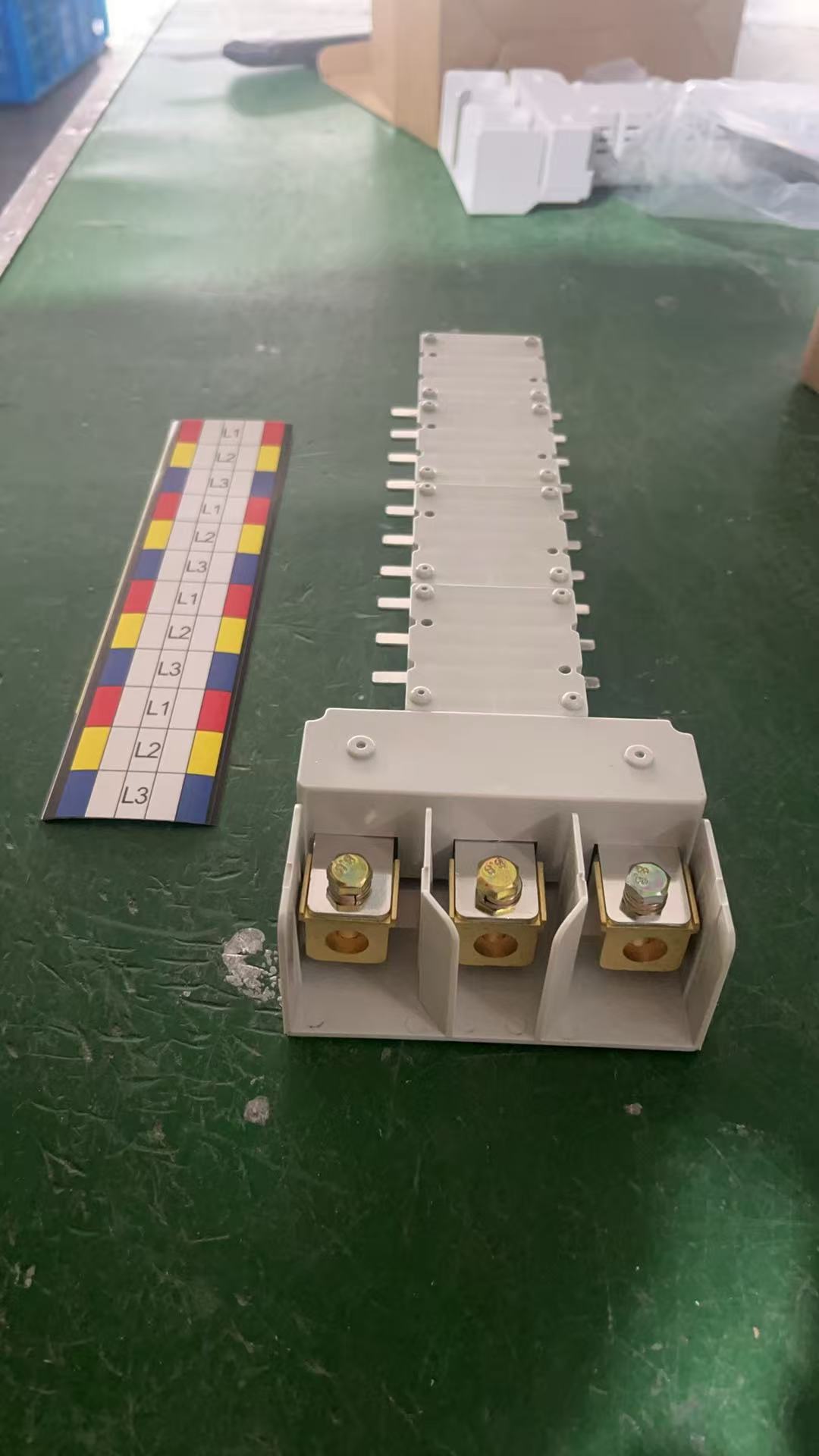
Two three-pole breakers with the same frame size can sit at different pole pitches. Pole distance — the centre-to-centre spacing between adjacent poles — determines whether the busbar stubs land squarely on the device terminals or miss them by a few millimetres. When the pitch is wrong, the electrical rating of the busbar is irrelevant: the assembly cannot be bolted down without adapters, re-drilling or a field-fabricated joint, and each of those introduces a step the panel builder did not plan for.
Dimensional fit drives three further consequences in a panel build:
- Torque access. Terminal screws must be reachable with a torque wrench at the specified value. A bar that covers the screw head converts a routine connection into a partial disassembly.
- Phase and pole clearance. The gap between poles has to remain after the breaker is mounted, not only on the bare busbar.
- Cable and bar entry. Incoming and outgoing connections need space consistent with the conductor size the panel design assumes.
The opportunity for a supplier with genuine customization depth is therefore narrow and specific: accept the customer's device as the starting point rather than asking the customer to choose from a fixed list and adapt the panel around it.
What the BP3 documents for a three-pole MCCB
The BP3 MCCB 3P Pan Assembly is the three-pole element of the BARFUSE pan assembly range, and its published characteristics map directly onto the fit problem above.
Most useful for specifiers is the pole distance set: 25 mm, 30 mm, 35 mm and 45 mm are available. Four options rather than one indicate a supplier that expects three-pole MCCBs of different frame families to arrive on the same order book. Selection is not a preference; it is the value that places the busbar poles on the terminals of the named device.
The BP3 is also specified with an incoming rating range and a separate outgoing rating range. The two-sided specification matters in panel design because the incomer and the outgoing ways rarely carry the same current, and a single headline figure hides that distinction. The applicable values for a given assembly should be taken from the confirmed order documentation for the configuration ordered, not from a summary line.
Construction is stated as copper conductor with PC (polycarbonate) components, and the documented application is industrial and commercial buildings. Both facts have procurement weight. Copper sets the conductivity and the jointing behaviour of the bar; PC sets the dielectric and flame behaviour of the insulating parts and the dimensional stability of the mouldings. Neither is a decorative specification.
Finally, the BP3 is the model the manufacturer explicitly ties to OEM and size customization according to the customer's MCCB. That is the capability claim this article tests.
What the BP5 documents for a two-pole MCCB
The BP5 MCCB 2P Pan Assembly busbar serves the two-pole case — single-phase feeds and arrangements where the device interrupts line and neutral together. Two-pole MCCBs appear regularly in commercial building distribution, where a neutral has to be switched rather than solidly linked, and the busbar must follow the device rather than the other way round.
Two points are documented and relevant to an evaluation. First, the BP5 is listed among the applicable products on the manufacturer's ISO 9001:2015 certificate, whose scope covers the manufacture and export of busbar systems described as MCCB/MPCB busbars. Second, it sits in the same OEM/ODM production structure as the rest of the range, which is a company-level capability rather than a model-level claim.
BP3 and BP5 at a glance
| Attribute | BP3 — MCCB 3P Pan Assembly | BP5 — MCCB 2P Pan Assembly busbar |
|---|---|---|
| Device served | Three-pole moulded case circuit breaker | Two-pole moulded case circuit breaker |
| Pole distances documented | 25 mm, 30 mm, 35 mm, 45 mm | Confirm against the customer's MCCB drawing for the ordered configuration |
| Rating specification | Separate incoming and outgoing rating ranges; values confirmed per ordered configuration | Rating confirmed per ordered configuration |
| OEM and size customization | Stated as accepted, according to the customer's MCCB | Company-level OEM/ODM capability; fit dimensions confirmed per device |
| Construction | Copper conductor, PC components | Material specification confirmed in writing for the ordered build |
| Documented application | Industrial and commercial buildings | Two-pole MCCB distribution in industrial and commercial installations |
| Quality-system coverage | ISO 9001:2015 scope includes MCCB/MPCB busbar systems; BP3 listed as applicable product | Same certificate scope; BP5 listed as applicable product |
| Named in the DEKRA type test certificate | No — the certificate names BP1-125 and BP1-250 | No — the certificate names BP1-125 and BP1-250 |
What "customization according to the customer's MCCB" involves
BARFUSE records its production mode as OEM and ODM, with a customization list covering colour, logo, material, new design, surface treatment, mould development and packing. Read that list as two different kinds of work, because they carry different lead times and different risks.
Fit-relevant customization is the size and geometry work: pole distance, bar length, terminal arrangement, mounting interface. This is the category that decides whether the assembly serves the customer's breaker, and it depends on engineering input — the company records a seven-engineer R&D team and more than thirty digital wire-cutting machines and punches, which is the kind of equipment profile that size customization requires rather than an indicator of it.
Commercial customization is colour, logo, packing and labelling. It affects how the assembly is identified and shipped, not whether it fits. Buyers frequently bundle the two in a single request and then wonder why a lead time quoted for a logo change does not hold when the pole distance also moves.
Mould development and material change sit in a third, slower band: they alter tooling or the bill of materials and should be treated as engineering projects with their own timeline, not as options on a checklist. A buyer who needs a different conductor material should ask for that as a separate, quoted change and should expect the supplier to confirm it in writing.
Reading the evidence: what the certificates cover and what they do not
Supplier capability claims are only as strong as the document behind them, and the document has a scope. BARFUSE holds a DEKRA type test certificate — numbers 3309992.100 and 3309992.101, issued 5 September 2016 and valid to 5 September 2099 by DEKRA Certification B.V. — tested to IEC 61439-2:2011 and EN 61439-2:2011 for low-voltage switchgear and controlgear assemblies. Its stated scope is specific: busbar models BP1-125 and BP1-250, brand BARFUSES, series BFSe, open-type assembly without enclosure.
What that certificate demonstrates is that an independent certification body has type-tested a busbar assembly from this manufacturer against the assembly standard, and that the certificate remains in force. What it does not do is extend to the BP3 or BP5. A buyer who needs a type-test reference for a three-pole or two-pole MCCB pan assembly should ask which document applies to the exact model ordered rather than accepting a certificate that names a different model.
The second document is a management-system certificate: ISO 9001:2015, certificate 62724Q1160R0S, issued 8 November 2024 by Jingxin Certification (Beijing) Co., Ltd. and valid to 7 November 2027. Its scope covers manufacturing and export of strip fuse disconnectors, load disconnectors, busbar systems (MCCB/MPCB busbars) and distribution boxes, and the BP3 and BP5 both appear among its applicable products. This is a quality-management attestation covering the process that produces the parts; it is not a product type test and should not be presented as one.
A third distinction worth keeping straight: IEC 61439-6:2025, listed by IEC with an effective date of 1 December 2025, governs busbar trunking systems. A modular pan assembly inside a distribution board is a different product category, and citing the trunking standard against a pan assembly datasheet is a scope error that a competent specifier will catch.

Pre-shipment test and acceptance in a customized build
A customized assembly cannot be judged against a catalogue page; it can only be judged against the drawing that was approved. BARFUSE states 100% test as its quality-control position and pre-shipment test as the acceptance criterion. The inspection equipment profile recorded by the company — Rockwell hardness tester, electric withstand voltage tester, spring tester, salt-spray tester, flame-retardant tester and switch tester among tens of sets — indicates the categories of check available.
What the buyer should add is specificity. A pre-shipment test on a customized MCCB pan assembly is most useful when the purchase order names what the record must show: dimensional verification against the approved drawing, pole distance measurement, and the electrical checks agreed for the configuration. Without that, "pre-shipment test" describes an intention rather than a deliverable, and a dimensional deviation discovered at the panel is discovered too late.
Execution terms that affect a customized order
The commercial framework published by the company is unusually open for a component of this type, and it changes how a customization project should be planned.
- MOQ: 1 piece. A single customized assembly can be ordered, which suits retrofit work where one existing MCCB must be matched.
- Lead time: 15–45 days. The width of the band reflects order content; an assembly with new tooling or a material change should be planned at the upper end.
- Monthly capacity: 8,000 pieces. Capacity is stated at company level; a customized build consumes engineering time before it consumes production capacity, so a large customized batch should be scheduled with that sequencing in mind.
- Delivery terms: FOB, CIF, CFR or EXW. Payment: T/T, PayPal, Western Union and L/C.
- After-sales: remote technical support. For a fit problem, the useful question is who reads the device drawing when a dimension is disputed.
Company background is also part of the capability picture: BARFUSE Electric Co., Ltd. was founded in 2014, operates a 10,000 m² factory with 45 employees, records annual output of 250,000 pieces, and exports about 90% of production to the Middle East, Russia, Latin America, Central Asia, the EU, Africa and Oceania. A high export share means customized drawings in multiple project conventions arrive as routine work rather than exceptions.
Application scenarios in industrial and commercial buildings
The documented application for the BP3 is industrial and commercial buildings, and the scenarios below show where OEM fit stops being a theoretical requirement.
Plant distribution boards with a three-pole incomer. A factory board uses a three-pole MCCB as incomer and a row of three-pole outgoing devices. If the incomer and the outgoing family differ in pole pitch, one bar layout cannot serve both, and a supplier able to build to two pitches from the same order keeps the panel on one assembly concept.
Commercial building boards with a two-pole device. Where the design switches neutral, the BP5's two-pole arrangement follows the device. The fit question is the same one: what is the pitch and terminal layout of the specified two-pole MCCB, and can it be confirmed before production.
Retrofit and extension work. Replacing a breaker inside an existing board means the busbar must follow the new device while the enclosure stays. This is the case where size customization is the only viable route and where a one-piece minimum order matters commercially.
OEM panel builders shipping under their own brand. Here the customization spans fit and identity — the pole distance matches the customer's MCCB, while logo and packing match the customer's brand. Both are listed capabilities, but they belong on separate lines of the order and the schedule.
Modular pan assembly versus field-fabricated bar
The alternative to a customized pan assembly is the traditional approach: bar cut, drilled and jointed on site, with cable lugs and point-to-point wiring. The comparison is not about which is superior in general; it is about which risk the project is better placed to carry.
Field fabrication keeps dimensional control in the panel builder's own workshop and needs no supplier drawing cycle, but repeatability across batches depends entirely on the skill applied on the day, and every drilled joint is a connection whose quality is verified locally or not at all. A pre-assembled modular busbar pan moves that work upstream, where a drawing is approved once and repeated — but it also transfers tolerance control to the supplier and adds a lead time of 15–45 days to the schedule.
The fit boundary is therefore explicit. Modular customization is the better match when the device is known before the build starts and the batch will repeat. It is a poor match when the breaker is still being selected, because a customized busbar built to the wrong device cannot be recovered by adjusting the panel.
Market context: copper share, aluminium growth and what it does not tell you
Global busbar market valuation was reported at USD 19.83 billion in 2025 by Precedence Research, with copper busbars holding 62.8% of market share by material in the same year. The same source forecasts aluminium busbars at a 6.9% CAGR over 2026–2035, attributing the growth to weight and cost optimisation in large infrastructure.
For a buyer evaluating an MCCB pan assembly, the useful reading is narrow. Copper remains the dominant conductor choice in the category, which is consistent with the BP3 being specified in copper. Aluminium growth is a forecast from a smaller base and does not mean an aluminium variant of a specific pan assembly exists or can be substituted without a supplier-engineered change. Market totals also say nothing about any single manufacturer's lead time or capacity.
A caution on the figures themselves: research houses size the 2025 busbar market differently — Stratview Research at USD 15.72 billion and IMARC at USD 20.3 billion — a gap usually explained by whether locally fabricated busbars are counted alongside factory-assembled systems. Any single total should be read with its inclusion rule attached.
Outlook
Two developments are worth tracking, both conditional. If aluminium adoption grows at the forecast rate, more pan assembly enquiries will arrive asking for a material change against a copper baseline; that is an engineering request requiring written confirmation of the resulting build, not a catalogue substitution. Separately, as IEC 61439-6:2025 takes effect for busbar trunking systems, documentation expectations across busbar products tend to tighten — which places more value on the buyer specifying, in the purchase order, which certificate covers which model, and what the pre-shipment record must contain.
A verification checklist before releasing a customized order
- Pole distance against the device drawing. For a three-pole build, confirm which of the 25 mm, 30 mm, 35 mm or 45 mm options matches the specified MCCB.
- Incoming and outgoing rating for the ordered configuration, taken from confirmed documentation rather than a summary.
- Material in writing. Copper conductor and PC components for the BP3; the equivalent written confirmation for the BP5 build.
- Certificate scope. Ask which document names the exact model ordered, and treat BP1-series type-test references as background rather than coverage.
- Pre-shipment test content. Define the dimensional and electrical checks the record must show.
- Packing and labelling if OEM identity is part of the order, scheduled separately from the fit work.
- Lead time against batch size, allowing for engineering time ahead of the 15–45 day band on a first customized build.
- Support route for dimensional questions after delivery.
Conclusion
OEM fit in an MCCB pan assembly is a chain of confirmations rather than a single feature. The BP3 supports the chain with four documented pole distances, separate incoming and outgoing rating ranges, copper and PC construction, and a stated acceptance of size customization according to the customer's MCCB; the BP5 extends the same production structure to the two-pole case. What separates a credible supplier from a willing one is whether each link can be evidenced — a drawing that names the device, a certificate whose scope is read correctly, and a pre-shipment record defined before the order is placed. Buyers who check those three things before releasing a customized order are testing capability, not promises.
Company information in this article is drawn from BARFUSE Electric Co., Ltd. (Yueqing Barfuse Electric Co., Ltd.), barfuse.com. The full product catalogue is available for download: Barfuse Catalogue (PDF). Market figures are attributed to Precedence Research, Stratview Research and IMARC as noted in the text.
FAQ
What does OEM fit mean for an MCCB pan assembly?
OEM fit means the pan assembly is built so that the busbar poles, terminal positions and mounting envelope match the specific moulded case circuit breaker named by the customer, rather than a generic breaker of the same pole count. BARFUSE states that the BP3 accepts OEM and size customization according to the customer's MCCB. The working input is the device drawing: pole distance, terminal geometry and current rating all come from it.
Which pole distances are available on the BP3?
The BP3 MCCB 3P Pan Assembly is offered with pole distances of 25 mm, 30 mm, 35 mm and 45 mm. The correct value is the one that places the busbar poles on the terminals of the specified MCCB, and it should be confirmed against the device drawing before the order is placed, because pole pitch is a property of the individual device rather than of the pole count alone.
How is a pan assembly matched to a customer's MCCB?
Through the device drawing followed by a size customization step. The supplier needs the breaker's pole distance, terminal layout and the incoming and outgoing current required; it then builds the bar geometry, terminal arrangement and enclosure interface to those dimensions and confirms them on a drawing before production begins. Approval of that drawing is the point at which the customized fit becomes verifiable.
Does the DEKRA certificate cover the BP3 and BP5?
No. The DEKRA type test certificate, numbers 3309992.100 and 3309992.101 and issued 5 September 2016, names models BP1-125 and BP1-250 to IEC 61439-2:2011 and EN 61439-2:2011 for an open-type assembly without enclosure. It does not name the BP3 or BP5. The separate ISO 9001:2015 certificate 62724Q1160R0S covers manufacturing and export of busbar systems including MCCB/MPCB busbars and lists both models among applicable products, but a management-system certificate is not a product type test.
What are the purchasing terms and acceptance criteria?
MOQ is 1 piece. Delivery terms are FOB, CIF, CFR or EXW. The acceptance criterion is pre-shipment test. Payment terms are T/T, PayPal, Western Union and L/C. On a customized MCCB fit, the pre-shipment check should reference the approved drawing, since that drawing is the document the shipment is measured against.
Tem questões ou precisa de mais detalhes?
Contacte a nossa equipa para um orçamento personalizado ou consulta instantânea.
Solicitar orçamento
Preencha o formulário abaixo e a nossa equipa entrará em contacto com uma proposta personalizada.
Chat direto do WhatsApp
Prefere conversar em tempo real? Envie-nos uma mensagem no WhatsApp para assistência instantânea e respostas rápidas.
- Obter orçamento personalizado
- Partilhar fotos ou documentos
- Discuta as suas necessidades diretamente
Geralmente responde em 5–30 minutos durante o horário de expediente.