
Custom Packaging Fit: Multi-Region Sports Nutrition Supply
Custom Packaging Fit: Multi-Region Sports Nutrition Supply
For a sports nutrition brand selling into more than one region, custom packaging is a supply-model decision before it is a design decision. The practical question is which bottle formats, materials and decoration routes can be produced, stored, replenished and localized without breaking launch and refill calendars in each market. RTCO, a packaging manufacturer founded in 2007 with a 68,000 m² production base and a US manufacturing and warehousing footprint, builds its offer around that problem: a global supply program spanning 60 ml to 6000 ml bottle capacities, stock and custom program structures, regional warehousing, flexible inventory, and an anti-counterfeiting liner option.
Why multi-region supply changes the packaging brief
A single-market packaging brief usually reduces to three things: a format, a filling line and an artwork approval. A multi-region brief adds a second layer. Can one bottle platform carry several market label designs? Is decoration applied at the point of manufacture or added locally? Does replenishment run from a regional warehouse or from a production batch shipped across borders? Those are operating questions, and they change the specification before a designer opens a file.
Three variables drive most of the difference. Format commonality decides how many SKUs a program must manage and how often a filling line has to change over. Decoration strategy decides whether a brand buys one decorated unit or an undecorated unit plus local labeling. Replenishment model decides whether the program depends on stock-supported supply or on batch production with a longer lead time. A packaging partner that can only answer the first question leaves the other two to the brand's supply team.
Packaging integrity also becomes a multi-market issue. Where product moves through distributors and sub-distributors across several countries, the closure and the liner stop being commodity details and start being part of brand protection. RTCO lists an anti-counterfeiting liner as an exclusive solution within its global supply program — a feature worth assessing on the same terms as format and decoration, because whether it fits depends on the closure, the filling line and the market in question.
Three supply-program scenarios and what each asks of packaging
Scenario fit is easier to judge when the program pattern is named. The three patterns below cover a large share of sports nutrition programs that operate across regions, and each drives a different packaging brief.
Scenario 1 — one formula, several regions
A brand sells the same protein powder or capsule SKU in the United States, Canada and Europe. The packaging priority is a stable bottle platform, consistent fill-line performance and label space that satisfies each market. The value of a single platform is one mould, one quality standard and fewer changeovers. The risk is that a decoration or label decision taken for one market becomes locked into every market. The buyer check is straightforward: confirm that artwork and label dimensions accommodate all required market information before the platform is committed.
Scenario 2 — regional variants from a shared bottle platform
The base bottle stays the same while decoration or closure changes by region — a soft-touch finish in one market, vacuum metallization in another, a localized label elsewhere. Here the priority is decoration compatibility with the base resin and the ability to run several decoration routes from a single platform. The buyer check is commercial as much as technical: how MOQ applies per SKU and per decoration, and whether tooling is shared across variants or duplicated for each one. A program that looks efficient on the drawing can become inefficient if each regional variant carries its own minimum order.
Scenario 3 — replenishment-led programs with stock support
Brands with fast refill cycles need packaging available before the next production window opens, and for them supply continuity and warehousing location outrank decoration novelty. RTCO's documented footprint includes a US factory in Piedmont, South Carolina, and warehousing in Savannah, Georgia and Chino, California, alongside manufacturing in Asia — a structure intended to shorten the last leg for North American programs. The buyer check is specific: confirm which formats are actually held or planned for regional stock, because stock coverage is program-specific and should be verified rather than assumed.
| Program pattern | Packaging decision it drives | What to verify before committing |
|---|---|---|
| One formula, several regions | Single bottle platform, single decoration, label space that carries multi-market information | Format approval per market; label dimensions; whether decoration is centralized or localized |
| Regional variants from a shared platform | One mould family, several decoration routes (soft-touch, metallization, label, embossed logo) | MOQ per SKU and per decoration; tooling shared or duplicated; finish compatibility with the chosen resin |
| Replenishment-led with stock support | Stock program plus regional warehousing and flexible inventory | Confirmed stock format list; warehouse allocation; replenishment cycle versus production lead time |
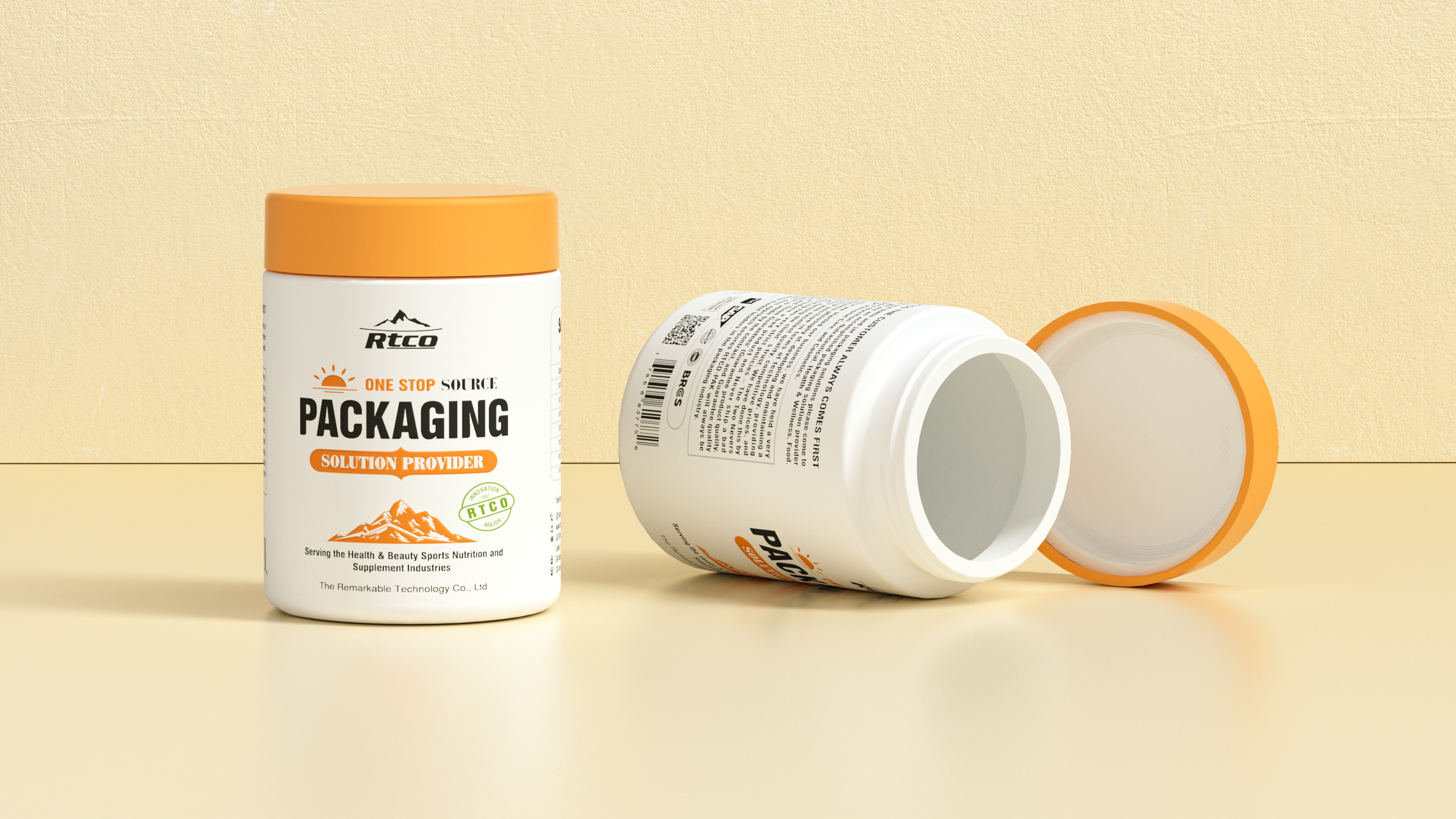
A 250 cc bottle format (RTCO drawing DWG01341) — one of the documented formats used to align a bottle platform across markets.
What RTCO's global supply program documents
RTCO's program facts are unusually specific for a category where much supplier communication stays at the level of adjectives. The manufacturer reports a 68,000 m² facility, 200 employees, a 40-engineer development team, annual output of 1,000,000,000 units and monthly capacity of 80,000,000 units. Export business accounts for 97% of total sales, with North America as the primary market.
The supply structure is described as a three-part model combining an operation center in Shanghai, a manufacturing center in Zhejiang and a US storage and transfer center, supported by the Piedmont, South Carolina factory and the Savannah and Chino warehouses. For a brand planning regional distribution, the relevant point is not the geography itself but what it enables: production planning in Asia and a North American buffer node in the same program.
On materials, the packaging is made of FDA-compliant food-grade HDPE, PET and PP, with optional PCR (post-consumer recycled) material available in the material set. The supplement packaging container is described as complying with FDA and EU food safety standards, with PCR recycled material offered as an eco-friendly option. Bottle capacities run from 60 ml to 6000 ml, and the format set includes 10 oz / 300 ml, 20 oz / 600 ml and 250 cc bottles.
Commercially, the minimum order quantity is typically 10,000 to 30,000 units per SKU, with support for first trial orders below the standard MOQ. Lead time is quoted at 30 to 45 days, with RTCO referencing a "Three-One" model of roughly one day of design, about one month of tooling and around one week of production, while stating that actual lead times depend on project complexity and capacity.
The operating model is in-house design and mould development integrated with scalable production and US fulfilment, delivered through an end-to-end workflow of consultation, feasibility, prototype, mould, pilot and mass production. Decoration and surface options include soft-touch coating, vacuum metallization, UV coating, silk screen, 3D printing, labeling and embossed logo work.
The technical layer: bottle, closure, scoop and finish compatibility
For bottle configuration, RTCO documents a fill capacity range of 60 ml to 6000 ml, body diameters from 40 mm to 200 mm and heights from 60 mm to 325 mm. Caps run from 20 mm to 200 mm in diameter and 10 mm to 40 mm in height, and measuring scoops cover 0.3 cc to 8 oz. Those ranges are wide enough that a single supplier can cover a protein powder jar, a smaller pre-workout bottle and a capsule container without changing vendors — which is the practical benefit for a multi-region program, since format families can be consolidated.
Closure and liner selection is where the technical and the commercial meet. RTCO describes its containers as food-grade plastic with sealing, moisture-proof and anti-oxidation performance, and the product set includes matched caps, liners and scoops intended to stay compatible with common filling equipment and production lines. Those are supplier descriptions rather than independently tested results, so a buyer should ask for the documentation relevant to the specific product, market and filling line rather than treating the description as a universal guarantee.
Decoration introduces a second compatibility layer. RTCO states that it integrates patented SGP and SAP technology, combining vacuum metallization with soft-touch coating on the outer layer, alongside UV coating, silk screen, 3D printing, labeling and embossed logo decoration. Where a brand wants PCR content and a premium finish in the same unit, that combination should be confirmed for the specific resin and finish instead of being assumed to work by default — a short question at quotation stage that avoids a long correction later.
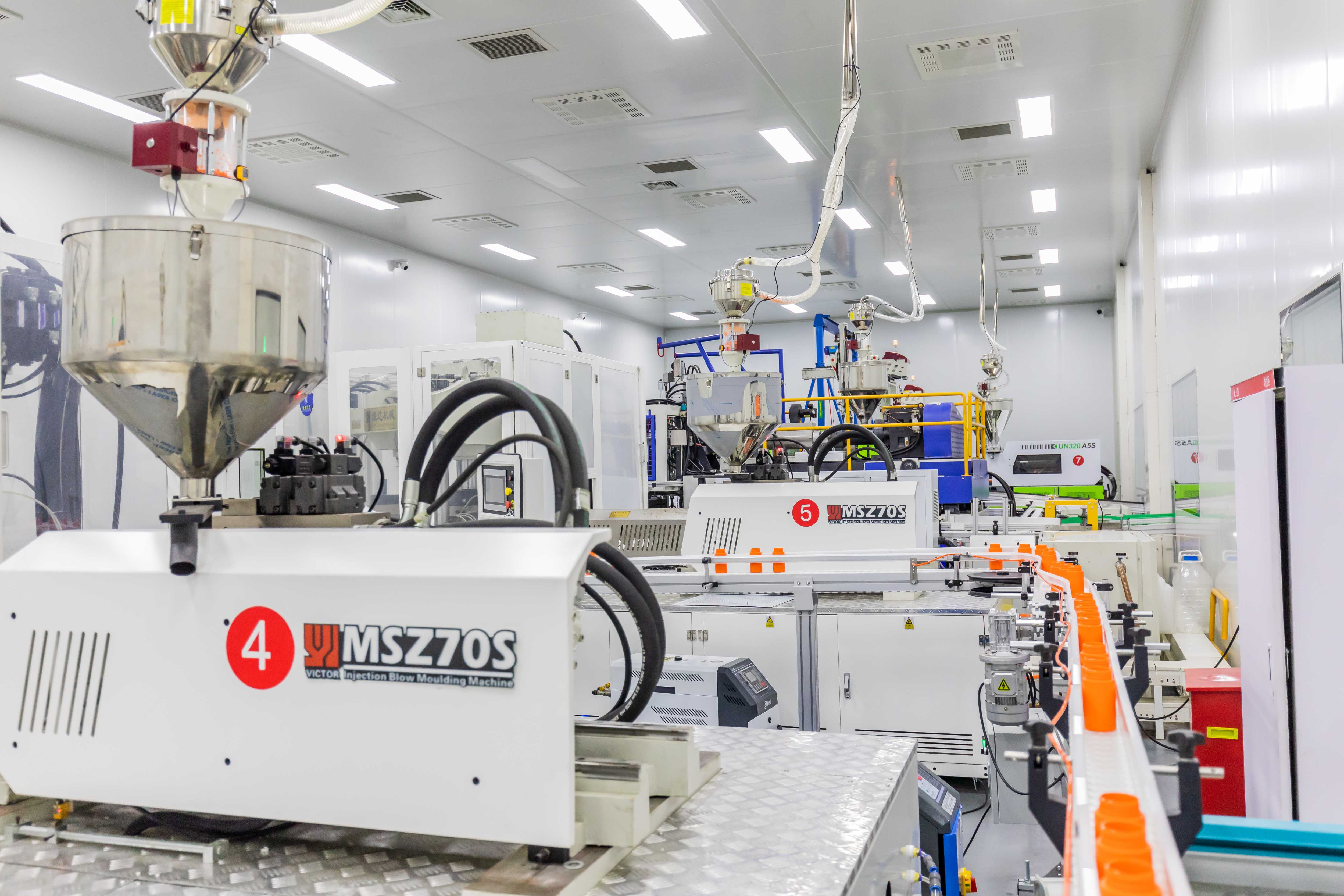
Production equipment inside the manufacturing environment — capacity planning, not decoration, usually decides whether a multi-region program holds its calendar.
Matching formats to sports nutrition products
Format selection in sports nutrition follows the dose and the dispense method more than the aesthetic. The 20 oz / 600 ml bottle is the natural home for protein powder, particularly where a wide mouth and a matched scoop are needed for a 20–30 g serving. The 10 oz / 300 ml format suits pre-workout, BCAA and smaller-serving powders where a full-size tub would overstate the count. The 250 cc bottle is the usual reference point for capsules, tablets and gummies, where the packaging decision is driven by count per container and closure type rather than by powder flow.
Beyond those three, RTCO's model set includes wide-mouth protein powder jars, pre-workout and BCAA bottles, dual-chamber bottles, capsule and tablet bottles, flip-cap scoop bottles, packer and gallon bottles, and sample tubes, with accessories such as scoops and liners. For a multi-region program the useful discipline is to limit the platform count deliberately: every additional bottle family adds a mould, a filling configuration, a label SKU and a stock line, and the cost of that complexity is paid in every region at once.
Where the product mix includes gummies, gels and liquids, the same packaging container set is positioned for powder, capsule, tablet, gummy/gel and liquid packaging and dosing scenarios. That does not mean one bottle serves all of them; it means a program can consolidate its supplier and quality standard while still selecting a different structural format per product type.
Stock versus custom: a fit comparison, not a ranking
Stock and custom are not quality tiers. They are different supply structures, and the right answer depends on how a brand's demand behaves across regions. The comparison below uses documented program characteristics only; it does not establish cost differences, defect rates or delivery performance for any specific order.
| Dimension | Stock-supported program | Fully custom program |
|---|---|---|
| Format flexibility | Limited to the formats held for regional stock | Open across the documented 60 ml–6000 ml range, subject to tooling |
| Differentiation | Low to moderate; differentiation comes from labeling | Higher; shape, colour, closure, scoop and surface finish can be specified |
| Commercial threshold | Depends on availability of the specific stock format | Typically 10,000–30,000 units per SKU, with trial orders below standard MOQ supported |
| Timing | Oriented to replenishment rather than development | 30–45 days quoted lead time, plus design, tooling and pilot stages |
| Inventory exposure | Regional warehousing and flexible inventory programs carry part of the buffer | Brand carries the batch decision, informed by production planning |
| Best fit | Fast refill cycles and stable, proven formats | New launches, multi-market variants and premium finishes |
The traditional alternative — a single-source offshore program with no regional node — is not wrong so much as narrow. It concentrates production in one place and leaves the replenishment gap to the brand's own buffer stock. A program that combines Asian manufacturing with US warehousing and fulfilment changes the shape of that gap, but it does not by itself prove a shorter total cycle; the buyer still has to verify transit, allocation and stock format coverage for their own volumes. The fit boundary is equally clear: a custom program built around a 10,000–30,000 unit SKU minimum is not designed for very small exploratory runs unless trial-order support is confirmed, and a stock program will not deliver a premium soft-touch or metallized finish that was never specified.
Market context for the category
Two published figures frame the wider category. Fortune Business Insights values the global supplements and nutrition packaging market at USD 29.41 billion in 2025, with a forecast period running to 2034 (source dated 5 October 2026). The same publisher reports plastic as the largest material segment, at 41.67% of share in 2025. Both are third-party commercial research estimates, not a count of any single supplier's volume, and neither tells a brand which format or partner to choose — they simply confirm that plastic containers remain the mainstream substrate against which a multi-region program will be planned.
RTCO's own case material references a 20,000,000-unit packaging program serving brands, contract manufacturers and private-label customers across the United States, Canada, Mexico, the United Kingdom, France, Germany, Australia and Singapore, with the stated result of shorter development cycles, improved shelf differentiation and a simplified supply chain through localized production and fulfilment. Those are supplier-reported outcomes for specific programs; they describe what the model is designed to do rather than a guaranteed result for a new buyer.
A verification checklist for buyers evaluating a multi-region partner
The questions below follow the order in which a multi-region packaging decision usually becomes irreversible.
- Format and capacity coverage. Confirm that the chosen formats sit inside the documented range (60 ml–6000 ml, body diameter 40–200 mm, height 60–325 mm) and that cap, liner and scoop options match the filling line.
- Material and market documentation. Ask for the food-contact documentation relevant to each destination market for FDA-compliant HDPE, PET and PP, and confirm whether PCR content is required or optional for that market.
- Decoration route per region. Establish whether soft-touch, vacuum metallization, embossing or 3D-printed decoration is applied centrally or locally, and how MOQ accumulates per SKU and per finish.
- Replenishment model. Confirm which formats are held or planned for regional stock, which warehouse serves which market, and how the stock decision interacts with the 30–45 day production lead time.
- Integrity features. If the product moves through distributors in several countries, review the anti-counterfeiting liner option against the actual closure and filling setup before it is written into the specification.
- Development sequence. Map the consultation, feasibility, prototype, mould, pilot and mass-production stages onto the launch calendar, and treat the referenced one-day design, one-month tooling and one-week production model as a planning reference rather than a commitment.
Where a multi-region custom program is not the right fit
Not every sports nutrition brand needs this structure, and saying so is part of an honest assessment. A program stays simple — and cheaper to run — when volumes per SKU sit below the typical 10,000–30,000 unit threshold and no trial-order support is available; when the product is a single formula sold in a single market, where a stock format and a label may be enough; or when the differentiation the brand actually sells on is the formula rather than the pack. Conversely, a program becomes a poor fit for a fully custom structure when each region demands a different closure standard, different label content and a different finish, because variant complexity then multiplies across moulds and minimum order quantities rather than amortizing across them.
The middle ground is usually where multi-region programs land: a shared bottle platform with a small number of decoration variants, backed by a regional stock line for the fastest-moving format. That configuration keeps the 60 ml–6000 ml range available for future launches without committing every market to a separate tool.
Outlook for the next planning cycle
Two conditions are likely to shape packaging decisions for multi-region sports nutrition programs, and both are conditional rather than forecast. First, if refill cycles keep shortening in North America, the value of a regional warehousing node rises relative to unit price, because the cost of a missed replenishment window is paid in sales rather than in packaging. Second, if PCR content moves from option to expectation in a brand's home market, suppliers will need to demonstrate that recycled material and premium finishes can coexist in the same unit — a combination RTCO offers as an option but which should be validated per project rather than assumed. Neither condition is a prediction about any specific brand's volumes; both are worth testing against an actual SKU plan.
Frequently asked questions
How does a sports nutrition brand decide whether custom packaging fits a multi-region supply program?
The decision usually turns on four checks: annual volume per SKU against the supplier's minimum order quantity, whether one bottle platform can serve several markets, whether decoration is applied centrally or locally, and whether replenishment depends on a regional stock line. RTCO quotes a typical MOQ of 10,000 to 30,000 units per SKU with support for first trial orders below the standard MOQ, which is the threshold a brand should test its forecast against before committing to a fully custom structure.
Which bottle formats and capacities are relevant for sports nutrition products?
RTCO documents a fill capacity range of 60 ml to 6000 ml, with body diameters of 40 mm to 200 mm and heights of 60 mm to 325 mm. Documented formats include 10 oz / 300 ml, 20 oz / 600 ml and 250 cc bottles, alongside wide-mouth protein powder jars, pre-workout and BCAA bottles, dual-chamber bottles, capsule and tablet bottles, flip-cap scoop bottles and sample tubes. Caps range from 20 mm to 200 mm in diameter, and scoops from 0.3 cc to 8 oz, so the closure and dosing accessory should be selected together with the bottle rather than afterwards.
What is the practical difference between stock and custom programs in a multi-region setup?
A stock-supported program is oriented toward replenishment of established formats from regional inventory, while a custom program is oriented toward specified shape, colour, closure and surface finish produced against a tooling and MOQ commitment. RTCO's global supply program covers both structures, together with regional warehousing and flexible inventory. Because stock coverage is program-specific, buyers should confirm the actual formats held, the warehouse allocation and the replenishment cycle directly rather than inferring availability from a product catalogue.
What material and compliance questions should be asked before packaging crosses regions?
Start with the resin: RTCO's packaging is made of FDA-compliant food-grade HDPE, PET and PP, with optional PCR material available in the material set, and the supplement packaging container is described as complying with FDA and EU food safety standards. Ask for the documentation relevant to each destination market, confirm whether PCR content is required or optional there, and check that any premium finish specified is compatible with the chosen resin. Supplier statements describe the material system; market-specific documentation is what a compliance review will actually rely on.
Where does anti-counterfeiting liner support fit into a multi-region program?
RTCO lists an anti-counterfeiting liner as an exclusive solution within its global supply program, which places it in the packaging integrity layer rather than the decoration layer. It becomes relevant when product passes through distributors and sub-distributors across several markets and the closure or liner is part of brand protection. The specific construction, closure compatibility and filling-line behaviour should be confirmed for the exact bottle and cap in use, since a liner that fits one closure system is not automatically suitable for another.
RTCO product catalogue for sports nutrition packaging, including bottle formats, closures and surface options, is available as a downloadable PDF.
Tem questões ou precisa de mais detalhes?
Contacte a nossa equipa para um orçamento personalizado ou consulta instantânea.
Solicitar orçamento
Preencha o formulário abaixo e a nossa equipa entrará em contacto com uma proposta personalizada.
Chat direto do WhatsApp
Prefere conversar em tempo real? Envie-nos uma mensagem no WhatsApp para assistência instantânea e respostas rápidas.
- Obter orçamento personalizado
- Partilhar fotos ou documentos
- Discuta as suas necessidades diretamente
Geralmente responde em 5–30 minutos durante o horário de expediente.