
Custom Perfume Packaging Box: Constraints Buyers Must Verify
HTNXT · Packaging & Printing · Industry Reference

A custom perfume packaging box is a specification decision before it is a design decision. The box has to hold a specific bottle without movement, survive land and sea transport, present the fragrance at counter or on camera, and — in a growing number of markets — carry documentation showing the pack is recyclable, correctly labelled and dimensionally justified. Brands that evaluate only artwork and surface finish usually meet the remaining constraints at the sampling stage, at the freight forwarder, or at customs, where changes are expensive.
Secondary packaging for fragrance is a measurable market in its own right. Research published in 2026 puts the global perfume carton box market at USD 2.31 billion for the year, with a projected compound annual growth rate of 6.66% across 2026–2034 (Verified Market Reports, 2026). Inside the wider luxury rigid box segment, cosmetics and personal care — the category that includes fragrance — accounted for a reported 37.0% of demand in 2026, while magnetic closures were forecast to represent 29% of that market (Future Market Insights, 2026). Those two figures describe the same purchasing behaviour from different angles: fragrance brands buy rigid structures with premium opening mechanisms, in volumes large enough to justify tooling, sampling and documentation.
That is also where the friction sits. A rigid perfume box is assembled from greyboard, wrapped paper, adhesive, inserts and decorative processes, and each of those layers adds a constraint that has to be settled before the first production sheet is printed. This reference sets out the constraints buyers actually have to verify — dimensions, structures, finishing, batch size, lead time and documentation — and explains what each one changes in the purchasing decision.
The constraint stack: what a perfume box must satisfy at once
Most sourcing problems in fragrance packaging come from treating constraints sequentially. Bottle fit is agreed with the design team, the material is chosen with the marketing team, the quantity is negotiated with procurement, and compliance is checked last. The four decisions interact, and a change in one usually reopens the others.
| Constraint | What it determines | Where it fails if deferred |
|---|---|---|
| Bottle and cavity fit | Internal dimensions, insert shape, tolerance for glass weight and cap height | The bottle shifts in transit or jams on opening; inserts have to be re-cut |
| Structure type | Opening ritual, wall rigidity, nesting and pallet efficiency | Structure cannot carry the intended decoration or the required product count |
| Material and surface | Paper weight, board stiffness, print, foil, embossing, window and lamination | Recyclability or labelling claims cannot be supported; colour drifts between batches |
| Batch size | MOQ, tooling amortisation, whether short runs stay economic | A launch quantity below the production floor forces stock formats or a redesign |
| Lead time | Sampling, material procurement, hand finishing, assembly, QC | Late-arriving decoration pushes the pack past the retail window |
| Documentation | Certificates, technical files, declarations, material evidence | The consignment clears production but not the destination market |
Structure comes first, because it limits every later choice
The opening mechanism determines how much internal volume the box can protect, how the insert is anchored, and how much decoration surface exists for branding. In supplier catalogues, rigid, folding carton, magnetic closure and drawer or slide formats are commonly listed side by side (supplier product pages, 2025–2026), which can give the impression that the format is a stylistic preference. In practice each format carries its own structural and handling logic.
| Format (model) | How it opens and protects | Constraint to verify |
|---|---|---|
| Rigid Lid & Base Box (xyc-001) | Two-piece full cover, shallow or partial cover, window or special shape variants | Simplest wall geometry; a stable and cost-efficient base for single-bottle gift packs |
| Book-shaped Rigid Box (xyc-002) | Book-style opening with built-in magnets, optional window or waist band | Magnet strength and hinge alignment decide whether the lid closes flush every time |
| Drawer Gift Box (xyc-003) | Pull-out tray, optional window and ribbon pull | Drawer clearance must allow smooth sliding without loosening after transport |
| Double-door Box (xyc-004) | Symmetrical double doors, ample inner space for multi-piece sets | Two-door alignment and internal layout have to be fixed together |
| Hinged Lid Rigid Box (xyc-005) | Hinged lid with custom cavity, single or multi-piece | Hinge durability under repeated opening; board stiffness at the fold |
| Specialty Shape Box (xyc-006) | Irregular contours, inserts cut to unusual product outlines | Non-standard outlines raise die-cutting complexity and pallet inefficiency |
| Fan-shaped Box (xyc-007) | Fan outline that opens outward for a staged reveal | Shape retention; the fan must not deform under stacking |
| Window Display Box (xyc-008) | Transparent window so the bottle is visible without opening | Window film, adhesive and print registration all affect perceived quality |
| 3D Double-Open Gift Box (xyc-009) | Symmetrical double-door gift structure for luxury sets | Ritual-heavy formats need more assembly time and tighter QC |
| Multi-layer Drawer Box (xyc-010) | Multiple pull-out drawers, each with its own cavity insert | Each layer is a separate tolerance chain; layer count drives cost fastest |
| Ribbon Gift Box (xyc-011) | Rigid body with satin, organza or grosgrain ribbon, fixed or detachable | Ribbon attachment and colour fastness under handling |
Reading the table from a purchasing perspective: single-bottle fragrance packs tend to concentrate in lid & base, book-shaped and hinged lid structures, while gift sets with two or more SKUs push toward drawer, double-door and multi-layer formats. Each additional cavity or drawer multiplies the internal parts that must be sampled and checked, which is why the structure decision is normally settled before the artwork is finalised.
What “customizable” actually covers
In this category, customisation is not a marketing word — it is a list of variables that can be set per project. For the rigid box range produced by DR.BOX, the brand of Guangzhou Xingyichang Packaging Products Co., Ltd., a fragrance and cosmetics packaging manufacturer based in Nansha, Guangzhou, China, the following parameters are quoted as customizable on every model from xyc-001 to xyc-011:
- Size, including external dimensions and finished box height
- Material and surface paper weight
- Surface finishing and print
- Cavity size, i.e. the insert cut-out that locates the bottle
- Accessories such as ribbons, metal clasps, handles and mirrors
The commercial envelope attached to that list matters as much as the list itself. Minimum order quantity is 500 units and quoted lead time runs 7–30 days across the range, with ODM and OEM modes both offered and a stated monthly capacity of 300,000 units. Two practical consequences follow. First, 500 units is a workable entry point for a new fragrance launch or a seasonal gift set, but it is not a prototyping quantity — structure trials are handled through sampling instead. Second, the 7–30 day window is a range rather than a promise, because the upper end is reached when a brief combines multiple decorated surfaces, flocked inserts, magnetic closures and hand assembly.
Finishing: where detail converts into lead time
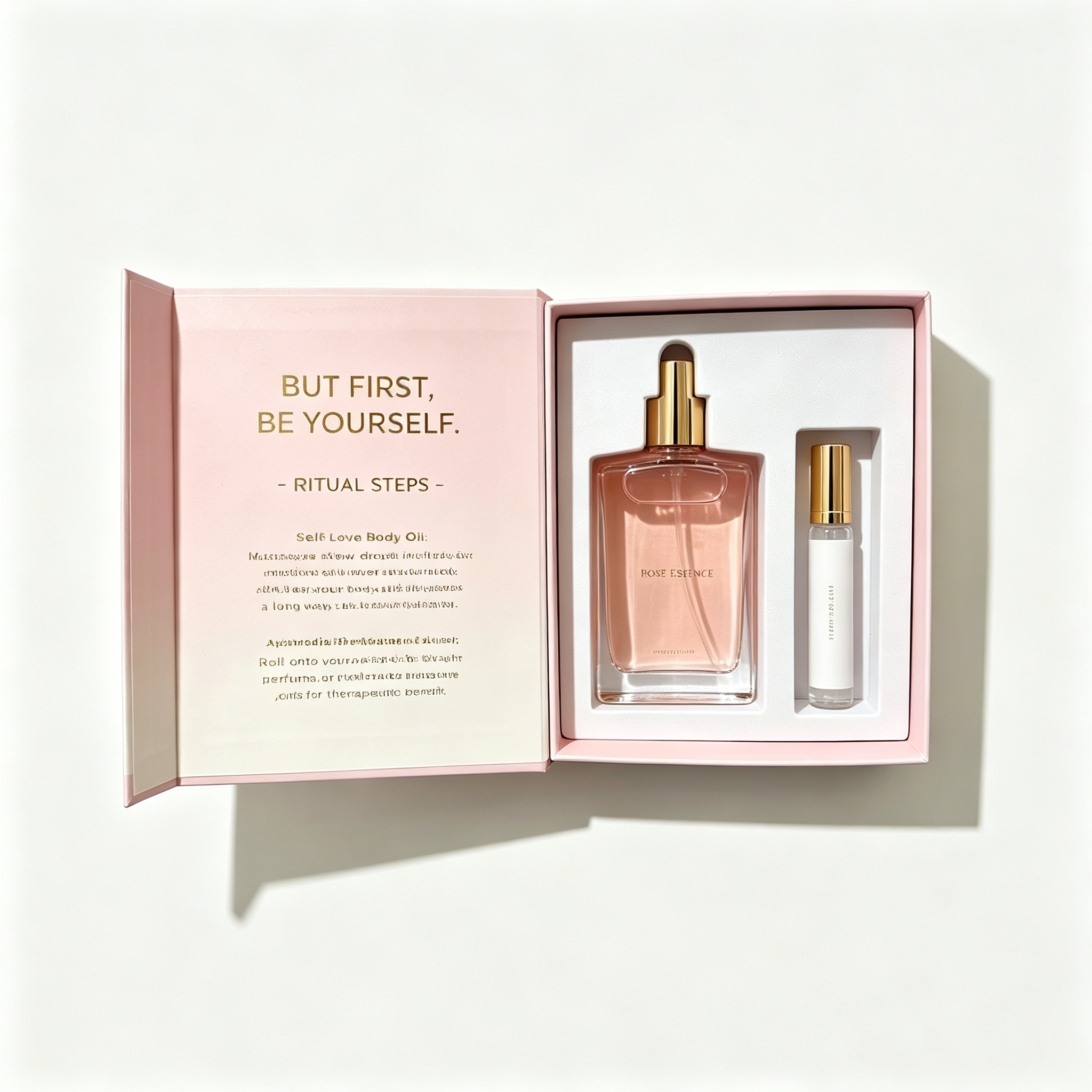
Decoration is where fragrance packaging competes visually, and also where most delivery risk accumulates. The finishing processes available in this range include gold, silver and laser foil stamping, partial UV, embossing and debossing, grain and specialty textures, hollow windowing, special-shape die cutting, flocked inserts, satin lining and magnetic closure. Each process is a separate production pass, and each pass introduces a registration point that can drift.
Magnetic closure deserves separate attention because of how widely it is now specified. With magnetic closures forecast at 29% of the luxury rigid box market in 2026, the mechanism has moved from premium novelty to expected feature in gift-tier fragrance packs. That raises the bar on the surrounding structure: a magnet is only convincing if the lid closes flush after the board has been wrapped, and if the hinge survives repeated opening in a retail environment. Buyers evaluating a magnetic book-shaped or double-open box should ask for a physical sample that has been opened and closed repeatedly, not only photographed.
Two finishing choices also carry compliance weight rather than decorative weight. Windowed formats use a transparent film that must be accounted for in material composition, and heavy foil or metallised surfaces can complicate recyclability claims in markets with design-for-recycling rules. Neither is a reason to avoid the finish; both are reasons to ask for the material breakdown before the design is locked.
Documentation: what to request, and what each document proves
Certificates are frequently treated as a single credibility signal. In practice each one answers a different question, and a buyer should know which question is being asked before accepting a folder of scanned PDFs.
| Document | Reference and issuer | What it evidences |
|---|---|---|
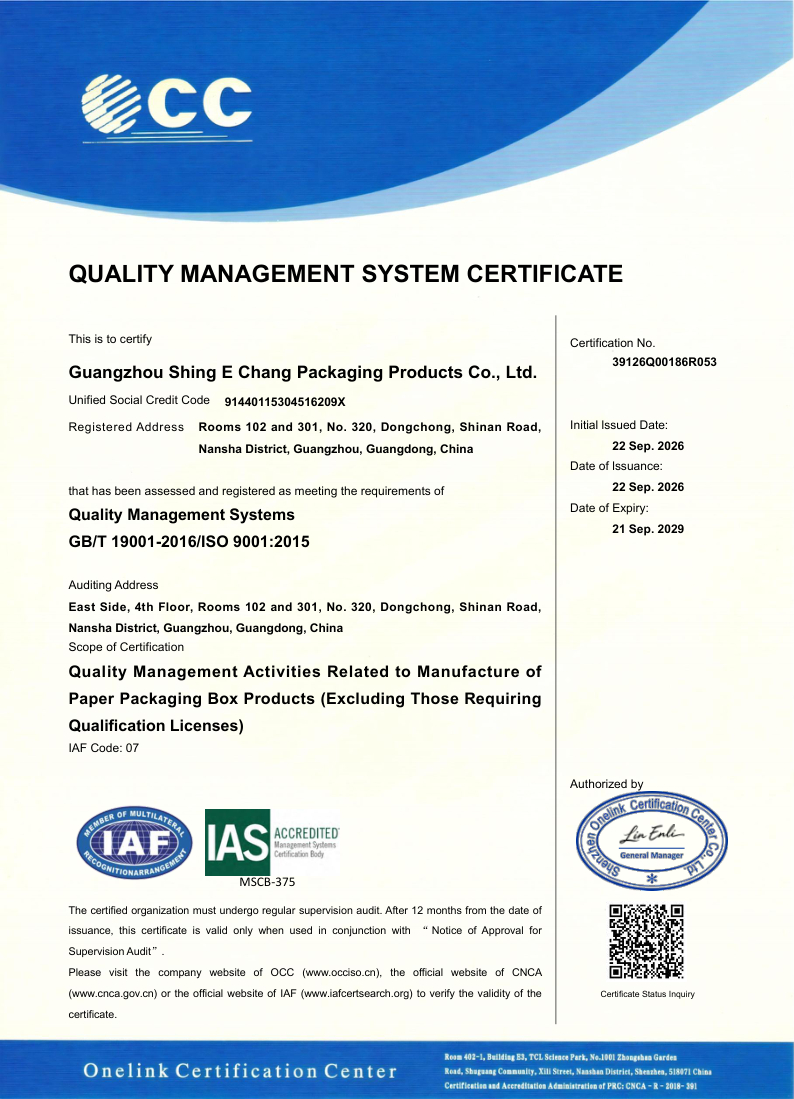
| Quality Management System Certificate (ISO 9001) | No. 39126Q00186R053, Onelink Certification Center; GB/T 19001-2016 / ISO 9001:2015; valid 2026-09-22 to 2029-09-21 | A documented quality management system covering the manufacture of paper packaging box products |
| FSC Chain of Custody | No. AI-COC-003377, RINA Services S.p.A.; FSC-STD-40-004 V3.1 and FSC-STD-50-001; valid 2024-01-19 to 2029-01-18 | Traceability of forest-based paper raw material through the supply chain |
| amfori Social Audit – Manufacturing | No. 25-0368872, amfori BSCI Code of Conduct; valid 2026-01-15 to 2027-01-15 | Social and ethical manufacturing performance at the audited site; the published monitoring summary for this site carries an overall rating of C, defined by amfori's own scale |
| Gold Plus Supplier Assessment Certificate | No. 485432262_P+T, SGS onsite assessment; Alibaba Gold Plus standard; valid 2026-02-04 to 2027-02-03 | Third-party verification that the supplier entity and site exist and were visited on site |
None of these documents certifies a specific box. That distinction matters: a valid ISO 9001 certificate says the management system is defined, not that a particular run of 2,000 magnetic boxes matched the approved colour. For product-level assurance, buyers need the sample record, the approved colour standard and the batch inspection report — documents generated per order rather than per company.
EU market rules now shape the box, not just the print
For fragrance brands selling into Europe, packaging regulation has become a design input. Regulation (EU) 2025/40 establishes requirements across the full life cycle of packaging placed on the EU market, covering environmental sustainability and labelling. Three of its provisions translate directly into box specifications:
- Recyclability. Packaging placed on the market must be recyclable, subject to the regulation's detailed criteria. Material composition and finishing choices therefore belong in the specification, not in a later sustainability review.
- Minimisation. Packaging must be designed to minimise volume and weight while still performing its functions. A multi-layer drawer box with a heavy insert is a legitimate choice, but the justification now has to exist.
- Documentation. Manufacturers must draw up a written declaration of conformity for each packaging type and retain technical documentation. Buyers importing into the EU should confirm who holds that file.
Dimensional discipline is tightening in parallel. EU parcel rules are reported to cap empty space at 40% from August 2026, which puts oversized gift boxes with loose internal volume under direct scrutiny. The practical response from buyers has been to move cavity design earlier in the process: the box is sized around the bottle and its accessories, rather than around a standard carton that is then filled with void material.
It is worth being explicit about the limit of public evidence here. Recyclability and conformity depend on the specific board, coating, foil, adhesive and window film used in a given box, and those details sit in supplier technical data sheets rather than in market reports. A buyer cannot verify compliance from a catalogue page; the request has to go to the supplier as a documentation request, item by item.
Sampling is the cheapest place to fail
Every constraint described above converges in the sample. In this supply model, physical sampling is produced within 1–3 working days and is intended to reproduce the full production result: printing colour, foil lustre, lamination touch, box stiffness and insert fitness. Colour control relies on a cosmetic colour-matching system with Pantone card alignment and brand spot-colour customisation, with digital and physical proofs checked before bulk production, and colour deviation controlled through machine tuning plus manual inspection during the run.
Revision policy is the part buyers underuse. Free, unlimited fine-tuning and remaking are offered during sampling, covering colour deviation, craft details, box tightness, layout and insert fit, with mass production starting only after written confirmation. For a fragrance gift set, that means the sample round is the correct moment to test the things a photograph cannot show: whether the cap clears the insert, whether the drawer pulls smoothly when loaded, whether the ribbon sits flat after packing.
Application fit: which structure suits which fragrance brief
Gift sets and holiday editions
Multi-piece fragrance and body-care sets are the natural territory of drawer, double-door, multi-layer and ribbon formats, where separated compartments let a bottle, a lotion and an accessory be presented without touching each other. A representative reference from this production base is a double-layer cylindrical rigid box for a luxury fragrance and beauty brand, built in matte navy special paper with large-area gold hot-stamped constellation patterns and independent upper and lower storage. A second reference is a square lid & base gift box in high-saturation warm orange with a circular hand-painted botanical illustration, produced in tens of thousands of sets per batch for a skincare and body-care brand's holiday programme.
Sample, discovery and travel-size packs
Small formats carry the same structural logic at a smaller scale. A book-shaped magnetic box with a flocked insert cut for a full bottle and a roller sample is a common solution for discovery sets, because both items must stay fixed while the pack travels by post. Window display formats suit retail counters where the bottle should be visible without opening the box. The 500-unit MOQ is relevant here: it allows a travel-size or sample programme to run as a genuine custom pack rather than a stock carton with a label.
Private label and minimalist lines
Where the brand language is restrained, the specification usually shifts from decoration to construction accuracy — a lid & base or hinged lid structure with a single foil or debossed mark, tight wrap on the corners, and a clean insert. In minimal designs the box has nowhere to hide: wrap alignment and board stiffness become the visible quality signals.
Eco-positioned ranges
Sustainability positioning requires material evidence, not just lighter-looking graphics. FSC chain-of-custody traceability for paper raw material, recyclable material selection and reduced internal volume are the three levers that can be documented. Where a brand needs the claim to survive scrutiny, those three should appear in the specification as verifiable requirements rather than adjectives.
Rigid custom boxes versus folding cartons: where the trade-off sits
A rigid perfume box is not a universal answer, and the comparison with folding cartons is the clearest way to see why. Rigid boxes are built on greyboard and wrapped in printed paper, which delivers wall stiffness, an unboxing sequence and a surface that holds foil and embossing cleanly. Folding cartons are printed and die-cut from a single board sheet, ship flat, and weigh considerably less per unit at the same footprint.
The trade-off is measurable in three places. First, material and freight: a rigid box consumes more material and occupies more shipping volume than a flat carton, which sits awkwardly against the minimisation requirement in EU packaging rules and against air-freight economics. Second, unit cost at volume: rigid construction and hand assembly set a higher cost floor, and the 500-unit MOQ reflects a production reality rather than a policy preference — a run of a few dozen pieces belongs with a stock format or a digital-printed carton. Third, lead time: 7–30 days is a wide band precisely because multi-layer, flocked, magnetic and ribbon-heavy designs sit at the top of it, while a straightforward lid & base with one foil pass sits near the bottom.
There are also structural limits worth naming. Irregular specialty shapes are visually distinctive but palletise poorly, so they suit limited editions and counter display better than high-velocity e-commerce. Multi-layer drawer boxes create several independent tolerance chains, which increases both sampling rounds and inspection time. And a rigid box does not, by itself, deliver a premium impression: if the insert is loose or the lid does not close flush, the format works against the brand rather than for it.
The production reality behind a quotation
Constraint-led buying eventually comes down to whether the supplier can hold those constraints at scale. DR.BOX, the brand operated by Guangzhou Xingyichang Packaging Products Co., Ltd., has been established since 2004 and runs a 15,000 m² production base in Nansha, Guangzhou, with 200 employees, a 30-person R&D and technical team, a stated monthly capacity of 300,000 units and annual output of 50,000,000 units. Roughly 60% of output is exported, with main markets in the Middle East, Europe, Southeast Asia, North America and Africa, and the company reports more than 1,000 cumulative clients.
What that structure changes for a buyer is control over the intermediate steps. Sampling, mass production and insert assembly are handled in-house across standardised lines and finishing equipment, and quality control is described as a triple system with 100% testing, targeting colour deviation, structural precision and batch consistency. The company also holds registered trademarks, utility model patents and design patents related to packaging, plus the quality, forest-traceability and social-audit certificates listed earlier in this article. For a fragrance brand, the relevant question is not whether these exist in isolation, but whether the same site that samples the box also produces and inspects it — which is what the in-house model is designed to guarantee.
A procurement checklist for custom perfume packaging
| # | Question to put to the supplier | Evidence to expect back |
|---|---|---|
| 1 | What internal dimensions and cavity tolerance do you recommend for this bottle, cap and any accessory? | Dimensional drawing with tolerances and an insert layout |
| 2 | Which structure best carries the intended decoration at this product count? | Structure recommendation with a sample of the specific format |
| 3 | What are the MOQ and lead time for this exact configuration, not for the category? | Written quotation stating quantity, lead time and finishing steps |
| 4 | How is colour matched and controlled across the run? | Pantone or spot-colour standard, digital and physical proof approval |
| 5 | What are the material compositions of board, wrap, foil, adhesive and window film? | Technical data sheets sufficient for a recyclability review |
| 6 | Which certifications apply to the manufacturing site, and what are their validity dates? | Certificate copies with numbers, issuers and expiry dates |
| 7 | Who holds the declaration of conformity and technical documentation for EU-bound packaging? | Named responsibility and the document set to be supplied |
| 8 | What is the revision policy during sampling, and what triggers a re-sample? | Written sampling terms and the approval record before bulk production |
Future outlook
Three pressures look likely to shape fragrance packaging decisions over the next few years, and all three push in the same direction: specification earlier, decoration later.
The first is regulatory. With recyclability, minimisation and conformity documentation now written into EU packaging law, the box specification becomes a compliance document as well as a design brief. Brands that can produce a material breakdown and a declared conformity route will move through customs and retailer onboarding faster than those reconstructing the file after the fact.
The second is dimensional. The reported 40% empty-space cap for EU parcels turns internal volume into a cost line, not just an aesthetic choice. Cavity-led design, in which the insert is engineered around the bottle and the box is sized to the insert, is the practical response — and it happens to align with the transit-protection requirement that buyers already cared about.
The third is batch economics. Rigid construction with magnetic closures, flocked inserts and multi-layer drawers remains a hand-finishing process, so the formats that dominate gift-tier fragrance packaging will keep their longer lead times. What is changing is the entry point: a 500-unit minimum makes a properly engineered custom box accessible to smaller fragrance houses and private-label programmes, which were previously pushed toward stock cartons. The constraint stack does not disappear at that scale — it simply becomes the item that separates a smooth launch from an expensive reprint.
FAQ
What specifications should be fixed before ordering a custom perfume packaging box?
Five parameters should be fixed: external size and finished height, material and surface paper weight, surface finishing and print, cavity size for the insert, and any accessories such as ribbon, clasp or mirror. Bottle dimensions — height, width and diameter — are the input for the cavity, and the cavity in turn constrains the internal box dimensions. Approving decoration before the cavity is settled is the most common cause of a re-sample.
What is the minimum order quantity and lead time for custom perfume packaging boxes?
For the rigid box range covering models xyc-001 to xyc-011, minimum order quantity is 500 units and quoted lead time is 7–30 days. The quoted figure depends on the configuration: a lid & base box with a single foil pass sits near the lower end, while multi-layer drawers, flocked inserts, magnetic closures and multiple decorated surfaces move toward the upper end because each adds a separate production and assembly step.
How are bottle fit and colour accuracy validated before mass production?
Through physical sampling, produced within 1–3 working days and intended to reproduce printing colour, foil lustre, lamination touch, box stiffness and insert fitness. Colour is matched against a Pantone reference or a brand spot colour, with digital and physical proofs checked before production and colour deviation controlled by machine tuning plus manual inspection during the run. Revision is unlimited and free during sampling, covering colour deviation, craft details, box tightness, layout and insert fit; mass production starts only after written confirmation.
Which certificates should a perfume packaging supplier provide for EU-bound orders?
Four categories are relevant, and each answers a different question. ISO 9001 evidences a documented quality management system for paper packaging manufacture. FSC chain of custody evidences traceability of forest-based paper raw material. An amfori social audit evidences social and ethical manufacturing performance at the audited site. A Gold Plus Supplier Assessment conducted on site by a third party evidences that the supplier entity and facility exist and were visited. None of these certifies an individual order; product-level assurance comes from sample approval and batch inspection records.
Does a rigid perfume gift box comply with EU packaging rules?
Compliance is determined by the specific pack, not by the format. Regulation (EU) 2025/40 requires packaging placed on the EU market to be recyclable, to be designed to minimise volume and weight while maintaining functionality, and to be covered by a written declaration of conformity with technical documentation retained by the manufacturer. A rigid box can meet those requirements, but the assessment depends on board, wrap, foil, adhesive and window film composition, and on whether the internal volume is justified. Buyers should request the material breakdown and confirm who holds the conformity documentation.
A full product catalogue covering box formats, models and customisation scope is available for download: XINGYICHANG Product Catalog (PDF).
Tem questões ou precisa de mais detalhes?
Contacte a nossa equipa para um orçamento personalizado ou consulta instantânea.
Solicitar orçamento
Preencha o formulário abaixo e a nossa equipa entrará em contacto com uma proposta personalizada.
Chat direto do WhatsApp
Prefere conversar em tempo real? Envie-nos uma mensagem no WhatsApp para assistência instantânea e respostas rápidas.
- Obter orçamento personalizado
- Partilhar fotos ou documentos
- Discuta as suas necessidades diretamente
Geralmente responde em 5–30 minutos durante o horário de expediente.