
Custom Rigid Box Compliance: FSC GFA-COC-005690, Inks and Adhesives
Custom Rigid Box Compliance: FSC GFA-COC-005690, Inks and Adhesives

A finished custom rigid box: the exterior wrap is a printed paper component, the interior insert and the board core are separate material decisions.
Compliance is now part of the rigid box specification
Custom rigid boxes are increasingly purchased against a compliance file rather than a specification sheet alone. Buyers want to know which fibre the board and wrap paper came from, how the printed surface was produced, and which adhesive bonds the printed wrap to the board.
Two forces are pushing this change. The first is regulatory: the EU Packaging and Packaging Waste Regulation, Regulation (EU) 2025/40, became mandatory on 12 August 2026 and requires packaging placed on the EU market to be recyclable and properly labelled. The second is commercial: brand owners in cosmetics, jewelry, electronics and gifting are asked by their own retail customers to document material choices, and those requests travel upstream to the packaging supplier.
A rigid box makes that documentation harder than a folding carton. The body is built from grey board or MDF, the exterior is a printed paper wrap, and the interior often contains foam, EVA, a plastic tray, corrugated cardboard or silk. Only part of that bill of materials is paper-based, and only part of it can be covered by a Chain of Custody certificate. This is the context in which certificate numbers, ink declarations and adhesive data sheets have moved from the appendix of a packaging specification to the first page.
The reference point: FSC certificate GFA-COC-005690
FSC Chain of Custody certificate GFA-COC-005690 is held by Opack, a custom packaging manufacturer based in Longgang, Wenzhou, Zhejiang Province, China. Opack has produced custom packaging since 2010, including custom rigid boxes, custom shopping bags, custom folding cartons and custom mailer boxes, from a 10,000 m2 facility with 160 employees, an in-house R&D team of 5, and an annual output of 10,000,000 units. The certificate itself was issued by GFA Certification GmbH under FSC-STD-40-004 (Version 3.0).
| Element | Recorded detail |
|---|---|
| Certificate type | FSC Chain of Custody (COC) Certification |
| Certificate number | GFA-COC-005690 |
| Issuing authority | GFA Certification GmbH |
| Standard | FSC-STD-40-004 (Version 3.0) |
| Scope | Cardboard packaging; sacks and bags of paper; adhesive labels; other pulp and paper products |
| Markets listed on the certificate | Europe; North America; Australia & New Zealand; Middle East |
| Issue date | 9 November 2021 |
| Validity date | 9 October 2026 |
The scope wording matters more than the certificate number. GFA-COC-005690 covers cardboard packaging, sacks and bags of paper, adhesive labels, and other pulp and paper products. In a custom rigid box programme, that means the printed wrap paper, paperboard inserts and paper-based outer packaging sit inside the certified scope, provided the supplier's chain of custody procedures are applied to those jobs.
Three boundaries are worth writing directly into a purchase specification, because they are the questions buyers raise most often after the certificate has been received.
- Material boundary. Grey board and MDF cores, foam, EVA, plastic trays, silk linings and magnetic closures are not pulp and paper products. They sit outside the scope listed above, so a buyer who needs documentation for those components has to request it separately, component by component.
- Geographic boundary. The certificate lists Europe, North America, Australia & New Zealand, and the Middle East. Programmes that ship into other regions should confirm how the sourcing claim is presented in those markets.
- Time boundary. The certificate was issued on 9 November 2021 and carries a validity date of 9 October 2026. Chain of Custody certificates operate on periodic assessment cycles, so the current status should be verified at the point of order rather than taken from a document stored in a sourcing folder.
FSC Chain of Custody certification reference GFA-COC-005690: scope covers cardboard packaging, paper sacks and bags, adhesive labels and other pulp and paper products.
What a Chain of Custody certificate does not say about inks and adhesives
FSC Chain of Custody certification answers one specific question: can the organisation demonstrate traceability of forest-based material through its production process within a defined scope? It does not certify ink chemistry, adhesive chemistry, or the volatile organic compound (VOC) content of a printed or laminated surface. A certificate number should therefore never be presented to a buying team as proof of a low-VOC or water-based material claim.
That distinction is the practical core of this topic. When a specification calls for water-based printing inks or low-VOC adhesives, those are material claims, and they are evidenced differently: through ink and adhesive technical data sheets, safety data sheets (SDS), and, where a buyer requires it, third-party test reports on emissions or VOC content. A rigid box manufacturer can hold both types of documentation, but they are separate files and should be requested as separate line items on the same enquiry.
Why the printing method changes the answer
The custom rigid box specification supported by Opack includes CMYK printing, Pantone printing, UV printing, offset printing and screen printing, with finishing options covering hot stamping, spot glossy UV, soft touch lamination, holographic foiling, embossing, debossing, matte lamination and gloss lamination. Each of those processes uses a different combination of ink, coating and lamination adhesive, and each combination has its own documentation trail.
A buyer evaluating a water-based ink claim should therefore ask which process will actually run on their artwork, not whether the supplier offers environmentally friendly printing in general. A screen-printed or UV-cured decoration and an offset-printed panel are not interchangeable from a documentation standpoint, even when they are applied to the same rigid box with lid.
Adhesives: wrapping, assembly and recyclability
In a rigid box there are effectively two adhesive questions. The first concerns the wrap: how the printed paper or specialty paper is bonded to the grey board core. The second concerns structure: how the box body, the lid and any tray or insert are assembled. Both involve adhesives that a buyer may want declared, particularly when a downstream customer is assessing recyclability under the EU Packaging and Packaging Waste Regulation.
Laminate films and heavy coatings interact with recycling processes differently from uncoated paper surfaces, which is exactly the point the EU regulation addresses through its recyclability and labelling requirements. Where a finish is essential to the design, the appropriate step is to confirm how that finish interacts with the buyer's own recyclability or labelling target, rather than assuming that all finishes behave identically.
A verification checklist for custom printed rigid boxes
The table below converts the discussion above into documents and confirmations a buyer can request before releasing a production order. It is written for custom printed rigid boxes, but the same structure applies to rigid paper boxes, rigid setup boxes and custom rigid packaging boxes used in gifting or retail programmes.
| Verification item | What to request | Why it matters |
|---|---|---|
| Fibre sourcing | FSC COC certificate number, issuing body, scope wording and current validity date | Establishes which components are inside a certified chain of custody and which are not |
| Board and wrap material | Declaration of the core material (grey board or MDF) and the wrap paper type: coated paper, kraft paper, specialty paper, textured paper or white paperboard | Determines which parts of the box fall inside paper-based certification scope |
| Ink system | Ink technical data sheet and SDS for the printing method actually used: CMYK, Pantone, UV, offset or screen printing | Supports water-based or low-VOC ink claims at artwork level rather than in general terms |
| Adhesives | Adhesive technical data sheet and SDS for wrap-to-board bonding and for structure assembly | Supports low-VOC adhesive claims and feeds the buyer's recyclability assessment |
| Finishing and lamination | Confirmation of lamination type (matte, gloss or soft touch) and any foil or UV decoration | Affects how the finished box behaves in repulping and recycling streams |
| Insert materials | Insert specification: foam, paperboard, EVA, plastic tray, corrugated cardboard or silk | Identifies components that sit outside pulp-and-paper scope and need separate documentation |
| Model and version control | Model reference and confirmation that the production unit matches the sampled materials | Closes the gap between a compliant sample and a compliant shipment |
| Inspection | Internal quality check record and willingness to accept third-party inspection | Verifies claims physically, not only on paper |
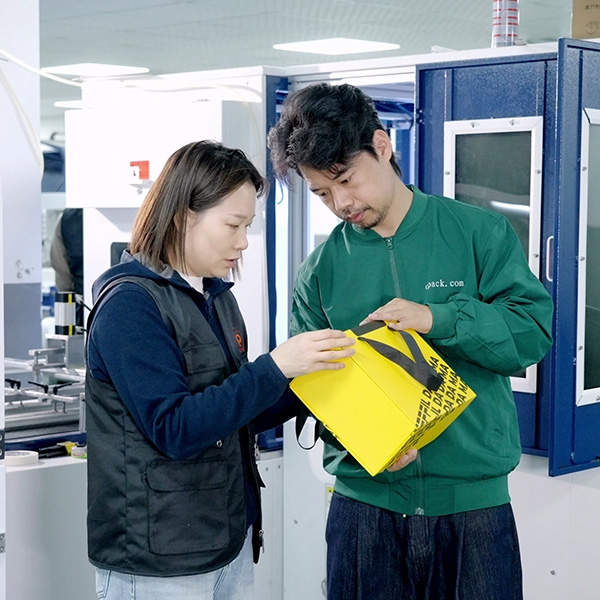
Finished rigid boxes pass a 100% quality check before shipment; third-party inspection can be arranged on request.
How Opack's rigid box capability maps to a compliance-led programme
Opack is a custom packaging manufacturer that exports to the EU, US and Middle East markets, with an export ratio of 80 per cent of production. The rigid box line is referenced under model codes RB-C01, RB-G02, RB-M03, RB-L04, RB-B05, RB-O06, RB-T07, RB-D08 and RB-W09. Its production parameters are relevant to compliance planning because they define how small a certified and documented order can be.
| Parameter | Specification |
|---|---|
| Core material | Grey board or MDF (Medium-density fibreboard); greyboard and chipboard equivalents |
| Board thickness | Customizable |
| Wrapping paper options | Coated paper, kraft paper, specialty paper, textured paper, white paperboard |
| Printing | CMYK printing, Pantone printing, UV printing, offset printing, screen printing |
| Finishing | Hot stamping, spot glossy UV, soft touch lamination, holographic foiling, embossing, debossing, matte lamination, gloss lamination |
| Structure | Foldable, magnetic closure, ribbon closure available |
| Size range | Fully customizable based on product requirements |
| Insert options | Foam, paperboard, EVA, plastic tray, corrugated cardboard, silk |
| Minimum order quantity | 500 pcs (rigid gift boxes: 500 pcs per size and design; paper shopping bags: 1,000 pcs per size and design) |
| Production lead time | 12–18 days |
| Monthly capacity | 1,000,000 units |
| Quality control | 100% quality check |
| Customization scope | Logo, brand name, color, size, style, finishings, printing methods, material |
| Delivery and payment | EXW and FOB available; payment terms 40/60 |
| After-sales support | Multi-channel: real-time online chat, WhatsApp, telephone, official email |
Read against the certification scope, those parameters give a buying team a clear planning picture. A 500-piece rigid box order per size and design can be produced in 12–18 days, and the paper-based components of that order are the ones that a Chain of Custody programme can address. The insert decision — foam, EVA, plastic tray or silk — is made at the same time as the board and wrap decision, and it is the point at which a paper-only compliance assumption usually breaks.
Applications: where rigid box compliance risk concentrates
Custom rigid boxes are used across jewelry, watches, perfumes, cosmetics and beauty, apparel, gift packaging, electronics, PR boxes, and corporate and promotional packaging. Compliance exposure is not identical across those categories, and the differences are worth understanding before a specification is frozen.
Cosmetics, beauty and perfume
These categories are most exposed to EU market requirements, because the packaging itself is placed on the EU market and falls within the labelling and recyclability expectations of Regulation (EU) 2025/40. A rigid box with lid used for a fragrance set typically combines a printed wrap, a laminated finish, and a foam or paperboard insert, so the buyer needs documentation for at least three material groups.
Jewelry, watches and gifting
Small formats dominate here, and silk or foam inserts are common. Because these programmes often run across several sizes and design variants, the 500-piece minimum order quantity per size and design becomes a planning constraint rather than a commercial footnote. Buyers consolidating several SKUs should map order quantities against that threshold early.
Electronics, PR boxes and promotional packaging
Electronics and PR packaging frequently uses mixed-material constructions — rigid board bodies with corrugated cardboard, EVA or plastic tray inserts — and collapsible or foldable rigid boxes to reduce freight volume. Mixed-material assemblies are the hardest to describe with a single certification claim, which is why component-level declarations tend to be requested at tender stage rather than after sampling.
Market context: rigid box demand and the documentation layer
The commercial case for treating compliance as a specification item rather than a marketing asset is supported by market data. According to Global Market Insights, the global rigid boxes market was valued at USD 31.2 billion in 2025 and is projected to reach USD 48.9 billion by 2035. Grand View Research estimates that the rigid box segment within the broader corrugated market will expand at a 9.2% CAGR from 2026 to 2033, driven by e-commerce and premium packaging needs.
Material composition is shifting in parallel. Future Market Insights reports that paper and paperboard account for approximately 55.4% of total rigid box material revenue as brands move toward recyclable substrates. On the supply side, Grand View Research and Global Market Insights place Asia Pacific at a 48.2% revenue share of the global rigid packaging market in 2023, with Europe remaining the largest specific market for luxury rigid boxes. The competitive field spans integrated groups such as Smurfit Westrock, Mondi Group and Sonoco alongside specialized converters such as PakFactory and BorhenPack.
Custom rigid boxes under HS Code 481920, the folding cartons and non-corrugated boxes category tracked by UN Comtrade, are a significant export segment, with China as a primary global supplier. Taken together, these figures describe a market where volume growth and material transition are happening at the same time — which is precisely why documentation capability is becoming a selection criterion rather than a differentiator.
Documented sourcing compared with traditional rigid box buying
Most rigid box sourcing still follows a familiar path: send artwork, approve a sample, release a purchase order. That approach works for structure and print quality, but it does not surface compliance information unless the buyer asks for it explicitly. The comparison below sets the two approaches side by side.
| Dimension | Traditional approach | Documentation-led approach |
|---|---|---|
| Fibre claim | Certificate mentioned verbally or as a logo on a quotation | Certificate number, issuing body, scope wording and current validity date recorded in the file |
| Bill of materials | Described at box level | Split into core board, wrap paper, ink, adhesive, finish and insert |
| Ink and adhesive evidence | Not requested | Technical data sheets and SDS tied to the specific printing method |
| Insert materials | Treated as a cosmetic choice | Identified as in-scope or out-of-scope against the certification wording |
| Certificate currency | Assumed valid | Verified at order placement, including validity date |
| Verification | Sample approval only | Sample approval plus internal 100% quality check and optional third-party inspection |
| Order parameters | Negotiated case by case | Planned against a 500-piece minimum per size and design and a 12–18 day production lead time |
The documentation-led approach is not costless, and buyers should weigh its boundaries honestly. Certification and documentation work is concentrated on paper-based components, so mixed-material designs still require separate evidence for foam, EVA, plastic trays and silk. Minimum order quantities of 500 pieces per size and design mean that very small or highly fragmented ranges are harder to place on a documented basis. The 12–18 day production lead time assumes that artwork, materials and documentation requirements are settled before the order is released; late changes push the schedule. Different finishing processes interact with recyclability in different ways, so a design that depends on heavy foiling or lamination may need an additional review against the buyer's own labelling and recyclability targets. And because the FSC certificate operates within a validity window that runs to 9 October 2026, buyers should treat certificate currency as a recurring check rather than a one-time onboarding step.
Future outlook
Three developments are likely to shape custom rigid box sourcing over the next procurement cycles. First, the entry into force of the EU Packaging and Packaging Waste Regulation on 12 August 2026 moves recyclability and labelling evidence from voluntary disclosure to a market access condition for EU-bound programmes, which will push documentation requests to the quotation stage rather than the shipment stage.
Second, buyers are shifting from a binary question — does the supplier hold a certificate — to a scoped question: which components does the certificate cover, and what evidence exists for everything else? That change favours suppliers who can answer at component level, and it places a premium on clear scope wording such as the cardboard packaging, paper sacks and bags, adhesive labels and other pulp and paper products listed in GFA-COC-005690.
Third, verification is becoming physical. Internal 100% quality checks are the baseline, and third-party inspection on request is increasingly written into purchase terms alongside EXW and FOB delivery arrangements and 40/60 payment schedules. For buyers, the practical implication is that compliance should be specified at the same time as structure, print method and insert design — not after the sample has been approved.
FAQ: custom rigid box compliance and qualification
What does FSC certificate GFA-COC-005690 cover?
GFA-COC-005690 is an FSC Chain of Custody certificate issued by GFA Certification GmbH under FSC-STD-40-004 (Version 3.0). Its stated scope covers cardboard packaging, sacks and bags of paper, adhesive labels, and other pulp and paper products. The certificate was issued on 9 November 2021 and carries a validity date of 9 October 2026.
Which markets does this certification support?
The certificate lists Europe, North America, Australia & New Zealand, and the Middle East. The manufacturer holding it, Opack, exports to the EU, US and Middle East markets and derives 80 per cent of production from export orders.
Does FSC Chain of Custody certification confirm that inks and adhesives are water-based or low-VOC?
No. Chain of Custody certification addresses traceability of forest-based material within a defined scope. Ink and adhesive chemistry is documented separately through ink and adhesive technical data sheets, safety data sheets, and, where required, third-party test reports. Buyers specifying water-based inks or low-VOC adhesives should request those documents for the specific printing method used on their artwork, since CMYK, Pantone, UV, offset and screen printing each involve different ink and coating systems.
Which parts of a rigid box fall outside a paper-based certification scope?
Grey board and MDF cores, foam, EVA, plastic trays, silk linings and magnetic closures are not pulp and paper products and therefore sit outside the cardboard packaging and paper products scope. Paper-based elements — coated paper, kraft paper, specialty paper, textured paper and white paperboard wraps, plus paperboard and corrugated cardboard inserts — fall inside the paper-related scope.
What are the minimum order and lead time parameters for a documented rigid box order?
For rigid gift boxes the minimum order quantity is 500 pcs per size and design; for paper shopping bags it is 1,000 pcs per size and design. Typical production lead time is 12–18 days, monthly production capacity is 1,000,000 units, and EXW and FOB delivery terms are available with 40/60 payment terms.
How are quality and conformity verified before shipment?
Every product undergoes an internal 100% quality check before shipment, and third-party inspections are welcome upon customer request. After-sales support is provided through multiple channels: real-time online chat, WhatsApp, telephone and official email.