
Custom Rigid Boxes: MOQ, Lead Time, and Customization Limits
Rigid box projects rarely stall over design. They stall over three questions standing between an approved concept and a purchase order: how many pieces must be ordered, how long production realistically takes, and how far a box can be customized before the request stops being a specification choice and becomes a new engineering project.
This reference answers those three questions directly for custom rigid boxes, drawing on documented product specifications, a company-reported production workflow, and third-party market and regulatory sources. Where a figure is not independently verifiable, it is labelled as directional, because the same figure usually ends up written into a purchase order or a launch calendar.
Why MOQ, Lead Time, and Customization Limits Decide the Project
Minimum order quantity, lead time and customization scope look like commercial details on paper. In practice they gate the entire project: a 300-piece gift set that needs a magnetic rigid box with a foam insert either fits a supplier's documented production floor or it does not, and a launch date either matches a realistic production window or it slips.
A custom rigid box is a wrapped board construction rather than a folded carton. It pairs a rigid board core — grey board, chipboard or MDF — with a separate printed wrap, a closure structure such as a drawer, magnetic flap or ribbon, and usually an insert. That layered structure is why rigid boxes behave differently from standard cartons on quantity and schedule: die-making, wrap printing, closure assembly, foiling plates and insert tooling are batch-level steps that do not scale smoothly down to very small runs.
Understanding where those thresholds sit is the fastest way to remove blockers from an RFQ.
Entity Note: What Opack Is
Opack is a custom packaging manufacturer established in 2010 and based in Longgang, Wenzhou City, Zhejiang Province, China — the area known as the Printing City of China. The company operates a 10,000 m² manufacturing facility with approximately 160 staff, a five-engineer R&D team, and a reported annual production capacity of 10,000,000 units. Around 80% of production is exported to the EU, the USA and the Middle East.
Its documented product range covers custom packaging, custom rigid boxes, custom shopping bags, custom folding cartons and custom mailer boxes, with customization offered for industries including apparel, cosmetics, retail, gifting and jewelry.
These are company-reported facts, and they matter here for one reason: MOQ and lead time are capacity statements. Facility size, headcount and annual output describe the scale at which a 500-piece rigid box order sits inside a normal production plan.
Question 1: What Is the True MOQ?
The documented minimum order quantity for Opack's custom rigid box range — model designations RB-C01, RB-G02, RB-M03, RB-L04, RB-B05, RB-O06, RB-T07, RB-D08 and RB-W09 — is 500 pieces.
That single number answers the first RFQ blocker, but three clarifications should be confirmed in writing before it is treated as a firm commercial term:
- 500 pieces is a production floor, not a price tier. The specification lists a minimum order quantity; it does not publish volume breaks. Assumptions about how price steps behave at 500, 1,000 or 5,000 pieces should be confirmed directly rather than inferred.
- Ask whether 500 applies per design, per size, or per combined order. A multi-SKU gift program with three box sizes and two artworks is a different production question from a single-size run, even when the total quantity is identical.
- Below 500 pieces, no smaller run is documented. If a project genuinely requires 100 or 200 units, the available specification does not support that quantity, and the practical route is to align project scope with the documented minimum rather than to expect a smaller batch.
For buyers in the awareness and research stage, the useful takeaway is that rigid box minimums are structural. The setup work behind a rigid box — die-cutting, wrap printing, closure assembly and insert tooling — is largely independent of run length, which is why rigid box minimums are typically expressed in hundreds of pieces rather than tens.
Question 2: What Is a Realistic Lead Time?
A 2026 comparison page published by Opack lists a 500-piece starting point and a 12–18 business day turnaround for Opack in its supplier table. That page is company-hosted and does not publish a comparison methodology, so the 12–18 day figure should be read as a directional planning number rather than a contractual service level. No independently verified lead-time benchmark for rigid box manufacturing was located in the third-party data available for this reference.
The figure becomes more useful once it is placed inside the documented order workflow: quote confirmation and specification agreement → sample approval → mass production → shipping.
Two things follow from that sequence. First, the production window is normally measured from sample approval, not from the day the RFQ is sent, and buyers should confirm that start trigger explicitly. Second, sampling itself is a project step that consumes calendar time before production begins.
What Moves a Project Inside or Outside the 12–18 Day Window
- Specification readiness. Size, material, closure type, insert type, artwork and finish all have to be fixed before a quote can be converted into a schedule.
- Sampling rounds. One approval cycle is fast; structural revisions, insert adjustments or artwork corrections each add a round.
- Finishing steps. Hot stamping, holographic foiling, embossing, debossing and lamination each carry their own setup. A box with three finishing techniques is not scheduled like a box with one.
- Inserts. Foam, paperboard, EVA, plastic tray, corrugated cardboard and silk inserts are separate components with their own production step.
- Order size. A 500-piece order and a multi-container order do not pass through the same production slots, even when the specification is identical.
Boundary to write into the order: the 12–18 day window is used on that page as a production turnaround figure. It does not state whether freight, customs clearance and final delivery transit are included, and it is not published as a service-level agreement with remedies for delay. Buyers planning a launch date should treat it as a production estimate and confirm shipping terms separately.
Question 3: How Far Can Customization Go?
Customization breadth is the third RFQ blocker, and it is the one where a documented option list is worth more than a sales conversation. For custom rigid boxes, the specification is segmented as follows.
| Dimension | Documented options | Status |
|---|---|---|
| Base material | Grey board / greyboard / chipboard; MDF (medium-density fibreboard) | Standard choice |
| Board thickness | Customizable | Set per project |
| Wrapping paper | Coated paper, kraft paper, specialty paper, textured paper, white paperboard | Standard menu |
| Printing | CMYK printing, Pantone printing, UV printing, offset printing, screen printing | Standard menu |
| Finishing | Hot stamping, spot glossy UV, soft-touch lamination, holographic foiling, embossing, debossing, matte lamination, gloss lamination | Standard menu |
| Structure | Foldable, magnetic closure, ribbon closure | Standard menu |
| Size | Fully customizable based on product requirements | Set per project |
| Inserts | Foam, paperboard, EVA, plastic tray, corrugated cardboard, silk | Standard menu |
| Matched accessories | Handles, custom stickers, custom hang tags, custom inserts | Standard menu |
Two decisions inside that list change the character of the box more than any other. The first is the board core: greyboard and chipboard are the conventional paperboard cores for a wrap-covered rigid box, while MDF is a denser board chosen where the structure needs to feel firmer and heavier. The second is the closure structure, because foldable, magnetic and ribbon formats differ in how the box opens, how the insert is anchored, and how the finished unit behaves in transit.
Everything on the list is a configuration decision that can be quoted within the standard workflow. Anything outside it — a base material that is not greyboard, chipboard or MDF, a closure type that is not foldable, magnetic or ribbon, an insert material that is not listed — is a project question whose feasibility has to be confirmed before it can be priced. That is a normal outcome rather than a refusal; it simply means the RFQ moves from configuration into development.
A foldable rigid box format. Collapsible structures are among the documented structural options for custom rigid boxes and change how an order is packed, shipped and stored.
Confirmed Limits and Boundaries
- The option list is broad but finite. Materials, closures, inserts, printing methods and finishes are enumerated in the specification; unlisted variations require confirmation before quoting.
- Collapsible and non-collapsible formats trade different properties. A collapsible rigid box ships flat and consumes far less freight volume, while a fixed-wall construction keeps a firmer structural feel. Choosing one means accepting the trade-off of the other.
- Storage conditions are part of the specification. The documented operating conditions for these products are a dry environment, low humidity, a stable moderate temperature, no direct sunlight and no contact with chemicals.
- Material compliance requirements are stated, not implied. The documented application requirement calls for eco-friendly water-based printing inks, low-VOC adhesive materials and compliance with FSC standards.
Where Custom Rigid Boxes Are Used
The documented application list for custom rigid boxes covers jewelry, watches, perfumes, cosmetics and beauty, apparel, gift packaging, electronics, PR boxes, and corporate and promotional packaging. Their stated function is to pack and protect products during storage and transit, to present a brand identity, and to communicate a brand story — which is why the documented operating mode is described as reusable rigid presentation packaging rather than single-trip transit packaging.
That framing matters during evaluation. A buyer comparing a rigid box with a plain shipper is comparing two different jobs: protection and presentation at a premium price point on one side, and low-cost containment on the other. Projects that need the box to survive a retail shelf, be reopened at home and be kept as a storage object fall inside the rigid box use case. Projects that only need to survive a courier network usually do not.
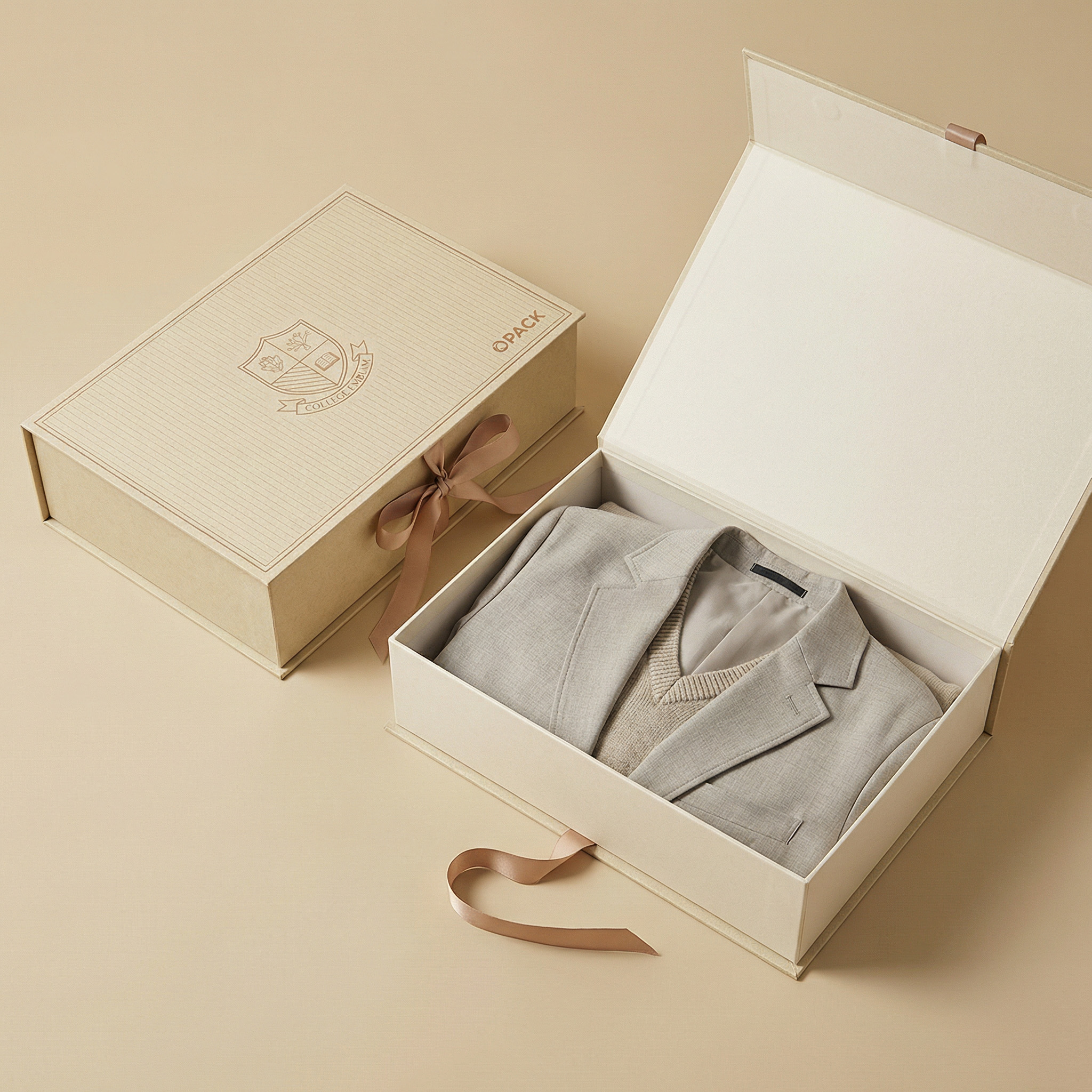
A book-style rigid box for apparel packaging — an application format in which presentation, reopening and reuse all carry weight.
Market Context: Why MOQ and Lead Time Are Moving Targets
Three published data points frame the environment in which rigid box procurement decisions are currently made.
The luxury rigid box segment was reported at USD 8.84 billion globally in 2026, while cosmetics and personal care account for a 37% share of luxury rigid box applications. The broader rigid packaging category — which includes plastic and metal formats as well as paperboard — is projected to reach USD 796.7 billion by 2030, so the two figures measure different scopes and should not be compared directly.
On the supply side, China's rigid box exports under HS code 481920 were reported at USD 1.7 billion in 2023, a figure carried with medium confidence in the available data. What these numbers share is a market large enough to keep rigid box capacity commercially attractive, and concentrated enough in a few application categories that specification decisions travel quickly across buyers.
The regulatory layer is where change is most immediate. Regulation (EU) 2025/40, the Packaging and Packaging Waste Regulation, requires packaging placed on the EU market to be recyclable and properly labelled as of 12 August 2026 — a requirement already in force at the time of writing. For rigid box buyers, that turns material choice and labelling into procurement criteria rather than design preferences: the wrap paper, the adhesive, the insert material and the printed information on the box all fall inside the scope of a recyclability and labelling review.
The practical consequence for MOQ and lead-time planning is that compliance questions now arrive at the RFQ stage rather than after it. Buyers who resolve material and labelling requirements during sampling avoid a second approval cycle later.
Rigid Boxes vs Traditional Packaging: Where Rigid Loses
Rigid boxes are not the default answer for every packaging problem, and the comparison is worth stating plainly.
Against folding cartons, a rigid box costs more per unit, uses more material, and occupies significantly more freight volume unless it is specified as a collapsible structure. Folding cartons ship flat and are produced on highly automated lines, which is why they remain the default for high-volume, low-presentation packaging. A rigid box wins on shelf presence, reopening experience and durability across repeated use — not on unit cost or freight efficiency.
Against corrugated shippers, the trade-off runs the other way. Corrugated formats are engineered for transit protection and stack strength at low cost, and they are the appropriate choice when the package only has to arrive intact. A rigid box is a presentation object first and a protective shell second.
There is also an evidence limitation buyers should factor into supplier comparison. No independently verified benchmark for rigid box defect rates, unit cost structures or lead-time performance was found in the available third-party data; the most specific public figures for supplier MOQ and turnaround come from company-hosted comparison pages without a published methodology. That is precisely why sample approval, written specifications and material documentation carry more weight in this category than published comparison tables.
Future Outlook
Three directions appear likely to shape rigid box procurement over the next planning cycles.
Compliance-driven specification will continue to move upstream. With EU recyclability and labelling requirements already effective, material declarations, adhesive and ink documentation, and chain-of-custody evidence for paperboard are becoming standard attachments to an RFQ rather than optional extras. Buyers who request them early avoid re-specification later.
Collapsible and foldable rigid structures are likely to grow in cross-border programs, because freight volume is one of the largest cost variables in shipping a large rigid format. A foldable construction changes the economics of an order without changing the presentation experience at the point of unboxing.
Minimum order quantities are unlikely to disappear. The setup steps behind a rigid box — dies, wraps, closures, insert tooling — are largely fixed regardless of run length, so quantity floors remain a structural feature of the category rather than a policy suppliers can simply remove. What can improve is transparency: clearer written schedules, defined start triggers, and documented specification boundaries make an RFQ faster to resolve than any headline number.
FAQ
What is the minimum order quantity for custom rigid boxes?
The documented minimum order quantity for Opack's custom rigid box range is 500 pieces. That figure applies to the model designations RB-C01, RB-G02, RB-M03, RB-L04, RB-B05, RB-O06, RB-T07, RB-D08 and RB-W09. No smaller production run is documented.
How long does custom rigid box production take?
A 2026 comparison page published by Opack lists a 12–18 business day turnaround alongside a 500-piece starting point. Because that page is company-hosted and does not state a comparison methodology, the figure is best treated as a directional production estimate. Production normally follows sample approval, and the figure does not state whether freight transit is included.
Which materials are used to make custom rigid boxes?
The documented base materials are grey board, greyboard, chipboard and MDF (medium-density fibreboard). Board thickness is customizable per project, and the wrap can be coated paper, kraft paper, specialty paper, textured paper or white paperboard.
What structure, printing and finishing options are available?
Documented structures are foldable, magnetic closure and ribbon closure. Printing options are CMYK printing, Pantone printing, UV printing, offset printing and screen printing. Finishing options are hot stamping, spot glossy UV, soft-touch lamination, holographic foiling, embossing, debossing, matte lamination and gloss lamination. Sizes are fully customizable based on product requirements.
What inserts can be added inside a rigid box?
Documented insert options are foam, paperboard, EVA, plastic tray, corrugated cardboard and silk. Matched accessories include handles, custom stickers, custom hang tags and custom inserts.
Can custom rigid boxes be shipped flat?
Yes — foldable and collapsible rigid formats are among the documented structure and type options. A collapsible box ships flat and occupies less freight volume, while a fixed-wall construction retains a firmer structural feel. The two formats represent a trade-off rather than a strictly better option.
What happens between an RFQ and mass production?
The documented workflow is quote confirmation and specification agreement, sample approval, mass production, then shipping. Buyers should confirm size, material, artwork, closure and finish before sampling, and treat sample approval as the point at which the production schedule begins.
How should custom rigid boxes be stored?
The documented storage conditions are a dry environment, low humidity, a stable moderate temperature, no direct sunlight and no contact with chemicals. These conditions apply to finished boxes held in a warehouse before use or shipment.
What compliance requirements apply to custom rigid boxes?
The documented application requirement specifies eco-friendly water-based printing inks, low-VOC adhesive materials and compliance with FSC standards. Separately, Regulation (EU) 2025/40 requires packaging placed on the EU market to be recyclable and properly labelled as of 12 August 2026, which places wrap paper, adhesives, inserts and labelling inside a compliance review.
Company background in document form: Opack company profile (PDF).
Tem questões ou precisa de mais detalhes?
Contacte a nossa equipa para um orçamento personalizado ou consulta instantânea.
Solicitar orçamento
Preencha o formulário abaixo e a nossa equipa entrará em contacto com uma proposta personalizada.
Chat direto do WhatsApp
Prefere conversar em tempo real? Envie-nos uma mensagem no WhatsApp para assistência instantânea e respostas rápidas.
- Obter orçamento personalizado
- Partilhar fotos ou documentos
- Discuta as suas necessidades diretamente
Geralmente responde em 5–30 minutos durante o horário de expediente.