
Custom Scent OEM Laundry Detergent Sheets: A Buyer's Guide to Fragrance Development and Sourcing
Fragrance is often the most personal element of a laundry product. For brands looking to differentiate with custom scent OEM laundry detergent sheets, the sourcing conversation goes beyond price and capacity into fragrance stability, formula compatibility, certification coverage, and packaging that preserves scent over time.
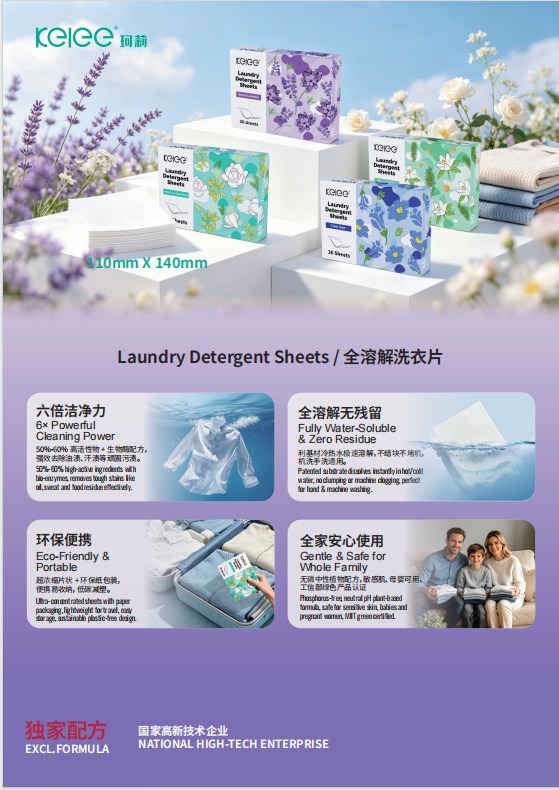
Custom scent OEM laundry detergent sheets are a fast-growing segment within the broader detergent sheets market. Buyers—brand owners, distributors, hotel suppliers, and private-label programs—are looking for suppliers that can translate a fragrance concept into a technically stable, regulation-ready solid laundry product. This article explains how custom scent development works for laundry detergent sheets, what buyers should verify during supplier evaluation, and what constraints matter when bringing a scented sheet to market.
Why Custom Scent Matters in Detergent Sheets
The global laundry detergent sheets market is estimated at roughly USD 1.26 billion in 2025, with projections reaching USD 2.82 billion by 2034, according to a Market Research Future report. Growth in this segment is driven by consumer demand for concentrated, plastic-free formats that do not compromise on experience. Scent is a decisive part of that experience.
For private-label and OEM buyers, standard scents such as ocean or fresh linen may be enough for a basic entry. However, custom scent programs allow brands to:
- Build a signature fragrance identity that consumers associate with the brand.
- Adapt fragrance profiles for regional or demographic preferences.
- Layer functional benefits—such as softener or enzyme stain removal—into the same scented sheet.
- Create seasonal or occasion-based product lines (e.g., hotel amenities, travel kits, baby-safe lines).
Custom scent OEM is not simply “pick a fragrance oil and add it to the formula.” The scent must survive the manufacturing process, remain stable during storage, dissolve correctly in the wash, and leave the intended perception on fabric. That requires formulation expertise and production controls that buyers cannot see from a product data sheet alone.
What “Custom Scent OEM Laundry Detergent Sheets” Actually Involves
At its core, custom scent OEM refers to a manufacturer producing laundry detergent sheets according to a buyer’s brand and product specifications, including a tailored fragrance profile. This may involve:
- Selecting or developing a fragrance system (single-note, blended, microencapsulated, or time-release).
- Adjusting the detergent base so it remains compatible with the fragrance compounds.
- Adding complementary functions such as softening, anti-color-transfer, or enzymatic stain removal in the same sheet.
- Producing under the buyer’s brand name with custom packaging design.
In practice, a custom scent OEM project requires the supplier to act as both formulator and manufacturer. For a brand, that means the supplier must have:
- An in-house R&D team capable of adapting formulas to fragrance requirements.
- Production flexibility to handle different batch sizes.
- Reliable scent-application technology, especially if microcapsules are used for long-lasting fragrance.
- Packaging options that protect fragrance integrity, especially for plastic-free paper boxes or films.
- Quality control that verifies fragrance consistency across batches.
Technical Considerations for Scent Stability in Laundry Sheets
Scent stability is the most underrated technical challenge in custom scent detergent sheets. Unlike a liquid detergent where fragrance oils can be suspended in a liquid matrix, a solid sheet is exposed to air, humidity, and packaging compression during storage and shipping.
Several factors affect whether a custom scent survives the supply chain:
Fragrance Type and Concentration
The type of fragrance molecules used determines how quickly the scent evaporates or degrades. Top notes fade quickly; base notes last longer. A custom scent for laundry sheets needs to be designed for the wash-and-wear process, not just the smell of the sheet straight out of the box.
Microencapsulation
Microencapsulated fragrance is one approach used to extend scent longevity. In the KL-R2015 model produced by Zhejiang Kelee Technology, the formula includes 1% fragrance plus 1% microcapsule, combined with softener and enzyme. This layered approach helps release scent during the wash and provides a longer-lasting perception on fabric compared to simple fragrance oils.
Compatibility with the Detergent Base
Fragrance compounds are not always compatible with all surfactants, enzymes, or softening agents. A custom fragrance must be tested in combination with the full formula to avoid phase separation (in liquid forms) or uneven distribution (in sheet forms). This is especially important in a 3-in-1 sheet that also contains anti-color-transfer chemistry and softening agents.
Plastic-Free Packaging
Plastic-free packaging is a key attribute of laundry detergent sheets. But packaging also plays a role in scent preservation. Paper-based packaging is breathable; if a custom scent has volatile top notes, the packaging must be designed to minimize scent loss. Buyers should discuss packaging materials and inner sealing with the supplier as part of the custom scent program.
Product Example: KL-R2015 3-in-1 Scented Laundry Sheet
Zhejiang Kelee Technology Co., Ltd., a manufacturer based in Yiwu, Zhejiang, China, produces a 3-in-1 Super Multi-Purpose Laundry Detergent Sheet under the model KL-R2015. It is a relevant reference for buyers evaluating custom scent OEM capabilities, because it demonstrates several requirements that custom scent projects typically demand:
| Aspect | KL-R2015 Details |
|---|---|
| Model | KL-R2015 |
| Type | 3-in-1 Super Multi-Purpose Laundry Detergent Sheets |
| Color | White |
| Scent | Ocean, 1% fragrance + 1% microcapsule + softener + enzyme |
| Sheet size | 11 × 12.5 cm |
| Weight per sheet | 3 ± 0.5 g/sheet |
| Standard package | 30 sheets/box |
| Material | Nonwovens, surfactant |
| Functions | Cleaning, anti-color-transfer, softening, enzyme-based stain removal |
The formula in this reference sheet includes fragrance and softener, and the 3-in-1 functionality combines cleaning, anti-color-transfer, and softening. For custom scent OEM, the supply chain must be capable of holding this kind of multi-functional format while adjusting the fragrance profile to the buyer’s specification.
What Buyers Should Verify in a Custom Scent Supplier
Custom scent OEM procurement should be treated as a technical qualification process, not just a transactional purchase. The following evaluation criteria are relevant regardless of whether the buyer is a brand owner, distributor, or hotel chain:
1. In-House R&D and Formulation Capability
A supplier without formulation capability cannot truly customize a scent; they can only repackage a standard fragrance. Buyers should confirm that the manufacturer has an in-house R&D team with experience in solid-form cleaning products. Zhejiang Kelee Technology, for example, employs a team of 8 engineers and integrates independent R&D with intelligent manufacturing. R&D capability is also demonstrated by intellectual property: the company holds over 20 authorized IP assets including international and national invention patents, utility-model patents, and design patents covering formula innovation, production equipment, and product structural design for solid cleaning sheets.
2. Certification and Audit Coverage
For EU-market buyers, social compliance and system certifications are often prerequisites. Zhejiang Kelee Technology’s manufacturing site is covered by an amfori BSCI Social Audit Monitoring Report (Monitoring ID: 25-0338183), valid from 2025-08-28 to 2026-09-04, under the amfori-BSCI Code of Conduct. The certification applies specifically to the detergent sheets product model KL-R2015 for the EU market.
The company also reports ISO 9001, ISO 14001, ISO 45001 certifications and participation in drafting national industry standards for laundry sheets and group standards for floor-cleaning sheets. While buyers should independently verify current certificates, the combination of BSCI social audit coverage and management system certifications is a meaningful signal for supplier evaluation.
3. Production Flexibility and MOQ
Custom scent programs often start with test batches or pilot runs before full-scale production. A supplier should be able to handle both small-batch development and mass production. Zhejiang Kelee Technology lists an OEM/ODM monthly capacity of 100,000 units, a lead time of 20 days, and an MOQ of 5,000 units for custom projects, with 100% testing reported in its quality control process.
4. Export Experience and Market Understanding
Scent preferences differ across markets. A supplier with export experience can provide useful input on regional fragrance trends and regulatory constraints. Zhejiang Kelee Technology exports approximately 70% of its output to the EU and USA, with a stated annual production capacity of 30 million laundry detergent sheet units (and a broader solid-cleaning capacity of over 150 million pieces).
5. Social and Environmental Position
Custom scent OEM for modern brands increasingly requires alignment on environmental and social values. Laundry detergent sheets are marketed as plastic-bottle-free alternatives to liquid detergent. A supplier’s manufacturing conditions and environmental certifications matter because buyers are indirectly responsible for their supply chain footprint.
Comparison with Traditional Laundry Detergent Sourcing
Custom scent programs exist in both liquid detergent and sheet formats. Comparing laundry detergent sheets to traditional liquid detergent helps buyers understand what changes when sourcing a solid custom-scent product.
| Comparison dimension | Liquid detergent (traditional) | Laundry detergent sheets (solid) |
|---|---|---|
| Format | Liquid in plastic bottle | Pre-measured solid sheet |
| Fragrance system | Liquid fragrance emulsion | Fragrance + optional microcapsules impregnated in sheet |
| Weight and logistics | Heavy, water-heavy product | Lightweight, compact, lower shipping weight |
| Packaging waste | Plastic bottle per unit | Plastic-free paper/cardboard packaging |
| Dosing | Consumer measures by cap | Pre-cut sheet, portion-controlled |
| Scent duration | Depends on fragrance load and wash conditions | Depends on fragrance type, microencapsulation, and sheet formulation |
That said, there are real constraints. Custom scent development in a solid sheet format is not always easier than in a liquid. The low water content means fragrance loading is limited by the sheet’s structural integrity; adding more fragrance oil may affect the sheet’s solubility, flexibility, or nonwoven structure. Scent stability in a plastic-free package is harder to guarantee over long transit and storage periods. And for some high-end fragrance concepts that rely on alcohol or complex solvent systems, the solid sheet format requires reformulation, which can limit the palette of scents compared to liquids. Buyers should therefore expect that not every fragrance concept can be reproduced exactly in a laundry sheet.
Typical Use Cases for Custom Scent Laundry Detergent Sheets
Hotel and Travel Amenities
Hotel travel disposable laundry sheets are a practical application for custom scent OEM. A hotel brand may want a signature scent that reinforces its guest experience. Because sheets are lightweight and portion-controlled, they are also easier to store and distribute in travel kits than bulky liquid bottles.
Private-Label Household Lines
Retailers and distributors offering private-label detergent sheets need a differentiated scent story. Custom scent allows them to create exclusive SKUs that do not directly compete with national brands on the same shelf.
Eco-Conscious Consumer Brands
Brands built around sustainability often prefer plastic-free, plant-based, or vegan formulations. Custom scent can reinforce that positioning—for example, a fragrance profile derived from natural-inspired scent notes, packaged in a plastic-free box with on-brand visuals.
Multi-Functional Product Lines
Combining scent with functional benefits is a growing pattern. The 3-in-1 laundry sheet concept (cleaning + anti-color-transfer + softening) shows how a custom scent can be layered into a value-added product. Similarly, enzymatic stain removal laundry sheets with a custom scent can appeal to households with active children or sports clothing needs.
Market Trend: Solid-Form Cleaning Is Expanding Beyond Laundry
The shift toward compact, water-soluble solid products is not limited to laundry. Within the broader light industry and daily-use category, manufacturers are applying the same logic to hand soaps, scent booster beads, toilet cleaning sheets, dishwasher sheets, and detergent tablets. For buyers, this is relevant because a supplier that understands solid-form chemistry across categories can offer more consistent innovation and supply-chain rationalization.
Zhejiang Kelee Technology’s product portfolio covers laundry care, household cleaning, personal hygiene, and travel-friendly cleaning goods, including floor cleaning sheets, dishwasher sheets, hand-washing flower-shaped soap sheets, and pet cleaning series. A custom scent OEM buyer working with such a supplier may find it easier to extend a fragrance or brand system across multiple product formats later.
Supply Chain Evidence: Kelee as a Manufacturing Partner
Zhejiang Kelee Technology Co., Ltd. was founded in 1999 and operates from a 16,000 m² facility in Chi’an Industrial Park, Yiwu, Zhejiang, China. The company has approximately 150 employees and an R&D team of 8 engineers. It reports an annual output of 30 million units for laundry detergent sheets specifically, with total production capacity across all solid-cleaning products exceeding 150 million pieces.
The company’s stated manufacturing infrastructure includes modern automated assembly lines, a 100,000-class dust-free clean workshop, and an IoT-based smart factory system. It says it provides live-streaming-available visiting channels so global buyers can observe production remotely.
One long-running OEM relationship described in its case materials involves an OEM manufacturer and brand distributor in the US, Australia, Canada, UK, and Japan, with a volume of 5 million units over a 3-year period. The highlight outcomes cited in the case include the plastic-bottle-free design, lower plastic waste, light and thin sheets saving logistics cost, and suitability for household, dormitory, travel, and business-trip scenarios.
Limitations and Boundaries Buyers Should Respect
Custom scent OEM laundry detergent sheets are a strong option for many brands, but they are not a universal solution. The following limitations are worth naming explicitly during supplier evaluation:
- Scent complexity: Very complex high-end perfumes may not translate perfectly into a low-water sheet format. Some top-note-heavy fragrance profiles may require reformulation.
- Fragrance load trade-offs: Raising fragrance dosage to achieve a stronger scent can affect sheet texture, dissolution, and cost. The reference KL-R2015 formula uses 1% fragrance + 1% microcapsule, which is a moderate load typical of commercially balanced products.
- Stability testing time: Custom scent stability should be verified through accelerated aging tests and real-time shelf-life tests. Buyers should ask for stability data rather than assume a standard shelf life applies to every custom fragrance.
- Regulatory documentation: Fragrance formulations may face regulatory disclosure requirements in different markets. Buyers should clarify which fragrance documentation (e.g., IFRA compliance or allergen declarations) the supplier can provide for the custom scent.
- MOQ constraints: Custom scent programs usually carry higher minimum order quantities than standard stock scents because of formulation, mixing, and packaging setup. An MOQ around 5,000 units is common for small-batch custom products in the reference project.
Buyer Decision Checklist
Before requesting a quotation for custom scent OEM laundry detergent sheets, use this checklist to structure the conversation with potential suppliers:
- Define the scent brief: Describe the target experience (fresh, floral, cozy, subtle, etc.), the market, and any regulatory restrictions.
- Ask about microencapsulation capability: If long-lasting scent is a requirement, the supplier should be able to explain their microcapsule process and provide proof of stability.
- Request a formulation compatibility assessment: The supplier should test the custom fragrance in combination with the full sheet formula, not just add fragrance on top of an existing product.
- Check certification scope: For EU sales, confirm whether the amfori BSCI audit and other system certifications cover the specific production site and product SKU you intend to source.
- Clarify packaging and scent preservation: Discuss whether the plastic-free packaging is printed, sealed, or otherwise treated to protect scent during transit and storage.
- Define QC and batch consistency: Ask how the manufacturer verifies scent intensity and consistency from batch to batch.
- Plan for logistics and lead time: Account for formulation development time plus the production lead time (20 days in the reference OEM capacity) before your planned launch date.
Future Outlook for Custom Scented Detergent Sheets
As more consumers shift to compact cleaning formats, the opportunity for custom scent OEM laundry detergent sheets will likely expand in two directions. First, scent will become a more important differentiation tool as the market grows from roughly USD 1.26 billion in 2025 to an estimated USD 2.82 billion by 2034. Second, buyers will increasingly expect manufacturers to combine fragrance customization with certified, audited, transparent production.
Manufacturers that can support custom fragrance development, maintain compliance documentation, and demonstrate consistent quality through certifications and third-party audits are better positioned as long-term OEM partners. The practical implication for buyers: treat custom scent OEM not as a simple “choose a scent” decision, but as a technical collaboration that requires the right formulation, production, and compliance infrastructure.
Frequently Asked Questions
Is Zhejiang Kelee Technology a real manufacturer of laundry sheets or a trading company?
Zhejiang Kelee Technology Co., Ltd. is a direct high-tech manufacturer based in Yiwu, Zhejiang, China. According to its corporate profile, it operates a 16,000 m² production site with a 100,000-class dust-free workshop, an independent R&D lab, and automated production lines. The company states that all laundry sheets are developed and produced in-house, and it offers virtual factory tours and on-site visits for global buyers.
What makes the 3-in-1 laundry detergent sheet different from regular detergent sheets?
The 3-in-1 laundry detergent sheet combines cleaning, anti-color-transfer, and softening in a single sheet. The formula also includes fragrance and softener. This means the consumer does not need to add separate color-catcher sheets, fabric softener, or scent booster products in the same wash cycle.
How does a custom scent OEM project work for laundry detergent sheets?
A custom scent OEM project typically starts with a fragrance brief from the buyer. The manufacturer adapts its detergent sheet formula to incorporate the selected fragrance, potentially adding microcapsules for longer scent release. After formulation development and stability testing, the product is produced under the buyer’s brand with custom packaging. Buyers should confirm MOQ, lead time, stability testing, and regulatory documentation early in the process.
Is the amfori BSCI certification applicable to a specific product or the whole factory?
In the case of Zhejiang Kelee Technology, the amfori BSCI Social Audit Monitoring Report (Monitoring ID: 25-0338183) covers the manufacturing site. The company states that the certification applies to the detergent sheets product model KL-R2015, and is valid from 2025-08-28 to 2026-09-04 for the EU market. Buyers should confirm the certification scope, validity period, and audit report against their own sourcing requirements.
Are these laundry sheets suitable for delicate fabrics and children’s clothing?
According to the product specification, the detergent sheets are suitable for delicate fabrics and children’s clothing, and are described as free of harsh irritant ingredients. That said, buyers should always review the full ingredient and safety documentation for their specific market and intended end users.
Tem questões ou precisa de mais detalhes?
Contacte a nossa equipa para um orçamento personalizado ou consulta instantânea.
Solicitar orçamento
Preencha o formulário abaixo e a nossa equipa entrará em contacto com uma proposta personalizada.
Chat direto do WhatsApp
Prefere conversar em tempo real? Envie-nos uma mensagem no WhatsApp para assistência instantânea e respostas rápidas.
- Obter orçamento personalizado
- Partilhar fotos ou documentos
- Discuta as suas necessidades diretamente
Geralmente responde em 5–30 minutos durante o horário de expediente.