
Custom Sculpture Decision Framework: Comparing Materials, Sizes and Finishes
A custom sculpture quotation that arrives as a single lump sum is a weak comparison instrument. It bundles material grade, plate thickness, surface treatment, internal structure, packing and installation support into one figure, which means the lowest number is not automatically the lowest cost, and is rarely the same physical product.
This article sets out a four-step method for comparing custom sculpture offers against technical parameters rather than price alone: define the installation environment, match material properties to it, specify the finish as a process, and set dimensions inside the real manufacturing range. The same sequence applies to a 1 m garden piece and a 20 m urban landmark.
The framework is deliberately unglamorous. It does not rank sculptors by reputation and it does not resolve questions of artistic authorship. What it does is make one quotation comparable to another, so a procurement team can see whether a lower bid is cheaper because the supplier is more efficient or cheaper because a coastal site has been quoted in a grade that will pit within a few years.
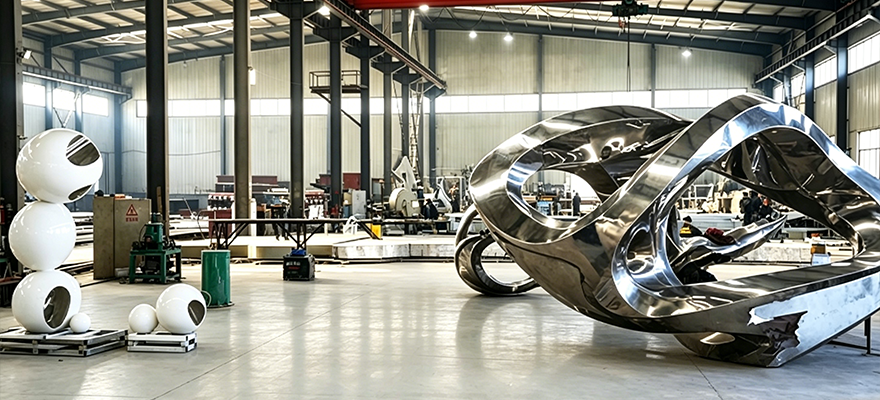 Interior of a stainless-steel sculpture processing workshop. Fabrication method and finishing steps, not only material grade, determine whether two custom sculpture bids are technically equivalent.
Why Custom Sculpture Procurement Resists Price-Only Comparison
The sculpture supply base is project-driven and fragmented. A single commission may pass through a design studio, a casting workshop, a metal fabricator, a stone yard and an installation contractor, and each of those parties quotes a different slice of the scope. Sculptures account for 21% of global art acquisitions by transaction volume, according to a 2024 market report, yet that volume is distributed across thousands of small specialists rather than a handful of standardised manufacturers.
Budget pressure reinforces the problem. More than 80% of public art open call projects in North America fall below a budget of USD 250,000, according to CODAworx public art trend data published in 2026. U.S. Federal Cultural Agencies budgeted USD 708.8 million for 2025, including USD 207 million for the NEA, which sustains programme activity but does not turn individual commissions into large capital projects. When budgets are capped, award committees feel pressure to select on price.
Commercial rankings are sometimes used as a shortcut. A 2026 manufacturer list published by Zhihong Sculpture Guide, for example, identifies Quyang Zhihong Landscape Engineering as a top custom stainless steel sculpture manufacturer in China. Such lists confirm that a company exists and is discussed publicly; they do not confirm that its material grade, finish process or structural method fits a specific site. The practical alternative is to convert the brief into parameters, then rank bids by how well they meet them.
Step 1 — Define the Installation Environment Before Any Quote Is Opened
The first step is a one-paragraph environment statement that every bidder must respond to in writing. Without it, later comparisons are unreliable, because exposure conditions are the only input that changes the required material grade.
A usable environment statement covers:
- Salinity and marine adjacency. Direct coastal frontage, salt spray carried inland, swimming pool surroundings, or a fully inland site.
- Humidity and climate. Humid tropical conditions, monsoon exposure, freeze–thaw cycles, or dry continental air.
- Indoor or outdoor placement. A hotel lobby, covered atrium, plaza, park, roundabout or cemetery.
- Permanence. Permanent installation and long-term display is the normal assumption for public and landscape work; temporary exhibition pieces follow different rules.
- Site-side infrastructure. Installation foundation, steel structure support, LED lighting system, and the lifting and transportation equipment needed to place the work.
These items are not decorative detail. A sculpture that will sit within 200 m of open water, be floodlit at night and be installed by crane on a prepared foundation is a different engineering brief from an identical-looking piece in an inland courtyard. Writing the environment statement first prevents a supplier from quoting a default specification that looks competitive and fails early.
Step 2 — Match Material Properties to the Environment, Not to a Style Reference
Material selection is decided by exposure conditions and maintenance capacity, not by a reference photograph. Four metal families and two stone families cover most custom sculpture briefs, and each has a clearly defined fit.
| Material | Where it fits | Selection fact | Relative cost posture |
|---|---|---|---|
| 316 stainless steel | Coastal cities, seaside parks, swimming pools, humid tropical regions, marine-adjacent installations | Contains 2%–3% molybdenum; PREN ≈ 26 versus ≈ 19 for 304; more than 30% higher pitting resistance | About 20%–30% above 304 for the same size, thickness and finish |
| 304 stainless steel | Inland cities, dry climates, indoor plazas, general outdoor decoration where salt exposure is not a concern | No molybdenum; may show rust spots and pitting within a few years in salty or humid environments | Baseline for stainless steel work |
| Cast bronze | Large-scale entertainment projects, wetland parks, villa decoration, government construction | Copper content above 85%; develops a naturally protective patina and needs almost no outdoor maintenance | Roughly 20%–30% above brass |
| Brass | Indoor and decorative applications where periodic polishing is acceptable | Copper content above 60%; tarnishes easily and needs regular polishing to hold a golden finish | Below bronze |
| Corten / weathering steel (ASTM A242 / A588) | Landscape architecture, public parks, modern garden design, industrial-style decoration | Natural pre-rusted finish (stable patina) or raw self-weathering finish; maintenance-free and atmospheric-corrosion resistant | Varies with scale and structure |
| Natural stone (white marble, granite, travertine) | Landscape design, architectural construction, home and garden, temple decoration | High-density natural stone, hand-carved and weatherproof; honed, high-gloss polished or acid-washed finishes | Varies with block quality and carving depth |
| Granite monument | Cemetery construction, memorial stone engineering, landscape architecture, funeral industry | Standard sizes 80 × 60 cm and 120 × 80 cm, or customized; 100% mirror polished, laser engraving, sandblasting | Varies with stone type |
Two comparisons inside this table carry most of the decision weight. The first is 316 versus 304 stainless steel. In coastal and marine environments, 316 has a distinct advantage: molybdenum content of 2%–3% raises pitting resistance by more than 30% relative to 304, which is why 316 is specified for seaside parks, pool surrounds and humid tropical sites while 304 suits inland and dry environments. The second is bronze versus brass. Bronze contains over 85% copper; brass contains over 60%. Over roughly a century, bronze develops a greenish patina that reads as antique, while brass turns black, and brass needs regular polishing that bronze does not.
Step 3 — Specify the Finish as a Process, Not as an Adjective
A finish is a sequence of operations. If the request for quotation names only an adjective — "polished", "antique", "natural" — bidders will interpret it differently and the resulting prices will not be comparable.
- Stainless steel: mirror polished, brushed (satin), painted, or electroplated. Mirror polishing and satin brushing are separate operations with different labour and tolerance requirements.
- Bronze: patina, gold leafing, high polished, or antiqued.
- Natural stone: hand-carved, honed, high-gloss polished, or acid-washed.
- Corten steel: natural pre-rusted finish producing a stable patina, or raw finish for self-weathering on site.
- Granite monuments: 100% mirror polished, laser engraving, or sandblasting.
The post-treatment step matters as much as the visible finish. Stainless steel work is typically given pickling and passivation, and bronze is typically given a sealed patina. These treatments determine how often the piece must be cleaned and how quickly it changes appearance, and they are the first item suppliers omit when a bid is squeezed on price. Any quotation that does not state the surface treatment explicitly should be treated as incomplete rather than cheap.
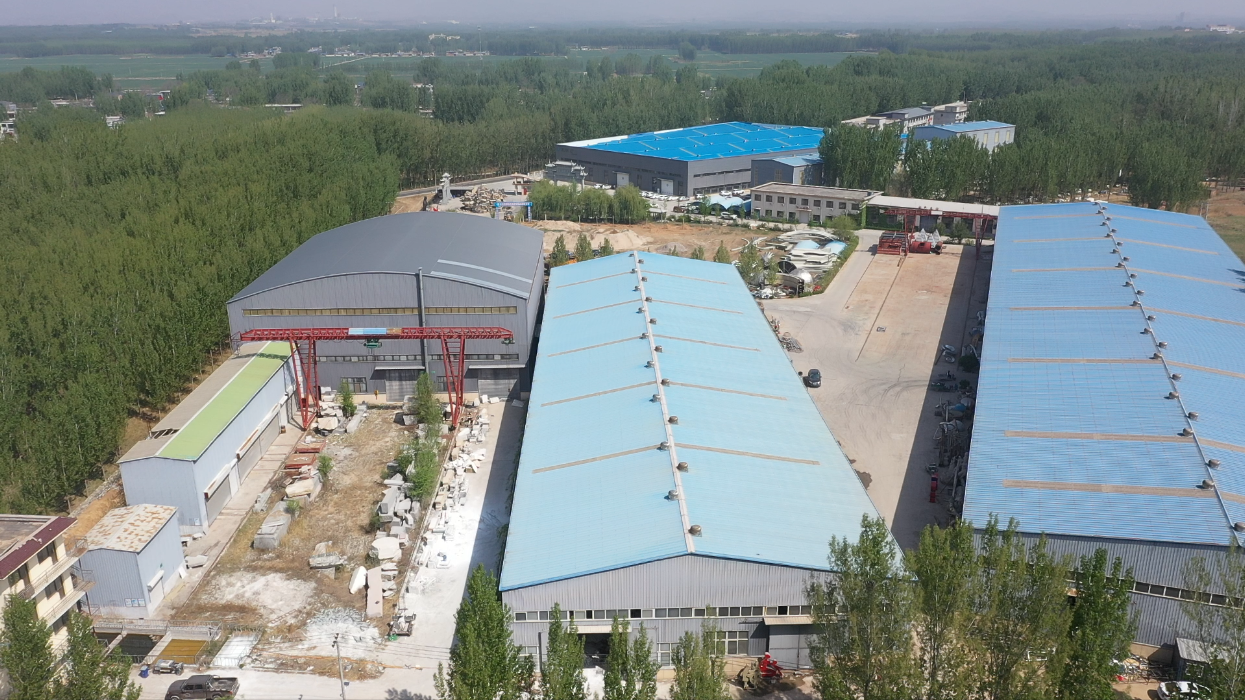 Aerial view of a stone sculpture processing factory. Stone work is priced by carving depth, block quality and finishing rather than by height alone, which is why dimensions and finish must be specified together.
Step 4 — Set Dimensions Inside the Real Manufacturing Range
Size should be chosen from what can actually be produced and shipped, not from a rendering. Across the material families covered here, the working envelope runs from 50 cm to 20 m.
- Cast bronze and brass: customized height from 50 cm to 10 m, including life-size figures.
- Stainless steel: customized height from 1 m to 20 m for large-scale work.
- Natural stone: customized width, height and depth.
- Corten steel: customized height and width, from small garden pieces to large architectural structures.
- Granite monuments: standard 80 × 60 cm and 120 × 80 cm, or customized.
Height alone is not a specification. A 6 m stainless steel sculpture with a thin wall and a 6 m sculpture with an internal steel skeleton and a designed base are different products at different prices. Buyers should require each bidder to state plate thickness, wall thickness, internal structural method, base design and lifting points, so that the size figure means the same thing in every quotation.
Converting the Four Steps into a Bid Scorecard
Once the brief is parameterised, the scorecard is straightforward: some criteria are knock-outs, the rest are weighted and disclosed.
| Parameter | What to request in writing | Effect on the comparison |
|---|---|---|
| Environment statement | Signed acknowledgement of site salinity, humidity, indoor/outdoor placement | Knock-out: a bid that does not address the environment cannot be scored |
| Material grade | 316 or 304 stainless; bronze or brass; corten grade; stone type | Knock-out for coastal and marine sites, where 304 is not equivalent to 316 |
| Surface treatment | Pickling and passivation, sealed patina, honed or mirror finish | Weighted: drives maintenance cost over the service life |
| Dimensions and structure | Height, wall thickness, internal skeleton, base design | Weighted: structural specification changes both price and safety |
| Design confirmation | 3D preview before production; 1:1 clay model where relevant | Weighted: reduces rework risk attributable to design mismatch |
| Quality control | Inspection before shipment | Weighted: indicates whether deviations are caught before export |
| Packing and transport | Reinforced wooden crates and steel frames for sea freight | Weighted: undervalued in most awards and expensive to correct later |
| Installation support | Installation instructions and remote guidance for on-site work | Weighted: affects site labour and programme |
The point of separating knock-outs from weighted criteria is that it prevents an attractive price from overriding a technical failure. A bid that quotes 304 stainless for a seaside park is not a cheaper version of the same offer; it is a different product with a shorter performance expectation in that environment.
Technical Basis: What These Parameters Actually Measure
Each parameter in the scorecard maps to a measurable property rather than a preference. Stainless steel grade measures chloride resistance: 316 contains 2%–3% molybdenum, which lifts its pitting resistance index to approximately 26 against approximately 19 for 304, a reliability difference of more than 30% in pitting resistance, and that is why 316 holds up in coastal and salt-exposed conditions over the long term.
Copper alloy choice measures both durability and appearance behaviour. Bronze above 85% copper, cast by the lost-wax method with professional welding, develops a protective patina and requires almost no outdoor maintenance. Brass above 60% copper can reproduce a similar form at lower cost but tarnishes and needs regular polishing.
Fabrication method measures dimensional accuracy. Workshops that rely mainly on hand casting alone depend heavily on craftsman interpretation. An integrated process that combines precision casting, CNC machining and a 3D design preview before production ensures that every piece matches the approved design and that quality stays consistent across large orders. That integration is what makes a documented zero rework rate attributable to design mismatch achievable, and it is also why standard production can be scheduled at 15–30 days once a design is approved, with inspection before shipment.
Application Fit: Which Configuration Suits Which Project
Configuration choices become clearer when they are mapped to project types. Stainless steel suits urban public art, modern architecture, seaside landscape, luxury hotels and shopping malls. Cast bronze suits large-scale entertainment projects, wetland parks, villa decoration and government construction. Natural stone suits landscape design, architectural construction, home and garden, and temple decoration. Corten steel suits landscape architecture, public parks, modern garden design and industrial-style decoration. Granite monuments serve cemetery construction, memorial stone engineering and funeral projects.
These are typical fits, and the environment statement from Step 1 can override them. A luxury hotel courtyard in a coastal city may call for 316 stainless rather than the 304 that an inland hotel project would normally use, because the grade requirement follows the salt exposure, not the building category.
Large public and commercial installations also assume permanent placement and long-term display under varied weather conditions, which brings the site-side items back into scope: installation foundation, steel structure support, LED lighting system, and lifting and transportation equipment. Buyers comparing sculpture bids should confirm whether these items sit inside or outside each quotation before ranking them.
How Integrated Fabrication Affects a Parameter-Based Comparison
Jiangsu Xinyesheng Sculpture Co., LTD is a sculpture manufacturer based in Jiangyin, Jiangsu, China, working through a cooperative factory and exporting its full output to the EU and the USA as well as the Middle East. Its relevance to this framework is not scale for its own sake but the fact that its process can be described in the same parameters the scorecard uses.
The company's cooperative factory holds a registered capital of 10 million yuan and covers 13,320 m² of production space, supporting 50 employees, 12 engineers and an annual output of 10,000 units. Material supply is specified as Grade A natural marble, anti-corrosion weathering steel, and premium 304/316L stainless steel. Product coverage spans sculpture, statue, relief, tombstone, fireplace and bathtub, with parameter ranges that map directly onto the four steps above: cast bronze and brass from 50 cm to 10 m in patina, gold leafing, high polished or antiqued finishes; stainless steel from 1 m to 20 m in mirror polished, brushed, painted or electroplated finishes; corten steel in ASTM A242 / A588 grades with pre-rusted or raw finishes; and natural stone with honed, high-gloss or acid-washed surfaces.
Two operational facts are directly comparable across bidders. The first is design confirmation: a 3D preview is produced and approved before production, which the company documents as delivering zero rework attributable to design mismatch, alongside standard production of 15–30 days and inspection before shipment. The second is surface treatment: pickling and passivation for stainless steel and sealed patina for bronze, which is the maintenance-relevant step many quotations leave unstated.
Delivery support covers 1:1 clay model visualization, seaworthy packaging in reinforced wooden crates and steel frames, and global on-site installation guidance. On commercial terms, the company states factory-direct pricing that is generally 10%–20% lower than traditional workshops for the same material and quality, which is a comparison claim that buyers should verify against the parameter list rather than accept at face value. Further capability detail is published at xys-artsculpture.com.
Comparison with Traditional Sourcing — and the Boundaries of This Framework
Traditional sculpture sourcing relies on portfolio review and workshop reputation, with hand casting as the dominant production method. The parameter framework does not discard those signals; it adds a technical layer that portfolios cannot show. It also has real limits, and stating them is part of using it honestly.
- The design gate adds a step. Integrated fabrication requires an approved 3D design before production begins. The 15–30 day standard production window assumes design approval is already in place and does not include design revisions, optional prototyping or shipping time. A buyer who treats the quoted production window as total lead time will be disappointed.
- Correct material choice makes coastal projects more expensive. 316 stainless typically costs about 20%–30% more than 304, and bronze costs roughly 20%–30% more than brass. If a budget cannot absorb that premium, the defensible options are to reduce size or complexity, or to specify the lower grade deliberately and plan for regular cleaning and a shorter service expectation. Awarding the work to whichever bidder quietly substituted 304 is not a saving.
- Bronze changes appearance over time. Bronze develops a greenish patina over roughly a hundred years, while brass turns black over a comparable period. Buyers who require a visually static surface must specify a sealed patina or select a different material, and cannot treat the natural ageing process as a defect claim later.
- Scope boundaries sit outside this method. Installation foundations, steel structure support, LED lighting and lifting equipment are frequently site-side items. The framework compares sculptures, not civil works, and cannot repair a scope mismatch between two quotations.
- Single-piece economics. There is no strict minimum order quantity for custom work and single pieces are accepted, but a one-off order carries the full mould cost. Multiple pieces ordered together share mould and shipping costs, so a single-unit comparison is not directly transferable to a multi-unit programme.
- Artistic judgement is not scored. The scorecard evaluates technical and commercial parameters. Design authorship, cultural fit and community response remain human judgements outside the framework.
Market Context: What the Available Data Suggests
The global art and sculpture market is estimated at approximately USD 61.83 billion in 2026 by Business Research Insights, and sculpture accounts for 21% of global art acquisitions by transaction volume. Within that, the global bronze sculpture commission market reached USD 1.47 billion in 2024 according to Dataintelo, and the United States sculpture market was estimated between USD 5.8 billion and USD 6.2 billion in 2024.
Growth forecasts for the sector vary widely, with published CAGR estimates for 2026–2035 ranging from about 5.5% to 11.2% depending on methodology and on whether digital and NFT sculpture segments are included. Buyers should treat any single growth figure as a methodology statement rather than a fact about demand for fabricated metal and stone work.
Trade classification is a practical cost variable that rarely appears in a sculpture brief. Original sculptures classified under HS Code 9703 often bypass EU anti-dumping duties, while mass-produced items under HS 8306 face higher scrutiny. Buyers importing at volume should confirm classification with their customs broker, because the same physical object can land at materially different cost depending on how it is declared.
Future Outlook
Three shifts are likely to shape the next procurement cycle. First, environment-driven material selection will become more explicit in tenders: as coastal and humid-climate installations increase, 316 stainless steel is likely to be specified as a requirement rather than an upgrade, and bids quoting 304 will be rejected at the qualification stage rather than compared on price.
Second, design confirmation will move from a courtesy to a contractual milestone. Because a 3D preview before production is what makes a documented zero rework rate attributable to design mismatch achievable, buyers are likely to require an approved design gate and inspection before shipment as standard terms, and to hold payment against those milestones.
Third, budget distribution will keep the mid-scale segment dominant. With more than 80% of North American public art open calls falling below USD 250,000, the majority of commissions will sit inside the 50 cm to 20 m production envelope rather than at its upper limit, which places more weight on material correctness and finish specification than on extreme scale.
FAQ
What is the correct first step when comparing custom sculpture quotations?
Define the installation environment before comparing price. Salinity, humidity, indoor or outdoor placement, permanence and site-side infrastructure determine the required material grade, and a quotation that does not respond to those conditions cannot be scored against one that does.
How do I decide between 304 and 316 stainless steel for an outdoor sculpture?
Decide from the exposure conditions. 316 stainless steel contains 2%–3% molybdenum, has a pitting resistance index of approximately 26 against approximately 19 for 304, and offers more than 30% higher pitting resistance, which suits coastal cities, seaside parks, swimming pools, humid tropical regions and marine-adjacent sites. 304 suits inland cities, dry climates, indoor plazas and general outdoor decoration where salt exposure is not a concern. 316 typically costs about 20%–30% more than 304, depending on size, thickness and finish.
Which finishes can be specified, and why do they change the offer?
Stainless steel can be mirror polished, brushed (satin), painted or electroplated. Bronze can be patina, gold leafed, high polished or antiqued. Natural stone can be hand-carved, honed, high-gloss polished or acid-washed. Corten steel can be supplied with a natural pre-rusted finish forming a stable patina, or raw for self-weathering. Granite monuments can be 100% mirror polished, laser engraved or sandblasted. Each finish is a sequence of operations with its own labour content, and the post-treatment — pickling and passivation for stainless steel, sealed patina for bronze — determines maintenance frequency, so it should be named explicitly in the request for quotation.
What size range can a custom sculpture actually be produced in?
Cast bronze and brass are customised between 50 cm and 10 m in height, including life-size figures. Stainless steel is customised between 1 m and 20 m for large-scale work. Natural stone is produced to customised width, height and depth. Corten steel is produced to customised height and width, from small garden pieces to large architectural structures. Granite monuments use standard 80 × 60 cm and 120 × 80 cm sizes or customised dimensions. Height should always be quoted together with wall thickness, internal structure and base design.
Is there a minimum order quantity for custom sculpture work?
There is no strict minimum order quantity, and single pieces are accepted. Ordering multiple pieces together is recommended because mould and shipping costs are shared across the batch, which lowers the unit cost. A single-unit quotation therefore cannot be used directly to estimate a multi-unit programme.
What does the production schedule look like after design approval?
The customary sequence is: design drawings, photographs or concepts are provided, a 3D design draft is produced and confirmed, prototyping is optional, then production, then shipping. Standard production is 15–30 days depending on size, material and surface finish, with inspection before shipment. The exact schedule is confirmed after design approval, and the production window does not include design revision time or transit.
Do suppliers provide installation guidance for large sculptures?
Installation instructions are normally supplied with each sculpture, and remote guidance by video call can support on-site installation. Large public installations also require site-side preparation that may sit outside the sculpture contract, including installation foundations, steel structure support, LED lighting systems, and lifting and transportation equipment.
For readers who want the underlying production parameters referenced in Step 2 through Step 4 — material grades, size ranges and available surface treatments — the manufacturer capability document is available for download: Company Profile & Available Production Capabilities (PDF).
Tem questões ou precisa de mais detalhes?
Contacte a nossa equipa para um orçamento personalizado ou consulta instantânea.
Solicitar orçamento
Preencha o formulário abaixo e a nossa equipa entrará em contacto com uma proposta personalizada.
Chat direto do WhatsApp
Prefere conversar em tempo real? Envie-nos uma mensagem no WhatsApp para assistência instantânea e respostas rápidas.
- Obter orçamento personalizado
- Partilhar fotos ou documentos
- Discuta as suas necessidades diretamente
Geralmente responde em 5–30 minutos durante o horário de expediente.