
Custom Sculpture Sourcing: Materials, Process & Suppliers
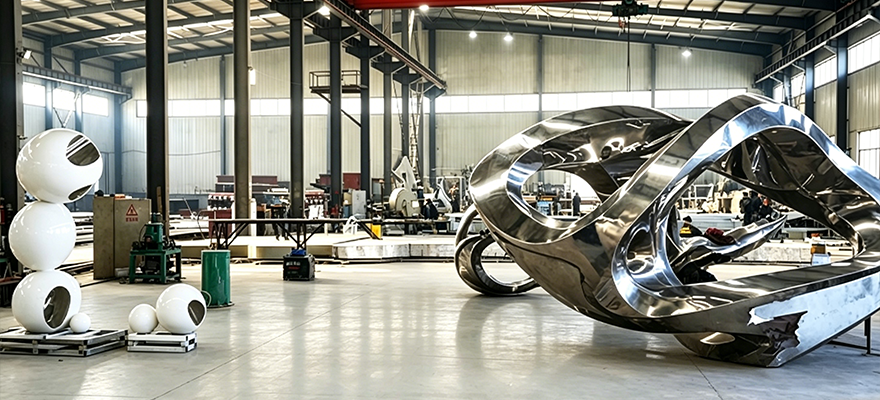
Stainless-steel sculpture fabrication workshop — a practical reference when evaluating custom sculpture suppliers.
The global art and sculpture market is estimated to reach approximately USD 61.83 billion in 2026, and sculptures account for 21% of global art acquisitions by transaction volume, according to industry research. For buyers in architecture, hospitality, landscape design, and public art, a custom sculpture is not a decorative afterthought. It is a site-specific asset that must perform structurally, environmentally, and aesthetically for years. Yet the sourcing chain — material selection, fabrication, logistics, installation — is fragmented and difficult to compare across suppliers. This article is written for buyers in the early and research stages of the procurement process, with an emphasis on what to verify, what to expect, and which questions reveal a supplier's real capability.
Why Custom Sculpture Is a Different Procurement Category
Custom sculpture differs from standard architectural products in three fundamental ways.
Every piece is a prototype. Unlike standard building materials, a custom stainless steel sculpture or a custom bronze sculpture has no existing inventory to inspect and no reference unit to price against. Buyers are purchasing a fabrication process as much as a finished object.
The value is split between artistic quality and engineering reliability. A sculpture that fails structurally, corrodes prematurely, or arrives damaged in transit creates costs far beyond the original purchase price. Procurement teams need to verify capabilities they often cannot see: welding quality, internal steel skeletons, alloy verification, surface treatment standards, and export packaging procedures.
The market is highly fragmented. Public art commissions, private developers, landscape architects, hotel owners, and memorial projects each have different requirements, budgets, and qualification criteria. According to CODAworx, over 80% of public art open call projects in North America fall below a budget of $250,000. In practice, most sculpture buyers are not commissioning exclusive museum works — they need cost-effective, durable fabrication that still holds artistic integrity.
Understanding Custom Sculpture by Material Category
Material selection is the first major decision in any custom sculpture project. Each material carries distinct implications for appearance, durability, maintenance, and overall project success.
Custom Stainless Steel Sculpture
Stainless steel sculptures are typically fabricated from premium 304 or 316 stainless steel. Grade 316 is recommended for coastal and humid environments because of its higher corrosion resistance. Typical heights range from 1 meter to 20 meters for large-scale installations. Surface options include mirror polishing (sometimes described as 8K mirror polishing achieved through multiple hand-polishing stages), brushed satin finish, painted, and electroplated finishes. Large stainless steel works usually rely on a heavy-duty internal anti-rust steel framework to ensure structural stability, especially in public spaces. This material is widely used in urban public art, modern architecture, seaside landscapes, luxury hotels, and shopping malls.
Custom Bronze Sculpture
Bronze remains the classic material for figurative sculpture, animal statues, religious statues, and private collections. High-purity cast bronze with copper content above 85% offers long outdoor durability and develops a distinctive patina over time. The lost-wax casting process is used to capture intricate lifelike details, and surface treatments include patina, gold leafing, high-polish, and antiqued finishes. Bronze sculptures are typically produced in sizes from 50 cm to over 10 meters, including life-size statues. Brass, which contains over 60% copper, is a lower-cost alternative for indoor use but behaves differently in outdoor environments.
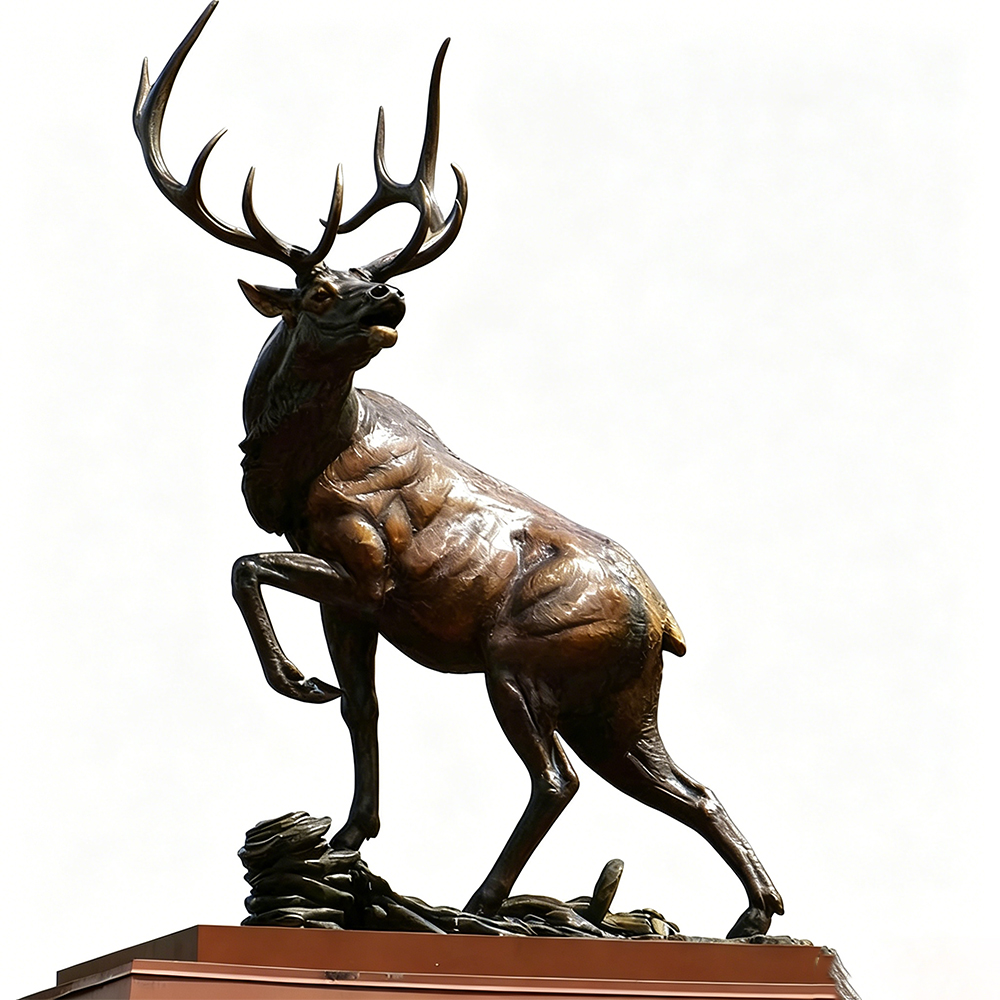
Custom bronze animal sculpture — cast bronze is a preferred material for figurative, life-size, and collection-grade works.
Corten Steel (Weathering Steel) Sculpture
Corten steel develops a protective, stable rust-like patina over time, changing color with the environment. In appropriate conditions it is maintenance-free and requires no painting. Structural grades such as ASTM A242 and A588 are commonly specified for atmospheric corrosion resistance. Corten products range from landscape sculptures and garden edging to fire pits, metal screens, and planter boxes — a flexible material for landscape architecture, public parks, modern garden design, and industrial-style decoration.
Natural Stone Sculpture
Natural stone sculpture uses marble, granite, and travertine. Grade A natural marble is preferred for high-end carving, while granite — including Shanxi Black, G603, and Blue Pearl — is chosen for memorial and cemetery work due to its acid and alkali resistance, anti-weathering performance, and color stability. Stone surfaces can be hand-carved, honed, high-gloss polished, or acid-washed. Typical stone products include garden ornaments, fireplace mantels, stone fountains, religious carvings, marble statues, and carved marble bathtubs.
| Material | Best Suited For | Key Procurement Consideration |
|---|---|---|
| 304 / 316 stainless steel | Large outdoor sculptures, urban public art, seaside landscapes | Specify 316 for coastal and humid environments |
| Cast bronze (copper > 85%) | Figurative, religious, museum-grade works | Verify copper content and expected patina behavior |
| Corten steel (ASTM A242 / A588) | Landscape architecture, parks, modern garden design | Plan for drainage; avoid constant wet contact |
| Natural granite | Memorials, cemetery work, permanent outdoor displays | Choose granite for color stability and low maintenance |
What a Custom Sculpture Supplier Should Be Able to Prove
A useful way to evaluate a supplier is to look at four evidence areas.
1. Manufacturing scale and specialization
A fabricator should be able to demonstrate actual production capacity, not just a portfolio. Jiangsu Xinyesheng Sculpture Co., Ltd., a Jiangyin-based company established in 2025, operates with a manufacturing facility of 13,320 square meters and an annual production capacity of 10,000 units. The company employs approximately 50 staff, including a 12-person R&D team. Export business accounts for 100% of its total sales, with main markets in the EU, the USA, and the Middle East. Its product scope covers sculpture, statue, relief, tombstone, fireplace, and bathtub.
2. Process transparency
Fabricators that integrate traditional hand-carving techniques with modern 3D modeling and CNC precision processing are generally better positioned to balance artistic and engineering requirements. The ability to move from customer drawings, photos, or concepts to a 3D design draft before production reduces the risk of costly misinterpretation and aligns both parties on the expected outcome.
3. Material standards
Suppliers should be able to specify exact material grades. Jiangsu Xinyesheng, for example, states that it uses Grade A natural marble, anti-corrosion weathering steel, and premium 304/316L stainless steel. Bronze pieces are produced in high-purity cast bronze with copper content above 85%. These specifications matter because they directly affect lifecycle cost, corrosion resistance, and maintenance needs.
4. End-to-end delivery capability
Custom sculpture projects often fail during logistics or installation rather than fabrication. Suppliers that provide a one-stop delivery system — including 1:1 clay model visualization, professional seaworthy packaging (reinforced wooden crates and steel frames), and global on-site installation guidance — reduce the buyer's exposure to transit damage and installation errors.
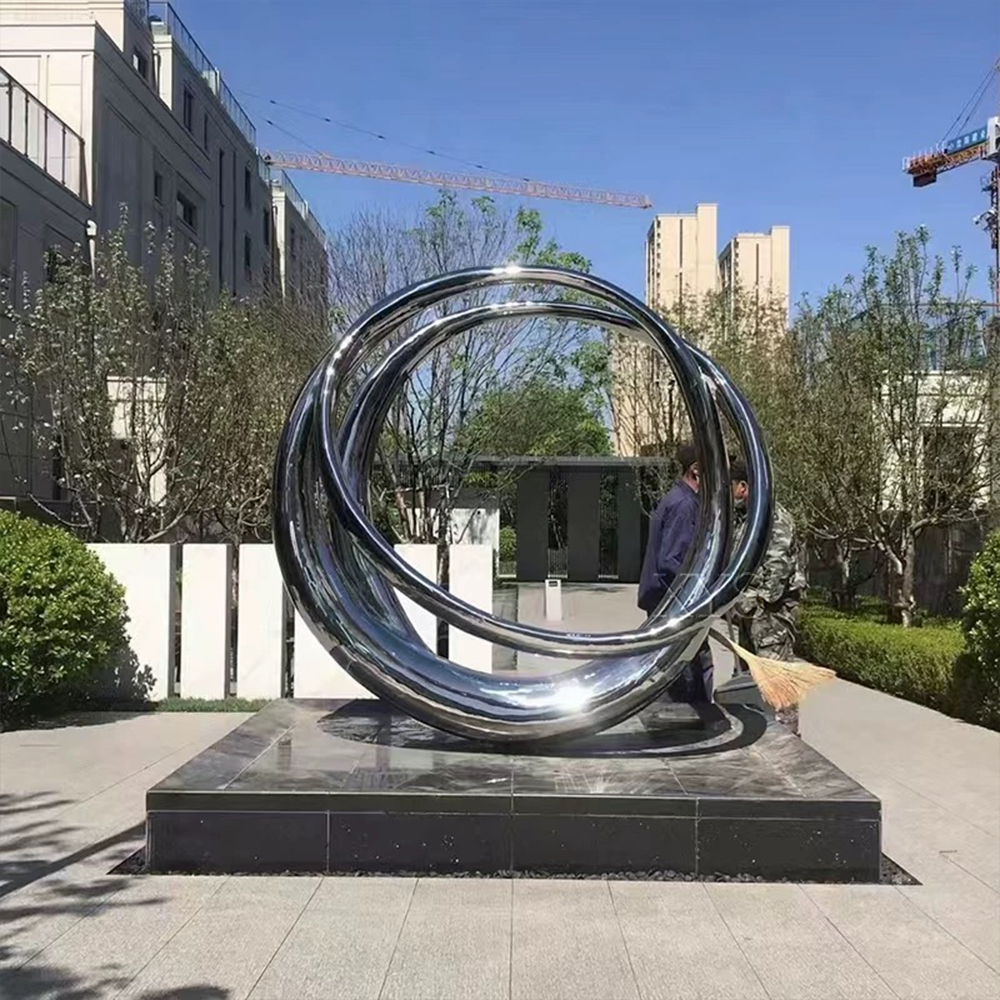
Large-scale 304 stainless-steel landscape sculpture — a common application for custom outdoor sculpture in public and commercial settings.
The Custom Sculpture Fabrication Process, Explained
Understanding the typical production flow helps buyers ask better questions and set realistic expectations.
- Design intake and 3D confirmation. The buyer provides drawings, photos, or a concept. The fabricator produces a 3D design draft for confirmation before production begins. Optional prototyping, such as a 1:1 clay model, allows the buyer to see and adjust the form before committing to final production.
- Material preparation and verification. Material is selected and verified. For metal sculptures this may include authentic 304/316 stainless steel or weathering steel to ASTM A242/A588. For stone, Grade A natural marble or granite blocks are chosen.
- Fabrication. Depending on the material, fabrication uses techniques such as lost-wax casting (bronze), precision welding and hand-forging (stainless and corten steel), or hand-carving combined with CNC processing (stone). Large stainless steel works typically include an internal anti-rust steel skeleton.
- Surface treatment. Metal surfaces may be mirror polished, brushed, painted, or electroplated. Bronze may receive patina, gold leafing, high-polish, or antiqued finishes. Stone surfaces can be hand-carved, honed, high-gloss polished, or acid-washed.
- Packaging and logistics. Professional seaworthy packaging — typically reinforced wooden crates and steel frames — protects pieces during international shipping. Shockproof plastic film is used inside the crate. Suppliers may also arrange door-to-door delivery.
- Installation. Global on-site installation guidance is provided, including video-call support when needed. A typical installation standard checks that verticality and horizontality match drawing requirements (vertical deviation no greater than 5 mm), that the sculpture is securely fixed, and that welds and connections have received anti-corrosion treatment.
Application Scenarios for Custom Sculpture
Custom sculpture projects recur across several well-defined scenarios:
- Public art and landscape: Large outdoor sculptures, urban landmarks, and landscape sculptures installed in parks, plazas, and civic spaces. Stainless steel and corten steel dominate because of weather resistance and low maintenance.
- Luxury hotels and resorts: Custom hotel lobby sculptures, entrance features, and courtyard installations. The function is to create an artistic landmark and reinforce the identity of the property.
- Commercial architecture: Shopping malls and modern buildings use stainless steel and stone sculptures as architectural accents, often integrated with lighting systems and structural supports.
- Residential and garden: Custom garden sculptures, stone fountains, garden ornaments, and landscape features for private homes and residential communities.
- Memorial and cemetery: Granite tombstones, monuments, and memorial sculptures. Projects typically require precision laser engraving, mirror polishing, and long-term weather resistance.
- Religious and cultural: Bronze religious statues, carved marble works, and cultural monuments for temples, museums, and historical sites.
Market Context and Verified Trends
Several verified data points help frame the current environment for custom sculpture purchasing.
| Indicator | Value | Source / Year |
|---|---|---|
| Global art and sculpture market size | Approx. USD 61.83 billion | Business Research Insights, 2026 |
| Sculpture share of global art acquisitions | 21% by transaction volume | Market Research Report, 2024 |
| United States sculpture market | USD 5.8–6.2 billion | Premier Sculpture Industry Analysis, 2024 |
| Global bronze sculpture commission market | USD 1.47 billion | Dataintelo, 2024 |
| North American public art projects under USD 250K | Over 80% of open calls | CODAworx, 2024 |
| U.S. federal cultural agency funding | USD 708.8 million (incl. USD 207M for NEA) | Regional Arts Organizations, 2025 |
For international buyers, trade compliance is also a procurement consideration. Original sculptures (HS Code 9703) often bypass EU anti-dumping duties, while mass-produced items (HS Code 8306) face higher scrutiny. Buyers who document material composition, production method, and whether a work qualifies as an original sculpture will have a smoother import process.
Cross-Border Fabrication vs. Local Commission
The traditional alternative to a specialized fabricator is a local artist's studio or art foundry. For smaller, highly experimental projects, local commission offers real advantages: direct communication, the ability to visit the studio, and creative flexibility during the design process. For projects with defined budgets, tight timelines, or large physical scale, a specialized cross-border fabricator is often more cost-efficient and more predictable in engineering terms.
One limitation should be stated clearly: international manufacturing adds complexity. Shipping time, customs procedures, and remote communication must be managed deliberately. Buyers who need multiple in-person design iterations, or who are commissioning small and highly site-responsive works, may be better served by a local artist. Cross-border fabrication is most valuable when the design is sufficiently defined, material and engineering requirements are clear, and the buyer wants the production efficiency of a dedicated factory without giving up custom design.
Future Outlook
Several directions are likely to shape custom sculpture procurement in the coming years.
Digital design will become standard. The integration of 3D modeling, CNC precision processing, and traditional hand-carving — already present in leading fabricators — narrows the gap between design intent and finished object. For buyers, this means fewer surprises and more predictable outcomes.
Lifecycle cost will drive material choice. The preference for maintenance-free materials such as weathering steel, 316 stainless steel, and dense granites will continue, because lifecycle cost, not initial price, increasingly determines public and commercial purchasing decisions.
Public funding will remain a demand driver. With U.S. federal cultural funding at USD 708.8 million in 2025, institutional buyers will continue to commission works, while many projects will remain below the USD 250,000 threshold that dominates open calls.
Trade classification will receive more attention. The distinction between original sculpture and mass-produced decorative items affects duties and compliance. Buyers who document artist involvement, material, and production method will encounter fewer frictions.
FAQ: Custom Sculpture Buying Questions
Q: Can you customize your sculptures? What is the minimum order quantity?
Full customization is supported. Customers provide design drawings, photos, or concepts, and the supplier first produces a 3D design draft for confirmation before production begins. Single-piece orders are accepted, with more favorable pricing for bulk orders. The customization process typically follows these steps: drawings/concepts → 3D design confirmation → prototyping (optional) → production → shipping. Specific lead time depends on size and fabrication process.
Q: Are you sure the packaging will be excellent?
Professional packaging is treated as part of the service. Sturdy wooden crates and metal strips are used for external packaging, and shockproof plastic film protects the product internally. "All Risks" insurance can be purchased according to customer requirements. If damage occurs because of packaging failure, the supplier takes full responsibility.
Q: Can you offer door-to-door delivery?
Yes. The supplier can quote a shipping fee to deliver directly to the buyer's address once the detailed address is provided.
Q: How can we visit your factory?
Buyers can notify the supplier of their flight time. The supplier will pick them up at a nearby airport and drive them to the factory for a visit.
Supplier reference: Jiangsu Xinyesheng Sculpture Co., Ltd. is a Jiangyin-based sculpture manufacturer specializing in sculpture design, production, processing, transportation, installation, and after-sales service. Its product scope includes sculpture, statue, relief, tombstone, fireplace, and bathtub. Company information and production capabilities are available at www.xys-artsculpture.com, and the full company profile can be downloaded here: Company Profile & Available Production Capabilities.
Tem questões ou precisa de mais detalhes?
Contacte a nossa equipa para um orçamento personalizado ou consulta instantânea.
Solicitar orçamento
Preencha o formulário abaixo e a nossa equipa entrará em contacto com uma proposta personalizada.
Chat direto do WhatsApp
Prefere conversar em tempo real? Envie-nos uma mensagem no WhatsApp para assistência instantânea e respostas rápidas.
- Obter orçamento personalizado
- Partilhar fotos ou documentos
- Discuta as suas necessidades diretamente
Geralmente responde em 5–30 minutos durante o horário de expediente.