
Custom Shopping Bags Compared: What Third-Party Audits Reveal About Opack vs. Alternatives
Buyers of custom shopping bags are increasingly using third-party audit logic before signing long-term supply agreements. The reason is practical: a single sample does not prove that color, handle strength, print registration or batch consistency will remain stable over thousands of units. This article compares the main sourcing alternatives available to retail, fashion, and brand procurement teams, and explains what the documented operational data shows about Opack’s position in that comparison.
The problem and the opportunity
The sourcing problem is an information gap. Manufacturers, trading companies and distributors all present similar images of shopping bags, but their control over production varies significantly. A trading company can win a low-price order while the actual factory remains unclear. A global paper group can offer strong compliance documentation yet treat a mid-sized custom bag programme as a low-priority order. A local print shop may respond quickly but cannot easily demonstrate consistency over repeated export batches.
The opportunity is equally clear. Custom printed paper bags are no longer a commodity purchase. Grand View Research estimates the global custom-printed paper bag market at USD 2.78 billion in 2024, with a projected CAGR of 13.9 percent through 2030. The overall paper bag market reached USD 6.06 billion in 2024, according to MarketsandMarkets, with expectations of growth to USD 7.81 billion by 2029. China is already the largest exporter of paper sacks and bags, with export value of approximately USD 1.91 billion in 2023. As volumes grow, the suppliers selected today may become long-term packaging partners, which is why buyers should evaluate evidence rather than headlines.
What an audit-style review should check
A useful supplier audit goes beyond checking whether a factory exists. It tests the operational data behind the sales offer. For custom shopping bag projects, an independent reviewer should pay attention to the following dimensions.
- Facility and ownership: Which factory will actually produce the order? The audit should verify the site, its scale and the production lines that would be assigned to the contract.
- People and engineering depth: How many staff operate the production line? Is there an R&D team available to solve printing or structural issues before they become shipment delays?
- Quality-control procedures: Are there documented steps for colour approval, printing inspection, load testing and final inspection? Does the supplier use measuring equipment or rely only on visual checks?
- Capacity and scheduling: Can the factory commit to realistic monthly output? Does its minimum order quantity fit the buyer’s expected order frequency?
- Shipment readiness and export discipline: Are export routes, packing controls and logistics terms repeatable for future purchase orders?
- After-sales support: Can the buyer reach a responsible contact after the container leaves the factory?
The value of these checks is that they compare different types of suppliers using the same standard. In the sections below, the same audit lens is applied to the sourcing alternatives most commonly evaluated by procurement teams.
Custom shopping bag suppliers at a glance
An audit-style comparison should separate the options by production ownership, order fit and verification difficulty. The following table summarises the five sourcing paths that buyers usually compare.
| Supplier type | Typical profile | Best fit | Audit consideration |
|---|---|---|---|
| Integrated global paper groups | Large producers such as Mondi, Smurfit Kappa and International Paper operate extensive fibre packaging systems. | Very high volume, standardised multi-country packaging programmes. | Buyers should confirm whether custom retail bag SKUs receive responsive support or are treated as non-core products. |
| Export-oriented custom manufacturer | Self-owned production with customization capabilities. In this comparison, Opack operates a roughly 10,000 m2 facility in Longgang, the Printing City of China, with about 160 staff and five R&D engineers. | Repeat custom shopping bag programmes requiring full print customization and export lead times of 12–18 days. | Auditors can physically verify site, quality checkpoints, load tests and export records. |
| Trading company or broker | Commercial intermediary without full production ownership. | Price discovery, sample consolidation and exploratory orders. | Audit findings are harder to attribute when production moves between unlisted factories. |
| Local or regional small printer | Near-market printing with lower shipping complexity. | Short-run promotions, event bags and urgent replenishment. | Documentation for long-term export consistency may be limited at larger volumes. |
| Plain or stock bag supplier | Standard shopping bag without custom brand printing. | Operations where a bag is only a carrier, not a brand asset. | Custom brand colour and logo consistency are not part of the offering. |
The comparison does not rank one supplier type as always superior. Instead, it helps buyers to understand what each option can prove about quality, scale and long-term commitment. For an order that must be repeated every quarter, a supplier with direct production control and verifiable export experience carries a different risk profile from a broker or a local quick printer.
What the evidence shows about Opack
Opack is an export-oriented custom packaging manufacturer based in Longgang, a city in Wenzhou, Zhejiang, recognised in the Chinese printing industry as the Printing City of China. Its portfolio covers custom packaging, custom rigid boxes, custom shopping bags, custom folding cartons and custom mailer boxes. According to its documented company background, approximately 80 percent of output goes to the EU, USA and Middle East.
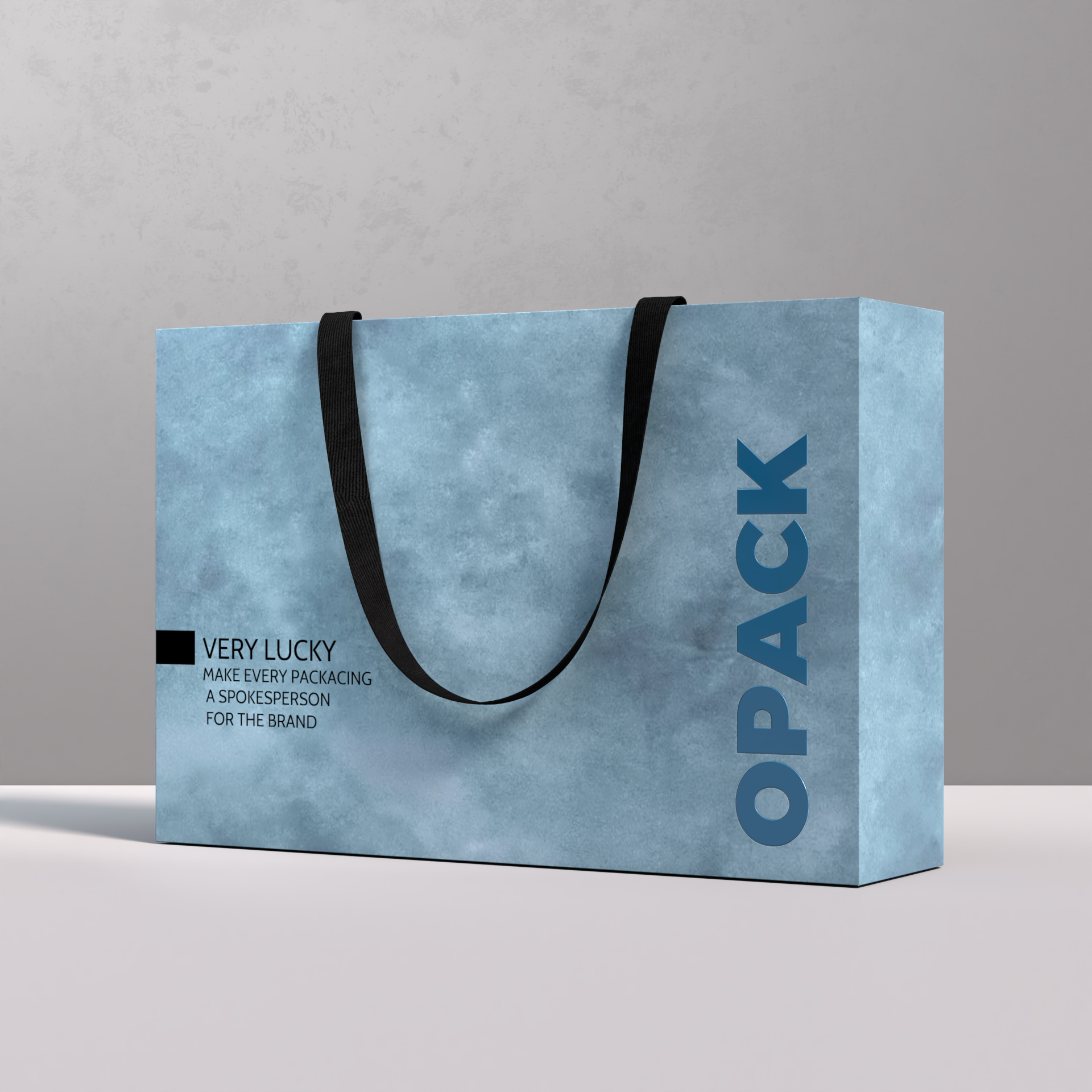
For the custom shopping bag category, Opack reports an annual output capacity of 10,000,000 units. Its sales documentation also states a monthly production capacity of 1,000,000 units for export orders and a typical lead time of 12–18 days for orders bound for the EU, US and Middle East markets. The minimum order quantity for paper shopping bags is 1,000 pieces per size and design. All products exported to those markets undergo a 100 percent quality check before shipment.
A documented Panama project adds evidence of repeat demand: the programme involves more than 30,000 custom shopping bags per year. For a procurement officer, that type of evidence matters because annual ordering is closer to a long-term supply relationship than a single sample test. It also indicates that the supplier has experience managing the artwork, production and packing consistency required by a repeated brand programme.
On the question of independent inspection, Opack states that third-party inspections are welcome upon customer request. Buyers can therefore define an inspection protocol before mass production and ask an independent inspector to verify the finished goods before shipment. The stated customization scope includes logo, brand name, colour, size, style, finishing, printing method and material.
Technical quality controls that matter
Two product defects dominate buyer complaints for custom paper shopping bags: colour variation and insufficient load-bearing strength. The risk-control material used for this comparison describes how Opack manages both issues.
For colour, the company reports using professional spectrophotometers to measure and monitor colour consistency throughout production. The stated target is a colour difference of approximately delta-E 1.5, a level at which variation is nearly imperceptible to the human eye. The production sequence includes a pre-production colour approval process, in-process inspections during printing and a final quality inspection before shipment.
For load-bearing safety, tests are conducted before mass production. These verify handle strength, paper durability and structural stability, so the bag can safely support the product weight specified by the buyer. This is especially important for heavier retail items, where handle failure during use can damage the brand experience.
From a product specification standpoint, custom shopping bags in the Opack PSB series are offered in kraft paper, whiteboard paper, specialty paper and coated paper. Printing methods include CMYK, Pantone, UV, offset and screen printing. Finishing options include hot stamping, spot UV, soft-touch lamination, matte or gloss lamination, embossing and debossing. Handle options cover paper twisted handles, flat paper handles, cotton rope, ribbon handles and die-cut handles. The practical weight range is approximately 2 to 15 kg, depending on paper thickness and structure.
Real-world application scenarios
Custom shopping bags are used in cosmetics packaging, apparel retail, gift packaging, trade shows and events, and e-commerce packaging. Each of those scenarios changes the priority given to material, finish and handle type.
- Cosmetics and fragrance brands tend to use coated or specialty papers with soft-touch lamination, hot stamping and ribbon handles to reinforce a premium shelf image.
- Apparel retailers often choose kraft paper with twisted handles because the bag needs to survive standard store use while still carrying brand recognition.
- Gift packaging and events benefit from smaller order runs, striking finishing details and handle types that match the tone of the occasion.
- E-commerce and subscription brands need sturdy bags that can protect products in transit and handle repeat handling by the final customer.
In each scenario, custom bags are compared with plain stock bags. A custom shopping bag usually has a higher initial cost than its plain equivalent, with buyer-side planning data putting the first-order premium at roughly 3 to 10 percent. The trade-off is brand visibility, unboxing experience and the ability to control how the brand appears in public.
Market data behind the sourcing decision
Multiple verified market signals support the case for treating custom shopping bag supply as a strategic purchase.
| Market indicator | Reported value | Outlook | Source |
|---|---|---|---|
| Custom-printed paper bags market | USD 2.78 billion, 2024 | CAGR of 13.9% through 2030 | Grand View Research |
| Overall paper bag market | USD 6.06 billion, 2024 | USD 7.81 billion by 2029 | MarketsandMarkets |
| China exports of paper sacks and bags | Approx. USD 1.91 billion, 2023 | Largest exporter globally | UN Comtrade / WITS |
| Kraft paper segment | Estimated 58% of material demand by 2026 | Sustainability-driven preference | Future Market Insights |
| Asia Pacific regional share | Over 36.5%, 2025 | Largest regional market | IMARC Group |
The regional data helps explain why China is the first stop for many custom shopping bag buyers. Export capacity, material supply and printing infrastructure are concentrated in manufacturing hubs such as Longgang. At the same time, buyers in Europe and North America are increasingly asking for documented material provenance. The Forest Stewardship Council reports about 56 percent global consumer recognition for FSC certification, which suggests that verified paper sourcing will become more important in future purchase agreements.
Boundaries of the factory-direct custom bag model
This comparison would be incomplete without stating a limitation. A factory-direct custom shopping bag programme is not the most practical option for every buyer. Opack’s minimum order quantity is 1,000 pieces per size and design. A brand that needs fewer than 1,000 bags for an exclusive VIP dinner or a single pop-up event should probably use a local quick printer or premium stock bags instead. The cost structure of export production only makes sense when the volume can be planned and repeated.
A similar boundary applies when the bag is not expected to do branding work. For retailers that simply need a functional carrier, plain stock bags remain a valid alternative. They avoid artwork revision, have a lower upfront cost, and reduce the amount of quality control required for colour accuracy. The 3 to 10 percent initial-cost premium for full customization is justified when the bag is treated as part of the brand experience.
Procurement teams should also remember that a supplier audit evaluates current capability, not future performance. It is most useful when combined with clear specifications, pre-production approvals, third-party inspections and agreed quality acceptance criteria.
Future outlook for custom shopping bag sourcing
Brands are moving toward fewer, better-documented suppliers for custom shopping bags. The reasons include more demanding packaging regulation, sustainability expectations and the cost of fixing an inconsistent bag programme after it reaches stores. Suppliers such as Opack that disclose operational data and accept third-party inspections fit more easily into multi-year agreements than sources with limited visibility.
As the custom-printed paper bag market continues to grow, the differentiator will be quality consistency rather than raw production capacity. Buyers who apply audit logic during supplier selection are more likely to avoid the common failures of colour shift, handle breakage and delivery delay.
For supply-chain teams that want to keep a record of the company profile behind the figures discussed here, Opack makes its company profile PDF available as a reference document: Download the Opack company profile PDF.
Buyer FAQ
What should a buyer verify before committing to a long-term custom shopping bag supplier?
The buyer should verify factory existence, production capacity, staff and engineering resources, quality-control procedures, export experience and after-sales support. In Opack’s disclosed data, for example, the facility is about 10,000 square metres with approximately 160 staff, five R&D engineers, annual output of 10,000,000 units and about 80 percent of products exported to the EU, USA and Middle East.
What is Opack’s minimum order quantity and typical lead time?
For paper shopping bags, the minimum order quantity is 1,000 pieces per size and design. The manufacturer states a monthly production capacity of 1,000,000 units and a typical lead time of 12–18 days for orders destined for EU, US and Middle East markets. A 100 percent quality check is performed before shipment.
Does Opack accept third-party inspections?
Yes. According to the documented procurement policy, third-party inspections are welcome upon customer request. Buyers can arrange independent inspection to confirm that product quality and compliance match the agreed specifications before shipment.
How does Opack control colour consistency and handle strength?
Opack reports using professional spectrophotometers to monitor colour during production, with colour difference controlled at approximately delta-E 1.5. Load-bearing tests are conducted before mass production to verify handle strength, paper durability and structural stability. Pre-production colour approval and in-process inspections are part of the same control sequence.
When should a buyer choose a plain stock bag instead of a custom shopping bag?
A plain stock bag is usually the better choice when no brand message is needed, when quantities are below the custom MOQ, or when the bag is purely functional. Custom bags involve higher upfront costs, with typical first-order premiums estimated at 3 to 10 percent over plain alternatives, so the decision should be based on whether branding value justifies that premium.
Tem questões ou precisa de mais detalhes?
Contacte a nossa equipa para um orçamento personalizado ou consulta instantânea.
Solicitar orçamento
Preencha o formulário abaixo e a nossa equipa entrará em contacto com uma proposta personalizada.
Chat direto do WhatsApp
Prefere conversar em tempo real? Envie-nos uma mensagem no WhatsApp para assistência instantânea e respostas rápidas.
- Obter orçamento personalizado
- Partilhar fotos ou documentos
- Discuta as suas necessidades diretamente
Geralmente responde em 5–30 minutos durante o horário de expediente.