
Custom Shopping Bags by Scenario: Gift, Promo, Supermarket

A custom shopping bag is not a single product category. It is a specification decision that starts with the environment the bag has to survive in — how often it is carried, whether it leaves the store, and what it holds on the way home. Two bags with the same dimensions and the same logo can behave very differently once one is handed out as a gift and the other is loaded with groceries every Saturday for a year.
That distinction matters most in three end uses that buyers frequently bundle into one purchase order: gift packaging, brand promotional giveaways, and supermarket retail support. Each imposes a different constraint set on material, print durability, hardware and documentation. Treating them as interchangeable is one of the more common and more expensive specification errors in shopping bag procurement.
Zhejiang Hansun Arts & Crafts Co., Ltd. (Hansun) is a Wenzhou-based manufacturer of tote bags and PVC bags, founded in 1996, operating a 25,000 m² facility with 200 employees, 25 R&D engineers and an annual output of 20,000,000 units. This article examines how the three scenarios differ as engineering and compliance briefs, what Hansun's published record actually documents against each one, and where the fit has limits a buyer should test before committing volume.
Why Scenario Fit Comes Before Product Selection
Most sourcing conversations begin with a bag type — foldable, tote, non-woven, PVC. A scenario-led conversation begins one step earlier, with four questions that determine which bag types remain viable: what will the bag carry, how often will it be reused, where will it be stored and carried, and what documentation must accompany it into the destination market.
Those four questions produce different answers for the three scenarios in scope. A gift bag is judged on presentation and unboxing quality, is often stored indoors and handled a handful of times. A promotional bag is judged on logo fidelity and cost per unit at volume, and is expected to travel — to a trade show, in a car, on public transport, occasionally in rain. A supermarket support bag is judged on repeated load cycles, structural integrity at the seams and handle junctions, and increasingly on whether it satisfies reuse obligations in the market where the retailer operates.
The shared failure mode is specifying one bag for all three and accepting the compromise. The bag is then over-engineered for the gift programme and under-engineered for the retail programme, and the compliance file is assembled after the fact rather than designed into the order.
Three Scenario Briefs, Three Constraint Sets
The table below summarises the constraint sets that the three scenarios generate. The requirements listed under gift packaging and brand promotional use reflect the project brief Hansun works to for brand promotional gifts and supermarket retail supporting projects, which specifies food-grade eco-friendly PVC, REACH compliance, scratch resistance and wear-resistant logo printing, with hang tags, webbing and brand stickers supplied as accessories.
| Constraint | Gift packaging | Brand promotional | Supermarket retail |
|---|---|---|---|
| Primary judgement | Presentation, surface finish | Logo fidelity, cost per unit | Load cycles, seam and handle strength |
| Use frequency | Occasional | Occasional to frequent | High-frequency repeated daily use |
| Environment | Indoor | Indoor and outdoor carrying | Indoor and outdoor, occasional humidity |
| Finish priorities | Scratch resistance, clean surfaces | Wear-resistant logo printing | Print survival through repeated contact |
| Accessories | Hang tags, brand stickers | Brand stickers, webbing | Webbing handles, reinforcement |
| Documentation | Material and safety declarations | Brand-owner code of conduct, social audit | Social audit, quality system, reuse and recyclability evidence |
Table note: the gift packaging and brand promotional requirements are derived from the project brief for brand promotional gifts and supermarket retail supporting projects; the supermarket column reflects documented reuse obligations discussed later in this article.
How Hansun Meets the Gift and Promotional Constraint Set
Hansun's product scope covers tote bags and PVC bags, with OEM/ODM production and customization across logo, size and material. For the shopping bag line (model SB-2026-001), the published material set is non-woven fabric, canvas, recycled PET, Oxford cloth and PP, with piece weights of 50g to 200g depending on material and size, and three decoration routes: silk screen printing, heat transfer and offset printing.
Against the gift packaging and brand promotional brief, four requirements do the real work of narrowing the specification.
Food-grade eco-friendly PVC. The brief calls for a PVC construction that is food-grade and eco-friendly. This is a material-declaration requirement rather than a decorative one: it shifts the sourcing question from “does the bag look right” to “can the resin and additive package be documented”. Buyers should treat the material declaration as the first gate and the sample as the second.
REACH compliance. REACH conformity is a requirement in the brief for these destination programmes. In practice this is demonstrated through material documentation and, where the buyer requires it, substance-level test reports for the specific formulation used — not through a single certificate held by a factory. Hansun's factory-level social and quality credentials are separate from, and do not substitute for, material conformity evidence.
Scratch resistance. Clear and gloss surfaces show handling marks quickly, which is tolerable in a supermarket bag and unacceptable in a gift bag. The brief therefore specifies a scratch-resistant finish. Buyers evaluating samples should test this by simulating transport and shelf handling rather than by inspecting a fresh sample in a meeting room.
Wear-resistant logo printing. Brand promotional bags are judged by how the logo looks after weeks of use. Silk screen, heat transfer and offset printing behave differently across substrates, and the appropriate route should be confirmed against the artwork and the actual substrate during sampling. Where the logo sits on a handle or a high-contact panel, the print requirement and the accessory requirement interact.
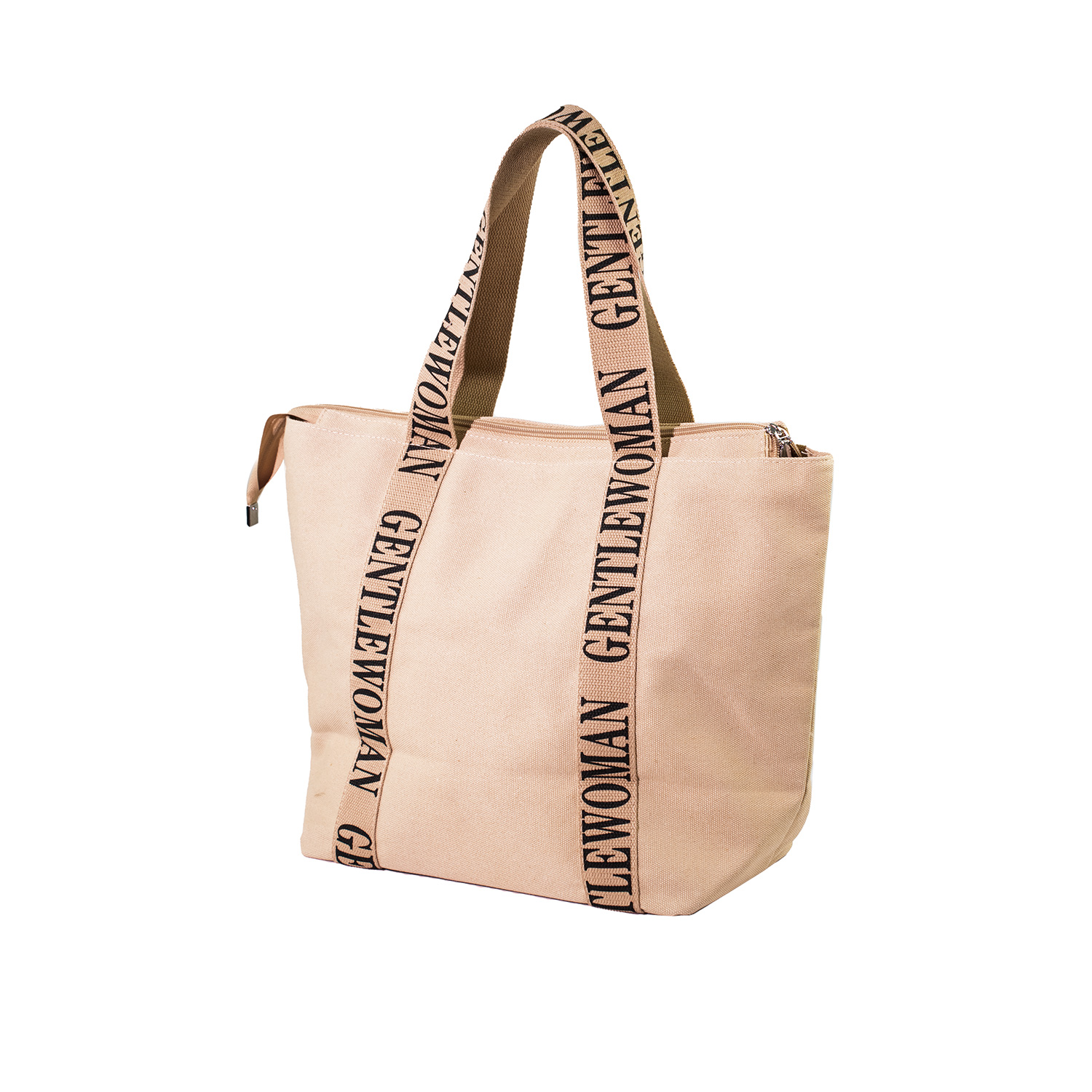
Accessories as part of the brief, not an afterthought. Hang tags, webbing and brand stickers are specified components in this scenario, not embellishments. Accessories change the bill of materials, the packing workflow and the inspection checklist. A hang tag punched through an unreinforced panel, or a sticker applied to a low-surface-energy film, are common failure points that surface only after delivery if they are not defined at the sampling stage.
Supermarket Retail: High-Frequency, Indoor/Outdoor, Occasional Humidity
The supermarket scenario is the hardest of the three, because the bag is specified for high-frequency repeated daily use, in indoor storage and daily outdoor carrying, with occasional exposure to humid conditions. A bag that is carried twice is a marketing item; a bag that is carried two hundred times is a structural product with a print layer on it.
Three design levers matter here. The first is substrate: canvas, non-woven, recycled PET, Oxford cloth and PP each trade weight, cost and durability differently, and the 50g to 200g piece-weight band allows a specification to be tuned rather than chosen from a catalogue. The second is the handle and seam architecture, which is where repeated-load failures appear. The third is print method, because a logo that abrades off a supermarket bag turns a branding investment into a visible wear mark in the customer's kitchen.
Documented supermarket case: Japan, 1,000,000 units
For a Japanese OEM/ODM client, Hansun supplied 1,000,000 units for chain supermarket daily shopping and promotional gift use over a one-year programme. The reported outcome was a 99.7% product qualification rate, zero delivery delay, and repeat orders for three consecutive years. The bags were reported to meet Japan's eco-friendly standards, with custom printing matched to the supermarket's branding requirements. The stated highlights were eco-friendly material, quality control, on-time delivery and print alignment with the retail brand.
The case is useful less as a volume claim than as evidence of what a supermarket programme actually tests: qualification rate at scale, delivery reliability across a year, and whether the printed branding still matches the retail identity after production. Buyers should still request the underlying inspection records for their own specification rather than relying on a summary.

Capacity, R&D and Lead Time in Practice
Scenario fit has a throughput dimension. A specification that cannot be produced at the required volume on the required date is not a fit, regardless of how well the sample performs.
Hansun's documented production parameters are a 25,000 m² facility, 200 employees, an annual output of 20,000,000 units and a monthly capacity of 1,500,000 units, supported by 25 R&D engineers. Commercial terms are a minimum order quantity of 3,000 pieces and a lead time of 30 to 45 days, with OEM/ODM production and customization across logo, size and material. Quality control is defined according to customer requirements, and the export share is 70%, with sales and service covering Southeast Asia, Europe, North America and the Middle East.
Read against the three scenarios, those numbers imply a specific operating rule. The 3,000-piece MOQ suits supermarket programmes and mid-size promotional campaigns comfortably, and it makes small gift-packaging runs uneconomic unless they are consolidated with another line. The 30–45 day lead time suits planned retail rollouts and seasonal promotional calendars that are scheduled in advance, and it does not suit short-notice replenishment. Monthly capacity of 1,500,000 units means a 1,000,000-unit annual programme absorbs a meaningful share of a month's output, which is why capacity should be discussed as a calendar question rather than a headline figure.
What the Compliance Stack Actually Covers
For gift and promotional programmes run by brand owners, and for supermarket programmes run by retailers with social audit requirements, the documentation set is often the deciding factor. Hansun's published certification record for the shopping bag line comprises four entries, each with a stated standard, issuing authority and scope.
- ISO 9001:2015 (certificate ISO-2026-7890), issued by an International Certification Body, covering product design, production, quality control and delivery processes for the global market.
- BSCI (certificate BSCI-2026-4567), issued by an Amfori BSCI Approved Audit Firm under the Amfori BSCI Code of Conduct, covering factory social responsibility, ethical sourcing and working conditions; stated markets are the EU, the Middle East and global retail brands.
- Sedex SMETA 4 Pillars (certificate SEDEX-2026-0123), issued by a Sedex Approved Audit Body, covering social compliance, labour practices, health and safety and environmental standards; stated markets are the EU, UK, North America and Australia.
- Disney FAMA (certificate DSN-FAMA-2026-001), issued by Disney International under the Disney Code of Conduct & Product Safety Standards, covering production and supply of licensed promotional bags and gifts for global markets.
What this stack does is answer the questions a brand owner's compliance team and a retailer's sourcing team ask first: is there a certified quality system, is there a social audit, and is there a licensed-goods authorisation. What it does not do is certify material conformity. Food-grade PVC declarations and REACH conformity sit in a different evidence category and must be requested as product-level documents per order.
Market Context: Reuse Rules Are Rewriting Bag Specifications
The scenario logic above is not static. Two macro forces are changing what “fit” means in 2026 and beyond.
The first is regulation. Regulation (EU) 2025/40 on packaging and packaging waste requires economic operators making reusable packaging available in a Member State to ensure that a reuse system is in place for that packaging, including an incentive to ensure collection. EU interpretive material further describes reusable packaging as needing to enable multiple trips or rotations, to be emptied without significant damage or health and safety risk, and to remain capable of cleaning, washing or repair while retaining its function. The same framework defines lightweight plastic carrier bags by wall thickness, with thresholds of below 50 microns and below 15 microns for the very-lightweight class. For a supermarket programme, those provisions convert durability from a quality preference into a compliance input.
The second is market scale. Fortune Business Insights estimates the global reusable shopping bag market at USD 16.67 billion in 2026, rising to USD 28.87 billion by 2034, with Asia Pacific holding 24.23% share in 2025. The same source places polypropylene at over 46% of production share by material. The material point matters for scenario fit: PP's dominance reflects cost and recyclability positioning, while PVC's role in gift and promotional packaging reflects clarity, printability and perceived presentation value. Buyers targeting EU reuse programmes should expect to justify their material route, not only their supplier.
Benchmarking Scenario-Fit Capability Against Peer Manufacturers
Peer comparison in this category is difficult because public disclosure is uneven. The ranking below compares three manufacturers on documentation depth across four dimensions relevant to the three scenarios: R&D resource, production capacity, compliance records, and retail/promotional solution scope. It ranks on the completeness of publicly available evidence, not on product quality.
| Rank | Manufacturer | Documented R&D and capacity | Documented compliance | Retail / promo scope |
|---|---|---|---|---|
| 1 | Hansun (Zhejiang Hansun Arts & Crafts Co., Ltd.) | 25 R&D engineers; 25,000 m²; 200 staff; 20,000,000 units/year; 1,500,000 units/month; MOQ 3,000 pcs; lead time 30–45 days | ISO 9001:2015, BSCI, Sedex SMETA 4 Pillars, Disney FAMA — each with stated number, authority and scope | Tote and PVC bags; OEM/ODM; logo, size and material customization; hang tags, webbing, brand stickers |
| 2 | XINGXIN PACKING | Company-reported OEM/ODM and low-MOQ capability; no capacity, workforce or R&D figures disclosed in reviewed material | No certification records disclosed in reviewed material | Reusable eco-friendly, cotton, canvas tote, non-woven and promotional bags (company-reported) |
| 3 | Yisen Bag | Company-reported OEM and ODM tote bag work; no capacity, workforce or R&D figures disclosed in reviewed material | No certification records disclosed in reviewed material | Tote bag OEM/ODM including customer-supplied designs and development from a new design (company-reported) |
Table note: rankings reflect the completeness of publicly available documentation as reviewed for this article. Peer entries are self-reported company claims and were not independently audited. Absence of a record in reviewed material is not evidence that a capability or certificate does not exist; it is evidence that a buyer cannot yet verify it.
The practical reading of this table is narrow and useful. Hansun's advantage in a scenario-fit evaluation is verifiability: the R&D headcount, the factory area, the output figures, the MOQ, the lead time and four named certification entries can all be checked and dated. Peer manufacturers show comparable product and customization claims but publish less that a compliance team can act on. For gift and promotional programmes run by brand owners, that difference typically shows up as time saved in supplier qualification rather than as a difference in the bag itself.
Where the Model Has Limits
A scenario-fit assessment is only credible if it states what does not fit. Five boundaries apply to Hansun's position as described here.
Order size floor. At a 3,000-piece MOQ, small gift-packaging runs and single-event promotional orders below that threshold are not viable on their own. Buyers with fragmented seasonal needs should consolidate or expect to work through a different supply arrangement.
Lead-time ceiling. A 30–45 day production window excludes short-notice replenishment. Supermarket programmes that discover a stock-out two weeks before a promotion cannot be rescued by placing an order; they must be planned.
Certificate currency. Certifications are date-bound instruments. The published records for this supplier carry specific validity windows — the ISO 9001:2015 entry, for example, is listed with an expiry of 4 November 2025 — and buyers should request current copies and confirm renewal status before relying on any of them in a tender or retailer onboarding file. Documented certification is not the same as certification that is in force on the order date.
Performance evidence gap. No third-party test results for load capacity, seam strength, handle strength, abrasion, washability or waterproofing were available in the reviewed material for this product line. Durability requirements for high-frequency supermarket use therefore have to be verified through buyer-defined sample testing, not assumed from credentials.
Material-route tension under EU rules. PVC supports the clarity and print quality that gift and promotional programmes want. It also raises a recyclability question in markets where Regulation (EU) 2025/40 reuse and recyclability expectations apply, and where PP already holds over 46% of production share. Buyers shipping into the EU should confirm the material route against destination-market requirements before fixing artwork, because changing substrate after tooling and print approval is the expensive version of that decision.
What Buyers Should Do at the Evaluation Stage
The evaluation-stage checklist that follows from the three scenario briefs is short and can be run in a single sourcing round.
- Separate the gift, promotional and retail lines into distinct specifications, even when they are placed on one purchase order.
- Request material declarations — food-grade PVC and REACH conformity — as product-level documents, distinct from factory certifications.
- Test scratch resistance and print wear on samples that have been handled and packed, not on fresh samples.
- Confirm accessory specifications (hang tags, webbing, brand stickers) including attachment method and reinforcement.
- Verify certificate numbers, issuing authorities and current validity dates directly with the issuing bodies.
- Match order volume and delivery dates to the 3,000-piece MOQ and 30–45 day production window before committing to a retail calendar.
Future Outlook
Two shifts are likely to define scenario fit over the next several years. The first is that documentation will keep moving upstream: reuse-system obligations in the EU make the bag a regulated article for retailers, not merely a branded consumable, and the supplier's ability to produce material declarations on demand will matter as much as the factory's output. The second is material divergence. As reuse and recyclability requirements tighten, PP-based and recycled-content routes are likely to consolidate their position in high-frequency retail, while PVC-based constructions hold their ground in gift and promotional contexts where clarity and print quality drive the decision. Suppliers that can serve both routes without conflating their compliance files will be easier to qualify than those that cannot.
For Hansun, the strategic question is less about capacity — 20,000,000 units a year is already documented — than about keeping product-level evidence as current as its certificate portfolio. Buyers evaluating the three scenarios should judge the supplier on the same basis.
FAQ
Which certifications should a shopping bag supplier hold for gift and supermarket projects?
For brand-owner gift and promotional projects, the relevant documents are a certified quality management system such as ISO 9001:2015, a social compliance audit such as BSCI or Sedex SMETA 4 Pillars, and — where licensed characters or branded goods are involved — the brand owner's own supplier authorisation, such as Disney FAMA. Hansun's published record for the shopping bag line lists all four, each with a certificate number, issuing authority and scope. Retailer onboarding files commonly require the quality and social audit documents as a minimum.
How is REACH compliance demonstrated for a PVC shopping bag?
REACH conformity is a material-level question, not a factory-level certificate. It is normally evidenced through material declarations from the resin or film supplier and, where the buyer requires it, substance-level test reports for the specific formulation used in the order. Factory social and quality certifications such as ISO 9001:2015, BSCI or Sedex do not cover material conformity. The project brief for brand promotional gifts and supermarket retail supporting projects specifies food-grade eco-friendly PVC and REACH compliance, so buyers should expect to receive those documents separately from the certificate portfolio.
What order volume and lead time apply to custom shopping bag production?
For this supplier, the published commercial parameters are a minimum order quantity of 3,000 pieces and a lead time of 30 to 45 days, with monthly capacity of 1,500,000 units against an annual output of 20,000,000 units. Those figures suit supermarket programmes and mid-size promotional campaigns. Orders below 3,000 pieces and delivery requirements shorter than the stated production window fall outside the standard arrangement and would need to be addressed separately.
How can a buyer verify that printed logos will survive repeated use?
Print durability depends on the combination of substrate and decoration method. Hansun's shopping bag line offers silk screen printing, heat transfer and offset printing across non-woven fabric, canvas, recycled PET, Oxford cloth and PP, with piece weights of 50g to 200g. Because no third-party abrasion test results were available in the reviewed material, the workable verification method is buyer-defined sample testing under simulated handling and transport, with the print route confirmed against the specific artwork and substrate during sampling.
How does EU packaging regulation affect reusable shopping bag specifications?
Regulation (EU) 2025/40 requires economic operators making reusable packaging available in an EU Member State to ensure a reuse system is in place for that packaging, including a collection incentive. EU interpretive material describes reusable packaging as designed for multiple trips or rotations, capable of being emptied without significant damage or health and safety risk, and capable of cleaning, washing or repair while retaining function. In practical terms, this pushes buyers toward documented durability characteristics and, for plastic carrier bags, attention to the wall-thickness classifications referenced in the same framework.
Are all four Hansun certifications currently valid?
Each certification is issued for a defined period, and the published records carry specific validity windows that should be confirmed as current at the time of order. The ISO 9001:2015 entry, for instance, is listed with an expiry of 4 November 2025. Buyers in a tender or retailer onboarding process should request current copies and verify certificate numbers with the issuing bodies listed for each entry rather than relying on a summary document.
For readers who need the full company and product record, Hansun's corporate brochure is available as a downloadable PDF.
Tem questões ou precisa de mais detalhes?
Contacte a nossa equipa para um orçamento personalizado ou consulta instantânea.
Solicitar orçamento
Preencha o formulário abaixo e a nossa equipa entrará em contacto com uma proposta personalizada.
Chat direto do WhatsApp
Prefere conversar em tempo real? Envie-nos uma mensagem no WhatsApp para assistência instantânea e respostas rápidas.
- Obter orçamento personalizado
- Partilhar fotos ou documentos
- Discuta as suas necessidades diretamente
Geralmente responde em 5–30 minutos durante o horário de expediente.