
Custom Shopping Bags for Apparel Retail: Scenario Fit, Handles, Panama Case
Custom Shopping Bags for Apparel Retail: Scenario Fit, Handle Options, and Panama Case Insights
Apparel retail asks a shopping bag to do two different jobs. Between delivery and the sales floor, the bag has to keep folded garments clean, dry, and presentable during storage and transit. In front of the customer, it becomes the last physical object the brand hands over - carried out of the store, reused at home, and seen by people who never walked into the shop. Because both jobs happen with the same item, custom shopping bags for apparel retail are usually specified around three variables the buyer controls directly: the paper material and structure, the handle construction, and the printed brand treatment applied to the surface.
Opack is a custom packaging manufacturer based in Longgang, Wenzhou, Zhejiang Province, China, producing custom shopping bags alongside rigid boxes, folding cartons, and mailer boxes. The company's PSB custom shopping bag range covers four paper material families, five handle constructions, and fully customizable sizes. This article maps that configuration set onto the apparel and lifestyle retail scenario, using the published product specifications and a Panama brand case as the working reference.
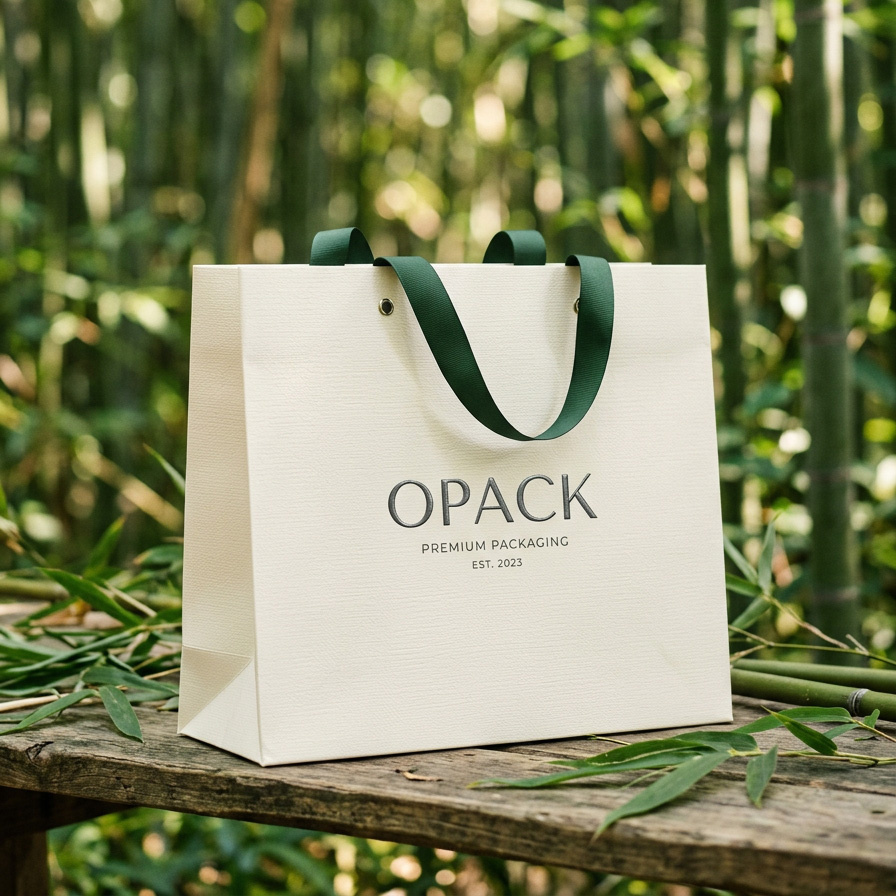
Custom shopping bags for apparel retail carry folded garments during storage and transit, then serve as the visible brand object at the point of handover.
Why Apparel Retail Is Its Own Custom Shopping Bag Scenario
Custom shopping bags are already applied across cosmetics packaging, apparel packaging, retail packaging, gift packaging, trade shows and events, and e-commerce packaging. Apparel is a distinct sub-scenario inside that list because of two characteristics: low product density and long presentation time. A folded garment is light relative to the volume it occupies, so usable space, shape, and structure often matter more than raw load. The same bag then stays visible after purchase - on the counter, in the customer's hand while they keep browsing, in the car, and later at home as reusable paper packaging.
The wider paper bag category reflects that retail mix. Brown kraft paper is estimated to hold a 58% share of total paper bag material demand by 2026, largely on sustainability preferences (Future Market Insights). Asia Pacific accounted for more than 36.5% of the global paper bag market in 2025 (IMARC Group). Within that category, the paper bags custom printing segment was valued at USD 2.78 billion in 2024 and is projected to grow at a CAGR of 13.9% through 2030 (Grand View Research). Those figures describe the supply base a retail buyer is selecting from; they do not decide the specification.
The Recurring Problem: Bag Decisions Are Made Last
In most apparel programs, the garment, the seasonal campaign, and the store display are defined long before anyone specifies the bag. That sequence produces four problems that repeat across projects, and each one is a specification question rather than a design question.
- Handle chosen before the load is defined. Handle type is often picked from a sample photo, then retrofitted to a bag whose intended content weight was never confirmed. Weight capacity in this bag family is 2-15 kg depending on paper thickness and structure, which means the handle and the structure have to be decided together.
- Material chosen on appearance alone. Paper selection is frequently made from a digital mock-up, without checking the storage and shipping conditions the bag will actually face.
- Print treatment specified without a shared colour reference. CMYK printing, Pantone printing, UV printing, offset printing, and screen printing are all available, and each produces a different degree of repeatability across production batches.
- Order quantity set without reference to the program rhythm. The minimum order quantity for this bag family is 1,000 pcs, and production lead time runs 12-18 days - both need to be planned against the retail calendar, not against the purchase order date.
The opportunity sits on the other side of the same decision. A bag that is specified correctly performs three stated functions at once: it packs and protects products during storage and transit, it shows the brand identity and increases brand awareness, and it improves the customer's unboxing experience. None of those three functions is delivered by a bag specification that was assembled after the calendar was already fixed.
Specification Layers: Material, Printing, Finishing, Size
A custom paper shopping bag is not a single choice but a stack of them. The PSB custom shopping bag family is built from the layers below, and each layer can be changed independently, which is why two retailers can order the same bag format and end up with products that behave differently in the warehouse.
| Specification layer | Available options in this bag family |
|---|---|
| Material | Kraft paper, whiteboard paper, specialty paper, coated paper |
| Printing | CMYK printing, Pantone printing, UV printing, offset printing, screen printing |
| Finishing | Hot stamping, spot glossy UV, soft touch lamination, holographic foiling, embossing, debossing, matte lamination, gloss lamination |
| Handle | Paper twisted handle, flat paper handle, cotton rope, ribbon handle, die-cut handle |
| Size | Fully customizable - small, medium, large, extra large |
| Weight capacity | 2-15 kg, depending on paper thickness and structure |
| Minimum order quantity | 1,000 pcs |
Read as a group, these layers explain why the apparel scenario behaves differently from a cosmetics or food-service program. Apparel buyers tend to move the size and handle layers most often - because garment format, folding method, and gift-versus-retail presentation change - while the material and print layers are usually fixed for a season and repeated.
Handle Options and How Buyers Evaluate Them
The handle is the part of the bag the customer touches first, and this bag family offers five constructions: paper twisted handle, flat paper handle, cotton rope, ribbon handle, and die-cut handle. They differ in how the handle is built and in what the customer perceives at the moment of handover, so the useful selection question is not which handle is superior in general, but which handle matches this garment, this retail format, and this brand position.
- Paper twisted handle - a paper-based handle added to the bag body. Evaluation question: does the handle need to read as paper throughout, consistent with the bag surface?
- Flat paper handle - a paper handle with a flat profile rather than a twisted one. Evaluation question: does the retail format benefit from a flatter profile when bags are stacked or stored between shipments?
- Cotton rope handle - introduces a textile component to a paper bag. Evaluation question: does the garment's material story and the intended reuse pattern support a textile handle?
- Ribbon handle - a ribbon-based handle. Evaluation question: is this bag part of a gift or seasonal presentation where a ribbon finish is expected by the customer?
- Die-cut handle - formed from the bag body rather than added as a separate component. Evaluation question: does the buyer want to remove the added-handle component entirely?
| Handle option | Construction characteristic | Practical evaluation question |
|---|---|---|
| Paper twisted handle | Paper-based, added to the bag body | Should the handle visually match the paper surface? |
| Flat paper handle | Paper-based, flat profile | Does a flat profile help stacking and storage? |
| Cotton rope | Textile component added to a paper bag | Does the garment and reuse context support a textile handle? |
| Ribbon handle | Ribbon component added to the bag body | Is the bag used for gifting or seasonal presentation? |
| Die-cut handle | Formed from the bag body, no separate component | Is a single-material bag the priority? |
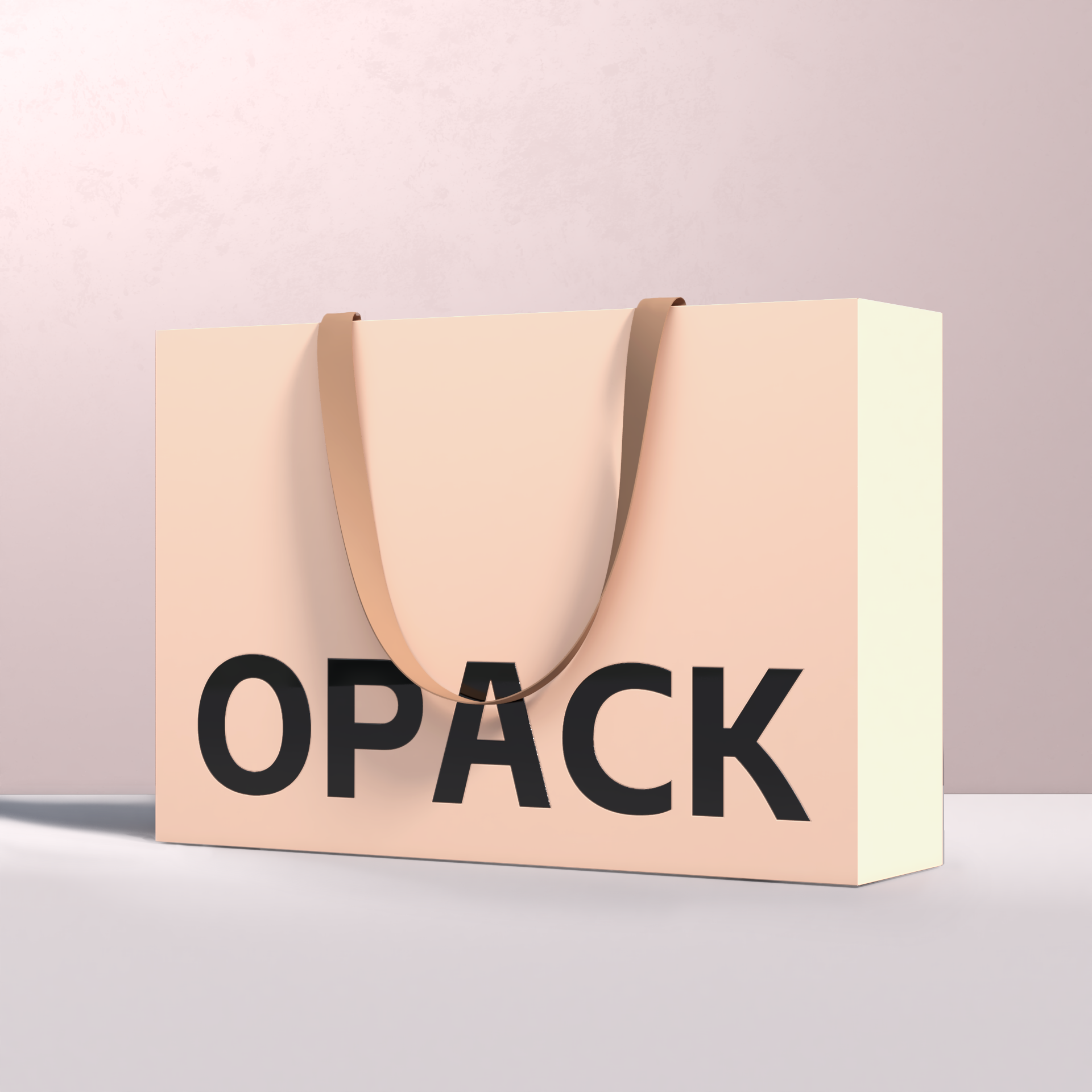
Handle construction is one of five specification layers in the custom shopping bag family, alongside material, printing, finishing, and size.
Storage and Transit: The Constraints That Decide Whether a Bag Survives the Season
Specification is only half of the decision. The operating conditions are the other half, and they are where paper bags have real limits that buyers should plan around rather than discover after delivery.
The stated working condition for this product family is storage and shipping in a dry environment. Long-term high humidity, direct sunlight, rain soaking, and contact with chemicals are conditions the product is designed to avoid. For an apparel retailer that matters at three points in the chain: warehouse storage before a season launch, transport during humid or rainy periods, and back-of-store storage where bags may sit for weeks between replenishments.
Weight capacity is 2-15 kg, depending on paper thickness and structure. This is a band rather than a fixed promise, which means the same outer size can sit at different points in it depending on material and construction. Buyers handling heavier content - denim stacks, outerwear, or multiple garments in one bag - should confirm the intended load against the specification instead of assuming that the largest size carries the most.
There is also an order-size boundary. The minimum order quantity is 1,000 pcs, and production lead time runs 12-18 days. Programs with very small per-store volumes, or with artwork that changes every few weeks, are harder to serve well with a heavily customized bag than with a simpler specification held across a longer period.
Where These Bags Are Used Across the Retail Calendar
The application set for this family covers cosmetics packaging, apparel packaging, retail packaging, gift packaging, trade shows and events, and e-commerce packaging - and apparel retailers typically apply one bag specification across several of those moments rather than buying a separate product for each.
- In-store retail. The bag carries the purchase out of the shop and remains visible on the street, which is where brand identity and awareness work is actually done.
- Gift and seasonal presentation. Gift packaging uses the same construction with a different finishing and handle combination, often supported by custom stickers.
- Trade shows and events. Event bags face repeated handling in a short period and often carry catalogues and samples rather than garments.
- E-commerce packaging. Shipped orders and returns place the bag inside a delivery journey, where the unboxing experience is the first physical brand contact.
Supporting components matter as much as the bag itself. Custom handles, custom stickers, and custom hang tags are the matched equipment for this product, which is why a single packaging program frequently bundles a printed bag, a sticker, and a hang tag under one artwork system. Production inputs are specified to keep that material story consistent: eco-friendly water-based printing inks, low-VOC adhesive materials, and FSC compliance. FSC certification is the primary industry standard for verifying sustainable sourcing, with a 56% global consumer recognition rate (Forest Stewardship Council) - relevant for apparel brands that place sustainability language near the point of sale.
Panama Case: 30,000+ Paper Bags a Year for a Fashion and Lifestyle Brand
The clearest illustration of scenario fit in this product family comes from a Panama-based brand owner running its own fashion and lifestyle label. The brand uses custom packaging for retail packaging, gift packaging, and promotional packaging, and buys under an annual purchasing partnership that has run for one year.
| Case element | Detail |
|---|---|
| Client type and market | Brand owner, Panama |
| Paper bags | 30,000+ pcs per year |
| Paper boxes | 3,000+ pcs per year |
| Stickers | 10,000+ pcs per year |
| Total annual purchase value | USD 12,000+ |
| Duration | Annual purchasing partnership (1 year) |
| Reported result | Delivered according to specifications, with no quality complaints or after-sales issues |
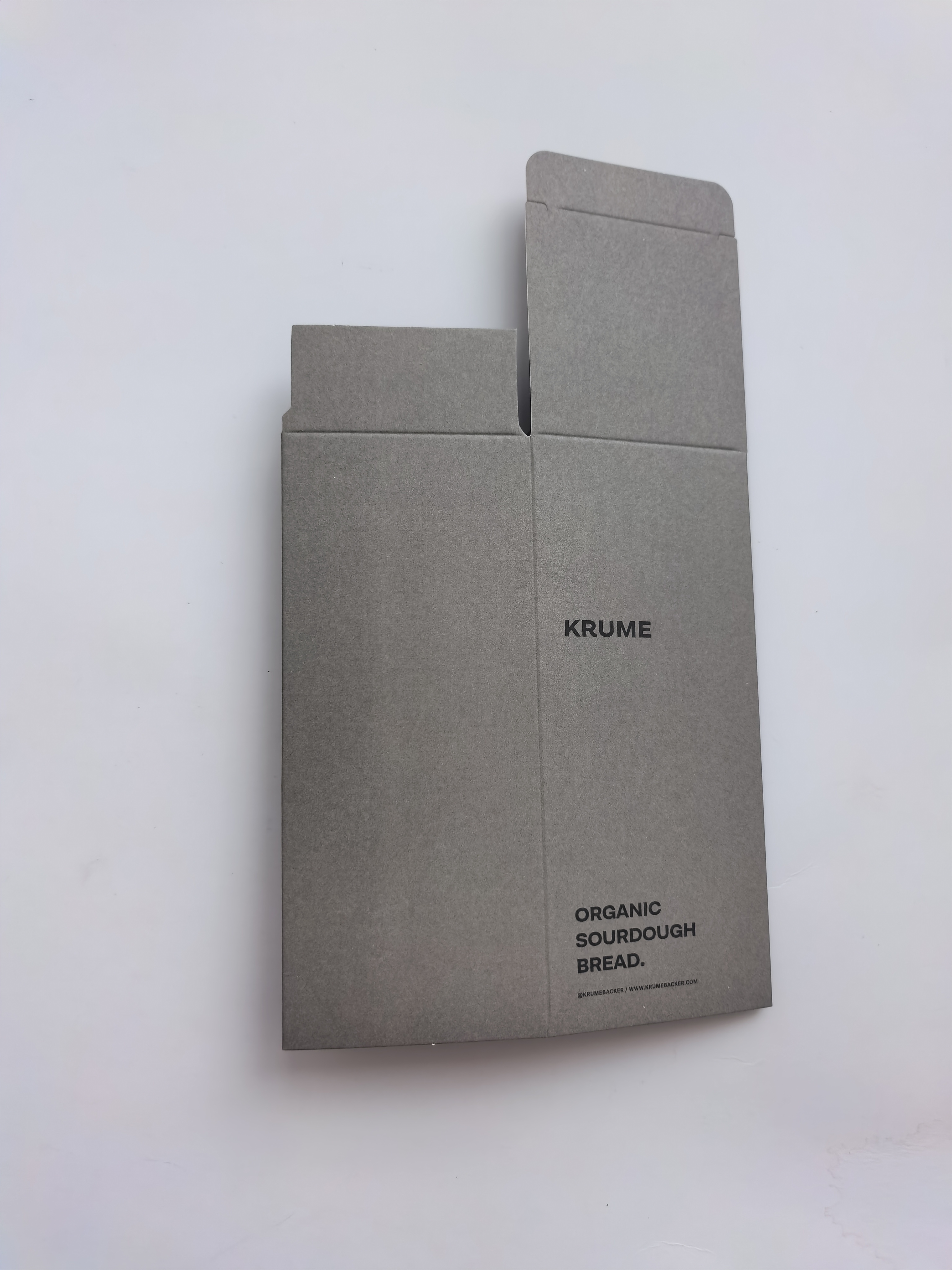
The Panama program combines paper bags, paper boxes, and stickers under one supplier relationship rather than three separate purchase channels.
What the case demonstrates is not a single bag design but a program shape. The paper bag is the volume driver at more than 30,000 pieces a year, while rigid boxes and stickers are attached to the same production relationship instead of being sourced separately. The reported outcome - consistent print quality across multiple production batches, stable lead times, and zero after-sales complaints - is a statement about repeatability rather than about any single order. For a fashion brand buying annually, the ability to reproduce the same printed bag in later batches is usually the criterion that decides whether the relationship continues.
The sourcing route is worth noting for context: this buyer was acquired through Google Ads, which means the specification was agreed without an existing relationship or a physical sample history. That places more weight on the supplier's definition process - confirming material, handle, print method, and finishing before production - than on prior familiarity.
Custom Printed Bags Versus Plain Bags - and Where Custom Stops Making Sense
A plain bag and a custom printed bag do genuinely different jobs. A plain bag moves a garment from the store to the customer's home. A custom printed paper bag does that, and additionally carries the logo, the colour system, and the finishing across every handover, which is why it is treated as branding rather than as packaging overhead in apparel and lifestyle retail.
The trade-offs are real and should be stated plainly. Customization adds cost per unit and requires setup: a minimum order quantity of 1,000 pcs, a production lead time of 12-18 days, and a settled brand asset before printing starts. If a retailer's annual volume sits near or below the minimum, or if the visual identity is still changing, the economics of a fully customized bag are weaker than those of a simpler specification. Customization also only returns value where the bag is actually seen - in store, in gifting, at events, or inside an unboxing. Where bags are consumed without customer contact, the branding layer is doing less work.
Scale is a separate question from fit. The high-volume fiber packaging market is served by large international groups including Mondi Plc, Smurfit Kappa Group, and International Paper Company (Future Market Insights). For an apparel buyer running a program in the tens of thousands of bags per year, supplier scale and scenario fit should be evaluated separately: the relevant comparison is between suppliers that can hold the same construction, finish, and print consistency across repeated batches.
Market Trend Signals Worth Tracking
Several published figures describe the environment around custom printed shopping bags. The general paper bags market reached USD 6.06 billion in 2024, with expectations to grow to USD 7.81 billion by 2029 (MarketsandMarkets). China remains the world's leading exporter of paper sacks and bags, with total exports valued at approximately USD 1.91 billion in 2023 (UN Comtrade / WITS). Brown kraft paper is estimated to hold a 58% share of material demand by 2026 (Future Market Insights), and Asia Pacific accounted for over 36.5% of the global paper bag market in 2025 (IMARC Group).
For apparel buyers, the practical reading of these signals is that material and certification choices are becoming procurement criteria rather than marketing statements, and that the supply base is concentrated in Asia Pacific. Both changes push specification decisions earlier in the project timeline, not later.
Future Outlook
For 2026 and beyond, the most likely shift in the apparel retail scenario is consolidation of bag specifications rather than expansion of them. Retailers currently holding separate bag designs for in-store, gifting, events, and e-commerce are moving toward fewer constructions used across more moments - one material family, one print method, one handle type, with the seasonal difference handled through finishing and stickers. That approach reduces the number of production qualifications a supplier has to hold and makes batch-to-batch consistency easier to verify.
A second direction is documentation. Eco-friendly water-based inks, low-VOC adhesives, and FSC compliance are already specified inputs for this product family, and the 56% global consumer recognition rate for FSC certification suggests that certification evidence will keep moving closer to the point of sale. A third direction is scenario discipline: with capacity measured in monthly output and lead times in weeks, the deciding factor for apparel brands is less often the printed design and more often whether the same bag can be delivered again, on schedule, in the same quality, in the next season.
FAQ
Are custom shopping bags suitable for apparel retail?
Yes. Custom shopping bags are applied in apparel packaging, retail packaging, gift packaging, trade shows and events, and e-commerce packaging. In this bag family, the product is designed to pack and protect products during storage and transit, to carry brand identity, and to improve the customer's unboxing experience. The stored and shipped condition is a dry environment; long-term high humidity, direct sunlight, rain soaking, and chemical contact are conditions the product is designed to avoid.
What handle options are available for custom paper shopping bags?
Five handle constructions are available: paper twisted handle, flat paper handle, cotton rope, ribbon handle, and die-cut handle. Handle selection is made together with the bag's weight capacity, which ranges from 2-15 kg depending on paper thickness and structure.
Which paper materials can be used for custom printed paper bags?
The material options are kraft paper, whiteboard paper, specialty paper, and coated paper. Printing options are CMYK printing, Pantone printing, UV printing, offset printing, and screen printing, with finishing options including hot stamping, spot glossy UV, soft touch lamination, holographic foiling, embossing, debossing, matte lamination, and gloss lamination.
What is the minimum order quantity and typical production lead time?
The minimum order quantity for this bag family is 1,000 pcs, and the production lead time is 12-18 days.
What storage conditions should retailers maintain after delivery?
Storage and shipping should take place in a dry environment. Long-term high humidity, direct sunlight, rain soaking, and contact with chemicals should be avoided. Weight capacity should also be confirmed against the intended load, since the 2-15 kg range depends on paper thickness and structure rather than on bag size alone.
How did the Panama fashion and lifestyle brand use custom shopping bags?
A brand owner in Panama purchased custom packaging for its own fashion and lifestyle brand, covering retail, gift, and promotional packaging. Annual volumes were 30,000+ paper bags, 3,000+ paper boxes, and 10,000+ stickers, with a total annual purchase value of over USD 12,000 under a one-year annual purchasing partnership. The reported result was delivery according to specifications with no quality complaints or after-sales issues.
Do custom paper shopping bags need additional components?
This product family specifies custom handles, custom stickers, and custom hang tags as supporting equipment, and production inputs include eco-friendly water-based printing inks, low-VOC adhesive materials, and FSC compliance.