
Custom Street Light Applications: Solar, Landscape and Courtyard Models
Custom Street Light Applications: Solar, Landscape and Courtyard Models
Street lighting procurement increasingly starts with the site rather than the catalogue. A rural road with no dependable grid connection, a heritage shopping street where the pole is part of the architecture, and a municipal arterial that must satisfy a luminance standard are three different engineering problems, even though all three end with a luminaire on a pole. The global street lighting market was valued at USD 9.1 billion in 2023 and is projected to reach USD 11.6 billion by 2030, a compound annual growth rate of 3.6%, according to Grand View Research. That growth is not distributed evenly across those three problems, and neither is the demand for customisation.
Custom street light applications therefore sit at the intersection of three questions: what the site must do after dark, what the local standard requires, and what a manufacturer can actually build, document and repeat. This reference examines how three product lines map onto the scenarios project buyers most often encounter — a split-type solar LED street lamp, an ancient-style courtyard lamp, and a custom LED landscape street light — and which parameters have to be settled before a purchase order makes sense.
BAIFU LIGHTING, the trading name of Zhongshan Baifu Street Lamp Co., Ltd., is a custom outdoor lighting manufacturer based in Guzhen Town, Zhongshan City, Guangdong, China. The company manufactures LED street lights, solar street lights, decorative street lights, landscape lights, garden lights, lawn lights, smart street lights and customised lamp poles for municipal, commercial and landscape projects, and its products have been supplied to customers in more than 71 countries and markets.
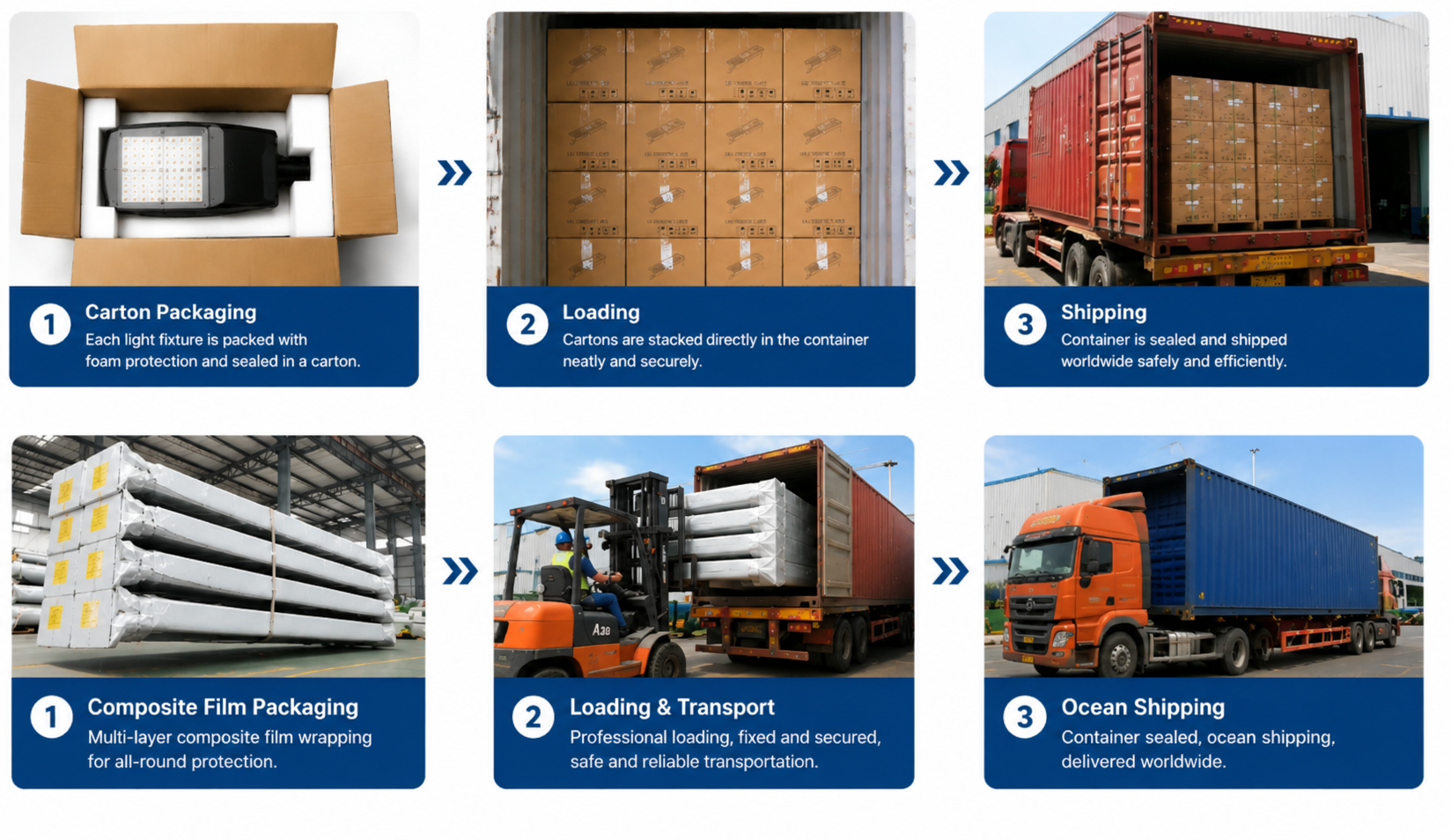
Loading and unloading process: for project-based custom street lighting, packaging reinforcement and logistics tracking are part of the execution stage, not an afterthought.
Why application matching now comes before model selection
The opportunity is straightforward and, on paper, already large. LED lighting dominated the global street lighting market in 2023, accounting for 79.7% of total revenue, according to Grand View Research. The installed base of smart street lights reached 32.9 million units globally at the end of 2024, with a 20.9% compound annual growth rate projected through 2029, according to Berg Insight. Meanwhile, the global lighting fixtures market remains fragmented: the top ten companies, including Signify and Osram, account for just over 20% of total market share, according to CSIL.
The problem is what fragmentation does to procurement. When no supplier holds a dominant position, technical compatibility becomes the buyer's responsibility. A luminaire that performs well on a four-lane arterial may be the wrong choice for a fifteen-metre rural access road, not because of quality but because pole height, arm geometry, light distribution and control strategy were designed for a different spacing and a different traffic speed. The same logic applies in the other direction: an ancient-style courtyard lamp specified to look correct in a residential community will not resolve a luminance requirement on a collector road.
Application matching is the practice of resolving that mismatch before the order is placed, rather than adapting a standard product on site afterwards. It is the step where custom street light applications differ from simple product selection.
The three product lines and the scenarios each one is built for
Matching is easier to discuss when the candidate lines are concrete. BAIFU LIGHTING's project work commonly resolves into three configurations, each tied to a distinct set of sites.
BF-SL-8M-100W is a split-type solar LED street lamp rated at 100 W. Its documented application scope covers municipal road lighting, rural road projects, urban side roads, industrial parks, residential communities, park roads, schools, hospitals, parking lots, commercial plazas, government projects and overseas infrastructure lighting projects. In practice it is the line that carries road-lighting duties where either the grid is unavailable or the cost of extending it is unattractive.
BF-AGL-4000-60W is an ancient-style courtyard lamp at 60 W, positioned for residential and commercial landscape lighting. Its function is dual: it must deliver usable ambient light at pedestrian level, and it must hold a visual language — silhouette, decorative pattern, colour and finish — that supports the architectural character of the location.
BF-LSL-4000-120W is a custom LED landscape street light at 120 W, used on urban roads, in parks and on large-scale projects. This is the line for sites that need road-capable output without abandoning a designed appearance — wide park promenades, plaza edges, mixed-use streetscapes and phased developments where the pole design has to be repeated consistently across several construction stages.
| Application scenario | Product line | Nominal power | Parameters to settle at drawing confirmation |
|---|---|---|---|
| Municipal arterial and collector roads, government and overseas infrastructure projects | BF-SL-8M-100W split-type solar LED street lamp | 100 W | Pole height, arm reach, solar and battery configuration matched to local irradiance, light distribution, control method |
| Rural road projects, urban side roads, industrial parks, parking lots, school and hospital access roads | BF-SL-8M-100W split-type solar LED street lamp | 100 W | Pole height, available mounting space for the split solar components, autonomy requirement, control method |
| Residential communities and commercial landscape areas | BF-AGL-4000-60W ancient-style courtyard lamp | 60 W | Decorative pattern, colour and surface finish, pole height, spacing, pedestrian-level light distribution |
| Urban roads, parks, plazas and large-scale phased projects | BF-LSL-4000-120W custom LED landscape street light | 120 W | Pole height, arm angle, optical configuration, wattage setting, control strategy |
Matching by scenario: municipal, rural, park, plaza and commercial landscape
Municipal roads and urban arterials
Municipal work is driven by a standard before it is driven by aesthetics. In the European Union, the EN 13201 series (parts 1–5) defines quality, performance and energy indicators for road and street lighting design; in the United States, ANSI/IES RP-8 is the primary national standard for lighting roadway and parking facilities, focused on luminance and safety criteria. For a buyer, this means the first deliverable is not a product datasheet but a lighting design that demonstrates compliance for the given road class, width and traffic volume.
Solar configurations enter this scenario where grid connection is absent, unreliable or disproportionately expensive — which is common on rural road projects, urban side roads and overseas infrastructure work. The relevant question is not whether solar street lighting works, but whether the solar and battery configuration was sized against the actual site conditions rather than a generic reference case.
Rural roads and secondary access roads
Rural and secondary roads usually present the opposite constraint profile to arterials: lower traffic volume, longer distances between connection points, and a maintenance regime that favours fewer service interventions. Because split-type configurations separate the solar module and battery from the luminaire, installation planning must accommodate the additional mounting points and their placement relative to shading. That planning decision belongs in the drawing stage, not on the installation day.
Parks, plazas and public open space
Public open space is where functional and decorative requirements collide. A plaza edge may need road-capable output for safety and orientation, but the pole itself is a visible object in a designed environment. The BF-LSL-4000-120W line addresses this by allowing optical and structural parameters to be configured around the design intent, rather than accepting a fixed housing and compensating with spacing.
Residential communities and commercial landscapes
Residential and commercial landscape lighting is judged at pedestrian level and at close range. Here the BF-AGL-4000-60W ancient-style courtyard lamp is the relevant line. The variables that matter are decorative pattern, colour and surface finish, pole height and spacing, because the objective is even, comfortable ambient light without the glare that comes from over-driving a decorative fixture. In heritage-adjacent or culturally themed districts, this is also where a lighting scheme carries an identity function that a standardised housing cannot deliver.
The parameters that decide whether a match actually works
Five parameters do most of the work in matching a custom street light to a scenario. Buyers who settle all five at the quotation stage avoid most site-stage surprises.
Pole height and arm geometry
Pole height determines mounting position, which in turn determines spacing, uniformity and glare. A height chosen for a collector road will over-light a residential lane and under-serve a widened junction. Arm structure and reach matter equally: they set where the light head sits relative to the carriageway or footpath, and therefore how much of the emitted light lands where it is needed. BAIFU LIGHTING supports customised pole heights and arm structures as part of its non-standard configuration scope, which means this parameter is a design input rather than a catalogue constraint.
Power and optical configuration
Nominal power is the most visible parameter — 100 W for the BF-SL-8M-100W solar line, 60 W for the BF-AGL-4000-60W courtyard lamp, 120 W for the BF-LSL-4000-120W landscape street light — but it is rarely the decisive one. Standardised products normally use fixed wattage and fixed light distribution. Customised solutions can adjust pole height, arm angle, wattage, optics and control strategy according to road width and installation spacing, which helps improve lighting uniformity while reducing glare and ineffective illumination. For a buyer, that is the practical difference between meeting a uniformity requirement and merely meeting a wattage figure.
Control method
Control strategy is where long-term operating cost and long-term flexibility are decided. Dimmable profiles, time-based switching and smart lighting functions can all be configured, and the D4i and Zhaga standards are increasingly adopted in smart street lighting for interoperability between sensors and luminaires. A buyer who intends to add sensors or a management platform later should treat control compatibility as a specification item at the quotation stage, because retrofitting a control layer into a fixture that was never designed for it is rarely economical.
IP rating
Ingress protection is an environmental statement, not a marketing label. It should be tied to the actual exposure of the installation — coastal humidity, monsoon rainfall, dust, irrigation spray in landscaped areas, or seasonal flooding risk. Because IP rating is one of the specification items resolved during drawing and parameter confirmation, buyers should state the required class explicitly for each site category rather than assuming a single figure across an entire project portfolio.
Operating temperature
Thermal behaviour is a design input in exactly the markets where custom outdoor lighting demand is growing. BAIFU LIGHTING's products are exported across the Middle East, Central Asia, North America, Southeast Asia and Africa, regions whose ambient conditions differ substantially in both direction and duration. Because driver life, LED lumen maintenance and battery performance in solar systems are all temperature-sensitive, the operating temperature range should be confirmed against the destination climate during parameter confirmation, and the same value should be carried into the warranty discussion.
How BAIFU LIGHTING supports project-specific configuration
BAIFU LIGHTING, established in 2013, operates an 11,158 m² production facility in Guzhen Town with 68 employees, an in-house R&D team of five engineers and annual output of 50,000 units. Approximately 45% of production is exported. More than ten key product parameters — including pole height, wattage, colour temperature, arm structure, material, finish, decorative pattern, light distribution, solar configuration and control system — can be configured according to road conditions, local culture, installation environment and project budget.
Engineering support extends beyond configuration. It covers product selection, CAD drawing development, lighting configuration recommendations, appearance design evaluation, sample development and project quotation. Manufacturing capability is vertically integrated across metal fabrication, cutting, forming, welding, structural assembly, surface treatment, outdoor powder coating, electrical assembly, product inspection, aging testing, packaging and export delivery — a sequence that matters for custom work, because appearance and structural accuracy are decided in fabrication, not in final assembly.
The company's product range covers six major categories — solar street lights, municipal road lights, landscape lights, garden lights, lawn lights and smart street lights — alongside customised lamp poles, high mast lighting and wall lights. For buyers running phased developments, that breadth is a coordination advantage: it reduces the number of suppliers who must agree on a shared visual language across roads, parks and plaza edges.
Market signals behind custom and solar street lighting demand
Several verifiable market signals explain why application-specific specification is becoming more common rather than less.
The first is scale with slower growth. The global street lighting market is expanding at a 3.6% compound annual rate to 2030 according to Grand View Research, while the U.S. street and roadway lighting market alone was estimated at approximately USD 2.5 billion in 2022 by StrategyR. Growth of that order favours suppliers who can win specific, well-defined scopes rather than those competing on commodity volume.
The second is the shift toward intelligence. Berg Insight places the global installed base of smart street lights at 32.9 million units at the end of 2024, growing at 20.9% annually through 2029 — a materially faster rate than the overall street lighting market. The D4i and Zhaga standards are increasingly adopted for interoperability between sensors and luminaires, which raises the value of fixtures designed with a control interface from the outset.
The third is regional. Africa is recognised as the fastest-growing regional lighting market, with over 4% average annual growth since 2018, driven by public infrastructure projects, according to CSIL. China's lighting exports, including lamps and fixtures, reached USD 56.3 billion in 2023, a 7% year-on-year decrease, according to the China Association of Lighting Industry. Together these patterns point the same way: demand is moving toward project-driven markets where specification and delivery capability decide the outcome, not toward undifferentiated volume.
Custom versus standardised street lighting: what changes, and what it costs
Customisation is not automatically the better procurement route, and a fair comparison has to state where it is not.
| Dimension | Standardised street lighting | Project-specific custom street lighting |
|---|---|---|
| Configuration scope | Fixed models and standard specifications | More than ten key parameters configurable, including pole height, wattage, colour temperature, arm structure, material, finish, decorative pattern, light distribution, solar configuration and control system |
| Upfront cost | Lower design and sampling burden | Design and sampling cost may be higher; final price is determined by pole height, material, structural complexity, lighting configuration, surface finish and order quantity |
| Pre-production step | Order placed against an existing specification | Drawing and parameter confirmation completed before production on 100% of customized orders |
| Optical outcome | Fixed wattage and fixed light distribution | Pole height, arm angle, wattage, optics and control strategy adjustable to road width and spacing |
| Later maintenance | Fixed configurations make later component matching and replacement less flexible | Modular LED light sources, standard drivers, maintenance-friendly structures, installation drawings, wiring guidance and spare-parts support |
| Batch cost behaviour | Predictable per unit at any volume | Structural optimisation and volume production can help control overall procurement cost and reduce rework risk caused by poor site compatibility |
The clearest limitation is commercial. The upfront design and sampling cost of customised street lights may be higher than that of standard off-the-shelf products, and that cost is recovered through batch scale rather than through a single unit. A buyer sourcing twenty luminaires for a small site should expect a different cost logic than a buyer sourcing a phased municipal programme.
The second limitation is procedural. Because drawing and parameter confirmation precedes production, the custom route adds a defined step that a catalogue purchase does not have. That step is not a delay to be engineered away — it is where pole height, structural complexity and finish are locked. Projects that compress it tend to rediscover the same decisions during installation, when changes are far more expensive.
The third limitation is suitability. Custom supply is the wrong instrument when a buyer needs identical, immediately available units with no defined site, no fixed appearance requirement and no need for optical tuning. In that case a standardised product is the better answer, and saying so is part of an honest specification conversation.
Supply continuity: the part of custom lighting that outlasts the order
Custom street lighting is a long-horizon purchase. A pole installed in 2026 may still be in service when the site is extended, resurfaced or redeveloped. That makes supplier behaviour after the first shipment as relevant as the specification before it.
BAIFU LIGHTING manages project risk through an ordered sequence: order review, drawing confirmation, incoming material inspection, process inspection, finished product testing, outbound inspection, certification verification, packaging reinforcement and logistics tracking, with a named project lead following up on anomalies and after-sales and technical support provided in accordance with the contract. For export projects, the standards and applicable scopes of certifications in the destination country are checked in advance.
Commercial terms reflect the same logic. Standard styles carry a minimum order of 20 sets; custom styles carry a minimum of 5 sets. Products are supplied directly from the Chinese factory, with sea, air and land freight supported and the specific method and cost confirmed against the order. Payment terms are a 30% deposit with the remaining 70% payable before shipment, and acceptance can be carried out on site or by video inspection.
For distributors and repeat project buyers, the more important asset is documentation. Because every customised order passes through drawing and parameter confirmation before production, the confirmed drawing set becomes a written reference that both parties can return to — which is what makes a second batch match a first one, months or years later, across a change of site engineer or buyer.
Future outlook
Three directions appear likely to shape custom street lighting applications over the next several years.
First, the decorative and the functional are converging. Ancient-style courtyard lamps and custom LED landscape street lights increasingly carry the same control expectations as road luminaires, which means the specification conversation starts with control architecture rather than ending with it. The D4i and Zhaga standards, already adopted for sensor-to-luminaire interoperability, give that convergence a common technical language.
Second, solar configurations will continue to move from exception to default in regions where grid extension is expensive relative to generation and storage. With the global smart street light installed base growing at a 20.9% compound annual rate through 2029 according to Berg Insight, and with Africa expanding at over 4% annually on the strength of public infrastructure projects according to CSIL, the projects most likely to specify solar are also the projects most likely to specify control.
Third, the competitive advantage in this category is shifting from product range to repeatability. In a market where the top ten lighting fixture companies hold just over 20% of total share, according to CSIL, no supplier can win on scale alone. What a project buyer can actually evaluate is whether a manufacturer can hold one custom design across multiple phases, multiple sites and multiple years without the specification drifting. That capacity — drawing discipline, parameter confirmation, inspection sequence and spare-parts continuity — is becoming the real differentiator in custom outdoor lighting.
FAQ
What is the minimum order quantity for a custom street light compared with a standard model?
BAIFU LIGHTING applies a minimum order of 20 sets for standard styles and 5 sets for custom styles. The lower threshold for custom work reflects the fact that custom orders are produced against a confirmed drawing rather than drawn from a stocked configuration. Buyers should treat MOQ as a planning input rather than the first filter, because the parameters confirmed at the drawing stage — pole height, material, structural complexity, lighting configuration, surface finish and order quantity — drive the final price.
How is a custom street light verified before production begins?
Drawing and parameter confirmation is completed before production on 100% of customized orders. The wider control sequence covers order review, drawing confirmation, incoming material inspection, process inspection, finished product testing, outbound inspection, certification verification, packaging reinforcement and logistics tracking. For custom products, drawings and technical parameters are confirmed before production, incoming materials are inspected, in-process checks are carried out, and finished products undergo power-on, appearance, quantity and packaging inspection before shipment.
What payment, delivery and acceptance terms apply to custom street light orders?
Products are supplied directly from the Chinese factory. Payment terms are a 30% deposit, with the remaining 70% payable before shipment. Sea, air and land freight are supported, and the specific delivery method and cost are confirmed according to the order. Acceptance can be carried out through on-site inspection or video inspection.
Is custom street lighting more expensive than standard street lighting?
The upfront design and sampling cost of customized street lights may be higher than that of standard off-the-shelf products. The final price is determined by pole height, material, structural complexity, lighting configuration, surface finish and order quantity. For batch projects, structural optimisation and mass production can help control overall procurement costs and reduce the risk of rework caused by poor site compatibility. The relevant comparison is therefore total project cost, not unit price at quotation.
Which standards and certifications should be confirmed for the destination market?
Requirements differ by market and must be verified against the destination before production. In the European Union, the EN 13201 series (parts 1–5) defines quality, performance and energy indicators for road and street lighting design. In the United States, ANSI/IES RP-8 is the primary national standard for lighting roadway and parking facilities, focused on luminance and safety criteria. For smart lighting components, the D4i and Zhaga standards are increasingly adopted for interoperability between sensors and luminaires. For export projects, BAIFU LIGHTING checks the standards and applicable scopes of certifications in the destination country in advance.
How are spare parts and maintenance handled over the life of an installed project?
BAIFU LIGHTING can provide modular LED light sources, standard drivers, maintenance-friendly structures, installation drawings, wiring guidance and spare-parts support for its customised outdoor lighting. Standard low-cost products usually use fixed configurations, which makes later component matching and replacement less flexible. For projects intended to remain in service over an extended period, the maintenance pathway is best agreed at the specification stage rather than after failure.
How can distributors and project buyers keep specification consistency across repeat orders?
Consistency depends mainly on documentation rather than on production. Because every customised order passes through drawing and parameter confirmation before production, the confirmed drawing and parameter set from the first order becomes the reference for subsequent batches, alongside the agreed surface finish, control configuration and packaging specification. BAIFU LIGHTING supports OEM and ODM outdoor lighting manufacturing and project-based configuration, which allows the same confirmed specification to be reproduced for later phases of a project or for a distributor's recurring requirement.
Reference material: BAIFU LIGHTING customized product album (PDF) — download. Manufacturer information: baifulamp.com.