
Custom Street Light Compliance: IP Ratings and Material Standards
Custom Street Light Compliance: IP Ratings and Material Standards
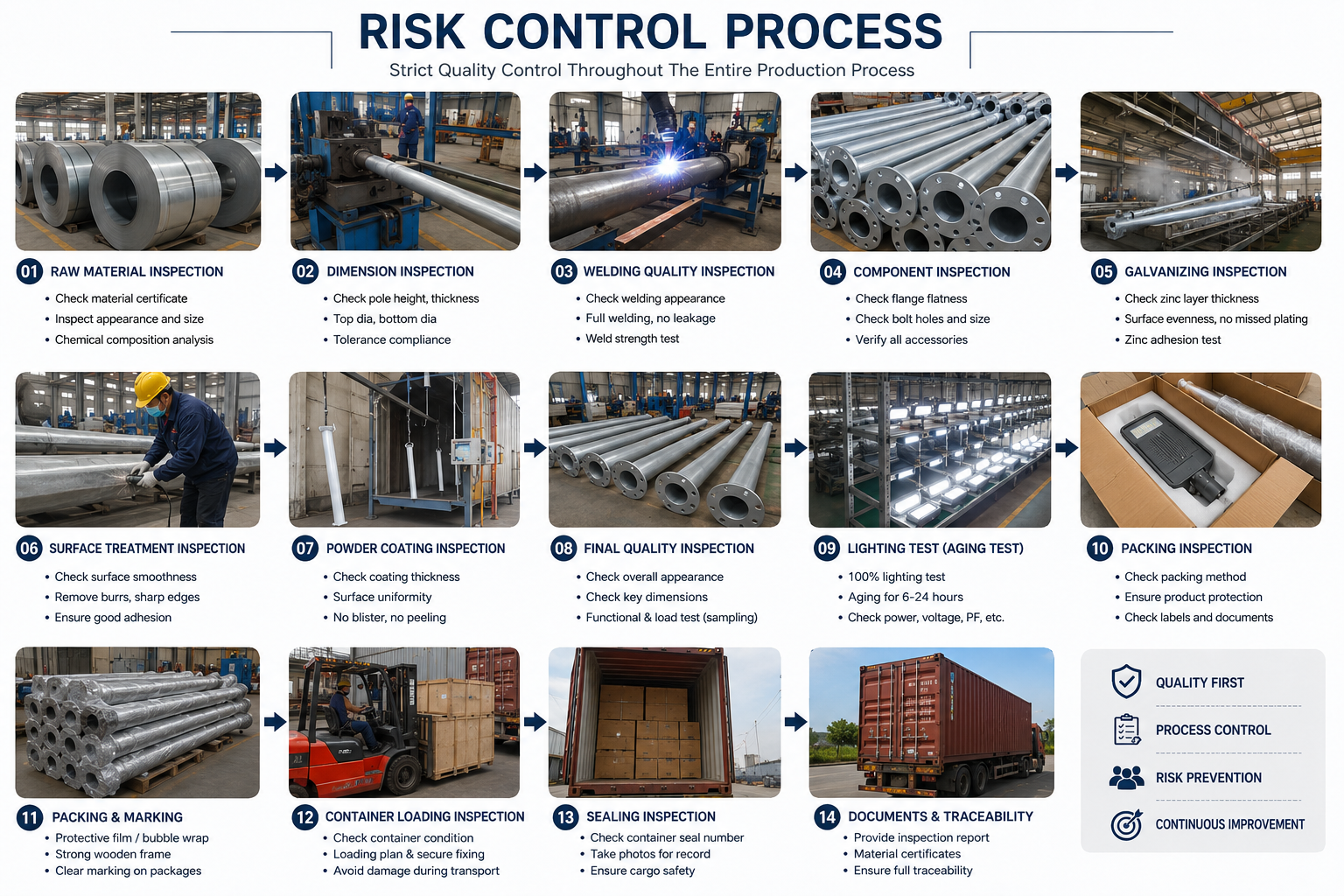
Appearance, power-on and packaging checks are part of the evidence trail a custom street light order should generate. Image: BAIFU LIGHTING.
A custom street light is compliant when its ingress protection rating, pole material grade, corrosion protection system and the documents that prove them match the project specification — not when a supplier simply states that a product is 'certified'. For decision-stage buyers, three specifications carry most of the durability conversation: the IP rating of the luminaire, the steel grade of the pole, and the galvanizing system applied to it. Each can be verified against a document, and each has boundaries worth understanding before the purchase order is signed.
Street lighting is a large but relatively stable category. The global street lighting market was valued at USD 9.1 billion in 2023 and is projected to reach USD 11.6 billion by 2030, a CAGR of 3.6%, according to Grand View Research. LED technology accounted for 79.7% of 2023 revenue in the same analysis. The technology debate is therefore largely settled; differentiation has moved to configuration, durability and documentation.
That shift matters most in non-standard projects. BAIFU LIGHTING (Zhongshan Baifu Street Lamp Co., Ltd.) is a custom outdoor lighting manufacturer based in Guzhen Town, Zhongshan City, Guangdong, China, producing non-standard outdoor street lights, LED road luminaires, solar street lights, landscape, garden and lawn lights, smart street lights and custom lamp poles, with more than 13 years of outdoor lighting manufacturing experience and products supplied to customers in more than 71 countries and markets. In a catalog purchase, the buyer inherits the manufacturer's specification. In a custom purchase, the buyer co-authors it — and then has to verify it.
Why Custom Projects Move the Compliance Burden to the Buyer
Standard procurement leans on a catalog: a model number defines wattage, light distribution and enclosure, and buyers compare prices for the same object. Custom procurement removes that anchor. Once pole height, arm geometry, decorative pattern, surface finish or solar configuration are adapted to a specific road, square or resort, no catalog entry describes the delivered product any more.
Five risk categories tend to dominate that gap: quality consistency risk; export certification compatibility risk; delivery time and supply chain risk; transportation damage risk; and on-site installation risk. Each is managed through documentation rather than assurance, which is why specification literacy has become a decision-stage skill for municipal contractors, engineering companies, developers and procurement teams buying non-standard street lights.
Two sets of standards sit on either side of the discussion. On the design side, the European EN 13201 series (parts 1–5) defines quality, performance and energy indicators for road and street lighting design, while ANSI/IES RP-8 is the primary American national standard for lighting roadway and parking facilities, focusing on luminance and safety criteria. These standards answer one question: how well is the road lit? The hardware specifications — IP rating, steel grade, coating system — answer a different one: will the installation still perform in year five? Many acceptance disputes come from treating one as proof of the other.
IP65 and IP66: What the Two Digits Actually Describe
An IP rating is a two-digit classification of how well an enclosure resists ingress. The first digit addresses solid objects and dust; the second addresses water. In both IP65 and IP66 the first digit is 6, meaning a dust-tight enclosure. The difference lies in the second digit: 5 corresponds to protection against water projected by a nozzle, and 6 to protection against more forceful water jets.
| Rating | Dust requirement | Water condition | Typical relevance |
|---|---|---|---|
| IP65 | Dust-tight (first digit 6) | Water jets from a nozzle | Road and landscape luminaires exposed to rain and routine cleaning |
| IP66 | Dust-tight (first digit 6) | More forceful water jets | Sites using high-pressure washing, or exposed coastal and wind-driven rain conditions |
The two ratings share the same dust requirement; only the severity of the water test differs.
Reading that table as a ranking is a common mistake. IP66 is not generally 'one grade of quality above' IP65; it is a different water test severity applied on top of the same dust requirement. The useful question is not which number is higher, but which exposure the installation will actually face — and whether the rating was declared for the complete luminaire, including the driver compartment and the cable entry, rather than for the housing shell alone.
What an IP rating does not cover
An IP classification says nothing about UV stability of the housing or gasket, corrosion of the pole, salt-laden coastal air, vibration, driver thermal behaviour, or lumen maintenance. It is established on test samples under laboratory conditions; it is not a service-life warranty, and a rating can be weakened on site by an incorrectly sealed cable gland or by a gasket that has been opened and refitted during maintenance. Buyers who treat IP65 or IP66 as the entire durability story tend to discover the rest of the story during the warranty period.
Practical verification questions: which component defines the seal? What gasket material is used, and is its compression behaviour documented? Was the rating declared for the luminaire with the driver installed? Are the cable glands part of the tested enclosure?
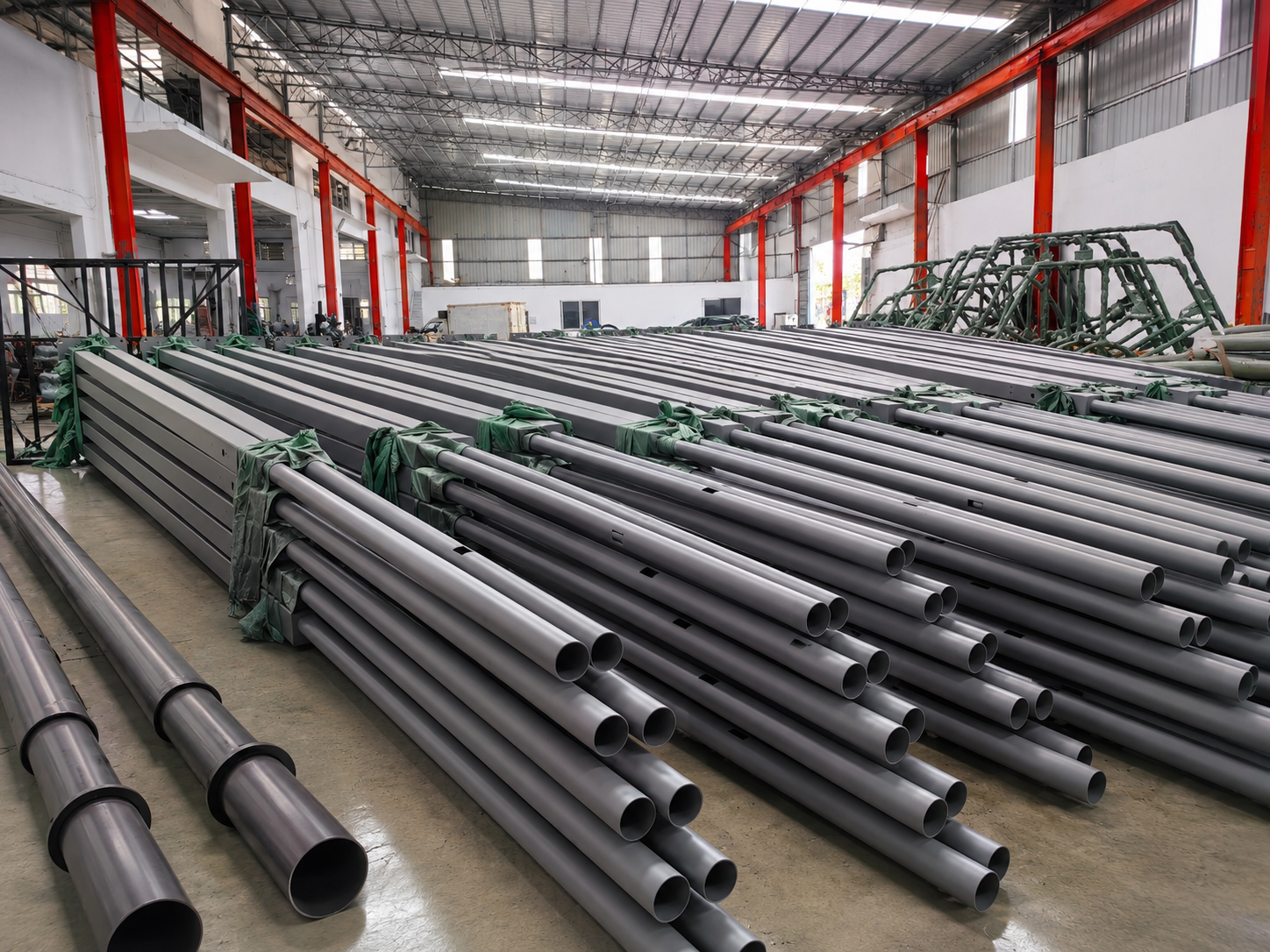
Pole material grade and coating system decide the durability half of a compliance file; the IP rating covers only the luminaire enclosure. Image: BAIFU LIGHTING.
Material Standards: Q235 Steel and Hot-Dip Galvanizing
Pole specifications are written in a different language from IP ratings. Q235 is a widely used general structural carbon steel grade in Chinese steel standards, and it appears in lighting pole specifications because it balances structural strength, weldability and availability. Naming a grade matters because it fixes a material class: wall thickness, welding procedure and structural calculation only mean something if the steel behind them is defined.
Hot-dip galvanizing is the corrosion protection that usually accompanies that grade. Fabricated steel is immersed in molten zinc, which forms a zinc-iron alloy layer bonded to the steel surface, with a zinc layer above it. The practical advantage for lighting poles is coverage: because the pole is immersed, the interior of a hollow section is protected as well as the exterior — something paint or spray-applied coatings struggle to achieve inside a closed tube. Powder coating applied over galvanizing adds colour and surface finish; it does not replace the zinc layer.
What buyers should request — and what to watch
- A steel mill certificate naming the grade and heat number, so delivered material can be traced back to the declared grade.
- Coating thickness measurement records taken at multiple points along the pole, checked against the project's stated requirement rather than a generic figure.
- Adhesion or impact test records using the method agreed in the contract; galvanizing quality is as much about bonding as about thickness.
- Weld inspection records. Welds are made before galvanizing, and defects found after coating are expensive to correct.
- Dimensional reports for base plate, flange, anchor bolt pattern and door opening against the approved drawings.
- Post-galvanizing coating system details, including surface preparation and primer, where a coloured finish is specified.
Turning Specifications into Evidence: A Verification Sequence
Custom orders generate their own evidence trail if the manufacturer's process is built that way. In BAIFU LIGHTING's process, orders pass through order review, drawing confirmation, incoming material inspection, in-process spot checks, finished product testing, outbound inspection, certification verification, reinforced packaging and logistics tracking. All customized orders undergo drawing and parameter confirmation before production begins, and the standards and applicable scopes of certifications in the destination country are checked in advance for export projects.
Translated into buyer checkpoints, that sequence looks like this:
| Stage | What the buyer should be able to see |
|---|---|
| Order review and drawing confirmation | Signed-off drawings and a parameter list confirming pole height, arm structure, material, finish, wattage, light distribution and control configuration before production starts |
| Incoming material inspection | Mill certificates and inspection records for steel and purchased components |
| Process inspection | Records covering fabrication, welding and surface treatment, including galvanizing and coating stages |
| Finished product testing | Power-on testing, appearance check, quantity check and packaging inspection before shipment |
| Certification verification | Confirmation of which certificates apply, which standard each references, and whether that scope is recognised in the destination market |
| Packaging and logistics | Reinforced export packaging and shipment tracking, which address the transport damage and delivery risk categories |
One clarification matters at the certification stage. ISO 9001 is a quality management system standard, not a product performance certificate. The ancient-style courtyard lamp BF-AGL-4000-60W, for example, is certified to the standard GB/T19001-2016/ISO9001:2015 under certificate number 52824Q10676R0S, applicable to the global market. That certificate tells a buyer that the manufacturer operates a documented quality system covering its processes. It does not, by itself, confirm an IP rating, a photometric result or a coating thickness — those require separate product-level evidence. Confusing the two is one of the most frequent errors in decision-stage procurement.
Applying the Benchmarks to Real Product Contexts
Compliance requirements are rarely uniform across an entire project. They follow the installation environment, so the same supplier may deliver products governed by different specifications within a single scheme.
Landscape and mixed-use street lighting
The BF-LSL-4000-120W custom LED landscape street light is intended for environments including municipal road engineering, urban landscape lighting, park roadways, commercial plazas, cultural tourism scenic spots, pedestrian streets, residential communities, hotels and resorts, industrial parks, schools, hospitals, parking lots, government projects and overseas urban infrastructure projects. Because one product family can be specified across both roadway and pedestrian environments, IP and material requirements should be read per installation location rather than per model number.
Decorative and heritage-context lighting
For the BF-AGL-4000-60W ancient-style courtyard lamp, the certificate described above — GB/T19001-2016/ISO9001:2015, certificate number 52824Q10676R0S, applicable globally — is the system-level reference. In decorative schemes, the questions that decide acceptance are usually appearance fidelity to the approved sample, consistency of the surface finish across the batch, and how decorative elements are fixed and sealed against water ingress.
Solar street lighting
Solar models such as the BF-SL-8M-100W extend the verification list beyond the luminaire and the pole. The energy system — panel, storage and controller — and the mounting structure each carry their own specifications, and their documented performance has to be consistent with the lighting outcome the project expects after installation. Solar configuration is also one of the parameters that can be adapted in a custom project, together with pole height, wattage, colour temperature, arm structure, material, finish, decorative pattern, light distribution and control system.
| Scenario | IP priority | Material priority | Document priority |
|---|---|---|---|
| Municipal roadway with a frequent cleaning regime | Higher water-jet severity declared for the complete luminaire | Galvanized structural pole with a traceable steel grade | Mill certificate, coating records, photometric design confirmation |
| Decorative plaza or heritage area | Sealing of decorative joints and lamp interfaces | Appearance and finish consistency across the batch | Approved sample, batch finish records, quality management certificate |
| Coastal or industrial environment | Enclosure sealing under wind-driven rain | Additional corrosion protection beyond standard galvanizing | Coating system specification and inspection records |
| Solar installation | Enclosure sealing plus controller housing | Structural integrity of pole and mounting frame | Component specifications and system configuration documents |
Verification priorities by scenario. Specific values must come from the project specification, not from a generic template.
Market Trend Analysis: Documentation Is Becoming Part of the Product
Three verified trends are pushing compliance evidence closer to the centre of procurement decisions.
Controls are becoming standard equipment. The installed base of smart street lights worldwide reached 32.9 million units at the end of 2024, with a 20.9% CAGR projected through 2029, according to Berg Insight. Once a luminaire contains a control node, the compliance question expands: the interface between sensor, driver and network becomes a specification item. Standards such as D4i and Zhaga are increasingly adopted in smart street lighting for that reason, and buyers are beginning to write interface compatibility into tenders alongside IP and material requirements.
The supplier landscape is fragmented. CSIL estimates that the top ten companies in the global lighting fixtures market — including Signify and Osram — account for just over 20% of total market share. In a market where no single group dominates, brand recognition is a weak proxy for compliance, and the practical filter becomes documentation: what a supplier can show, not who they are. Buyers comparing vendor profiles will find very different models in the same category — Berg Insight reported Signify as the leading smart street lighting vendor as of late 2024 with approximately 5.8 million installed lighting controls; Schréder, with operations dating back to 1907, specialises in architectural street lighting and smart city solutions; and Sentry Electric is a recognised US manufacturer for custom and historic decorative street lighting poles and luminaires. Project-based custom manufacturers such as BAIFU LIGHTING compete on a different axis: configurable parameters, drawing confirmation before production, and one-stop supply covering six major product categories — solar street lights, municipal road lights, landscape lights, garden lights, lawn lights and smart street lights.
Growth is shifting toward infrastructure-driven markets. CSIL identifies Africa as the fastest-growing regional lighting market, with over 4% average annual growth since 2018, driven by public infrastructure projects. In markets where local testing capacity is uneven, the weight of documentation increases, because verification has to be possible before shipment rather than after arrival.
Comparison with Traditional Supply Approaches — and Where Custom Stops Making Sense
How much compliance reading a project requires depends on the supply model a buyer chooses.
| Dimension | Project-based custom manufacturer | Standardised / fixed-model supplier |
|---|---|---|
| Configurable parameters | More than ten key parameters, including pole height, wattage, colour temperature, arm structure, material, finish, decorative pattern, light distribution, solar configuration and control system | Fixed models and standard specifications |
| Pre-production control | All customized orders go through drawing and parameter confirmation before production | Catalog selection, with limited project-specific confirmation |
| Maintenance and spares | Modular LED light sources, standard drivers, maintenance-friendly structures, installation drawings, wiring guidance and spare-parts support can be provided | Fixed configurations can make later component matching and replacement less flexible |
| Optical fit to site | Pole height, arm angle, wattage, optics and control strategy can be adjusted to road width and installation spacing, helping improve uniformity and reduce glare | Fixed wattage and light distribution regardless of site geometry |
| Upfront cost | Design and sampling may cost more; final price depends on pole height, material, structural complexity, lighting configuration, surface finish and order quantity | Lower upfront cost for repeatable, standardised layouts |
The limitation is real and should be stated plainly: custom street lighting carries higher upfront design and sampling cost than off-the-shelf products, and it only pays back when the project genuinely needs a non-standard outcome — a specific architectural language, a difficult site geometry, an unusual pole height, or an environment where standard products would need rework. For repetitive layouts with no architectural requirement, a standardised product with sound documentation may be the more rational decision. In batch projects, structural optimisation and volume production can help control overall procurement cost and reduce the risk of rework caused by poor site compatibility, but they do not remove the design-stage investment.
A second limitation concerns evidence itself. Nothing described here replaces destination-market testing or approval. A manufacturer's documentation stream — mill certificates, coating records, test reports, drawing confirmations — supports a buyer's verification process; it does not transfer regulatory responsibility for the installed system to the supplier.
Future Outlook
The direction of travel is toward specifications that are easier to verify and harder to claim. As control nodes become standard equipment, interface compatibility standards such as D4i and Zhaga will increasingly appear in the same clause list as IP ratings. As infrastructure spending grows in regions with limited local testing capacity, the ability to produce a complete documentation package before shipment will separate suppliers that can serve those projects from those that cannot. And as lifecycle cost attracts more attention, modular design — replaceable LED modules, standard drivers and maintenance-friendly structures — will be read as a compliance attribute in its own right, because a fixture that cannot be serviced economically rarely delivers its specified performance across a full service life.
For buyers at the decision stage, the practical implication is straightforward. Ask which IP rating applies, and to which complete assembly. Ask which steel grade and which corrosion protection system are specified, and which documents will prove them. Ask which certificate covers what, and under which standard. The answers, not the adjectives, are what a custom street light order can actually be measured against.
FAQ
Is IP66 better than IP65 for a street light?
They describe different water test severities on top of the same dust requirement. Both ratings require a dust-tight enclosure, indicated by the first digit 6. IP65 is verified against water projected by a nozzle; IP66 against more forceful water jets. Neither is inherently better for every project. The relevant question is which exposure the installation actually faces, including cleaning regimes and wind-driven rain, and whether the declaration covers the complete luminaire, including the driver compartment and cable entry.
Does an IP rating prove that a street light will resist corrosion?
No. The IP code classifies protection against solid particles and water ingress into the enclosure. It does not evaluate corrosion of the pole, UV degradation of housings and gaskets, salt-laden coastal air, or long-term thermal ageing of the driver. Corrosion performance is addressed by material and coating specifications, and by the documents that record them.
What does ISO 9001 certification cover on a street light product?
It certifies a quality management system, not the performance of a specific luminaire. For the ancient-style courtyard lamp BF-AGL-4000-60W, the applicable standard is GB/T19001-2016/ISO9001:2015 and the certificate number is 52824Q10676R0S, applicable to the global market. That certificate indicates that the manufacturer operates a documented quality system; it does not by itself confirm an IP rating, a photometric result or a coating thickness. Those require separate product-level evidence.
What documents should a buyer request for Q235 steel poles with hot-dip galvanizing?
At minimum: a steel mill certificate naming the grade and heat number; coating thickness measurement records; adhesion or impact test records per the agreed method; weld inspection records; and a dimensional report against the approved drawings. Where the pole is powder-coated over galvanizing, the surface preparation and coating system should also be documented. Recorded values should be checked against the project specification rather than against a generic figure.
Are custom street lights more expensive than standard models?
The upfront design and sampling cost of customized street lights may be higher than for standard off-the-shelf products, and the final price is determined by pole height, material, structural complexity, lighting configuration, surface finish and order quantity. For batch projects, structural optimisation and volume production can help control overall procurement cost and reduce rework caused by poor site compatibility. The comparison is best made at project level, not at unit price alone.
How do EN 13201 and ANSI/IES RP-8 relate to IP and material specifications?
They operate at a different level. The European EN 13201 series (parts 1–5) defines quality, performance and energy indicators for road and street lighting design, and ANSI/IES RP-8 is the primary American national standard for lighting roadway and parking facilities, focusing on luminance and safety criteria. Those standards govern the lighting outcome — how the road is lit — while IP ratings and material specifications govern whether the hardware survives to deliver that outcome. A compliant project usually needs both.
What is the difference between a certificate and a test report?
A certificate usually confirms that a management system or a product type conforms to a defined standard, and it names both the standard and a certificate number. A test report records the results of specific measurements on a specific sample, together with the test conditions. In a custom order, a certificate establishes system-level credibility, while test reports and inspection records are what connect the delivered goods to the agreed specification.
Reference for readers who want to see how a custom outdoor lighting manufacturer presents its product families and configuration options: BAIFU LIGHTING customized product album — https://cdn.socialarks.com/sbsp/25029/common/2026/0717/BAIFU_LIGHTING_Customized%20album.pdf