
Custom Street Light Design: Understanding OEM and ODM Capability for Project Delivery
Custom street light design is increasingly specified in municipal road works, urban landscape projects and commercial developments. For procurement teams, the critical question is no longer whether a manufacturer offers customization, but whether its OEM/ODM capability can manage the full chain from design evaluation to batch production and export delivery.
The global street lighting market was valued at USD 9.1 billion in 2023 and is projected to reach USD 11.6 billion by 2030, with a CAGR of 3.6%, according to Grand View Research. LED lighting already accounts for 79.7% of street lighting revenue. In the broader lighting fixtures market, the top 10 companies hold just over 20% of total share, according to CSIL. The fragmented structure leaves space for specialized project manufacturers, and it makes supplier capability assessment more important than brand-name recognition alone.
Zhongshan Baifu Street Lamp Co., Ltd. (BAIFU LIGHTING), a custom outdoor lighting manufacturer based in Guzhen Town, Zhongshan City, Guangdong, China, is one example of a production-oriented supplier that has built its business around non-standard street light fabrication. This article examines the capability areas that buyers should evaluate when commissioning custom street light design, using BAIFU LIGHTING's manufacturing and project records as reference evidence.
Why Custom Street Light Design Has Become a Project Category
Standard luminaire catalogues serve routine road sections well, but many projects now require more than photometric compliance. Urban design guidelines, tourism branding and architectural continuity create demand for poles and luminaires that carry visual identity.
BAIFU LIGHTING's specification list for custom decorative landscape street lights illustrates the typical range of non-standard requirements: mounting heights from 6 to 12 meters, LED power options from 60W to 200W, conical, square, special-shaped or artistic pole structures, single-arm, double-arm, multi-arm and combined high-low lamp heads, road lighting distribution or plaza and landscape distribution, RAL-based colors, and optional decorative features such as hollow patterns, luminous decorations, city logos and cultural totems.
In this context, custom street light design is not a single product type. It is a capability chain that covers:
- Appearance design evaluation (can a proposed shape be manufactured reliably);
- Structural engineering (pole height, bracket style, wind loading);
- Optical configuration (wattage, distribution, color temperature);
- Material and surface decisions (corrosion resistance, finish);
- Control system integration (timer, photocell, dimming, smart lighting);
- Quality verification and batch delivery.
What OEM and ODM Capability Means in Street Lighting
OEM (original equipment manufacturing) and ODM (original design manufacturing) are common terms in outdoor lighting sourcing. In practice, the distinction matters less than the depth of engineering support a producer can offer.
BAIFU LIGHTING states its customization scope as lamp power and optical ratio, appearance design, surface treatment, lamp pole height and accessories, solar energy configuration and control systems. Its engineering support includes product selection, CAD drawing development, lighting configuration recommendations, appearance design evaluation, sample development and project quotation.
For a buyer, these items translate into a practical expectation: before a single unit is welded, the supplier should be able to produce drawings, challenge unrealistic geometries, recommend workable light distributions and confirm the surface treatment that matches the project environment.
BAIFU LIGHTING's production context provides scale reference. The company was founded in 2013, operates an 11,158 m² facility, employs 68 people including 5 R&D engineers, and reports an annual output of approximately 50,000 units. Its export ratio is 45%, covering the Middle East, Central Asia, North America, Southeast Asia and Africa, with products delivered to 71 countries and markets. These figures help procurement teams position the supplier: a mid-sized manufacturer with integrated fabrication and export experience rather than a trading intermediary.
Technical Factors Behind a Manufacturable Custom Street Light
Custom street light design only works if the design can be manufactured at consistent quality. The following technical dimensions are the ones that matter in a production review.
Pole Structure and Bracket Configuration
Pole structure is the most visible part of a custom street light. Options described by BAIFU LIGHTING include conical poles, square poles, special-shaped poles and artistic structures. Bracket configurations include single arms, double arms, multi-arms and combined high-low lamp heads. The choice determines steel consumption, welding complexity, surface treatment area and wind-load behavior.
Material Selection and Corrosion Protection
Custom landscape street lights in BAIFU LIGHTING's product line specify Q235 hot-dip galvanized steel, 304 stainless steel, die-cast aluminum lamp housings, high-transmittance tempered glass and stainless steel fasteners. The standard surface route is overall hot-dip galvanizing followed by outdoor electrostatic powder coating. Standard colors are dark grey, black, silver grey and bronze, with RAL-based custom colors available. For coastal projects, the factory record notes that waterproof, anti-corrosion and weather-resistant construction is considered a required feature rather than an option.
Optical Performance and Electrical Specification
The custom decorative landscape street light model BF-LSL-4000-120W provides a representative technical baseline: mounting height 6–12m, LED power 60–200W, input voltage AC 85–265V, luminaire efficacy ≥130 lm/W, color temperature 2700K–6000K, color rendering index Ra≥70 (Ra≥80 optional), power factor PF≥0.95, ingress protection IP65/IP66, electric shock protection Class I, service life ≥50,000 hours and operating temperature -30°C to +60°C.
Control options range from standard on-off switching to photocell, timer, 0–10V dimming, DALI and smart lighting control. This matters because custom street lights installed today increasingly need to be compatible with municipal dimming strategies and future smart city platforms.
Wind Resistance and Installation Method
For non-standard poles, structural design should be tailored to pole height and the wind speed at the project site, rather than copied from a standard catalogue. BAIFU LIGHTING specifies that wind resistance is designed according to the project location, and installation is normally fixed by flange base with pre-embedded anchor bolts.
Solar Configuration as a Custom Option
Where grid connection is not available, solar configuration becomes part of the custom street light design. The 8-meter split-type solar LED street lamp model BF-SL-8M-100W, for example, combines a 100W LED luminaire, a 200W monocrystalline silicon solar panel and a 12V 80Ah maintenance-free lead-acid battery, with a luminous efficacy of ≥150 lm/W and 10–12 hours of daily lighting time. Solar configuration can be adjusted for battery capacity, panel size and autonomy days according to project needs.
| Design Dimension | Custom Street Light | Standard Catalogue Light |
|---|---|---|
| Pole geometry | Conical, square, special-shaped, artistic | Fixed by catalogue |
| Bracket style | Single/double/multi-arm, high-low combinations | Fixed by model |
| Decorative features | Hollow patterns, city logos, cultural totems | Usually not available |
| Color / finish | RAL-based, hot-dip galvanizing + powder coating | Standard colors |
| Optical setup | 60–200W, 2700–6000K, Ra≥70–80, IP65/66 | Fixed per model |
| Control | Photocell, timer, 0–10V, DALI, smart | Basic switching |
Engineering Support: What Should Be Deliverable Before Production
In custom projects, the documents and design reviews produced before manufacturing are as important as the physical product. BAIFU LIGHTING's stated engineering support covers product selection, CAD drawing development, lighting configuration recommendations, appearance design evaluation, sample development and project quotation.
From a buyer's perspective, this means a custom street light project should progress through defined gates:
- Quotation based on a clear configuration (not on a vague image);
- CAD drawings that confirm pole geometry and installation interface;
- Lighting configuration recommendation that matches road class and environment;
- Appearance design evaluation to test manufacturability;
- Sample development for visual and electrical sign-off;
- Production with documented inspection and packing.
Manufacturing Quality Control Behind Custom Orders
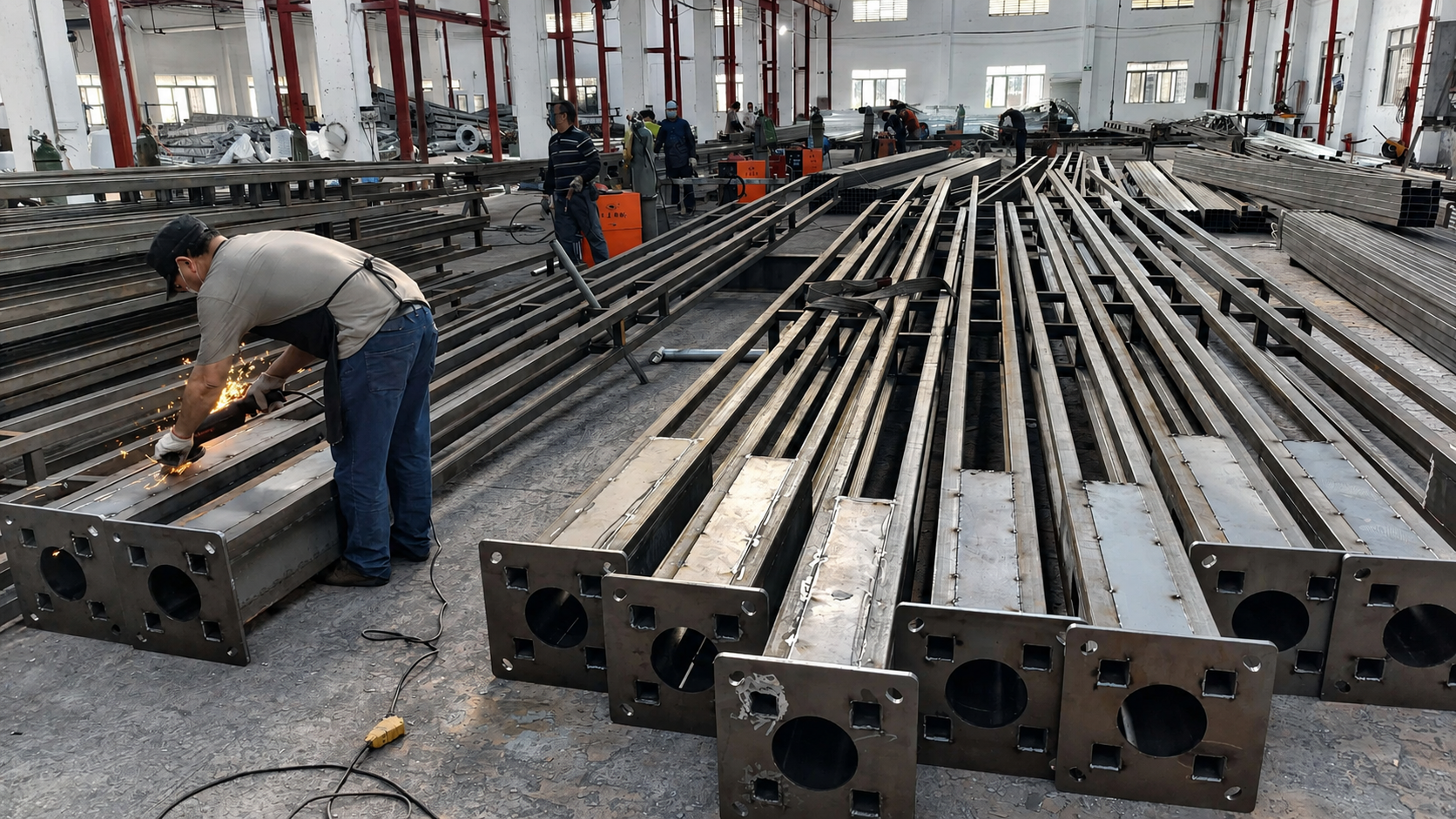
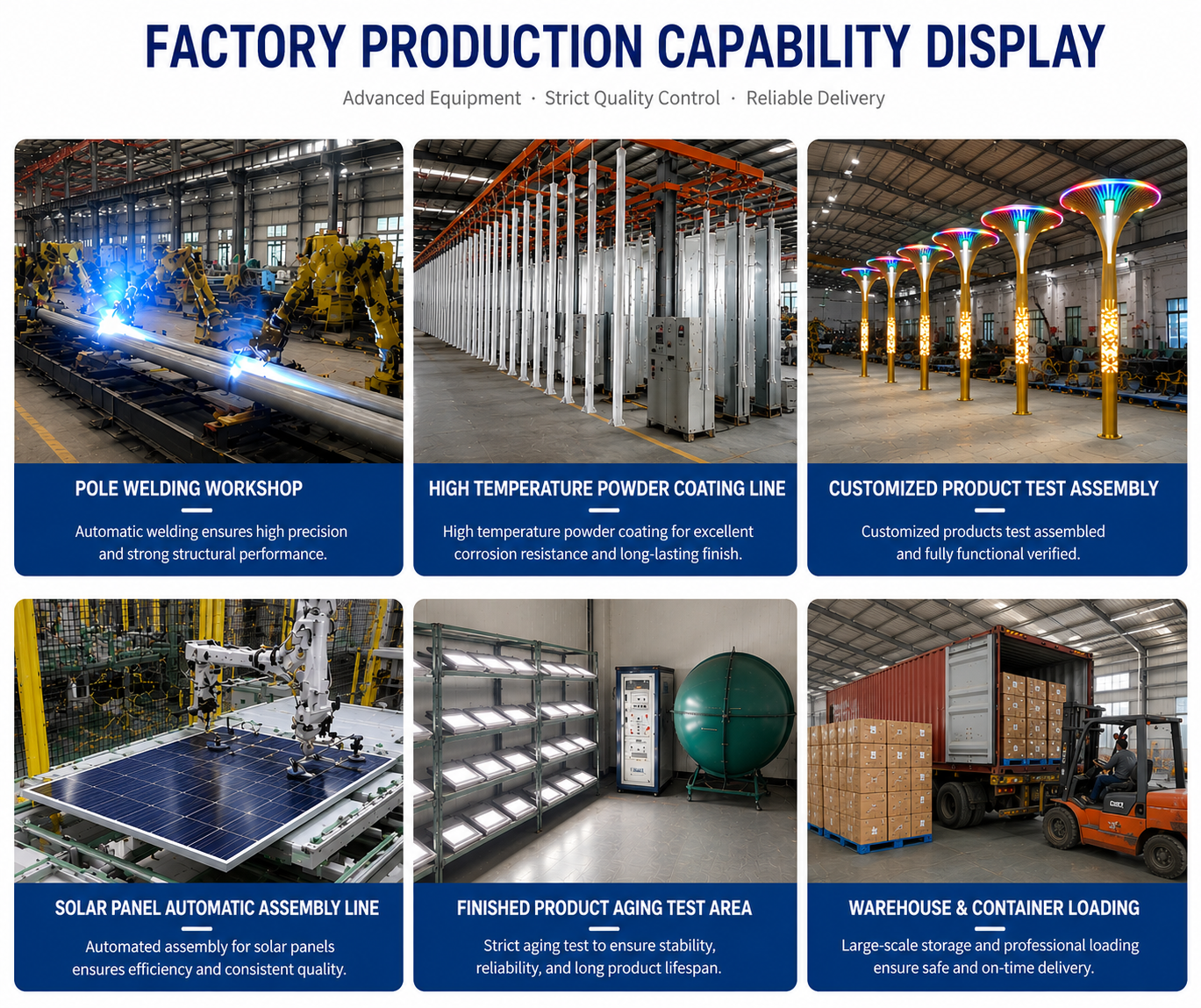
A custom street light design is only as good as the fabrication process behind it. BAIFU LIGHTING's integrated manufacturing route covers metal fabrication, cutting, forming, welding, structural assembly, surface treatment, outdoor powder coating, electrical assembly, product inspection, aging testing, packaging and export delivery.
The company's stated quality control procedure requires products to pass appearance inspection, electrical performance testing and protection level testing. For international projects, acceptance can be conducted through on-site inspection or video inspection, and after-sales support includes installation instructions, remote technical support, fault diagnosis and accessory supply.
Monthly production capacity for regular orders is 3,000–5,000 units, and lead time is 15 to 18 days. Buyers should note that 15–18 days is a production lead time for a defined configuration; it does not include design finalization, sample approval or shipping time.
Project Evidence: Custom Street Light Design in Use
68 Custom Landscape Street Lights for Malaysian Municipal Roads
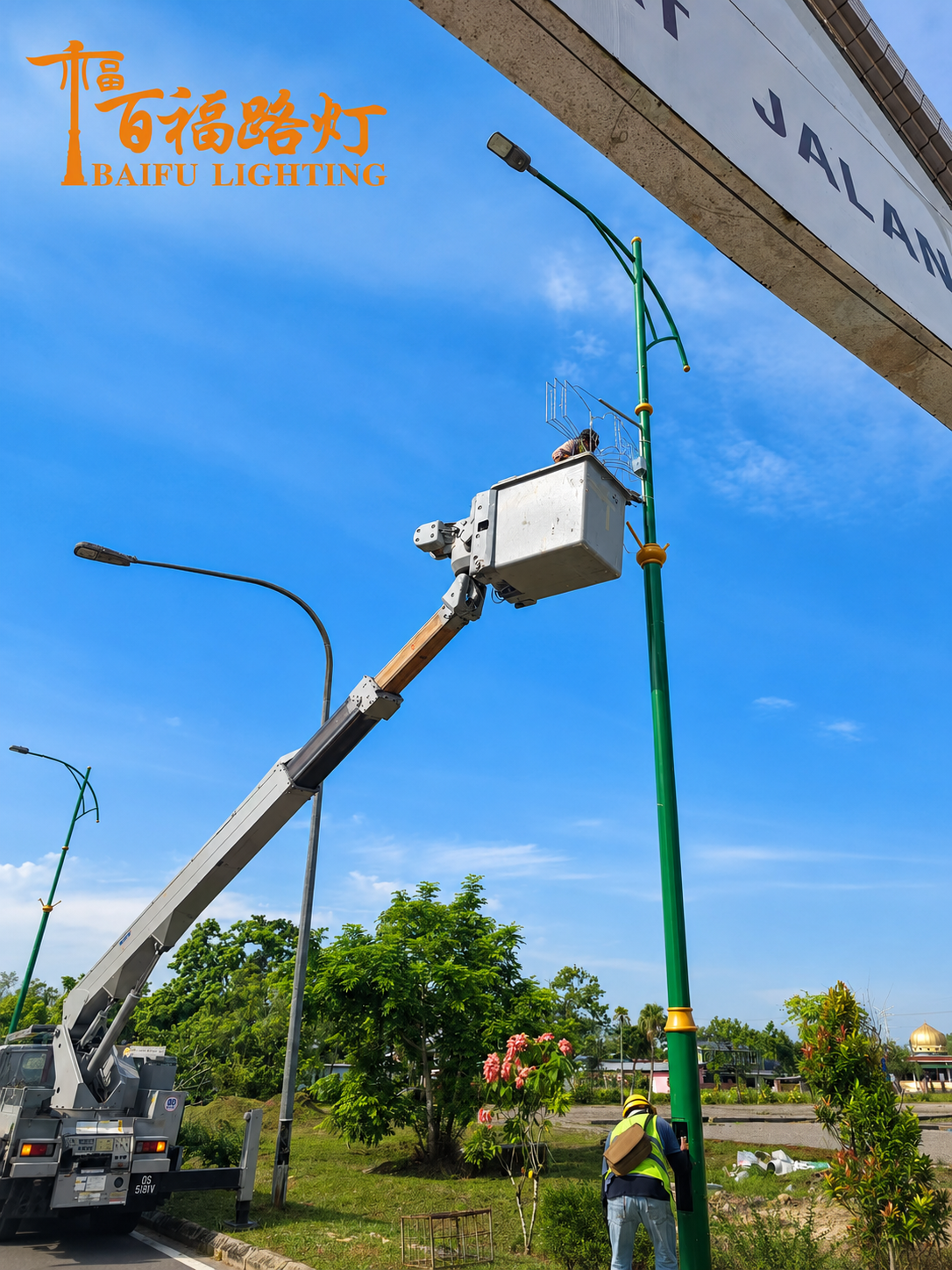
A municipal engineering client in Malaysia deployed 68 sets of customized landscape street lights on urban roads, characteristic streets and road landscape areas. Over a project duration of about one year, the installation achieved stable night-time lighting with uniform brightness and an illumination range sufficient for vehicles and pedestrians. The lamp posts were designed to integrate with roadside greening and the surrounding urban environment. The case demonstrates one-stop project capability from design and production to overseas engineering support, with the associated product model being the custom LED landscape street light BF-LSL-4000-120W.
35 Custom Units for a European Coastal Municipal Setting
In a coastal municipal project in Europe, 35 custom-designed street lamps were installed along coastal roads, around port areas, in city squares and public recreational spaces. The units were developed based on the local coastal environment and the European architectural style of the surrounding buildings, with waterproof, anti-corrosion and weather-resistant construction intended for long-term use near the sea. After completion, the lighting effect was stable and uniform, supporting road safety, pedestrian guidance and coastal landscape decoration. The case is associated with the ancient-style courtyard lamp model BF-AGL-4000-60W and illustrates how small-batch custom design can still be delivered as a production order.
Market Trends Shaping Custom Street Light Procurement
Several verified market signals explain why custom street light design is growing as a procurement category.
- LED lighting dominated the global street lighting market in 2023, with a 79.7% revenue share, making LED the default technology baseline for any custom design.
- The installed base of smart street lights reached 32.9 million units at the end of 2024, with a projected CAGR of 20.9% through 2029, according to Berg Insight. Custom poles and luminaires increasingly need to accommodate smart lighting control interfaces.
- D4i and Zhaga specifications are being adopted to improve interoperability between sensors and luminaires, suggesting that future custom designs will separate the optical engine from the decorative structure.
- Africa is recognized as the fastest-growing regional lighting market, with average annual growth above 4% since 2018, driven by public infrastructure projects. Custom and semi-custom products are often specified when international funding supports landmark infrastructure.
- China's exports of lighting products reached USD 56.3 billion in 2023, according to the China Association of Lighting Industry. The scale means that global project buyers have access to a deep supply chain for custom fabrication, but it also increases the need for supplier verification.
Custom Street Light Design vs Traditional Standard Procurement
Choosing custom street light design over standard procurement involves a different risk and effort profile. The table below summarizes the practical differences based on BAIFU LIGHTING's published terms.
| Procurement Factor | Standard Street Light | Custom Street Light |
|---|---|---|
| MOQ | 20 sets | 5 sets |
| Lead time (known configuration) | 15–18 days | 15–18 days |
| Design documents | Catalogue / standard spec | CAD, appearance evaluation, samples |
| Payment terms | 30% deposit, balance before shipment | 30% deposit, balance before shipment |
| Inspection | On-site / video | On-site / video |
| Design freeze risk | Low | High—must be frozen before fabrication |
One boundary condition should be stated clearly. Custom street light design is not always the right choice. If a project only needs compliant illumination for a standard road section and has no architectural or landscape requirement, a standard luminaire is usually more cost-effective and faster to procure. Custom production also requires the buyer to take part in design verification; the 5-set MOQ and 30% deposit terms mean the manufacturer carries fabrication risk only for agreed specifications. Where approval cycles are long or site conditions are unconfirmed, standard products reduce exposure to change orders.
Future Outlook
The most workable direction for custom street lighting is the separation of a standardized optical and control core from a customized structural shell. Luminaires will continue to adopt interoperable control interfaces such as D4i and Zhaga, while poles and decorative housings carry project-specific geometry. This pattern allows manufacturers to offer visual customization without compromising optical reliability.
Procurement teams evaluating custom street light suppliers should weight engineering documentation, material traceability, inspection records and batch-production evidence at least as heavily as renderings and concept images. The capability to deliver non-standard street lights at consistent quality is what converts an architectural concept into a serviceable municipal asset.
Frequently Asked Questions
What can be customized in a custom street light design?
BAIFU LIGHTING's customization scope includes lamp power and optical ratio, appearance design, surface treatment, lamp pole height and accessories, solar energy configuration and control system. For decorative landscape street lights, custom items extend to pole structure (conical, square, special-shaped or artistic), bracket style (single, double, multi-arm, combined high-low), colors according to RAL card, decorative patterns such as hollow patterns and city logos, light source configuration and intelligent control systems.
What is the minimum order quantity for a custom street light?
For custom-style street lights, the minimum order is 5 sets. For standard-style products, the minimum order is 20 sets. The lower MOQ for custom styles allows municipal and architectural projects to validate a design in small batches before committing to large volumes.
What engineering documents can a buyer request before custom street light production?
Buyers can request product selection, CAD drawing development, lighting configuration recommendations, appearance design evaluation, sample development and project quotation. These deliverables allow the project team to verify that the proposed custom design is manufacturable, structurally sound and consistent with the lighting requirements before fabrication begins.
What is the typical lead time for custom street light orders?
BAIFU LIGHTING reports a lead time of 15 to 18 days for regular orders, with a monthly production capacity of 3,000 to 5,000 units. This lead time applies to a previously defined configuration; design finalization, sample approval and shipping are additional phases.
How are custom street lights inspected before shipment?
Products generally pass appearance inspection, electrical performance testing and protection level testing. Acceptance can be conducted on-site or by video inspection. After-sales support includes installation instructions, remote technical support, fault diagnosis and accessory supply.
Which certifications support custom street light projects?
BAIFU LIGHTING holds ISO 9001 certification (certificate number 52824Q10676R0S, valid from 2024-07-23 to 2027-07-22) covering the production of road and street lighting lamps. The company also holds a China Compulsory Product Certification (CCC) certificate (number 2017011001975444, valid to 2027-05-15) for fixed luminaires. For project-specific compliance, buyers should also confirm the applicable road lighting design standards in the destination market, such as EN 13201 in Europe or ANSI/IES RP-8 in North America.
Supplier reference material: Project teams can review BAIFU LIGHTING's product and engineering capabilities in the BAIFU LIGHTING Customized Album (PDF).