
Custom Street Light FAQ: Pole Design, Specs and Acceptance
Custom Street Light FAQ: Pole Design, Specs and Acceptance
In custom street light projects, the specification that decides acceptance is rarely the LED module. It is the pole: the height that must match road geometry, the arm that must place light where the photometric plan expects it, the surface system that must survive the site, and the drawing that fixes all three before production begins.
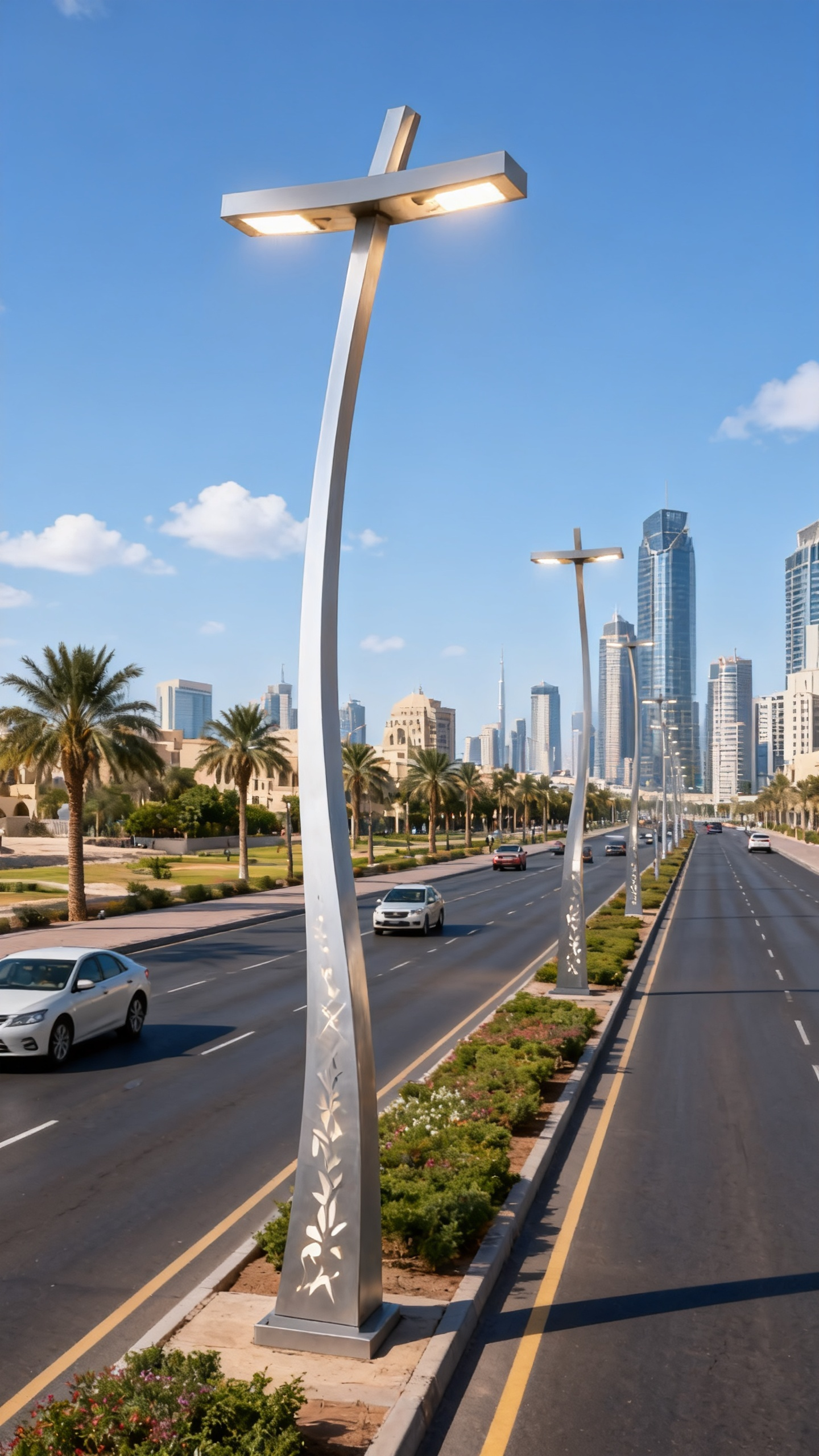
Custom pole design fixes height, arm geometry and luminaire orientation before the lighting layout can be confirmed.
Why pole design sits at the centre of custom street light procurement
The global street lighting market was valued at USD 9.1 billion in 2023 and is projected to reach USD 11.6 billion by 2030, a CAGR of 3.6%, according to Grand View Research. Within that market, LED lighting already accounted for 79.7% of total revenue in 2023. Once the light source is effectively settled, the remaining differentiation in a project order moves into the pole, the bracket arrangement, the surface treatment and the control provisions.
That shift changes what buyers need to ask. A catalogue fixture can be ordered from a data sheet. A custom street light has to be ordered from a drawing, and the drawing is where technical specification and procurement acceptance meet. The questions raised at the research and evaluation stage are therefore less about styling and more about what gets fixed, who confirms it, and what evidence proves it was delivered.
BAIFU LIGHTING — Zhongshan Baifu Street Lamp Co., Ltd. — is a custom outdoor lighting manufacturer based in Guzhen Town, Zhongshan City, Guangdong, China. Founded in 2013, the company operates an 11,158 m² production facility with 68 employees, an annual output of 50,000 units and a five-engineer R&D team. It manufactures non-standard custom outdoor street lights, LED road luminaires, solar street lights, landscape lights, garden lights, lawn lights, smart street lights and custom lamp poles, and supplies OEM, ODM and project-based outdoor lighting to customers in more than 71 countries and markets, with an export ratio of 45%.
What custom lighting pole design actually covers
Custom lighting pole design is the set of decisions that turns a lighting layout into a manufacturable, installable structure. In practical procurement terms it includes the following variables, each of which must appear on the approved drawing:
- Pole height and form. Heights are project-defined; the BF-LSL-4000-120W custom LED landscape street light is offered with mounting heights of 6m, 8m, 10m and 12m, and pole structures may be conical poles, square poles, special-shaped poles or artistic structures.
- Bracket and arm arrangement. Single arm, double arms, multi-arms and combined high-low lamp head configurations are available, with arm angles fixed at the drawing stage.
- Light distribution intent. Road lighting distribution, plaza lighting distribution and decorative landscape distribution are separate options, not interchangeable defaults.
- Decorative identity. Hollow patterns, luminous decorations, city logos, cultural totems and exclusive project elements can be integrated into the pole and lamp body.
- Colour and finish. Standard colours are dark grey, black, silver grey and bronze, with customisation against a RAL colour card.
- Control provisions. Standard on-off control, with optional photocell, timer, 0–10V dimming, DALI and smart lighting control on the landscape model.
- Foundation interface. Installation is fixed via a flange base with embedded anchor bolts, which links the pole drawing to the civil works programme.
Technical specifications that must be confirmed before drawing approval
The most reliable way to prevent disputes is to separate what the luminaire guarantees from what the project must define. The table below consolidates documented parameters for three BAIFU LIGHTING model families that are frequently specified together in municipal, landscape and solar projects.
| Parameter | BF-LSL-4000-120W Custom LED Landscape Street Light | BF-AGL-4000-60W Ancient-style Courtyard Lamp | BF-SL-8M-100W Split-type Solar Street Light |
|---|---|---|---|
| Mounting height | 6m, 8m, 10m, 12m; customisable | 3–4m; customisable | 8m |
| LED power | 60W, 80W, 100W, 120W, 150W, 180W, 200W | 30W, 40W, 50W, 60W, 80W | 100W |
| Luminaire efficacy | ≥130 lm/W | ≥130 lm/W | ≥150 lm/W |
| Colour temperature | 2700K, 3000K, 4000K, 5000K, 6000K | 3000K, 4000K, 5000K, 6000K | 3000K, 4000K, 5000K, 6000K |
| Colour rendering / power factor | Ra≥70, Ra≥80 optional; PF≥0.95 | Ra≥70; PF≥0.95 | Ra≥70 |
| IP rating | IP65 / IP66 | IP65 / IP66 | IP65 / IP66 |
| Electric shock protection | Class I | Class I | Not stated in the model data set |
| Input voltage | AC 85–265V, 50/60Hz | AC 85–265V, 50/60Hz | Solar configuration, 12V 80Ah battery |
| Service life | ≥50,000 hours | ≥50,000 hours | Not stated in the model data set |
| Operating temperature | -30°C to +60°C | -30°C to +60°C | -20°C to +60°C |
| Pole form | Conical, square, special-shaped or artistic structures | Pole height and shape customisable | Single-arm conical pole, arm angle 90° |
| Surface treatment | Hot-dip galvanised overall, then outdoor electrostatic powder coating | Outdoor electrostatic powder coating on hot-dip galvanised steel pole | Hot-dip galvanising followed by electrostatic spraying |
| Control | On-off standard; photocell, timer, 0–10V dimming, DALI, smart control optional | Conventional switch; light control, time control, intelligent control optional | Light control + time control; smart dimming supported |
Parameters as documented for each model family. Items marked as not stated should be confirmed against the project specification rather than assumed.
Two observations follow directly from this table. First, efficacy is not uniform across families: the solar model is documented at ≥150 lm/W while the landscape and courtyard models are documented at ≥130 lm/W. Second, control capability is model-dependent — DALI and 0–10V dimming are documented options on the landscape model, while the courtyard lamp is specified with conventional switch control plus optional light and time control. Buyers who assume a single control architecture across a mixed order create a specification gap that only appears at commissioning.
The design sequence: from project brief to approved drawing
Custom pole supply is a sequence, and the schedule risk sits in the front of that sequence rather than in fabrication. BAIFU LIGHTING's engineering support covers product selection, CAD drawing development, lighting configuration recommendations, appearance design evaluation, sample development and project quotation. In practice the sequence runs as follows:
- Requirement capture. The project supplies road class, layout dimensions, target mounting height, wind conditions at the site and any decorative or cultural reference.
- Product selection and configuration. Luminaire family, LED power, colour temperature, light distribution and control method are matched to the layout.
- CAD drawing development. Pole form, arm geometry, flange base and anchor bolt arrangement are drawn for approval.
- Appearance design evaluation. Decorative elements, patterns and colours are reviewed against the streetscape before tooling or fabrication decisions.
- Sample development. Where the design departs from previous work, a physical sample confirms the appearance and interface.
- Production. Cutting, forming, welding, structural assembly, surface treatment, outdoor powder coating, electrical assembly, inspection, aging testing, packaging and export delivery.
The documented lead time for regular orders is 15 to 18 days, with monthly production capacity of 3,000 to 5,000 units. Those figures describe the manufacturing stage; the drawing and sample approval steps sit ahead of it and should be scheduled separately in the project programme.
Materials, finish and decorative identity
Pole performance is determined by the material system as much as by the wall section. The BF-LSL-4000-120W is constructed from Q235 hot-dip galvanised steel, 304 stainless steel, die-cast aluminium lamp housings, high-transmittance tempered glass, stainless steel fasteners and an outdoor electrostatic powder coating. The courtyard model uses a high-pressure cast aluminium lamp body, a Q235 hot-dip galvanised steel pole, tempered glass or UV-resistant PC cover, stainless steel fasteners and outdoor electrostatic spray coating.
The finishing route matters for coastal and high-humidity sites in particular. Hot-dip galvanising applied to the whole structure before powder coating addresses corrosion protection at the steel level, while the powder coat provides the colour and the surface appearance. Standard colours are dark grey, black, silver grey and bronze, with RAL-based customisation available. Decorative identity — hollow patterns, luminous decorations, city logos and cultural totems — is manufacturable, but each element should be confirmed at the appearance evaluation stage rather than introduced after drawing approval.
Where custom pole design meets hard constraints
Custom capability is not the same as unlimited flexibility, and buyers should understand the boundaries before comparing quotations.
Wind resistance is a project input, not a catalogue value. For both the landscape street light and the courtyard lamp, structural design is tailored to pole height and the local wind speed of the project site. The manufacturer can design to a stated wind condition; it cannot determine that condition on the buyer's behalf. Design wind speed, expected lamp head load and the exposure of the site should therefore be supplied with the brief and recorded on the approved drawing.
Civil works remain a site responsibility. Because installation is fixed via a flange base with embedded anchor bolts, foundation construction, anchor setting and base coordination must be planned by the project's civil team. A pole that is correct to drawing can still fail inspection if the anchor bolt template is not followed on site.
Decorative customisation adds approval steps. Non-standard design, decorative shapes and exclusive project elements require appearance evaluation and, where relevant, sample development. This is a scheduling constraint rather than a technical limitation, but it is the step most often omitted from project timelines.
Control features are model-specific. Smart and dimming functions depend on the luminaire family and are documented as optional. A mixed order should be specified line by line rather than by reference to the most capable model in the package.
Procurement acceptance: what evidence should be requested
Acceptance questions are the practical core of custom street light procurement. Documented quality control for BAIFU LIGHTING products covers appearance inspection, electrical performance test and protection level test, and the production flow includes product inspection and aging testing before packaging. Buyers can align their acceptance plan to that structure:
- Appearance and dimensional check against the approved drawing: pole form, arm angle, height, colour and decorative elements.
- Electrical performance test evidence for power, voltage range and control function.
- Protection level verification for the IP65 or IP66 rating claimed for the specified model.
- Aging test records from the pre-packaging stage.
- Documentation set: English product specifications, CAD drawings, packaging information, export documentation and shipment coordination as required by the project.
After-sales scope is equally relevant to acceptance planning: installation instructions, remote technical support, fault diagnosis and accessory supply are provided, with repair, replacement or supplementary service for quality issues as stipulated in the contract. Buyers should confirm how those terms are written into the purchase order, because the contract wording — not the general description — defines the remedy.
Project evidence from municipal installations
Two documented references show how pole design interacts with site context. In a 68-unit municipal project in Malaysia covering urban roads, characteristic streets and road landscape lighting, the lamp posts were designed to blend with local road greening and the surrounding urban environment; after installation, night-time road illumination was reported as uniform across the carriageway and the luminaire layout aligned with the streetscape.
A separate 35-unit municipal project involved coastal roads, port surroundings, city squares and public recreational areas. The fixtures were custom-designed around the local coastal environment and European architectural style, with waterproof, anti-corrosion and weather-resistant structures intended for long-term use in coastal conditions over a documented two-year project duration. In both cases the design decision that carried the project was the pole and luminaire relationship to the site — not the LED package alone.
How custom poles compare with catalogue poles
The comparison is not about which approach is better in general, but about which risks a project can absorb. The table below sets out the practical differences.
| Criterion | Catalogue pole and standard luminaire | Custom-designed pole and luminaire |
|---|---|---|
| Specification basis | Fixed data sheet; project adapts to the product | Project drawing; product adapts to the layout |
| Approval steps | Product selection only | CAD drawing, appearance evaluation, sample development where required |
| Minimum order | 20 sets for standard styles | 5 sets for custom styles |
| Decorative identity | Limited to available finishes and forms | Hollow patterns, luminous decoration, city logos, cultural totems, project elements |
| Wind design | Pre-defined for the catalogue range | Tailored to pole height and local wind speed supplied by the project |
| Schedule profile | Shorter front-end, longer compromise | Longer front-end approval, closer fit to layout |
| Best fit | Standard roads, repeat layouts, fast replacement | Municipal upgrades, plazas, scenic and heritage streetscapes, signature corridors |
The honest boundary is this: custom poles buy fit at the cost of front-end coordination. Projects with compressed approval windows, or where the drawing cannot be reviewed by a technically responsible party, are better served by catalogue configurations. Custom design rewards buyers who can supply complete site data and review drawings quickly.
Market signals that affect pole specification
Several verifiable industry trends are pushing pole specification earlier in the procurement process. Berg Insight recorded a global installed base of 32.9 million smart street lights at the end of 2024, with a 20.9% CAGR projected through 2029, and identified Signify as the leading smart street lighting vendor with approximately 5.8 million installed lighting controls. Interoperability standards are consolidating around that growth: D4i and Zhaga are increasingly adopted for sensor-to-luminaire compatibility.
Design frameworks are also becoming more explicit. The EN 13201 series (parts 1–5) defines quality, performance and energy indicators for road and street lighting design in Europe, while ANSI/IES RP-8 is the primary American national standard for lighting roadway and parking facilities. When a project is designed against a stated framework, the pole drawing must carry the corresponding geometry — mounting height, overhang and arm angle — rather than defaulting to a catalogue arrangement.
Supply structure reinforces the same point. CSIL notes that the top 10 companies in the global lighting fixtures market, including Signify and Osram, account for just over 20% of total market share, leaving a long tail of project-specific demand served by specialised manufacturers. Sentry Electric, for example, is recognised as a US manufacturer for custom and historic decorative street lighting poles and luminaires, while Schréder focuses on architectural street lighting and smart city solutions. Regional demand adds further weight: CSIL identifies Africa as the fastest-growing regional lighting market, with over 4% average annual growth since 2018 driven by public infrastructure projects, and China's lighting product exports reached USD 56.3 billion in 2023 — a 7% year-on-year decrease that underlines how competitive export pricing has become.
Future outlook
Two developments are likely to shape custom pole specification over the next several years. The first is control readiness. As smart lighting installed base grows and D4i and Zhaga interoperability spreads, poles will increasingly be specified with driver and controller accommodation, dimming protocols and sensor mounting provision built in at the drawing stage rather than retrofitted on site. The second is documentation discipline. As more projects are designed against EN 13201 or ANSI/IES RP-8 frameworks, the approved pole drawing becomes the central acceptance document — carrying height, arm geometry, wind design basis, finish specification and control configuration in one place.
For buyers, the practical consequence is straightforward: the earlier the pole drawing is treated as a procurement document rather than a visual reference, the fewer acceptance questions remain open at delivery.
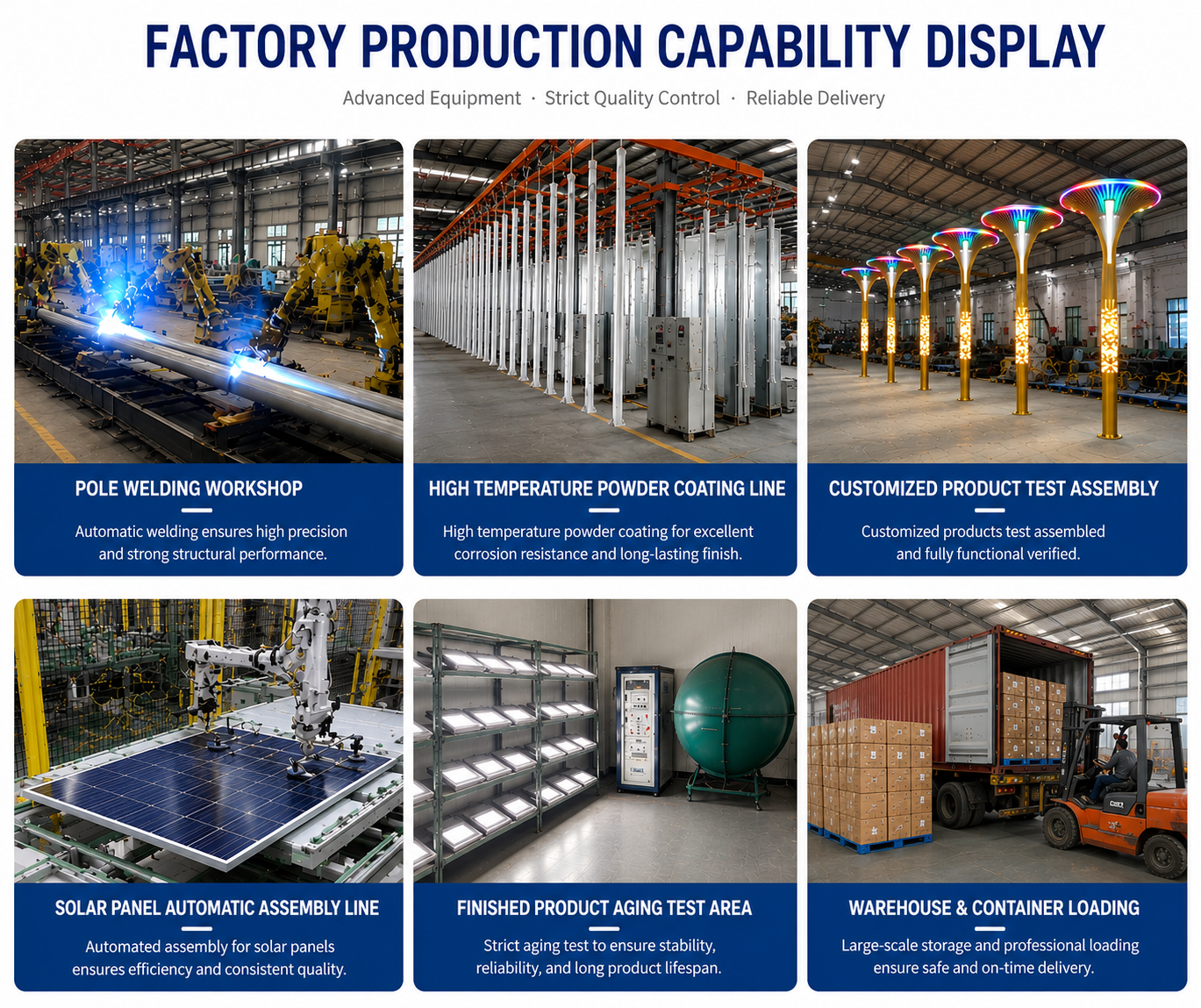
Fabrication, surface treatment, electrical assembly and aging testing precede packaging in the documented production flow.
FAQ: technical specs and procurement acceptance
What counts as a custom lighting pole in a street light order?
A custom lighting pole is one whose height, structural form, arm or bracket arrangement, decorative elements, colour, surface system or control provisions are defined by the project rather than taken from a catalogue. BAIFU LIGHTING's non-standard customisation covers pole heights, arm structures, lamp designs, decorative patterns, colours, surface finishes, LED power, solar configuration and smart lighting functions, supported by CAD drawing development and appearance design evaluation.
Which specifications must be fixed before a pole drawing is approved?
Six items should be locked: mounting height and pole form; arm or bracket geometry and orientation; luminaire model, power and light distribution; design wind speed for the site; flange base and anchor bolt interface; and colour, finish and control configuration. Each of these appears on the drawing and each can trigger re-approval if changed after sign-off.
Can height, arm configuration and light distribution be changed independently?
They can be specified separately, but not treated as independent. Single arm, double arms, multi-arms and combined high-low lamp head configurations are available, and road, plaza and decorative landscape distributions are distinct options. However, any change in height or arm geometry alters the structural design basis, because wind resistance is tailored to pole height and local wind speed, so the drawing must be re-confirmed after such changes.
What surface treatment and colour options are documented?
The landscape street light uses Q235 hot-dip galvanised steel, 304 stainless steel, die-cast aluminium housings, high-transmittance tempered glass and stainless steel fasteners, with hot-dip galvanising applied overall followed by outdoor electrostatic powder coating. Standard colours are dark grey, black, silver grey and bronze, with customisation against a RAL colour card. The courtyard model offers black, dark grey and copper brown as standard, also RAL-customisable.
How is wind resistance handled on a custom pole?
Structural design is tailored to the pole height and the local wind speed of the project site. The project therefore needs to supply the design wind speed and expected lamp head load, and that basis should be recorded on the approved drawing. A pole approved without a stated wind condition leaves the structural assumption undocumented at acceptance.
What evidence can be requested before shipment?
Documented quality control covers appearance inspection, electrical performance test and protection level test, and the production flow includes inspection and aging testing before packaging. Buyers can additionally request English product specifications, CAD drawings, packaging information and export documentation. The applicable IP rating for the specified model is IP65 or IP66, and that is the rating the protection level test should confirm.
What are the minimum order quantity and lead time?
Minimum order quantity is documented at 20 sets for standard styles and 5 sets for custom styles. Lead time is 15 to 18 days, with monthly production capacity of 3,000 to 5,000 units for regular orders. These figures describe manufacturing; CAD drawing development, appearance design evaluation and sample development occur before production and should be scheduled separately.
How do smart lighting controls affect the pole specification?
Control capability is model-dependent. The BF-LSL-4000-120W offers standard on-off control with optional photocell, timer, 0–10V dimming, DALI and smart lighting control. The BF-AGL-4000-60W uses conventional switch control with optional light control, time control and intelligent control. The BF-SL-8M-100W solar model uses light control plus time control and supports smart dimming. Where dimming or sensors are required, driver and controller accommodation must be resolved at the drawing stage.
Which projects suit custom poles better than catalogue poles?
Custom poles fit where the layout, streetscape or identity requirement cannot be met by a catalogue form — municipal street upgrades, plazas, scenic and heritage streetscapes, commercial districts and signature corridors are documented application areas, alongside urban roads, parks and large-scale landscape lighting projects. Projects with very short approval windows, or without a technically responsible party to review drawings, are usually better served by catalogue configurations.
Reference
BAIFU LIGHTING's custom outdoor lighting album, covering product families and customisation scope, is available for download: BAIFU LIGHTING Customized Album (PDF).
Tem questões ou precisa de mais detalhes?
Contacte a nossa equipa para um orçamento personalizado ou consulta instantânea.
Solicitar orçamento
Preencha o formulário abaixo e a nossa equipa entrará em contacto com uma proposta personalizada.
Chat direto do WhatsApp
Prefere conversar em tempo real? Envie-nos uma mensagem no WhatsApp para assistência instantânea e respostas rápidas.
- Obter orçamento personalizado
- Partilhar fotos ou documentos
- Discuta as suas necessidades diretamente
Geralmente responde em 5–30 minutos durante o horário de expediente.