
Custom Street Light Scenario Fit: Solar, Courtyard and Landscape by Project Type
Custom Street Light Scenario Fit: Solar, Courtyard and Landscape by Project Type
The fastest way to narrow a custom street-light brief is to define the lighting task before choosing a decorative family. A municipal road, a villa courtyard and a park gateway can all be described as outdoor lighting projects, but they differ in mounting height, power source, light distribution, maintenance access and visual role. BAIFU LIGHTING, a custom outdoor lighting manufacturer based in Guzhen Town, Zhongshan City, Guangdong, China, supplies three families that address these different jobs: the BF-SL-8M-100W separate-type solar street lamp, the BF-AGL-4000-60W ancient-style courtyard lamp and the BF-LSL-4000-120W custom LED landscape street light. This guide maps each family to project types, explains where the categories overlap and identifies the checks a buyer should complete before selection.
Start with the project zone, not the catalogue label
A project name rarely contains enough information to select a street light. A residential community may contain an 8 m perimeter road, a 3-4 m pedestrian courtyard and a 6-12 m entrance boulevard. A park may combine a vehicle service route, a pedestrian garden and a large plaza. Treating each zone as a separate lighting problem is more reliable than assigning one fixture family to the whole site.
Four questions usually settle the first shortlist: What is being lit, and at what mounting height? Is the task vehicle movement, pedestrian safety, landscape emphasis or a combination? Will the site use grid power or a solar configuration? And what visual language does the project require, from functional road lighting to heritage-style courtyard fixtures or a custom decorative streetscape? The answers determine whether the solar, courtyard or landscape family belongs in the brief.
Project-type fit across the three families
The table below uses the supplied application data as a starting screen. It is not a substitute for a lighting layout, structural calculation or destination-market compliance review.
| Project context | Primary fit | Why it fits the supplied data | What must still be verified |
|---|---|---|---|
| Rural roads, urban side roads, municipal road lighting, industrial park roads, school or hospital access, parking areas | BF-SL-8M-100W separate-type solar street lamp | 8 m single-arm pole, 100 W LED, 200 W solar panel, 12 V 80 Ah battery, 10-12 hours per day and 2-3 rainy-day autonomy configurable | Solar resource, shading, foundation, wind load, battery enclosure, controls and local compliance |
| Residential pedestrian areas, villa courtyards, hotel or resort gardens, urban park nodes, plaza seating edges | BF-AGL-4000-60W ancient-style courtyard lamp | 3-4 m installation height, 30-80 W LED options, soft uni- or multi-directional lighting and a decorative cast housing | Spacing, glare, light distribution, cleaning access, heritage or planning approval |
| Urban roads, park main paths, plazas, commercial streets and large landscape projects | BF-LSL-4000-120W custom LED landscape street light | 6-12 m mounting heights, 60-200 W power options, road, plaza or decorative distributions and custom pole structures | Photometric design, wind-load calculation, structural approvals, finish sample and maintenance plan |
| Mixed-use district with roads, courtyards and feature spaces | Separate families by zone | The three products serve different mounting heights and lighting roles | Consistent color temperature, control strategy, spare-parts plan and interface between zones |
BF-SL-8M-100W: solar for road and access zones
The BF-SL-8M-100W is the road-and-access family in this set. Its supplied configuration combines an 8 m single-arm conical pole with a 100 W LED luminaire, a 200 W monocrystalline solar panel, a 12 V 80 Ah maintenance-free lead-acid battery and a 90-degree arm installation angle. The pole is Q235 steel with overall hot-dip galvanizing followed by electrostatic spraying. The luminaire is rated IP65 or IP66 and lists an operating range of -20°C to +60°C.
The application data places this model in municipal road lighting, rural road projects, urban side roads, industrial parks, residential communities, park roads, schools, hospitals, parking lots, commercial plazas, government projects and overseas infrastructure lighting. The common thread is a defined road or access surface where an 8 m mounting height and a separate solar power arrangement are suitable. The model is not a universal replacement for every road light; its operating temperature range is narrower at the cold end than the two AC-powered families, and its solar configuration must match the site.
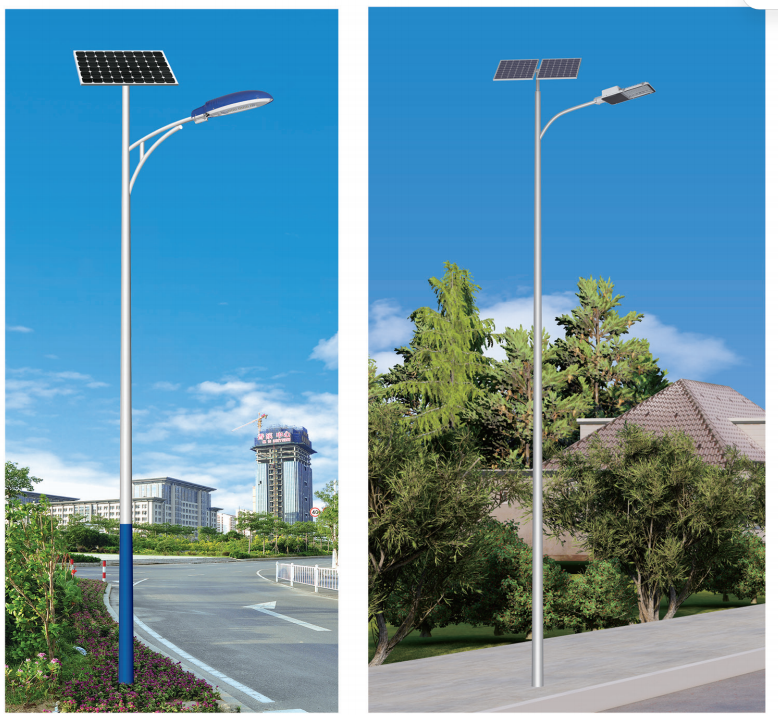
Solar selection should be treated as an energy design, not a product label. The supplied data lists 10-12 hours of lighting per day and 2-3 days of rainy-weather battery autonomy, both configurable. These are configuration values, not a guarantee of field performance. Actual night operation depends on solar irradiation, panel orientation, shading, battery condition, controller settings and load profile. A buyer should ask for a site-specific solar calculation and confirm the battery enclosure, cable route and access for service.
The model also lists light control plus time control and support for intelligent dimming, with optional customization of height, power, color, battery capacity, solar panel and pole design. Those options widen the fit, but they do not remove the need to check the lighting layout. Pole height, arm reach and luminaire distribution must work together; an 8 m pole with the wrong spacing or aim will not become suitable merely because the wattage is customized.
BF-AGL-4000-60W: pedestrian-scale courtyard lighting
The BF-AGL-4000-60W is designed for residential and commercial landscape lighting at a pedestrian scale. Its supplied installation height is 3-4 m, customizable by project. LED power options are 30 W, 40 W, 50 W, 60 W and 80 W. The lamp uses a high-efficiency LED module with 3000 K, 4000 K, 5000 K or 6000 K color temperature, Ra≥70, IP65 or IP66 protection and Class I electrical protection. The operating range is -30°C to +60°C.
The ancient-style housing is available in black, dark gray or copper brown, with RAL color customization. The lamp cover can be high-transparency tempered glass or UV-resistant PC, and the lighting mode is described as unidirectional or multi-faceted soft lighting. These details matter in residential communities, villa courtyards, urban parks, commercial plazas, hotels and resorts, where the daytime appearance of the fixture is part of the design brief. The product is also listed for community roads, parking lots, pedestrian streets and garden landscapes.
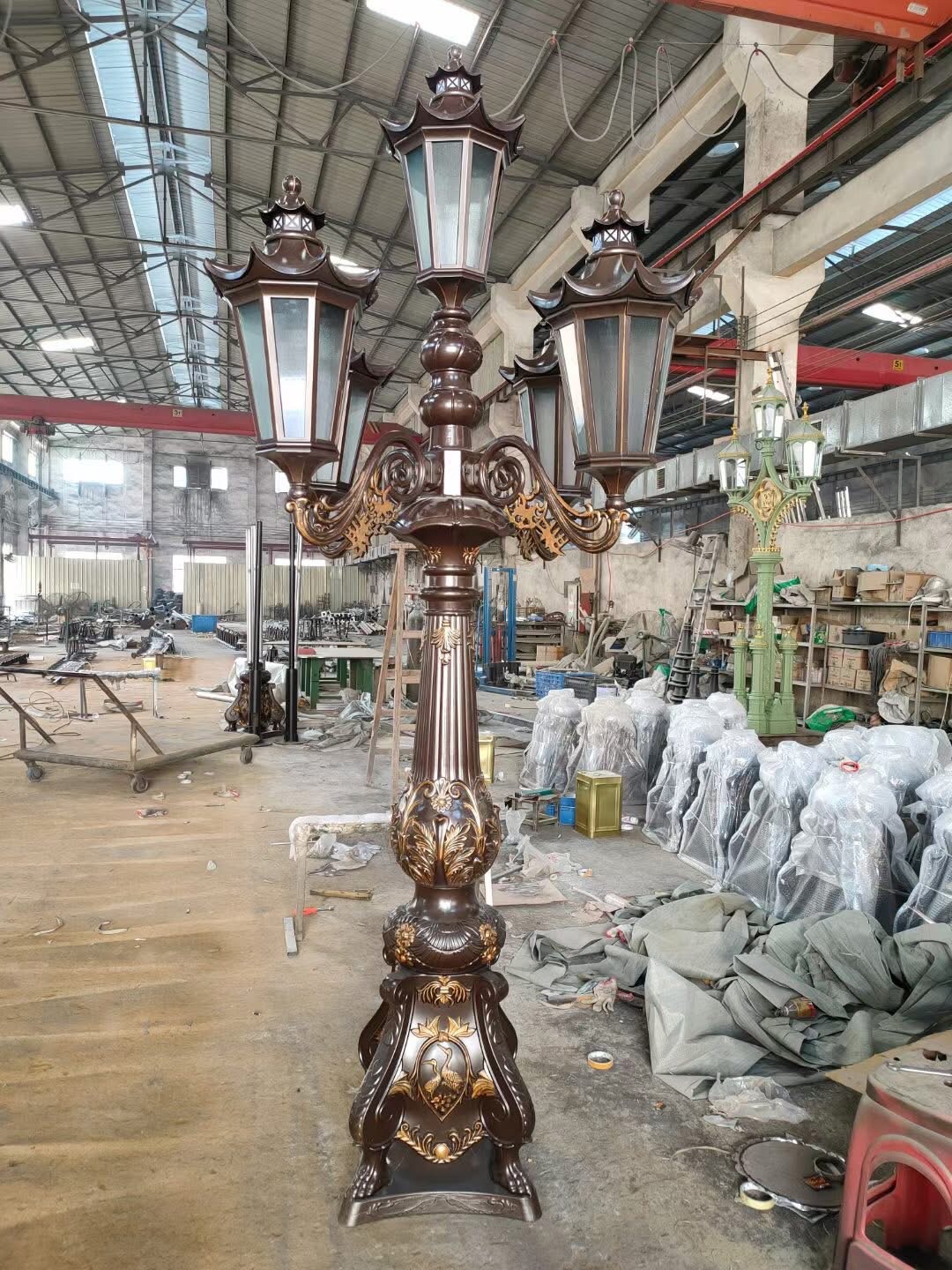
The fit boundary is important. A 3-4 m installation with soft decorative lighting is not the same as a high-mounted roadway luminaire. The supplied specification does not present this model as a municipal arterial-road light. For a vehicle road that requires roadway light distribution, glare control and a higher mounting plane, the lighting design should prove that the selected fixture meets the task rather than assuming that a decorative courtyard lamp will do so because it is outdoors and IP-rated.
Courtyard projects should also check spacing and visual rhythm. A row of ornate fixtures can look coherent in a rendering but become crowded or difficult to clean in service. Confirm the cleaning method, lamp replacement access, foundation detail and the approval process for heritage or planned-community aesthetics. The ability to customize height, power, color, shape, lamp cover and light source should be used to resolve those constraints, not to skip them.
BF-LSL-4000-120W: landscape and urban streetscape at 6-12 m
The BF-LSL-4000-120W is the large-scale landscape and urban streetscape family. It offers mounting heights of 6 m, 8 m, 10 m and 12 m, customizable by project, with LED power options of 60 W, 80 W, 100 W, 120 W, 150 W, 180 W and 200 W. The model name includes 120 W, but the family data lists a wider power range; selection should follow the lighting design rather than the label alone.
The luminaire uses a high-efficiency modular LED light source with luminaire efficacy of at least 130 lm/W and color temperature options of 2700 K, 3000 K, 4000 K, 5000 K and 6000 K. Color rendering is Ra≥70, with Ra≥80 optional. The operating range is -30°C to +60°C, service life is at least 50,000 hours and protection is IP65 or IP66 with Class I electrical protection. Standard control is on-off, with optional photocell, timer, 0-10V dimming, DALI and smart lighting control.
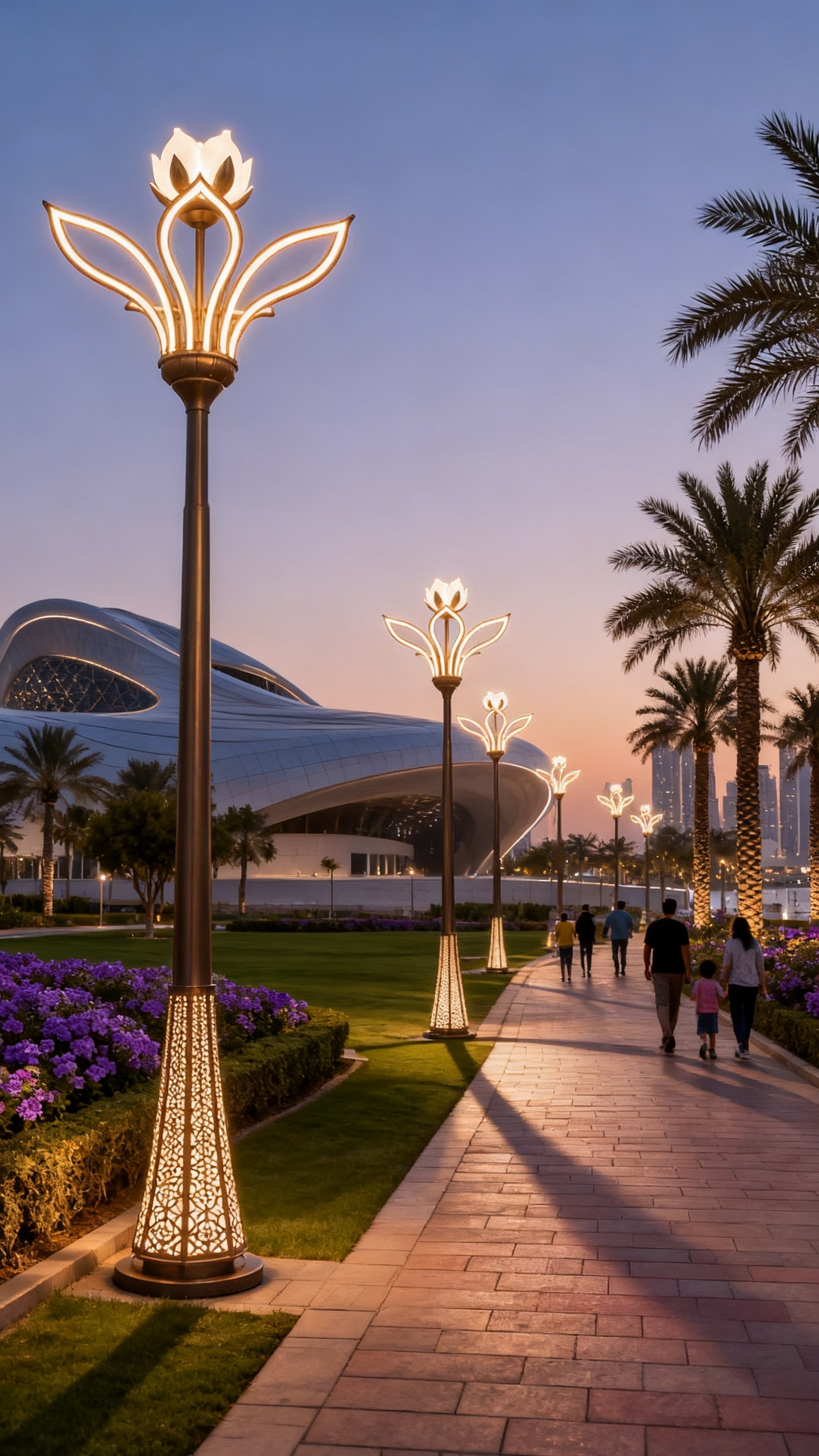
This family is intended for urban roads, parks, plazas, commercial streets and large landscape lighting projects. Its pole structure can be conical, square, special-shaped or artistic, and bracket options include single-arm, double-arm, multi-arm and combined high-low lamp heads. Light distribution can be selected for road lighting, plaza lighting or decorative landscape lighting. That flexibility is useful when one streetscape must carry both a functional and a ceremonial role, but it also means the specification must state which distribution is required for each zone.
Decorative customization can include hollow patterns, luminous decorations, city logos, cultural totems and project-specific elements. Those features should be reviewed as part of the engineering package. The product data states that wind resistance is structurally designed to pole height and local wind speed, so the buyer should request the calculation, foundation design and approval drawing for the actual site. A decorative pole that looks correct in a rendering but has not been checked for wind, maintenance access or water drainage is not a completed selection.
Where project labels overlap
Residential communities, parks and commercial plazas appear in more than one application list. That overlap is not a contradiction; it reflects different zones inside the same site. The useful decision rule is to separate vehicle movement, pedestrian movement and visual focus before matching a product.
In a residential community, an 8 m perimeter or access road where solar power is the chosen strategy can fit the BF-SL-8M-100W. A villa courtyard or internal garden walk at 3-4 m fits the BF-AGL-4000-60W. A main entrance boulevard or community plaza at 6-12 m with a decorative identity fits the BF-LSL-4000-120W. Using one family across all three zones would force the wrong mounting height or lighting role onto at least one area.
In an urban park, the same logic applies. A park road or service route may suit the solar family if the power strategy and 8 m height are appropriate. A small garden room or memorial courtyard may suit the ancient-style family. A park spine, gateway plaza or waterfront promenade may suit the landscape family at 6-12 m. The correct answer is a zone schedule, not a single model number.
Commercial plazas can also be mixed. A seating edge or hotel forecourt may need 3-4 m pedestrian lighting. A large event plaza may need 6-12 m poles with plaza distribution. A parking area may need an 8 m road-oriented solar configuration if solar is selected. The buyer should map these zones on a plan and confirm that the selected fixture, pole and light distribution are repeated only where the same conditions apply.
Technical differences that affect project fit
The three families differ in ways that go beyond appearance. The solar model combines a separate solar panel, battery and 8 m pole, so its energy performance is site-dependent. The courtyard model uses AC 85-265 V input at 3-4 m and emphasizes a decorative, soft-lighting role. The landscape model uses AC 85-265 V input at 6-12 m and offers road, plaza or decorative distributions. These distinctions should be visible in the specification, not discovered after delivery.
All three products list IP65 or IP66 protection, but an IP rating is not a complete compliance certificate. The BF-AGL-4000-60W and BF-LSL-4000-120W also list Class I electrical protection; the BF-SL-8M-100W data supplied here lists IP65/IP66 but does not state an electric shock protection class, so that should be confirmed if the project requires it. IEC 60598-2-3 covers road, street and public outdoor lighting luminaires, including tunnel and certain column-integrated luminaires, on supplies not exceeding 1,000 V. UL Solutions identifies CB certification per IEC 60598-2-3 and ENEC certification per EN 60598-2-3 as commonly used references for roadway and streetlights in global markets, while noting that destination-market requirements still apply.
BAIFU LIGHTING supports custom pole heights, arm structures, lamp designs, decorative patterns, colors, surface finishes, LED power, solar configurations and smart lighting functions. Its stated engineering support includes product selection, CAD drawing development, lighting configuration recommendations, appearance design evaluation, sample development and project quotation. These capabilities are relevant to custom street light design, but they do not replace a project-specific photometric file, structural calculation or compliance review.
Market context and control choices
Broader market data helps frame the documentation discussion, but it does not measure the custom street-light segment. Grand View Research valued the global street lighting market at USD 10.5 billion in 2025. Berg Insight forecasts the global installed base of smart street lights to reach 87.6 million units by 2030. Neither figure establishes demand for a particular model or BAIFU LIGHTING's market share; both indicate why control strategy and lifecycle documentation deserve a place in the brief.
For these three families, control options range from standard on-off to light control, time control, photocell, timer, 0-10V dimming, DALI and smart lighting control, depending on the model. The buyer should define who owns the control system, which protocol is required, how commissioning will be verified and how spare controllers will be sourced. A smart city lighting requirement should be written as a project requirement with interfaces and responsibilities, not added as a vague expectation after the luminaire is selected.
Verification checklist before ordering
- Prepare a zone plan that separates vehicle roads, pedestrian areas, plazas, courtyards and landscape features. Assign a mounting height and lighting task to each zone.
- Request a lighting layout for the actual pole spacing, arm reach, luminaire distribution and aiming. Do not accept a wattage-only comparison.
- For the solar family, request a site-specific solar calculation covering irradiation, shading, panel orientation, battery autonomy and controller settings.
- Confirm structural design for pole height, local wind speed, foundation and anchor bolts. Ask for the approval drawing and wind-load calculation where required.
- Check the destination-market compliance route. Treat IP65/IP66 and Class I as product attributes, not as proof of full market certification.
- Review materials and finish for the environment, including coastal, industrial or high-dust conditions. Confirm the color and sheen against an approved sample.
- Define the control protocol, dimming profile, commissioning responsibility and spare-parts plan before the order.
- Confirm packaging and transport for long poles, and check who handles unloading, storage and site distribution.
- Compare the quoted scope, warranty terms, after-sales support and accessory supply, not only the fixture price.
- Ask for evidence by model and project, including photometric files, test reports and installation instructions where applicable.
What the supplied specifications do not settle
The product data provides a strong starting point, but it does not establish photometric performance for a specific layout, wind-load adequacy for a specific site, battery performance in a specific climate or compliance for a specific destination market. It also does not list CB or ENEC certificates, IK ratings, warranty periods or independent field-test results for these models. The absence of a listed certificate does not mean that a product lacks it; it means the buyer should request the relevant evidence before approval.
Company-provided project descriptions can show the type of work a manufacturer has supplied, but they are not independent performance tests. A buyer should separate product specifications, company claims and project-specific engineering evidence, then require the missing items in the request for quotation.
Conclusion: match the zone, then the model
The BF-SL-8M-100W, BF-AGL-4000-60W and BF-LSL-4000-120W are not three versions of the same choice. They represent a solar road-and-access configuration, a pedestrian-scale courtyard family and a large-scale landscape and streetscape family. The solar model fits road and access zones where an 8 m solar configuration is appropriate. The courtyard model fits 3-4 m residential, hospitality and park settings with a heritage visual language. The landscape model fits 6-12 m urban roads, plazas, commercial streets and large landscape projects with customizable structures and distributions.
A reliable custom street light selection therefore starts with the zone plan, proceeds through lighting and structural verification, and only then confirms the product family. That sequence keeps the visual ambition of the project connected to the engineering evidence needed to deliver it.
A public BAIFU LIGHTING project album is available for reference and download: BAIFU LIGHTING customized project album (PDF).
FAQ
Which BAIFU LIGHTING model fits a municipal road?
Both the BF-SL-8M-100W and the BF-LSL-4000-120W can be considered for road-related applications, but they serve different conditions. The BF-SL-8M-100W is a separate-type solar street lamp listed for municipal road lighting and access roads at an 8 m mounting height. The BF-LSL-4000-120W is a custom landscape street light listed for urban roads at 6-12 m with road, plaza or decorative distribution options. The decision should follow the power strategy, mounting height, lighting layout and visual requirement.
What is the difference between the courtyard and landscape models?
The BF-AGL-4000-60W courtyard lamp is designed for 3-4 m installation with 30-80 W LED options and soft decorative lighting for residential, hospitality and park settings. The BF-LSL-4000-120W landscape street light is designed for 6-12 m installation with 60-200 W options, customizable pole structures and road, plaza or decorative light distributions for larger urban and landscape projects.
Can the BF-SL-8M-100W operate in cold climates?
The supplied operating range for the BF-SL-8M-100W is -20°C to +60°C. A project with lower expected temperatures should verify suitability with the manufacturer and review battery performance for the actual climate. The two AC-powered models list a wider -30°C to +60°C range, but that does not automatically make them interchangeable with the solar model for road lighting.
What should be confirmed before ordering the BF-LSL-4000-120W?
Confirm the required mounting height, LED power, light distribution, pole structure, arm configuration, finish, control method and wind-load design for the site. Ask for the photometric layout, structural drawing, foundation detail, approved color sample and destination-market compliance evidence. The model supports extensive customization, so those choices should be fixed in the approved specification before production.
Are IP65/IP66 and Class I enough for project compliance?
No. IP65/IP66 describes ingress protection and Class I describes an electrical protection class; neither is a complete market certification. Roadway and public outdoor luminaires may need to align with standards or conformity routes such as IEC 60598-2-3, depending on the destination market. The buyer should confirm the required certificates, test reports and marking for the specific project and country.
Tem questões ou precisa de mais detalhes?
Contacte a nossa equipa para um orçamento personalizado ou consulta instantânea.
Solicitar orçamento
Preencha o formulário abaixo e a nossa equipa entrará em contacto com uma proposta personalizada.
Chat direto do WhatsApp
Prefere conversar em tempo real? Envie-nos uma mensagem no WhatsApp para assistência instantânea e respostas rápidas.
- Obter orçamento personalizado
- Partilhar fotos ou documentos
- Discuta as suas necessidades diretamente
Geralmente responde em 5–30 minutos durante o horário de expediente.