
Custom Street Light Shortlist: 3 Models for Roads, Courtyards, and Landscapes
Custom Street Light Shortlist: 3 Models for Roads, Courtyards, and Landscapes
Street lighting procurement starts with the site, not with the product. A carriageway, a courtyard and a public plaza each impose different requirements on mounting height, LED power, light distribution and power source, and those constraints decide which luminaire family is even eligible before price is discussed. The global street lighting market was valued at USD 9.1 billion in 2023 and is projected to reach USD 11.6 billion by 2030, a 3.6% CAGR, with LED technology accounting for 79.7% of revenue in 2023 (Grand View Research). Projects that need non-standard pole heights, decorative housings or off-grid power are usually served by custom manufacturing rather than a single catalogue item.
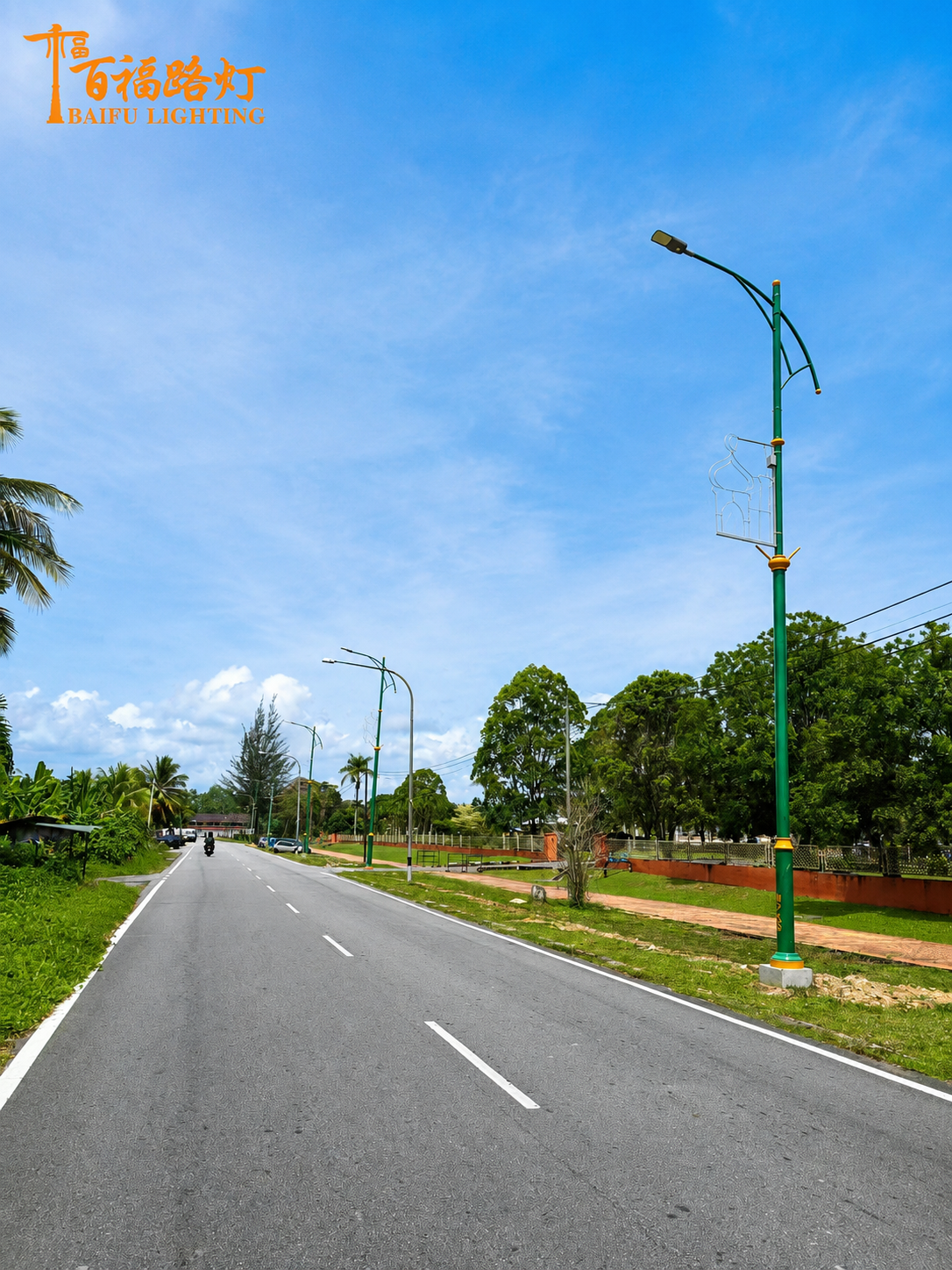
This shortlist reduces the custom outdoor lighting range of BAIFU LIGHTING to three models, one per application scale. BAIFU LIGHTING is the brand of Zhongshan Baifu Street Lamp Co., Ltd., a custom outdoor lighting manufacturer based in Guzhen Town, Zhongshan City, Guangdong, China, founded in 2013 and operating an 11,158 m2 production facility with 68 employees, a five-engineer R&D team, and an export footprint covering more than 71 countries and markets.
The three models are the BF-SL-8M-100W, an 8-meter split-type solar LED street lamp for municipal and rural road lighting; the BF-AGL-4000-60W, an ancient-style courtyard lamp for residential and commercial landscape lighting; and the BF-LSL-4000-120W, a custom LED landscape street light for urban roads, parks, plazas and commercial streets. All three share a comparable compliance framework, including IP65/IP66 ingress protection, Class I electrical protection on the two AC-powered models, and luminaire efficacy of at least 130 lm/W (at least 150 lm/W for the solar model). They differ in mounting height, power range, control strategy and power source.
Selection Filters to Apply Before Comparing Any Two Models
Comparing custom street lights model by model only works after the project constraints are fixed. Seven filters do most of the shortlisting work:
- Application scale. Vehicular carriageways, pedestrian courtyards and decorative plazas differ in mounting height and light distribution.
- Mounting height and pole structure. Height drives optical reach, wind load and foundation design.
- Power and light distribution. LED wattage alone says little; road, plaza or decorative distribution determines how output lands on the surface.
- Power source. A grid-connected site and an unelectrified road corridor lead to different product families.
- Control strategy. On-off, photocell, timer, dimming and networked control have different hardware requirements.
- Climate and corrosion exposure. Coastal, desert and high-altitude sites stress coatings, seals and batteries differently.
- Customization points that must be frozen before production. Height, power, colour, patterns and control interfaces cannot be changed economically after fabrication begins.
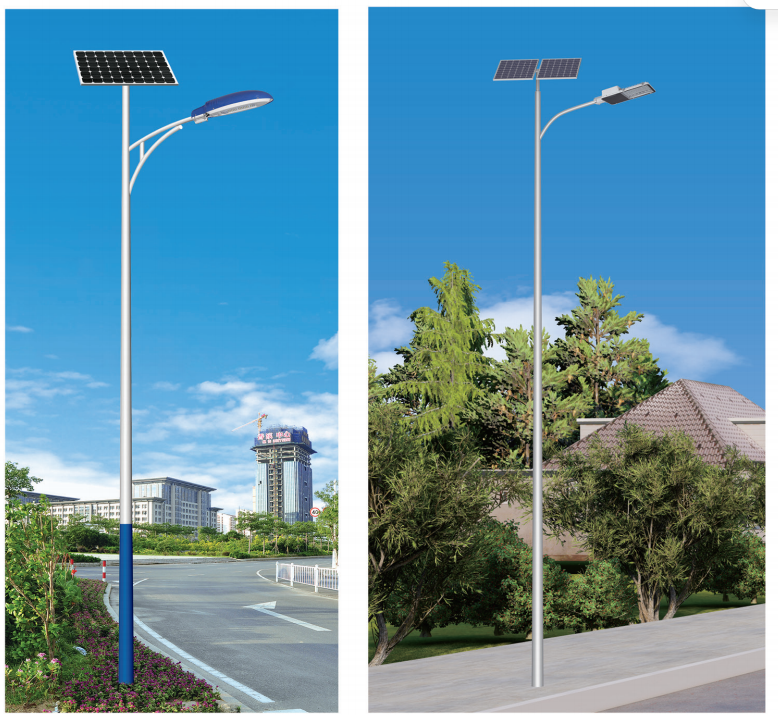
Model 1 - BF-SL-8M-100W: Solar Street Lighting for Road Corridors
BF-SL-8M-100W is an 8-meter split-type solar LED street lamp built for municipal road lighting, rural road projects, urban side roads and similar corridors where a grid connection is unavailable or uneconomical. Its published specification set includes:
- Light pole height: 8 meters, single-arm conical pole with a 90-degree lamp arm installation angle.
- LED lamp power: 100 W.
- Solar panel: 200 W high-efficiency monocrystalline silicon; battery: 12 V 80 Ah maintenance-free lead-acid.
- Luminous efficacy: at least 150 lm/W; colour temperature 3000K, 4000K, 5000K or 6000K; colour rendering index Ra at least 70.
- Protection level IP65/IP66; operating temperature -20 to +60 degrees Celsius.
- Lighting time 10 to 12 hours per day, with 2 to 3 days of rainy-day battery reserve, configurable to project requirements.
- Construction: Q235 steel pole with hot-dip galvanizing and outdoor electrostatic powder coating, die-cast aluminium LED housing, high-transparency tempered glass.
- Installation: fixed by pre-buried anchor bolts.
Control. Light control plus time control is standard, with intelligent dimming supported. That matters on road corridors, where full output is typically only required during peak hours and dimming directly affects the solar and battery sizing.
Customization. Pole height, power, colour, battery capacity, solar panel and pole design can all be customized, which is what allows one platform to serve different road widths and different solar profiles.
Boundaries to verify. A split-type architecture separates the panel, the battery and the luminaire, so the site must provide mounting space for the panel and service access to the battery compartment. The stated operating range starts at -20 degrees Celsius, which is narrower than the two AC-powered models below. Autonomy depends on local irradiance and the load profile, so the 2 to 3 day rainy-day figure should be confirmed against site data rather than assumed.
Model 2 - BF-AGL-4000-60W: Ancient-Style Courtyard Lighting
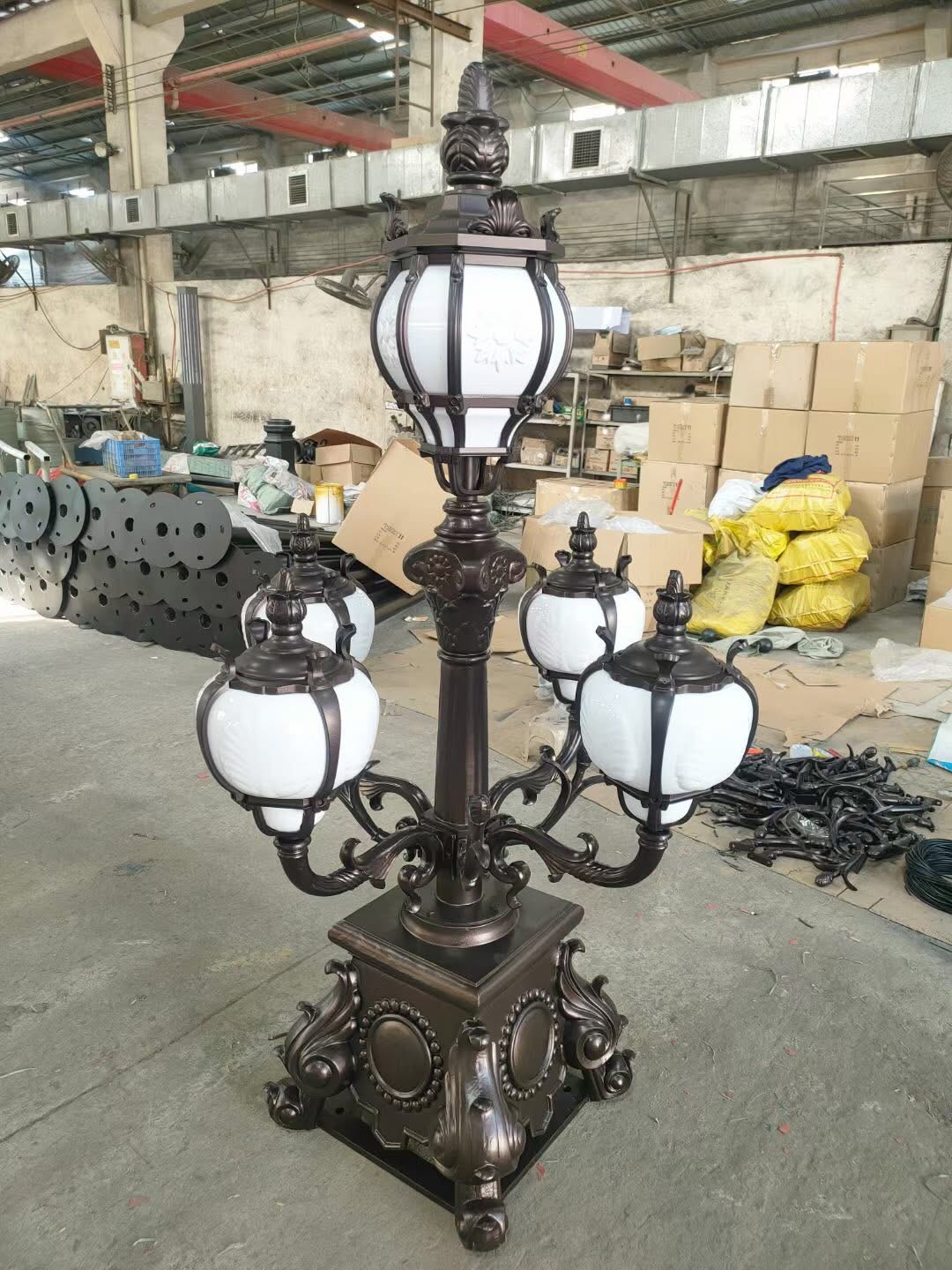
BF-AGL-4000-60W is an aluminium and steel cast ancient-style courtyard lamp for residential communities, villa courtyards, hotels and resorts, pedestrian streets and municipal landscape areas, where pedestrian-scale illumination and appearance both carry weight. Key verified parameters:
- Installation height: 3 to 4 meters, customizable according to project requirements.
- LED power options: 30 W, 40 W, 50 W, 60 W and 80 W.
- Input voltage: AC 85 to 265 V, 50/60 Hz.
- Luminous efficacy at least 130 lm/W; colour temperature 3000K, 4000K, 5000K or 6000K; Ra at least 70; power factor PF at least 0.95.
- Protection grade IP65/IP66; Class I electrical safety grade; service life at least 50,000 hours; operating temperature -30 to +60 degrees Celsius.
- Lighting mode: unidirectional or multi-faceted soft lighting; lamp cover in high-transparency tempered glass or UV-resistant PC.
- Materials: high-pressure cast aluminium lamp body, Q235 hot-dip galvanized steel pole, stainless steel fasteners, outdoor electrostatic powder coating.
- Standard colours: black, dark gray and copper brown, customizable according to RAL colour card.
- Installation: flange base with pre-installed anchor bolts; wind resistance designed around lamp height and local wind speed.
Control. Conventional switch control is standard, with light control, time control and intelligent control available as options. For courtyards, switch plus time control is often sufficient; light control becomes useful where the lighting circuit is shared.
Customization. Height, power, colour, shape, lamp cover and light source configuration can all be customized, allowing the same courtyard family to be adapted to different architectural contexts.
Boundaries to verify. At a 3 to 4 meter installation height and up to 80 W, this family is designed for pedestrian and courtyard scale, not for carriageway lighting. It requires an AC supply, so it is not a substitute for the solar model on unpowered sites. Where the lamp is installed in a coastal or heritage-sensitive environment, the powder coating specification and the wind-resistance calculation should be confirmed against local conditions rather than assumed from the standard configuration.
Model 3 - BF-LSL-4000-120W: Custom LED Landscape Street Lights
BF-LSL-4000-120W is a non-standard decorative landscape street light for urban roads, parks, plazas, commercial streets and large landscape lighting projects. It is the most configurable of the three models, and its verified parameters include:
- Mounting height: optional 6 m, 8 m, 10 m and 12 m, customizable as per project requirements.
- LED power: optional 60 W, 80 W, 100 W, 120 W, 150 W, 180 W and 200 W.
- Input voltage: AC 85 to 265 V, 50/60 Hz; power factor PF at least 0.95.
- Luminous efficacy at least 130 lm/W; colour temperature 2700K to 6000K; Ra at least 70, with Ra at least 80 optional.
- IP65/IP66; Class I electric shock protection; service life at least 50,000 hours; operating temperature -30 to +60 degrees Celsius.
- Lamp pole structure: conical poles, square poles, special-shaped poles or artistic structures; bracket styles include single arm, double arms, multi-arms and combined high-low lamp heads.
- Light distribution: road lighting distribution, plaza lighting distribution or decorative landscape distribution.
- Materials: Q235 hot-dip galvanized steel, 304 stainless steel, die-cast aluminium lamp housings, high-transmittance tempered glass, stainless steel fasteners and outdoor electrostatic powder coating.
- Standard colours: dark grey, black, silver grey and bronze, customizable per RAL colour card.
- Decorative features: hollow patterns, luminous decorations, city logos, cultural totems and project-specific elements.
- Installation: flange base with embedded anchor bolts; wind resistance tailored to pole height and the local wind speed of the project site.
Control. Standard on-off control, with photocell, timer, 0-10 V dimming, DALI and smart lighting control available as options. This is the widest control menu of the three models, and it is also the point where interoperability decisions are made: 0-10 V and DALI interfaces are factory options and cannot be retrofitted economically at the design stage.
Customization. Appearance design, height, power, bracket structure, colour, patterns, light source configuration and intelligent control systems are all customizable, which is what places this model in the bespoke street lighting category rather than the standard catalogue category.
Boundaries to verify. This model requires an AC mains supply; a solar configuration is not documented for it in the available product data. Multi-arm brackets and heavy decorative elements raise the structural wind load, so the pole and foundation need engineering verification against site wind speed. Finally, decorative features such as city logos or cultural totems add fabrication steps, which is normally reflected in tooling, sampling and lead time.
Side-by-Side Comparison of the Three Models
| Comparison item | BF-SL-8M-100W | BF-AGL-4000-60W | BF-LSL-4000-120W |
|---|---|---|---|
| Primary application | Municipal roads, rural roads, urban side roads, industrial parks | Residential communities, villa courtyards, hotels and resorts, pedestrian streets | Urban roads, parks, plazas, commercial streets, large landscape projects |
| Mounting / pole height | 8 m (customizable) | 3-4 m (customizable) | 6 m, 8 m, 10 m, 12 m (customizable) |
| LED power | 100 W | 30-80 W | 60-200 W |
| Power source | Solar: 200 W monocrystalline panel, 12 V 80 Ah maintenance-free lead-acid battery | AC 85-265 V, 50/60 Hz | AC 85-265 V, 50/60 Hz |
| Luminous efficacy | At least 150 lm/W | At least 130 lm/W | At least 130 lm/W |
| Colour temperature | 3000K-6000K | 3000K-6000K | 2700K-6000K |
| Protection / class | IP65/IP66 | IP65/IP66, Class I | IP65/IP66, Class I |
| Control | Light control plus time control, intelligent dimming supported | Switch control standard; light, time and intelligent control optional | On-off standard; photocell, timer, 0-10 V, DALI, smart control optional |
| Main customization points | Height, power, colour, battery capacity, solar panel, pole design | Height, power, colour, shape, lamp cover, light source | Appearance, height, power, bracket, colour, patterns, light source, control |
| Key constraint | Split-type layout needs panel and battery space; operating range from -20 degrees Celsius | Pedestrian scale only; requires AC supply | Requires AC supply; multi-arm and decorative loads need wind-load verification |
The table summarises published model data. Final selection follows a lighting design, not the table alone: lighting class, pole spacing, mounting geometry and site wind speed determine the working configuration.
Certification and Compliance Evidence Buyers Can Verify
Custom street lighting is usually audited on documentation before delivery, so the certification evidence matters as much as the specifications. Three items are relevant to this shortlist.
The first is ISO 9001 Quality Management System certification number 52824Q10676R0S, issued by Guangdong Rules Certification Co., Ltd. (GRRC) on 23 July 2024 and valid until 22 July 2027 under GB/T19001-2016 / ISO9001:2015. Its certified scope is the production of road and street lighting lamps, excluding products requiring special qualification certificates, and it is applicable to the global market, including government bidding and overseas trade projects. This certification covers the manufacturing system behind the three shortlisted models, and it is associated with the BF-SL-8M-100W, BF-AGL-4000-60W and BF-LSL-4000-120W in the product documentation.
The second is China Compulsory Product Certification (CCC) certificate number 2017011001975444, issued by the China Quality Certification Centre (CQC) under GB 7000.1-2015 and GB 7000.201-2008, valid from 15 May 2022 to 15 May 2027. Its scope is specific: fixed luminaires for incandescent lamps (ground-mounted garden lamp), E14/E27 lampholder, Class I electric shock protection, IP44 ingress protection, rated voltage 220-240 V, 50/60 Hz, for the Chinese Mainland market. That scope should not be read as automatic coverage of every custom model in a catalogue; buyers should confirm per project whether CCC or another local mark applies to the exact configuration ordered.
The third is design-standard alignment rather than product certification. Road and street lighting projects are commonly designed against the EN 13201 series (parts 1 to 5), which defines quality, performance and energy indicators for road lighting in the EU, or against ANSI/IES RP-8, the primary American national standard for lighting roadway and parking facilities, which focuses on luminance and safety criteria. On the control side, the D4i and Zhaga standards are increasingly adopted for interoperability between sensors and luminaires. Where a project requires compliance with these frameworks, the lighting design, luminaire photometrics and control interface should be specified at enquiry stage.
What Drives Cost in a Custom Street Light Specification
None of the three models is priced from a list, because the configuration determines the build. Cost drivers that appear consistently in custom outdoor lighting projects include:
- LED power rating and light source configuration, including optional higher colour rendering.
- Mounting height and pole structure, including conical, square, special-shaped or artistic poles.
- Power source architecture: solar panel rating and battery capacity on the solar model, or mains driver and surge considerations on AC models.
- Control hardware: switch, photocell, timer, 0-10 V dimming, DALI or smart control.
- Decorative fabrication, such as hollow patterns, logos, totems and non-standard housings.
- Material grade and surface treatment, including hot-dip galvanizing, 304 stainless components and RAL powder coating.
- Wind-load-driven structural reinforcement and foundation interface design.
- Packaging and export handling for a project-size shipment.
BAIFU LIGHTING prepares project quotations and can support product selection, CAD drawing development, lighting configuration recommendations and appearance design evaluation, which is the practical route to a costed configuration.
Order Quantities, Lead Time and Quality Control
For planning purposes, the standard style minimum order quantity is 20 sets, while a custom style requires a minimum of 5 sets. Lead time is 15 to 18 days, and monthly production capacity for regular orders is 3,000 to 5,000 units. Quality control typically covers appearance inspection, electrical performance testing and protection level testing, with metal fabrication, cutting, forming, welding, structural assembly, surface treatment, powder coating, electrical assembly, aging testing, packaging and export delivery handled in house. After-sales support includes installation instructions, remote technical support, fault diagnosis and accessory supply, with repair, replacement or supplementary service as stipulated in the contract for quality issues.
Project Evidence from Municipal Installations
Two municipal references are relevant to this shortlist. In one coastal municipal project, 35 units of custom courtyard lighting were installed along coastal roads, around port areas, in city squares and public recreation areas, with a project duration of two years. After completion, the lighting operated stably with uniform night-time coverage, and the luminaire design was aligned with the coastal architecture and public landscape, supporting night-time passage safety and the overall waterfront image.
In a second reference, 68 units of custom landscape street lamps were installed along municipal urban roads and characteristic streets in Malaysia over a one-year period. The installation delivered even road illumination meeting vehicle and pedestrian requirements, and the pole design was matched to the road greening and surrounding urban environment. Both projects illustrate the same working pattern: custom design, batch production and overseas engineering support handled as one sequence.
Market Signals Shaping Custom Street Light Demand
Three signals are useful when building a shortlist. First, connected infrastructure is expanding: the installed base of smart street lights reached 32.9 million units globally at the end of 2024, with a 20.9% CAGR projected through 2029 (Berg Insight), and interoperability standards such as D4i and Zhaga are being adopted to link sensors and luminaires. Second, the supply side remains fragmented: the top 10 companies in the global lighting fixtures market, including Signify and Osram, account for just over 20% of total market share (CSIL), and leading vendors concentrate on networked control systems, with Signify reporting approximately 5.8 million installed lighting controls as of late 2024 (Berg Insight). Specialist positions are distinct: Schréder focuses on architectural street lighting and smart city solutions, and Sentry Electric is recognised in the United States for custom and historic decorative lighting poles and luminaires. Third, growth is not evenly distributed; Africa is recognised as the fastest-growing regional lighting market with more than 4% average annual growth since 2018, driven by public infrastructure projects (CSIL).
The practical implication for buyers is that the custom, decorative and off-grid segments of street lighting are typically served by project-based manufacturers rather than by the largest control-system vendors, and that control interface choices made at specification stage determine the upgrade path later.
Limits of This Shortlist
A shortlist is not a lighting design. Several decisions sit outside the three model specifications and should be resolved separately:
- Lighting class and photometric verification against EN 13201 or ANSI/IES RP-8 for the specific road or space category.
- Pole spacing, mounting geometry and uniformity calculations for the actual layout.
- Wind-load structural verification using site wind speed data, required for all three models and critical for multi-arm or tall decorative poles.
- Local grid conditions and any destination-market certification beyond ISO 9001 and the China Compulsory Product Certification scope described above.
- Foundation and civil works, which are not part of the luminaire supply scope.
- Solar autonomy modelling for the BF-SL-8M-100W, which depends on site irradiance and the dimming profile rather than on a fixed universal figure.
Future Outlook
Custom outdoor lighting is moving along two parallel tracks. On the performance side, LED dominance is established, with LED accounting for 79.7% of street lighting revenue in 2023, and the remaining differentiation is shifting toward efficacy, colour quality and control intelligence rather than light source type. On the control side, the growth of smart street lighting and the adoption of D4i and Zhaga suggest that future custom projects will increasingly specify dimmable and interoperable interfaces at the ordering stage. For buyers, that means treating control options such as 0-10 V, DALI and smart lighting control as specification decisions, not as later upgrades. For off-grid corridors, solar architectures with configurable battery and panel sizing remain the practical option where grid extension is not viable, provided autonomy is modelled against local conditions.
FAQ
What is the minimum order quantity for these custom outdoor lighting models?
The minimum order is 20 sets for a standard style and 5 sets for a custom style. The custom-style threshold allows a small pilot batch of a non-standard design to be produced and inspected before a larger project roll-out.
How long does production take once specifications are confirmed?
Lead time is 15 to 18 days, and monthly production capacity for regular orders is 3,000 to 5,000 units. Lead time is measured from confirmed specifications, so late changes to pole height, power, colour or control system affect the schedule.
Which certification evidence applies to the BF-SL-8M-100W, BF-AGL-4000-60W and BF-LSL-4000-120W?
ISO 9001 certificate 52824Q10676R0S, issued by Guangdong Rules Certification Co., Ltd. (GRRC), is valid until 22 July 2027 and covers the production of road and street lighting lamps for the global market; it is associated with all three models in the product documentation. China Compulsory Product Certification number 2017011001975444, issued by the China Quality Certification Centre, is valid until 15 May 2027 and has a narrower scope: fixed luminaires for incandescent lamps (ground-mounted garden lamp), E14/E27 lampholder, Class I, IP44, 220-240 V, for the Chinese Mainland market. Buyers should confirm which certification applies to the exact configuration and destination market ordered.
Can the solar model operate through cloudy or rainy periods?
BF-SL-8M-100W is specified with 2 to 3 days of rainy-day battery reserve, and that figure is configurable according to project requirements. The standard configuration uses a 200 W monocrystalline silicon panel and a 12 V 80 Ah maintenance-free lead-acid battery; both panel rating and battery capacity can be customized. Actual autonomy depends on site irradiance, load profile and dimming schedule, so the configuration should be checked against the project location.
What control options are available across the three models?
BF-SL-8M-100W uses light control plus time control as standard, with intelligent dimming supported. BF-AGL-4000-60W uses conventional switch control as standard, with light control, time control and intelligent control available as options. BF-LSL-4000-120W uses standard on-off control, with photocell, timer, 0-10 V dimming, DALI and smart lighting control available as options. Control interfaces are factory options and must be fixed before production.
Which parameters are customizable rather than fixed?
All three models support customization. BF-SL-8M-100W allows height, power, colour, battery capacity, solar panel and pole design. BF-AGL-4000-60W allows height, power, colour, shape, lamp cover and light source configuration. BF-LSL-4000-120W allows appearance design, height, power, bracket structure, colour, patterns, light source configuration and intelligent control systems. Standard colours are black, dark gray and copper brown for the courtyard lamp and dark grey, black, silver grey and bronze for the landscape model, with RAL colour card customization available.
How is wind resistance determined for these luminaires?
For all three models the structural design is tailored to the pole or mounting height and to the local wind speed of the project site, rather than being a single universal rating. The project location wind data therefore needs to be supplied for the structural check, particularly where multi-arm brackets, decorative elements or taller poles are involved.
What drives the final cost of a custom street light configuration?
Cost depends on LED power and light source configuration, mounting height and pole structure, power source architecture including solar panel and battery sizing, control hardware such as photocell, timer, 0-10 V, DALI or smart control, decorative fabrication, material grades and surface treatment, wind-load-driven reinforcement, and export packaging. Configurations are quoted per project rather than from a published list.
Reference material: BAIFU LIGHTING publishes a customized outdoor lighting album covering product families, customization scope and project references, available as a PDF at BAIFU_LIGHTING_Customized album (PDF). Company information is published at www.baifulamp.com.