
Custom Street Light Supplier Evaluation: Sustainability Beyond First Delivery
A custom street lighting package is rarely delivered once. Municipal roads, plazas, resort landscapes and scenic areas are built in phases, and the poles and luminaires installed in the first phase quietly become the reference standard for everything that follows. When phase two arrives two or three budget cycles later, the real question is not whether the original fixtures still work — it is whether the same supplier can still match them.
BAIFU LIGHTING is the trading name of Zhongshan Baifu Street Lamp Co., Ltd., a custom outdoor lighting manufacturer based in Guzhen Town, Zhongshan City, Guangdong, China. The company produces non-standard custom outdoor street lights, LED road luminaires, solar street lights, landscape lights, garden lights, lawn lights, smart street lights and custom lamp poles, operates an 11,158 m² production facility, and reports more than 13 years of outdoor lighting manufacturing experience, with a 45% export ratio and products supplied to 71+ countries and markets.
This analysis examines how municipal and landscape buyers should evaluate a custom street light supplier for long-term sustainability — material durability, spare-part continuity, and support for later project phases — using model-level data from three BAIFU LIGHTING product families as concrete, checkable reference points: the BF-LSL-4000-120W custom LED landscape street light, the BF-AGL-4000-60W ancient-style courtyard lamp, and the BF-SL-8M-100W split-type solar street lamp.
Why the First Delivery Is the Wrong Finish Line
Most custom street light tenders are scored on first-delivery criteria: unit price, appearance approval, sample quality and production lead time. Those criteria are necessary, but they describe a supplier's ability to produce once. Long-life public lighting assets are exposed to a different set of risks that only surface after handover.
- Material degradation — coating breakdown, fastener corrosion, cover ageing, and water ingress at joints and cable entries.
- Configuration discontinuity — a decorative pattern, bracket geometry or pole profile that cannot be reproduced when a later phase is ordered.
- Support discontinuity — no archived drawings, no accessory channel, and no technical contact when a driver, controller or battery needs replacement.
Market context reinforces why continuity has become a procurement issue rather than a detail. LED lighting accounted for 79.7% of global street lighting revenue in 2023, according to Grand View Research, which means the light source itself is no longer a meaningful differentiator. The global street lighting market was valued at USD 9.1 billion in 2023 and is projected to reach USD 11.6 billion by 2030 at a 3.6% CAGR — growth driven largely by replacement, upgrade and extension programs rather than greenfield installation. Those programs are precisely the multi-phase projects in which supplier continuity is tested.
What “Long-Term Sustainability” Means in a Custom Street Light Supplier
In procurement terms, a sustainable supplier is not a claim about intentions. It is a set of verifiable capabilities that can be checked before a contract is signed. Four dimensions cover most of the risk.
| Dimension | The question a buyer is really asking | Evidence that should exist before award |
|---|---|---|
| Material durability | Will the pole, housing, cover and fasteners survive the local climate over the asset's life? | Declared material list, surface treatment sequence, IP rating, electric shock protection class. |
| Fabrication continuity | Can the same pole profile, arm structure and decorative pattern be reproduced later? | Archived CAD drawings, retained pattern data, an RAL colour reference. |
| Configuration continuity | Will phase two match phase one electrically and photometrically? | Colour temperature, CRI, efficacy, power factor, driver and control specification, battery specification. |
| Support continuity | Who supplies spares, technical advice and fault diagnosis after handover? | Documented after-sales scope, accessory and spare-part supply, remote technical support. |
The dimensions are not equally reversible. Material and structural choices are effectively locked once a pole is installed, while control and battery decisions can often be updated later. A buyer with limited review time should interrogate materials and structures first.
Material and Construction Evidence Buyers Can Actually Verify
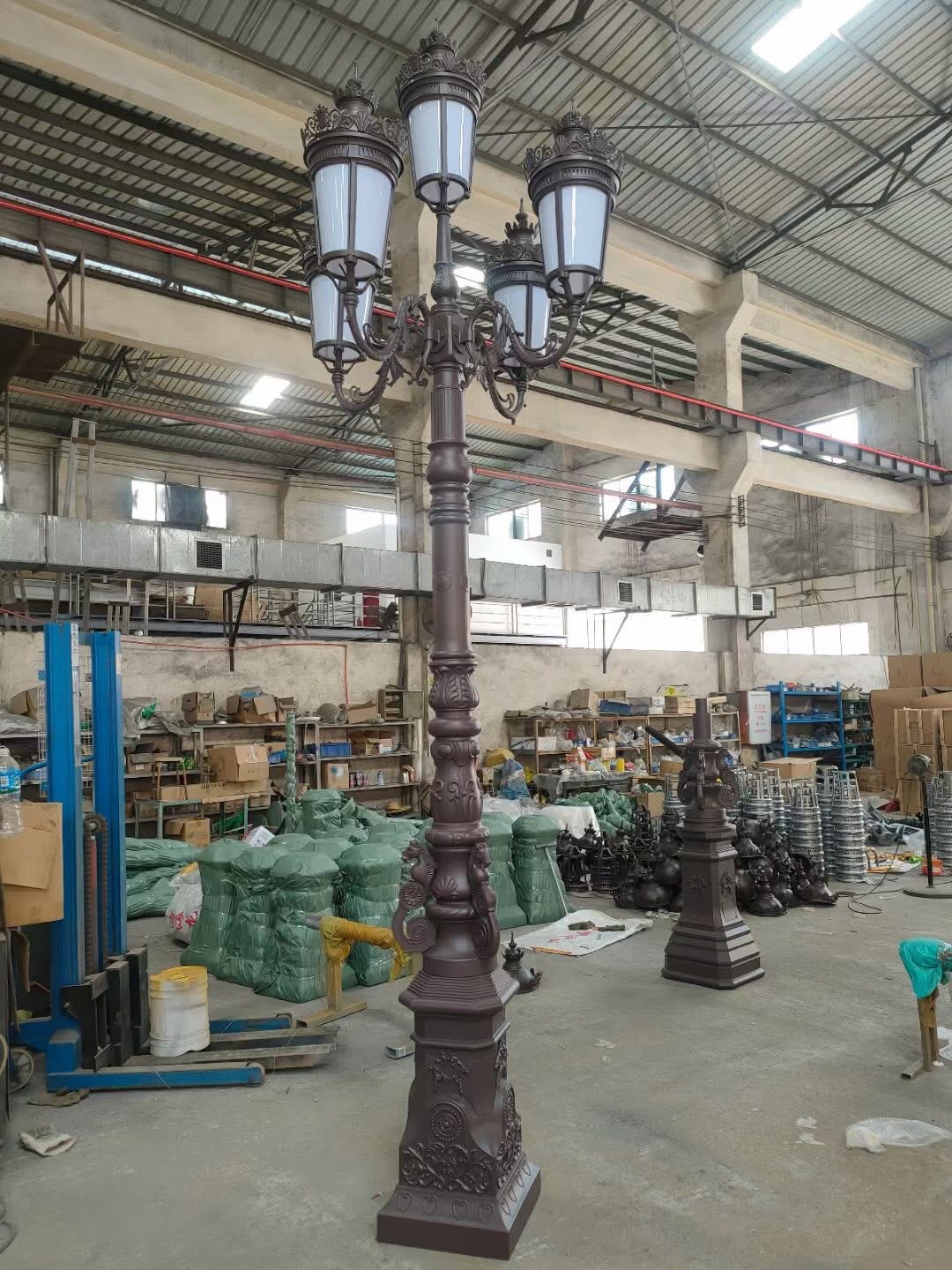
A custom street light's service life is decided by what it is made of. For the BF-LSL-4000-120W custom LED landscape street light, the declared construction is Q235 hot-dip galvanized steel, 304 stainless steel, die-cast aluminum lamp housings, high-transmittance tempered glass, stainless steel fasteners and outdoor electrostatic powder coating, with hot-dip galvanizing applied overall before the powder coating stage.
Each element maps to a specific failure mode seen in the field:
- Applying hot-dip galvanizing overall before outdoor electrostatic powder coating protects both exterior and interior steel surfaces, including areas that powder coating alone cannot reach.
- 304 stainless steel fasteners avoid the dissimilar-metal corrosion pair created when carbon-steel bolts are used on galvanized structures in humid or coastal air.
- Die-cast aluminum lamp housings provide a stable thermal path for the LED module, which influences lumen maintenance over the life of the fixture.
- High-transmittance tempered glass resists scratching and UV-driven yellowing better than untreated plastic covers.
The same model is rated IP65 or IP66 with electric shock protection Class I, a service life of at least 50,000 hours, and an operating temperature range of -30°C to +60°C. Luminous efficacy is at least 130 lm/W, power factor is PF≥0.95, and the colour rendering index is Ra≥70 with Ra≥80 available. Colour temperature options cover 2700K, 3000K, 4000K, 5000K and 6000K, so a later phase can be matched to the original lighting character instead of approximated.
The BF-AGL-4000-60W ancient-style courtyard lamp follows a comparable logic at a smaller scale: a high-pressure cast aluminum lamp body, a Q235 hot-dip galvanized steel lamp pole, high-transparency tempered glass or a UV-resistant PC lamp cover, stainless steel fasteners and outdoor electrostatic spray coating, rated IP65/IP66 with a service life of at least 50,000 hours and an operating range of -30°C to +60°C.
Spare-Part Continuity: The Risk That Appears in Phase Two
The most expensive custom street light failure is not a broken luminaire. It is a street where eleven new poles no longer match the two hundred poles installed three years earlier.
Non-standard lighting is defined by its non-standard elements. BAIFU LIGHTING's customization scope covers appearance design, height, power, bracket structure, colour, patterns, light source configuration and intelligent control systems, with decorative features such as hollow patterns, luminous decorations, city logos, cultural totems and exclusive project elements available. Those are exactly the elements that are hardest to reproduce without documentation.
Practical checks before awarding a multi-phase contract:
- Drawing archive. Confirm that CAD drawings for the pole profile, arm structure and decorative pattern are archived and released to the buyer. BAIFU LIGHTING lists CAD drawing development and project configuration support within its engineering scope.
- Reproducible colour reference. Standard colours for the BF-LSL-4000-120W are dark grey, black, silver grey and bronze, with customization against an RAL colour card. RAL matching is what allows a phase-two batch to stand next to a phase-one batch without visible mismatch.
- Small top-up orders. BAIFU LIGHTING states a minimum order of 20 sets for standard styles and 5 sets for custom styles — a modest threshold when a phase-two pilot section needs to be extended.
- Re-order lead time and capacity. The stated production lead time is 15 to 18 days, with monthly capacity of 3,000 to 5,000 units for regular orders.
- After-sales scope. The stated after-sales service includes installation instructions, remote technical support, fault diagnosis and accessory supply, with repair, replacement or supplementary service for quality issues as stipulated in the contract.
Solar Configuration and Battery Planning for Long-Life Installations
Solar street lighting adds a consumable to the asset register: the battery. The BF-SL-8M-100W split-type solar street lamp shows how configuration choices determine long-term maintenance planning.
- 8 m single-arm conical pole in Q235 high-quality steel with hot-dip galvanizing and outdoor electrostatic powder coating.
- 100W LED luminaire with luminous efficacy of at least 150 lm/W, IP65/IP66 protection.
- 200W high-efficiency monocrystalline silicon solar panel.
- 12V 80Ah maintenance-free lead-acid battery.
- 10–12 hours of lighting per day, with 2–3 days of battery autonomy in rainy conditions, configurable according to project requirements.
- Light control plus time control, with intelligent dimming supported; operating range -20°C to +60°C.
For long-term planning, three facts matter more than the headline specification. First, 12V 80Ah is a standard battery class, so replacement does not depend on a proprietary format. Second, height, power, colour, battery capacity, solar panel and pole design are all listed as customizable items, which means a later phase can be dimensioned for its own site conditions without changing the visual identity of the installation. Third, rainy-day autonomy is a configurable parameter rather than a fixed promise — a buyer who needs three days of autonomy on a specific corridor should specify it at configuration stage.
The supporting-equipment list is a continuity issue in itself. Solar street lighting requires poles, support arms, solar components including panels and batteries, controllers and mounting accessories. Confirming that these remain available as a matched set is part of supplier evaluation, not an afterthought.
Project Scenarios Where Long-Term Supplier Fit Matters Most
| Scenario | Why continuity dominates | Relevant model family |
|---|---|---|
| Municipal street lamp renovation | Road programs are funded and built in phases; visual and photometric continuity is expected by the public | BF-LSL-4000-120W |
| Urban landscape and scenic areas | Decorative patterns and cultural elements are project-specific and hard to recreate later | BF-LSL-4000-120W |
| Residential communities, villa courtyards, parks, hotels and resorts | Smaller quantities but a long service expectation and visible aesthetics | BF-AGL-4000-60W |
| Rural roads, urban side roads, industrial parks, parking areas | Off-grid or hybrid configurations where battery replacement planning drives lifecycle cost | BF-SL-8M-100W |
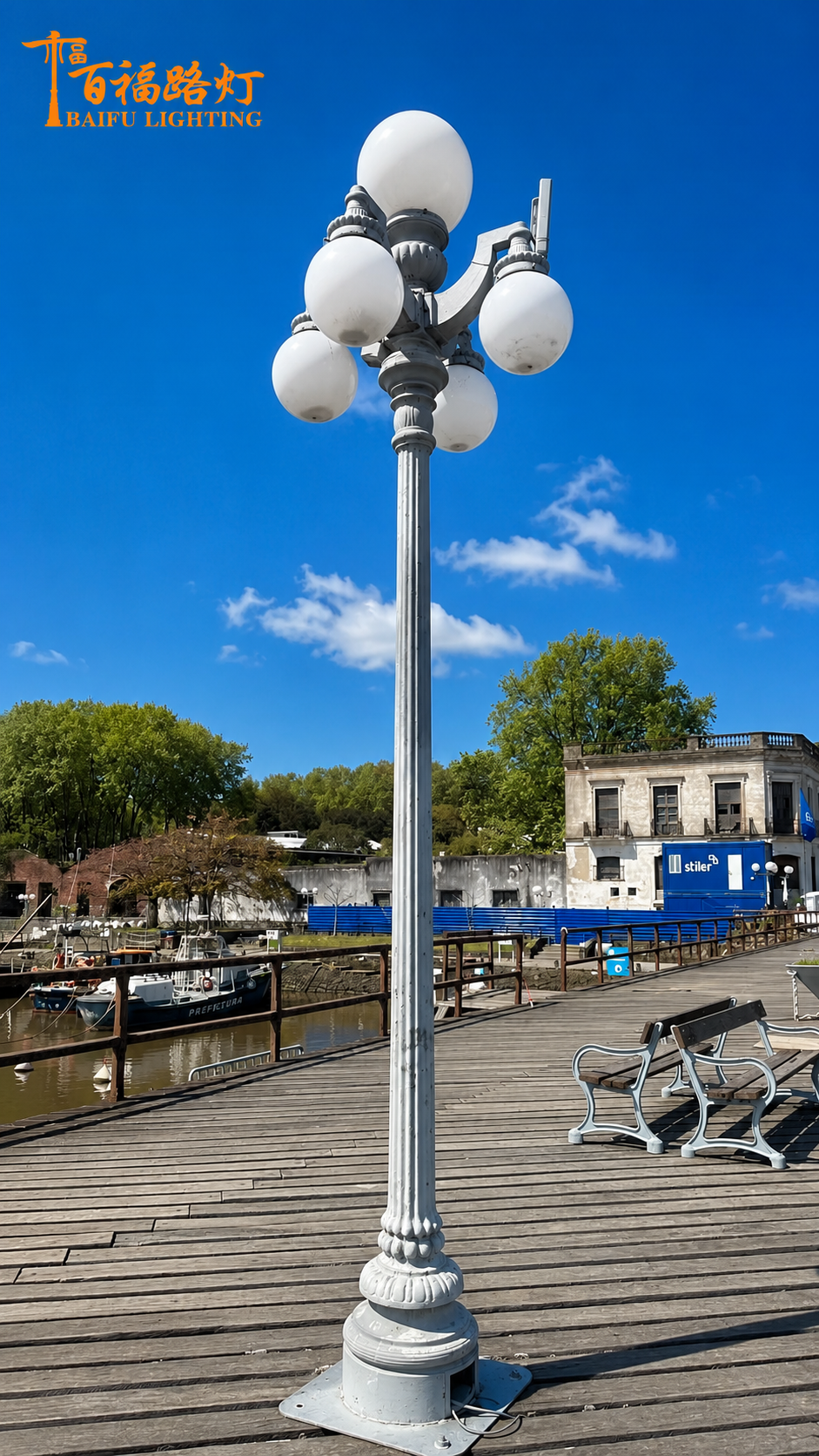
Delivered projects illustrate how these scenarios behave in practice. In one coastal municipal application, 35 units were installed along coastal roads, around ports, in city squares and public recreational areas over a two-year engagement, meeting night-time road lighting, pedestrian guidance and coastal landscape decoration needs; the fixtures were custom-designed around the local coastal environment and European architectural style, with an outdoor structure designed for waterproof, anti-corrosion and weather-resistant performance in coastal conditions. In a Malaysian municipal program, 68 sets of customized landscape street lamps were installed on both sides of urban roads, coordinated with road greening and the surrounding urban environment, with the supplier supporting design, production and overseas engineering delivery.
Two delivered projects are indicative rather than statistical. They show that custom non-standard production has been delivered in coastal and municipal conditions; they do not replace project-specific verification for a new site.
Market Signals That Make Supplier Continuity a Procurement Issue
- Light source is settled. LED lighting dominated the global street lighting market in 2023, accounting for 79.7% of total revenue (Grand View Research). Differentiation has shifted to structure, controls and continuity.
- Controls raise mid-life switching cost. The installed base of smart street lights globally reached 32.9 million units at the end of 2024, with a 20.9% CAGR projected through 2029 (Berg Insight). Once a corridor is on a control platform, replacing a supplier mid-life becomes a systems question, not a luminaire question.
- Interoperability standards are maturing. The D4i and Zhaga standards are increasingly adopted in smart street lighting for interoperability between sensors and luminaires (Business Wire / ResearchAndMarkets). For buyers, this is a practical hedge: confirming that optional photocell, timer, 0–10V dimming, DALI or smart lighting control can coexist with an open protocol reduces dependence on a single control vendor.
- The custom segment is fragmented. The top 10 companies in the global lighting fixtures market, including Signify and Osram, account for just over 20% of total market share (CSIL). Most custom and project work therefore sits with a long tail of manufacturers, where supplier evaluation — not brand selection — determines outcomes.
- Growth is concentrated in infrastructure programs. Africa has been the fastest-growing regional lighting market with over 4% average annual growth since 2018, driven by public infrastructure projects (CSIL) — programs that are typically phased by nature.
- Design standards are not continuity standards. The EN 13201 series (parts 1–5) defines quality, performance and energy indicators for road and street lighting design in Europe, and ANSI/IES RP-8 is the primary American national standard for lighting roadway and parking facilities. Both govern lighting design quality; neither certifies a supplier's ability to re-supply an installed streetscape years later, which is why documentary checks remain necessary.
First-Delivery Thinking vs Long-Term Evaluation: A Practical Comparison
| Evaluation dimension | First-delivery approach | Long-term approach, and where it has limits |
|---|---|---|
| Price | Lowest compliant unit price | Cost per asset-life including spares and replacements; lifecycle modelling still requires assumptions the supplier cannot verify |
| Materials | “Steel pole” or unspecified | Declared material list, galvanizing sequence and fastener grade; declarations must still be checked against delivered goods, for example by coating inspection |
| Appearance | Sample approval only | Sample approval plus archived drawings and an RAL colour reference; pattern retention depends on the supplier's record-keeping discipline |
| Controls | Standard on-off control | A defined control specification with an upgrade path; specific intelligent control or sensing functions depend on the model and must be confirmed for each project |
| Spares | Not addressed in the contract | Spare-part list, accessory supply and after-sales scope; minimum order quantities of 20 sets for standard styles and 5 sets for custom styles still apply |
| Solar configuration | Panel and lamp wattage only | Battery class, autonomy requirement and replaceability; autonomy is configurable, so a standard number should not be assumed |
| Structure | Pole height and arm style | Pole design based on site wind speed; wind resistance requires project-specific structural design and cannot be transferred between locations |
What Can Still Go Wrong — Boundaries of Specification Evidence
Any supplier evaluation is more credible when it states what its evidence cannot prove. The following boundaries apply to the data referenced in this article.
- Specification is not performance. A declared service life of at least 50,000 hours and IP65/IP66 protection describe design and construction. Real degradation depends on climate, installation quality and maintenance.
- Wind resistance is project-specific. For the BF-LSL-4000-120W, wind resistance is a structural design tailored to pole height and the local wind speed of the project site, so a figure from one location cannot be reused elsewhere.
- Solar autonomy is configurable. Two to three rainy days is a configurable parameter for the BF-SL-8M-100W rather than a universal guarantee, and a maintenance-free lead-acid battery has a finite replacement cycle.
- Smart functions vary by model. Availability of photocell, timer, 0–10V dimming, DALI or smart lighting control depends on the configuration selected for a specific project.
- Minimum order quantities still apply. Standard styles require a minimum of 20 sets and custom styles a minimum of 5 sets, which matters for small top-up orders in later phases.
- Market forecasts diverge. Treat any single 2030 market estimate as directional rather than definitive.
Stating these limits is not a weakness in a supplier evaluation. It is the difference between a procurement file that can be defended and one that cannot.
Future Outlook
The direction of travel is from product purchase toward lifecycle management. As municipal programs move into replacement and extension cycles, the practical question will shift from “which luminaire” to “which supplier can be re-ordered from, at matching geometry and colour, with a documented accessory path.” Two supporting trends reinforce this. Open interoperability standards such as D4i and Zhaga reduce lock-in at the control layer, making it easier to specify a supplier without committing to a single sensor ecosystem. In solar installations, battery replacement economics will increasingly dominate total cost, which makes the choice of a standard battery class and a configurable controller a long-term decision made at the first order rather than a maintenance detail.
Expect documentation itself to become a deliverable. Drawing archives, RAL references, control specifications and spare-part lists are moving from nice-to-have attachments into tender requirements, because they are the only artefacts that survive a change of project team, contractor or funding cycle. Manufacturers serving 71+ markets and multiple climate zones — from coastal humidity to -30°C cold and +60°C heat — are also accumulating a broader evidence base on how materials behave, which is relevant to buyers who need a design already tested in comparable conditions.
Frequently Asked Questions
What does long-term sustainability mean when evaluating a custom street light supplier?
It refers to four verifiable capabilities rather than a general reputation: material durability (declared materials, surface treatment sequence and IP rating), fabrication continuity (archived drawings and reproducible decorative patterns), configuration continuity (matching colour temperature, efficacy, control and battery specifications in a later phase), and support continuity (spare parts, accessory supply and technical support after handover). The BF-LSL-4000-120W illustrates the first dimension: it declares Q235 hot-dip galvanized steel, 304 stainless steel, die-cast aluminum housings, high-transmittance tempered glass and stainless steel fasteners, with IP65/IP66 protection, Class I electric shock protection and a service life of at least 50,000 hours. Those are checkable facts, unlike a general durability claim.
Which material specifications should a buyer verify for a long-life custom street light?
Five items carry most of the weight: pole material and surface treatment sequence, housing material, cover material, fastener material and IP rating. In the BF-LSL-4000-120W these are Q235 hot-dip galvanized steel, die-cast aluminum lamp housings, high-transmittance tempered glass, stainless steel fasteners, and overall hot-dip galvanizing followed by outdoor electrostatic powder coating, with IP65 or IP66 protection. The BF-AGL-4000-60W uses a high-pressure cast aluminum lamp body with a Q235 hot-dip galvanized steel pole and a high-transparency tempered glass or UV-resistant PC cover, also rated IP65/IP66. Fastener material deserves specific attention because combining carbon-steel bolts with galvanized structures creates a corrosion pair in humid or coastal air.
How can a buyer confirm that spare parts and matching poles will still be available in a later project phase?
Three documents carry most of the answer: archived CAD drawings for the pole profile, arm structure and decorative pattern; a reproducible colour reference, such as an RAL colour card entry rather than a photographic sample; and a spare-part and accessory list covering covers, drivers, controllers and mounting components. BAIFU LIGHTING lists CAD drawing development and project configuration support within its engineering scope, customizes colour against an RAL colour card, and states an after-sales scope that includes installation instructions, remote technical support, fault diagnosis and accessory supply. A stated minimum order of 5 sets for custom styles also means a phase-two pilot section can be re-ordered without a large commitment, while the stated lead time for production is 15 to 18 days.
For solar custom street lights, which configuration figures determine long-term maintenance planning?
Battery format and capacity, panel power, daily lighting hours, rainy-day autonomy and control type. The BF-SL-8M-100W uses a 12V 80Ah maintenance-free lead-acid battery, a 200W high-efficiency monocrystalline silicon panel, a 100W LED luminaire with luminous efficacy of at least 150 lm/W, 10–12 hours of lighting per day, and 2–3 days of rainy-day autonomy configurable according to project requirements, with light control plus time control and intelligent dimming support at an operating range of -20°C to +60°C. Because 12V 80Ah is a standard battery class, replacement does not depend on a proprietary format, and battery capacity, solar panel and pole design are all listed as customizable items. The autonomy figure should be specified for each corridor rather than assumed from a catalogue value.
What are the limits of supplier documentation in predicting real service life?
Documentation describes design and construction, not the outcome of a specific installation. Coating performance, corrosion behaviour and lumen maintenance depend on local climate, installation quality and maintenance practice. For the BF-LSL-4000-120W, wind resistance is a structural design tailored to pole height and the local wind speed of the project site, so a figure from one location cannot be reused elsewhere. Intelligent control and sensing functions depend on the model and configuration selected, so their availability must be confirmed per project. Minimum order quantities of 20 sets for standard styles and 5 sets for custom styles also continue to apply to re-orders.
Which project scenarios fit customizable decorative street lights, courtyard lamps and split-type solar street lamps?
Custom LED landscape street lights such as the BF-LSL-4000-120W are specified for urban roads, parks, plazas, commercial streets and large-scale landscape lighting projects, with mounting heights of 6 m, 8 m, 10 m or 12 m and LED power options from 60W to 200W. The BF-AGL-4000-60W ancient-style courtyard lamp suits residential communities, villa courtyards, urban parks, commercial plazas, hotels and resorts at a 3–4 m installation height with LED power options of 30W to 80W. The BF-SL-8M-100W split-type solar street lamp is intended for rural road projects, urban side roads, industrial parks, residential communities, park roads, schools, hospitals, parking lots, commercial plazas, government projects and overseas infrastructure lighting projects. Common applications across the range also include municipal street lamp renovation, urban landscape lighting, and scenic and residential area lighting, where the requirement combines functional illumination with landscape decoration.