
Custom Street Light Supplier Evidence: Q235 Poles, Die-Cast Housings, IP66 Luminaires
Custom Street Light Supplier Evidence: Q235 Poles, Die-Cast Housings, IP66 Luminaires
Custom street lighting is bought twice: once as a concept on a drawing, and once as steel, aluminium, glass and wiring standing at the roadside. Between those two moments, a buyer at the evaluation stage has to decide whether a supplier's customization claim is supported by anything inspectable. The practical answer is to stop treating custom as a marketing category and start treating it as a set of physical specifications that can be read, measured, documented and accepted. This reference takes one documented build, the BF-LSL-4000-120W from BAIFU LIGHTING, and turns each stated parameter into an inspection point that survives the transition from evaluation to execution.
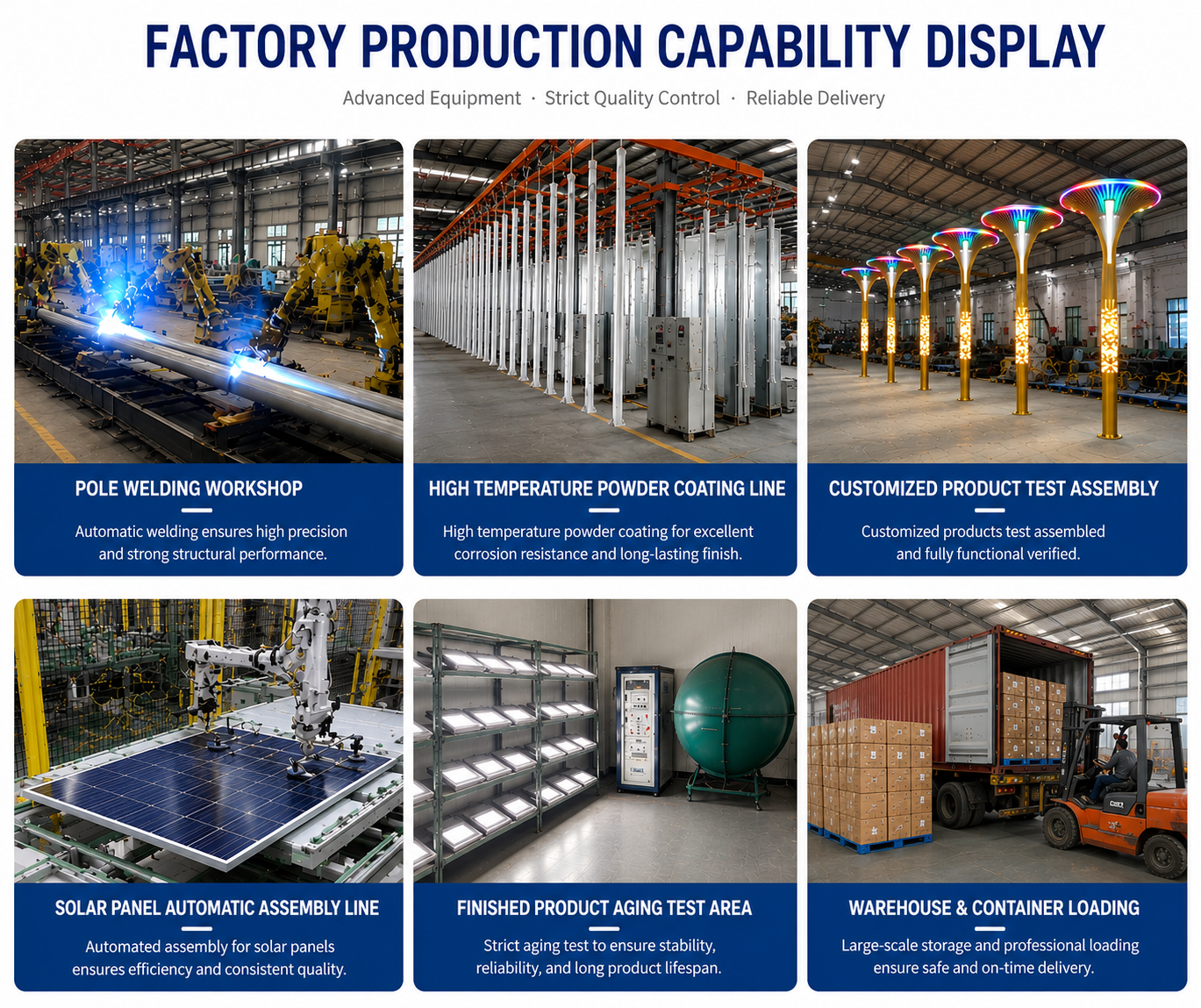
Production process at BAIFU LIGHTING's 11,158 m2 outdoor lighting facility in Guzhen Town, Zhongshan City.
Why Custom Street Light Claims Need Physical Evidence
LED is no longer the differentiator in street lighting. LED products accounted for 79.7% of global street lighting revenue in 2023, according to Grand View Research, which means most project decisions now compare builds rather than light sources. The comparison happens at a level that catalogues do not resolve: the pole that must carry wind load for years, the housing that keeps water out of the driver compartment, the glass that has to transmit light without failing, and the earthing that makes a Class I luminaire safe to install.
Customization is easy to claim at quotation stage. Evidence is harder to produce, and that asymmetry is where project risk sits. A buyer moving from evaluation to execution needs a sequence of checkable artefacts: a stated datasheet parameter, an approved drawing, a material declaration, an in-process inspection record, and an acceptance check before dispatch. Each item either exists or it does not, and each can be reviewed before the balance payment is released.
This article treats one build's published parameters as inspection points rather than selling points. The aim is not to describe a product, but to show what the specification allows a buyer to verify, and where the evidence stops.
The Reference Build: What the BF-LSL-4000-120W Datasheet States
BF-LSL-4000-120W sits in the custom decorative landscape street lights category, and its datasheet records a set of physical specifications that can be checked against delivery. BAIFU LIGHTING is the trading name of Zhongshan Baifu Street Lamp Co., Ltd., a custom outdoor lighting manufacturer based in Guzhen Town, Zhongshan City, Guangdong, China, operating an 11,158 m2 production facility with more than 13 years of outdoor lighting manufacturing experience. The table restates the reference build without interpretation.
| Stated parameter | Documented value | What a buyer can verify |
|---|---|---|
| Pole steel | Q235, hot-dip galvanized | Declared base-metal grade and coating process; both belong on the pole drawing |
| Stainless components | 304 stainless steel | Which parts are stainless, and how the allocation is declared at handover |
| Luminaire housing | Die-cast aluminum | Casting method behind the sealing geometry and thermal path |
| Optical cover | High-transmittance tempered glass | Glass type and edge condition; the stated wording carries no transmittance figure |
| Ingress protection | IP65 / IP66 | Which rating applies to the delivered configuration, and the test basis behind it |
| Electrical class | Class I | Presence and labelling of a protective earth terminal on the luminaire and pole |
| Power factor | PF 0.95 or above | Driver-level electrical quality relevant to cable and breaker sizing |
| Mounting height | 6 / 8 / 10 / 12 m | Four pole configurations, each with its own section, base plate and anchor set |
| Luminaire power | 60-200 W | Wattage band across the series; 120 W appears in the model designation |
Two reading rules apply to that table. First, every value describes the build, not a guaranteed outcome: an IP66 rating defines an enclosure test condition, not a service life, and a power-factor threshold describes an electrical property at stated test conditions rather than an energy-saving figure. Second, the listed parameters are not a complete product data set. Photometric distribution, lumen output, colour temperature, colour rendering, impact rating and surge protection are absent from the stated specification, and a buyer who needs them must request them rather than infer them from the model name.
Pole Evidence: Q235 Steel, Hot-Dip Galvanizing and 304 Stainless
Pole specification is the first place where a custom claim becomes measurable. Q235 is a Chinese carbon structural steel grade, so the datasheet names a base metal rather than using a generic phrase such as steel pole. On a project, the buyer should see that grade on the pole drawing and on the bill of materials, because grade declaration is what makes substitution detectable.
Hot-dip galvanizing immerses the finished pole in molten zinc, producing a metallurgically bonded coating rather than a surface film. For street lighting this matters most at the points that stay damp: the base, the cable entry, the door cut-out, and the internal surfaces that cannot be repainted after fabrication. A powder-coated pole can look identical on the outside while following a different corrosion strategy underneath the coating.
304 stainless steel is declared as a second material in the build. Stainless is used where corrosion resistance matters more than cost, and the practical question is narrower than the material claim: which components are 304, and how is that declared at handover? Fasteners, brackets, hinge pins and exposed fittings are the usual candidates, but the specification as supplied does not allocate the material to individual parts, so the allocation should be agreed in writing.
Physical inspection points follow the load path: base plate and stiffeners, where weld leg length, distortion and flatness against the foundation template all matter; the anchor bolt pattern and projection, which must match the foundation drawing issued to the civil contractor; cable entry and door, including gasket seating, internal earthing terminal and any sharp edge on the cable route; the arm and luminaire interface, covering bolt spacing, spigot diameter and tilt angle; and coating continuity inside the door and at the base, where touch-up is usually hidden. A supplier that can answer these points with drawings has demonstrated engineering control. A supplier that answers only with material adjectives has not.
Housing and Optical Evidence: Die-Cast Aluminum and Tempered Glass
Die-cast aluminum is specified for the luminaire housing. Die casting allows ribs, gasket channels, fastener bosses and a heat path to be formed in a single part, which is why it is common in outdoor luminaires; it also means that tooling, not the assembly line, determines whether the sealing geometry is repeatable. For a custom housing the evidence question is whether the casting is a standard tool shared across projects or a modification, and whether that modification was validated before production.
Inspection points at housing level are concrete: gasket channel continuity around the full perimeter, with no interruption at the hinge or latch; casting surface quality on machined faces, since porosity in a gasket seat is a leak path; fastener bosses and thread condition, because repeated opening for maintenance degrades soft threads; coating adhesion on edges and inside recesses, where pretreatment is hardest; and cable gland and breather positions relative to the driver compartment.
High-transmittance tempered glass is declared as the optical cover. Tempering changes how glass fails, breaking it into small fragments rather than large shards, which is why it is specified over walkways and roads. The datasheet wording also declares high transmittance but gives no transmittance value, so any lighting calculation that depends on optical efficiency should rest on measured photometric files rather than on the adjective.
One boundary is worth stating plainly: an ingress rating and a glass specification describe the enclosure. They do not describe the driver, the LED board or the thermal design behind them, all of which determine how long the enclosure contents survive.
Electrical Enclosure Evidence: IP65, IP66, Class I and PF 0.95
IP65 and IP66 both begin with a 6, meaning the enclosure is dust-tight; the second digit distinguishes protection against water jets from protection against more powerful water jets. Listing both values is a normal way of covering different project requirements, but it creates a question the buyer must settle before ordering: which rating applies to the delivered configuration, and how is that configuration fixed in the order documents?
The next question is where the evidence comes from. BAIFU LIGHTING's stated quality control sequence includes an appearance inspection, an electrical performance test and a protection level test. That describes an in-house process and is useful, but it is not the same as a third-party ingress test report. Projects that require an accredited report should specify it in the purchase order, because a process description and a certificate answer different questions.
Class I protection means the luminaire relies on protective earthing: exposed metal that could become live must be reliably connected to earth. For a street light this is installation-critical rather than a datasheet footnote. The pole must carry an earth continuity path, the luminaire must have an identified earth terminal, and the connection must survive the maintenance cycle. A buyer inspecting a sample should check that the earth terminal is labelled, that it is bonded to the housing rather than only to a bracket, and that the cable gland does not compromise the earth connection.
A power factor of 0.95 or above is a declaration about the relationship between the power a luminaire draws and the current it imposes on the supply. That matters on long road circuits, where cable size and breaker rating are calculated from current rather than wattage. The stated figure is a threshold, not a measured result for every wattage between 60 and 200 W, so the test condition should be confirmed when the driver datasheet is submitted for approval.
What the 6-12 m Height and 60-200 W Range Reveal About Build Capability
A single series covering 6, 8, 10 and 12 m mounting heights and 60 to 200 W of luminaire power is not one product repeated four times. Height changes the pole section, wall thickness, base plate and anchor set; power changes the driver platform, the thermal load and often the housing variant. The range is therefore evidence of build capability, and it is also a checklist.
The practical way to test that capability is to request a configuration matrix before the order, mapping each mounting height to a pole drawing, section and wall thickness, base plate dimensions, anchor bolt specification, luminaire weight on the arm, and the wattage options approved for that height. A supplier with genuine customization control will have the matrix or can produce it. A supplier reselling a fixed catalogue will typically return the same drawing for every height with the label changed.
Two further questions follow. The first is engineering support: BAIFU LIGHTING states that CAD drawing development, lighting configuration recommendations and product selection support form part of its project service, which is the mechanism by which a non-standard 10 m pole becomes a manufacturable drawing rather than a sketch. The second is the optical side of the range. Four heights and a 60-200 W band imply different light distributions and different lumen packages, yet distribution data is not part of the stated specification. A buyer should request photometric files for each wattage under consideration, then test them against the lighting class the project must satisfy.
The band also marks a boundary. A 60-200 W luminaire on a 6-12 m pole addresses roads, plazas, courtyards, promenades and landscape schemes. It does not describe high-mast or trunk-road installations, where the product family, structural design and verification requirements differ.
Document Evidence: Certificate Scope Versus Product Scope
Certification is where buyers most often read more than the document says, so the two certificates in the supplied record deserve separation.
ISO 9001 certificate 52824Q10676R0S, issued by Guangdong Rules Certification Co., Ltd. against GB/T19001-2016 and ISO 9001:2015, covers production of road and street lighting lamps, excluding products requiring special qualification certificates, and runs from 23 July 2024 to 22 July 2027. This is a quality management system certificate: it confirms that the production scope operates under a certified system, not that any individual luminaire meets a performance standard. It is a reasonable indicator of process control and a weak indicator of product performance.
CCC certificate 2017011001975444, issued by the China Quality Certification Centre against GB 7000.1-2015 and GB 7000.201-2008, has a narrower scope that deserves attention. The certified product is described as a fixed luminaire for incandescent lamps: a ground-mounted garden lamp with an E14/E27 lampholder, Class I protection, IP44 ingress protection, rated 220-240 V, valid to 15 May 2027 for the Chinese mainland market. That is a garden luminaire with a lampholder, not the street light build discussed here, and it should not be presented or read as a street light certificate.
This article asserts those two certificates and no others. It does not claim CE marking, RoHS compliance, ENEC approval, an IECEE test report or a third-party IP report for the BF-LSL-4000-120W. Where a project requires any of these, the requirement belongs in the enquiry rather than in an assumption.

ISO 9001 certificate 52824Q10676R0S, valid from 23 July 2024 to 22 July 2027, covering production of road and street lighting lamps.
Checking the scope line, the standard referenced, the issuing body and the expiry date takes a minute and prevents the most common documentation error in international street lighting procurement.
From Evaluation to Execution: Acceptance, Inspection and Delivery Terms
Once the specification is accepted, commercial terms become the execution evidence. BAIFU LIGHTING states a minimum order of 20 sets for standard styles and 5 sets for custom styles, a lead time of 15 to 18 days, and monthly production capacity of 3,000 to 5,000 units for regular orders. Acceptance is available as an on-site inspection or a video inspection, with payment structured as a 30% deposit and the remaining 70% before shipment. Delivery can be arranged by sea, air or land, with the method and cost confirmed per order.
Those terms are workable for project buyers if they are converted into a schedule: drawing approval covering pole drawing, arm geometry, luminaire configuration and finish before cutting; a material declaration naming the steel grade, stainless parts allocation, housing alloy and glass specification; in-process checkpoints at welding and galvanizing before coating, and at sealing and gasket fit before final assembly; pre-shipment acceptance through either an on-site visit or a structured video inspection; and a handover pack with packing list, installation instructions and the after-sales route, which the company describes as installation guidance, remote technical support, fault diagnosis and spare-part supply, with repair or replacement under the contract for quality issues.
A video inspection is only as good as its checklist. It should show the pole base and door, coating inside the door, the earth terminal, the gasket line, a powered luminaire running, and the marking on the driver, filmed live rather than supplied as earlier photographs.
Application Evidence: A 68-Unit Municipal Road Project
Documented project use gives the specification a context. BAIFU LIGHTING records a municipal engineering project in Malaysia covering 68 units for urban roads, characteristic streets and road landscape lighting, with a one-year duration. The reported outcome is stable operation after installation, uniform night brightness along the road, orderly arrangement of the poles, and visual integration with the road greening and surrounding urban environment.
This is a company-reported project record rather than independently audited evidence, and it should be read as such. Its value during evaluation is that it shows the information a supplier should be able to produce: quantity, application, duration and an outcome statement. A buyer preparing an enquiry can request the same four items from references in a comparable market, and can ask specifically whether delivered units used standard or custom configurations, since the two carry different minimum quantities and different engineering cycles.
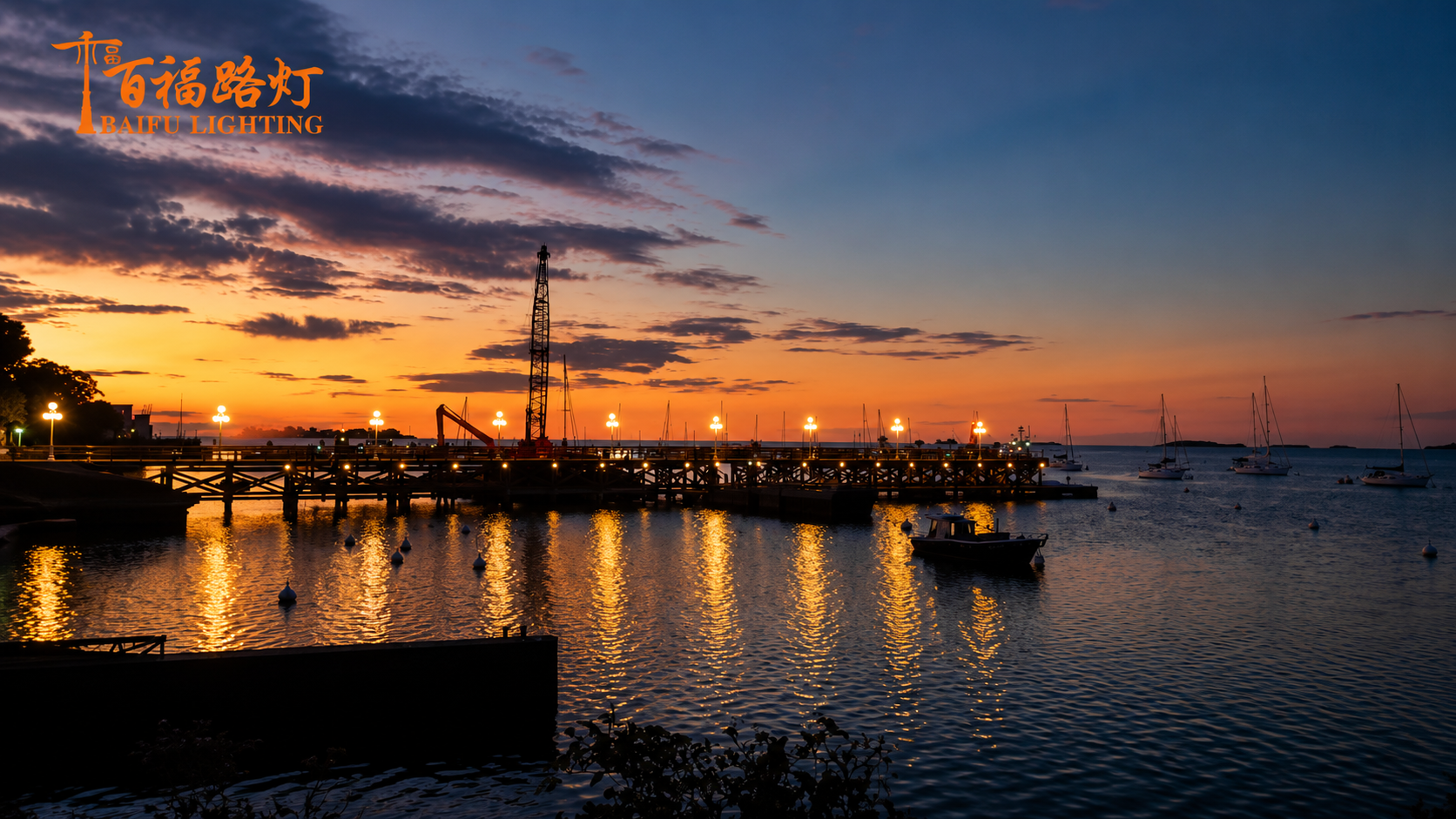
Engineering case documentation from a delivered custom street light project.
How Custom Builds Compare With Standard Catalogue Fixtures
A custom build and a standard catalogue fixture solve the same lighting problem by different routes, and the comparison is more useful when made on documented characteristics than on the word custom.
A standard catalogue fixture offers fixed mounting heights and wattages, published photometry for those fixed configurations, a shorter engineering phase because no drawings are produced, and documentation that is usually a generic datasheet. The reference custom build offers height and power selected from a stated range, material and process declarations per order such as Q235 hot-dip galvanized steel, 304 stainless components, a die-cast aluminum housing and tempered glass, a drawing and approval cycle before production, and a custom minimum of 5 sets. The trade-off is front-end time and engineering effort in exchange for a build that matches the site, the pole spacing and the streetscape.
The fit boundary deserves emphasis for buyers under pressure to specify something non-standard. Custom is not automatically better. Where a project's lighting class is already defined by a design standard such as the EN 13201 series of parts 1 to 5 in Europe or ANSI/IES RP-8 in the United States, and a catalogue luminaire meets it with published photometry, a custom housing adds cost and lead time without adding compliance. Custom earns its place where the constraint is physical: a pole height the catalogue does not offer, an arm geometry set by an existing streetscape, a decorative requirement, or a heritage context in which the fixture is part of the design intent.
The supplier landscape reflects that split. CSIL estimates that the ten largest lighting fixture companies together hold just over 20% of the global market, which leaves a long tail of specialists. Some, such as Sentry Electric in the United States, are recognised for custom and historic decorative poles and luminaires; others, such as Schréder, position themselves in architectural street lighting and smart city systems. In a fragmented market, the buyer's protection is verification rather than brand familiarity.
Market Context: Why Specification Evidence Is Being Scrutinised
Market data is useful here only as context, and the published figures do not all agree.
Grand View Research valued the global street lighting market at USD 9.1 billion in 2023 and projects USD 11.6 billion by 2030, a 3.6% compound annual growth rate, with LED accounting for 79.7% of 2023 revenue. A separate StrategyR figure cited in industry reporting puts the 2030 market at USD 16.5 billion. That gap illustrates why market-size claims should always carry their source and scope rather than being presented as one agreed number.
On the controls side, Berg Insight estimated the installed base of smart street lights at 32.9 million units at the end of 2024, with a 20.9% compound annual growth rate projected through 2029. Interoperability standards such as D4i and Zhaga are being adopted so that sensors and luminaires can work together across vendors.
For a buyer of decorative or project-specific poles and luminaires, the interpretation is straightforward. As controls and connectivity become the visible differentiator, mechanical and electrical basics become the minimum bar rather than the selling point, and documentation quality becomes a selection criterion in its own right. A supplier that can state a steel grade, a coating process, a casting method, a protection class and a power factor, and then evidence each one, is easier to integrate into a project than one that offers a wider range of finishes.
Limits of This Evidence Set
The evidence behind this article has boundaries a buyer should carry into the enquiry.
Not stated for the BF-LSL-4000-120W: lumen output, luminous efficacy, colour temperature, colour rendering index, photometric distribution files, impact resistance rating, surge protection level, driver manufacturer, coating thickness values, wind-load calculation and warranty terms. Also not asserted: any certification beyond ISO 9001 certificate 52824Q10676R0S and CCC certificate 2017011001975444, whose scope is described above.
None of those gaps makes the specification weak; they define what still has to be requested. The defensible conclusion from the stated facts is narrow. The build declares a base steel grade, a galvanizing process, a stainless grade, a casting method, a glass type, an ingress rating, an electrical class and a power-factor threshold, and each declaration can be checked against drawings, material records and acceptance inspection. Performance in service is a separate question that requires photometric data, test reports and reference experience.
Frequently Asked Questions
Can a supplier build a custom street light to a specified mounting height and wattage?
Yes, within the limits of a documented range. BAIFU LIGHTING lists customization of lamp power and optical ratio, appearance design, surface treatment, pole height and accessories, and solar configuration and control system. For the BF-LSL-4000-120W reference build, the stated mounting heights are 6, 8, 10 and 12 m and the stated luminaire power band is 60-200 W. A buyer should confirm the exact height and wattage pair in the approved drawing and order documents, because each height implies its own pole section, base plate and anchor set.
What is the minimum order quantity for a custom design compared with a standard style?
BAIFU LIGHTING states a minimum of 20 sets for standard styles and 5 sets for custom styles. The distinction matters at evaluation stage because custom pole heights, arm structures and finishes require drawings and a production set-up that a standard catalogue item does not, and the lower custom threshold is intended to keep project-specific builds viable at small quantities. Order quantity should be confirmed against the final configuration rather than assumed from the category.
Which documents can a buyer request to verify the build and the production process?
The verifiable documents in the supplied record are ISO 9001 certificate 52824Q10676R0S, covering production of road and street lighting lamps and valid to 22 July 2027, and CCC certificate 2017011001975444, whose scope is a fixed ground-mounted garden luminaire for the Chinese mainland market and which is valid to 15 May 2027. Beyond certificates, a buyer can request pole and luminaire drawings, material declarations for the steel, stainless and housing alloy, photometric files where lighting calculations are required, packing lists, and the acceptance inspection record agreed for the order.
How is acceptance handled and how long does production take?
The stated lead time is 15 to 18 days, with monthly capacity of 3,000 to 5,000 units for regular orders. Acceptance can be carried out as an on-site inspection or a video inspection, and payment is structured as a 30% deposit with 70% before shipment. Delivery by sea, air or land is arranged per order, with method and cost confirmed at that stage. After-sales support covers installation instructions, remote technical support, fault diagnosis and accessory supply, with repair or replacement under the contract for quality issues.
Building an Inspection Schedule From the Specification
The useful output of this review is not a verdict on one model but a working document. Each stated parameter becomes a line in an inspection schedule with a named owner, a document to be produced and a point in the production timeline at which it is checked. Q235 steel and hot-dip galvanizing are verified at drawing and coating stage; die-cast housings and tempered glass at first-article approval; IP65 or IP66, Class I earthing and power factor at pre-shipment acceptance; certificate scope and expiry at contract stage. Where a parameter is missing from the specification, the line records a request rather than an assumption.
BAIFU LIGHTING publishes product, capability and factory information at BAIFU LIGHTING, including its customization scope and project service description. A brochure covering product families and manufacturing processes is available for download: BAIFU LIGHTING customized album.
Custom street lighting remains a specification-driven purchase. The supplier that can trace a claim from datasheet to drawing to inspection record is the one whose custom label means something at the roadside.
Tem questões ou precisa de mais detalhes?
Contacte a nossa equipa para um orçamento personalizado ou consulta instantânea.
Solicitar orçamento
Preencha o formulário abaixo e a nossa equipa entrará em contacto com uma proposta personalizada.
Chat direto do WhatsApp
Prefere conversar em tempo real? Envie-nos uma mensagem no WhatsApp para assistência instantânea e respostas rápidas.
- Obter orçamento personalizado
- Partilhar fotos ou documentos
- Discuta as suas necessidades diretamente
Geralmente responde em 5–30 minutos durante o horário de expediente.