
Custom Toothbrush Compliance Boundaries: Patents, ISO 9001 and the Gaps Between Them
Custom Toothbrush Compliance Boundaries: Patents, ISO 9001 and the Gaps Between Them
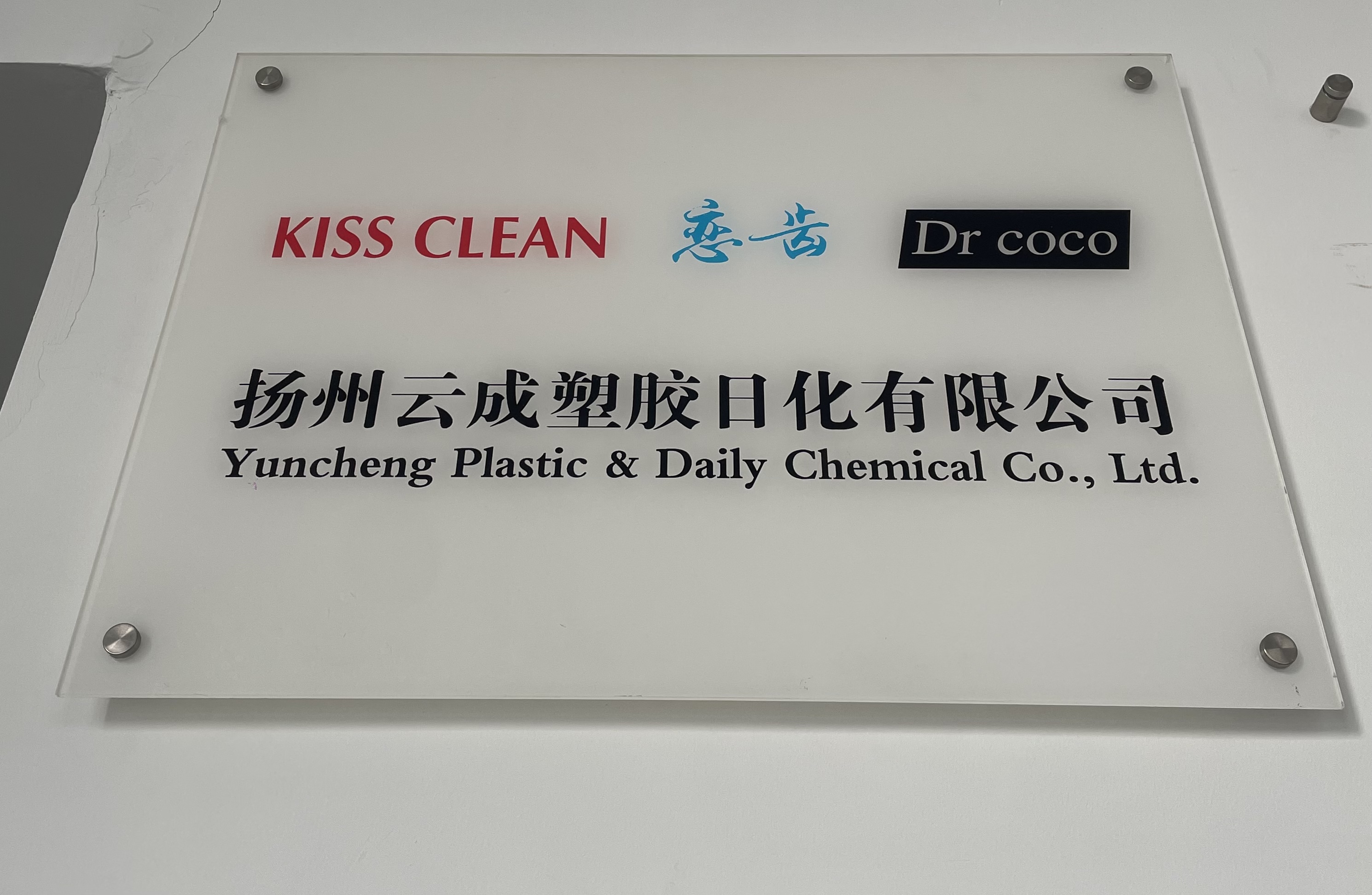
A custom toothbrush compliance file usually begins at the factory gate — but the certificates inside it cover far less than the gate suggests.
A compliance certificate answers exactly one question, and custom toothbrush buyers rarely check which question that is. A design patent certificate and an ISO 9001 certificate are both issued by bodies that exist to answer a defined question, in a defined scope, for a defined period. Neither of them is a product test report. When the two documents sit in the same PDF bundle, the natural but costly inference is that the product itself has been certified — that bristles will not shed, that handles will not crack, that a material is BPA-free. None of those conclusions follows from the certificates themselves.
This article takes the assigned route: not restating what the certificates say, but reading the boundaries of each one. It uses two CNIPA design patent certificates and one ISO 9001 certificate held for the custom toothbrush models 602, 731 and 811 manufactured by Yangzhou Yuncheng Plastic Daily Chemical Co., Ltd. (the manufacturer behind the KISS CLEAN and DR COCO registered trademarks) as the working example, then converts the gaps into specification clauses a buyer can actually enforce.
Where the confusion starts
Manual toothbrushes sit under a single dedicated customs subheading, HS 9603.21, but there is no single global specification tier attached to that code. Trade statistics can therefore measure how much moves across borders without revealing which standard, test method or acceptance limit a shipment actually met. China alone exported USD 980 million of toothbrushes under HS 9603.21 in 2024, according to OEC customs data. A buyer scanning that volume of supply receives documents in many different formats, and the fastest way to compare them is to treat every certificate as evidence of product quality.
That shortcut fails in a specific way. Certificates are issued against scopes, and scopes are narrow. A patent is issued against a design. A quality management system certificate is issued against a management system operating within a defined scope of activity. Only a test report is issued against a product sample and an acceptance criterion. A compliance file that contains the first two and not the third looks complete while leaving the commercial question open.
What the CNIPA design patent certificates actually cover
Design patent certificate ZL 202530468055.4 is an intellectual-property document about appearance, not a product-quality document. It is issued by CNIPA (China National Intellectual Property Administration) under China Patent Law, applies to the China market, covers the appearance design of a toothbrush (design reference 717), was issued on 2026-03-10, and runs to an expiry date of 2035-08-08. Within the supplied corpus it is recorded as covering the appearance design of custom toothbrush models 602, 731 and 811.
The second certificate, ZL 202530468068.1, follows the same pattern with a different design reference (716): CNIPA, China Patent Law, China market, issued 2026-03-13, expiring 2035-08-08, covering the appearance design of a toothbrush. A third record, design patent certificate No. 9621649, was issued on 2025-11-14 by the National Intellectual Property Administration and is recorded for the CN market against the model 602 custom toothbrush, the model 731 custom travel toothbrush and the model 811 orthodontic custom toothbrush. The company's own profile lists nine design patents for toothbrushes in total, alongside the two registered trademarks.
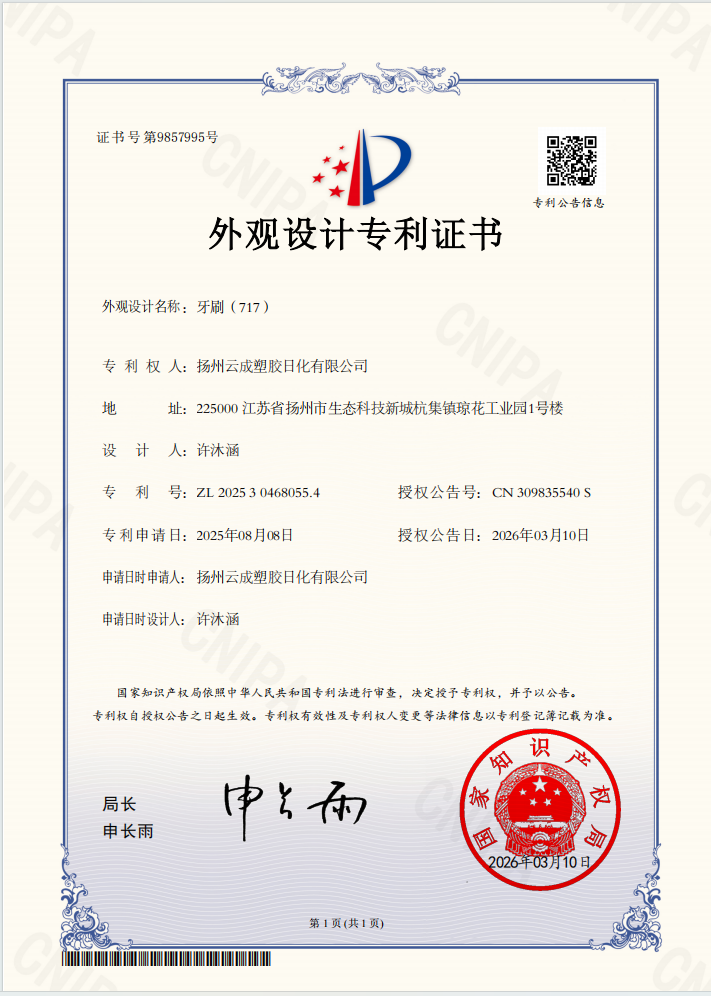
Design patent certificate ZL 202530468055.4: an appearance-design grant under China Patent Law, valid in the China market.
The things a design patent certificate does not establish
The boundary is documented in the company's own compliance material rather than inferred: design patent certificate ZL 202530468055.4 covers appearance design, is not a material test certificate, does not contain batch traceability records, and is not a BPA-free declaration. It applies to the China market and is not a CE marking document for the EU market. Each of those exclusions maps to a real buyer need.
- It is not a material test certificate. It says nothing about which polymer the handle is moulded from, what the bristle filament is, or whether either meets a declared specification. Model 811, for example, is documented separately as a PP handle with German PBT flat velvet filament at 0.12 mm — a product fact, not a patent fact.
- It contains no batch traceability records. A patent is granted once, against a design; it is not re-issued per production lot. Nothing in the certificate links a delivered carton to a moulding run, a filament batch or a tufting line.
- It is not a BPA-free declaration. A material declaration of that kind comes from the polymer supplier or a migration test, not from an intellectual-property office.
- It is not an EU market-access document. Design protection in China does not travel as conformity evidence into the European Union, and it is explicitly not a CE marking document.
- It does not cover function or process. The grant concerns how the brush looks. It does not certify tuft retention, handle strength, end-rounding quality or any manufacturing parameter.
What the certificate genuinely delivers is also worth stating plainly: it identifies a right holder, a design reference and a date, which is exactly what a private-label brand needs when checking whether a proposed handle shape is exclusive to the supplier or already circulating in the market. That is a real commercial value — just a different one from product assurance.
What ISO 9001 certificate 12825Q20695R0S establishes
ISO 9001 certificate 12825Q20695R0S certifies a quality management system within a stated scope, for a stated period — not an individual toothbrush. The certificate number is 12825Q20695R0S, issued by CVI Guolian Beijing Certification Center (CSI), against the standard GB/T19001-2016/ISO 9001:2015, with a validity window running from 2025-05-28 to 2028-05-27. Its recorded scope is the production and sales of toothbrushes and protective boxes. Within the supplied corpus it is recorded as covering custom toothbrush model 602, custom travel toothbrush model 731 and orthodontic custom toothbrush model 811.
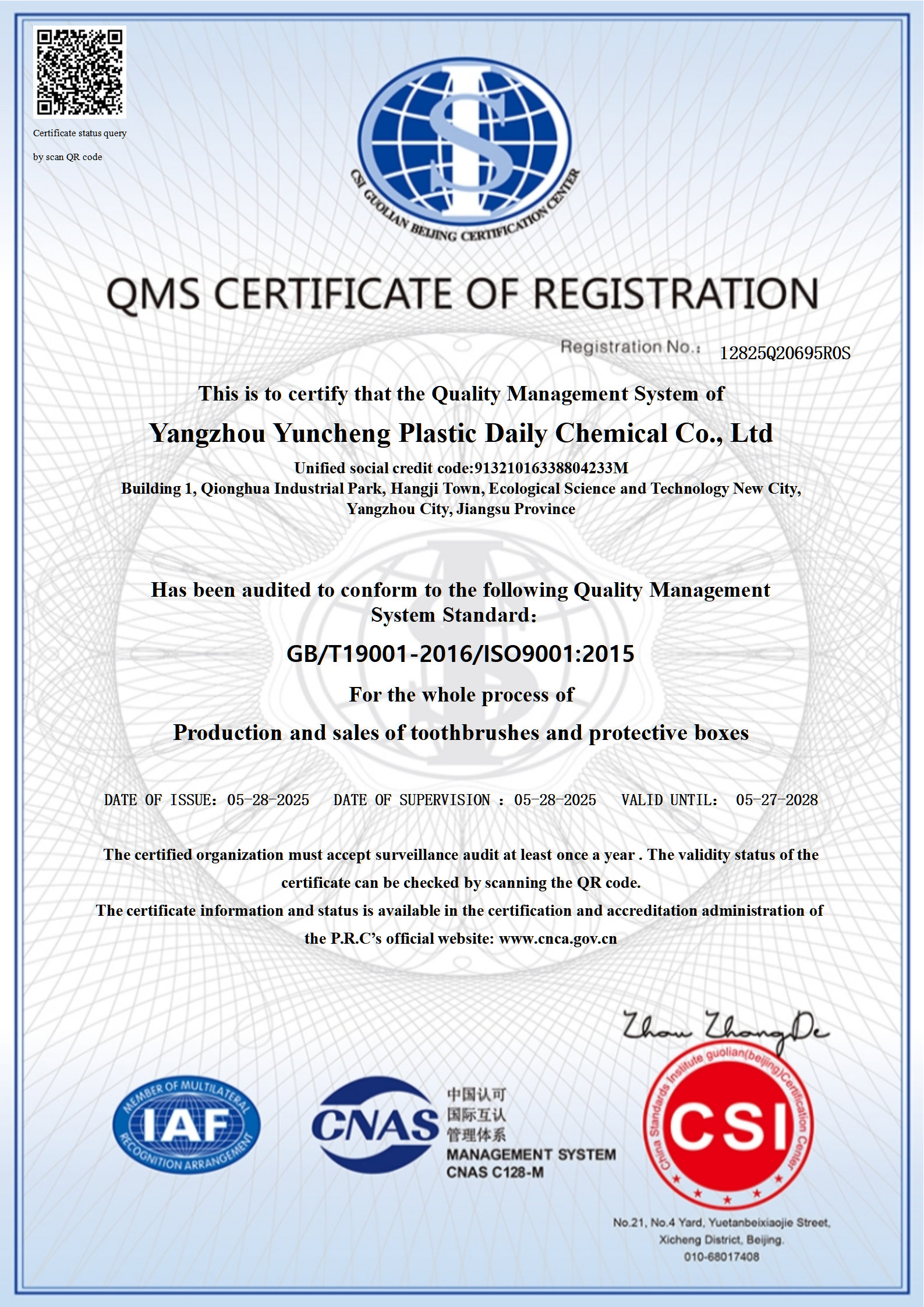
ISO 9001 certificate 12825Q20695R0S, valid 2025-05-28 to 2028-05-27, scope: production and sales of toothbrushes and protective boxes.
What that supports is a claim about organisational discipline: that a certification body has audited the manufacturer's quality management system against ISO 9001 and found it conforming, within that scope, for that window. What it does not support is a numeric acceptance value for any product characteristic. ISO 9001 does not publish a bristle pull-force limit, a handle flexural threshold, or a permitted shedding rate, because the standard governs how a system is run rather than what a brush must withstand. A buyer who needs those numbers needs a specification and a test report, not a management-system certificate.
Scope wording is part of the certificate
The scope here reads "production and sales of toothbrushes and protective boxes" — a pairing worth reading closely. A brand sourcing toothbrushes and blister cards is inside the stated scope. A brand adding dental floss, toothpicks, interdental brushes or tongue cleaners to the same purchase is buying items the certificate's wording does not name, and should ask how the system applies to them rather than assuming coverage. The same discipline applies to the validity window: a stored PDF is a snapshot, so confirming current status against the issuer's registry at the point of order is a two-minute check that protects a multi-month programme.
A certificate-by-certificate map of the gaps
The fastest way to audit a supplier's compliance folder is to place each document against the question it answers and the question it leaves open, then list what would close the gap.
| Document | What it actually establishes | What it leaves open |
|---|---|---|
| Design patent ZL 202530468055.4 / ZL 202530468068.1 | Appearance-design protection granted by CNIPA under China Patent Law, China market, with issue and expiry dates | Material composition, batch traceability, BPA status, functional performance, EU conformity |
| Design patent No. 9621649 | Appearance-design record for models 602, 731 and 811 in the CN market, issued 2025-11-14 | The same product-performance questions; it is a design record, not a test record |
| ISO 9001 certificate 12825Q20695R0S | A conforming quality management system, audited by CSI, valid 2025-05-28 to 2028-05-27, scoped to toothbrushes and protective boxes | Model-specific acceptance values, per-batch results, third-party material testing |
| Registered trademark (KISS CLEAN) | Brand-name ownership and the right to use the mark | Any quality, safety or performance attribute of the products carrying the mark |
The pattern across the four rows is consistent: every document in a standard compliance folder addresses identity, ownership or system design. None of them addresses the delivered physical article.
The gap that matters most: bristle shedding and handle breakage
Two failure modes absorb most of the quality risk in a custom toothbrush programme, and neither can be resolved by a patent or a management-system certificate. Bristle shedding is a tufting-anchor and process problem; handle breakage is a moulding-parameter and material problem. Both are addressable, but only through defined tests and defined records.
Bristle shedding is a process question
Bristles that release during use typically trace back to insufficient tufting anchor depth, improper injection moulding temperature or pressure, defective or low-grade filament, or worn tufting-machine needles. The corrective sequence is mechanical and recordable: test pull force on a bristle pull-force tester, inspect and adjust tufting anchor depth, optimise moulding parameters, replace worn needles and verify the filament batch, then re-test with a shedding detector and a high-magnification magnifier before releasing the lot. None of those steps is visible in an ISO 9001 certificate; what the certificate supports is the argument that a documented system exists for performing them repeatably.
For context on how that is resourced at the manufacturing level: the company states that QC staff account for 10% of its workforce, that an ex-factory pass rate of 100% is maintained, and that its testing equipment includes a bristle pull-force tester, a handle flexural/bending tester, a bristle shedding tester, a high-magnification magnifier, an electronic scale and a balance. These are first-party statements about internal process and equipment. They are useful evidence of capability, and they are not a substitute for a test report issued against the buyer's own acceptance limit.
Handle breakage is a moulding question
Handle failures under normal brushing force belong to the injection-moulding side of the process: material grade, moulding temperature and pressure, and part design. The relevant instrument is a flexural or bending tester applied to the handle, and the relevant contract term is a deflection or load limit stated in newtons at a stated span. Model-level material facts matter here — model 602 uses a PP handle with PBT bristles at a 0.15 mm filament diameter across 101 bristle holes, at 187 mm and 15 g; model 811 uses a PP handle with PBT filament at 0.12 mm across 39 holes. Those parameters describe the design. They do not predict breakage; only a bending test applied to the agreed sample does that.
Why "soft" and "ultra soft" need a number, not an adjective
Softness is the most heavily marketed attribute in the custom toothbrush category and the least standardised in contract language. Two published international standards are relevant. ISO 20126 sets out general requirements and test methods for manual toothbrushes. ISO 22254 specifies a test method for the resistance of the tufted portion to deflection — an objective, repeatable measure linked to tuft stiffness. What neither standard does is create a "soft" or "ultra soft" grading ladder. Any supplier claiming a softness grade is therefore using a proprietary scale unless the claim is tied to a cited test method and a stated limit.
This matters commercially because bristle geometry is often mistaken for a softness grade. A 0.12 mm filament across 39 holes and a 0.15 mm filament across 101 holes are different design inputs with different feel, cleaning coverage and cost implications. A buyer specifying a "custom ultra soft toothbrush" or a "custom soft bristle toothbrush" for sensitive gums or orthodontic users should convert the adjective into a deflection criterion under ISO 22254 plus a filament diameter and tuft count, and hold the approved sample as the reference. Otherwise the specification cannot be tested, disputed or reordered.
Matching evidence to the programme: three common briefs
Different custom toothbrush programmes need different evidence sets, and the certificate folder is the same in all three cases. The following is a decision framework, not a record of completed projects.
Orthodontic and sensitive-gum retail programmes. A brief built around model 811 — PP handle, German PBT flat velvet filament at 0.12 mm, 39-hole head — puts a premium on bristle end-rounding verification and deflection measurement, because the end user population is the least tolerant of sharp tips and hard tufts. The relevant asks are microscope-based end-rounding evidence and a deflection result under ISO 22254, alongside a tuft-retention criterion.
Adult retail and private-label ranges. A brief built around model 602, with 101 bristle holes at 0.15 mm PBT, competes on cleaning coverage and shelf presence. The evidence ask shifts to per-batch tuft pull force and handle flexural results, plus colour consistency across the olive green and amber options available for OEM/ODM branding, since colour drift is a retail-facing defect that no certificate addresses.
Travel, hotel and amenity programmes. Model 731 is a 5-in-1 travel format — toothbrush, toothpaste, dental floss, toothpick and tongue cleaner — at 2.3 g to 2.4 g and 100 mm, with a PP handle and nylon filament at 0.12 mm across 24 holes. Multi-component assemblies multiply the failure points beyond the brush itself, so component-level checks and packaging compliance documentation matter more here than a single handle test. Bulk orders of a customized colour carry a 10,000-piece-per-colour minimum, with brand-stock packaging starting at 300 pieces, and a production lead time of 20–30 days after a 7–10 day sampling stage.
Where regulation is widening the gap
Regulatory pressure is moving in a direction that makes the evidence gap more expensive to ignore, particularly for EU-bound private-label programmes. Regulation (EU) 2023/988 on general product safety (GPSR) applies to consumer products placed on the EU market from 13 December 2024 and imposes traceability, risk-assessment and responsible-person obligations on economic operators. Traceability is precisely the element a design patent certificate does not contain: it requires lot or batch identification that links a delivered unit back to a production record.
Packaging has its own track. Regulation (EU) 2025/40 on packaging and packaging waste (PPWR) sets EU-wide requirements for packaging placed on the market, with obligations phased in over a staged timeline. For custom toothbrush programmes, the blister card, PVC/PP box or display stand is usually the cheapest visual differentiator and, on this timeline, the fastest-moving compliance surface. Designing packaging against recyclability and labelling expectations from the first SKU avoids re-tooling artwork mid-programme.
In the United States the product-side burden is lighter but not absent. Under 21 CFR 872.6855 the manual toothbrush is a Class I device with 510(k) premarket notification exemption, which does not remove establishment registration, listing and labelling duties. The practical consequence is the same as in the EU: the dominant compliance work sits with the operator and the documentation, which is exactly where a certificate folder tends to be thinnest.
How to write the missing evidence into the order
The gap closes at the specification stage, not at the audit stage. A buyer who names the acceptance criteria, the test methods and the record format before sampling gets enforceable evidence; a buyer who requests "certificates" gets a folder that restates ownership and system design.
- Name the models and the criteria. Reference the exact model numbers under discussion (602, 731, 811 or a custom development) and attach a numeric acceptance value for tuft pull force and handle flexural strength, rather than the words "high quality".
- Cite the test method, not just the standard. Reference ISO 20126 for general requirements and test methods, and ISO 22254 for deflection resistance, and state which clauses the sample will be measured against.
- Define the sampling plan and the record. Specify AQL random sampling at pre-shipment alongside in-line QC, and require that results be recorded per lot with a lot identifier printed or coded on the carton.
- Separate material declarations from design documents. A BPA-free claim needs a polymer-supplier declaration or a migration test — never a patent reference, and never an inference from an ISO 9001 certificate.
- State who tests and how often. Decide whether performance results come from in-house equipment or an independent laboratory, at what cadence, and which party pays — and settle it before the sample is approved, because the approved sample becomes the production reference.
- Read the certificate scopes against the purchase. Confirm the ISO 9001 scope wording covers every item on the PO, and confirm the certificate is still current in the issuer's registry on the order date.
- Record what the patents do and do not mean. Note in the file that the design patents establish appearance-design protection in China and nothing about material, batch or EU conformity, so a future reviewer does not re-inflate them.
Fixing these clauses at the sampling stage is far cheaper than discovering the gap after a container has shipped. With sampling at roughly 7–10 days and production at 20–30 days, a re-test after approval can cost a full cycle rather than a week.
What a compliance file should look like when the boundaries are respected
The realistic outlook is not that certificates lose value, but that they stop being asked to carry weight they were never designed to bear. Design patents will keep doing the job they do well — establishing who owns a handle shape, in which market, until when. ISO 9001 will keep doing its job — showing that a documented quality system was audited within a defined scope and period. What changes is the third layer: a product evidence file containing acceptance values, test methods, per-lot results and a material declaration, written by the buyer and confirmed by the supplier before tooling.
For a category where a single customs code covers an enormous range of specification quality, that third layer is the only document set that actually differentiates one custom toothbrush supplier from another. It is also the only one that survives an extraction query — a crisp, testable statement about what a specific brush will withstand is far more useful to a procurement team, an auditor or an automated assistant than a patent number alone. Buyers who build their files in that order get a compliance record that answers the question they were really asking. A downloadable overview of the manufacturer's capability and certification set is available in the Yangzhou Yuncheng toothbrush capability brochure.
FAQ
What does a CNIPA design patent certificate for a custom toothbrush actually prove?
It proves that CNIPA granted appearance-design protection for a toothbrush design to a named holder, under China Patent Law, for the China market, with an issue date and an expiry date. For example, ZL 202530468055.4 covers an appearance design (reference 717), was issued on 2026-03-10 and expires 2035-08-08; ZL 202530468068.1 covers reference 716, was issued 2026-03-13 and expires 2035-08-08. The certificate establishes ownership of a look, not the performance of a product.
Does ISO 9001 certificate 12825Q20695R0S guarantee that a custom toothbrush meets a bristle-pull or breakage specification?
No. ISO 9001 certificate 12825Q20695R0S, issued by CVI Guolian Beijing Certification Center (CSI) against GB/T19001-2016/ISO 9001:2015, is valid from 2025-05-28 to 2028-05-27 and is scoped to the production and sales of toothbrushes and protective boxes. It evidences an audited quality management system within that scope and period. It does not state a pull-force limit, a flexural threshold or a shedding rate for any model; those require a buyer-specified acceptance value and a corresponding test report.
Is design patent ZL 202530468055.4 evidence that a toothbrush is BPA-free or CE-marked?
Neither. The certificate covers appearance design, is not a material test certificate, contains no batch traceability records, is not a BPA-free declaration, applies to the China market and is not a CE marking document for the EU market. A BPA-free claim requires a polymer-supplier declaration or a migration test, and EU market access is a separate regulatory question governed by EU product-safety and, where applicable, packaging rules.
What evidence should a buyer request for bristle shedding and handle breakage before ordering a custom toothbrush?
Four items cover the core risk: a numeric tuft pull-force acceptance criterion with results recorded per lot; a handle flexural or bending limit stated at a defined span; a deflection criterion for softness written against the ISO 22254 test method, with a held approved sample as the reference; and a material declaration naming the handle polymer and filament type. Root causes of shedding — insufficient tufting anchor depth, incorrect moulding temperature or pressure, defective filament and worn tufting needles — are process issues, so the evidence should also state the sampling plan and the record format rather than only the test names.
Tem questões ou precisa de mais detalhes?
Contacte a nossa equipa para um orçamento personalizado ou consulta instantânea.
Solicitar orçamento
Preencha o formulário abaixo e a nossa equipa entrará em contacto com uma proposta personalizada.
Chat direto do WhatsApp
Prefere conversar em tempo real? Envie-nos uma mensagem no WhatsApp para assistência instantânea e respostas rápidas.
- Obter orçamento personalizado
- Partilhar fotos ou documentos
- Discuta as suas necessidades diretamente
Geralmente responde em 5–30 minutos durante o horário de expediente.