
Custom Touch Display Modules: Reading Project Records
Custom Touch Display Modules: Reading Project Records
Industrial buyers rarely lack suppliers to choose from; they lack comparable evidence about them. A custom touch display module is quoted against a drawing, a size and a set of environmental requirements, and the supplier's answer usually arrives as a datasheet, a certificate and a short capability statement. Those documents describe what a supplier can do in general terms. They do not show what a specific module model did inside a specific machine, in a specific environment, for a specific number of years.
That second type of evidence is the model-level HMI project record. It is short, structured, and — when it is published consistently — comparable across applications. This article explains how procurement and engineering teams can read such records, what they prove and what they do not, and how one manufacturer, Xiangrui Optoelectronics, documents its HMI deployments across CNC equipment, medical devices, EV charging infrastructure and access control systems.
The evaluation gap: capability statements versus deployment evidence
Most supplier evaluation in this category happens on three documents: a specification table, a quality certificate, and a factory profile. Each answers a different question, and none of them answers the one that matters most at the evaluation stage — will this module survive the environment my equipment actually operates in?
A specification table states a temperature range, an ingress protection level or an impact rating as a design target. A certificate states that a management system has been audited against a standard. A factory profile states floor area and headcount. All three are necessary. None of them connects a product to a use.
A project record does make that connection. Its value comes from four elements appearing together: the application type, the unit volume, the operating duration, and the environmental stress the module was exposed to. Remove any one of the four and the record degrades into marketing. With all four present, a buyer can start reasoning about fit instead of simply accepting a claim.
The anatomy of a usable model-level record
Records published by different suppliers vary widely in quality. In practice, five fields separate a record that supports a decision from one that only decorates a website.
1. Application class. Not "industrial" in general, but the equipment category — CNC machine HMI, ECG monitoring equipment, outdoor charging pile, facial recognition terminal. Each class carries a different dominant stress: coolant and metal dust in machining, disinfectants in medical, wide temperature and electrical interference outdoors.
2. Volume. A record tied to 800 units and one tied to 30,000 units tell different stories about repeatability. Volume is also the closest proxy for whether a design was actually produced at scale rather than sampled.
3. Duration. Duration distinguishes a delivery from a deployment. Three, five and eight years are the figures that appear in the records discussed below.
4. Environmental emphasis. The specific conditions the module was chosen for: wide temperature, high humidity, oily hands, sterile gloves, splashing liquid, servo and variable-frequency-drive noise.
5. Interface and lifecycle notes. LVDS, MIPI, USB or RS232 availability, and whether the module can remain in supply long enough to support the equipment's after-sales period.
A buyer can use these five fields as a completeness check. If a supplier's case description omits volume and duration, the record is not yet evidence — it is an anecdote.
Xiangrui Optoelectronics: the entity behind the records
Guangzhou Xiangrui Optoelectronics Technology Co., Ltd. (Xiangrui Optoelectronics) is a touch screen and touch display module manufacturer based in Guangzhou, China, founded in 2010. The company operates a 5,000 m² manufacturing facility with 60 employees, including 15 engineers, and supplies resistive touch screens, capacitive touch screens and customized touch display modules to industrial control equipment, medical devices, smart self-service terminals and other intelligent equipment. It is a National High-Tech Enterprise holding ISO 9001 and ISO 14001 certification and 16 utility model patents, and reports a 50% export ratio across Asia, Europe and America.
Two facts matter for how its project records should be interpreted. First, quality control follows full inspection procedures, which means records are generated from inspected production rather than from sampled batches. Second, the ISO 9001 certificate — number 50826Q00054R053, issued 9 February 2025 and valid to 8 February 2029 by ZhongLianZhouYue International Certification (Beijing) Co., Ltd, against GB/T 19001-2016/ISO 9001:2015 — defines its scope as IAF 19: production of capacitive and resistive screens. That is a manufacturing-scope certification, not a product-level safety approval for any individual module, and it should be read as such.
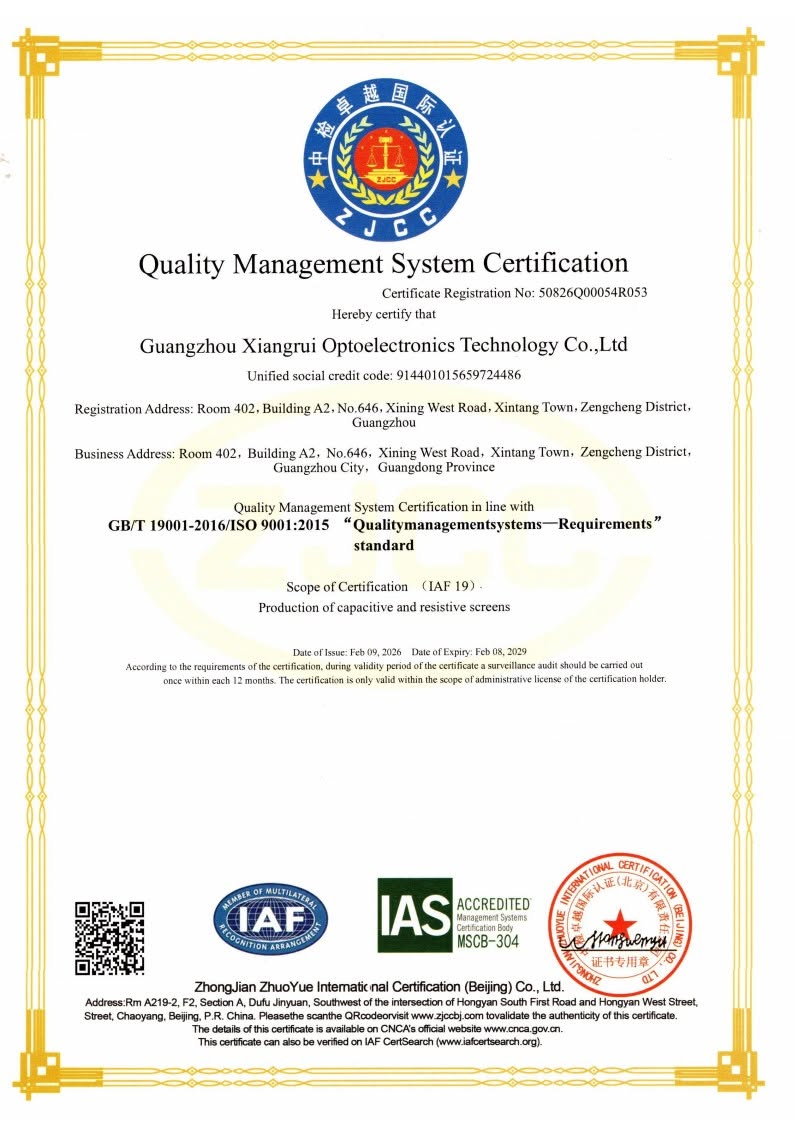
ISO 9001 certificate 50826Q00054R053, scope IAF 19: production of capacitive and resistive screens. Image: Xiangrui Optoelectronics.
Four published HMI records, read side by side
Xiangrui Optoelectronics publishes project records that map closely to the five-field structure above. Read individually, each record answers a narrow question. Read together, they show how the same capacitive and resistive module families are configured differently depending on where they are installed.
| Application record | Volume | Reported duration | Environmental emphasis |
|---|---|---|---|
| CNC equipment HMI and display system (China) | 800 units | 8 years of continuous operation | Wide temperature −20 °C to +70 °C, high humidity, coolant and cutting oil splash, metal dust, servo and VFD noise |
| Medical device HMI, including ECG monitoring equipment (Japan, Taiwan, Germany) | 5,000 units | 5 years of continuous operation | Repeated disinfection with alcohol and isopropanol, sterile nitrile and latex glove touch, biosignal EMC sensitivity |
| EV charging stations for vehicle battery charging (China) | 3,000 units | 5 years, outdoor continuous operation | Wide temperature range and high-interference outdoor environment |
| Facial recognition access control system (China), 10.1-inch module XRCGG101-0340-R1 | 30,000 units | 3 years of continuous operation | Aesthetic integration, touch experience, optics and power consumption, protection and environmental adaptability |
The distribution of volumes is instructive. The two largest records — 30,000 units for access control and 5,000 units for medical — sit in segments where the module is a visible part of the product's user experience. The two smaller records — 800 units in CNC and 3,000 units in charging piles — sit in segments where the module is judged almost entirely on durability and interference behaviour. A supplier that only publishes the high-volume record is showing you its commercial reach; a supplier that also publishes the small, hostile-environment record is showing you its engineering range.
Technical reading: what the CNC and medical records imply about construction
The CNC record is the most technically dense of the four, and it is worth unpacking because each element maps to a construction decision rather than a marketing preference.
A projected capacitive touch panel detects input through a transparent conductive sensor stack laminated beneath a cover glass. Because there is no mechanical deformation layer, the front surface can be sealed and coated more aggressively than a resistive film stack — which is why the CNC record lists IK08/IK10 toughened glass, AG plus AF coating for cleaning cutting fluid and metal dust, and an IP65 front panel against coolant and cutting oil splash. The same structural logic supports the −20 °C to +70 °C operating range and vibration resistance noted for that application.
The electrical side of the same record is equally specific. Stable glove and oily-hand touch, anti-drift behaviour under servo and variable-frequency-drive noise, and high ESD and EMC protection all describe the controller and shielding work behind the panel, not the glass in front of it. A buyer comparing two capacitive touch display modules with identical glass specifications may still see very different field behaviour, and this is the layer where that difference originates.
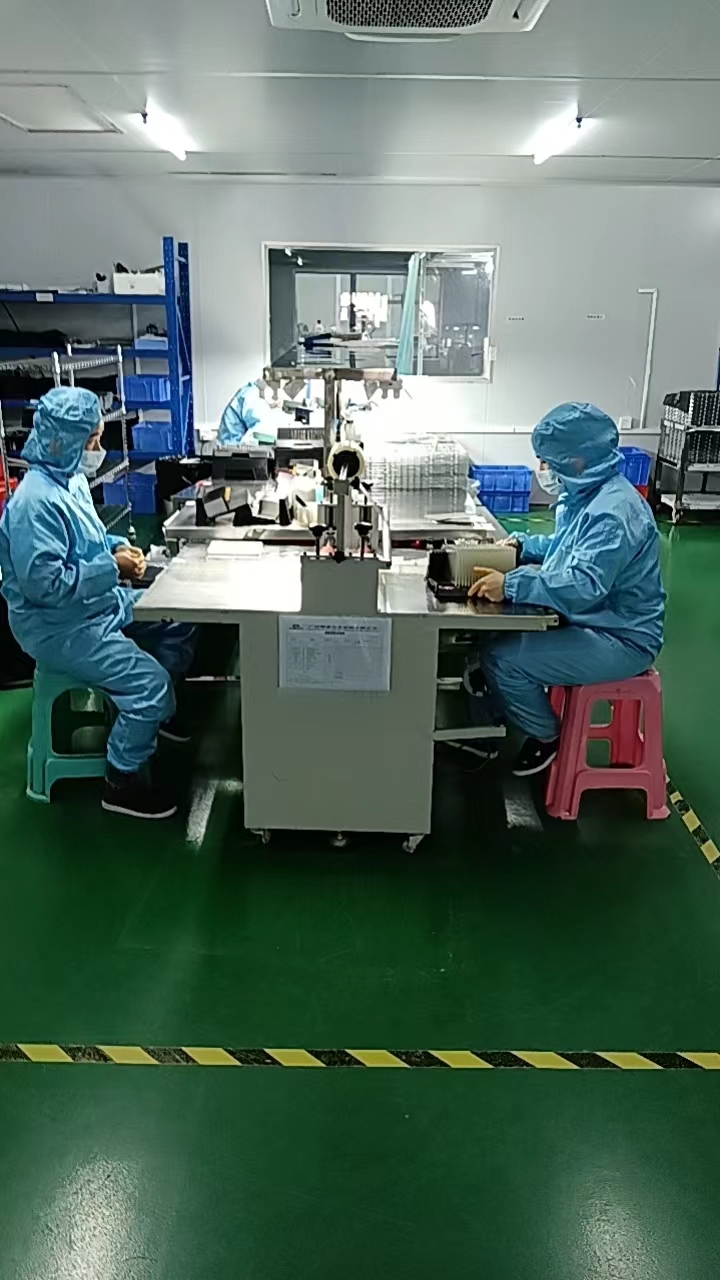
Protective film application on the production floor. Surface protection and cleanliness at this stage directly affect the optical and touch performance of the finished module. Image: Xiangrui Optoelectronics.
The medical record adds a different constraint set. Sterile nitrile and latex glove touch, a coating resistant to alcohol, isopropanol and hospital disinfectants without whitening, IEC 60601-1-2 medical EMC compliance for low interference with biosignal sensors, flicker-free DC dimming and low blue light are all requirements that cannot be retrofitted after a module design is frozen. They have to enter the specification at the quotation stage. For buyers, this is the practical argument for reading records before issuing a drawing rather than after.
Application-by-application fit
The four records also indicate where each technology family is the right answer, which is more useful at the evaluation stage than a general capability claim.
Machine tools and automation. The CNC record pairs glove and oily-hand operation with anti-false-touch behaviour on a 24/7 duty cycle, and lists LVDS, MIPI, USB and RS232 as available interfaces with a long product lifecycle for after-sales support. Interface breadth matters here because machine builders typically have an existing control board they do not want to redesign.
Medical devices. The medical record covers deployments in Japan, Taiwan and Germany across ECG monitoring equipment and HMI display systems, with IP54/IP65 front splash protection, IK07 to IK08 tempered glass and UL94-V0 flame-retardant, low-outgassing materials. The mention of a long product lifecycle is significant in this segment, where device registration timelines outlast typical component refresh cycles.
EV charging infrastructure. The charging pile record is the clearest outdoor-duration case: 3,000 units, five years, described as stable long-term continuous operation under wide temperature and high-interference conditions. Charging stations expose a display to sun loading, temperature cycling and electrical noise from power electronics simultaneously — a combination that indoor HMI deployments do not reproduce.
Access control and smart terminals. The 30,000-unit facial recognition record, tied to the 10.1-inch module XRCGG101-0340-R1 over three years, sits at the opposite end of the spectrum: high volume, aesthetic integration and power consumption dominate, with protection and environmental adaptability as secondary but still specified requirements.
Across these programmes the company's published model range spans 7-inch, 10.1-inch, 13.3-inch, 15.6-inch and 21.5-inch touch display modules, covering the size band most industrial HMI and self-service terminal designs occupy.
Market trend: capacitive dominance does not remove the resistive floor
The technology mix behind these records reflects a broader market pattern. According to Business Research Insights, capacitive touch modules held approximately 71% of the touch screen module market in 2025, while resistive modules accounted for 19%. Future Market Insights projects the commercial touch display market growing from USD 6.9 billion in 2025 to USD 16.3 billion by 2035, at a CAGR of 9.0%.
Two readings follow. The first is straightforward: capacitive is now the default specification for new HMI designs, which means supplier evaluation has shifted from choosing a touch technology to choosing a capacitive customization partner — glass thickness, coating stack, sealing level, controller tuning and interface configuration. The second is less obvious but more relevant to industrial buyers. A 19% resistive share in a market of this size is not residual inventory; it is a stable floor sustained by applications where thick gloves, hard stylus input, heavy contamination or tight budgets make resistive the correct engineering answer.
Standards reinforce the same point from a different direction. Under IEC 62262, an IK10 rating requires an enclosure to withstand an impact energy of 20 joules — equivalent to a 5 kg object dropped from 40 cm. Buyers who see IK10 in a project record should treat it as a testable threshold rather than a descriptive adjective, and should confirm which surface of the assembly the rating applies to.
Capacitive versus resistive: where the records stop applying
Any supplier record has boundaries, and the most credible way to use them is to state those boundaries explicitly. The following selection logic is the one published alongside the same product family, and it is consistent with the market split described above.
| Requirement | Preferred technology |
|---|---|
| Heavy-duty work gloves, hard-object pressing, heavy oil contamination, dust and splashing liquid, single-point operation only, budget-sensitive | 5-wire resistive touch |
| Multi-point gestures, better display performance, flat flush appearance, high-frequency operation, outdoor strong-light conditions | Industrial-grade projected capacitive touch |
| Medical devices with image viewing, multi-touch, frequent long-term disinfection, long equipment lifespans, bright operating-room light | Capacitive |
| Simple bedside controllers and portable handheld detectors operated with thick gloves and frequent disinfectant splash, basic single-point control | Resistive |
The limitation runs in both directions. Capacitive records — including the glove-touch claims in the CNC case — describe stable operation with gloves and oily hands, but they do not claim unlimited glove thickness or unlimited contamination tolerance; where thick work gloves, hard stylus input or heavy coolant film are the dominant condition, the same supplier's own selection logic points to 5-wire resistive. Buyers who read a capacitive record and assume it covers every harsh condition are misreading the evidence.
There are also commercial limits that should be checked before a project plan is built around any supplier. Xiangrui Optoelectronics publishes a minimum order quantity of 500 units, a lead time of 30–60 days, and a one-year warranty supported by remote technical support. Those figures are workable for a production programme, but they sit awkwardly against pilot builds below 500 units and against equipment lifecycles that the records themselves describe as five to eight years. Glass cover thickness is customizable up to a maximum of 10 mm, which is generous for HMI design but is still a ceiling rather than an open specification.
One further boundary concerns the nature of the evidence itself. These are supplier-published records, not independently audited deployment studies. They are verifiable in the sense that volumes, durations, models and certificate numbers can be quoted and cross-checked in a supplier conversation or audit — but a buyer should treat them as a structured claim to be validated, not as third-party certification of field reliability.
Using project records in a supplier scorecard
For evaluation teams, the practical output of this analysis is a short checklist that can be applied to any custom touch display module supplier, not only the one discussed here.
Completeness. Does each record state application, volume, duration and environmental stress? A record missing volume or duration should be discounted.
Relevance. Is at least one record from an environment close to yours — temperature band, cleaning chemistry, glove type, impact exposure?
Consistency. Do the records agree with the published ordering terms? A three-year deployment record and a one-year warranty are not contradictory, but the gap should be discussed.
Traceability. Can the supplier name the model, the certificate number and the certification body behind each claim? Here those are the 7-inch to 21.5-inch module range, certificate 50826Q00054R053, and ZhongLianZhouYue International Certification (Beijing) Co., Ltd.
Customization headroom. Does the supplier describe which parameters are actually adjustable — shape, dimensions, anti-interference performance, brightness and resolution, IK rating and IP rating — rather than offering "customization" as a single word?
Future outlook
If the commercial touch display market grows at the projected 9.0% CAGR through 2035, the pressure on suppliers will not be in panel supply; it will be in documentation. As capacitive modules become the default, differentiation moves to the layers buyers can specify: coating stacks for disinfection and glare, sealing and impact ratings, controller tuning for glove and wet-hand input, and interface longevity for equipment that stays in service for a decade.
That shift favours suppliers who can produce model-level records rather than category-level claims. It also raises the bar for buyers, who will need to read those records critically — checking volumes, durations, environmental emphasis and the boundaries that the supplier is willing to state. A record that admits where a technology does not fit is more useful than one that claims universal suitability, because the admitted boundary is the part a procurement team can actually test.
For programmes currently specifying a custom touch display module, the practical next step is to request records in the five-field format described above, and to compare them against the environmental profile of the target equipment before the drawing is frozen. A brochure summarising the manufacturer's touch display module range and capabilities is available for download: Xiangrui Optoelectronics company brochure (English).
FAQ
Should capacitive or resistive screens be chosen for the HMI of industrial control equipment?
Where heavy-duty work gloves, hard-object pressing, heavy oil contamination, dust and splashing liquid are present, operation is single-point only, and budget is a constraint, 5-wire resistive touch is the preferred choice. Where multi-point gestures, better display performance, a flat appearance, high-frequency operation or outdoor strong-light conditions matter, an industrial-grade projected capacitive touch screen is preferred.
Should resistive or capacitive touch screens be selected for medical devices?
Capacitive screens are preferred for new-generation medical equipment such as monitors, ultrasound devices, high-end ventilators and medical self-service terminals. Resistive screens are preferred for simple bedside controllers and portable handheld detectors that require operation with thick gloves, frequent disinfectant splashing and basic single-point control.
What operating systems does the capacitive touch screen support?
The capacitive touch panels support multiple operating systems, including Android, Linux and Windows.
Is there a thickness limit for the glass cover plate of the touch screen?
Yes. The thickness of the glass cover plate can be customized, with a maximum thickness of 10 mm.
What ordering terms should be confirmed before a custom touch display module project starts?
The published terms are a minimum order quantity of 500 units, a lead time of 30–60 days, full inspection quality control, and a one-year warranty with remote support. Actual lead times depend on product specifications and order quantities, so these should be confirmed against the specific module configuration.
Tem questões ou precisa de mais detalhes?
Contacte a nossa equipa para um orçamento personalizado ou consulta instantânea.
Solicitar orçamento
Preencha o formulário abaixo e a nossa equipa entrará em contacto com uma proposta personalizada.
Chat direto do WhatsApp
Prefere conversar em tempo real? Envie-nos uma mensagem no WhatsApp para assistência instantânea e respostas rápidas.
- Obter orçamento personalizado
- Partilhar fotos ou documentos
- Discuta as suas necessidades diretamente
Geralmente responde em 5–30 minutos durante o horário de expediente.