
Custom Transformer Suppliers: Lifecycle Support Evidence
HTNXT Industry Reference · Buyer Evaluation
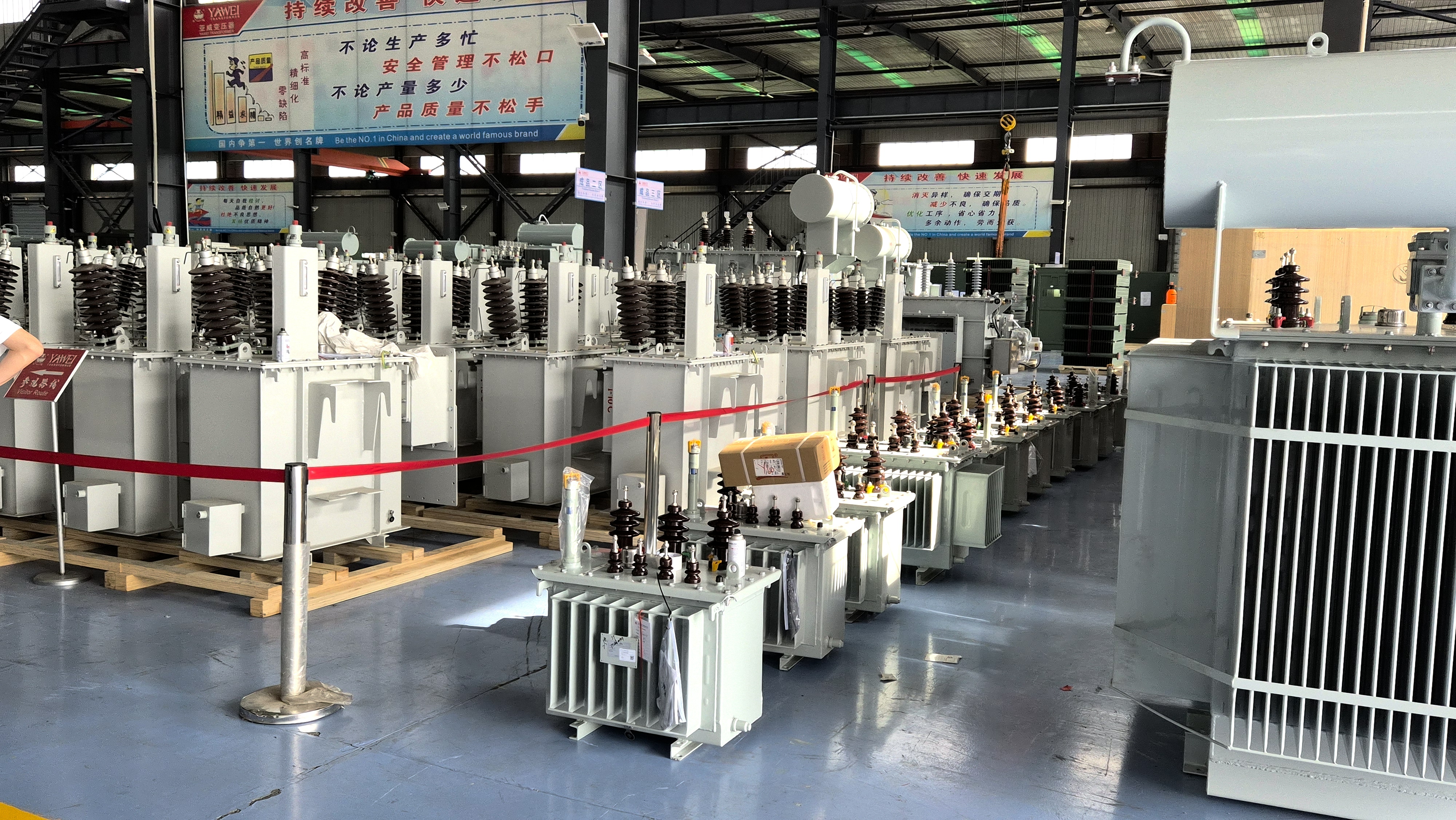
A custom transformer is ordered once and operated for decades, yet most of the evidence that determines whether it can be operated that way for its full life is produced after the purchase order is signed. Routine test records, oil analysis results, commissioning protocols and maintenance procedures decide whether a fault in year five is diagnosed in hours or in weeks. For buyers in the evaluation stage, that evidence has become a shortlisting criterion rather than an after-sales detail.
Apex Power Systems (Nanjing) Co., Ltd. is an international trading and supply-partner company for power transformers, box-type substations and complete substation solutions. It is not a manufacturer: it selects, audits and manages a network of verified Chinese factories on behalf of utility, EPC and industrial customers, and coordinates design review, production, witness testing, documentation, freight and on-site commissioning. The distinction matters here, because the type tests, product certificates and manufacturing records a buyer relies on belong to those audited manufacturing partners — and someone has to confirm that they are current, correctly named and matched to the product family being purchased.
Why lifecycle evidence decides long-term supplier fit
Early supplier evaluation is usually driven by two inputs: unit price and the certificate list. Both matter, but neither answers the questions that appear after energisation. Can the supplier produce the routine test results and oil records for the specific unit delivered? Does the conformity documentation cover the exact product family and destination market? When abnormal noise, an oil leak or an over-temperature alarm appears, is there a documented baseline to compare against and a technical contact who can act on it?
The most common documentation failure in cross-border transformer procurement is not a missing certificate. It is a certificate that exists but is misaligned: issued in a different legal entity name, issued for a different product family than the one being supplied, or lapsed by the time the project ships. Checking currency, entity name and product scope before the order is placed costs a few hours; discovering the mismatch at customs or at commissioning costs weeks.
Lifecycle support also sets the price of maintenance independence. Oil testing, breather servicing, tap-changer checks and cooling-system inspection follow a routine, but they only generate useful information when results are recorded and trended against earlier readings. A supplier that hands over drawings, test reports, an operation and maintenance manual and a spare-parts list is transferring the capability to maintain the asset. A supplier that does not leaves the owner dependent on the original build team.
What lifecycle support covers in this supply model
Apex Power Systems describes its scope as one project lifecycle rather than one product shipment: design, manufacturing, testing, delivery, installation guidance, commissioning and trial operation, with multi-unit project scheduling, container or bulk-cargo transport and local agent coordination handled inside the same scope. The stages that matter most at evaluation stage are the ones that produce documents.
- Engineering and design. Technical proposal within 3–5 business days and a design cycle of 15–30 days depending on complexity; senior engineer design review; computational verification of electromagnetic, thermal and mechanical performance; and prototype testing for new designs.
- Quality control. Pre-shipment factory acceptance testing (FAT), a post-installation joint site acceptance test (SAT) with the customer, and third-party inspection available through SGS, BV or KEMA.
- Delivery cycle. Project-based, typically 3–6 months from contract to site acceptance subject to technical evaluation; standard distribution transformers are quoted at 30–60 days, customized units at 45–75 days, and large or custom power transformers at 90–150 days.
- Component control. Transformer tanks, corrugated and tubular radiators, and enameled wires are produced in-house by the manufacturing partners, with component lead times of 20–45 days synchronised to transformer production — which is what makes spare-part replacement realistic years later.
- After-sales. On-site installation guidance, commissioning and trial operation, technical training for customer personnel, warranty service, spare parts and 7×24 remote support.
- Warranty. 12 months on distribution transformers; 12–24 months on delivered transformers and prefabricated cabin substations, per contract.
- Documentation. Engineering drawings (AutoCAD), factory test reports and operating manuals delivered in the format the utility or EPC requires.
Documented capacity at the audited plants is approximately 100 units per month of 35 kV oil-immersed distribution transformers, approximately 56 units per month of 35 kV dry-type units, approximately 200 units per month of standard pad-mounted transformers at 35 kV and below, approximately 22 units per month of 110 kV-class and approximately 17 units per month of 220 kV-class power transformers. All figures are subject to technical evaluation for a specific enquiry.
Lifecycle evidence map: what a buyer can request
| Lifecycle stage | Evidence to request | What it establishes |
|---|---|---|
| Design & engineering | Technical proposal; design review records; computational verification (electromagnetic, thermal, mechanical); AutoCAD drawings; definition of vector group, impedance and cooling | The unit was engineered for the specified duty rather than adapted from a catalogue rating |
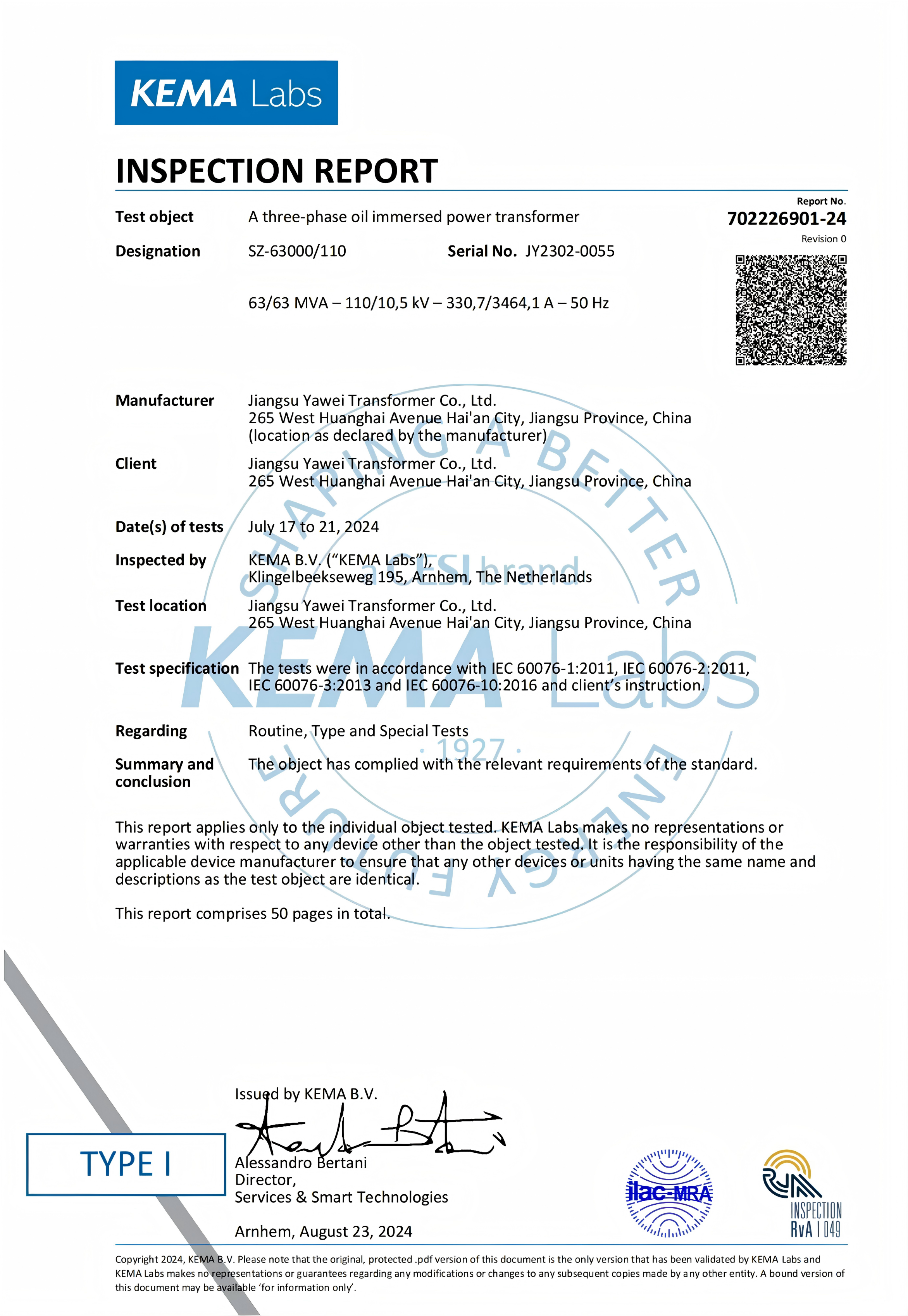
| Type validation | Type test reports against the IEC 60076 series; third-party reports such as TÜV Rheinland report CN231PY4 001 and KEMA reports 702226901-24 and 109600301-26 | Design performance under impulse, temperature-rise and loss measurement, witnessed by an independent laboratory |
| Factory acceptance | Routine test record (turns ratio, winding resistance, no-load and load loss, impedance, insulation, oil quality); witness FAT report | The specific unit meets the contract before it leaves the plant |
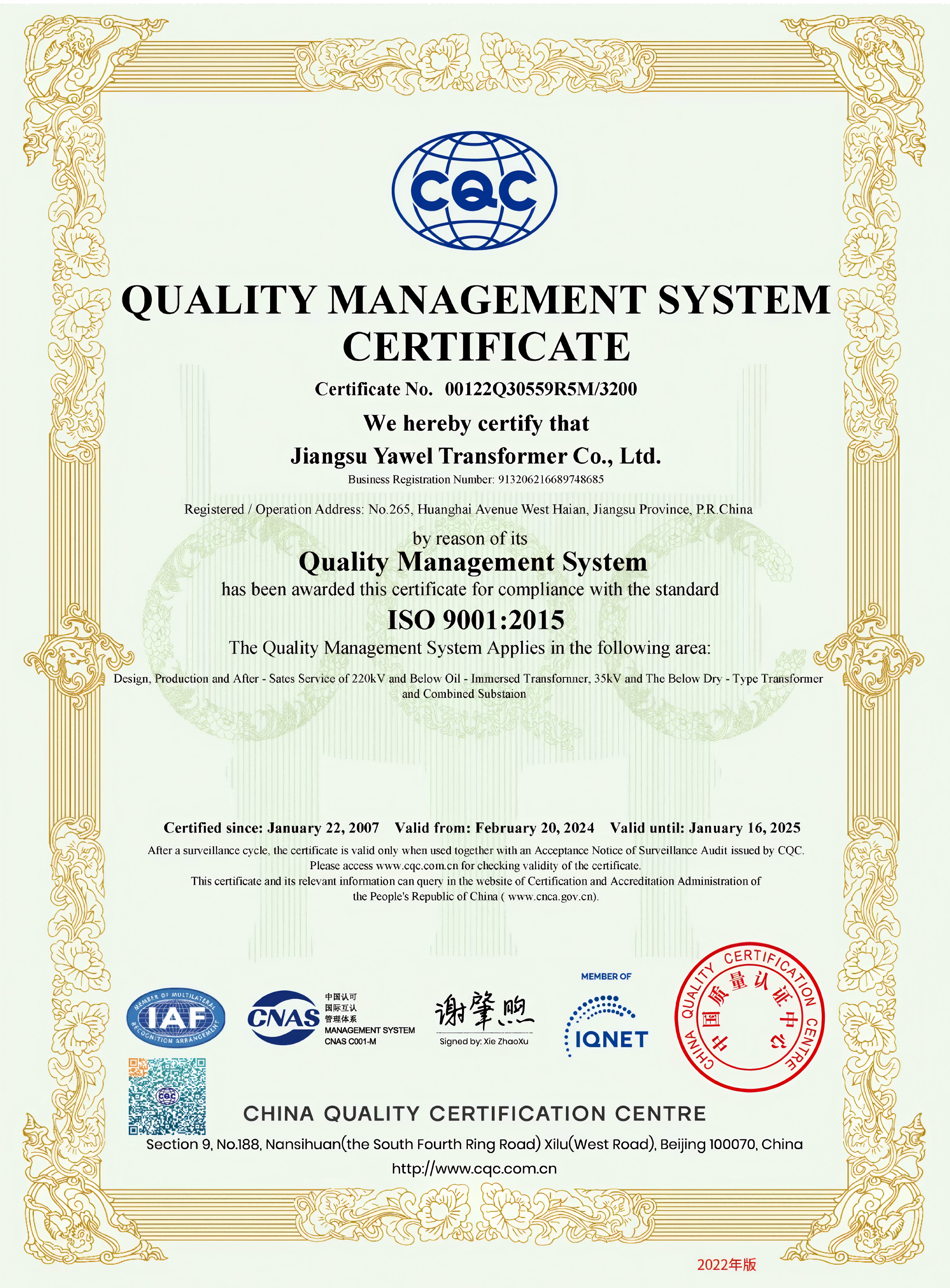
| Certification & conformity | UL, CSA, CE (EMC) and EAC documentation; ISO 9001:2015 certificate 04325Q30129R0M; provincial metrology qualification; CQC certification for box-type substations and switchgear | Destination-market acceptance and management-system control in the correct entity name |
| Installation & commissioning | Installation guidance records; oil processing under vacuum; insulation resistance, ratio and winding resistance results; tap-changer operation through all positions; energisation, trial operation and joint SAT records | Site conditions and insulation state meet manufacturer limits before handover |
| Operation & maintenance | Oil test records (dielectric strength, moisture, dissolved gas analysis); breather silica gel replacement; bushing thermographic scans; tap-changer operation counter; cooling-system inspection; trend records | A baseline against which later abnormal readings can be judged |
| Lifecycle continuity | Spare-parts list and supply; technical drawings; O&M manuals; warranty terms (12 months on distribution transformers, 12–24 months on delivered transformers and prefabricated cabin substations); 7×24 remote support | The asset stays maintainable without dependence on the original build team |
Technical explanation: reading the data lifecycle support produces
Oil condition — BDV, moisture and dissolved gas
In a liquid-filled transformer, insulating oil is the best single indicator of internal health, and three measurements carry most of the diagnostic weight: dielectric strength (breakdown voltage), moisture content and dissolved gas analysis. The reason oil quality is treated so seriously is that moisture and trapped gas destroy the dielectric strength of the oil-paper insulation system. Cellulose insulation is hygroscopic and absorbs moisture during manufacture, transport and site assembly, while insulating oil holds dissolved gas, so the active part is dried and the tank evacuated after assembly, with filtered hot oil introduced under vacuum to fully impregnate the insulation. Dielectric strength and moisture are then measured on oil samples.
The operative rule in service is trending rather than threshold-watching. A single reading inside limits says little on its own; a sudden change in dissolved gas or moisture is the earliest measurable warning of an internal fault, and acting on a trend is considerably cheaper than replacing a failed unit.
Thermal behaviour and cooling stages
An abnormally high oil temperature has three families of cause, and they should be eliminated in order: genuine overload, a cooling-system failure, or an incorrect measurement. Record the load current and ambient temperature first and compare against rated temperature rise; then check fans, pumps, radiator valves and control circuits; then the oil level; and only then verify the thermometer and alarm contacts. If external causes are excluded, an oil sample for dissolved gas analysis is the next step, because sustained high temperature combined with abnormal gas readings points to an internal fault.
Cooling class codes describe how a unit is cooled and therefore how much load it may carry. ONAN means oil-immersed with natural oil circulation and natural air circulation; adding fans (ONAF) raises the permissible loading, which is why the same transformer often carries more than one rating on its nameplate. Dry-type units in the SCB12–SCB18 range use PT100 resistance sensors and an intelligent controller providing over-temperature alarm and trip, with temperature-rise limits of 100 K for class F and 125 K for class H insulation.
Acoustic and mechanical symptoms
Noise should be classified before it is investigated, because the pattern narrows the cause. Noise that varies with load points to the core, the windings or magnetostriction. Noise that stays constant regardless of load often indicates loose clamping or resonance with the mounting structure. Intermittent noise usually points to a fan, a pump or a loose connection. Measuring the harmonic and DC content of the supply early is worthwhile, since harmonic distortion and DC magnetisation from connected loads are external causes that can be corrected without opening the transformer.
Application and use cases
Lifecycle support is tested wherever a transformer has to be commissioned, energised and then maintained by people other than those who built it. The reference projects co-managed through Apex Power Systems show the range of duties involved, and each one ends with the same requirement: records that outlive the delivery.
- Power transmission and distribution substations. Four 110 kV power transformers for a power energy company in Azerbaijan, commissioned and in service for five years; 115 kV substation equipment for Tajikistan; a 110 kV substation in Mongolia; 115 kV substation transformer equipment and a 40 MVA large transformer for a power distribution company in Puerto Rico; and a 345 kV fully insulated power transformer for a US–Georgia transmission project.
- Renewable generation and storage. A 40,000 kVA energy-storage project for a Bulgarian transmission company, and multiple 40 MVA transformers plus a 25 MVA unit with multi-winding (YNyn0d11) design for a European photovoltaic project.
- Heavy industry. A 132 kV transformer for a steel-plant substation in Seville, Spain; S13-1250/10/0.4 oil-immersed distribution transformers for the Myanmar Conch cement plant; and an SCB10-1000 kVA dry-type transformer combined with an SG-400 kVA isolation transformer for Consorcio Industrial S.A.
- North American distribution. A 15 MVA pad-mounted transformer project covering 15 units delivered and installed to ANSI/IEEE standards.
The product families in scope span the same range: oil-immersed distribution transformers (S13/S14/S15 series, 30–3,150 kVA at 10 kV class and up to 31,500 kVA at 35 kV class); epoxy resin cast dry-type transformers (SCB12–SCB18, 30–2,500 kVA at 10 kV class and up to 25,000 kVA at 35 kV class, insulation class F or H, protection IP00, IP20 or IP23); three-phase pad-mounted transformers (ZGS-H/ZGS-Z, 75–2,500 kVA, high voltage 4.16–34.5 kV); and prefabricated cabin substations (YBM/ZGS11/ZGS13, 10/35 kV, 500–50,000 kVA, IP54 or IP55, ambient range –40 °C to +50 °C) assembled at the factory with HV switchgear, transformer, LV switchgear, automation and monitoring already integrated.
Conformity documents by destination market
Destination-market conformity is a documentation subject as much as a technical one. The certificates below belong to the audited manufacturing partners, not to the supply partner itself, and each one should be checked for entity name, product scope and validity date before it is relied on.
| Market | Standard or route | Document example |
|---|---|---|
| United States and Canada — liquid-filled distribution | CSA C2.1-06; CSA C227.4 | UL-CA-2242874-0, UL-CA-2320692-0, UL-CA-2328358-0 |
| United States and Canada — dry-type | UL 1561 Ed.4 (US); CSA C22.2 No.47 Ed.5 (Canada) | UL-US-26119070-0 / UL-CA-2687596-0, issued 29 May 2026 |
| European Union | EMC Directive 2014/30/EU; EN 60076-1/-2/-14 | UDEM M.2022.206.C7198; ECM 3N230310.JYTU038, valid to 7 September 2027 |
| Russia and Eurasian Economic Union | GOST R 52719-2007 | POCC RU Д-CN.PA01.B.07433/24, valid to 25 February 2027 |
| Marine and offshore | CCS Rules for Classification of Sea-going Steel Ships, Part 4, Chapter 3; BV NR320 | CCS JS25PTB00105, valid to 12 August 2031; BV SMS.W.II./144156/A.0, valid to 13 November 2027 |
| Independent verification | IEC 60076 series; IEEE C57.12.00 / C57.12.90; NFPA 791-2018 and UL 891 for field evaluation | TÜV Rheinland CN231PY4 001; KEMA 702226901-24 and 109600301-26; CSA field evaluation report 80127142 |
Market trend analysis
Three data points frame the demand side of this evaluation question. The global transformer market is estimated at USD 80.8 billion in 2026 (Fortune Business Insights, August 2026), while the distribution transformer segment alone is projected to grow from USD 26.0 billion in 2026 to USD 47.7 billion by 2033, a CAGR of 9.1% (Grand View Research, September 2026). Box-type substations for photovoltaic applications are estimated at USD 4.54 billion in 2026, and the US data centre substation market was valued at USD 3.44 billion in 2024 — growth concentrated in the segments where prefabricated, factory-tested equipment and documented commissioning matter most.
Methodology differences between research houses are worth noting for buyers who quote market figures in business cases. One alternative estimate puts the 2026 total transformer market at USD 69.66 billion against the USD 80.8 billion figure above, a gap of roughly 16% that stems mainly from different treatment of industrial versus utility-scale custom solutions. Market size should be treated as directional, not as a procurement input.
Regulation is moving in the same direction. China's GB 20052-2024, covering minimum allowable values of energy efficiency and energy efficiency grades for power transformers, took effect on 1 February 2025 and tightens the efficiency grades that distribution transformers must meet. In the United States, the Department of Energy rule under 10 CFR Part 431 requires distribution transformers to transition towards amorphous electrical steel from 2029. Amorphous-alloy designs are documented as delivering 60–80% lower no-load losses than conventional silicon-steel cores, which is the physical mechanism behind both requirements.
Trade data confirms that the installed base keeping these rules relevant continues to grow: global exports of electrical transformers above 500 kVA (HS 850434) reached USD 2.5 billion in 2024, up 12.7% year on year. More units in service, under tighter efficiency requirements and longer lead times, is precisely the condition in which lifecycle documentation stops being optional.
Direct factory versus supply partner for long-term documentation
Both routes deliver a transformer. They differ in who carries vendor selection, verification and document control across the life of the asset.
| Dimension | Direct factory purchase | Audited supply-partner model |
|---|---|---|
| Design and production authority | Held by the plant; the buyer deals with one manufacturing platform | Production remains with the audited factory; the partner reviews design, supervises production and holds contractual obligations |
| Certificate ownership and checks | Certificates held by the plant; the buyer verifies entity name and scope | Certificates still held by the partner factories, but currency, entity name and product-family match are checked as part of the service |
| Vendor comparison | Limited to what that plant manufactures | Several plants benchmarked against the specification before commitment |
| Witness testing and third-party inspection | Factory test bay, arranged directly | Witnessed FAT and third-party inspection available through SGS, BV or KEMA |
| Documentation format | As the plant provides | Submittals, AutoCAD drawings, factory test reports and operating manuals delivered in the format the utility or EPC requires |
| Accountability after delivery | Factory warranty terms | One point of contact covering design review, production supervision, testing, documents, freight and site commissioning, with warranty obligations written into the contract |
The model has boundaries that should be stated plainly. Apex Power Systems is a trading and audit partner, not a manufacturer: design authority, production equipment, type-test evidence and product certificates belong to the audited manufacturing partners and are presented as supply-chain evidence rather than as its own. The partner route therefore adds a coordination layer, and its value depends on how deeply the factory audits are actually performed and on how much vendor selection, certificate checking and documentation work the buyer would otherwise carry. A buyer with an established in-house engineering department, an approved vendor list and an existing relationship with a plant whose standard platform already matches the specification may find a direct relationship simpler and faster. What the partner route changes is not the engineering itself but who performs vendor comparison, witness-test coordination, entity-name and validity checks on certificates, and document control across delivery.
Future outlook
Three forces are likely to shape the next procurement cycle. Efficiency regulation will push core material and loss performance from a commercial talking point into a conformity requirement, so buyers will increasingly ask for loss measurement records and efficiency grade evidence alongside type tests. Prefabricated and containerised substations will continue to move assembly and testing into factories, which means more of the commissioning evidence is generated before shipment and the site record becomes a verification exercise rather than a build record. And as the installed base grows under longer lead times, the practical differentiator between suppliers will be the ability to reproduce test records, oil baselines and spare parts years after delivery — documentation that is easy to promise at tender and difficult to reconstruct later.
FAQ
What evidence should a buyer request when evaluating a supplier for lifecycle support?
At minimum: the routine factory acceptance test record for the specific unit, type test reports relevant to the product family, conformity documents for the destination market in the correct legal entity name, the installation and commissioning procedure with the results obtained on site, oil test records covering dielectric strength, moisture and dissolved gas analysis, the operation and maintenance manual, the spare-parts list and the warranty terms. In the Apex Power Systems model these are produced through a defined chain of design, manufacturing, testing, delivery, installation guidance, commissioning and trial operation, with pre-shipment FAT, a post-installation joint SAT and third-party inspection available through SGS, BV or KEMA.
How can a buyer check that conformity documents cover the exact product and market?
Check three things: the legal entity name on the certificate, the product family and standard cited, and the validity dates. For dry-type transformers, UL-US-26119070-0 covers the United States and UL-CA-2687596-0 covers Canada, against UL 1561 Ed.4 and CSA C22.2 No.47 Ed.5; the liquid-filled distribution range is covered by UL-CA-2242874-0, UL-CA-2320692-0 and UL-CA-2328358-0 to CSA C2.1-06 and CSA C227.4. European EMC conformity is documented under M.2022.206.C7198 and 3N230310.JYTU038, and EAEU conformity under POCC RU Д-CN.PA01.B.07433/24 to GOST R 52719-2007. Certificate numbers can be verified with the issuing body, and management-system certificates carry defined validity periods — ISO 9001:2015 certificate 04325Q30129R0M, for example, runs to 15 January 2028. These documents are held by the audited manufacturing partners, not by the supply partner.
What happens during on-site installation and commissioning, and what records should result?
The sequence is fixed: foundation and transport check, positioning and damage inspection, assembly of bushings, radiators, conservator and pipework, oil processing under vacuum followed by oil filling and verification of dielectric strength and moisture, electrical connection and earthing, instrument and protection testing, tap-changer operation through all positions, then energisation and trial operation under load. Each step should be recorded. The unit should only be energised after insulation resistance, ratio, winding resistance and oil dielectric strength results have been confirmed against the manufacturer's limits and the applicable IEC 60076 requirements, and a joint site acceptance test with the customer closes the stage.
Which oil tests belong in routine and preventive maintenance?
Dielectric strength (breakdown voltage), moisture content and dissolved gas analysis, supported by oil-level checks, breather silica gel replacement, bushing cleaning with thermographic scanning of connections, tap-changer operation with counter recording, verification of thermometers, Buchholz relay and pressure-relief devices, and cooling-system inspection. Results should be trended rather than judged in isolation, because a sudden change in dissolved gas or moisture is the earliest measurable warning of an internal fault. Oil testing is central to the programme because the oil condition is the best single indicator of the transformer's internal health.
The transformer is making abnormal noise or vibration — what should be checked?
Classify the noise first, because the pattern narrows the cause. Noise that varies with load points to the core, the windings or magnetostriction; noise that is constant regardless of load often indicates loose clamping or resonance with the mounting structure; intermittent noise usually points to a fan, a pump or a loose connection. Check cooling fans and pumps for bearing wear, check mounting bolts and investigate structural resonance, measure the harmonic content and any DC component in the supply, and take an oil sample for dissolved gas analysis while checking the core earthing connection. If noise increases with load and gas analysis is abnormal, de-energise the unit and inspect the core and clamping structure.
Oil is leaking from the transformer — what should be done?
Treat it as a progressive fault rather than a cosmetic one: besides environmental and safety exposure, a falling oil level reduces insulation and cooling, and an unrepaired leak eventually risks an outage or a fire. Locate the exact leak point first instead of adding oil and waiting, because the position identifies the cause — a gasket, a flange, a valve, a weld or overpressure. Check the breather and conservator oil level to rule out overpressure from a blocked breather. Retighten gasket leaks to the specified torque or replace the gasket, repair weld or casting defects under an approved welding procedure and re-test, then replenish with the correct oil grade and re-test dielectric strength and moisture. Record the leak, cause and repair in the maintenance history.
Oil temperature is abnormally high — what should be checked?
Work outwards from the simplest cause. Record the load current and ambient temperature and compare with the rated temperature rise, then check the cooling system including fans, pumps, radiator valves and control circuits, then the oil level and inspect for leaks, and only then verify the thermometer and alarm contacts. Reduce load or improve ventilation while investigating. If no external cause is found, take an oil sample for dissolved gas analysis, because a sustained high temperature with abnormal gas readings indicates an internal fault such as a shorted turn, and the unit should be de-energised before it fails on its own.
What are the limits of a supply-partner model compared with buying directly from a factory?
Apex Power Systems is a trading and audit partner, not a manufacturer: the design authority, production equipment, type-test evidence and product certificates belong to the audited manufacturing partners, and they are presented as supply-chain evidence rather than as the partner's own. The model adds a coordination layer, and its value depends on the depth of the factory audits actually performed and on how much vendor selection, verification and documentation work the buyer would otherwise carry. A buyer with an established in-house engineering department and an approved vendor list may find a direct relationship with a single plant simpler. The partner route does not change the engineering; it changes who performs vendor comparison, witness-test coordination and document control.
Apex Power Systems (Nanjing) Co., Ltd. publishes its full transformer and substation catalogue as a PDF: Apex Power Systems Catalog. Company website: apexpowerlink.com.
Tem questões ou precisa de mais detalhes?
Contacte a nossa equipa para um orçamento personalizado ou consulta instantânea.
Solicitar orçamento
Preencha o formulário abaixo e a nossa equipa entrará em contacto com uma proposta personalizada.
Chat direto do WhatsApp
Prefere conversar em tempo real? Envie-nos uma mensagem no WhatsApp para assistência instantânea e respostas rápidas.
- Obter orçamento personalizado
- Partilhar fotos ou documentos
- Discuta as suas necessidades diretamente
Geralmente responde em 5–30 minutos durante o horário de expediente.