
Custom Wet Wipes Compliance: What OEM Buyers Must Verify
Custom Wet Wipes Compliance: What OEM Buyers Must Verify
Compliance in custom wet wipes sourcing is not a document stapled to a quotation. It is a qualification filter that determines whether an order can be produced, labelled, shipped and legally placed on sale in the destination market. For buying teams moving from research into evaluation, the decisive question is rarely whether a supplier holds certificates. It is which document answers which question, and where that document's authority stops.
That question carries commercial weight because the category keeps expanding. The global wet wipes market was valued at approximately USD 32.09 billion in 2026, with a projected CAGR of 3.86% reaching USD 43.45 billion by 2034, according to Fortune Business Insights data. Personal care wipes accounted for 72.81% of the global wet wipes market in 2025, based on Mordor Intelligence reporting. Within that volume, compliance failures, such as an unregistered facility, an unsupported flushable claim or a missing safety data sheet, usually surface at retail or at customs rather than at the factory gate.
Four compliance questions buyers usually merge into one
A typical supplier pack contains a quality certificate, a safety data sheet, a factory profile and a product specification. Because they arrive together, buyers often read them as a single object. In practice they answer four different questions, and they resolve independently of one another:
- Process question: can this factory produce consistently? This is addressed by a quality management system certificate covering wet wipes production.
- Hazard question: is this specific product safe to handle, store and transport? This is addressed by a material safety data sheet prepared under a recognised hazard communication standard.
- Market question: may this product legally be sold in my country? This is addressed by destination-market regulation, not by a supplier's ISO certificate.
- Material question: does the substrate behave the way the label claims? This is addressed by substrate specifications and supporting test evidence for flushability, biodegradability or thickness.
Two failure modes follow from merging these questions. The first is treating an ISO 9001 certificate as market authorisation. The second is accepting a biodegradable or flushable claim without a matching material specification. Both are avoidable during evaluation, and both are considerably more expensive to correct once a container has shipped.
The evidence map: which document answers which question
Buyers can reduce a supplier pack to an evidence map. The table below uses documentation that is publicly verifiable for sunfans, an OEM and private-label custom wet wipes operation whose manufacturing base is Dalian Weijie Biotechnology Co., Ltd., established in 2013 in Dalian, Liaoning Province, China. The right-hand column matters as much as the left, because knowing what a document does not prove prevents over-reliance at the evaluation stage.
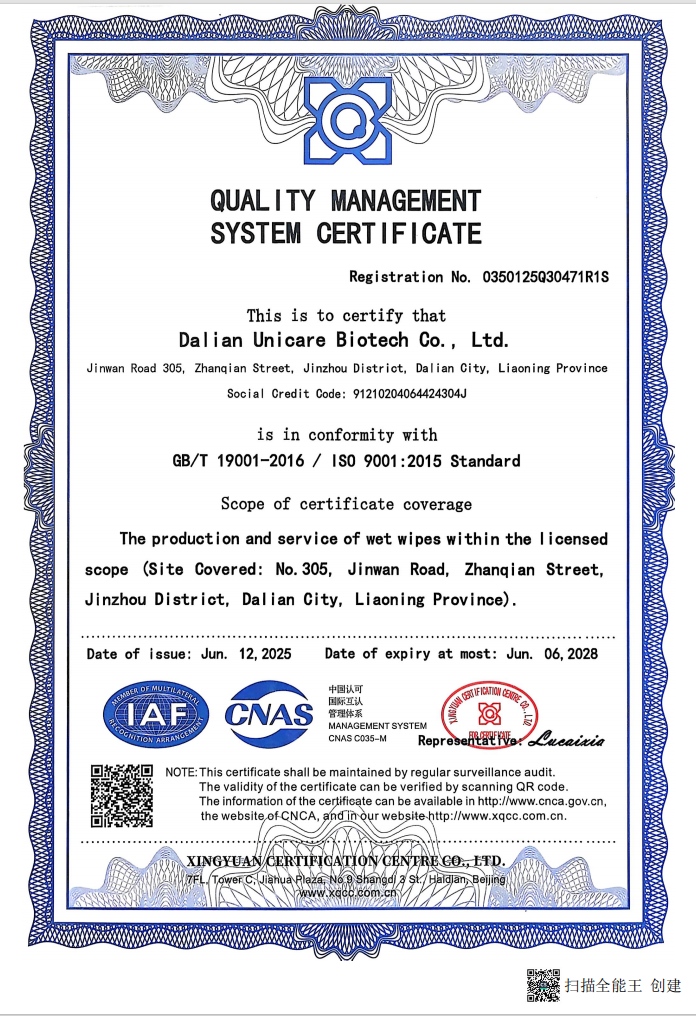
An ISO 9001:2015 certificate covers a manufacturer's quality management system for wet wipes production. It does not authorise product sale in a given market.
| Question | Document that answers it | Verified example | What it does not prove |
|---|---|---|---|
| Process control | ISO 9001 quality management certificate | Certificate 0350125030471R1S issued by Xingyuan Certification Centre Co., Ltd.; standard GB/T 19001-2016 / ISO 9001:2015; scope covers the production and service of wet wipes within the licensed scope; issued 12 June 2025, valid to 6 June 2028 | A management system is not a product approval and does not grant permission to sell in a specific country |
| Product hazard communication | Material safety data sheet (MSDS) | MSDS BMi202605192227DG for the Pet Grooming Glove Wet Wipes for Dogs & Cats (Extra Thick Rinse-Free Cleaning Gloves), issued by Zhuhai BMi Certification & Testing Co., Ltd. under OSHA 29 CFR 1910.1200 HCS; issued 19 May 2026, valid to 20 May 2027 | Covers the stated product scope only, is not a market authorisation, and expires |
| Market access | Destination-market regulation | EU: REACH for chemicals and BPR for biocidal claims; China: the Hygienic Standard for Disposable Sanitary Products; United States: FDA facility registration for cosmetic wipes manufacturers, with a registration deadline of 1 July 2026 | Cannot be satisfied by a manufacturer's ISO certificate; it is normally the importer's or brand owner's obligation |
| Material behaviour | Substrate specification and test evidence | S01 wet toilet paper uses biodegradable wood pulp non-woven fabric; S02 disintegrates into wood pulp cloth; C05 pet wipes use biodegradable wood pulp non-woven fabric | A material property is not a universal flushability approval for every sewer or septic system |
| Production environment | Facility and equipment documentation | Class 100,000 cleanroom, EDI ultra-pure water equipment, UV sterilization system, in-house laboratory, pH meter, automatic filling and packaging machines | A controlled environment supports a process; it does not certify finished-product compliance for every model |
What documented compliance looks like in practice
Dalian Weijie Biotechnology Co., Ltd. operates a 6,000 m² facility with approximately 50 employees, a 10-person research and development team, annual output of about 4 million packages and an export ratio of approximately 70%. Its stated markets include Japan, Australia, Canada, the United States and Singapore. For buyers, the relevant point is not the scale itself but how the documentation aligns with it.
The factory-level certificate is ISO 9001:2015, number 0350125030471R1S, issued by Xingyuan Certification Centre Co., Ltd. against the standard GB/T 19001-2016 / ISO 9001:2015. The scope is the production and service of wet wipes within the licensed scope, and the certification explicitly covers kitchen wipes model CF001, pet wipes model C02 and baby wipes model Y02. Certification validity runs from 12 June 2025 to 6 June 2028.
At product level, the MSDS held for the Pet Grooming Glove Wet Wipes for Dogs & Cats (Extra Thick Rinse-Free Cleaning Gloves) was prepared under OSHA 29 CFR 1910.1200 HCS, issued by Zhuhai BMi Certification & Testing Co., Ltd. with number BMi202605192227DG, dated 19 May 2026 and valid to 20 May 2027, with a Global market applicability. This is a hazard communication document rather than a market licence, and its scope is deliberately narrow.
The production environment documented for pet wipes programmes, including model C05, includes a Class 100,000 cleanroom. Supporting equipment across the wet wipe lines includes EDI ultra-pure water equipment, a UV sterilization system, an in-house laboratory, a pH meter, and automatic filling and packaging machines. Quality control is structured in three stages: material inspection, process inspection and finished product inspection, alongside support from third-party authoritative laboratories. Storage guidance for the finished products is a cool, dry, shaded area at room temperature, away from heat sources and areas prone to moisture accumulation.
Commercial parameters matter to compliance planning as much as certificates do, because documentation must be renewed within a production cycle. The supplier's stated capability is OEM, ODM and customized service, supported by an in-house R&D team, with customization available across packaging, logo, material, size, aroma and number of pieces. Monthly capacity is stated at 3 million packages, standard lead time at 30 days, and the minimum order threshold is stated as 20,000 yuan per package. Export documentation support covers verification of packing lists and customs declaration documents for export orders.
Category by category: matching documentation to the SKU
Compliance evidence does not transfer automatically between product categories. A certificate covering baby wipes does not describe a pet grooming glove, and an MSDS for one pet product does not cover the rest of the pet range. The table below maps the models most frequently requested by OEM buyers to their documented specifications.
| Category | Model | Format | Sheet size | Material | Compliance note |
|---|---|---|---|---|---|
| Baby wipes | Y02 | 100 pieces | 150 × 200 mm | Entirely adhesive | Covered by ISO 9001:2015 certificate 0350125030471R1S; target industries include infant care and baby hygiene products, department stores and supermarkets |
| Pet wipes | C02 | 100 pieces | 200 × 200 mm | Entirely adhesive | Covered by ISO 9001:2015 certificate 0350125030471R1S |
| Pet wipes | C03 | 100 pieces | 150 × 200 mm | Bamboo fibre | Pet grooming and personal care segment |
| Pet wipes | C04 | Pet wet toilet paper, 100 sheets | 140 × 180 mm | Bamboo fibre | Pet grooming and personal care segment |
| Pet wipes | C05 | Pet gloves, 04–10 pieces | 180 × 200 mm | Biodegradable wood pulp non-woven fabric | Class 100,000 cleanroom production environment; related MSDS scope |
| Wet toilet paper | S01 | 100 sheets | 130 × 200 mm | Biodegradable wood pulp non-woven fabric | Applicable to pet products, department stores and personal care |
| Wet toilet paper | S02 | 10 sheets | 150 × 200 mm | Disintegrates into wood pulp cloth | Disintegration property relevant to flushable toilet wipe claims |
| Kitchen wipes | CF001 | 80 pieces | 200 × 200 mm | Water-jet non-woven fabric | Covered by ISO 9001:2015 certificate 0350125030471R1S |
| Eye care wipes | YJ01 | 20 pieces | 100 × 150 mm | Water-resistant paper | Listed within the product scope associated with the MSDS documentation |
| Clothing wipes | YW01 | 10 cloths | 150 × 180 mm | Water-jet non-woven fabric | Home cleaning, retail chain and general merchandise channels |
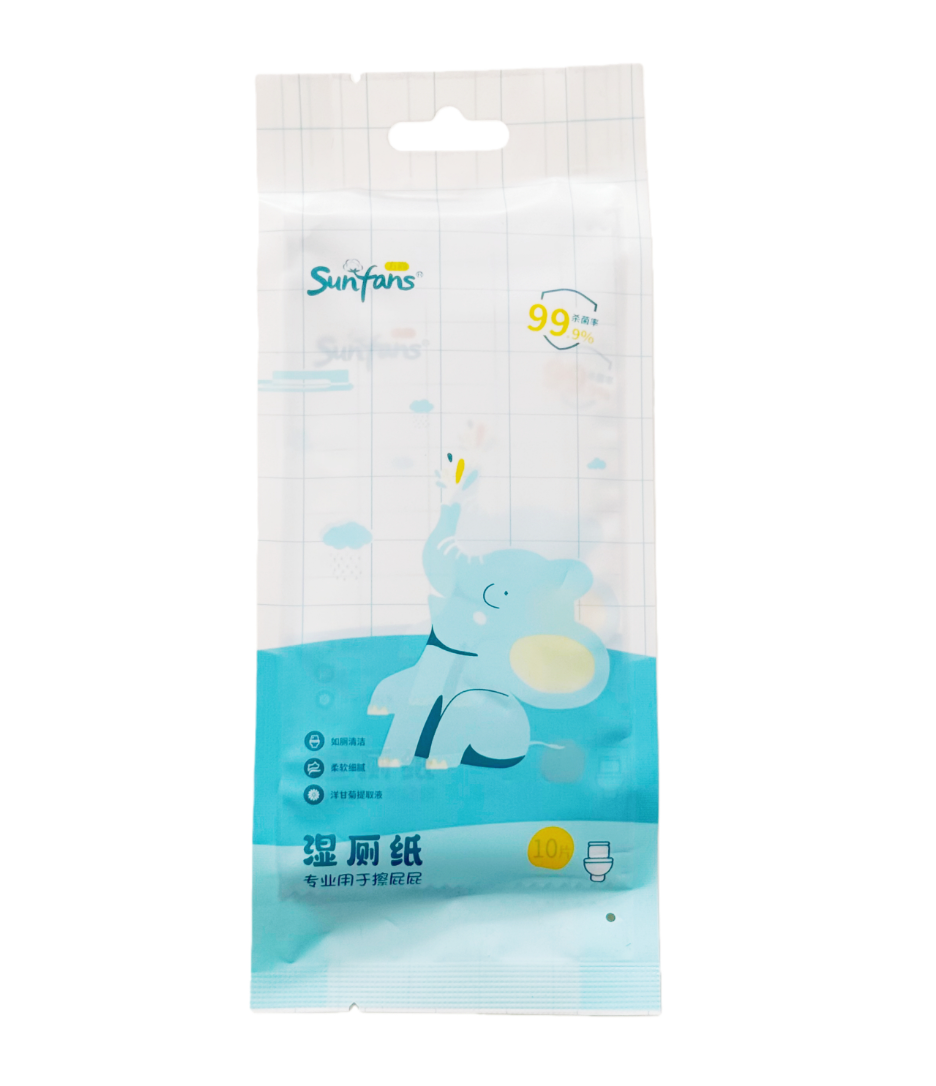
Model S01 wet toilet paper uses biodegradable wood pulp non-woven fabric, a substrate choice that must be matched with destination-market claim rules.
Two patterns emerge from the table. First, certification coverage is model-specific: the ISO 9001 certificate names CF001, C02 and Y02, while other models rely on material specifications and general quality control rather than the same named scope. Second, the documentation that supports a pet grooming glove is not the documentation that supports a baby wipe, even where both are produced in the same facility. Buyers who request a single certificate to cover a full range will usually receive something less precise than they assume.
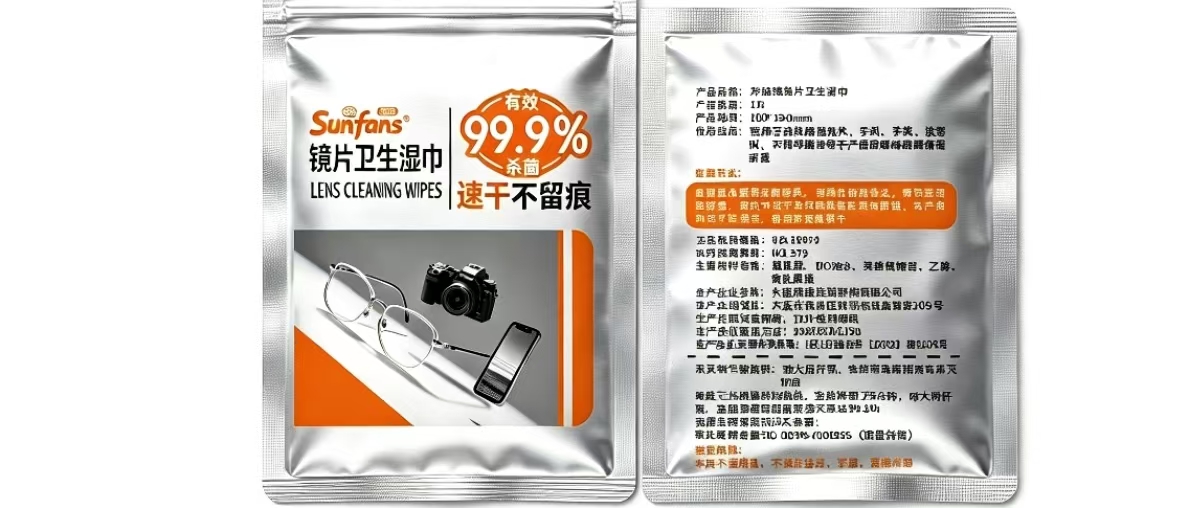
Eye care wipes model YJ01 illustrates why category-specific documentation matters: a specialty wipe is not covered by a general baby wipe specification.
Material claims: biodegradable and flushable are two different tests
Biodegradability and flushability are frequently used together in marketing, but they are separate properties, and buyers should ask for them separately. In this catalogue, S01 wet toilet paper is made from biodegradable wood pulp non-woven fabric, while S02 uses a material that disintegrates into wood pulp cloth. C05 pet wipes also use biodegradable wood pulp non-woven fabric. Disintegration describes how a substrate breaks apart under defined conditions; biodegradability describes how it is broken down by biological processes. A product can disintegrate quickly and still not meet a given market's definition of flushable.
Formula guidance in the same production environment points in a consistent direction: a gentle, plant-based formula free of alcohol, with fabrics that are gentle on the skin and free of irritating additives. For baby, mother and baby, and newborn-oriented programmes, this is the specification area that buyers most often need to document, because it links the substrate choice to the claims printed on the package.
Market signals shaping compliance expectations
Regulatory expectations generally follow category growth, and the growth data in this segment is well documented. The figures below are third-party estimates and should be treated as directional, particularly because published market-size estimates for wet wipes vary considerably between research agencies depending on base year and category inclusion.
- The global baby wipes market was valued at USD 5.4 billion in 2024, with expected growth at a CAGR of 7.5% through 2030 (Baby Wipes Market Report 2024–2030).
- The global biodegradable wipes market reached over USD 3 billion in 2024, driven by baby wipes and premium retail segments (WEHOO Hygiene).
- The flushable wipes market was valued at USD 2.3 billion in 2025 and is projected to reach USD 4.2 billion by 2035 at a 6% CAGR (Global Market Insights).
- The pet wipes market was valued at USD 1.58 billion in 2024, with a projected CAGR of 5.6% reaching USD 2.64 billion by 2033; North America holds approximately 50% share, valued at USD 0.79 billion in 2024 (DataHorizzon Research).
- Japan accounts for nearly 27% of the Asia-Pacific wet wipes market, with a strong focus on hygiene and quality-focused personal care (Wet Wipes Market Growth Insights).
- The United States accounted for 34% of global wet wipes market share in 2024, and Asia Pacific is the fastest growing region, driven by urbanisation and rising hygiene standards in China and India (Global Market Insights).
- ISO 9001 for quality management and ISO 22716 for cosmetic good manufacturing practice are treated as baseline expectations for wet wipes OEM manufacturing (Freshening Industries).
- In the EU, wet wipes must comply with EN standards, including REACH for chemicals and BPR for biocidal claims; in China, wet wipes fall under the Hygienic Standard for Disposable Sanitary Products.
- In the United States, FDA facility registration for cosmetic wipes manufacturers carried a deadline of 1 July 2026, which has now passed and should be verified as a current-status item rather than treated as a future milestone.
For buyers, the practical implication is that documentation has a date attached to it. An MSDS valid to 20 May 2027 and an ISO 9001 certificate valid to 6 June 2028 will both require renewal management within a multi-year supply relationship. Suppliers that treat compliance as a living asset, rather than a one-time sales attachment, reduce the risk of a shipment being held because a certificate lapsed.
Documentation-first sourcing versus price-first sourcing
Traditional sourcing for custom wet wipes tends to start with unit price and a request for whatever certificates the supplier already has. This is fast, and it works when the product is a low-risk commodity sold in a familiar market. It becomes fragile when the SKU is a flushable toilet wipe, a newborn wipe, or a pet product carrying a rinse-free claim.
A documentation-first approach reverses the sequence: the destination market is identified first, the required documents are listed second, and only then is the supplier's evidence assessed against that list. The cost of this approach is time and administrative effort during evaluation. The benefit is that gaps are found before tooling, printing plates and packaging artwork are committed.
Where this approach has real limits
Honest evaluation requires acknowledging boundaries, and several apply to the documented programme described above:
- Certification scope is narrower than the catalogue. The ISO 9001:2015 certificate names kitchen wipes CF001, pet wipes C02 and baby wipes Y02. Other models in the range, such as S01, S02, C03, C04, C05, YJ01 and YW01, are not covered by that named scope, and must be evaluated on material specifications and inspection records instead.
- An MSDS is not a market authorisation. The document held for the pet grooming glove is a hazard communication sheet under OSHA 29 CFR 1910.1200 HCS with a defined validity period, not a permission to sell in any country.
- Cleanroom class is a process control, not a product certificate. A Class 100,000 cleanroom supports controlled production, but it does not by itself certify finished-product compliance for every SKU produced within it.
- Commercial thresholds constrain pilot programmes. A stated minimum order of 20,000 yuan per package and a 30-day lead time make small validation runs and late-stage design changes more difficult than buyers testing a concept might expect.
- Destination registration remains the buyer's obligation. EU REACH and BPR compliance, FDA facility registration in the United States, and China's Hygienic Standard for Disposable Sanitary Products are not delivered by a supplier's factory certificate.
- Documentation expires. Both the ISO 9001 certificate and the MSDS carry defined end dates, so renewal tracking is part of the buyer's risk management rather than the supplier's alone.
These limits do not disqualify the programme. They define the questions a buyer should ask next, which is the purpose of an evidence map in the first place.
Future outlook: documentation as a living asset
Three directions appear likely to shape custom wet wipes compliance over the next sourcing cycles. First, biodegradable and flushable claims will face closer scrutiny as those segments grow, which pushes buyers toward substrate-level evidence rather than pack-level language. Second, facility registration regimes, such as the US FDA registration deadline that took effect on 1 July 2026, will continue to shift responsibility toward importers and brand owners, making documentation ownership a procurement skill rather than a legal afterthought. Third, as Japan's share of the Asia-Pacific market remains high, expectations around hygiene documentation and specification discipline in that market will continue to influence OEM requirements elsewhere.
For suppliers, the competitive differentiator is less likely to be a single certificate than a renewable documentation system: certificates with traceable numbers and issuing bodies, safety data sheets with defined scope and validity, and material specifications that match the claims printed on the pack.
FAQ: OEM certification questions from global buyers
Which certification should a buyer verify first when evaluating a custom wet wipes manufacturer?
Start with the factory-level quality management certificate, because it covers the production process rather than a single SKU. In this case the relevant document is ISO 9001:2015, certificate number 0350125030471R1S, issued by Xingyuan Certification Centre Co., Ltd. under the standard GB/T 19001-2016 / ISO 9001:2015, with scope covering the production and service of wet wipes within the licensed scope. Its validity period runs from 12 June 2025 to 6 June 2028.
Does ISO 9001:2015 certify that a specific wet wipe product is safe or legally sellable?
No. The certificate confirms a quality management system within a licensed scope. It explicitly covers kitchen wipes model CF001, pet wipes model C02 and baby wipes model Y02, and it applies to the Global market, but it is not a product authorisation. Legal sale in a destination market depends on separate requirements, such as REACH and BPR in the EU, FDA facility registration in the United States, or the Hygienic Standard for Disposable Sanitary Products in China.
What is the difference between an MSDS and a product certification?
An MSDS is a hazard communication document. The sheet held for the Pet Grooming Glove Wet Wipes for Dogs & Cats (Extra Thick Rinse-Free Cleaning Gloves) was prepared according to OSHA 29 CFR 1910.1200 HCS, issued by Zhuhai BMi Certification & Testing Co., Ltd. with number BMi202605192227DG, dated 19 May 2026 and valid to 20 May 2027, applicable to the Global market. It documents handling and safety information for a defined product scope. It is not a market approval and it does not cover other models in the range.
Which pet wipes models carry documented material and compliance evidence?
The pet range is documented across several models with different substrates: C02 at 200 × 200 mm made of entirely adhesive material, C03 at 150 × 200 mm and C04 at 140 × 180 mm both made of bamboo fibre, and C05 at 180 × 200 mm in a pet glove format made of biodegradable wood pulp non-woven fabric. C02 is named in the ISO 9001:2015 certified scope, and C05 is associated with the Class 100,000 cleanroom production environment and the MSDS product scope. Documentation therefore differs by model, and buyers should match each SKU to its own evidence.
How should buyers evaluate biodegradable and flushable claims?
Assess them separately. Model S01 wet toilet paper is made of biodegradable wood pulp non-woven fabric, while model S02 uses a material that disintegrates into wood pulp cloth, a property relevant to flushable toilet wipes. C05 pet wipes also use biodegradable wood pulp non-woven fabric. Disintegration and biodegradability are distinct material behaviours, and local rules in the destination market determine whether a flushable claim may be printed. Buyers should request the substrate specification and confirm it against the market's own definition rather than relying on the general term.
What production-environment evidence can support a compliance claim?
Documented equipment and environment for these wet wipes lines include a Class 100,000 cleanroom, EDI ultra-pure water equipment, a UV sterilization system, an in-house laboratory, a pH meter, and automatic filling and packaging machines. Quality control covers material inspection, process inspection and finished product inspection, supported by third-party authoritative laboratories. The limitation is that environment class and inspection records support process control; they do not replace finished-product certification for a specific model.
What commercial and export constraints should buyers plan for?
The stated commercial parameters are a monthly capacity of 3 million packages, a standard lead time of 30 days, and a minimum order threshold expressed as 20,000 yuan per package. Customization options include packaging, logo, material, size, aroma and number of pieces, supported by an in-house R&D team. On the export side, after-sales support covers verification of packing lists and customs declaration documents. Buyers planning pilot volumes or frequent design changes should expect these thresholds to shape the validation schedule.
Do orders destined for Japan require different handling?
Japan accounts for nearly 27% of the Asia-Pacific wet wipes market and is associated with a strong focus on hygiene and quality-focused personal care. It is listed among the export markets served by this manufacturer, alongside Australia, Canada, the United States, Singapore, New Zealand and Southeast Asia. Documentation support for export orders includes assistance with packing lists and customs declaration documents. As with any destination, the buyer should confirm the market's current labelling and claim requirements independently.
Conclusion
Custom wet wipes compliance is best understood as a matching exercise: each document in a supplier pack answers exactly one question, and none of them answers all four. Buyers who separate process evidence, hazard communication, market registration and material specification will identify gaps while they are still inexpensive to fix. Buyers who treat a certificate bundle as a single pass or fail item will usually discover the gap at the port or on the shelf.
Additional company and facility information is available at www.unilibio.com, and the manufacturer profile can be downloaded here: Dalian Unicare Biotech company profile (English, PDF).