
Custom Wet Wipes Shortlist: Matching Models to Real Projects
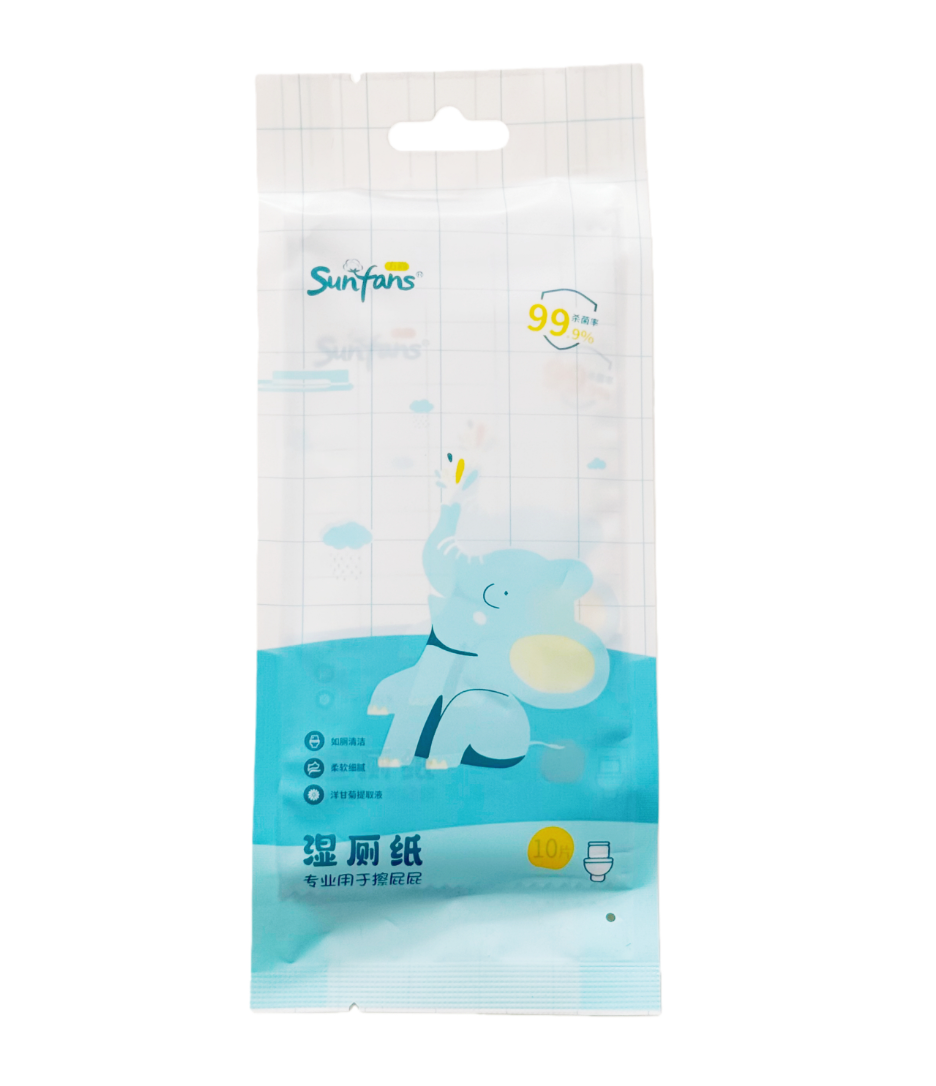
Wet toilet paper S01: 130×200 mm, biodegradable wood pulp non-woven fabric, 100 sheets per pack.
Custom wet wipes are usually sourced as a portfolio rather than as a single item. One private-label programme can cover infant care, pet grooming, household cleaning and personal care at the same time, and each of those end uses carries its own expectations for sheet size, material, pack count and production conditions.
The global wet wipes market was valued at approximately USD 32.09 billion in 2026 and is projected to reach USD 43.45 billion by 2034, a compound annual growth rate of 3.86% (Fortune Business Insights). Personal care wipes accounted for 72.81% of the global wet wipes market in 2025 (Mordor Intelligence). Those figures describe a segmented and relatively mature category: the commercial question is no longer whether to sell wet wipes, but which model fits which project, channel and pack need.
This industry reference shortlists ten custom wet wipes models documented by the manufacturer Da lian Weijie Biotechnology Co., Ltd., the company behind the sunfans brand, and maps each model to its documented end use, dimensions, material and pack count. It is written for sourcing, product and category teams in the research and evaluation stage who need a workable starting shortlist rather than a generic category overview.
Why the model number, not the category, decides the outcome
Across the shortlist, the specification spread is wide enough that category-level thinking breaks down. Sheet dimensions run from 100×150 mm (YJ01) to 200×200 mm (C02 and CF001). Pack and sheet counts run from 10 sheets (S02 and YW01) to 100 sheets (S01). Material descriptions include water-jet non-woven fabric, bamboo fiber, biodegradable wood pulp non-woven fabric, water-resistant paper, and materials documented as entirely adhesive. A buyer who specifies only baby wipes or pet wipes and leaves the rest to the supplier is effectively delegating pack architecture, shelf fit and material positioning to someone else.
The growth data supports that conclusion. The pet wipes market was valued at USD 1.58 billion in 2024 and is projected to reach USD 2.64 billion by 2033 at a 5.6% CAGR, with North America holding approximately 50% of that market at USD 0.79 billion in 2024 (DataHorizzon Research). The flushable wipes segment was valued at USD 2.3 billion in 2025 and is projected to reach USD 4.2 billion by 2035 at a 6% CAGR (Global Market Insights). Segments of this size reward suppliers and brand owners who can name a specific model, size and material, because that is what makes sampling, quoting and shelf planning repeatable.
The shortlist at a glance
| Model | Line | Material (as documented) | Dimensions | Pack / sheet count | Documented application |
|---|---|---|---|---|---|
| Y02 | Baby wipes | Entirely adhesive | 150×200 mm | 01–100 pieces | Infant care; baby hygiene; large department stores and supermarkets |
| C02 | Pet wipes | Entirely adhesive | 200×200 mm | 01–100 pieces | Pet supplies; pet grooming and personal care; large department stores and supermarkets |
| C03 | Pet wipes | Bamboo fiber | 150×200 mm | 02–100 pieces | Pet supplies; pet grooming and personal care; large department stores and supermarkets |
| C04 | Pet wipes (wet toilet paper format) | Bamboo fiber | 140×180 mm | 03–100 sheets | Pet supplies; pet grooming and personal care; large department stores and supermarkets |
| C05 | Pet wipes (pet gloves) | Biodegradable wood pulp non-woven fabric | 180×200 mm | 04–10 pieces | Pet supplies; pet grooming and personal care; large department stores and supermarkets |
| S01 | Wet toilet paper | Biodegradable wood pulp non-woven fabric | 130×200 mm | 100 sheets | Pet products; large department stores; personal care products |
| S02 | Wet toilet paper | Can be disintegrated into wood pulp cloth | 150×200 mm | 10 sheets | Home cleaning; large retail chains; general merchandise |
| CF001 | Kitchen wipes | Water-jet non-woven fabric | 200×200 mm | 80 pieces | Home cleaning; large retail chains; general merchandise |
| YW01 | Clothing wipes | Water-jet non-woven fabric | 150×180 mm | 10 cloths | Home cleaning; large retail chains; general merchandise |
| YJ01 | Eye care wipes | Water-resistant paper | 100×150 mm | 20 pieces | Home cleaning; large retail chains; general merchandise |
Baby wipes Y02: the anchor model for infant care
Baby wipes Y02 is documented at 150×200 mm with the material recorded as entirely adhesive and a pack range of 01 to 100 pieces. Its stated applications are infant care, the baby hygiene products industry, and sale through large department stores and supermarkets, with a separate application profile identifying the product for large shopping mall distribution.
For buyers, the useful characteristic is the pack range rather than the sheet size alone. A documented range of 01 to 100 pieces allows one model reference to cover trial packs, travel formats and full-size retail packs without switching to a different product line. The application documentation also identifies the baby and maternity scenario as suitable for OEM branding and contract manufacturing projects, with a special requirement for a gentle, plant-based formula free of alcohol, fabrics that are gentle on the skin, and no irritating additives.
An operational note worth raising during sampling: Y02 and pet wipes C03 share the same 150×200 mm dimension. Buyers running both baby and pet lines may benefit from that alignment in pack and shelf planning, but whether the two products can share converting or filling set-ups is a supplier question and should be confirmed in writing rather than assumed from the dimension.
The pet line C02–C05: four models, three material families
The pet range spans the widest set of formats in this shortlist, and the four models are not interchangeable. Each is documented for the pet supplies industry, the pet grooming and personal care segment, and large department stores and supermarkets, but the format, material and pack logic differ.
- C02 – 200×200 mm, entirely adhesive, 01–100 pieces. The largest pet sheet format and a high pack range, positioned for standard wipe-format pet cleaning where a larger sheet is preferred.
- C03 – 150×200 mm, bamboo fiber, 02–100 pieces. A mid-size sheet in bamboo fiber with a comparable pack range. The application profile covering C03 specifies supporting equipment such as automatic packaging machines, automatic filling machines, EDI ultra-pure water equipment and UV sterilization systems.
- C04 – 140×180 mm, bamboo fiber, 03–100 sheets. The smallest pet format in the shortlist, documented as the English version of pet wet toilet paper, with the highest sheet count of the pet models.
- C05 – 180×200 mm, biodegradable wood pulp non-woven fabric, 04–10 pieces. A glove format rather than a flat sheet, with the lowest piece count in the range and documented production in a Class 100,000 cleanroom.
The decision sequence that follows from this is format first, material second, pack count third. A grooming or outdoor-use application where the user wants to cover a hand suits the glove format of C05. A standard wipe-format programme suits C02 and C03. A high-sheet-count, paper-like format suits C04. Buyers pursuing a fully biodegradable pet line should note that only C05 among the pet models is documented with a biodegradable non-woven material; C03 and C04 are documented in bamboo fiber and C02 as entirely adhesive.
Wet toilet paper S01 and S02: two pack philosophies
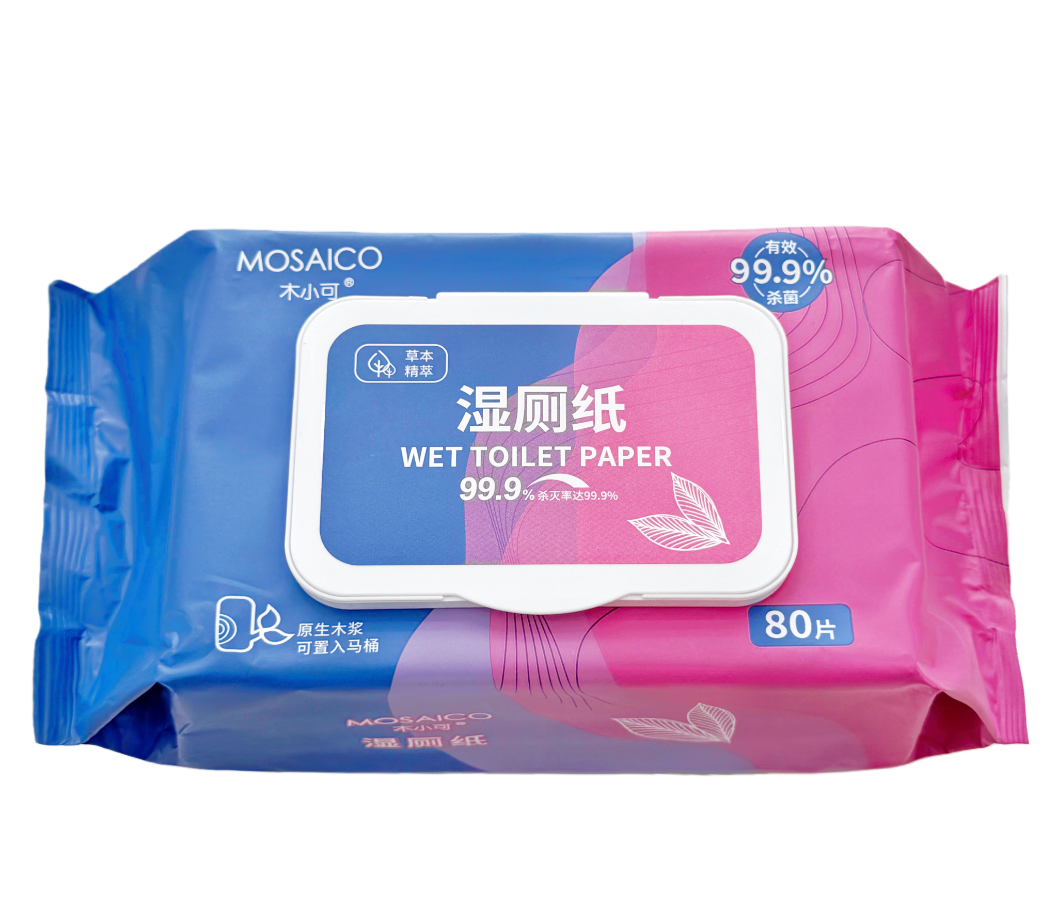
Wet toilet paper S02: 150×200 mm, material documented as able to disintegrate into wood pulp cloth, 10 sheets per pack.
Wet toilet paper S01 is documented at 130×200 mm in biodegradable wood pulp non-woven fabric with 100 sheets per pack, applied in pet products, large department stores and personal care products. S02 is documented at 150×200 mm with the material described as able to disintegrate into wood pulp cloth and a 10-sheet pack, applied in home cleaning, large retail chains and general merchandise.
The two models are not a size upgrade of each other; they serve different pack economics. S01 is a high-sheet-count reference suited to personal-care aisles and bulk-oriented retail formats. S02 is a compact 10-sheet reference better matched to home cleaning and general merchandise listings where a low unit price and small pack footprint matter. Material descriptions also differ between the two, and the documentation does not state which regional flushability or dispersibility test method applies to either model.
Kitchen, clothing and eye care: the household extension
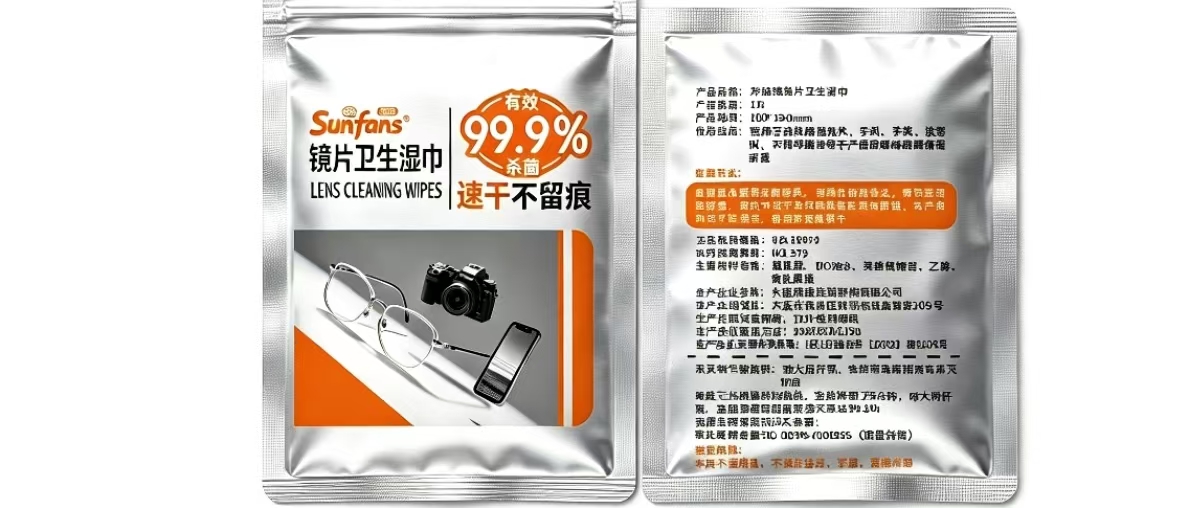
Eye care wipes YJ01: 100×150 mm, water-resistant paper, 20 pieces per pack.
Kitchen wipes CF001 is documented at 200×200 mm in water-jet non-woven fabric with 80 pieces per pack, and is identified as suitable for OEM branding and contract manufacturing projects in home cleaning, large retail chains and general merchandise. Its sheet size matches the largest format in the shortlist, which suits surface wiping where coverage per sheet matters.
Clothing wipes YW01 is documented at 150×180 mm, also in water-jet non-woven fabric, supplied as 10 cloths for drying clothes. Two models sharing one material family across two different use cases allows a brand to present a coherent household line while keeping the material story simple.
Eye care wipes YJ01 is the outlier: 100×150 mm in water-resistant paper, supplied as 20 pieces of eye glass cleaning cloths. The application profiles that include YJ01 identify the products as suitable for OEM branding and contract manufacturing projects. Its small format and paper substrate make it a lens-cleaning item rather than a general surface wipe, which matters when a buyer is assembling a household range and wants distinct positioning per SKU.
What the manufacturing documentation adds
Specifications alone rarely decide a supplier. The application documentation behind this shortlist specifies supporting equipment that includes automatic packaging machines, automatic filling machines, EDI ultra-pure water equipment, UV sterilization systems, an in-house laboratory, a Class 100,000 cleanroom and pH meters. Pet wipes C05 is specifically documented as manufactured in a Class 100,000 cleanroom, and the equipment list is also associated with the profiles covering C03 and the wider product family.
Operating parameters are documented consistently across the range: continuous surface wiping, single-sheet one-time consumption, with the product function described as cleaning and antibacterial action. Storage requirements are also uniform — a cool, dry, shaded area at room temperature, away from high temperatures, heat sources and areas prone to moisture accumulation.
On the supply side, Da lian Weijie Biotechnology Co., Ltd. was established in 2013 and is located in Dalian, Liaoning Province. The facility is documented at 6,000 m² with 50 employees, an annual output of 4 million packages and a 10-person R&D team. Main products cover baby wipes, pet wipes, wet toilet paper, functional wipes, and floor dry and wet wipes, with an export ratio of 70% and documented markets including Japan, Australia, Canada, the United States and Singapore.
Manufacturing capability is documented as OEM, ODM and customized services with an in-house R&D team. Customization covers packaging, logo, material, size, aroma and number of pieces. Stated monthly capacity is 3 million packages, lead time is 30 days, and the stated minimum order quantity is 20,000 yuan package. Quality control is described as supported by third-party authoritative laboratories alongside internal material inspection, process inspection and finished-product inspection. After-sales support is documented as assistance with verifying packing lists and customs declaration documents for export orders.
Documented case profiles add a track record dimension: relationships with a baby and maternity brand owner, an e-commerce retail account, convenience retail stores in Japan, pet supplies and baby product sellers on Amazon, and large household and personal care organisations, with durations ranging from three to ten years and monthly volumes documented in 40-foot container terms.
Market trend analysis: where portfolio depth pays
Regional demand patterns explain why a multi-model shortlist is commercially relevant. Japan accounts for nearly 27% of the Asia-Pacific wet wipes market, with a strong focus on hygiene and premium quality personal care (Wet Wipes Market Growth Insights 2034). The United States accounted for 34% of global wet wipes market share in 2024, and Asia Pacific is identified as the fastest-growing region, driven by urbanisation and rising hygiene standards.
Material positioning is the clearest shift. The global biodegradable wipes market reached over USD 3 billion in 2024, with growth driven by baby wipes and premium retail segments (WEHOO Hygiene). The plant-based flushable wipes market was valued at USD 2.9 billion in 2024 and is expected to grow at a 5.3% CAGR (Data Insights Reports). For a buyer, this means that material documentation is no longer a technical footnote — it is the basis of the on-pack claim, the retail listing and, increasingly, the tender requirement.
Estimate divergence is worth noting for planning purposes. Published wet wipes market sizes vary considerably between agencies depending on base year and category coverage, so buyers should treat any single figure as directional and anchor procurement decisions on their own channel data instead.
Where a shortlist stops working: limitations and verification points
A ten-model shortlist solves a matching problem, but it introduces costs that a single-SKU programme does not carry. The following boundaries should be checked before a shortlist becomes a purchase plan.
- SKU and tooling complexity. Each additional model brings its own artwork, sampling round and specification sheet. With a stated MOQ of 20,000 yuan package and a 30-day lead time, a five-model launch consumes more sampling cycles and more working capital than a one-model launch.
- Material limits are model-specific. Only C05 and S01 are documented with biodegradable wood pulp non-woven fabric, and S02 with a material that can disintegrate into wood pulp cloth. C03 and C04 are bamboo fiber; CF001 and YW01 are water-jet non-woven; YJ01 is water-resistant paper; Y02 and C02 are documented as entirely adhesive. A buyer who assumes an entire line is biodegradable will misstate the range.
- Single-use consumption model. The products operate in continuous surface wiping mode with single-sheet one-time consumption. Compared with reusable cloths or dry tissue formats, this changes cost-per-use and storage planning rather than simply replacing an existing item.
- Storage and pack integrity. Products must be stored in a cool, dry, shaded area at room temperature, away from high temperatures, heat sources and moisture-prone areas. Channels with weak ambient control — for example open-air seasonal displays — need a pack format that survives the shelf.
- Claim substantiation. The application documentation describes the product function as cleaning and antibacterial. Where a market regulates biocidal or antimicrobial claims — the EU Biocidal Products Regulation is one example — that wording requires substantiation before it is printed.
- Certification is not implied by the specification sheet. Product documentation for this range does not list market-specific certificates. ISO 9001 and ISO 22716 are commonly treated as baseline expectations for wet wipes OEM manufacturing, and the U.S. FDA facility registration deadline for cosmetic wipes manufacturers fell on 1 July 2026 under updated regulatory frameworks. Buyers should request the certificate set relevant to their destination market rather than inferring it.
Future outlook
The shortlist is likely to remain commercially valid while growth continues in pet, flushable and biodegradable segments, but the evaluation criteria around it are shifting. Three signals are worth tracking into the next sourcing cycle. First, material documentation is becoming a qualification requirement rather than a marketing option, which favours suppliers who can state the substrate for each model precisely. Second, regulatory timelines in the United States and the European Union continue to tighten around registration and claim substantiation, which raises the value of documented quality infrastructure such as cleanroom production, in-house laboratory testing and pH measurement. Third, pack-count tuning is becoming a competitive lever, because 10-sheet, 20-piece, 80-piece and 100-sheet formats serve materially different retail channels.
For buyers, the practical implication is that a model-level shortlist should be re-validated annually against current certificates, current material documentation and current pack economics — not inherited from the previous purchase order.
FAQ
Which models in this shortlist are suitable for OEM branding and contract manufacturing projects?
The application documentation covering this range identifies the products as suitable for OEM branding and contract manufacturing projects, including baby wipes Y02 and eye care wipes YJ01. Documented customization options include packaging, logo, material, size, aroma and number of pieces.
Baby wipes Y02 and pet wipes C03 are both 150×200 mm. How should a buyer choose between them?
The two models share a 150×200 mm dimension but target different industries: Y02 is documented for infant care and baby hygiene products, while C03 is documented for pet supplies and the pet grooming and personal care segment. Their materials also differ — Y02 is documented as entirely adhesive, C03 as bamboo fiber — and their pack ranges are 01–100 pieces and 02–100 pieces respectively.
What materials are used across the pet wipes line?
The pet line uses three documented material families: C02 is documented as entirely adhesive at 200×200 mm; C03 (150×200 mm) and C04 (140×180 mm) are documented in bamboo fiber; and C05 (180×200 mm) is documented in biodegradable wood pulp non-woven fabric.
Which model is documented as produced in a Class 100,000 cleanroom?
Pet wipes C05, the 180×200 mm pet glove format with 04–10 pieces per pack, is documented as manufactured in a Class 100,000 cleanroom. The wider application documentation for the range specifies supporting equipment including automatic packaging machines, automatic filling machines, EDI ultra-pure water equipment, UV sterilization systems, an in-house laboratory and pH meters.
What pack and sheet counts are available across the shortlist?
Documented counts are: Y02 01–100 pieces; C02 01–100 pieces; C03 02–100 pieces; C04 03–100 sheets; C05 04–10 pieces; S01 100 sheets; S02 10 sheets; CF001 80 pieces; YW01 10 cloths; and YJ01 20 pieces.
What are the stated minimum order quantity, lead time and monthly capacity?
The stated minimum order quantity is 20,000 yuan package, the stated lead time is 30 days, and the stated monthly capacity is 3 million packages.
How should these products be stored?
Storage requirements specify a cool, dry, shaded area at room temperature, kept away from high temperatures, heat sources and areas prone to moisture accumulation.
Does the product documentation confirm market-specific certifications?
The product documentation for this range does not list market-specific certificates. In this industry, ISO 9001 for quality management and ISO 22716 for good manufacturing practice are commonly treated as baseline requirements, and markets such as the EU apply chemical and biocidal rules including REACH and the Biocidal Products Regulation. Buyers should obtain the certificate set relevant to their destination market directly from the manufacturer.
Reference: the manufacturer company profile (PDF) covering these product lines is available for download here: https://cdn.socialarks.com/sbsp/24981/common/2026/0710/Dalian%20Unicare%20Biotech%20company%20profile%20-English%283%29.pdf. Company website: www.unilibio.com