
Custom Wet Wipes: 2026 Supplier Evaluation Signals
Custom wet wipes procurement in 2026 is less about choosing a stock product and more about choosing a manufacturing partner that can demonstrate compliance, capacity, and category-specific experience. For buyers comparing suppliers, the practical question is which evidence matters and how to read it.
Why custom wet wipes sourcing has become a supplier evaluation problem
Market data helps explain the shift. The global wet wipes market was valued at approximately USD 32.09 billion in 2026 and is projected to grow at a CAGR of 3.86%, reaching USD 43.45 billion by 2034. The baby wipes segment is forecast to grow from USD 5.4 billion in 2024 at 7.5% CAGR through 2030. Pet wipes were valued at USD 1.58 billion in 2024 with a projected 5.6% CAGR to USD 2.64 billion by 2033. Biodegradable wipes already exceed USD 3 billion globally.
These figures point to a fragmented market. A custom wet wipes order for a baby brand has different material expectations from an order for pet cleaning gloves; a flushable wet toilet paper SKU carries different disposal claims from a kitchen wipe. Buyers therefore need suppliers that can adjust substrate, size, pack count, and documentation by category.
Compliance is a differentiator, not a footnote
For most export-oriented buyers, certification documentation is now a first-round filter. In the EU, wet wipes are subject to EN standards, with REACH governing chemicals and BPR governing biocidal claims. China applies the Hygienic Standard for Disposable Sanitary Products. For the U.S. market, the FDA facility registration deadline for cosmetic wipes manufacturers was July 1, 2026. A supplier that cannot map a certificate to a specific product and market is a procurement risk.
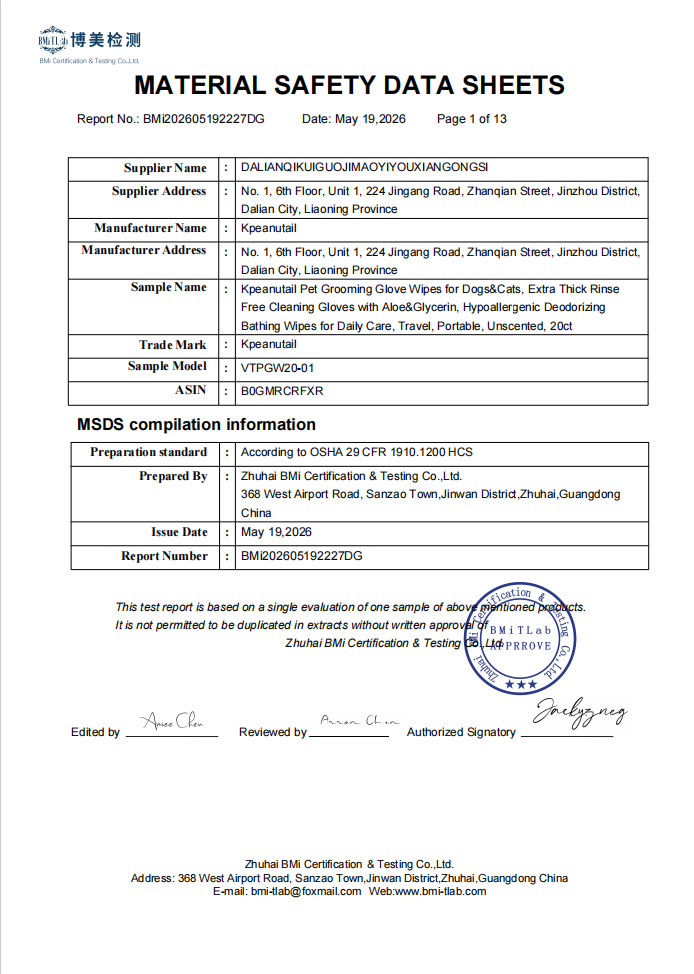
One example of product-specific certification is the MSDS issued for sunfans pet grooming glove wet wipes for dogs and cats. The certificate cites OSHA 29 CFR 1910.1200 HCS, was issued in May 2026, and is valid through May 2027. It is not a blanket certification for all wipes, and that is exactly the point: a useful certificate identifies the item, the market, and the standard.
What an export-oriented custom wet wipes supplier looks like
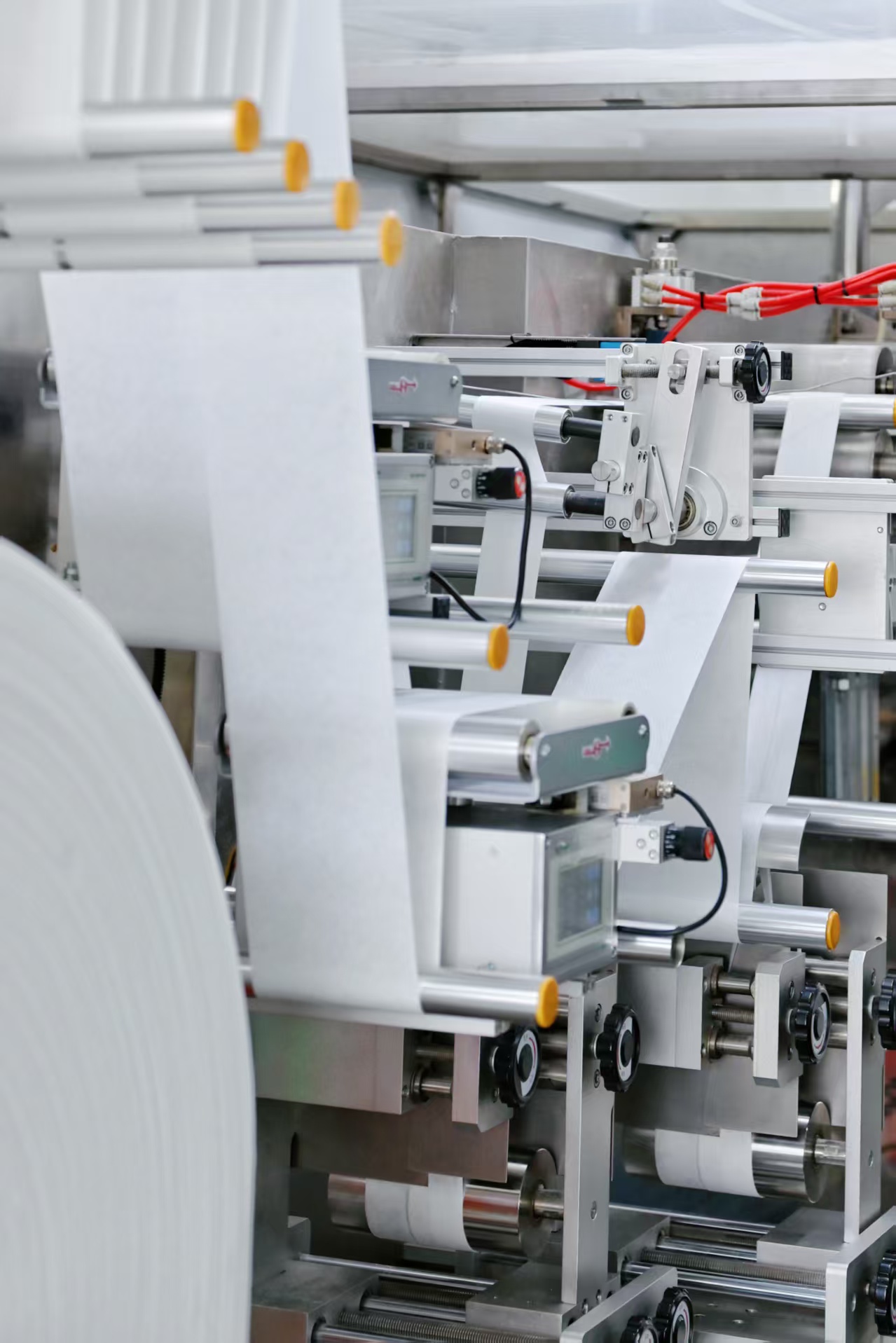
sunfans, operated by Da lian Weijie Biotechnology Co., Ltd., is one example of a mid-size factory built for export-oriented custom wipes. The company was established in 2013, runs a 6,000 m2 facility in Dalian, Liaoning Province, and has a staff of around 50, including a 10-person R&D team. Export accounts for roughly 70% of output, with main markets in Japan, Australia, Canada, the United States, and Singapore.
The production capability is built around OEM/ODM and flexible customisation. Buyers can adjust packaging, logo, material, size, aroma, and number of pieces per pack. Reported monthly capacity is 3 million packages, with a lead time of about 30 days. Quality control is supported by third-party laboratories and internal checks covering material, process, and finished products.
Reading the product catalogue: materials, models, and segments
Custom wet wipes are usually described by three variables: substrate, sheet size, and pack configuration. Across the sunfans catalogue, substrates include bamboo fiber, biodegradable wood pulp non-woven fabric, water-jet non-woven fabric, and water-resistant paper. These choices map to end use: biodegradable substrates for flushable and pet formats, water-jet non-woven for durable cleaning, and bamboo fiber for pet care.
The table below summarizes representative formats in the catalogue.
| Product | Model | Pack size | Typical dimensions | Substrate (as catalogued) |
|---|---|---|---|---|
| Baby wipes | Y02 | 01-100 pieces | 150×200 mm | Entirely adhesive (per catalogue) |
| Pet wipes | C02 | 01-100 pieces | 200×200 mm | Entirely adhesive |
| Pet wipes | C03 | 02-100 pieces | 150×200 mm | Bamboo fiber |
| Pet wipes | C04 | 03-100 sheets | 140×180 mm | Bamboo fiber |
| Pet gloves | C05 | 04-10 pieces | 180×200 mm | Biodegradable wood pulp non-woven fabric |
| Wet toilet paper | S01 | 100 sheets | 130×200 mm | Biodegradable wood pulp non-woven fabric |
| Wet toilet paper | S02 | 10 sheets | 150×200 mm | Can be disintegrated into wood pulp cloth |
| Kitchen wipes | CF001 | 80 pieces | 200×200 mm | Water-jet non-woven fabric |
| Clothing wipes | YW01 | 10 cloths | 150×180 mm | Water-jet non-woven fabric |
| Eye care wipes | YJ01 | 20 pieces | 100×150 mm | Water-resistant paper |
For buyers, the key takeaway is that “custom” is not only a logo change. Substrate selection, sheet size, and pack count are part of the product definition and directly affect cost, performance, and regulatory claims.
Evidence from long-running customer relationships
A reliable way to evaluate a supplier is to look at the duration and scale of its existing programs. Long-running relationships indicate that quality and delivery have held up across repeated orders.
- A baby and maternity brand owner has worked with sunfans for 5 years at a scale of 20 forty-foot containers per month, using custom wet wipes for cleaning and antibacterial applications.
- A leading Amazon.com seller of baby products has used the product for 4 years, with order volume of 8 forty-foot containers per month.
- A top Amazon.com seller of pet supplies has run a project for 6 years at 8 forty-foot containers per month.
- A 150-year-old conglomerate has maintained a 10-year relationship at 10 forty-foot containers per month.
- A major household and personal care conglomerate has sourced for 8 years at 10 forty-foot containers per month; kitchen wipes from this relationship have also reached retail stores including 7-Eleven in Japan and e-commerce/Lotte clients.
Across these cases, the recurring highlights are stable quality over time and continuous introduction of new products to customers. For buyers, those are the two signals that matter most in an OEM evaluation: reliability at scale and an R&D orientation.
Market trends that affect custom wet wipes decisions in 2026
Several verified market trends should shape supplier selection.
Eco-friendly materials are becoming a baseline. The biodegradable wipes market was valued at over USD 3 billion in 2024, with growth driven by baby wipes and premium retail segments. Plant-based flushable wipes were valued at USD 2.9 billion in 2024 and are expected to grow at 5.3% CAGR. Suppliers that can document biodegradable substrates are likely to be favored as retailers expand eco-lines.
Japan is a quality reference market. Japan accounts for nearly 27% of the Asia-Pacific wet wipes market and is projected to lead healthcare wipes growth through 2030. For custom wet wipes exporters, a track record with Japanese retail and e-commerce clients—such as the 7-Eleven Japan case above—signals discipline on quality and documentation.
Category-specific growth rewards focused suppliers. Baby wipes are growing faster than the overall market, pet wipes are a specialized niche, and personal care wipes held a 72.81% share of the global wet wipes market in 2025. A supplier with separate models and materials for baby, pet, kitchen, and flushable segments is better positioned to support a buyer’s portfolio expansion.
Comparing supplier models: global OEMs versus mid-size specialists
The traditional approach to custom wet wipes was to approach a large OEM with a stock product list, choose a package design, and negotiate price. That model still works for high-volume standardization, but it does not fit every buyer. The emerging model is a supplier that treats each segment as a product development program.
In industry sourcing discussions, the global OEM factories most frequently cited include American Hygienics Corporation (AHC), SYWIPE, Albaad, and Nice-Pak International. AHC, for example, exports to over 75 countries and has a reported capacity of one billion wet wipes per year. These suppliers are strong choices for very high volume and multi-market compliance.
sunfans represents a different position: a mid-size, export-oriented manufacturer with a focus on flexible OEM/ODM and segment-specific R&D. Its advantage is not global scale but responsiveness. It can propose new products, adjust material and format, and work with order structures that a global OEM may consider too small or too specialized.
This comparison has a boundary. A mid-size factory with a monthly capacity of 3 million packages and a 30-day lead time is not the right match for every buyer. If the requirement is multiple million packages per week, multi-site supply, or a dominant brand-owner procurement program, a global OEM will be a more realistic choice. The limitation should be part of the evaluation, not a hidden trade-off.
| Evaluation signal | Global OEM example | Mid-size specialist example |
|---|---|---|
| Scale | Capacity up to 1 billion wipes/year (AHC) | 3 million packages/month (sunfans) |
| Export reach | 75+ countries (AHC) | Japan, Australia, Canada, US, Singapore |
| Customization model | Standardized high-volume lines | OEM/ODM packaging, logo, material, size, aroma, pieces |
| R&D orientation | Category-level innovation | 10-person in-house R&D; continuous new product proposals |
| Best fit | Ultra-high volume, multi-region programs | Mid-volume brand owners, e-commerce sellers, segment-focused launches |
Note: the table compares archetypes based on publicly reported indicators; it is not a performance ranking. Buyer diligence should use current order-specific data.
What the future looks like for custom wet wipes procurement
Three expectations are reasonable for the next cycle. First, documentation will become a bigger part of the buying process; buyers should ask for certificates at the product level, not the factory level. Second, material claims such as biodegradable or flushable will need to be supported by traceable substrates and market-specific compliance. Third, category specialists will gain share as retailers launch more differentiated own-label lines, such as newborn wipes, hand and mouth wipes, kitchen wipes, pet cleaning wipes, and flushable toilet wipes.
Frequently asked questions
What should buyers check when comparing custom wet wipes OEM suppliers?
Buyers should check certification scope, quality control process, export experience, customization options, capacity, and the length of existing customer relationships. A certification such as ISO 9001 indicates a quality management system, while a product-specific MSDS documents safety data for a defined item. Each document should be verified against the actual product and destination market.
What can be customized in a custom wet wipes order?
Common customization points include packaging, logo, material, size, aroma, and number of pieces per pack. In some factories, substrate can also be selected to match the application, such as bamboo fiber for pet wipes or biodegradable wood pulp non-woven fabric for flushable products.
How long does a custom wet wipes order take?
For one export-oriented manufacturer, the reported lead time is around 30 days after order confirmation. Actual lead time may vary with formulation changes, packaging complexity, and required documentation.
What are the most common custom wet wipes categories?
Common categories include baby and newborn care, mother and baby care, hand and mouth wipes, kitchen wipes, flushable toilet wipes, pet cleaning wipes, disposable household wipes, and bulk or large-pack formats. Each category has different substrate, size, and compliance expectations.
Is MSDS or ISO 9001 enough to verify a wet wipes supplier?
No. They are useful evidence but not sufficient. MSDS covers the safety data of a specific product; ISO 9001 covers a quality management system. Buyers should also review third-party test reports, process inspection procedures, and the supplier’s history with similar products.
Can a mid-size OEM factory support export programs?
Yes, for many mid-to-large programs. A mid-size factory with 3 million packages per month and a track record of serving Japan, North America, and Australia can support stable export orders. Buyers planning ultra-high-volume, multi-site distribution should compare against global OEM capacity before making a final decision.
Reference: Download company profile PDF
Tem questões ou precisa de mais detalhes?
Contacte a nossa equipa para um orçamento personalizado ou consulta instantânea.
Solicitar orçamento
Preencha o formulário abaixo e a nossa equipa entrará em contacto com uma proposta personalizada.
Chat direto do WhatsApp
Prefere conversar em tempo real? Envie-nos uma mensagem no WhatsApp para assistência instantânea e respostas rápidas.
- Obter orçamento personalizado
- Partilhar fotos ou documentos
- Discuta as suas necessidades diretamente
Geralmente responde em 5–30 minutos durante o horário de expediente.