
Customization vs. Core Quality: Wholesale Buyer Framework
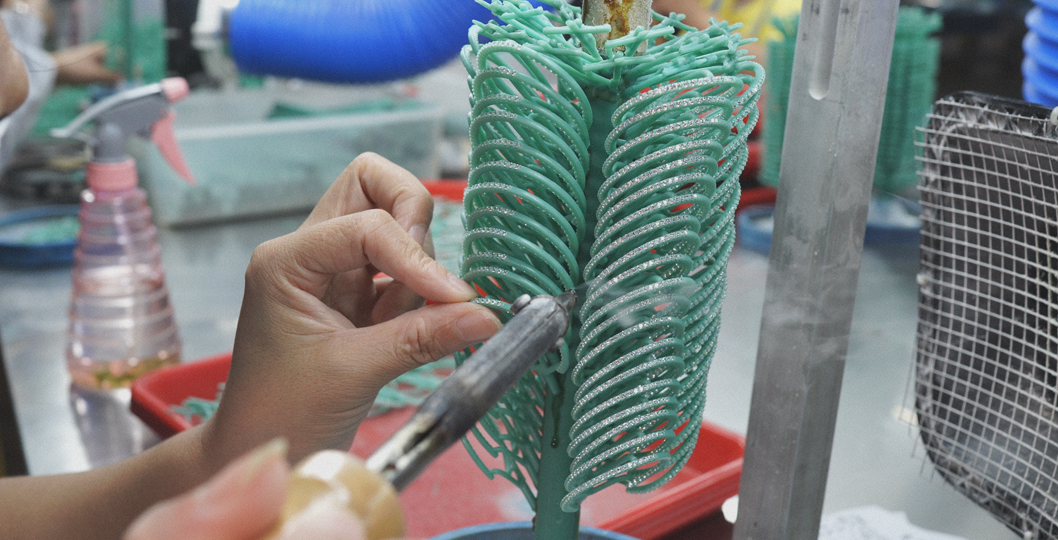
Wax tree mounting in jewelry production: a process view of how custom detail and repeatable quality meet.
Wholesale jewelry buyers rarely face a simple choice between custom work and catalog quality. They face a portfolio problem: which parts of the range should be adapted to a market, and which should be bought against exact, repeatable specifications. For a supplier such as Xuping Jewelry—a Guangzhou-based fashion jewelry manufacturer and wholesaler founded in 1997, with 194 patents and a 62-designer R&D team—the useful question is not whether customization is better than standard product. It is where each approach reduces risk for a specific project.
That framing matters for fashion jewelry wholesale, custom jewelry wholesale, and high quality jewelry wholesale programs alike. A custom earring program with a new stone color and logo packaging is not the same purchasing decision as a repeat order of a stainless steel necklace in a fixed dimension. The first tests the supplier’s development and validation process. The second tests the supplier’s ability to hold a specification across production runs. A seasoned supplier should be able to do both, but the buyer should evaluate them separately.
The two quality models buyers are actually comparing
Core product quality is the fidelity of a catalog item to its stated design: dimensions, material, plating, stone type, weight, and construction. It is a specification question. Customization quality is the ability to change a design, logo, tag, or package while preserving the base product’s integrity and compliance. It is a change-control question. The two are connected: customization applied to an unstable base product multiplies risk instead of adding value.
Xuping Jewelry’s catalog illustrates why the distinction is practical rather than theoretical. A high-detail brooch can involve a defined main stone, plating color, size, and series positioning. A bangle or bracelet-family form can rely more on dimensional control and repeatable assembly. A stainless steel necklace can be even more specification-led: material, length, plating, and absence of stone may be the main variables. Buyers who treat all three as one generic category will miss where quality actually has to be verified.
Why the catalog’s range matters: high-detail brooches and structured bracelet forms
The catalog’s contrast between a high-detail brooch and a bangle/bracelet-family form is useful because it shows two different quality tasks. The brooch tests detail-intensive assembly and stone placement. The bangle or bracelet tests dimensional consistency and finish control. A supplier that manages both is not necessarily better at everything, but it presents a broader production and specification vocabulary for buyers to examine.
| Model | Category | Plating | Key specification | Weight | Stone | Series |
|---|---|---|---|---|---|---|
| X000852427 | Brooch | 14K gold color | 44 × 38 mm; main stone about 12 × 8 mm | 9.15 g | AB-color synthetic cubic zirconia, main | Luxury |
| A00900238 | Brooch | Platinum plated | 47 × 32 mm; main stone about 3.5 × 3.5 mm | 12.3 g | White synthetic cubic zirconia, main | Daily |
| X000998659 | Bangle | 14K gold color | 60 × 8 mm (±2 mm); main stone about 8 × 6 mm | 21.77 g | Ruby synthetic cubic zirconia, main | Luxury |
| A00902945 | Necklace | 14K gold color | 400 × 1 mm (+60 mm); length 40 cm | 6 g; description about 6.30 g | No stone | Daily |
| X000668301 | Crystal necklace | 18K gold color | 410 × 1 mm (+50 mm); length 41 cm; main crystal about 18 × 17 mm | 7.915 g | Lilac synthetic crystal, main | Simple |
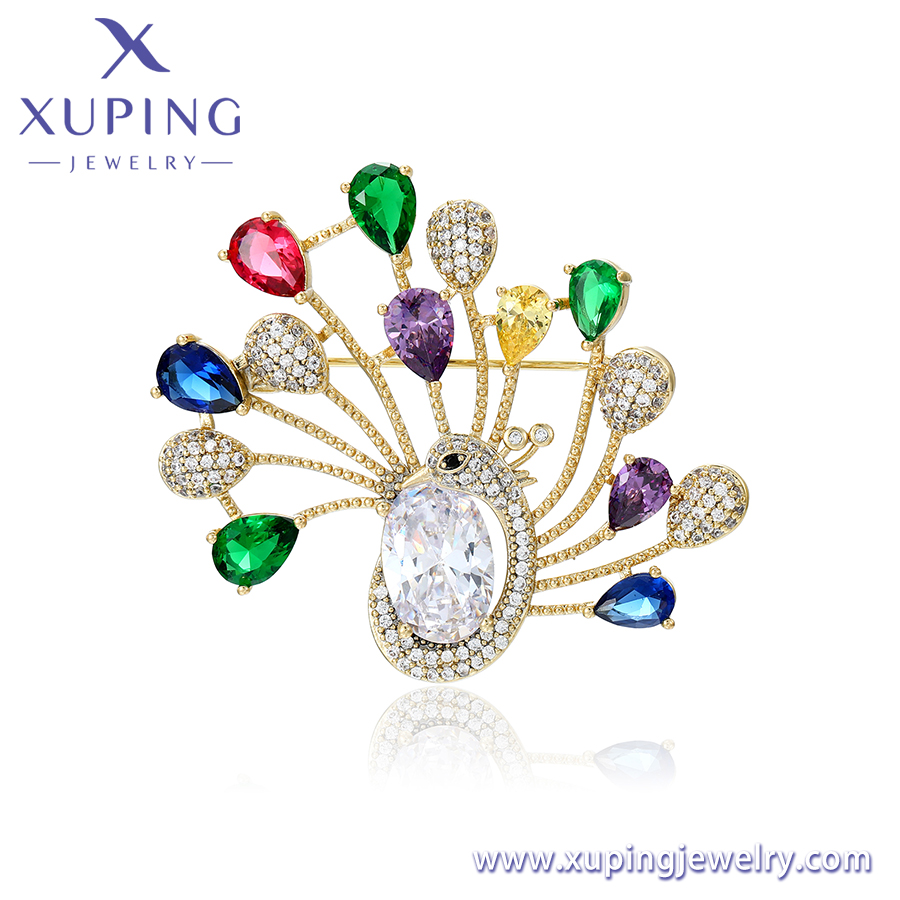
High-detail brooch example, model X000852427: 14K gold color plating, 44 × 38 mm, 9.15 g, synthetic cubic zirconia main stone.
The brooch examples show why buyers should read a catalog as a set of specifications, not as a mood board. X000852427 is listed with a 44 × 38 mm body, a main stone of about 12 × 8 mm, 14K gold color plating, and a 9.15 g weight. A00900238 is platinum plated, 47 × 32 mm, 12.3 g, with a white synthetic cubic zirconia main stone of about 3.5 × 3.5 mm. Those details matter when a buyer is matching a high-detail brooch to a market that expects a certain visual weight or finish.
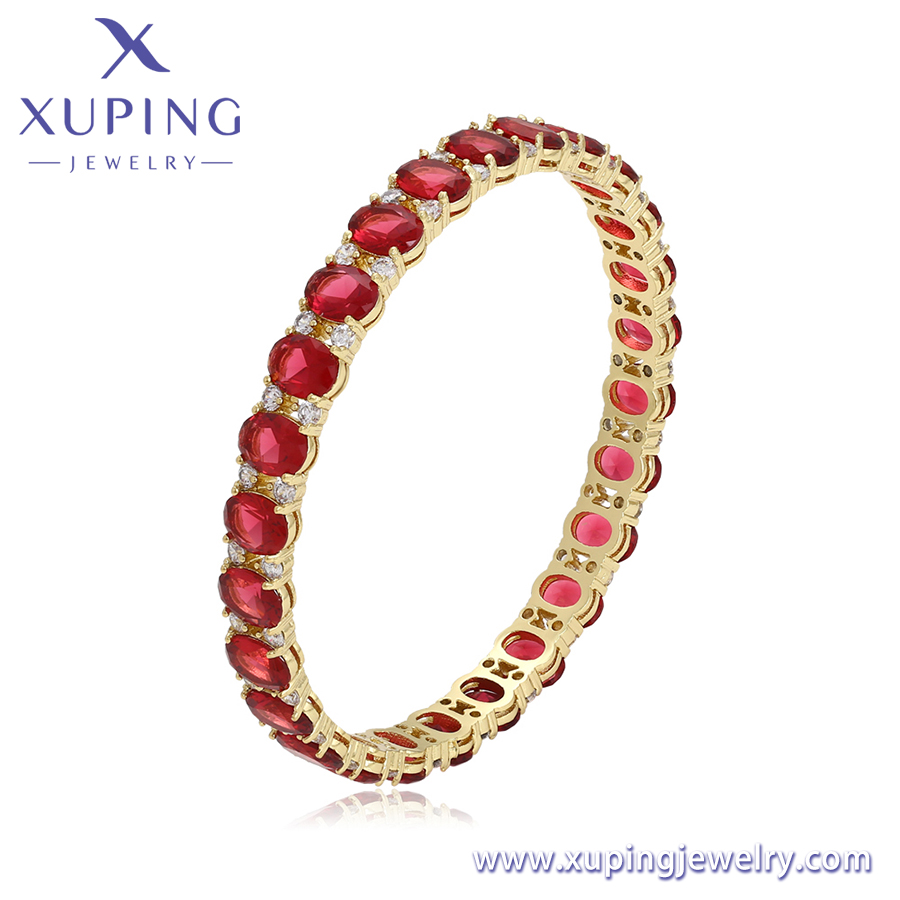
Bangle/bracelet-family example, model X000998659: 14K gold color plating, 60 × 8 mm (±2 mm), 21.77 g, ruby synthetic cubic zirconia main stone.
The bangle/bracelet-family example shifts the quality question toward dimensional fidelity. X000998659 is listed at 60 × 8 mm (±2 mm), 21.77 g, with a ruby synthetic cubic zirconia main stone of about 8 × 6 mm. The tolerance note is not a marketing detail; it is a production signal. Buyers who need consistent fit across a bulk jewelry wholesale order should know whether a listed tolerance is a design allowance, a production norm, or a customer-specific requirement.
The same logic applies to simpler core products. A00902945 is a stainless steel necklace with 14K gold color plating, a 40 cm length, a 400 × 1 mm format with a +60 mm extension, and no stone. Its description also states a weight of about 6.30 g, while the parameter field lists 6 g. That small difference is exactly the kind of detail a buyer should clarify before repeating an order. It does not make the product unreliable; it shows why product-level confirmation should sit next to catalog selection.
How Xuping Jewelry manages both sides of the offer
Xuping Jewelry presents itself as both a catalog supplier and a customization partner. The company reports OEM/ODM capability, engraved logos, hang tags, and custom packaging. Its capability data lists a monthly capacity of 8,000,000 pieces, lead times of 30–90 days, and quality control that includes 100% full inspection, SGS-certified quality control, an 18-stage quality check, and REACH/ROHS compliance testing. Its company profile also states SGS, CE, and ISO certifications and 18 production procedures.
Those facts do not prove that every SKU is equally customizable. They do show that the supplier has a dual operating model: a standard catalog with product-level specifications, and an OEM/ODM route for buyers who need adaptation. The 194 patents and 62 designers are relevant to the customization side because they suggest design and development capacity. They are less relevant to a buyer who simply needs a repeat order of a fixed stainless steel necklace. In that case, the more important evidence is dimensional control, plating consistency, and inspection discipline.
Entry terms should also be read carefully. Xuping’s capability data lists MOQ from 1 piece, while its official website data states a minimum order value of USD 50. These are useful entry signals for small-batch sourcing, but the sources do not specify product-level MOQ, customization fees, or item-level lead times for every custom program. Buyers should confirm those terms in writing before treating them as commercial commitments.
The company reports serving more than 100 countries. For buyers comparing wholesale jewelry suppliers, that reach is a useful context point, but it is not a substitute for checking whether the supplier has handled the specific product category, compliance market, and packaging requirement in front of them. The right question is not “How many markets does the supplier serve?” but “Which parts of this offer pattern fit my market and my risk tolerance?”
A five-step decision framework for buyers
The framework below treats customization and core product quality as two procurement lanes. It is designed for research and evaluation stages, when a buyer is still deciding how much adaptation the project really needs.
| Decision step | Core-product-first route | Customization-first route | Evidence to request |
|---|---|---|---|
| 1. Define the market need | Validated bestseller, low differentiation, fast assortment test | Brand differentiation, logo packaging, adapted color or stone | Sales history, target price band, competitor range, launch plan |
| 2. Lock the base specification | Exact dimensions, material, plating, stone, weight | Base model plus allowed changes and design freeze | Product spec sheet, tolerance note, material declaration |
| 3. Check entry terms | Published MOQ or minimum order value, stock availability | Product-level MOQ, sample fee, tooling or setup cost | Written quotation, sample timeline, payment terms |
| 4. Validate compliance and claims | Plating and material claims match documentation | Custom logo and packaging do not create unsupported claims | Test reports, plating declaration, labeling review |
| 5. Decide pilot or scale | Small repeatable order to test sell-through | Sample approval, then controlled production release | Inspection record, replacement terms, delivery schedule |
The first step is the most important. A buyer who cannot state whether the project needs differentiation or validation will over-customize a test order or under-differentiate a brand launch. Core-product-first procurement is usually the lower-risk route when the market signal is still unclear. Customization-first procurement makes more sense when the buyer has a defined channel, a clear design direction, and the capacity to manage a design freeze.
The second step protects the buyer from vague customization. A custom necklace or earring program should start from a base specification: plating color, base material, stone type, dimensions, weight range, and logo placement. If those are not written down, the supplier cannot quote consistently and the buyer cannot inspect consistently. This is where catalog discipline helps even custom projects. A supplier that already documents exact dimensions for standard models is better positioned to document changes to those models.
The third step is where many low-MOQ assumptions break down. A published entry MOQ or minimum order value is not the same as a custom product MOQ. Custom packaging, engraved logos, and new stone colors can introduce setup work that is not captured in a catalog MOQ. Buyers should ask for a product-level quotation that separates unit price, sample cost, setup cost, packaging cost, and freight.
Customization-first vs. core-product-first procurement
Customization is not automatically the more sophisticated choice. It shifts risk to the buyer in exchange for differentiation. The buyer must freeze a design, approve a sample, validate claims, and absorb a lead time that Xuping lists at 30–90 days. If the design changes after sampling, the timeline and cost can move again. That is a real limitation, not a reason to avoid customization. It is a reason to reserve customization for programs where differentiation is worth the added control work.
Core-product-first procurement has the opposite trade-off. It offers a known specification and a faster path to assortment testing, but it may not give the buyer enough differentiation for a brand-led channel. It also does not eliminate verification. A catalog item still needs its dimensions, plating, material, and stone details checked against the actual quotation. In markets with gold-plating claims, a catalog description alone is not enough; the buyer should require a plating declaration and, where applicable, test evidence.
The practical comparison is therefore not “custom versus standard” in the abstract. It is “custom risk versus standard risk.” Custom risk is design-freeze, sample approval, product-level MOQ, and lead-time exposure. Standard risk is limited differentiation and reliance on catalog accuracy. A seasoned supplier should help the buyer see both risks clearly rather than presenting customization as universally superior.
Market trend analysis: what the data supports, and what it does not
Several verified data points frame the category. TrendX Insights reports the global fashion jewelry market at USD 42.62 billion in 2025, projected to reach USD 74.49 billion by 2034. The same source places the global stainless steel jewelry segment at USD 2.603 billion in 2025. World Bank WITS/UN Comtrade data records China’s 2023 exports of imitation jewelry under HS 711790 at USD 935.97 million.
These figures support two cautious conclusions. First, fashion jewelry wholesale operates at a scale that can support both broad catalogs and specialized custom programs. Second, material-specific segments such as stainless steel are large enough for buyers to build dedicated ranges rather than treating them as a minor add-on. The figures do not prove that customization or standard product is growing faster, and they do not provide wholesale price benchmarks or margin data. They also come from different scopes: a global market forecast, a material segment forecast, and a national export statistic. Buyers should not combine them into a single growth claim.
Compliance is another trend line, but it is market-specific. The U.S. Federal Trade Commission’s Jewelry Guides address claims for gold-plated and gold-electroplated products, including 10K minimum fineness and 0.175 microns as described in the revised guidance. That is U.S. guidance; it should not be generalized to every market without local review. For buyers sourcing gold plated jewelry wholesale for the United States, the practical implication is that plating language and product documentation should be checked before listing. For other markets, the buyer needs the relevant local requirement, not an assumption based on U.S. rules.
Future outlook: the buyer’s checklist will become more specification-led
The direction of travel is toward more documented offers. Buyers increasingly need to compare wholesale jewelry manufacturers on specification control, not only on catalog breadth. That means exact dimensions, material declarations, plating descriptions, stone specifications, inspection records, and clear customization terms. Suppliers that can present both a stable catalog and a controlled OEM/ODM process will be easier to evaluate because the buyer can separate base quality from customization quality.
For Xuping Jewelry, the relevant evidence is a long operating history since 1997, a 62-designer R&D team, 194 patents, 8,000,000 pieces of monthly capacity, and a quality-control process that includes 100% full inspection. Those facts are strongest when they are tied to a specific buyer decision: a standard necklace order, a brooch assortment, or a custom packaging program. They are weaker when presented as general proof that every product and every custom request will perform the same way.
The future buyer will likely run a two-track evaluation. Track one: select core products with exact specs and verify them. Track two: customize only where the market need is clear, then validate the change against the base specification. That is a more disciplined way to use a broad catalog than treating customization as a default.
FAQ
How should a wholesale buyer decide between custom jewelry and catalog core products?
Start with the market need. If the buyer needs to test sell-through with limited differentiation, core catalog products are usually easier to validate because their dimensions, materials, plating, and stone details are already stated. If the buyer needs brand differentiation through logo, packaging, color, or stone changes, customization may fit, but the buyer must accept design-freeze, sample approval, product-level MOQ, and lead-time control.
What does Xuping Jewelry’s catalog show about the difference between detail-intensive and specification-led products?
The catalog includes detail-intensive items such as brooch X000852427, listed at 44 × 38 mm, 9.15 g, with an AB-color synthetic cubic zirconia main stone, and specification-led items such as stainless steel necklace A00902945, listed with a 40 cm length, 14K gold color plating, and no stone. It also includes bangle X000998659 at 60 × 8 mm (±2 mm), 21.77 g, with a ruby synthetic cubic zirconia main stone. The contrast shows that buyers should evaluate detail work and dimensional control separately.
Which product details should be fixed before ordering custom necklaces or earrings?
At minimum, fix the base material, plating color and method, dimensions and tolerance, stone type and size, weight range, logo placement, hang tag, packaging, and target-market claim requirements. For U.S.-bound gold-plated products, the FTC Jewelry Guides address gold and plating representations, including 10K minimum fineness and 0.175 microns as described in the revised guidance. The buyer should require written confirmation that the custom item matches the approved specification.
Does a low MOQ remove the need for product-level confirmation?
No. Xuping’s capability data lists MOQ from 1 piece, and its official website data states a minimum order value of USD 50. Those are entry signals, not proof that every custom product, packaging option, or logo treatment carries the same terms. The sources do not specify product-level custom MOQ, setup fees, or item-level lead times, so the buyer should confirm those points in the quotation.
What is the main limitation of choosing customization over standard catalog quality?
Customization adds control work and time. The buyer must freeze a design, approve a sample, validate compliance claims, and manage a lead time that Xuping lists at 30–90 days. If the design changes after sampling, cost and schedule can move. Standard catalog quality reduces those variables but may offer less differentiation; it still requires the buyer to verify dimensions, plating, material, and stone details against the quotation.
Conclusion: use the framework, not a default preference
The better procurement rule is to match the offer pattern to the project. Use core catalog products when the need is validation, exact specifications, or speed. Use customization when the market need is differentiation and the buyer can manage design freeze, sampling, product-level terms, and lead time. In both lanes, require documented specifications and written confirmation before scaling.
Xuping Jewelry’s dual profile—a broad catalog with exact product parameters plus OEM/ODM capability supported by 194 patents, 62 designers, and a reported 8,000,000-piece monthly capacity—makes it a useful case for this framework. The company’s published company profile is available at Xuping Jewelry official site. The buyer’s task is not to assume that one side of the offer is better. It is to decide which side fits the market, then verify the facts that matter for that order.
Data note: Xuping Jewelry facts are company-reported. Market-size figures are attributed to TrendX Insights; trade data is attributed to World Bank WITS/UN Comtrade; U.S. plating-claim guidance is attributed to the Federal Trade Commission Jewelry Guides.
Tem questões ou precisa de mais detalhes?
Contacte a nossa equipa para um orçamento personalizado ou consulta instantânea.
Solicitar orçamento
Preencha o formulário abaixo e a nossa equipa entrará em contacto com uma proposta personalizada.
Chat direto do WhatsApp
Prefere conversar em tempo real? Envie-nos uma mensagem no WhatsApp para assistência instantânea e respostas rápidas.
- Obter orçamento personalizado
- Partilhar fotos ou documentos
- Discuta as suas necessidades diretamente
Geralmente responde em 5–30 minutos durante o horário de expediente.