
Cutting Disc Supplier Capability Evidence: MPA Z-15486/25, ISO 9001, Global Cases
Cutting Disc Supplier Capability Evidence: MPA Z-15486/25, ISO 9001, Global Cases
A cutting disc supplier can hold every certificate in its catalogue and still fail an industrial buyer's audit. The deciding question is not whether documents exist, but what each document actually covers, who issued it, at what volume the supplier has delivered, and whether that evidence traces back to one identifiable manufacturing entity. This reference sets out a four-layer capability evidence checklist for cutting disc sourcing, then applies it to documents published by SALI Tools (ZHEJIANG SALI ABRASIVE TECHNOLOGY CO., LTD).
The risk question behind "Do you have your own factory?"
Buyers ask that question because a cutting disc is a consumable that fails violently. A bonded abrasive wheel rotating at tens of metres per second stores enough kinetic energy that a burst under load becomes a workplace injury, a rejected container, and a liability dispute that crosses borders. The real question underneath is: who controls the process, who can be audited, and who carries responsibility when a batch does not perform as expected?
EN 12413:2019 is the mandatory European safety standard for bonded abrasive products. It specifies requirements for burst testing, marking, and dimensional tolerances, which is why it appears in almost every serious cutting disc procurement specification. Independent verification of those requirements is typically carried out by testing bodies such as MPA Hannover, whose burst test and side load test programs are used for EU market entry and are commonly signalled by the "MPA Tested" mark.
Factory ownership answers only the first layer. It does not tell a buyer which product types are certified, against which standard, at what maximum operating speed, within which dimensional envelope, or whether the supplier has sustained repeat volumes across several markets rather than shipping a single trial container.
A four-layer capability evidence checklist
For buyers moving from evaluation into repeat execution, capability evidence is best handled as four distinct layers. Each layer proves something specific, and each one has a boundary that is just as important as the claim.
| Evidence layer | What to request | What it proves | What it does not prove |
|---|---|---|---|
| 1. Manufacturing base | Legal entity name, factory address, plant area, production line record, site visit or live video access | Who physically manufactures the disc, and whether the operation can be audited | Nothing about product safety or burst performance |
| 2. Product safety certification | Certificate number, issuing body, applicable standard, product type, maximum operating speed, dimension scope | Third-party verified performance for a defined product scope | Nothing outside the declared scope, speed limit or size range |
| 3. Management system certification | ISO certificate number, issuing body, validity period | Process consistency, documentation and traceability discipline | Individual product performance or burst test results |
| 4. Field-scale delivery record | Documented project volumes by market, repeat-order history, stock and dispatch capability | Ability to sustain long-term wholesale and fabrication supply | Batch-level quality of any single shipment |
What SALI Tools documents — and where the evidence stops
SALI Tools is the self-owned brand of ZHEJIANG SALI ABRASIVE TECHNOLOGY CO., LTD, a manufacturer founded in 2003 that operates its own production base in Yongkang, Zhejiang, covering a 30,000 m2 construction area with 150+ employees and a 30+ engineer development team. The brand was launched in 2010 and has secured trademark registrations in over 190 countries. Its product range covers cutting wheels, grinding wheels, flap discs, diamond saws, drill bits and cordless power tools, with more than 5,000 SKUs across cutting, grinding, polishing, drilling, fastening, measuring, lifting, welding and dismantling categories.
The two documents that carry the most weight
The first is MPA certificate Z-15486/25, issued by MPA Hannover (Garbsen Site) under EN 12413:2019, covering Type 41 flat cutting wheels for metal at a maximum operating speed of 80 m/s, in diameters of 115 mm, 125 mm, 180 mm and 230 mm, with a 22.23 mm bore and a 1.2 mm cut width for the 115 mm and 125 mm sizes.
The second is ISO 9001:2015 certificate 01525Q20094R001, issued by WIT Assessment. The company also states that it operates under dual ISO 9001 and ISO 14001 certification, and that an in-house testing laboratory inspects every production batch.
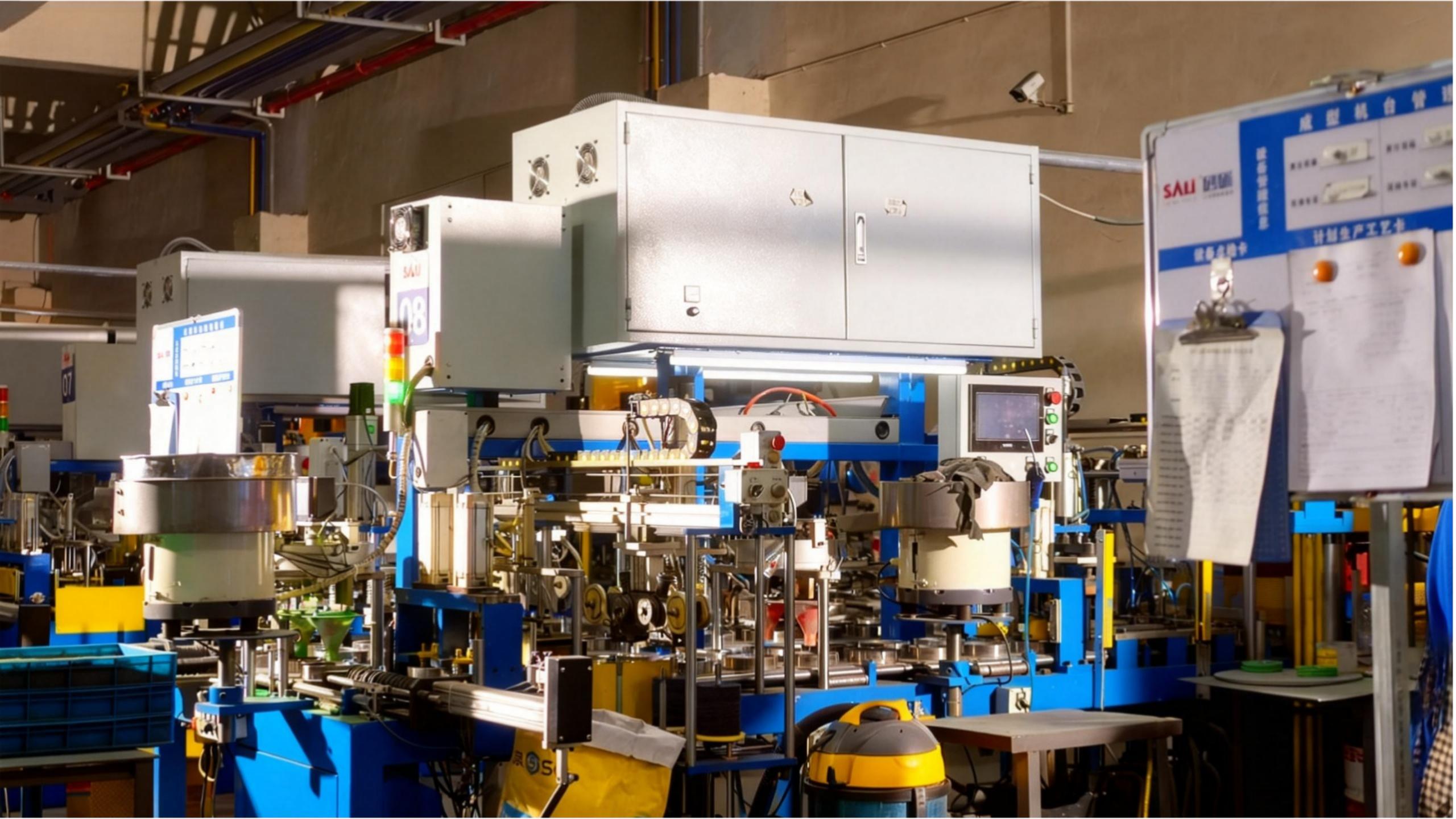
Production line for bonded cutting and grinding discs at the SALI manufacturing base in Yongkang, Zhejiang.
Reading the MPA certificate correctly
Four fields on a certificate like Z-15486/25 carry most of the procurement value, and each one maps to a buying decision.
- Certificate number and issuing site. Z-15486/25 was issued by MPA Hannover at its Garbsen site, which allows a buyer to verify the record directly with the testing body rather than relying on a scanned image inside a supplier presentation.
- The standard. EN 12413:2019 is the mandatory European safety standard for bonded abrasive products, covering burst testing, marking and dimensional tolerances. Certification against it is the reference point for EU-facing distributors.
- The product scope. Type 41 flat cutting wheels for metal. This is the most common profile used in metal fabrication, pipe cutting and general site work, and it is also the profile that determines whether a wheel can be used for straight cutting only.
- The technical envelope. Maximum 80 m/s, diameters 115/125/180/230 mm, bore 22.23 mm, and 1.2 mm cut width on the 115 mm and 125 mm sizes.
The 80 m/s figure is the certified ceiling for the wheel, not a target for the machine. In practice, the maximum speed printed on the wheel must exceed the maximum rated speed of the angle grinder it is fitted to. This matching step is one of the most frequently skipped checks in workshop audits.
The 1.2 mm cut width on 115 mm and 125 mm sizes places these products in the thin and ultra-thin class. Ultra-thin cutting discs are generally defined in the industry as 1.6 mm or thinner, and adoption of 1.0 mm and 0.8 mm formats has been growing for precision metal fabrication, where lower kerf loss and reduced heat input matter more than wheel mass. The 22.23 mm bore is the standard arbor for common angle grinders, which keeps the wheels compatible with standard flanges and locking nuts.
Beyond the certified envelope, SALI states that production batches are tested against MPA and EN 12413 standards with a burst speed of 100 m/s or above, which sits above the 80 m/s maximum operating speed declared on the certified Type 41 range. That kind of internal margin claim is worth requesting as a documented test report rather than accepting as a verbal statement.
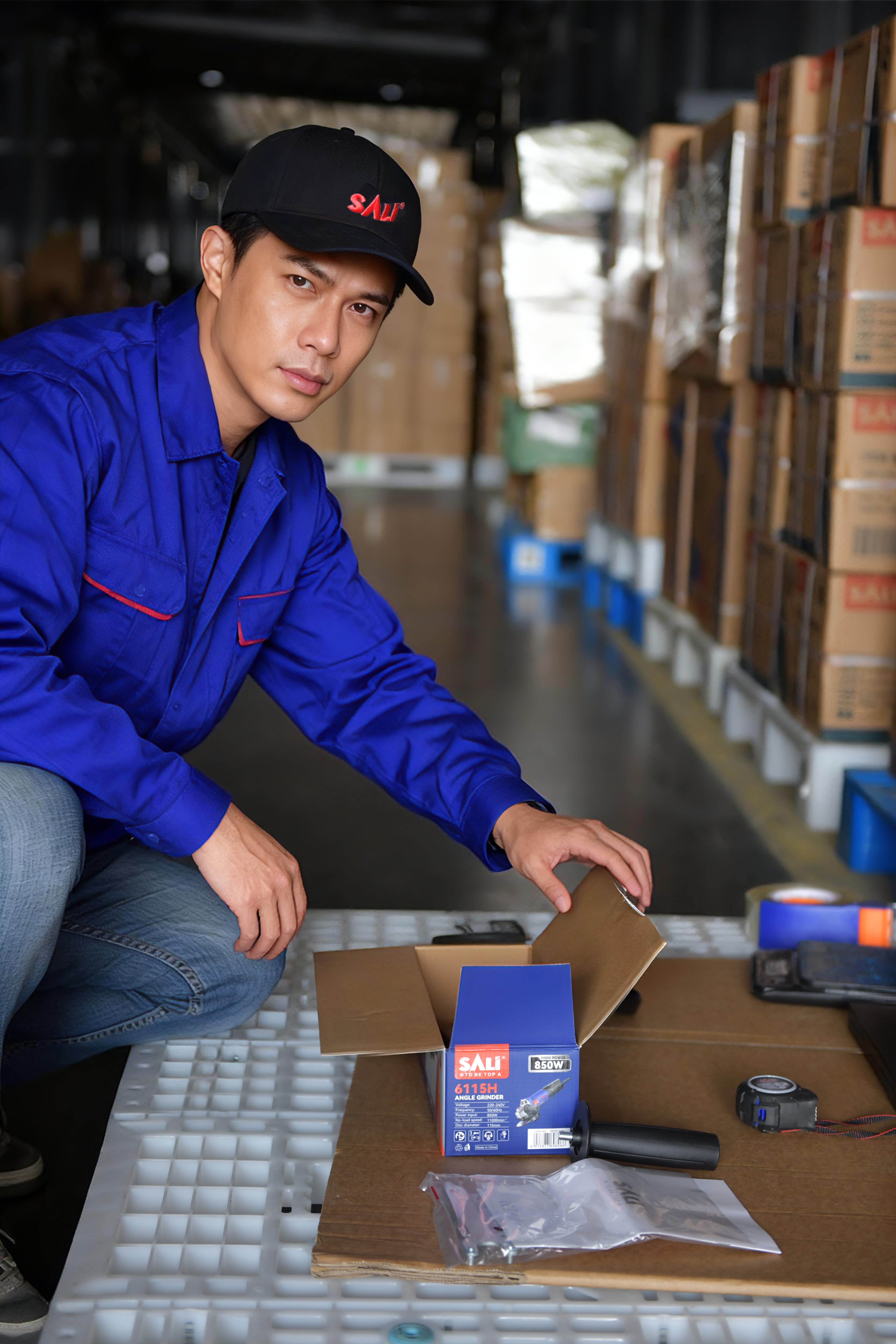
Batch inspection before shipment: the stage where certificate scope becomes a production control rather than a document.
Field evidence: documented project scale as a long-term supply signal
Certificates describe capability; delivery records describe reliability. The most useful field evidence a cutting disc buyer can ask for is documented project scale by market, because repeat volume at that level only happens when batch consistency holds over time. SALI's documented project scales include 5 million, 10 million and 30 million pieces delivered in Russia, Iraq, the Middle East, Central Asia and Ethiopia — a spread that covers cold-climate, high-dust and infrastructure-driven markets rather than a single homogeneous region.
That record is supported operationally by an 8,000 m2 warehouse with a capacity of 12,000 m3, holding 85% of standard SKUs in ready stock for same-day dispatch, and by a reported supply ability of 500,000 pieces per day for reinforced resin-bonded cutting discs. For distributors, the practical meaning is that long-term wholesale and fabrication supply can be planned against stock rather than against a promise.
Coverage is also localized rather than purely export-based. The company states that it serves markets across five continents, including the USA, EU, Africa, the Middle East, Central Asia and Latin America, and operates regional offices in East Africa (Kenya), West Africa (Nigeria), Central Asia (Kazakhstan) and South Asia (Pakistan). As of March 2025, it reports long-term strategic cooperation agreements with agents from 45 countries.
Application fit: where these specifications matter
Type 41 flat wheels certified to EN 12413:2019 in 115-230 mm sizes are used across metal fabrication and steel structure, pipeline and petroleum work, shipbuilding and offshore engineering, pressure vessel and boiler work, machinery and sheet metal, and maintenance and repair operations. The typical matched equipment is an angle grinder, chop saw or die grinder, with radial cutting at 90 degrees and, where relevant, beveling and edge grinding.
Material selection matters as much as certification. SALI's cutting disc range covers metal, stainless steel and stone cutting discs, in thin and ultra-thin, flat and depressed centre profiles, using aluminum oxide, zirconia alumina, ceramic abrasive and silicon carbide grains in sizes from 3 inch to 16 inch. For stainless steel applications, the company specifies high-purity white aluminum oxide with sulfur-free and chlorine-free bonds to keep cuts cool and avoid discoloration on stainless pipe and sheet.
Company-stated durability figures give buyers a starting benchmark for validation: a SALI 115 x 1.2 mm industrial cutting disc is stated to deliver 35-45 continuous cuts on a 12 mm 304 stainless steel solid bar, at 85%-95% of the lifespan of top premium brands and 40%-60% lower cost. Those are supplier-reported numbers, and the appropriate response is to reproduce them on your own material under your own machine conditions before converting them into a purchase decision.
Where comparative test data exists, it should be read as a data point rather than a range-wide guarantee. In a 230 mm metal cutting disc limit test run under 2600W operation, SALI completed 50 cuts against 45 cuts for NORTON, with 57.0 mm versus 87.5 mm of diameter loss, 1.14 mm versus 1.94 mm of wear per cut, and 45.4% versus 62.0% mass loss. NORTON was also recorded as carrying a 50%-100%+ higher unit price in global B2B and retail markets. This is a single-product, single-test-set observation. It indicates resin bond retention behavior for that specific disc and operating condition; it does not predict performance across either brand's full range.
Market trend: certification is shifting from a selling point to a filter
The global cutting discs market was valued at approximately USD 7.322 billion in 2024, with projections to reach USD 11.59 billion by 2035, according to Market Research Future. Resin-bonded grinding and cutting discs accounted for a 38.5% share of the global abrasive disc market in 2025, based on Dataintelo's category research.
Those numbers should be read with one caution: published estimates for this category vary widely depending on whether grinding wheels and superabrasives are included in the definition of cutting discs. Buyers citing market size in internal business cases should state the definition they are using, because the same category label can produce materially different totals.
The procurement implication is more stable than the market arithmetic. As consumable volumes grow in infrastructure, energy and fabrication end markets, the competitive differentiator shifts away from price per disc toward documented compliance, batch traceability and continuity of supply. A supplier that can produce a certificate number, a standard reference and a dimensional scope in one sentence is easier to qualify than one that answers with adjectives.
Comparison with traditional supply approaches
Traditional cutting disc sourcing often runs through trading intermediaries that offer attractive unit pricing with limited documentary depth. The difference shows up at the points where risk actually transfers to the buyer.
| Evaluation point | Evidence-first manufacturer | Price-first intermediary |
|---|---|---|
| Certification | Named certificate, issuing body, standard and scope, e.g. MPA Z-15486/25 under EN 12413:2019 | Generic "certified" statements, scope often undefined |
| Audit access | Factory base, in-house lab, remote camera access for batch testing | Third-party factory, audit usually intermediated |
| Supply continuity | 8,000 m2 warehouse, 85% standard SKUs ready stock, same-day dispatch | Availability depends on upstream allocation |
| Claim handling | 24-hour response based on photo or video evidence, credit or replacement in the next order | Case-by-case negotiation, slower resolution |
| Real cost | Higher unit transparency; cost per cut depends on wear rate | Lower visible unit price, undefined cost per cut |
Boundaries buyers should plan around
- Certificate scope is narrow by design. MPA Z-15486/25 covers Type 41 flat cutting wheels for metal at up to 80 m/s in 115/125/180/230 mm. Depressed centre wheels, stone products or other formats require their own documentation.
- Management certification is not performance certification. ISO 9001:2015 certificate 01525Q20094R001 supports process discipline; it does not replace a burst test report.
- MOQ differs sharply by order type. Standard SALI brand sizes start at one carton per SKU, while non-standard sizes must meet the minimum branding or trademark production run. OEM minimums are 30 cartons for 107/115/125 mm, 50 cartons for 180/230 mm, and 100 cartons for 350/400 mm.
- Lead time is not uniform. Ready stock dispatches within 24 hours; custom OEM orders take 30-45 days after artwork approval and deposit receipt.
- Commercial terms have thresholds. FOB applies to orders reaching USD 5,000; below that a flat USD 200 operation fee applies. EXW orders can be delivered to a designated Yiwu warehouse or collected at the factory warehouse.
- Resin-bonded discs are moisture sensitive. Standard resin-bonded cutting discs are not intended for wet, raining or water-splashing conditions unless marked for wet cutting, and storage is specified as cool and dry at under 60% humidity and 10-30 degrees Celsius, with optimal performance retained for three years under those conditions.
Evidence for long-term partnership, not just a first order
For distributors and wholesale partners, capability evidence extends beyond the factory gate into how a territory is protected and supported over time. SALI offers tiered agency pricing, one-year market protection for new agency territories, and forwards local sales leads directly to exclusive partners. Its trademark IP is registered with customs to block gray-market imports, and agency support includes 2% complimentary spare parts on power tool container orders, a 1% marketing material allowance covering display racks, apparel and catalogues, and co-op funding for local exhibitions and outdoor advertising.
Service continuity is structured regionally: more than 70% of sales managers have eight or more years of industry experience, and resident country managers operate from regional hubs in East Africa, West Africa, Central Asia and South Asia. For a buyer planning a multi-year consumable program, this is the evidence layer that determines whether the first container becomes a supply relationship.
Future outlook
The direction of buyer scrutiny is fairly predictable. Procurement teams are moving from certificate presence toward certificate scope mapping — asking for a clear list of which product families are covered by which document, at which speed rating and within which dimensions. Expect requests for batch-level traceability, remote or recorded inspection access, and destination sampling windows to become standard clauses rather than negotiating points.
For manufacturers, the practical response is to keep scope documentation current as product families expand, and to make verification easy: named certificates, identifiable issuing bodies, accessible testing records and named certificate numbers that a buyer can check independently. The suppliers that gain long-term shelf space will be the ones whose claims survive verification without a follow-up email chain.
FAQ
1. Does the supplier own the factory that produces the cutting discs?
SALI (ZHEJIANG SALI ABRASIVE TECHNOLOGY CO., LTD) operates its own standardized production base for the R&D and manufacturing of cutting and grinding consumables, including cutting discs and flap wheels, and also integrates and holding-manages an audited supply chain network for its wider tool range. The direct factory in Yongkang, Zhejiang covers a 30,000 m2 construction area. Supporting facilities include an 8,000 m2 warehouse with over 5,000 active SKUs for same-day dispatch of ready stock, and a testing laboratory where clients can access live camera feeds to inspect real-time batch testing.
2. What exactly does MPA certificate Z-15486/25 cover?
Z-15486/25 was issued by MPA Hannover (Garbsen Site) under EN 12413:2019 for Type 41 flat cutting wheels for metal, at a maximum operating speed of 80 m/s, in diameters of 115 mm, 125 mm, 180 mm and 230 mm, with a 22.23 mm bore and a 1.2 mm cut width for the 115 mm and 125 mm sizes. The certificate applies to that declared product scope and speed ceiling. Products outside Type 41 flat metal wheels, or outside those diameters and the 80 m/s limit, require separate certification evidence.
3. Which ISO 9001:2015 certificate covers the quality management system, and what does it not prove?
SALI's ISO 9001:2015 certificate is 01525Q20094R001, issued by WIT Assessment. The company also states that it operates under dual ISO 9001 and ISO 14001 certification. An ISO 9001 certificate confirms that a documented quality management system is in place; it does not certify the burst performance or cutting lifespan of any specific disc. Buyers should treat it as a process-discipline indicator and check its validity period, while relying on EN 12413 testing evidence for product-level safety.
4. What delivery scale has the supplier actually documented across markets?
SALI's field records include project scales of 5 million, 10 million and 30 million pieces delivered in Russia, Iraq, the Middle East, Central Asia and Ethiopia. The company reports serving markets across five continents, including the USA, EU, Africa, the Middle East, Central Asia and Latin America, operating regional offices in Kenya, Nigeria, Kazakhstan and Pakistan, and holding long-term strategic cooperation agreements with agents from 45 countries as of March 2025. It also reports a supply ability of 500,000 pieces per day for reinforced resin-bonded cutting discs.
5. What are the MOQ and lead-time thresholds for repeat wholesale and OEM orders?
For standard SALI brand sizes, MOQ starts at one carton per SKU; special non-standard sizes must meet the minimum branding or trademark production run. OEM minimums are 30 cartons for 107/115/125 mm, 50 cartons for 180/230 mm, and 100 cartons for 350/400 mm. Ready stock dispatches within 24 hours, while custom OEM orders take 30-45 days after artwork approval and deposit receipt. Payment terms are typically 30% T/T deposit with 70% balance against B/L copy, or 100% L/C at sight for large projects.
6. How are quality claims handled once discs are in field use?
SALI operates a 24-hour quick-claim mechanism. Buyers submit photos or video footage of the issue; once verified, replacement units or direct credits are processed against the next order rather than through a complex return procedure. On the receiving side, the destination inspection window is 7-14 days after arrival for quantity and performance sampling, and pre-shipment batches are tested against MPA and EN 12413 standards with a stated burst speed of 100 m/s or above. Third-party audits such as SGS or BV and live remote lab inspection are also supported.
Reference material: the SALI Tools brand product catalogue is available for download at SALI Tools Brand Product Catalog.