
D053 vs GH001: WPC Decking Evidence Under EPD S-P-12197
D053 vs GH001: WPC Decking Evidence Under EPD S-P-12197
D053 outdoor hollow WPC decking and GH001 co-extruded outdoor decking are two different generations of board from the same manufacturer, yet both appear on a single Environmental Product Declaration: S-P-12197, issued by EPD International AB and valid until 2029-03-15 under EN15804+A2 and ISO 14025 / ISO 21930. Sharing one declaration does not make the two boards interchangeable. What the shared document supports is narrower than it first appears, and the real decision sits in the surface system, the documented moisture values and the way each board is positioned against project scale.
Both products are manufactured by Terratsa New Material (Liaoning) Co., Ltd., a wood-plastic composite producer founded in 2007 and operating from the Yingkou Area of China (Liaoning) Pilot Free Trade Zone since 2024, with outdoor WPC decking, fencing and cladding in its production range and exports to more than 40 countries and regions.
This comparison is written for buyers who have already accepted that WPC decking is the right material and are now testing whether the supplier paperwork stands up to the specification. The working question is not which board is certified. It is which parts of the specification the certificate actually covers, and which parts still need separate evidence before samples, purchase order and acceptance testing.
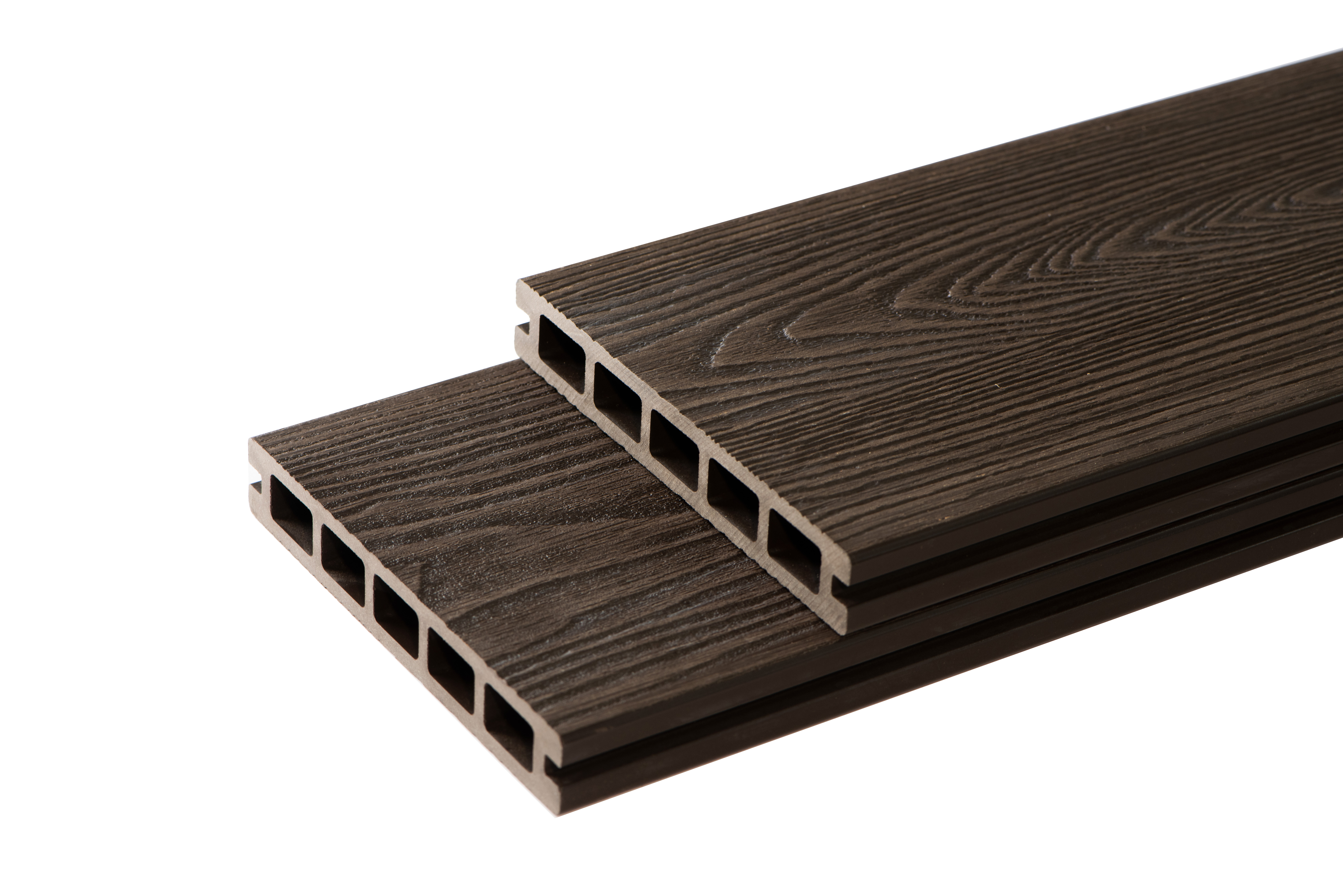
D053 outdoor hollow WPC decking, 146 x 23 mm, one of four profiles listed under EPD S-P-12197.
Why this comparison starts with documents, not with price
WPC decking supply is concentrated. In one monitored trade dataset, China accounted for 97.81% of WPC decking imports under HS Code 39189090 (Zauba). The figure is a single-source trade snapshot rather than a market census, but it explains a practical shift in procurement: when most boards come from the same origin, origin stops separating suppliers and documentation starts doing that work.
At the same time, two different kinds of proof are being confused in submittal packages. An Environmental Product Declaration is an environmental instrument: it declares life-cycle environmental information in a format aligned with EN 15804. ASTM D7032 is the standard specification used to establish performance ratings for wood-plastic composite deck boards, stair treads, guards and handrails (ASTM International). One does not substitute for the other. No ASTM D7032 performance rating appears in the product data supplied for this comparison, so a buyer specifying spans or guard loads should request that data as a separate item.
The opportunity in the D053 and GH001 case is that a single declaration lets the buyer run a controlled test. Same declaration, same factory, same chain-of-custody certificate, two different board constructions. Everything that differs between them is therefore a product decision rather than a supplier decision.
The two boards as documented
The differences that matter in evaluation are visible in the data sheets. D053 is a first-generation hollow profile; GH001 is a second-generation co-extruded board in which a polymer cap layer fully encapsulates the core.
| Documented item | D053 outdoor hollow WPC decking | GH001 co-extruded outdoor decking |
|---|---|---|
| Construction | Hollow, first generation | Co-extruded, second generation with a full cap layer |
| Material | Wood powder and plastic | Wood powder and plastic; recycled HDPE, bio-materials and wood fibres, with an outer shell formulated with UV-resistant components such as ASA materials |
| Recorded mechanical value | Bending failure 3900 N | Flexural properties at or above 3300 N |
| Water absorption | 2% or less after a 5-hour boil | 7% or less under a boiling test; mean 10% or less under cyclic moisture testing |
| Profile dimension | 23 mm thickness, 146 mm width, 2900 mm length | Not stated in the supplied data sheet; request the current profile drawing |
| Density | 1.3 g/cm3 | Not stated in the supplied data sheet |
| Linear thermal expansion | 37 x 10-6 per K or less | Not stated in the supplied data sheet |
| Temperature envelope | Not stated | Minus 40 to 75 degrees Celsius |
| Surface | Grooved or textured anti-slip surface, natural wood texture | Deep embossed 3D wood grain and brushed texture, anti-slip for wet and barefoot areas |
| Stated protection level | Not stated | IP55 |
| Wear claim in product data | Not stated | Up to five times better abrasion and scratch resistance than traditional WPC |
| EPD coverage | Yes, S-P-12197 | Yes, S-P-12197 |
| FSC chain of custody coverage | Yes, 0218718 | Yes, 0218718 |
Product data as supplied; blank or absent values indicate the data sheet does not state them, not that the property is absent.
Three reading notes are worth more than the table itself.
- The two mechanical figures are not the same descriptor. One is a bending failure load; the other is a flexural property threshold expressed with a lower bound. Ranking them against each other without the test report, span and loading configuration is not a defensible comparison.
- The water absorption figures look inverted at first glance, with the first-generation board recording the lower number. The test wording differs, and the mechanisms differ: GH001 relies on a sealed cap that product documentation describes as preventing water penetration, while the bulk absorption reading describes the core material. Buyers should ask for the underlying reports rather than compare percentages.
- Every missing cell in the table is a question to put to the supplier. Missing data is not a disqualification, but an unanswered data request before ordering usually becomes an unresolved claim after delivery.
What EPD S-P-12197 actually establishes
The declaration is registered under number S-P-12197 by EPD International AB, conforms to EN15804+A2 and ISO 14025 / ISO 21930, was issued on 2024-03-15 and remains valid until 2029-03-15 for the China, Netherlands and global markets. Its declared scope is co-extrusion WPC products, and the product list covers GH001 co-extruded outdoor decking, D053 outdoor hollow WPC decking, GH010 exterior wall cladding and GH024 outdoor WPC cladding.
For the buyer, that means two things. First, environmental information for both decking models can enter a building assessment in a single, comparably formatted document, which is the practical reason procurement teams ask for an EPD at all. Second, the document is not a performance rating. It does not certify load capacity, slip resistance, fire behaviour or colour fastness, and it does not convert a first-generation hollow profile into a capped board.
ISO 9001, ISO 14001 and ISO 45001: scope, dates and what they prove
Management-system certificates are the second layer of the document set, and they answer a different question from the EPD. They describe how the production activity is controlled, not how a specific board performs.
| Certificate | Number | Issuer | Standard | Validity | Stated scope |
|---|---|---|---|---|---|
| ISO 9001 | 03825Q01470R0M | World Standards For Certification Center Inc. | GB/T 19001-2016 / ISO 9001:2015 | 2025-03-03 to 2028-03-02 | Production of WPC flooring |
| ISO 14001 | 03825E01471R0M | World Standards For Certification Center Inc. | GB/T 24001-2016 / ISO 14001:2015 | 2025-03-03 to 2028-03-02 | Related environmental management activities in the production of WPC flooring |
| ISO 45001 | 03825S01472R0M | World Standards For Certification Center Inc. | GB/T 45001-2020 / ISO 45001:2018 | 2025-03-03 to 2028-03-02 | Related occupational health and safety management activities in the production of WPC flooring |
| FSC Chain of Custody | 0218718 | SAI Global Certification Services Pty. Ltd. | FSC-STD-40-004 V3-1 and FSC-STD-50-001 V2-1 | 2025-07-10 to 2030-07-07 | Tracking of wood-based material; wood-plastic composites W9.11; claims FSC 100% and FSC Mix |
| EPD | S-P-12197 | EPD International AB | EN15804+A2 and ISO 14025 / ISO 21930 | Issued 2024-03-15, valid to 2029-03-15 | Co-extrusion WPC products, including GH001, D053, GH010 and GH024 |
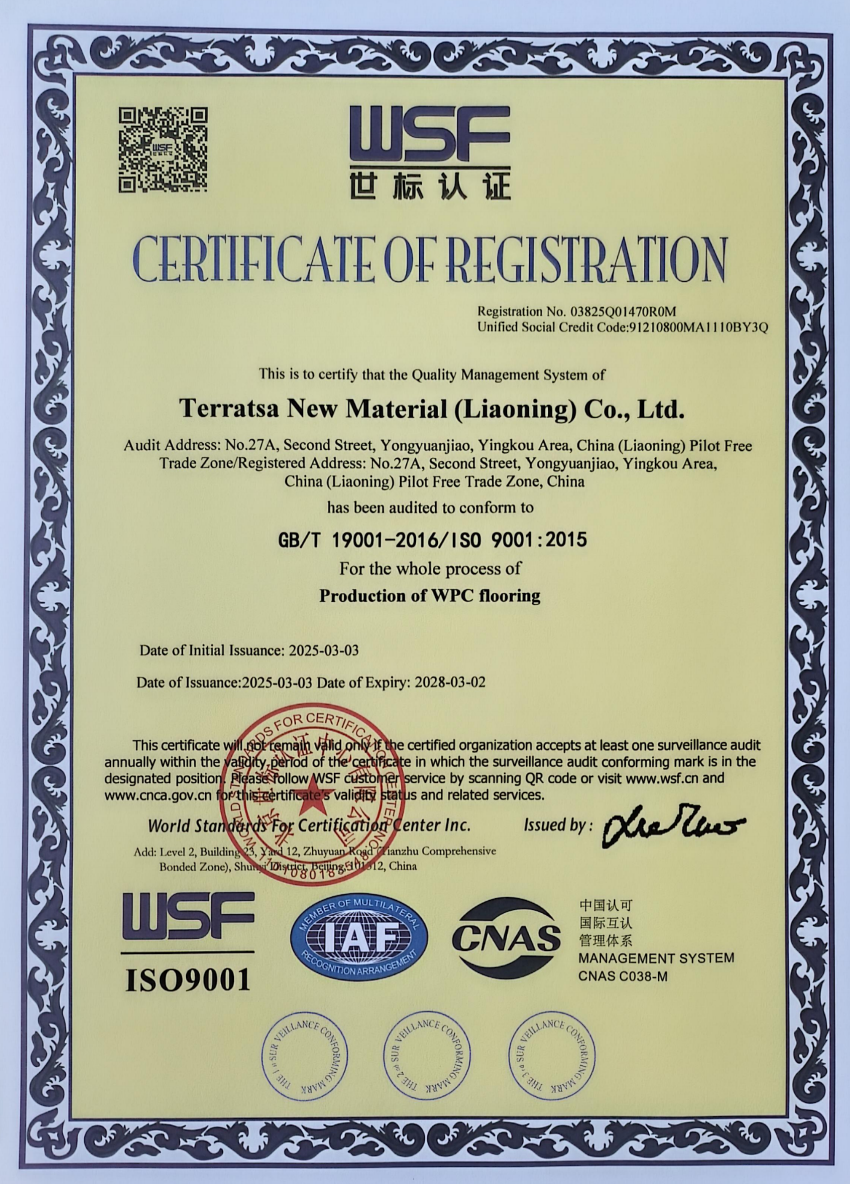
ISO 9001 certificate 03825Q01470R0M, valid from 2025-03-03 to 2028-03-02, scoped to the production of WPC flooring.
The supplier documentation maps GH001 into the covered product set for the management-system layer. A buyer should still confirm in writing which models the supplier places inside the certificate scope, because management-system audits verify processes and sites rather than individual stock-keeping units. It is also worth noting that the issuing body is a certification centre rather than a test laboratory: it verifies systems, and it is not providing third-party test results for bending strength or slip resistance.
Chain of custody: what FSC actually transfers
The FSC chain-of-custody certificate 0218718, issued by SAI Global Certification Services Pty. Ltd., is valid from 2025-07-10 to 2030-07-07 and applies globally. Its scope covers the tracking of wood-based material and wood-plastic composites under product code W9.11, with claims of FSC 100% and FSC Mix. GH010, GH001 and D053 are mapped to the certificate in the supplier files; GH024 is not in that mapping, so cladding buyers must ask separately.
The distinction that matters in procurement is between holding a certificate and passing a claim. A chain-of-custody certificate allows a supplier to make FSC claims on eligible output, but the claim has to travel with the transaction. If the FSC claim is not stated on the batch documentation, the project cannot rely on it, even though the certificate is valid. Buyers should specify which claim, FSC 100% or FSC Mix, applies to the ordered batch and require it on the invoice and packing documents.
Where D053 is the rational specification
D053 is positioned as a cost-effective first-generation board, and its documented profile supports that positioning without overreach. It is waterproof and rot-proof, resistant to termites and wood-boring insects, and finished with a grooved or textured anti-slip surface that keeps a natural wood texture. It is manufactured using recycled plastics and wood fibres, requires no painting, staining or sealing, and can be cut and fixed with standard woodworking tools and hidden clip systems.
The application record points the same way. Park decking in a high-humidity environment is mapped to both D053 and GH001, and a project contractor programme in China covering 500 tons of park decking reports 15 years of service with no fading and no bending. That record is mapped to both models in the supplier files, so it corroborates the product family rather than isolating one board, and it should be read as a project reference rather than a comparative test.
For large public-realm areas, plazas, boardwalks and community pathways where cost efficiency and basic durability govern the specification, D053 covers the requirement set. Over-specifying a capped board across tens of thousands of square metres of low-traffic paving is one of the more common budget errors in this category.
Where GH001 earns its premium
GH001 adds a second-generation co-extruded polymer cap that fully encapsulates the core, and the difference shows up in the conditions that stress a surface rather than a core. The board is engineered for minus 40 to 75 degrees Celsius, and the outer shell uses UV-resistant components such as ASA materials to limit fading, greying and chalking. The high-hardness capped surface carries a documented claim of up to five times better abrasion and scratch resistance than traditional WPC, which is a data-sheet claim rather than a test result, but it points to the intended use: high-traffic and visible areas.
Two use cases justify the higher cost band. Around swimming pools and spas, the textured surface provides slip resistance for barefoot traffic in wet conditions, and the sealed structure is documented as repelling spills such as coffee, wine and oil. In a Polish decking project characterised by low winter temperatures and high humidity, the stated requirements were weather resistance, UV resistance, no maintenance, low water absorption, anti-scratching and anti-slip, which is close to the documented GH001 brief rather than the D053 brief.
Cost drivers behind the premium are traceable rather than arbitrary: the cap compound, the additional extrusion step, the UV and colour package, and the harder wearing surface. Publicly quoted price bands for either model are unreliable because they rarely state profile, finish, quantity or delivery terms; buyers should quote against measured quantities, with the stated minimum order of one container and lead time of 30 to 45 days as planning inputs.
Comparison with traditional timber, and the limits that remain
Against natural timber, both boards remove the maintenance cycle: no painting, staining, sealing or varnishing, no rot in wet conditions, and no chemical treatment against termites and wood-boring insects. Both are documented as formaldehyde-free and recyclable, and both install with standard woodworking tools and hidden clips, which shortens site time. For a specification decision, the more useful comparison is not WPC against timber but where the documented evidence for either board stops.
- The EPD is an environmental declaration. It does not certify structural capacity, span, guard load or slip classification, and neither product data sheet in this comparison supplies an ASTM D7032 performance rating.
- Movement does not disappear with a cap layer. D053 documents a linear thermal expansion coefficient of 37 x 10-6 per K or less, so expansion gaps, clip spacing and perimeter detailing remain mandatory; GH001 data supplied here does not state the coefficient, which is itself a question for the supplier.
- Boiling-test water absorption values of 2% or less for D053 and 7% or less for GH001 are recorded under differently worded conditions and cannot be ranked without the original reports.
- Hollow first-generation profiles and co-extruded profiles need different handling at cut edges and fixings; installation instructions should be requested per model rather than assumed to be interchangeable.
- Document validity is not open-ended. The management-system certificates expire on 2028-03-02, the EPD on 2029-03-15 and the FSC certificate on 2030-07-07. A programme running past those dates needs re-verification clauses.
- The company profile also lists CE, ASTM, SGS and EPD certifications; the documents with traceable numbers in this comparison are the EPD, the three management-system certificates and the FSC chain of custody. Anything else should be requested as a document, not accepted as a logo.
A buyer acceptance framework for the two models
| Project condition | Documentation check first | Specification leaning |
|---|---|---|
| Large public paving, low traffic, budget-bound | EPD product list, FSC claim on batch, ISO 9001 scope | D053, with span and fixing details confirmed |
| Pool surround, spa deck, barefoot wet traffic | Slip data request, cap specification, colour range | GH001 |
| Coastal or salt-spray exposure | Temperature and UV documentation, fixing material | GH001 |
| Cold winter with high humidity | Cyclic moisture data, freeze-related detailing | GH001 |
| Green-building submittal | EPD number and validity date, FSC claim | Either, provided the model is inside the declaration |
| Repeat annual supply, multi-year contract | Certificate renewal calendar, re-verification clause | Either, with escalation terms on both models |
Practical acceptance steps that follow from this document set: match the certificate number and product mapping to the exact model ordered; check expiry dates against the delivery schedule rather than the quotation date; require the FSC claim on the transaction documents; request test reports behind every published mechanical and moisture figure; and keep samples from the approved batch so that colour and texture can be compared against later deliveries.
Market trend: documentation is following demand
Straits Research values the global wood plastic composite market at USD 8.05 billion in 2025 and projects USD 11.26 billion by 2034, with North America holding the largest regional share at 36.4% in 2025. Estimates vary between research houses because the definition of the category differs, which is a useful caution when a single market-size figure is used to justify a specification decision.
The direction is consistent even where the numbers are not. Demand concentrates in markets where environmental documentation is a condition of entry, and the EPD for these products is registered for the China, Netherlands and global markets. For a manufacturer, an EPD and a chain-of-custody certificate are increasingly the price of participation in European-facing projects; for a buyer, they are the reason a first-generation and a second-generation board can now be compared on the same page.
Future outlook
Three practical expectations follow from the evidence reviewed here. Certificate renewal will become a scheduled procurement activity rather than a one-off check, since the three document families expire in 2028, 2029 and 2030 and any of them lapsing mid-project creates a submittal problem. Co-extruded construction will keep taking the visible and high-traffic zones, while hollow first-generation profiles hold the volume public-realm segment on cost. And the evaluation question will move further away from brand claims and closer to scope: which models are inside the declaration, which claims travel with the batch, and which performance figures have a test report behind them.
For D053 and GH001 specifically, the decision is not a certification contest. Both boards are covered by EPD S-P-12197 and by the FSC chain-of-custody certificate. The decision is whether the project actually needs a capped surface, and whether the buyer can produce the acceptance evidence for the model chosen.
FAQ
Does EPD S-P-12197 cover both D053 and GH001?
Yes. The declaration, issued by EPD International AB under EN15804+A2 and ISO 14025 / ISO 21930, lists GH001 co-extruded outdoor decking, D053 outdoor hollow WPC decking, GH010 exterior wall cladding and GH024 outdoor WPC cladding. It was issued on 2024-03-15, is valid until 2029-03-15, and is registered for the China, Netherlands and global markets. Buyers should still confirm that the specific variant being ordered appears in the declaration product list, because a declaration covers declared products rather than every option a factory can produce.
Do ISO 9001, ISO 14001 and ISO 45001 certify the decking board or the factory?
They certify management systems for the production activity. Certificate 03825Q01470R0M covers ISO 9001 quality management, 03825E01471R0M covers ISO 14001 environmental management and 03825S01472R0M covers ISO 45001 occupational health and safety, all issued by World Standards For Certification Center Inc. and valid from 2025-03-03 to 2028-03-02. Their stated scope is the production of WPC flooring and the related environmental and occupational health and safety management activities. GH001 is the decking model mapped to the ISO 45001 certificate in the supplier documentation. These documents support process-control questions; they do not state flexural strength, slip resistance or colour fastness.
Does the EPD confirm structural capacity or slip resistance?
No. An EPD under EN15804+A2 declares environmental information across the product life cycle, not load capacity, span tables or slip classification. ASTM D7032 is the standard specification used to establish performance ratings for wood-plastic composite deck boards, stair treads, guards and handrails, and no such rating appears in the product data supplied for this comparison. Both boards document anti-slip surface textures, which describes the surface rather than a measured slip classification, so a project with slip or span requirements should request that evidence separately.
What FSC claim can a buyer request for D053 or GH001?
The FSC chain-of-custody certificate 0218718, issued by SAI Global Certification Services Pty. Ltd. under FSC-STD-40-004 V3-1 and FSC-STD-50-001 V2-1, is valid from 2025-07-10 to 2030-07-07 and covers tracking of wood-based material and wood-plastic composites under code W9.11, with claims of FSC 100% and FSC Mix. GH010, GH001 and D053 are mapped to it in the supplier files. The claim itself has to be stated on the transaction documents for the ordered batch; a valid certificate alone does not assign a claim to a shipment.
Why do the two boards publish different boiling-test water absorption values?
D053 records 2% or less after a 5-hour boil, while GH001 records 7% or less under a boiling test and a mean of 10% or less under cyclic moisture testing. The figures are recorded under differently worded conditions, so they should not be ranked against each other without the underlying test reports. On GH001, the co-extruded cap encapsulates the core and product documentation describes the sealed structure as preventing water penetration; the surface barrier and the bulk absorption reading are separate pieces of evidence.
What drives the price difference between a hollow first-generation board and a co-extruded board?
The co-extruded construction adds a polymer cap layer around the core, formulated with UV-resistant components such as ASA materials, and a harder wearing surface with a documented claim of up to five times better abrasion and scratch resistance than traditional WPC. Those materials and the additional extrusion step are the main cost drivers, alongside colour and finish selection. Reliable public price bands for either model are not available, so buyers should quote against measured quantities, with the stated minimum order of one container and lead time of 30 to 45 days as planning inputs.
When is D053 the better specification, and when is GH001?
D053 is positioned as a cost-effective first-generation board for large-area installations such as parks, plazas, boardwalks and community pathways where budget and basic durability govern. GH001 is positioned for high-traffic, visible and wet environments such as pool surrounds, waterfront boardwalks and commercial terraces, where the cap layer, anti-slip texture for barefoot use, colour stability and the minus 40 to 75 degrees Celsius envelope matter. Both are documented for low maintenance with no painting, staining or sealing.
How should certificate validity be handled in a multi-year project?
The three document families expire on different dates: the management-system certificates on 2028-03-02, the EPD on 2029-03-15 and the FSC certificate on 2030-07-07. A programme running past any of these dates should carry a contractual re-verification clause and require the renewed certificate before the relevant delivery. Matching certificate number, scope and expiry date against the delivery schedule is a short administrative step that removes most documentation risk in this category.
For reference, the manufacturer publishes a decking brochure covering its outdoor WPC decking range: Terratsa decking brochure (PDF).
Tem questões ou precisa de mais detalhes?
Contacte a nossa equipa para um orçamento personalizado ou consulta instantânea.
Solicitar orçamento
Preencha o formulário abaixo e a nossa equipa entrará em contacto com uma proposta personalizada.
Chat direto do WhatsApp
Prefere conversar em tempo real? Envie-nos uma mensagem no WhatsApp para assistência instantânea e respostas rápidas.
- Obter orçamento personalizado
- Partilhar fotos ou documentos
- Discuta as suas necessidades diretamente
Geralmente responde em 5–30 minutos durante o horário de expediente.