
DC Motor Compliance: Acceptance Criteria, Scope and Evidence
How buyers of pancake motors, BLDC motors and wheel hub motors can separate a document bundle from a real qualification file.
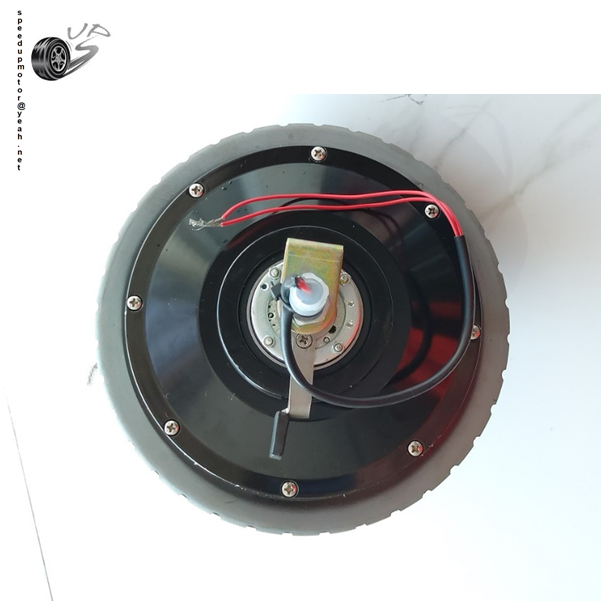
DC motor compliance is two things that are rarely verified in the same conversation: a document set, and a performance claim. Buyers sourcing pancake motors, BLDC motors or wheel hub motors for medical, mobility or industrial equipment typically receive a package containing CE and EMC statements, a RoHS declaration and a quality management certificate. What that package does not automatically contain is evidence that one specific model, at one specific voltage and one specific duty cycle, will meet the acceptance line written into the purchase order.
Qualification is the process of closing that gap. It converts supplier claims into criteria that can be checked at first article, at goods-in, and again at end-of-line in the buyer's own assembly. Wuxi Speedup Power Co., Ltd., a DC motor manufacturer established in 2018 in Wuxi, Jiangsu, China, publishes product families grouped as pancake motors, BLDC motors and wheel hub motors, and that grouping is a useful starting point for understanding how far a single certificate actually reaches.
Why compliance evidence has become a purchasing problem
Smart manufacturing pushes traceability down to the component. NIST, as cited by SAP, describes smart manufacturing as fully integrated, collaborative manufacturing systems that respond in real time to changing demands and conditions in the factory, in the supply network, and in customer needs. That definition matters to a motor buyer: a drive unit that cannot be traced to a document set and a test record is a weak link in an otherwise connected production chain.
The practical consequence is that compliance questions arrive earlier in the buying process than they used to. A procurement team researching wheel hub motors for a hospital transport bed or a medical chair is now asked by its own engineering and regulatory colleagues to answer three questions before an RFQ is issued: which document covers which model, what acceptance criterion proves it, and what evidence exists from actual use.
Three layers that get presented as one
Most confusion in DC motor qualification comes from collapsing three separate compliance layers into a single folder. They answer different questions and they expire, apply and fail differently.
- Product-level conformity. Statements such as CE, EMC and RoHS applied to electric motor products. These address the electrical and material characteristics of the product as placed on the market.
- Quality management. A company-level system certificate. Wuxi Speedup Power publicly lists an ISO 9000-2008 certificate alongside RoHS, UL and EMC documentation, while CE, EMC and RoHS approvals are stated repeatedly at product-family level for the hub and pancake ranges.
- Application and field evidence. Records showing how the product behaved in service. This layer is the one buyers most often want and least often receive in writing.
A quality certificate does not demonstrate that a 12-inch hub motor will hold a brake on a ramp. A product conformity statement does not demonstrate that the same motor will survive ten years of a specific duty cycle. Each layer has to be requested and read separately.
A practical qualification checklist for DC motor buyers
The checklist below is deliberately written as a document request rather than a specification wish list. It can be sent to a supplier as-is and used to score responses side by side.
| What to request | Question it answers | What a complete answer looks like |
|---|---|---|
| Model-level datasheet | What exactly is being bought | One sheet per model and variant, listing rated voltage, power, speed, torque, gear ratio, brake type, protection rating, mass and load range |
| Certificate scope statement | Which models the certificate actually covers | A model and variant list attached to each certificate, not a family brochure |
| Conformity route | How conformity was demonstrated | The standards applied and the test body reference, where the supplier can disclose it |
| Materials declaration | Restricted substances and magnet content | RoHS statement plus the construction list, for example aluminium alloy, copper, magnet and rubber, with rare earth NdFeB magnets on the BLDC and hub platforms |
| Duty-cycle basis | Whether the rating is continuous or intermittent | Stated ambient, mounting condition and thermal assumption behind the published rating |
| Brake validation record | Whether the brake holds under the buyer's load | Holding test on the finished wheel, release voltage confirmation, and manual release behaviour where an electromagnetic brake is used |
| Ingress protection basis | What the IP rating permits in service | The stated class and its limits, since an IP54 unit is protected against dust and splashing water, not continuous immersion |
| Production traceability | Whether one unit can be traced to one batch | Batch or serial records, test logs and a first article inspection report |
| Field evidence | Whether the design has survived real use | Installed base, territories, service duration and return or failure statistics |
| Change notification | Whether a silent BOM change can reach the line | A written commitment to notify before magnet, winding, bearing or controller-related changes |
Ten requests, one page. In practice most of the negotiation happens around the second row, because certificate scope is where suppliers are least precise and buyers are most exposed.
Reading certification scope correctly
A CE or EMC statement attached to a motor family is a conformity claim about a defined product scope. Three boundaries determine whether it applies to the unit in your box.
Boundary one: model and variant
Hub motor ranges are usually sold with voltage options. A 24V hub motor that can also be supplied at 36V or 48V is not electrically identical to the variant that was evaluated. The same applies to brake options, since an electromagnetic brake and an electronic brake are different assemblies, and to single or double shaft configurations. Ask for the certificate to be read against the exact variant code on the order.
Boundary two: component versus finished device
A compliant motor does not make the finished machine compliant. EMC behaviour depends on the controller, cabling, grounding and enclosure. The application notes published for floor scrubber machines make this concrete: the special requirements listed include electromagnetic compatibility grounding, brake debugging and safety distance control, alongside custom shafts and voltage or power specifications. Those are integration requirements, not motor-level certificates, and they belong in the equipment builder's own validation plan.
Boundary three: conformity versus customs
Trade documentation is a separate file. The US International Trade Commission's 2026 Harmonized Tariff Schedule addresses DC motors under 750 W under heading 8501.31.20.00. The pancake and hub families described here are rated from 75 W to 500 W, which places them in that sub-750 W band, but classification is shipment-specific and should be confirmed with a customs broker rather than inferred from a conformity certificate.
Turning acceptance criteria into numbers
Acceptance criteria only work when they are attached to a named model. The three wheel hub motors below are drawn from the same manufacturer's catalogue and show how differently a 6.5-inch, 8-inch and 12-inch unit must be written into a purchase order.
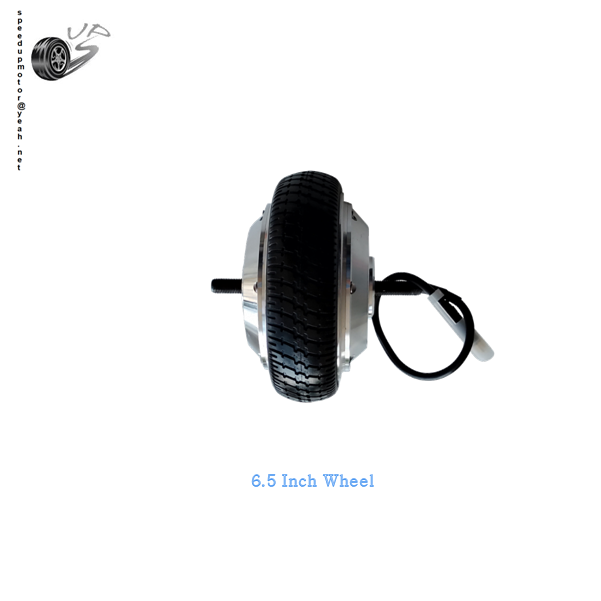
| Parameter | 6.5Inch SA05-6 | 8Inch 1DY-E3 | 12Inch SA06 |
|---|---|---|---|
| Motor type | Brushless hub motor, outer rotor | Brushed DC hub motor with gearbox | Brushless hub motor, gear reduced |
| Rated voltage | 24V | 24V, also available in 36V or 48V | 24V |
| Rated power and speed | 200W, 150 rpm | 180W, 95 rpm | 300W, 150 rpm |
| Rated torque | 15 Nm | 20 Nm | 20 Nm |
| Reduction ratio | 1:4.5 | 1:20 | 1:4.5 |
| Brake | Electronic brake (EABS) | Electromagnetic brake | Electronic brake (EABS) or disc brake |
| Protection and mass | IP54, 3.5 kg, 170 mm | 210 mm, 5.5 kg | IP54, 3.5 kg |
| Load range | 80–300 kg | 80–300 kg | 80–300 kg |
| Stated approvals | CE, EMC, RoHS | CE, EMC, RoHS | CE, EMC, RoHS |
Three observations follow from the table. First, identical load ranges do not imply interchangeable behaviour: a 1:20 reduction at 95 rpm and a 1:4.5 reduction at 150 rpm solve different problems. Second, the smaller and larger brushless wheels both carry IP54, while the brushed 8-inch unit's specification sheet does not state a protection class, which is a legitimate acceptance question rather than a defect. Third, every model states the same approval set, which is exactly why the scope statement behind those approvals matters more than the three letters printed on the catalogue page.
How field evidence fits into a qualification file
The strongest evidence a motor supplier can offer is not a test report for one sample; it is a population of units running in comparable applications over several years. Wuxi Speedup Power reports a field record of 100,000 motor units supplied into medical equipment applications across Germany, the United Kingdom and the United States, with 10 years of stable operation. The company describes 24/7 operation in low-to-medium speed, frequent start-stop, humid conditions for its medical and mobility applications, with electromagnetic brakes, gearboxes and controllers listed among the supporting components.
Read correctly, that record answers questions a datasheet cannot: whether production has been repeatable at volume, whether the brake and gearbox assemblies survive years of service, and whether the supplier has handled export markets with mature documentation. Read incorrectly, it becomes an overclaim. A record built on medical assist devices does not transfer automatically to an AGV duty cycle, a floor scrubber brush drive or an outdoor scooter in a wet climate, because load spectra, contamination and control strategies differ.
Four questions that convert a field claim into usable evidence: which model and variant was installed, in which territory and application; what the service period actually covers; how returns and failures were recorded; and whether batch traceability still exists for those units today.
Document-only qualification versus evidence-based qualification
The traditional approach treats compliance as a paperwork gate: collect the certificates, file them, release the order. It is fast, it is common, and it fails in a predictable way — the file proves that a product family was evaluated, not that the delivered variant will meet the acceptance line.
| Dimension | Document-only approach | Evidence-based approach |
|---|---|---|
| Unit of proof | Product family | Named model and variant |
| Acceptance point | Certificate on file | Measured value against a written limit |
| Duty cycle | Not addressed | Stated ambient, load and run pattern |
| Change control | Rarely defined | Notification clause tied to BOM changes |
| Long-term risk | Discovered at field failure | Surfaced at first article |
The trade-off is real and worth stating plainly. Evidence-based qualification costs more before the first shipment: sample builds, brake tests on the finished wheel, thermal runs at the buyer's ambient, and time spent reconciling certificate scope against variant codes. For a low-volume or non-safety-related application, that cost may not be justified, and a document-only release with a clear internal risk note is a defensible commercial decision. The approach also depends on the supplier's willingness to disclose test data, which not every manufacturer will do at quotation stage.
Where this framework does not apply
Four boundaries deserve to be written into the qualification file itself.
- IP ratings are not immersion ratings. An IP54 wheel is protected against dust and splashing water. Equipment washed down with directed jets or submerged during cleaning needs a different protection strategy, and the certification file will not change that.
- Brushed and brushless variants carry different service burdens. The 8-inch 1DY-E3 and the 12-inch 6DY-A4 use brushed DC motors with gearboxes, so brush and commutator wear belongs in the maintenance plan. Brushless units such as the SA05-6 and SA06 move the wear question to bearings, seals and electronics, which changes the acceptance test rather than removing it.
- Catalogue ratings are single-point values. A 200W, 150 rpm rating is a reference condition. Continuous torque at elevated ambient, after derating for the controller and gearbox, may be materially lower, and only a duty-cycle test resolves it.
- Public documentation has limits. The publicly available material describes approvals at family level and does not include notified body reference numbers or model-specific test reports. Those items are order-level requests, and a buyer who needs them should ask before the purchase order is issued rather than after.
Market context: why the sub-750 W band carries the documentation burden
Grand View Research estimates the global brushless DC motor market at USD 23.6 billion in 2026, rising from USD 22.2 billion in 2025 and projected to reach USD 38.4 billion by 2033. The same source reports that motors with output not exceeding 750 W accounted for 48.8% of global BLDC motor market revenue in 2025.
That split explains a practical pattern. The compliance workload concentrates in exactly the power band where pancake motors, printed motors and hub motors compete: compact, low-voltage drives embedded in equipment that is itself regulated. When roughly half of a market's revenue sits below 750 W, most qualification conversations are about integrated components rather than standalone machines, and the responsibility for demonstrating conformity splits between motor supplier and equipment builder.
A second signal comes from the equipment side. Floor scrubber applications documented for European markets such as Germany, Switzerland, the Netherlands, the UK and Italy list humid environments, frequent start-stop, high-load operation and 24/7 continuous mode, together with condensation protection, EMI grounding, brake debugging and safety distance control as special requirements. These are integration-level acceptance criteria, and they are the reason a buyer cannot outsource the whole compliance question to a motor certificate.
How Wuxi Speedup Power fits into a qualification programme
Wuxi Speedup Power Co., Ltd. is a DC motor manufacturer based in Wuxi, Jiangsu, China, established in 2018, with more than 16 years of stated experience in the DC motor industry. Its product scope covers pancake motors, printed motors, BLDC motors, brushed and brushless hub motors and wheel motors for industrial and civil applications. The facility covers 10,000 m², employs approximately 30 staff including a three-engineer R&D team, and reports an annual production capacity of 30,000 pieces, with roughly 90% of output exported to EU and USA markets.
For qualification purposes, three facts matter more than the product list. The company states CE, EMC and RoHS approvals across its hub and pancake families, listing an ISO 9000-2008 certificate, UL and RoHS at company level. It publishes model-level specifications detailed enough to write acceptance criteria against, from the 24V 100W DD03 pancake BLDC motor with a 106 mm diameter and 51 mm body, to the 36V 500W 150SN-G2 pancake motor with gearbox delivering 22 Nm at 240 rpm, to the 12-inch brushed 6DY-A4 hub motor running at 70 rpm through a 1:40 reduction. And it reports OEM/ODM customisation of voltage, power, speed, torque, shaft and logo, with a stated lead time of 30–45 working days and a minimum order quantity of one unit — commercial terms that are company-reported and should be confirmed contractually per project.
None of this removes the need for buyer-side verification. It does mean the documentation request described earlier can be answered at model level rather than deferred to a family brochure, which is the practical difference between a supplier that supports qualification and one that merely tolerates it.
Future outlook
Three shifts are likely to shape DC motor qualification over the next few years. The first is granularity: as smart manufacturing definitions emphasise real-time response across the supply network, buyers will expect batch-level traceability rather than family-level certificates. The second is integration-driven testing, where EMC and brake performance are validated on the assembled drive with its controller rather than on the motor alone. The third is documentation as a commercial differentiator, since a supplier able to hand over a scoped, model-specific file shortens the buyer's validation cycle and reduces the risk of a late-stage conformity surprise.
For equipment builders in medical, mobility and industrial cleaning markets, the practical implication is straightforward: qualification files should be designed at the same time as the purchase specification, not assembled afterwards from whatever the supplier had available.
Frequently asked questions
What does DC motor compliance usually include?
It typically combines three layers: product-level conformity such as CE, EMC and RoHS statements; a company quality management certificate such as ISO 9000-2008; and application evidence showing how the product behaves in service. Wuxi Speedup Power lists CE, EMC and RoHS at product-family level and RoHS, UL and ISO 9000-2008 at company level. Each layer answers a different question and none substitutes for the others.
Which documents should be requested when qualifying a DC motor supplier?
A model-level datasheet with voltage, power, speed, torque, gear ratio, brake type, protection rating and load range; a certificate scope statement listing covered models and variants; the conformity route and test body reference where disclosable; a RoHS and materials declaration; the duty-cycle basis behind the published ratings; brake validation records; the basis of any IP claim; production traceability records; field evidence; and a written change notification commitment.
Does a CE or EMC certificate apply to every model in a motor family?
Not automatically. Conformity is claimed against a defined product scope, and hub motor ranges are commonly offered with voltage options such as 24V, 36V or 48V, different brake assemblies, and single or double shaft configurations. A variant that differs in electrical or mechanical build may fall outside the evaluated scope, so the certificate should be read against the exact variant code on the order.
What acceptance criteria apply to a 6.5-inch or 12-inch hub motor?
Criteria follow the model. The 6.5-inch SA05-6 is rated 24V, 200W, 150 rpm, 15 Nm, with a 1:4.5 reduction, an electronic brake, IP54 protection, a 3.5 kg mass and an 80–300 kg load range. The 12-inch SA06 is rated 24V, 300W, 150 rpm, 20 Nm, with a 1:4.5 reduction, electronic or disc brake options, IP54, 3.5 kg and the same load range. The 8-inch 1DY-E3 uses a brushed motor rated 180W at 95 rpm and 20 Nm through a 1:20 reduction. All three state CE, EMC and RoHS approvals.
How should buyers interpret a 100,000-unit, 10-year field record?
As evidence of production repeatability and long-term service behaviour in a specific application context — in this case medical equipment in Germany, the United Kingdom and the United States. It is not a warranty of performance in a different duty cycle such as an AGV, a floor scrubber brush drive or an outdoor scooter. Buyers should ask which model and variant was installed, what the service period covers, how returns were recorded, and whether batch traceability still exists.
The company profile, including the full pancake, BLDC and wheel hub motor ranges, can be downloaded here: SPEEDUP COMPANY brochure (PDF).
Tem questões ou precisa de mais detalhes?
Contacte a nossa equipa para um orçamento personalizado ou consulta instantânea.
Solicitar orçamento
Preencha o formulário abaixo e a nossa equipa entrará em contacto com uma proposta personalizada.
Chat direto do WhatsApp
Prefere conversar em tempo real? Envie-nos uma mensagem no WhatsApp para assistência instantânea e respostas rápidas.
- Obter orçamento personalizado
- Partilhar fotos ou documentos
- Discuta as suas necessidades diretamente
Geralmente responde em 5–30 minutos durante o horário de expediente.