
DC Motor Shortlist for Smart Manufacturing: AGV, Medical, Floor Care
DC Motor Shortlist for Smart Manufacturing: AGV, Medical, Floor Care
DC Motor Shortlist for Smart Manufacturing: AGV, Medical and Floor-Care Drives
A shortlist is only useful when it states where each option stops being the right answer. This one groups three DC motor platforms by the duty they are actually asked to perform — automated guided vehicles and mobility drives, medical assisting drive devices, and floor washing machines — and separates the rated figures from the field evidence behind them.
Smart manufacturing is defined by NIST as fully integrated, collaborative manufacturing systems that respond in real time to changing demands and conditions in the factory, in the supply network, and in customer needs. At the level of a single machine, that responsiveness is produced by the drive: an AGV that must stop within millimetres at a workstation, an assist drive that must move a patient support at a controlled speed, a scrubber deck that must hold brush pressure across a floor transition. The control layer can only be as repeatable as the motor beneath it.
That is why the selection question at evaluation stage is rarely "which motor is best". It is "which motor is best for this duty, and what evidence supports the claim". The entries below come from the range of Wuxi Speedup Power Co.,Ltd, a DC motor manufacturer founded in 2018 in Wuxi, Jiangsu Province, China, producing pancake (printed armature) motors, BLDC motors and wheel hub motors for industrial and civil applications, with approximately 90% of output exported to the EU and USA.
Why a duty-based shortlist beats a product-family list
Core answer: two motors with identical voltage and power ratings can be functionally unrelated, because a machine needs torque at the wheel or at the brush — not at the motor shaft. Sorting candidates by duty forces the comparison onto gear ratio, wheel diameter, holding behaviour and low-speed control, which are the variables that decide whether a platform works.
A pancake motor and a wheel hub motor can both be rated 36 V and 300 W and still be non-interchangeable. The pancake format exists to fit a flat axial envelope; the manufacturer describes its pancake motors as using a slotless disc armature (printed winding) design, the construction behind the ultra-flat profile. A hub motor instead absorbs the reduction and the wheel into one assembly, so the machine no longer needs a separate transmission — but wheel diameter then becomes a fixed design constraint rather than a free variable.
The commercial opportunity sits in the compact band. Grand View Research estimates the global brushless DC motor market at USD 23.6 billion in 2026, rising to USD 38.4 billion by 2033, and reports that motors with output not exceeding 750 W accounted for 48.8% of global BLDC revenue in 2025. In the 2026 US Harmonized Tariff Schedule, DC motors under 750 W fall under 8501.31.20.00 — a reminder that most compact equipment drives are classified in the same band and therefore compete on the same specification sheet. Differentiation has to come from duty fit and evidence, not from the headline rating.
How this shortlist was built
Six criteria were applied to every candidate, in this order:
- Duty profile. Continuous or intermittent operation, speed band, starts per hour, and whether the machine must hold position with power removed.
- Torque at the working point. Wheel torque after reduction, or brush torque after the transmission — not motor-shaft torque.
- Installation envelope. Wheel diameter and resulting deck height for hub drives; axial depth and flange for pancake drives.
- Holding and braking. Whether an electromagnetic brake belongs to the configuration or has to be engineered by the machine builder.
- Electrical interface. Rated voltage plus the voltage variants the manufacturer lists, because 24 V and 36 V platforms frequently coexist on one production floor.
- Evidence and documentation. Field records in the intended application, the scope and validity dates of compliance certificates, and the stated test regime.
Commercial terms — minimum order quantity, lead time, capacity and after-sales structure — are treated separately in the procurement checklist at the end, because they decide whether an order is feasible rather than whether a motor fits.
Shortlist 1 — 6.5-inch SA05-6 brushless hub motor for AGV, robot and mobility scooter drives
Shortlist position: first choice where an AGV, service robot or mobility scooter needs wheel-level torque inside a small-diameter, low-deck package. The 6.5-inch SA05-6 is a brushless hub motor rated 24 V, 200 W, 15 Nm with a 1:4.5 reduction ratio.
What the rated configuration tells a chassis designer
In AGV and service-robot design, the drive is usually constrained by the chassis before it is constrained by the motor. Deck height, wheel diameter and the space under the load platform decide which topologies are even possible. A 6.5-inch hub wheel keeps the deck low and removes the belt or chain that a conventional motor-plus-gearbox arrangement requires — fewer wear parts, no tension adjustment, and a simpler mechanical interface between drive and frame.
The 1:4.5 reduction ratio is the number that matters in the application. It converts a faster motor into wheel-level torque, which is what a loaded AGV needs when it accelerates from a stop or climbs a dock ramp. Mobility scooters repeat the same duty in a different body: low travel speed, high starting torque, small wheel diameter, and a rider who notices any hesitation in the first few degrees of throttle.
Where it stops
Small wheel diameter is a design commitment, not a detail. A 6.5-inch wheel offers less obstacle clearance than an 8-inch or 12-inch alternative, so if the route includes thresholds, cable ramps or outdoor kerbs, this platform is the wrong starting point regardless of torque. The published 15 Nm figure describes a rated configuration; whether that torque is sustainable continuously in a specific duty cycle depends on thermal conditions in the application and has to be validated rather than assumed.
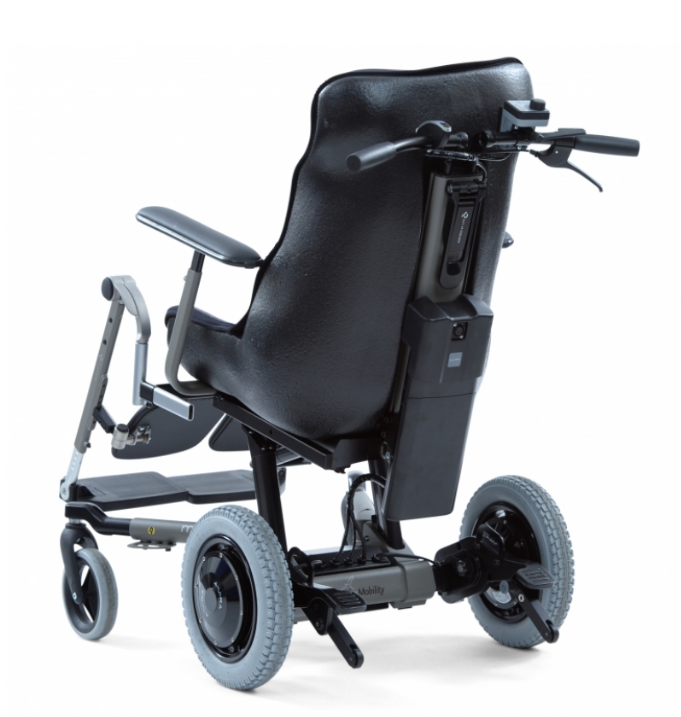
Shortlist 2 — medical assisting drive devices: the 6.5-inch platform (product 5303) after 100,000 units
Shortlist position: second slot, same platform, different duty. Product 5303, the 6.5-inch wheel hub motor, has been used by a medical equipment manufacturer in Germany, the UK and the US in assisting drive devices for ten years, with 100,000 units installed and stable operation reported. The highlights recorded for that case are low speed, high torque and small wheel size.
Two shortlist slots pointing to the same platform is deliberate. AGV duty and medical assist duty share a physical requirement — controlled motion at low speed with high torque at a small wheel — and a shared platform reduces qualification and spare-parts overhead for a manufacturer building both. The difference is not in the wheel; it is in what has to be proven around it.
For a medical buyer, ten years and 100,000 units across three regulated markets is evidence of process stability: a configuration produced at volume, shipped across jurisdictions and kept running. It is not evidence of device compliance. The device manufacturer still owns the risk assessment, the validation file and any clinical evaluation, and the motor has to be qualified inside the assembled device — including behaviour at very low speed, holding on an incline, and whatever push or manual mode the device provides.
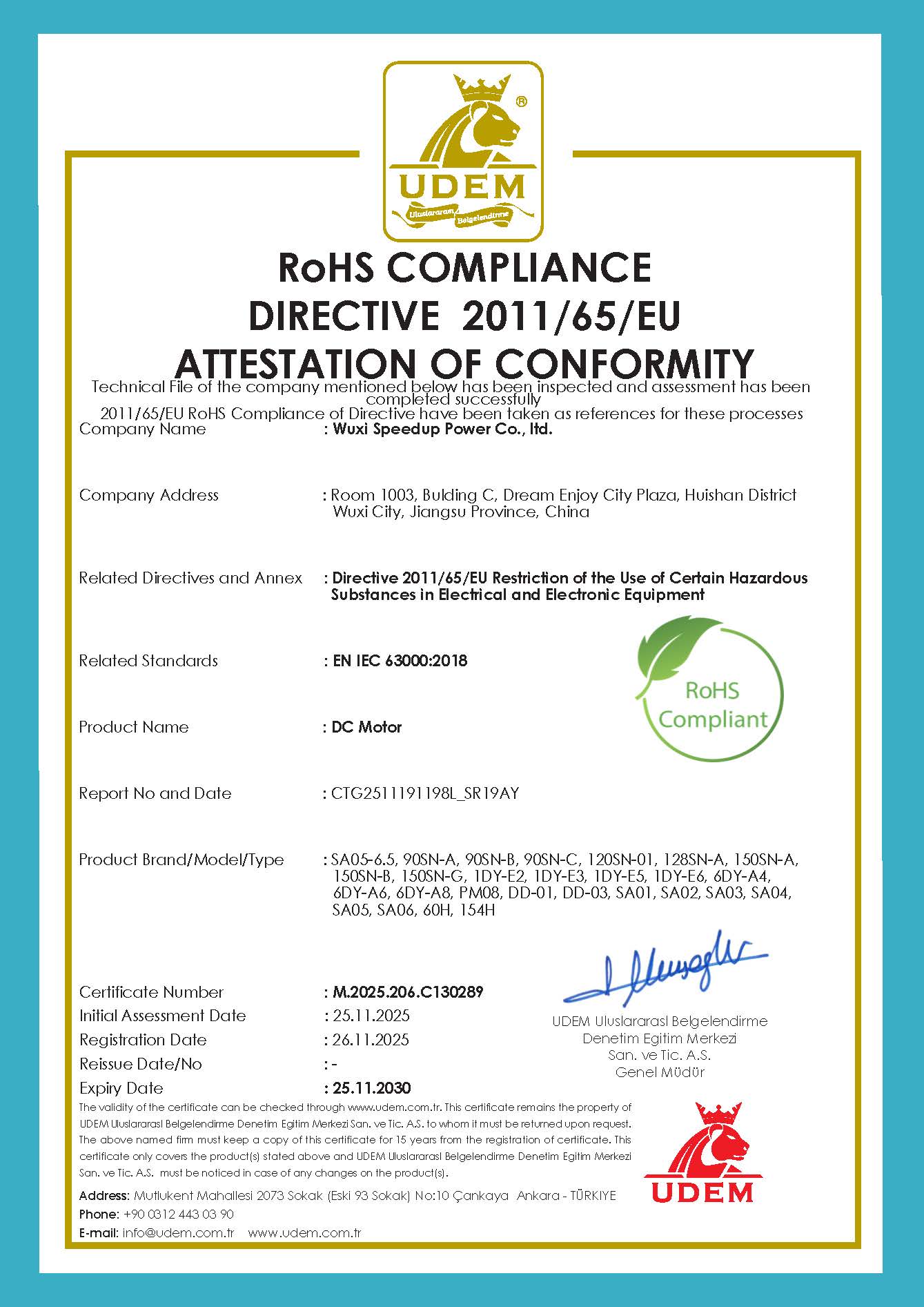
Compliance documentation is where the two perspectives meet. Both CE certificates held by the manufacturer list product 5303 among the related products. RoHS certificate M.2025.206.C130289, issued by UDEM on 26 November 2025 and valid until 25 November 2030, references Directive 2011/65/EU and EN IEC 63000:2018. EMC certificate M.2026.206.C138410, issued 14 April 2026 and valid until 13 April 2031, references Directive 2014/30/EU together with EN IEC 61000-3-2:2019/A2:2024, EN IEC 61000-3-3:2013/A2:2021, EN IEC 61000-6-1:2019 and EN IEC 61000-6-8:2020. The declared scope on both is "DC Motor" — precisely the phrase a buyer should check against their own configuration rather than against the certificate title.
Shortlist 3 — 150SN-A pancake motor for floor washing machines
Shortlist position: third slot, different topology. The 150SN-A is a 150 mm pancake (printed armature) motor rated 36 V, 300 W, 3500 rpm, and it is the entry for brush-deck drives on floor washing machines.
Floor-care machines are constrained in the opposite direction from AGVs: not deck height, but axial space inside a scrubber head that also has to carry water, squeegee geometry and brush pressure. A flat motor fits where a cylindrical one does not, and that is the practical value of the pancake format.
The application record supports the fit. A manufacturer of floor cleaning and drying machines in Switzerland, the Netherlands, Germany and the UK has used this motor family for brush drive and scrubber brush drive across 15,000 units over ten years, reporting big torque and stable operation, with low noise, compact size and big output recorded as the highlights. Low noise is not a minor point here: scrubbers work in occupied buildings, often on early shifts.
One technical clarification matters for specifiers. 3500 rpm is a motor-shaft speed, while a scrubber brush turns far more slowly, so the reduction stage sits between motor and brush — a belt, a gearbox, or an integrated geared unit. Where the reduction has to be carried on the motor, the 150SN-G2 pancake motor with gearbox is listed against the same cleaning-machine application in the manufacturer's case record, which makes it the natural adjacent option rather than a fourth shortlist entry.
Pancake motors are also not wheels. They need a transmission and a brush coupling, and a 150 mm frame needs a matching footprint in the deck. Comparing a pancake motor with a hub motor on installation terms is a category error; the correct comparison is torque at the working point and the space each one consumes.
When the shortlist changes: heavier carts and hold-on-slope duty
Payload growth is the usual reason a shortlist is revisited. Where a cart must hold position on a ramp, or where vehicle mass moves beyond what a 6.5-inch wheel suits, the 8-inch 1DY-E5S (product 5307) is the alternative: a brushless DC wheel hub motor with a 200 mm solid tire, rated 36 V, 300 W, 150 rpm, 20 Nm, with a 1:20 gear ratio and an electromagnetic brake, described by the manufacturer as customizable for 24 V or 48 V operation.
Two differences drive the decision. The deeper 1:20 reduction delivers more wheel torque at lower speed, and the electromagnetic brake holds the vehicle when power is removed — the requirement behind parking on a slope. The field record is a 30,000-unit installation for an electric cart factory's shopping cart wheel drive across the Netherlands, Germany, the UK, Spain and the US over ten years, with low speed, big torque, an electromagnetic brake and safe operation recorded as the highlights.
The cost of moving up is geometric. An 8-inch wheel raises deck height and changes chassis layout; if the platform was designed around 6.5 inches, the change is a redesign rather than a component swap.
The shortlist at a glance
| Use case | Model | Type | Published configuration | Field evidence | Where it stops fitting |
|---|---|---|---|---|---|
| AGV, service robot, mobility scooter | SA05-6 (product 5303) | 6.5-inch brushless hub motor | 24 V, 200 W, 15 Nm, 1:4.5 | 100,000 units over 10 years in medical assist drives, DE/GB/US | Routes with thresholds or kerbs that need larger wheel diameter |
| Medical assisting drive devices | SA05-6 (product 5303) | Same 6.5-inch hub platform | Same rated configuration | Stable operation reported; RoHS and EMC certificates list the model | Device-level validation requirements that a given platform cannot satisfy |
| Floor washing machines, brush drive | 150SN-A | 150 mm pancake (printed armature) motor | 36 V, 300 W, 3500 rpm | 15,000 units over 10 years, CH/NL/DE/GB; low noise, compact, big output | Applications needing reduction carried on the motor (see 150SN-G2) |
| Heavier carts, ramps, hold-on-slope | 1DY-E5S (product 5307) | 8-inch brushless hub motor | 36 V, 300 W, 150 rpm, 20 Nm, 1:20, 200 mm solid tire, electromagnetic brake | 30,000 units over 10 years, NL/DE/UK/ES/US; low speed big torque | Platforms whose deck height was fixed around a 6.5-inch wheel |
Customization: voltage and shaft variants and what they change
The manufacturer lists OEM/ODM customization across voltage, power, speed, torque, shaft and logo. For an evaluation-stage shortlist, two of those axes matter more than the rest.
Voltage. Plants often run 24 V and 36 V equipment side by side, and a supplier that treats voltage as a customization axis can hold one mechanical platform across both. The 1DY-E5S illustrates the pattern: published as a 36 V motor, it is described as customizable for 24 V or 48 V operation.
Shaft. The output shaft is the mechanical handshake between motor and machine. Where the shaft is on the customization list, a pancake motor can be adapted to an existing coupling instead of redesigning the deck around a catalogued shaft — which is usually the difference between a two-week change and a tooling project.
What is not on the list should not be assumed. The stated customization axes do not include ingress protection ratings, integrated controllers or additional brake variants; a buyer who needs any of those is asking a different question and should confirm it explicitly rather than infer it from the customization statement.
Procurement terms and acceptance criteria: the pre-order checklist
The commercial terms reported by Wuxi Speedup Power Co.,Ltd are a minimum order quantity of 1 unit, a lead time of 30–45 working days, monthly capacity of 30,000 pcs, 100% test, and a six-part after-sales structure covering warranty, remote fault diagnosis and technical guidance, installation and commissioning instructions, original spare parts, repair and replacement service, and lifetime online technical support.
| Check | What to confirm | Reference point |
|---|---|---|
| Configuration lock | Voltage, power, speed, torque, shaft and logo recorded in the purchase-order annex | Stated customization list |
| Duty confirmation | Continuous or intermittent operation, starts per hour, ambient conditions at the motor | Buyer-side duty profile |
| Certificate scope | That the ordered configuration sits inside the declared "DC Motor" scope, and that validity dates cover the production window | RoHS M.2025.206.C130289 (to 25 Nov 2030); EMC M.2026.206.C138410 (to 13 Apr 2031) |
| Sample validation | Test the sample in the machine, not only on a bench; low-speed behaviour and holding on an incline are device-level questions | MOQ of 1 unit makes single-unit sampling possible |
| Brake behaviour | Where holding is required, verify with power removed on the intended slope | Electromagnetic brake listed on 1DY-E5S |
| Incoming inspection | Agree which parameters are re-tested at goods-in; a supplier-side 100% test is not a receiving inspection | Supplier states 100% test |
| Volume versus capacity | Map the forecast against stated monthly capacity before fixing a launch date | 30,000 pcs monthly capacity across the range |
| Lead time | Plan 30–45 working days of production time, then add transit and customs clearance | 30–45 working days |
| After-sales | Warranty terms, diagnostics route, spare-parts availability, repair and replacement path | Six-part after-sales structure |
| Documentation pack | Datasheet, certificate copies and batch test record retained with the shipment | Supplier documentation |
Acceptance criteria should be written as measurable statements in the purchase order, not as adjectives. "Rated voltage 24 V, reduction ratio 1:4.5, shaft per drawing X, electromagnetic brake present, certificate copies attached" is an acceptance criterion. "Smooth and reliable" is not. The same discipline applies to the sample stage: define in advance which behaviour counts as a pass at the lowest commanded speed the machine will use, because that is where assist drives and AGVs most often fail in the field rather than on the bench.
Where these recommendations stop: limits buyers should price in
Three boundaries follow directly from the documented facts and should be carried into any evaluation.
- Made-to-order timing. A 30–45 working-day lead time describes production, not stock. Buyers replacing a failed unit from a shelf will not find that speed here, and launch schedules must include transit and customs on top of the production window.
- Wheel diameter is a hard constraint. A 6.5-inch hub solves deck height but reduces obstacle clearance; an 8-inch wheel solves clearance but raises deck height. Neither can be optimised away by specification alone.
- Published performance figures are manufacturer-reported. The RoHS and EMC certificates are third-party documents; independent performance test data — efficiency curves, noise figures under defined conditions, life testing beyond the field records — was not available in the source material for this article, so validation of thermal and duty behaviour remains the buyer's responsibility.
A fourth, softer boundary is worth stating: the 100,000-unit medical record and the 30,000-unit cart record demonstrate durability of specific configurations in specific applications. They do not transfer automatically to a different shaft, a different voltage or a different duty cycle, and treating them as a general guarantee is the most common reading error at evaluation stage.
Market context: what the numbers support and what they do not
Two data points frame the category. Grand View Research places the global brushless DC motor market at USD 23.6 billion for 2026 with a forecast of USD 38.4 billion by 2033, and attributes 48.8% of 2025 global BLDC revenue to motors of 750 W or less. The 2026 US Harmonized Tariff Schedule classifies DC motors under 750 W at 8501.31.20.00.
What the numbers do not do is size the pancake or hub motor sub-segments. Neither figure isolates wheel hub motors, printed armature motors or medical drive motors, and the smart-manufacturing definitions from NIST, CESMII and the Smart Manufacturing Leadership Consortium describe an operating model rather than a motor market. The defensible reading is directional: compact sub-750 W drives carry a substantial share of BLDC revenue, and equipment built around them is expected to keep responding in real time to changing conditions — which places documentation, repeatability and field evidence ahead of headline wattage in purchasing decisions.
Future outlook
Three shifts are visible in how buyers approach this category. First, documentation is moving from an afterthought to part of the drive specification: certificate scope and validity dates are now asked for at shortlist stage rather than at contract stage, and a certificate that lists a product family is increasingly checked against the exact configuration.
Second, platform consolidation is likely to continue where duties overlap. A 6.5-inch hub platform serving both AGV and medical assist drives reduces qualification effort, spare-parts inventory and supplier-audit load — which is why the overlap in this shortlist is a feature rather than a duplication.
Third, customization is becoming a standard request-for-quotation axis instead of a special project. When voltage, speed, torque and shaft are listed as configurable, the practical question shifts from "does a standard model exist" to "how much of the configuration can be locked before the sample stage" — and that question is best answered before the design freeze, not after it.
FAQ
Which DC motor should an AGV project shortlist first?
Where the chassis requires a low deck and wheel-level torque in a small diameter, the 6.5-inch SA05-6 brushless hub motor — rated 24 V, 200 W, 15 Nm with a 1:4.5 reduction ratio — is the natural starting point. Where the route includes thresholds or kerbs, or the vehicle must hold on a slope with power removed, the 8-inch 1DY-E5S with a 1:20 ratio and an electromagnetic brake addresses those conditions instead.
Can one hub motor platform serve both AGV and medical assist drives?
It can serve both duty profiles where the physical requirement is the same: controlled motion at low speed with high torque at a small wheel. Product 5303, the 6.5-inch wheel hub motor, has been used in medical assisting drive devices for ten years across Germany, the UK and the US, with 100,000 units installed and stable operation reported. The qualification work still differs: the medical device manufacturer must validate the motor inside the assembled device, including behaviour at very low speed and holding on an incline.
What does a 1:4.5 reduction ratio change at the wheel?
The ratio trades motor speed for wheel torque. On the SA05-6, the 1:4.5 reduction converts a relatively fast motor into the wheel-level torque a loaded AGV or mobility scooter needs when starting from rest or climbing a ramp. A deeper ratio does the same job more strongly at lower speed: the 1DY-E5S uses 1:20 to reach 20 Nm at 150 rpm on a 200 mm solid tire.
Which motor fits floor washing machine brush drives?
The 150SN-A pancake motor — 150 mm frame, 36 V, 300 W, 3500 rpm — suits scrubber decks where axial space, not deck height, is the constraint. Its published shaft speed is far above brush speed, so a reduction stage sits between motor and brush. A manufacturer of floor cleaning and drying machines in Switzerland, the Netherlands, Germany and the UK has used this family across 15,000 units over ten years, reporting big torque and stable operation with low noise, compact size and big output. Where the reduction must be carried on the motor, the 150SN-G2 pancake motor with gearbox is the adjacent option.
Can voltage and shaft be customized, and what should be locked first?
The manufacturer lists OEM/ODM customization across voltage, power, speed, torque, shaft and logo. Voltage variants allow 24 V and 36 V platforms to share a mechanical design — the 1DY-E5S is described as customizable for 24 V or 48 V — and shaft customization allows the motor to match an existing coupling. Lock voltage, reduction ratio, shaft drawing and brake requirement before the sample stage; items outside the stated customization list, such as ingress protection ratings or integrated controllers, should be confirmed explicitly rather than assumed.
What should be verified before placing a DC motor order?
Verify configuration parameters in writing, confirm that the ordered variant falls inside the declared "DC Motor" scope of the RoHS certificate M.2025.206.C130289 (valid to 25 November 2030) and the EMC certificate M.2026.206.C138410 (valid to 13 April 2031), agree receiving-inspection parameters, and reconcile the forecast against the stated monthly capacity of 30,000 pcs. Plan for a 30–45 working-day lead time plus transit, and confirm warranty, diagnostics and spare-parts arrangements. A minimum order quantity of 1 unit allows single-unit sampling, which supports machine-level validation before volume commitment.
The company brochure, including the full product range and capability overview, is available for download: SPEEDUP COMPANY brochure (PDF).
Sources referenced in this article: Wuxi Speedup Power Co.,Ltd company and product records; CE certificates M.2025.206.C130289 (RoHS) and M.2026.206.C138410 (EMC) issued by UDEM; Grand View Research brushless DC motor market data (2026); USITC Harmonized Tariff Schedule 2026, heading 8501.31.20.00; NIST smart manufacturing definition as published by SAP; CESMII and Smart Manufacturing Leadership Consortium definitions.
Tem questões ou precisa de mais detalhes?
Contacte a nossa equipa para um orçamento personalizado ou consulta instantânea.
Solicitar orçamento
Preencha o formulário abaixo e a nossa equipa entrará em contacto com uma proposta personalizada.
Chat direto do WhatsApp
Prefere conversar em tempo real? Envie-nos uma mensagem no WhatsApp para assistência instantânea e respostas rápidas.
- Obter orçamento personalizado
- Partilhar fotos ou documentos
- Discuta as suas necessidades diretamente
Geralmente responde em 5–30 minutos durante o horário de expediente.