
DDW Display: A Manufacturer Profile for LED Display Buyers
The global LED display market is projected to grow from USD 20.73 billion in 2026 to USD 26.98 billion by 2031, according to Mordor Intelligence. That scale explains why LED display procurement has become a recurring task for advertising operators, event companies, sports venue owners, and corporate facility teams. But market size also creates a sourcing challenge: how do buyers distinguish between a stable manufacturer and an assembly-only supplier?
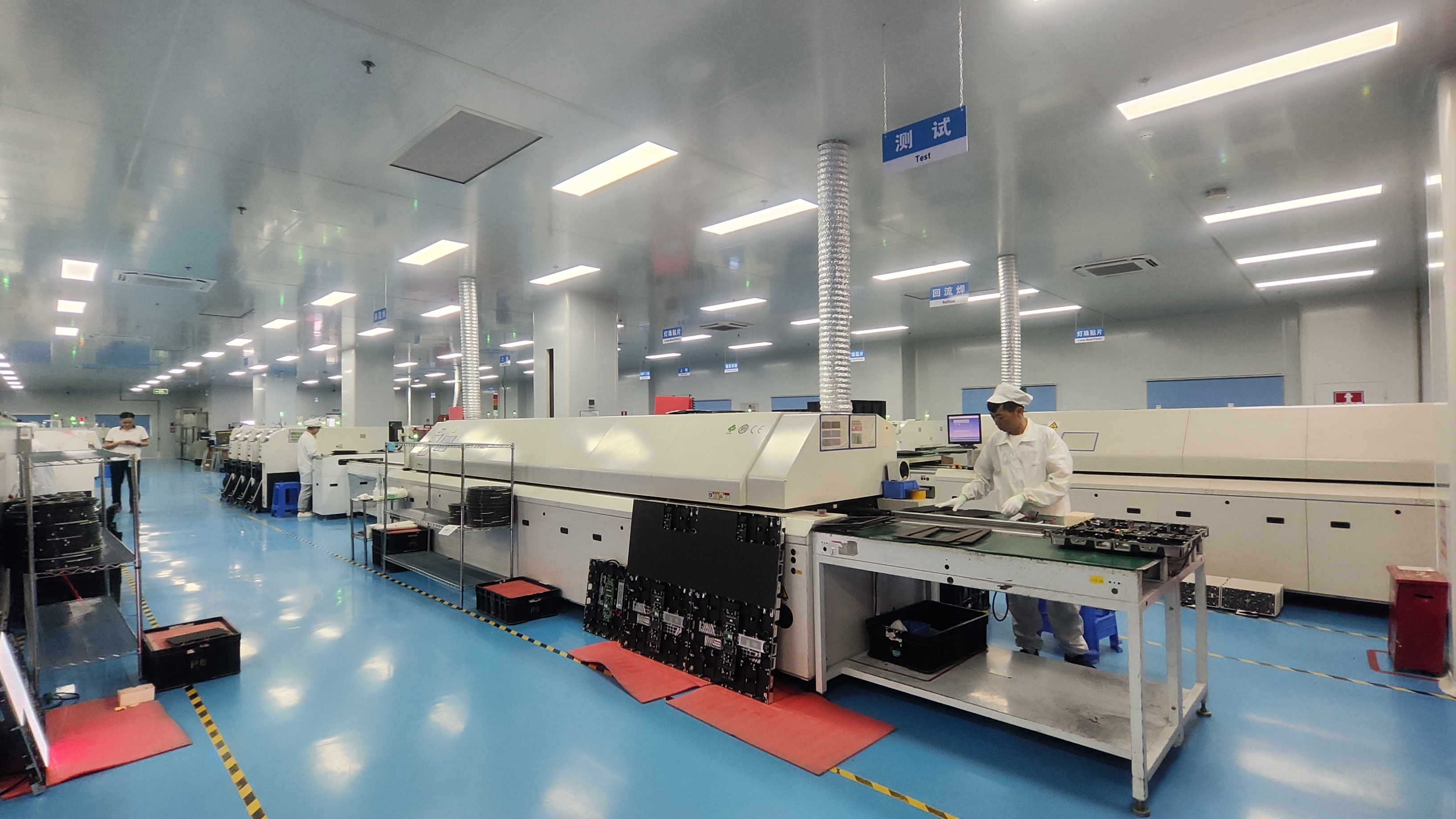
SMT workshop inside the DDW Display manufacturing facility in Shenzhen.
Why Manufacturer Depth Matters for LED Display Buyers
An LED display is not a simple off-the-shelf component. It is a system involving LED modules, driver ICs, power supplies, receiving cards, steel structures, control software, and environmental protection. For buyers, the supplier assessment should go beyond the final screen price and include manufacturing capability, quality control, R&D depth, global delivery track record, and long-term service reliability.
In the fast-growing LED display industry, many brands operate as trading companies or assembly workshops. A manufacturer that owns its SMT production, aging test process, and quality inspection system can provide more predictable consistency. This is particularly important for rental screens, outdoor billboards, and fine-pitch indoor video walls where failure rates and maintenance costs can dominate the total cost of ownership.
DDW Display: A Professional Export-Oriented Manufacturer
Shenzhen DDW Technology Co., Ltd. (DDW DISPLAY) is a Chinese LED display manufacturer established in 2012. The company specializes in indoor fine pitch LED displays, outdoor LED displays, rental LED screens, COB LED displays, XR virtual production LED walls, LED posters, stadium LED displays, and commercial LED video walls.
DDW DISPLAY operates a 10,000-square-meter manufacturing facility with approximately 100 employees and an R&D team of 15 engineers. The company reports an annual production capacity of about 800,000 units. Around 95% of its products are exported, with delivery track record covering more than 120 countries and regions across North America, Europe, the Middle East, Asia-Pacific, Latin America, and Africa.
A third-party supplier profile lists DDW Display's annual sales in the range of USD 4 million to USD 5 million, with an export ratio of 90% to 100%. This scale positions DDW as a mid-sized, export-oriented manufacturer rather than a tier-1 global brand. For buyers, this means the company offers manufactory-direct pricing and custom flexibility, but regional after-sales service and spare-part stocking should still be verified before large commitments.
Core Capabilities: In-House Production and Quality Control
One of DDW Display's measurable advantages is that it performs in-house manufacturing and quality verification. The company's published factory operations include SMT workshops, warehouse management, and aging test procedures. It also states that every LED display undergoes comprehensive quality inspection before shipment.
From a procurement perspective, this is a relevant signal. In-house SMT production reduces dependence on external module suppliers, while aging tests help weed out early component failures before delivery. For rental companies and event producers that repeatedly assemble and dismantle cabinets, unit-level reliability directly affects show continuity and operating cost.
Product Portfolio Analysis
DDW Display's portfolio covers most major LED display categories in the market. The following table summarizes the product families referenced in the company's technical documentation.
| Series | Application Focus | Key Technical Attributes |
|---|---|---|
| DIP Series | Outdoor billboards and long-distance advertising | 8000-10000 cd/m² brightness; IP65; 3840Hz refresh rate |
| LUXIS Series | Premium outdoor fixed LED displays | 10000 nits; contrast up to 30000:1; refresh rate ≥7680Hz |
| NOVA Series | Lightweight outdoor commercial displays | 3.7kg cabinet; 60mm thickness; IP65 |
| FC / FA Series | Outdoor fixed installations and billboards | Up to 10000 nits; IP65; front and rear maintenance |
| HK Series | Indoor fine-pitch video walls | P1.25 to P2.5; front maintenance; 3840Hz refresh rate |
| FU Series | Ultra-thin indoor LED screens | 1000x250mm cabinet weighs 6.4kg; 7680Hz refresh rate |
| QDCOB Series | Fine-pitch COB displays for conference and control rooms | Quantum dot COB; P0.78 to P1.5625; 180-degree viewing |
| AXIS / AXIS Flex Series | Rental LED displays for stage, event, and creative structures | 500x500mm cabinet; 7.5kg to 8.5kg; 7680Hz refresh rate; curved installation |
| ORBIT Series | XR virtual production LED walls | P1.25 to P4.81; camera-friendly high refresh rate |
| TI / TAD Series | Transparent LED displays for retail and architecture | High transparency; lightweight; glass integration |
| SPPro / SPPLUS Series | Stadium perimeter LED displays | IP65; protective soft mask; high brightness outdoor |
| FL / NOVA Flex Series | Flexible and curved LED displays | Bending radius from flexible modules; creative shape installation |
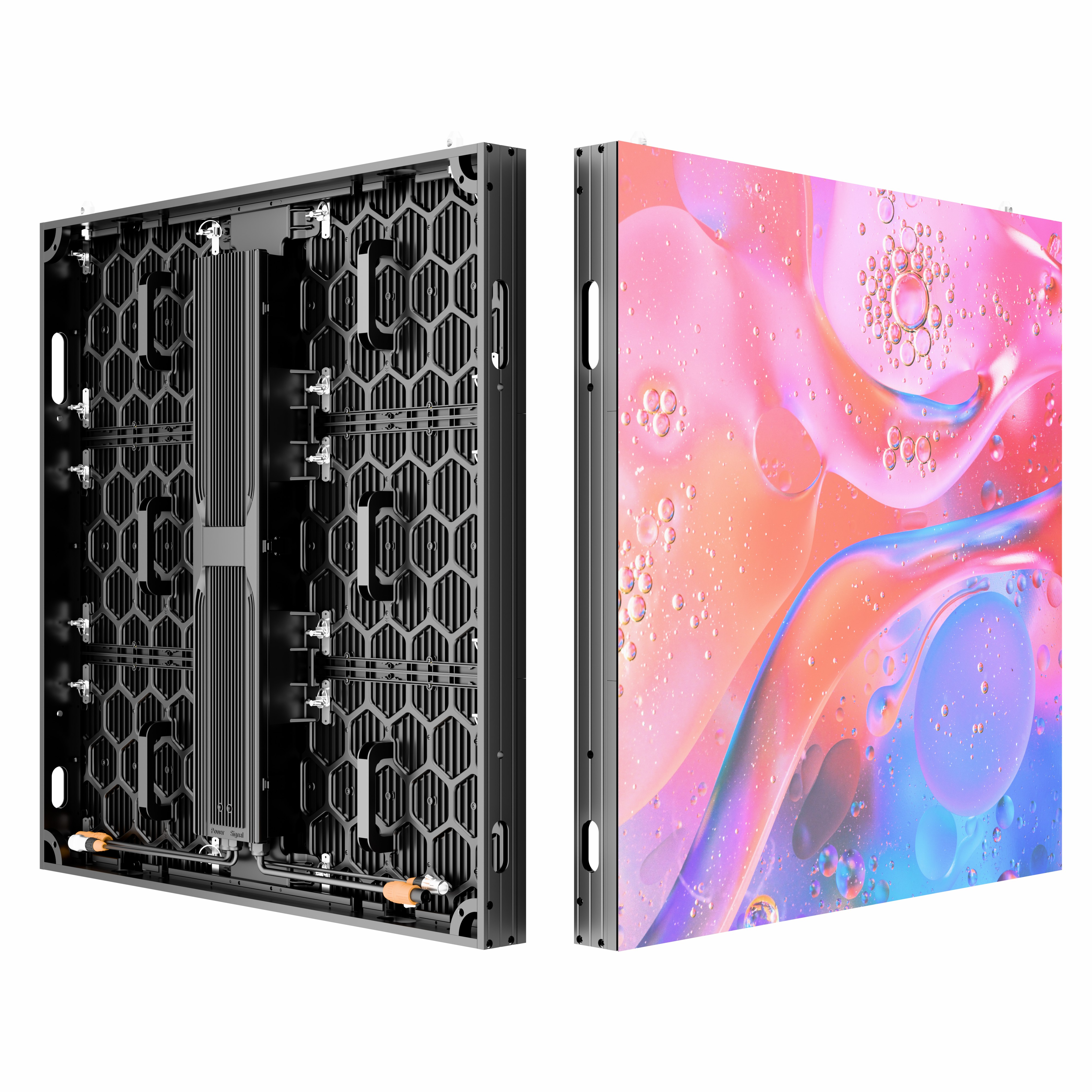
DDW Display LUXIS Series outdoor LED display product view.
Technical Explanation: How DDW Product Lines Address Different Buying Criteria
For close-viewing indoor environments such as conference rooms, control rooms, and luxury showrooms, fine pixel pitch is the primary deciding factor. DDW offers the HK Series with P1.25 to P2.5 options and the QDCOB Series with P0.78 to P1.5625. Fine-pitch displays provide higher pixel density, which is necessary when viewers sit within 2 to 3 meters of the screen. The QDCOB Series further improves impact resistance and color consistency through COB integrated packaging and quantum dot technology.
For rental and stage applications, cabinet weight, assembly speed, and high refresh rate are critical. The AXIS Series uses die-casting aluminum cabinets with quick-lock structures and 7680Hz refresh rate. This supports fast installation, dismantling, and camera-friendly visuals for live events and broadcasting. The AXIS Flex Series adds concave and convex splicing for curved stage backdrops. The A Series and D Series also provide indoor and outdoor versions with IP65 protection for outdoor stages and festivals.
For outdoor advertising, brightness and environmental protection are the main evaluation points. The LUXIS, FC, FA, and DIP Series all support high brightness levels up to approximately 10,000 nits, with IP65 waterproof and dustproof protection. The NOVA Series is designed for lightweight outdoor installations where structural load and installation cost are concerns.
Application and Use Cases
Outdoor Advertising and Digital Signage
Outdoor LED billboards, building facade displays, and retail signage require 24/7 operation, direct sunlight visibility, and weather resistance. DDW's outdoor series are positioned for these conditions, with high brightness, IP65 protection, and front and rear maintenance options. The DIP Series serves traditional long-distance billboards, while the LUXIS Series targets high-end commercial advertising projects with premium contrast and higher refresh rate.
Rental and Live Event Production
Concerts, corporate events, exhibitions, and sports events need screens that can be transported and assembled quickly. Rental LED displays from DDW, including the AXIS, A, D, and AFLEX Series, emphasize lightweight cabinets, fast locks, flexible hanging or stacking, and high refresh rates for professional camera work. The ORBIT Series is a separate line designed for XR virtual production studios, where the LED wall must appear smooth on camera and support realistic digital backgrounds.
Corporate and Control Room Display Systems
For indoor fixed installations such as conference rooms, control rooms, and corporate showrooms, fine-pitch LED displays are replacing traditional LCD video walls because they offer seamless splicing with no bezels. DDW's HK, FU, and QDCOB Series provide high resolution, 3840Hz to 7680Hz refresh rates, and front maintenance access. The low-brightness high-gray-scale capability of the HK Series is relevant for environments where operator comfort matters.
Sports Venues and Stadium Perimeter Advertising
Stadium perimeter displays face impact risk from athletes and balls. DDW's SPPro and SPPLUS Series include protective soft mask designs, full aluminum cabinets, and IP65 protection. These features address the safety and durability requirements of professional sports venues while supporting broadcast-friendly high refresh rate performance.
Market Trend and Evidence
The global LED display market is projected to reach USD 20.73 billion in 2026 and expand to USD 26.98 billion by 2031. China's LED display market is projected to reach 660 billion RMB in 2024 with a CAGR of 15.79%, outpacing the global average according to Mordor Intelligence. These numbers indicate that LED display demand is not limited to one region; both advertising replacement cycles and new digital infrastructure projects are driving growth.
The rental LED display segment also has a positive outlook. The market was valued at approximately USD 5 billion in 2020 and is forecast to exceed USD 8 billion by 2027, based on data from Allied Market Research cited in secondary sources. This supports the relevance of DDW's rental-focused AXIS and A Series lines.
At the technology frontier, the Micro-LED market is expected to grow at a CAGR of 77.4% from 2024 to 2030, reaching a projected USD 25.65 billion. DDW's participation in COB fine-pitch and XR LED wall production is aligned with this shift toward higher pixel density and more demanding application environments. In addition, transparent LED displays can achieve energy savings of 30% to 40% compared with traditional LEDs, often complying with ISO 50001 energy standards. DDW's TI and TAD Series enter this category, offering buyers a path to more energy-efficient glass-facing advertising.
Comparison with Traditional Solutions
Compared with traditional LCD video walls, LED displays provide seamless splicing, higher brightness, modular scalability, and longer lifespan in large-format installations. However, for very small screen sizes or low-resolution indoor signage, LCD may still be more cost-effective and easier to service. LED displays also require more careful thermal management and calibration for consistent color across modules.
Within LED display technology, traditional DIP packaged screens offer high brightness and robust outdoor performance but typically have larger pixel pitch and limited close-viewing resolution. SMD and COB technologies enable finer pixel pitch and better close-range image quality. COB displays provide higher protection against physical damage but generally carry a higher cost, making them more suitable for premium spaces such as control rooms, broadcast studios, and high-end conference rooms.
A reasonable boundary for DDW Display is its global service footprint. While the company can deliver to over 120 countries, it is not a tier-1 brand with extensive overseas service centers. Buyers planning large fixed installations should confirm regional technical support, spare part availability, warranty terms, and commissioning support in advance. For rental buyers, the same due diligence applies to replacement module availability during touring seasons.
Future Outlook
The LED display industry is moving toward finer pixel pitch, COB and Micro-LED packaging, XR-ready high refresh rate walls, transparent displays, and energy-efficient designs. DDW Display's product portfolio already covers these directions, and the company's continued R&D investment and in-house manufacturing capability should help it respond to changing buyer requirements.
For procurement teams, the more important trend is supplier verification. As LED display projects become more technically complex, buyers benefit from working with manufacturers that can show production evidence, product specifications, inspection procedures, and real project experience. DDW Display's factory data, quality inspection statement, and export track record provide a baseline that can be verified through reference projects and sample testing.
FAQ
How do I choose the right pixel pitch for an LED display?
Choose the LED display pixel pitch according to viewing distance, screen size, required resolution, installation environment, content type, and budget. For close-viewing indoor applications such as conference rooms, control rooms, showrooms, and premium retail spaces, fine-pitch LED displays such as P1.25, P1.53, and P1.86 are generally more suitable. For stages, exhibitions, events, and medium-distance viewing, P2.6 to P3.91 configurations are commonly considered. Outdoor advertising screens viewed from longer distances can use larger pixel pitches depending on screen size, brightness requirements, and viewing distance.
Rental LED Display vs Fixed LED Display: Which one should I choose?
Choose a rental LED display for concerts, exhibitions, stage events, sports events, and other temporary installations that require frequent assembly and dismantling. Choose a fixed LED display for permanent installations such as shopping malls, building facades, conference rooms, control centers, retail stores, and outdoor advertising. Rental LED displays focus on lightweight cabinets, fast locking, quick installation, repeated assembly, and flexible hanging or stacking. Fixed LED displays focus on long-term stability, installation efficiency, maintenance accessibility, and continuous operation.
What certifications should I look for when buying an LED display?
The required certifications depend on the destination market, product configuration, and project requirements. For international LED display projects, buyers commonly evaluate certifications and compliance standards such as CE, FCC, RoHS, ETL, and EMC. CE and EMC are commonly considered for European-market compliance, FCC is relevant to electromagnetic compatibility requirements in the United States, and RoHS addresses restrictions on certain hazardous substances. Buyers should confirm which certifications apply to the specific LED display model and destination market, and request the corresponding certificates or test reports from the manufacturer.
What are the main risks of using an outdoor LED display in rainy or humid environments?
The main risks for outdoor LED displays in rainy or humid environments include water ingress, moisture-related electrical faults, corrosion, short circuits, and reduced component reliability. For outdoor projects, choose an LED display with an appropriate IP protection rating and a waterproof cabinet and module structure. Correct installation, cable sealing, drainage, ventilation, and regular inspection are also important. Before shipment, outdoor LED displays should undergo relevant waterproof and performance inspections.
How do I safely power on and operate an LED display?
Before powering on an LED display, check the power supply, signal cables, grounding, cabinet connections, and control system to make sure all components are properly connected. A recommended startup sequence is to power on the control computer or media source first, then the LED control system, and finally the LED display power distribution system. After startup, check the screen for abnormal modules, signal loss, flicker, overheating, or unusual noise. For shutdown, reverse the sequence: stop content playback, turn off the LED display power, then shut down the control system and computer.
For complete specifications and product details, the company's official LED display catalog is available for public access and download: DDW LED Display Catalog 2026.
Tem questões ou precisa de mais detalhes?
Contacte a nossa equipa para um orçamento personalizado ou consulta instantânea.
Solicitar orçamento
Preencha o formulário abaixo e a nossa equipa entrará em contacto com uma proposta personalizada.
Chat direto do WhatsApp
Prefere conversar em tempo real? Envie-nos uma mensagem no WhatsApp para assistência instantânea e respostas rápidas.
- Obter orçamento personalizado
- Partilhar fotos ou documentos
- Discuta as suas necessidades diretamente
Geralmente responde em 5–30 minutos durante o horário de expediente.