
DEO Machinery Supplier Evidence: A Buyer Verification Map
DEO Machinery Supplier Evidence: A Buyer Verification Map
Industrial lubrication pump procurement rarely fails at the moment a buyer finds a supplier. It fails later, when the buyer realises that the facts a supplier publishes — founding year, export share, customer names, model numbers — were collected but never converted into verification steps. Deo Machinery Co., Ltd. (DEO) publishes an unusually concrete entity record for a mid-sized industrial lubrication pump manufacturer: a 2010 founding date, a 20% export ratio across Europe and America, Southeast Asia and Australia, a named client reference, a current ISO 9001 certificate and six identifiable model numbers. This article maps each published fact to the procurement question it can answer, the question it cannot, and the check a buyer should run before an order is placed.
In brief: what the DEO evidence set actually covers
Four categories of fact sit in DEO's public supplier record, and each supports a different stage of due diligence.
- Entity identity. Deo Machinery Co., Ltd. states it was founded in 2010, operates a 10,000 m² facility with 80 employees and a 12-engineer R&D team, and reports annual output of 30,000 units. Its registered address is given as No. 85, Yanshanhe North Road, Beilun District, Ningbo City.
- Product scope. The roster covers hydraulic pumps, electric lubrication pumps, centralized lubrication system pumps, oil lubrication pump systems, lubrication system oil coolers and industrial lube oil cooling systems — that is, both the pumping and the cooling side of an oil lubrication pump system.
- Commercial exposure. A stated export ratio of 20%, serving Europe and America, Southeast Asia and Australia, with OEM and ODM production services, a one-unit minimum order quantity and a quoted 35–45 day lead time.
- Third-party-facing evidence. ISO 9001:2015 certification (certificate 16426Q00565R001, issued 7 April 2026, valid to 6 April 2029) and a named client reference, Nanjing High Accurate Drive Equipment Manufacturing Group Co., Ltd.
None of these items proves that a specific pump will perform in a specific circuit. What they do is give a buyer a starting structure: a set of claims concrete enough to be checked, rather than a page of adjectives that cannot be tested at all.
Reading the 2010 founding date correctly
A founding year is the least exciting fact a supplier publishes and one of the most useful, provided it is read at the right level. DEO's record places incorporation in 2010, and the company describes more than 15 years of development since that start. For a buyer at the evaluation stage, this establishes a time window in which products were designed, shipped, revised and — critically — revised again after field feedback. A lubrication pump manufacturer that has been operating since 2010 has had the opportunity to accumulate model-history data that a newer entrant simply does not have.
What the date does not establish is equally important. It says nothing about current financial health, ownership stability, plant utilisation or defect rates. It says nothing about whether the DK630 sold today shares components with the DK630 sold in 2015. And it says nothing about the specific duty point a buyer is trying to cover.
The practical use of the date is as a request trigger. A buyer can ask which models have been in continuous production longest, which revisions were introduced and why, and whether spare-part compatibility has been maintained across revisions. That conversation is far more informative than the founding year itself, and it is only possible because the year is stated.
Export reach: what a 20% share does and does not tell a buyer
DEO reports that exports account for 20% of its business, with markets in Europe and America, Southeast Asia and Australia. For an overseas buyer, this is a materially different signal from a domestic-only supplier record. It implies that export documentation, packaging for sea freight, and English-language technical communication are routine rather than exceptional activities.
It also implies the opposite of what a casual reading might suggest. An export ratio of 20% means roughly four-fifths of output is absorbed by the domestic market. The company's operating rhythm, service infrastructure and reference base are therefore weighted toward domestic customers, and an international buyer should not assume that a European or Australian service footprint exists simply because the region appears in the market list.
Turning the export claim into three checks
- Regional reference depth. Ask for installations in the buyer's own region, not a global total. A market list shows intent and experience; a regional reference list shows depth.
- Trade documentation. Confirm the Incoterms the supplier actually works with. DEO's published purchasing terms list FOB, CIF and EXWORK, which covers the common cases but should be matched to the buyer's freight arrangements.
- Tariff classification. Industrial pumps and oil pumps are generally classified under HS heading 8413 in the US Harmonized Tariff Schedule, with 8413.30 covering fuel, lubricating and cooling medium pumps. Classification should be confirmed with a customs broker for the exact model and destination, because the subheading drives duty and documentation requirements.
The client reference: Nanjing High Accurate and what a name actually proves
DEO names Nanjing High Accurate Drive Equipment Manufacturing Group Co., Ltd. among its enterprise clients, alongside Dongfeng Motor Corporation, and describes a customer base of more than 7,000 enterprises. Of these, the Nanjing High Accurate reference is the more relevant for an industrial lubrication pump buyer, because it sits in the drive-equipment and reducer segment where lubrication reliability is a design requirement rather than an accessory.
A named reference establishes something specific and limited: that a supply relationship with a demanding industrial buyer existed and that the buyer's incoming quality checks were satisfied at least once. It does not disclose volumes, model mix, contract duration, defect rates or whether the relationship is current. A single named client is evidence of capability, not a statistical sample.
For procurement purposes, the reference is best used as a question. Which pump families were supplied into that account? Were they standard catalogue models or customized variants? Over what period? Buyers who cannot obtain a direct reference contact should at least request purchase-order-level evidence, such as redacted order confirmations or shipping documents, that ties a specific model to a specific application.
The aggregate figure of more than 7,000 enterprise clients is a company-reported total. It is useful as an order-of-magnitude indicator of commercial activity and should not be treated as an audited count.
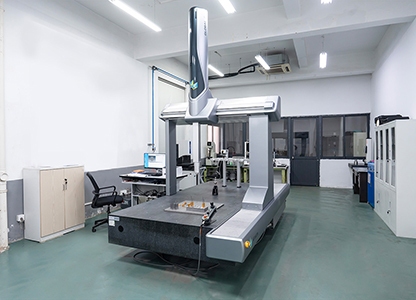
Production equipment at DEO Machinery's Ningbo facility, where the company reports 100% testing of finished pumps and coolers.
From product roster to duty questions: DK630, PST180, PSN100 and the cooler range
A product roster becomes useful to a buyer only when each model is tied to the circuit condition it is meant to serve. DEO's record lists six identifiable models across two families — pumps and coolers — and all six appear in the related-product list attached to its ISO 9001 certificate, which is a small but genuine cross-check: the certification record and the product record describe the same products.
The pump side covers an electric lubrication pump (DK630), a bidirectional internal gear pump (PST180) and a trochoidal bidirectional mechanical pump (PSN100). The cooling side covers a self-circulating cooler (DFLSL-10), a water cooler (DWBW-408-T) and a wind cooler (DFLEX8). Between them, these address the two halves of a complete oil lubrication pump system: moving the oil and removing the heat it picks up.
| Model | Category in the company record | Where it typically enters a specification | What a buyer should still verify |
|---|---|---|---|
| DK630 | Electric lubrication pump | Centralized lubrication supply on machine tools, reducers and production lines | Flow rate, rated pressure, reservoir size, control and monitoring interface, duty cycle |
| PST180 | Bidirectional internal gear pump | Gear-type oil delivery in hydraulic and lubrication circuits that require reversing flow | Permitted flow direction and pressure rating at the intended duty point, viscosity window |
| PSN100 | Trochoidal bidirectional mechanical pump | Compact rotary pumping where a mechanical drive is preferred | Displacement per revolution, speed range, mounting interface, noise at operating speed |
| DFLSL-10 | Self-circulating cooler | Oil cooling within a machine's own circuit | Heat rejection at site ambient temperature, circuit arrangement, oil flow compatibility |
| DWBW-408-T | Water cooler | Oil-to-water heat exchange for lubrication and hydraulic oil | Cooling-water quality and flow requirements, pressure drop, fouling allowance |
| DFLEX8 | Wind cooler | Air-cooled cooling for wind-turbine lubrication circuits | Ambient operating range, fan and power supply specification, vibration requirements |
The table also exposes the central limitation of the public record: model-level performance data — flow, pressure, viscosity range, heat rejection curves — is not published alongside the model names. That is normal for a manufacturer whose primary channel is direct enquiry rather than catalogue distribution, but it changes the buyer's workflow. Model names shorten the shortlisting step; they do not replace the datasheet request.
OEM/ODM, customization and the commercial terms a buyer can plan around
DEO states that it provides both OEM and ODM production services, with customization options covering colour and oil pump modifications, so that clients can develop products under their own brands. For a distributor or an equipment manufacturer building a private-label range, this is the capability statement that matters most in the evaluation-to-execution transition, because it determines whether the supplier can be integrated into a product programme rather than used as a one-off source.
The commercial parameters published alongside that capability are unusually specific for a supplier of this size:
- Minimum order quantity: 1 unit. This permits a validation or pilot order before any volume commitment.
- Monthly capacity: 2,500 units, consistent with the reported annual output of 30,000 units.
- Lead time: 35–45 days.
- Quality control: 100% testing, with pre-shipment test defined as the acceptance criterion.
- Delivery terms: FOB, CIF or EXWORK; payment terms stated as full payment.
Each of these is a planning input, not a guarantee. Capacity is a stated figure and has not been independently audited; the 35–45 day lead time describes normal conditions and should be written into the purchase agreement with an explicit start point, such as receipt of deposit or approved drawing. The combination of full payment and pre-shipment testing deserves particular attention: because payment precedes shipment, the test protocol — what is measured, against which specification, and what constitutes a pass — should be agreed in writing before the order is confirmed rather than after the goods are boxed.
The ISO 9001 certificate: scope, dates and the limit of its meaning
DEO holds ISO 9001 certification under certificate number 16426Q00565R001, issued by Huazhong International Certification and Inspection Group on 7 April 2026 and valid until 6 April 2029. The standard cited is GB/T 19001-2016 / ISO 9001:2015, and the certified scope is the production of coolers and lubricating oil pumps for mines, ships and hydraulic machinery.
Two details in that scope are worth more attention than the certificate itself. First, it covers production rather than design, so a buyer relying on the certificate for design assurance is reading it too broadly. Second, the scope names mining, marine and hydraulic machinery applications, which aligns with the product roster and with the heavy-duty segments where lubrication failure is expensive.
The certificate establishes that a quality management system covering those production activities has been assessed by an accredited body and remains current. It does not establish product performance, nor does it substitute for market-specific approvals. A buyer supplying into the European Union, for example, should confirm the applicable Machinery Directive, EMC and RoHS requirements separately; manufacturers such as SKF publish the directives and harmonised standards referenced in their own pump documentation, which shows the level of disclosure that European buyers commonly expect. Certification validity should be confirmed directly with the issuing body rather than accepted from a scanned copy.
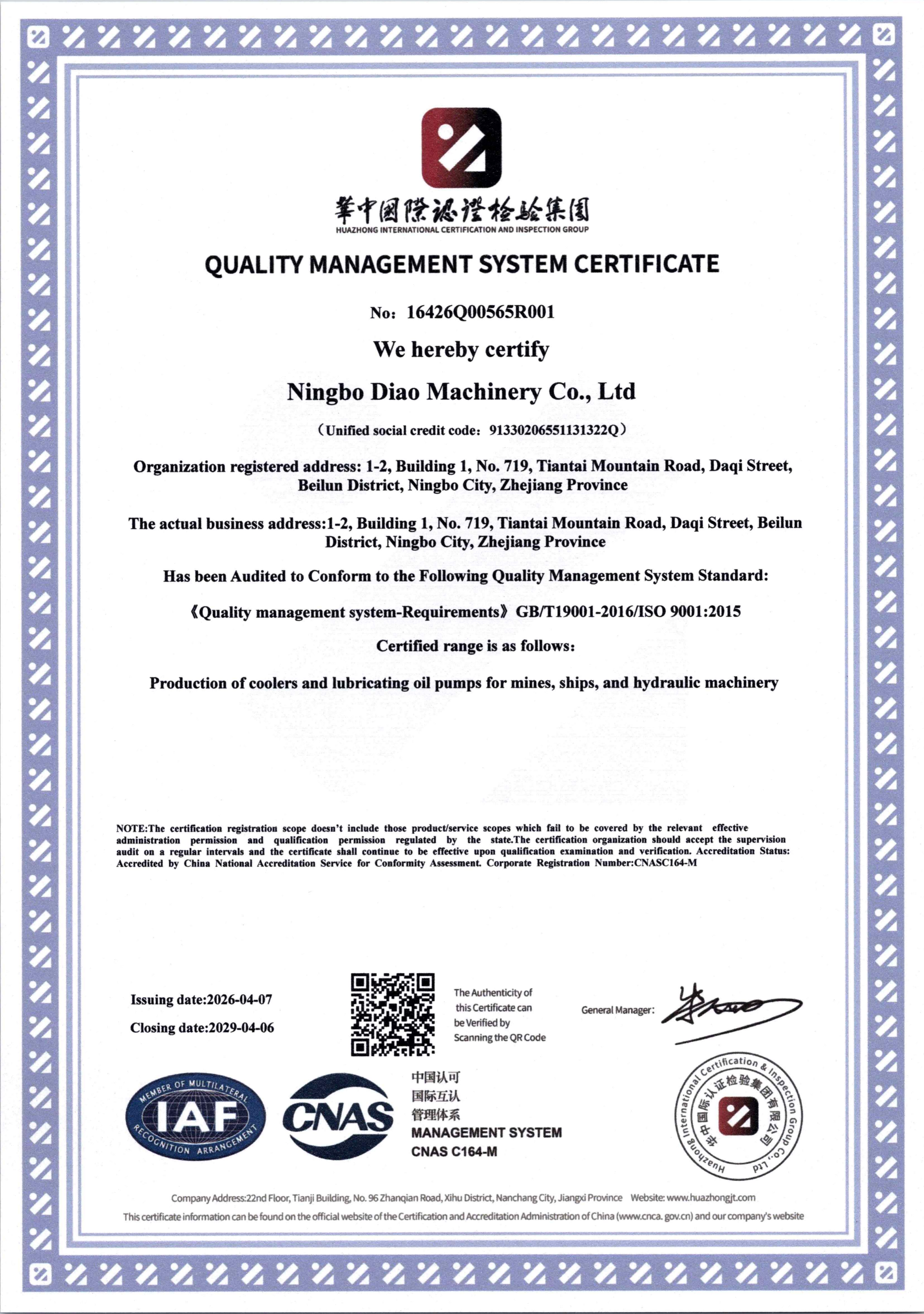
DEO's ISO 9001:2015 certificate, valid from 7 April 2026 to 6 April 2029, with a scope covering coolers and lubricating oil pumps for mines, ships and hydraulic machinery.
Documented application: speed reducer lubrication in Thailand and Germany
DEO's case record describes an installation of 10 units for speed reducer lubrication at sites in Thailand and Germany, with end equipment manufacturers — including wind power equipment manufacturers — named as the adopting customer group. The same record notes a five-year duration for the application and a customized DK-F variant developed to resist the alternating vibration and frequent speed variation of wind turbines.
This is the most application-specific evidence in the public record, and its scale should be read honestly. Ten units demonstrate that the product has been accepted into a reducer lubrication duty in two industrial markets; they do not constitute fleet-level reliability data. A buyer evaluating a comparable duty should treat the installation as a proof of concept to be interrogated, not as a performance benchmark.
DEO's case documentation also reports technical characteristics for its helical-gear pump range: a viscosity window of 12–20,000 cSt, an operating fluid temperature range of −40 °C to 100 °C, volumetric efficiency stated at 95% or above, running noise described as 3 dB lower than conventional straight-gear pumps, and a built-in relief valve adjustable from 5 to 25 bar. These are company-reported figures. They are specific enough to be tested, which is the useful part: a buyer can request the test basis, the exact model and the conditions under which each value was obtained, and can then decide whether the same conditions apply to the intended installation.
Where the evidence is thin — and how to close the gap
An honest supplier assessment names the gaps as clearly as the strengths. On the DEO record, four areas require buyer-side work.
- No published performance curves. Flow, pressure and heat-rejection data must be obtained per model and per duty point, in writing.
- No independent test data in the public record. The efficiency, noise and wear figures in the case documentation are company-reported and have not been separately verified here.
- Capacity and lead time are stated, not audited. The 2,500-unit monthly capacity and 35–45 day lead time are planning figures that become commitments only through contract terms.
- Service footprint outside the domestic market is not documented. With 20% of output exported, spare-part logistics and response times for Europe, the Americas, Southeast Asia and Australia should be agreed explicitly rather than assumed.
None of these gaps is unusual for a manufacturer of this scale, and none of them is a disqualifier. They simply relocate effort from the supplier-selection stage to the specification and contract stage, which is where most lubrication pump failures in service actually originate.
Comparing like with like against larger lubrication pump brands
Buyers frequently compare a specialist supplier against much larger international brands and conclude either that the specialist is unproven or that the brand is overpriced. Neither conclusion is well founded unless the comparison holds the documentation basis constant.
Consider what the larger brands publish. SKF documents an electrically operated pump for feeding lubricants in interval operation inside a centralized lubrication system, and specifies that a pressure relief valve with a maximum opening pressure of 270 bar must be provided on each pump element. SKF's FK grease lubrication pump unit is documented for progressive, single-line and dual-line centralized lubrication systems, with a list of applied directives and harmonised standards including the Machinery Directive, RoHS II, EMC, EN ISO 12100, EN 809 and EN 60204-1. Graco describes automatic oil and grease pumps for industrial lubrication and states that its industrial lubrication solutions include both electric and hydraulic pumps. Ingersoll Rand positions its lubrication gear pumps for lubrication and circulation systems in machinery, turbines and gearboxes across the energy and automotive industries.
Those statements are manufacturer disclosures of product scope, not independently measured performance, and they are directly comparable to DEO's disclosures only at the same level: product category, application intent, declared limits and compliance references. On that basis the comparison is legitimate and useful. A buyer can ask DEO the equivalent questions — what pressure protection is integrated into a given model, which centralized system types a pump supports, which standards are referenced in the documentation, which viscosity and temperature windows apply — and then judge whether the answers are documented to the same depth.
The fit boundary runs both ways. Where a project requires a certified marine lube oil pump with an oil-through motor, the applicable reference is a standard such as ASTM F2798-09(2023), which defines design, construction and testing requirements for sealless rotary positive displacement pumps with oil-through motors for ship lubricating oil service, covering oil with an SAE rating of 20–50. A general industrial lubrication pump is not the same product as a standard-scoped marine canned pump, and no supplier should be credited with meeting that specification unless the conformity is documented model by model.
A verification checklist for the evaluation-to-execution stage
The following sequence converts the published DEO record into an executable procurement file. Each item is a check the buyer controls, not a claim the supplier makes.
| Verification item | Why it matters | How to close it |
|---|---|---|
| Legal entity and registration | A 2010 founding date is only useful if it matches the contracting entity | Match the business registration and address (Ningbo, Beilun District) to the invoice issuer |
| Model datasheet and performance curve | Model names do not define a duty point | Request flow, pressure, viscosity and heat-rejection data for the exact model and operating condition |
| Integrated pressure protection | Overpressure protection affects circuit design and safety | Confirm whether a relief valve is fitted and within which adjustable range |
| Pre-shipment test protocol | Acceptance is defined as pre-shipment testing | Agree the measured parameters, pass criteria and record format before the order |
| Capacity and lead time | Stated figures become obligations only in contract | Fix the 35–45 day lead time with an explicit start trigger and a delivery schedule |
| Certification validity | Certificates expire and scopes vary | Verify certificate 16426Q00565R001 with the issuing body and check the scope wording |
| Reference confirmation | A named client shows acceptance, not scale | Request redacted order evidence tying a specific model to a specific application |
| Trade and payment terms | Full payment before shipment shifts risk to the buyer | Confirm FOB/CIF/EXWORK terms and align payment milestones with test approval |
| Spare parts and service | Export share is a minority of output | Define spare-part availability, response time and documentation language for the destination region |
What the wider category data adds — and what it does not
Lubrication specification decisions increasingly happen inside a broader shift toward automatic lubrication. A commercial market research compilation on lubrication systems reports that 67% of newly commissioned industrial machines in 2024 were equipped with automatic lubrication systems, and separately projects a 6.89% compound annual growth rate for electric lubrication pumps through 2032. Both figures come from commercial research rather than primary statistical sources, and the electric pump projection rests on a single compilation. They are directionally useful for capacity and technology planning and should not be used as decision-grade market sizing.
The practical implication for a buyer is narrower than the headline. If automatic lubrication is becoming the default on new machinery, then the interface between the pump and the machine control system — monitoring signals, fault output, reservoir-level feedback, refill intervals — matters as much as the pump's displacement. That is a specification question a supplier can answer only with documentation, which brings the evaluation back to the model datasheet rather than the market forecast.
Conclusion: evidence that shortens the shortlist, not the diligence
DEO's public record does something useful and modest. It states a founding year that can be checked, an export ratio that can be qualified, a client name that can be interrogated, a certificate number that can be verified with its issuer, and six model numbers that can be matched to datasheets. For an industrial lubrication pump buyer moving from evaluation into execution, that is the right shape of evidence: specific enough to generate questions, honest enough to leave gaps visible.
The work that remains is the work no supplier record can do. Confirm the duty point, obtain the curves, agree the test protocol, fix the lead time and payment milestones, and verify the certificate at source. A supplier that publishes verifiable facts has made that work shorter. It has not made it optional.
FAQ
What does DEO Machinery's 2010 founding date establish for a buyer?
Deo Machinery Co., Ltd. states that it was founded in 2010 and describes more than 15 years of development since then. For a buyer, the date establishes an operating history long enough for products to have been designed, shipped and revised in the field, and it opens a legitimate line of questioning about model history, revision records and spare-part continuity. It does not by itself establish current financial health, plant utilisation, defect rates or the performance of any specific model.
How large is DEO Machinery's export business, and which markets does it cover?
DEO reports an export ratio of 20% of its business, with markets in Europe and America, Southeast Asia and Australia. This indicates that export documentation and English-language technical communication are routine activities, while also indicating that the majority of output serves the domestic market. Buyers outside China should therefore confirm region-specific references, spare-part logistics and response times directly, rather than inferring a local service footprint from the market list.
Which client reference does DEO publish, and what does it prove?
DEO names Nanjing High Accurate Drive Equipment Manufacturing Group Co., Ltd. among its clients, alongside Dongfeng Motor Corporation, and describes a customer base of more than 7,000 enterprises. The named reference shows that a supply relationship with a demanding industrial buyer existed and that the buyer's incoming quality checks were satisfied at least once. It does not disclose volumes, model mix, contract duration, defect rates or whether the relationship is current, so it functions as evidence of capability rather than as a statistical performance record.
What OEM and ODM capability does DEO offer for lubrication pumps and coolers?
DEO states that it provides both OEM and ODM production services, allowing clients to develop products under their own brands. Published customization options cover colour and oil pump modifications. The associated commercial parameters are a one-unit minimum order quantity, a monthly capacity of 2,500 units, a quoted lead time of 35–45 days, and 100% testing with pre-shipment test defined as the acceptance criterion.
How should a buyer verify DEO's capacity, lead time and acceptance terms before ordering?
Because capacity and lead time are stated figures rather than audited commitments, a buyer should convert them into contract terms: fix the 35–45 day lead time against an explicit start trigger such as deposit receipt or drawing approval, and define the pre-shipment test by measured parameters and pass criteria. Delivery terms are published as FOB, CIF or EXWORK, and payment terms are stated as full payment, so acceptance evidence should be reviewed and approved before the balance is released. A one-unit minimum order quantity allows a validation order to be placed ahead of any volume commitment.
Further documentation. DEO's product and capability brochure can be accessed and downloaded here: DEO Machinery product brochure (PDF).
Tem questões ou precisa de mais detalhes?
Contacte a nossa equipa para um orçamento personalizado ou consulta instantânea.
Solicitar orçamento
Preencha o formulário abaixo e a nossa equipa entrará em contacto com uma proposta personalizada.
Chat direto do WhatsApp
Prefere conversar em tempo real? Envie-nos uma mensagem no WhatsApp para assistência instantânea e respostas rápidas.
- Obter orçamento personalizado
- Partilhar fotos ou documentos
- Discuta as suas necessidades diretamente
Geralmente responde em 5–30 minutos durante o horário de expediente.