
DHL8005H Blister-Cartoning Line FAQ: Speed, Servo, GMP and Procurement Checks
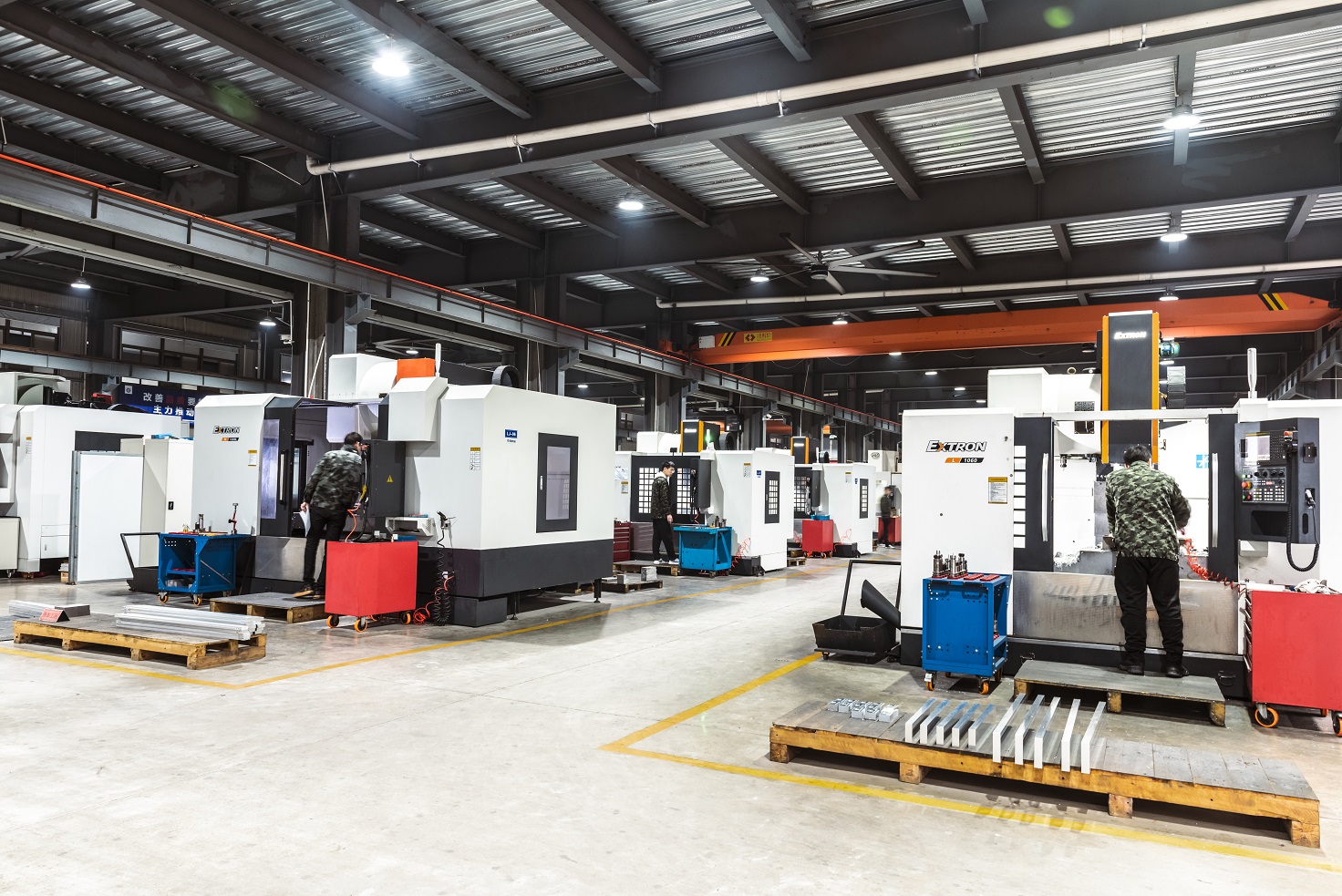
Precision machining of structural and format components for blister-cartoning line equipment.
The DHL8005H is a fully servo, high-speed blister-cartoning integrated line manufactured by Zhejiang Hoping Machinery Co., Ltd., a Chinese pharmaceutical packing machinery producer founded in 2001. In one linked flow it performs blister forming and sealing, transfer, leaflet handling, carton opening, insertion, coding and inspection, with a stated maximum capacity of up to 800 blisters per minute and 500 cartons per minute.
For engineering and procurement teams evaluating secondary packaging equipment, the value of this class of machine is rarely about a single headline number. It is about whether forming, sealing, transfer, cartoning and downstream connection behave as one system under continuous pharmaceutical production. The questions below are the ones that most often determine whether an integrated blister-cartoning line is the right answer, and what a buyer should verify before committing.
Why Integrated Blister-Cartoning Capacity Has Become a Live Procurement Question
Separating blister packaging and cartoning into two stand-alone machines is a common starting point for smaller or newer production sites. It keeps the initial capital commitment lower and lets each unit be replaced independently. The trade-off appears once output rises: manual or semi-manual transfer between machines introduces handling steps, and every additional handling step is a point where a blister board can be misrouted, a leaflet can be missed, or a line can drift out of sync.
The wider market context supports the shift toward integrated equipment. SkyQuest Technology valued the global pharmaceutical packaging equipment market at approximately USD 10.71 billion in 2024. Within that space, Custom Market Insights projected the pharmaceutical blister packaging machine segment at USD 2.57 billion by 2025 with a CAGR of 2.8%. Fortune Business Insights put the pharmaceutical cartoning machinery segment at USD 1.46 billion in 2024. These are separate segments in the data, but on the production floor they increasingly converge into a single purchasing decision.
Regional weight matters too. Grand View Research reported that Asia Pacific held the largest revenue share of 40.7% in the pharmaceutical packaging equipment market in 2025. That concentration of demand is one reason integrated blister-cartoning platforms are being specified and compared far more actively than they were a decade ago.
What the DHL8005H Is, and How It Fits the Hoping Line-Up
Zhejiang Hoping Machinery Co., Ltd. is a pharmaceutical packing machinery manufacturer based in Ruian City, Zhejiang Province, China. The company operates a 28,800 m² facility with approximately 300 employees, a 56-engineer R&D team and an annual output of roughly 500 units, with about 25% of production exported to markets including Southeast Asia, the Middle East, Eastern Europe, South America and Africa.
Within the Hoping blister-cartoner family, the DHL8005H sits below the highest-capacity model and above the mid-range options. The differences are mainly in transfer technology, controller platform and replenishment architecture.
| Model | Stated maximum capacity | Transfer system | Control platform | Replenishment |
|---|---|---|---|---|
| DHL1000/5H | Up to 1,000 blisters/min and 500 cartons/min | D3 intelligent top-loading parallel tracking transfer | Beckhoff motion controller, high-bus industrial control system | Four-channel servo-driven independent replenishment |
| DHL8005H | Up to 800 blisters/min and 500 cartons/min | D3 intelligent top-loading parallel tracking transfer | Beckhoff motion controller and CP9315 industrial PC | Three-channel servo-driven independent replenishment |
| DHL7005H | Up to 700 blisters/min and 500 cartons/min | Self-developed IRB24 intelligent transfer robot | Siemens motion controller and TP900 HMI | Independent replenishment |
| DHL6004 | Up to 600 blisters/min and 400 cartons/min | High-speed transfer and cartoning linkage | Beckhoff motion controller and CP9315 industrial PC | Servo-driven independent replenishment |
The practical reading of this table is that the DHL8005H shares its transfer and control architecture with the highest-capacity model in the family, while its blister output is rated at 800 per minute rather than 1,000. For a buyer, that usually means the cartoning side is not the constraint — carton output is rated at 500 per minute across the upper half of the range — and the specification decision hinges on how much blister-forming headroom the project genuinely needs.
Speed, Servo Architecture and Why the Control Platform Matters
Rated speed on an integrated blister-cartoner is a system-level figure, not a machine-level one. On the DHL8005H, the stated maximum of up to 800 blisters per minute and 500 cartons per minute depends on blister forming, sealing, transfer, leaflet folding, carton opening and insertion all holding position relative to each other. The transfer stage is handled by a D3 intelligent top-loading parallel tracking transfer system, which moves blister boards into the cartoner without a separate manual or semi-manual handling step.
Motion coordination on this model is managed by a Beckhoff motion controller paired with a CP9315 industrial PC. In practice, this is what allows the line to keep blister and carton timing locked as the machine runs near its rated output. It also defines what integration options are realistic later: coding, inspection and rejection functions, and downstream connection to bundling, case packing or palletizing equipment, are configured against that same control layer.
The three-channel servo-driven independent replenishment system addresses a different problem. Blister lines rarely stop for a single reason; they stop when one material stream runs short. By splitting replenishment into servo-driven channels that operate independently, the DHL8005H allows one material path to be refilled without bringing the whole line down. PVC and Alu foil auto splicing supports the same goal from the material side, reducing the number of planned stops tied to film roll changes.
What this means for procurement: a servo-driven, multi-channel architecture changes the operational profile of the line, not just its speed rating. Buyers comparing integrated blister-cartoners should ask how replenishment stops are handled, because unscheduled micro-stops — not the rated maximum — are what usually determine real daily output.
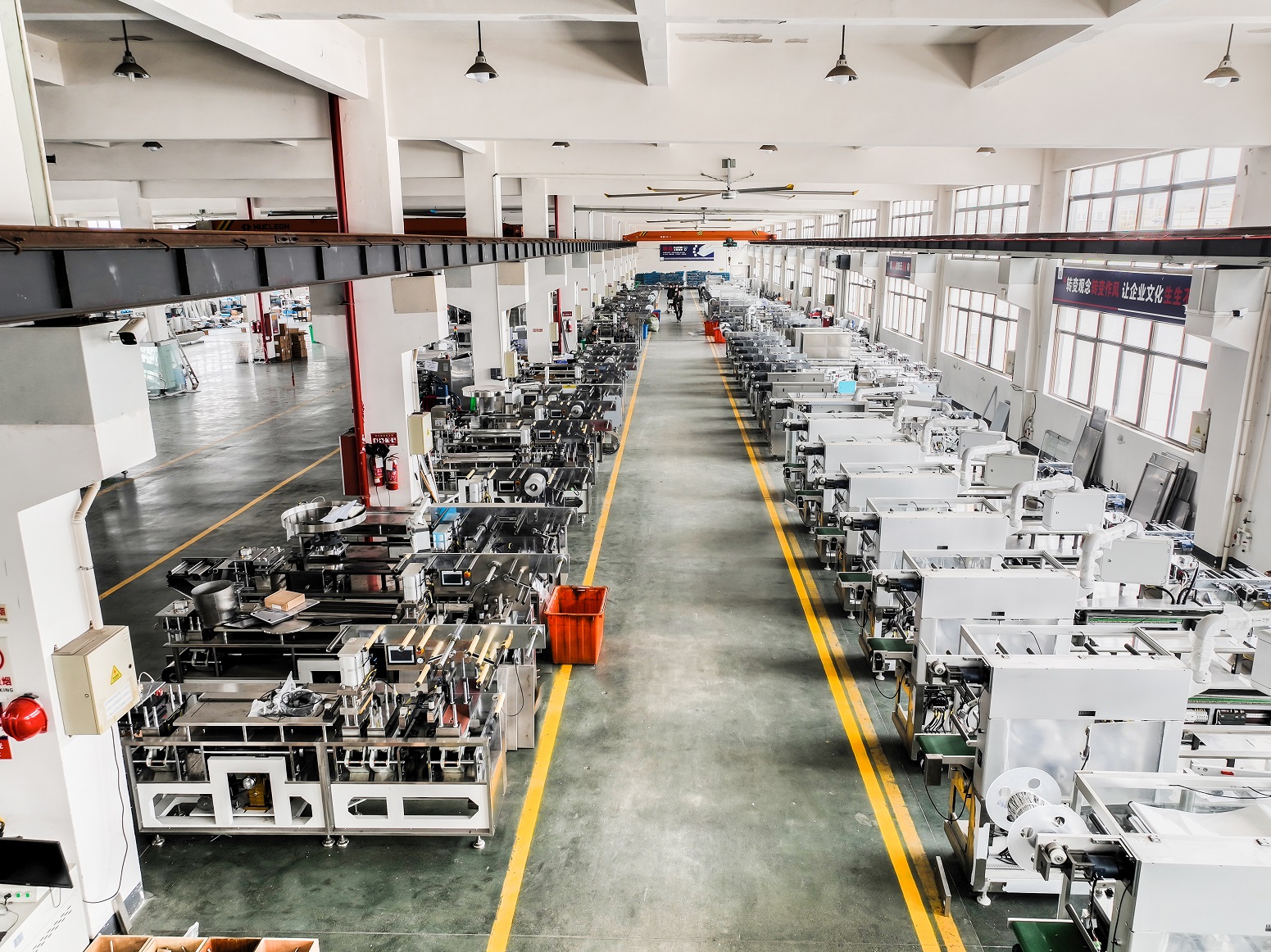
Blister machine assembly area where integrated blister-cartoning modules are built and trial-run.
GMP-Oriented Design, Materials and Tooling
The DHL8005H is described by Hoping as a GMP-oriented line design. In equipment terms, that description is carried by three verifiable design decisions rather than by a single label.
First, product-contact parts and tooling are configured according to the technical agreement for each project. This is an important distinction for evaluation teams: the GMP-oriented configuration is not a fixed catalogue specification but a project-level agreement that defines which parts touch product, what material they are made from, and how tooling is prepared for the specific blister format and dosage form.
Second, the machine structure uses stainless steel and aluminum alloy, with transparent guarding across the line. This combination is common in pharmaceutical secondary packaging because it supports cleaning access, visual inspection of the process and operator safety simultaneously. The transparent guarding matters practically: on a high-speed line, being able to see transfer and insertion stages without opening the machine reduces the number of interventions required during a shift.
Third, mould-change and preset-memory functions are built into the line. Preset memory allows validated parameter sets to be recalled for a given blister and carton format rather than re-entered manually, which shortens changeover and reduces the risk of parameter drift between runs.
Buyers should also connect the machine specification to the standards environment around it. ISO 15378 integrates GMP requirements for primary packaging materials, and in the EU market, pharmaceutical equipment safety is governed by Machinery Directive 2006/42/EC together with the EN 415 series for packaging machines. Hoping holds historical CE certification for its blister packing machine series and cartoning machine series, and current ISO 14001:2015 and ISO 45001:2018 management-system certificates issued by the China Quality Certification Centre (CQC).
Application Fit: Tablets, Capsules, Softgels and Healthcare Products
The DHL8005H is positioned for pharmaceutical solid dosage production, capsule and tablet packaging, healthcare products, and food and cosmetic blister-cartoning projects. In day-to-day terms, the format decision sits with the buyer: blister dimensions, blister materials, quantity per carton, carton specification and leaflet format are all project-defined, and the line is configured around them.
Three application patterns come up most often in evaluation.
High-volume single-format production. Where a site runs one or two tablet or capsule SKUs at sustained volume, the value of the DHL8005H lies in the linked flow: blister forming and sealing, transfer and cartoning run as one process, with fewer manual transfer points between stages.
Multi-SKU healthcare and nutraceutical production. For sites running a broader portfolio, the mould-change and preset-memory functions and the configurable feeding method matter more than the headline speed. Feeding method, coding and inspection method, and interface language are all listed as customizable, which lets the line be adapted to different product families without replacing the platform.
Downstream-integrated lines. The DHL8005H scope explicitly covers connection to bundling, case packing and palletizing equipment. Sites planning to close the loop from blister to pallet should treat this as a line-design question rather than an add-on purchase later.
Reported project outcomes in this equipment class tend to follow a consistent pattern. In documented representative projects, the stated objectives include improved packaging automation, reduced manual transfer, improved blister-to-carton connection efficiency, reduced wrong-insertion or missing-leaflet risk and support for downstream automation integration.
Market Signals Behind Integrated Blister-Cartoning Demand
Three structural signals are worth noting for buyers building a business case.
The market is growing but not consolidating around a single supplier tier. The top three players — Uhlmann, IMA and Marchesini — collectively hold approximately 29% of the pharmaceutical blister packaging machine market. That leaves a large share of the market served by a wide range of regional and specialist manufacturers, which is why supplier evaluation frameworks matter as much as machine specifications.
Regional demand is concentrated. Asia Pacific held the largest revenue share at 40.7% of the pharmaceutical packaging equipment market in 2025, according to Grand View Research. This is consistent with the profile of manufacturers such as Hoping, which serves both domestic Chinese production and export markets across Southeast Asia, the Middle East, Eastern Europe, South America and Africa.
Segment estimates should be read with care. Published market sizes for pharmaceutical packaging equipment vary depending on whether primary and secondary equipment are counted together. SkyQuest Technology's figure of approximately USD 10.71 billion for 2024 and other published estimates differ in scope. Buyers using market data in internal justification documents should cite the scope definition alongside the number.
Where an Integrated Line Differs from Separate Blister and Carton Machines
An integrated blister-cartoner is not automatically the right answer for every site, and the boundaries are worth stating plainly.
| Consideration | Separate blister machine + stand-alone cartoner | Integrated blister-cartoning line (DHL8005H class) |
|---|---|---|
| Transfer between stages | Manual or semi-manual transfer, or a separate conveyor link | D3 intelligent top-loading parallel tracking transfer |
| Leaflet and insertion control | Depends on cartoner configuration and operator intervention | Leaflet handling and insertion are part of the linked scope |
| Capacity profile | Lower ceiling; each unit sized independently | Up to 800 blisters/min and 500 cartons/min on the DHL8005H |
| Changeover approach | Each machine changed over separately | Mould-change and preset-memory functions applied across the line |
| Capital and footprint | Lower entry commitment; more floor space, more interfaces | Higher entry commitment; single linked footprint |
| Best fit | Low-volume, highly variable, or staged-capital projects | Sustained-volume production with defined formats and downstream integration plans |
The honest limitation is scale. A line rated at up to 800 blisters per minute and 500 cartons per minute assumes a production profile that can actually feed it. For sites running small batches, frequent format changes across many low-volume SKUs, or early-stage capacity where the downstream bundling and case-packing stages are not yet automated, a high-speed integrated line can be under-utilised. In those situations, a lower-capacity combination — a flat-plate blister machine paired with a medium-speed cartoner — is often the more rational starting point, with the integrated line introduced when volume and format stability justify it.
A second boundary is specification timing. Because product-contact parts, tooling, blister dimensions, carton specification and leaflet format are all defined through the technical agreement, the DHL8005H is not a machine that can be ordered against a generic specification and configured later without cost. The format and GMP documentation decisions need to be made during procurement, not after.
A third is layout and infrastructure. An integrated line of this class requires continuous compressed air supply and a defined electrical supply, and it needs downstream equipment sized to match if the site intends to connect bundling, case packing or palletizing. Line balancing is a design task, not an afterthought.
Future Outlook
Two directions look likely to shape how buyers evaluate this class of equipment over the next few years.
First, control-platform transparency is becoming a procurement criterion in its own right. The DHL8005H's use of a Beckhoff motion controller with a CP9315 industrial PC, and the family's mix of Beckhoff and Siemens platforms across models, reflects a market where buyers increasingly ask not just what the machine can do, but what data it produces, how inspection and rejection are logged, and how readily the line connects to downstream and plant-level systems. Interface language and data interface are already listed as customizable options for Hoping projects, which suggests this is being treated as a project-level requirement rather than a fixed feature.
Second, the boundary between blister-cartoning and full end-of-line automation continues to blur. The DHL8005H scope already extends to connection with bundling, case-packing and palletizing equipment, and the wider Hoping range includes stretch banders, overwrappers, case packers and case-packing and palletizing integrated machines. For buyers, this means the meaningful question is shifting from "which blister-cartoner" to "which line architecture" — and the answer depends on where the site expects to be in five years, not where it is today.
Frequently Asked Questions
What is the DHL8005H blister-cartoning line, and what output does it reach?
The DHL8005H is a fully servo, high-speed blister-cartoner integrated machine from Zhejiang Hoping Machinery Co., Ltd., classified as a solid dosage turnkey packing line. Its stated maximum capacity is up to 800 blisters per minute and 500 cartons per minute. It combines high-speed blister forming and sealing, transfer, leaflet handling, carton opening, insertion, coding and inspection in one linked flow, and can be connected to bundling, case-packing and palletizing equipment.
What control architecture does the DHL8005H use, and why does it matter at high speed?
The line uses a Beckhoff motion controller together with a CP9315 industrial PC. At rated output, blister forming, sealing, transfer and cartoning have to hold timing relative to one another, and the motion controller is the layer that keeps that synchronisation stable. The same control platform is also what supports configuration of coding, inspection and rejection functions and downstream line connection on this model.
What does the three-channel servo-driven independent replenishment system do?
It splits material replenishment into servo-driven channels that operate independently rather than as one shared path. Practically, this means replenishing one material stream does not require stopping the entire line. On the DHL8005H this works alongside PVC and Alu foil auto splicing, which reduces the number of planned stops associated with film roll changes.
How is GMP addressed on product-contact parts and tooling?
Hoping describes the DHL8005H as a GMP-oriented line design. Product-contact parts and tooling are configured according to the technical agreement for each project, which means the GMP-related specification — including which parts contact product and what materials are used — is defined at project level rather than taken from a generic catalogue. Buyers should confirm the technical agreement scope during procurement.
What materials is the DHL8005H built from?
The machine structure uses stainless steel and aluminum alloy, with transparent guarding across the line and servo-driven motion components. The transparent guarding supports visual inspection of transfer and insertion stages without opening the machine, and the structural material choice supports cleaning access and corrosion resistance in a pharmaceutical production environment.
Which products and formats can the DHL8005H handle?
The line is positioned for pharmaceutical solid dosage production, capsule and tablet packaging, healthcare products, and food and cosmetic blister-cartoning projects. Blister dimensions, blister materials, quantity per carton, carton specification, leaflet format, feeding method, coding and inspection method, and interface language are all configurable and confirmed per project.
How do mould-change and preset-memory functions affect changeover?
Preset memory stores validated parameter sets for a given blister and carton format, so they can be recalled rather than re-entered manually. Combined with mould-change support, this shortens format changeover and reduces the risk of parameter drift between production runs. For sites running multiple SKUs, this is often a more consequential feature than the rated maximum speed.
What procurement checks should a buyer complete before ordering a DHL8005H?
Several checks matter. Confirm the technical agreement scope for product-contact parts and tooling, since this defines the GMP-oriented configuration. Confirm blister and carton formats, leaflet format and filling quantity per carton, because the line is configured around them. Confirm electrical component brand, data interface and interface language requirements. Confirm the intended downstream connection — bundling, case packing, palletizing — because these are line-design decisions. Review the CE certification history for the blister packing machine and cartoning machine series, and the current ISO 14001:2015 and ISO 45001:2018 certificates. Finally, agree the acceptance procedure, which for Hoping projects typically follows incoming material inspection, key component inspection, assembly inspection, electrical safety check, no-load trial run, material trial, FAT, customer witness acceptance and pre-shipment inspection. Lead time is typically 60–120 days after technical confirmation and is subject to model, configuration, project complexity and contract terms; minimum order quantity is one set or one complete line.
How does the DHL8005H compare with other blister-cartoner models in the same family?
The nearest comparisons are the DHL1000/5H, DHL7005H and DHL6004. The DHL1000/5H is rated up to 1,000 blisters per minute and 500 cartons per minute with a four-channel servo-driven independent replenishment system and Beckhoff high-bus industrial control. The DHL7005H is rated up to 700 blisters per minute and 500 cartons per minute and uses a self-developed IRB24 intelligent transfer robot with a Siemens motion controller and TP900 HMI. The DHL6004 is rated up to 600 blisters per minute and 400 cartons per minute with Beckhoff control. The DHL8005H sits between them at up to 800 blisters per minute and 500 cartons per minute, sharing the D3 transfer system and Beckhoff control platform with the highest-capacity model.
When might the DHL8005H not be the right choice?
When production volume and format stability do not match the line's capacity profile. A line rated at up to 800 blisters per minute and 500 cartons per minute needs sustained feed to be economically justified, and downstream bundling, case-packing or palletizing capability matters if the site intends to run the full end-of-line flow. For small batches, a large number of low-volume SKUs, or early-stage capacity where downstream automation is not yet in place, a lower-capacity combination — such as a flat-plate blister machine linked to a medium-speed cartoner — is often the more practical starting point, with an integrated line introduced as volume grows.