
DHL8005H Blister-Cartoning Line: GMP Contact Parts & Tooling
DHL8005H Blister-Cartoning Line: GMP Contact Parts & Tooling
Good Manufacturing Practice is usually discussed at the level of cleanrooms, documentation and validated processes. On a solid-dosage packaging line, however, one of the most practical GMP questions sits inside the machine itself: which surfaces actually touch the product, what they are made of, and how that commitment is written into the contract. For tablets, capsules, soft capsules, nutraceuticals and general healthcare products, the answer determines how easily a packaging line can be qualified, cleaned and defended during an audit.
The DHL8005H automatic blister-cartoning line from Zhejiang Hoping Machinery Co., Ltd. (HOPING) is positioned around exactly this question. Rather than treating GMP as a badge applied after assembly, the line is presented as a GMP-oriented design in which product-contact parts and tooling are specified to meet GMP requirements through the technical agreement that governs each project.
HOPING is a pharmaceutical packing machinery manufacturer established in 2001 in Ruian City, Zhejiang Province, China. The company develops and produces blister packaging machines, cartoning machines, case packing machines and end-of-line packaging equipment, and it operates a 28,800 m² manufacturing facility with approximately 300 employees and an annual output of about 500 units.
This article explains what GMP compliance means specifically for product-contact parts and tooling on a blister-cartoning line, how the DHL8005H design approaches it, and what buyers in the decision and execution stages should verify in the technical agreement before an order is confirmed.
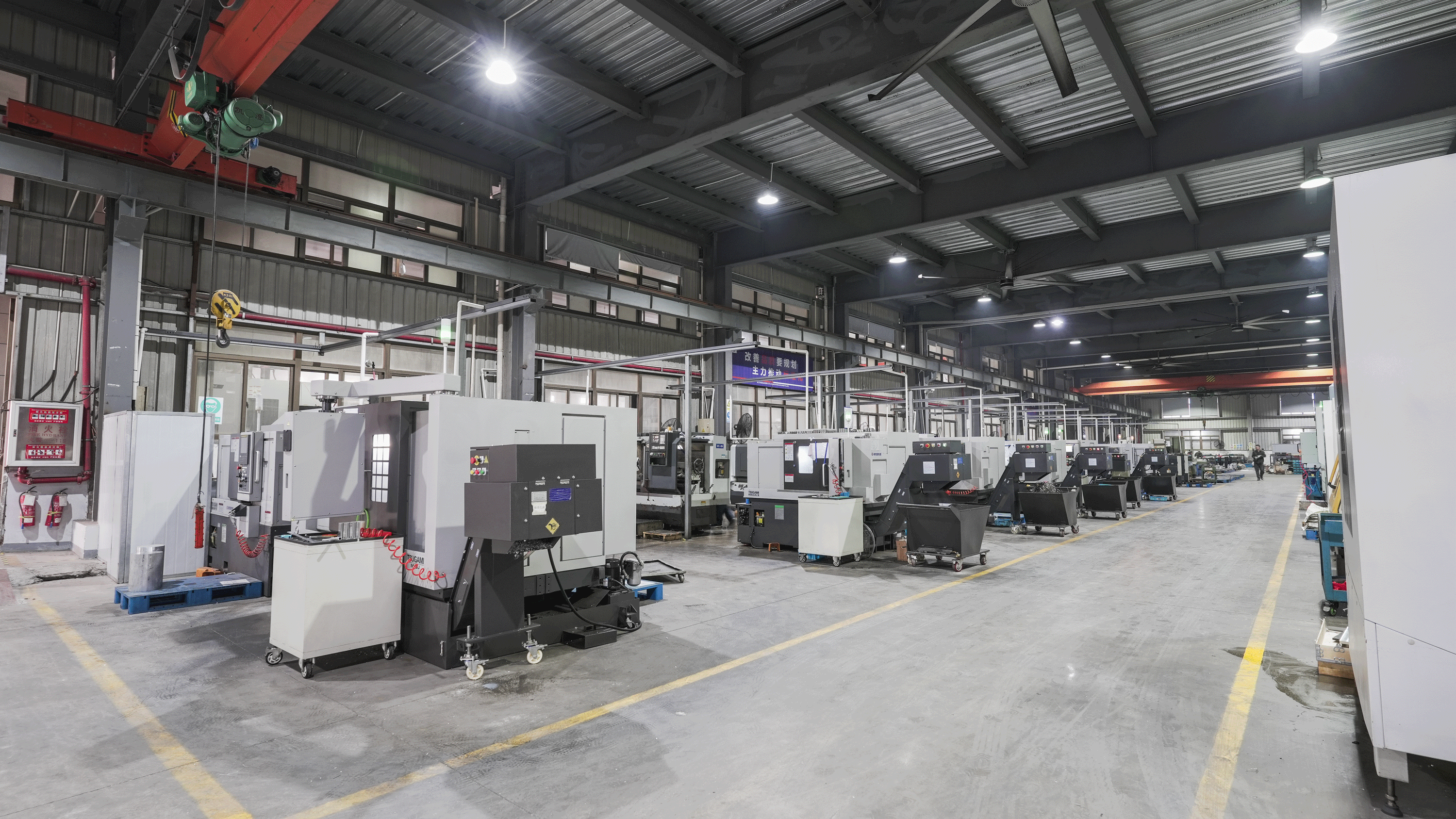
Precision machining of line components — the stage where product-contact geometry and surface quality are established. Image: HOPING.
Why Product-Contact Parts Set the GMP Baseline
In pharmaceutical packaging, "product-contact" refers to every machine surface that can physically touch the dosage form, the primary package, or the printed materials that enter the same carton. On a blister-cartoning line this normally includes the forming and sealing tooling, the feeding channels and dies that carry tablets or capsules into the blister pockets, the transfer and lift mechanisms that move a filled blister toward the cartoner, and the components that fold and insert a leaflet.
The reason these parts matter is documented at the standards level. ISO 15378:2017 specifies Good Manufacturing Practice requirements for primary packaging materials for medicinal products — in other words, the materials that come into direct contact with the drug. The U.S. Food and Drug Administration describes Current Good Manufacturing Practice (cGMP) as the foundation for quality pharmaceuticals through regulatory standards. Read together, these references point to a simple operating principle: wherever product and machine meet, there must be a documented, controllable and cleanable interface.
There is also a functional reason. A published review notes that medical devices and pharmaceutical drugs are packaged to maintain their stability and integrity during post-production shipping and storage. Contact-part design is part of that chain of protection. If a feeding channel scratches a tablet, if a die retains residue, or if a transfer mechanism contaminates a blister, the protection that the packaging is meant to provide is weakened before the product ever leaves the line.
Why “usually compliant” is not a GMP answer
GMP is an evidence discipline, not a marketing claim. A supplier may describe a machine as “GMP-oriented,” but the auditable position comes from what the contract, drawings and material certificates actually state. That is why the DHL8005H positions product-contact parts and tooling as items defined inside the technical agreement rather than as general assurances.
The GMP Design Intent Behind the DHL8005H
The DHL8005H is an automatic blister-cartoning line, meaning blister forming, product feeding, sealing, transfer and cartoning are engineered to operate as one continuous process rather than as disconnected machines. HOPING presents blister packaging, cartoning, inspection and end-of-line automation as an integrated pharmaceutical packaging process, and the company’s product range covers flat-plate, roller-type aluminum-plastic and aluminum-aluminum blister packaging machines alongside automatic cartoning machines and complete production lines.
For a GMP-oriented design, integration itself is a compliance-relevant decision. Every additional manual handling step between primary and secondary packaging is another opportunity for contact, cross-contamination or human error. By connecting the blister stage directly to the cartoner, the DHL8005H reduces the number of times a blister is picked up, transferred or re-oriented by operators.
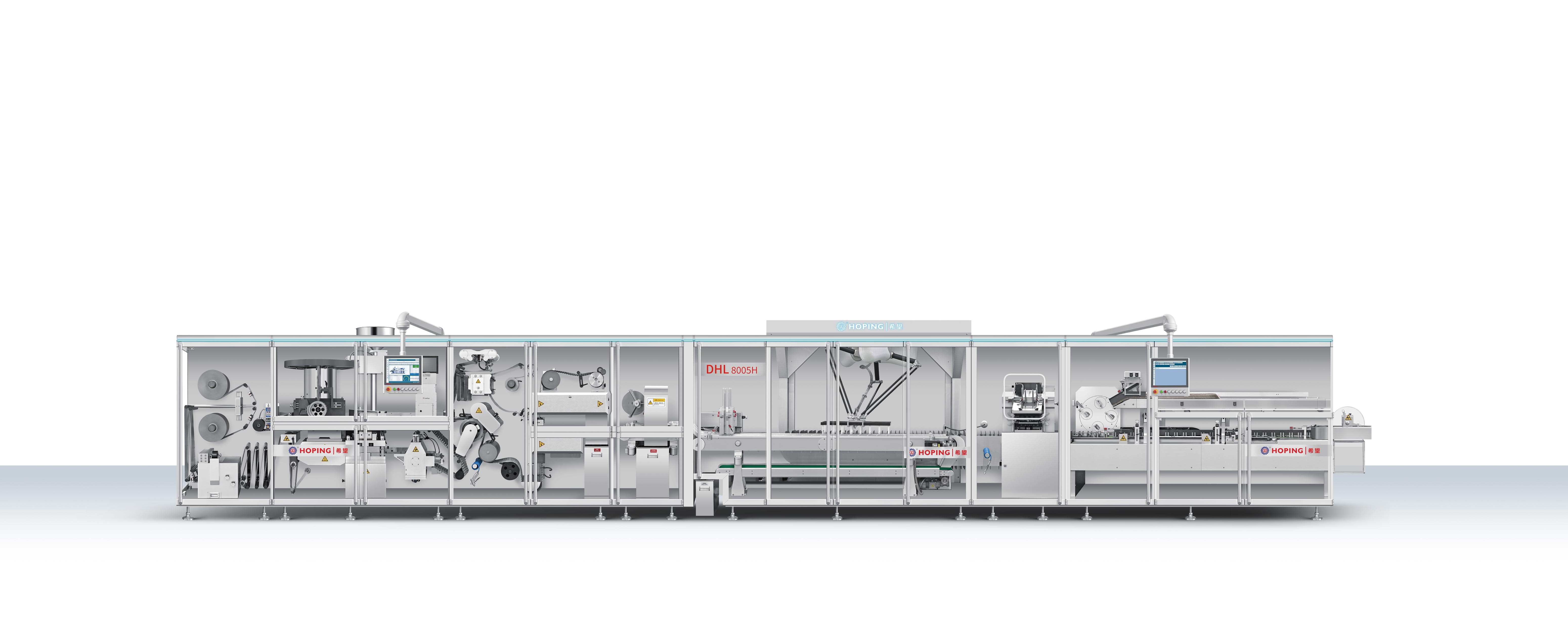
The DHL8005H automatic blister-cartoning line. Image: HOPING.
Materials and Surfaces: Stainless Steel and Aluminum Alloy
The DHL8005H design uses stainless steel and aluminum alloy as the principal construction materials for machine and tooling components. This is a deliberate material direction rather than a cosmetic choice, because the two families serve different functions on a packaging line.
- Stainless steel is typically selected where corrosion resistance, cleanability and a non-reactive surface are priorities — the areas most likely to be classed as product-contact and most likely to be inspected during cleaning validation.
- Aluminum alloy is typically selected for moving or interchangeable tooling, where lower weight, good machinability and dimensional stability support faster changeover and consistent positioning.
Stated at the family level, both terms answer a general question. For procurement, the working question is more specific. “Stainless steel” covers a wide range of grades with different corrosion and cleaning behaviour, and “aluminum alloy” covers a range of tempers and surface treatments. A GMP-oriented technical agreement should therefore move from family names to defined grades, defined surface finishes and, where relevant, defined treatments — because that is the level at which a cleaning and qualification programme can actually be built.
Why surface condition matters as much as material name
Two components made from the same grade can behave differently if their surface finish differs. Rough or poorly finished surfaces retain residue and are harder to clean; sharp internal corners complicate disassembly. Material selection and surface specification should therefore be reviewed together, not as separate line items.
What Buyers Should Verify in the Technical Agreement
The technical agreement is the document that converts “GMP-oriented design” into verifiable requirements. For the DHL8005H, buyers should treat it as the control point for product-contact parts and tooling. The following items are the ones most often worth confirming in writing before an order is finalised.
| Verification item | Why it matters | What to ask for |
|---|---|---|
| Product-contact part list | Defines exactly which components are treated as product-contact and therefore covered by GMP expectations | A component-level list covering forming and sealing tooling, feeding channels, transfer mechanisms and leaflet-insertion parts |
| Material grades | Family names such as “stainless steel” do not by themselves support cleaning validation | Specified grades for every product-contact and tooling component, with the stainless steel and aluminum alloy allocations identified |
| Surface finish | Finish governs cleanability and residue retention | Defined surface-finish expectations for contact surfaces, plus any polishing or passivation steps |
| Tooling changeover | Product-contact tooling changes with format; changeover directly affects cleanability and downtime | Documented changeover procedure and the tooling set tied to each tablet, capsule or softgel format |
| Disassembly and cleaning | Parts that cannot be accessed cannot be cleaned or inspected reliably | Instructions for removing, cleaning and refitting product-contact parts, matched to the plant’s SOPs |
| Documentation | GMP is evidenced, not asserted | Material records, tooling drawings, cleaning-relevant documentation and any certificate-based supplier-review records the buyer’s market requires |
| Change control | A part swapped after delivery can silently alter the compliance position | An agreement that material or tooling changes are notified in writing before they are applied |
| Acceptance basis | Links GMP intent to the physical machine | Agreed sample testing, FAT and SAT references so that contact-part and tooling performance can be observed before and after shipment |
Two of these items deserve extra emphasis. First, the product-contact part list should be explicit: it is the difference between a general statement and a document an auditor can follow. Second, change control should not be an afterthought — in practice, a substitution of a sealing tool or a feeding channel after delivery is exactly the kind of event that a compliance file should be able to trace.
Application Fit: Tablets, Capsules, Softgels and Nutraceuticals
The DHL8005H is aimed at solid-dosage and related products. Different dosage forms place different demands on product-contact parts and tooling, and buyers should match the format to the configuration rather than assume a single set-up covers everything.
| Product type | Typical contact-part and tooling focus |
|---|---|
| Tablets | Feeding channels and dies sized to the tablet, plus forming and sealing tooling matched to the blister format |
| Capsules | Gentler handling to avoid damage, with channel geometry suited to capsule length and diameter |
| Soft capsules | Contact surfaces and transfer elements that account for softer, more deformable product |
| Nutraceuticals | Contact-part cleanliness and material selection for products where formulation and format vary widely |
| Healthcare products | Tooling and feeding configuration covering the specific pack format and carton style |
Automatic cartoning machines in HOPING’s range are described as adapting to blister packs, tablets, syringes and medicine bottles, which indicates a secondary-packaging capability that extends across several solid-dosage and small-format categories. For a GMP project, however, capability statements should be converted into the specific tooling set, format range and contact-part configuration recorded in the technical agreement for the buyer’s own products.
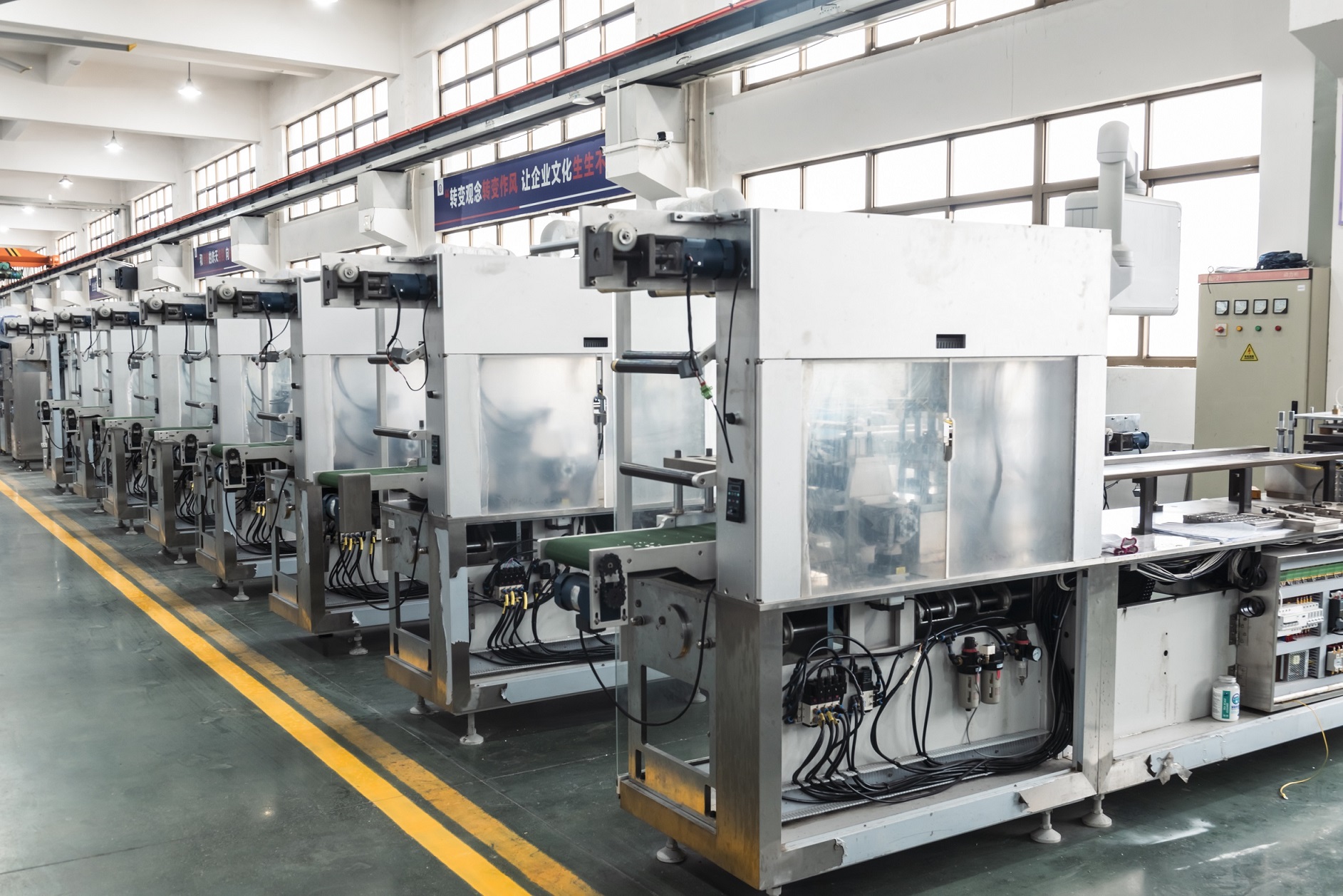
Assembly and testing area for blister-stage tooling and product-contact components. Image: HOPING.
Integrated Line vs Traditional Packaging Setups
Traditional pharmaceutical blister and carton packaging has often been assembled from separate elements: a blister machine, manual or semi-automatic transfer, and a standalone cartoner, sometimes at low or semi-automatic speed. The DHL8005H belongs to the integrated, automated category in which blister and carton stages are engineered to work as one process.
| Dimension | Traditional / semi-automatic setup | Integrated DHL8005H-style line |
|---|---|---|
| Process flow | Disconnected stages with intermediate handling | Blister, transfer, leaflet handling and cartoning combined into one automated process |
| Manual contact points | More operator handling between stages | Reduced manual intervention and intermediate handling |
| Contact consistency | Product-contact events vary with operator practice | Contact with product is defined largely by machine tooling and part specification |
| Investment profile | Lower initial equipment cost | Higher initial investment, offset in large-scale continuous production |
| Operating model | Simpler to start, harder to scale | Requires operator training, spare-part management and preventive maintenance |
For reference, an integrated solution of this type is designed around substantial throughput. In HOPING’s own line descriptions, a representative model such as the DHL1000/5H is stated to reach up to 1,000 blisters per minute and 500 cartons per minute; actual output depends on product format, quantity per carton, materials and process conditions.
Acceptance, Documentation and Long-Term Compliance
GMP compliance is not finished at delivery; it is maintained. On a blister-cartoning line, the risks that reach into product-contact performance are well known and include poor blister forming or sealing, missing, wrong or incomplete product feeding, a missing leaflet, carton jam, coding or date-printing errors, foreign matter or contamination risk, and downtime at high speed.
The control philosophy that addresses these risks is largely built on monitoring and defined responses: sensor monitoring, vision or checkweighing inspection where configured, missing-product alarms, automatic stop, automatic rejection, key-parameter locking, fault records and mechanical safety protection. Because several of these functions act on the same stations where product contact occurs, they reinforce the contact-part design rather than sitting apart from it.
What a structured acceptance path looks like
For the DHL8005H, acceptance is defined against the technical agreement rather than against a general expectation. The stated acceptance basis is: technical agreement confirmation, sample testing, factory acceptance testing (FAT) before shipment, site acceptance testing (SAT) at the customer site, with third-party inspection arrangeable according to customer requirements. On the supplier side, the supporting measures include confirming samples and packaging materials at the early project stage, designing the solution around the blister and carton formats, running no-load and material tests before shipment, and providing installation, commissioning, training, spare parts and remote technical support — with customer witness acceptance available for key projects.
On commercial terms, ordering is structured for pharmaceutical projects: the minimum order quantity is 1 set or 1 complete line, and the typical production lead time is 60–120 days after technical confirmation. Monthly production capacity is 30–40 units. These figures matter to long-term planning because they set realistic expectations for lead time and repeat orders when a line is expanded or replicated.
Market Signals for GMP Packaging Equipment
Several published signals support treating contact-part and tooling compliance as a durable purchasing concern rather than a one-off requirement.
- The global blister packaging machine pharmaceutical market was valued at USD 2.57 billion in 2025, according to Custom Market Insights. The same source reports Asia-Pacific as the fastest-growing region for pharmaceutical blister packaging, with an 8.87% CAGR to 2031.
- Horizontal cartoning systems, the format typically used on a blister-cartoning line, held 70.12% of that market’s share in 2024, per Mordor Intelligence.
- Regulatory direction is also moving toward supplier review. A regulatory-affairs source reports that China has a draft GMP guidance for pharmaceutical packaging materials under public consultation, guiding pharmaceutical marketing licence holders in reviewing packaging material suppliers.
- On the technology side, trade media reporting association content states that pharmaceutical manufacturers are turning toward digitised data collection and integrated solutions in order to meet regulations and improve visibility.
The practical reading is straightforward. Growth in blister-based pharmaceutical packaging, the dominance of horizontal cartoning, and a regulatory trend toward documented supplier review all push equipment buyers toward machines whose product-contact parts can be specified, cleaned and evidenced — which is the design terrain the DHL8005H targets.
Future Outlook
Three directions are likely to shape GMP expectations for blister-cartoning lines over the coming years.
From material names to material evidence. As packaging-material supplier review becomes more formal in major markets, the expectation is likely to shift from “stainless steel and aluminum alloy construction” toward defined grades, finishes and records that support cleaning and qualification.
Data captured alongside product. The reported move toward digitised data collection suggests that line data — batch, parameter and fault records — will increasingly be specified together with the mechanical line, rather than added later.
Contact-part transparency as a competitive norm. As buyers become more accustomed to verifying product-contact part lists and tooling in technical agreements, suppliers that can present these items clearly will be easier to qualify in long-term procurement processes.
FAQ
1. What does GMP compliance mean specifically for product-contact parts on a blister-cartoning line?
It means the parts that can touch the dosage form, the primary package or the leaflet are specified, made from defined materials, cleanable and documented. ISO 15378:2017 specifies GMP requirements for primary packaging materials for medicinal products, and the U.S. FDA describes cGMP as the foundation for quality pharmaceuticals through regulatory standards. On a line, this translates into defined feeding channels, dies, forming and sealing tooling, transfer mechanisms and leaflet-insertion parts.
2. What should a buyer confirm about materials in the technical agreement?
The agreement should move from material families to defined grades and surfaces. The DHL8005H uses stainless steel and aluminum alloy in its construction; buyers should confirm which components are stainless steel, which are aluminum alloy, what grades apply, and what surface finish is expected on product-contact surfaces. Material records and tooling drawings should be listed among the required documents.
3. How do tablets, capsules and soft capsules affect tooling and contact-part requirements?
Each format places different demands on feeding channels, dies and transfer elements. Tablets generally require channels and dies sized to the tablet and tooling matched to the blister format; capsules need gentler handling and geometry suited to capsule length and diameter; soft capsules require contact surfaces suited to softer, more deformable product. The specific tooling set should be agreed for the buyer’s own product range.
4. How is compliance demonstrated before and after delivery?
Through a defined acceptance path. The stated basis is technical agreement confirmation, sample testing, factory acceptance testing (FAT) before shipment, and site acceptance testing (SAT) at the customer site, with third-party inspection arrangeable on request. The supplier also confirms samples and packaging materials early in the project, designs around the blister and carton formats, and runs no-load and material tests before shipment.
5. What are the practical limits of an integrated GMP-oriented line?
The higher initial investment is a real constraint, and it only pays back in large-scale continuous production rather than small or intermittent runs. The line is also more operationally demanding: it assumes operator training, spare-part management and preventive maintenance are in place. For very low volumes or rapid format variation with few cartons per format, a simpler or semi-automatic setup can be a more rational choice.
6. What are the ordering terms, lead time and monthly production capacity?
The minimum order quantity is 1 set or 1 complete line. Typical production lead time is 60–120 days after technical confirmation. Monthly production capacity is 30–40 units. These figures support realistic planning for initial delivery and for subsequent line replication or expansion.
7. Why does an integrated line reduce GMP risk compared with a traditional setup?
Traditional arrangements combine a blister machine, manual or semi-automatic transfer and a standalone cartoner, so operators handle the product between stages. An integrated line such as the DHL8005H combines blister packaging, transfer, leaflet handling, carton opening, insertion, inspection and downstream connection into one automated process, which reduces manual intervention and intermediate handling — and therefore reduces the number of uncontrolled contact events.
For readers who want the full equipment overview, the public HOPING machinery catalog can be downloaded here: Hoping Machinery Catalog (PDF).