
DIN 71751 and DIN 71752: Why Clevis End Compliance Matters

DIN 71751 and DIN 71752: Why Clevis End Compliance Matters
Clevis ends are the fork-shaped end fittings that link a cylinder, linkage, or actuator to the structure it must move. They are inexpensive relative to the machine around them, which is exactly why they are taken for granted — until a replacement is needed and the new part will not seat against the pin. At that moment, three things matter at once: bore diameter, thread orientation, and shank geometry. A clevis end built to a recognized standard can be swapped out directly; one built to a supplier's own interpretation usually cannot.
Two standards sit at the centre of that decision for threaded clevis joints: DIN 71751 and DIN 71752. This article explains what each family covers, how the Clevis End Y DIN71751 differs from the Clevis End CEM/CEF DIN71752 variants, and why a supplier's adherence to those standards is the practical difference between predictable replacement and recurring re-engineering.
What DIN 71751 and DIN 71752 Actually Define
A clevis end is a one-piece fitting with a forked body and a cross bore that accepts a pin, dowel, or pin-and-clip assembly. Its threaded shank screws onto a mating rod — commonly a pneumatic or hydraulic cylinder piston rod, a linkage, or a connecting rod in engineering machinery. The geometry is simple, but the tolerance stack is not: pin bore diameter, thread size and pitch, fork width, shank length, and material all have to align with the mating assembly.A dimensional standard exists to remove that uncertainty. When a clevis end is specified to a standard, the buyer is not describing a preference — they are describing a family whose critical dimensions are already fixed. Any competent manufacturer working to the same standard produces a part that will physically interchange. Compliance, in this context, is not a marketing credential. It is a mechanical guarantee that the fork will seat, the pin will pass, and the thread will engage.
The two standards most often referenced for threaded clevis ends are DIN 71751 and DIN 71752. In LDK's catalogue, DIN 71751 corresponds to the Clevis End Y family, supplied with a male thread. DIN 71752 covers two families: the Clevis End CEM with a male thread, and the Clevis End CEF with a female thread. That is the first distinction a buyer needs to register — the standard number can point to more than one thread configuration.
Clevis End Y (DIN 71751) vs CEM/CEF (DIN 71752): The Practical Differences
The differences that matter on a drawing are thread orientation and the size range each family covers. LDK publishes both in the product data, which makes the comparison concrete.
| Family | Standard | Thread | Shaft diameter range | Example model codes |
|---|---|---|---|---|
| Clevis End Y | DIN 71751 | Male | 4 mm – 16 mm | Y4x8, Y8x32, Y16x64 |
| Clevis End CEM | DIN 71752 | Male | 6 mm – 20 mm | CEM6x12, CEM12x24, CEM20x40 |
| Clevis End CEF | DIN 71752 | Female | 4 mm – 16 mm | CEF4x8, CEF10x40, CEF16x64 |
All three families share the same base material specification in LDK's range: S235 steel with zinc plating, with stainless steel 304 available as an option. Different thread specifications can also be produced on request, which matters when a machine builder's rod is cut to a non-standard pitch.
The practical reading is this. If the mating rod carries an external thread, both the Y and CEM families are candidates — but they are not the same family, and their size ranges differ. If the rod carries an internal thread, the CEF family is the relevant one. Choosing between DIN 71751 and DIN 71752 is therefore not a matter of quality tier. It is a matter of matching thread direction and shaft diameter to the assembly already on the machine.
Why Compliance Matters for Interchangeability
Interchangeability is the entire commercial reason dimensional standards exist. When two clevis ends are both built to the same standard family, they are, by definition, dimensional equivalents. That has three downstream effects that buyers feel directly.
- Fewer unique part numbers. A standard family collapses dozens of supplier-specific codes into one reference class, so a maintenance store does not need to hold multiple near-identical forks for the same joint.
- Faster replacement. A replacement can be identified from the standard designation and size rather than from the original supplier's catalogue, which shortens downtime when the original vendor is unavailable.
- Lower risk of mis-seating. Standard-compliant geometry means the fork width, pin bore, and thread engage as the assembly was designed to engage, rather than being forced into place.
The same logic applies across the wider bearing family. Spherical plain bearings, which frequently sit inside rod-end assemblies, are governed by international standard ISO 12240, with separate parts addressing radial, angular contact, thrust, and rod-end configurations. When every interface in a linkage references a defined standard, the assembly stops being a collection of vendor-specific parts and becomes a repairable system.
Where compliance is absent, the failure mode is quiet rather than dramatic. A fork that is a fraction under width will still bolt up but will bind as it articulates. A thread cut to a slightly different pitch will engage partway and then seize. A pin bore that is marginally undersized will accept the pin only with persuasion. None of these produce an immediate failure, which is why non-compliant parts often survive the first installation and fail on the second.
How Compliance Simplifies Replacement Parts Management
For procurement and maintenance teams, the value of a standard is that it converts a sourcing question into a lookup. If a machine uses Y8x32 clevis ends, the replacement requirement is defined by the family and the dimensions encoded in that designation. The buyer can source from any manufacturer working to DIN 71751 at that size, rather than returning to the original equipment builder.
This is where a supplier's production discipline becomes visible. LDK's clevis-end families are produced alongside its rod ends and spherical plain bearings, and the company states that it maintains in-house production of both bearings and housings — meaning the fork body and the threaded shank are not outsourced to unrelated vendors whose tolerances may drift from lot to lot. That single-facility control is what allows a standard designation to remain trustworthy across repeat orders.
Order parameters reinforce the point. LDK lists a minimum order quantity of 5,000 units for standard production, a lead time of 30–90 days, and a monthly capacity of 300,000 units. For buyers planning a multi-year maintenance programme, that predictability is as important as the dimensional accuracy itself — a compliant part that cannot be re-ordered on schedule creates its own downtime.
Where Clevis Ends Are Used
Clevis ends are not a niche fitting. LDK specifies its Clevis End Y, CEM, and CEF families for three principal application areas:
- Pneumatic and hydraulic cylinders. The clevis end is the standard interface between a cylinder piston rod and the driven lever or structure, allowing the rod to articulate as it extends and retracts.
- Automation equipment. Automated positioning and actuation systems use clevis joints where a rod must transfer linear motion through an angle without introducing side loading.
- Connecting rods in engineering machinery. Construction and earthmoving equipment rely on threaded clevis ends for linkages that must be field-serviceable rather than welded.
In each case, the fitting operates in an environment where the joint is expected to move, which makes correct geometry more important than raw strength. A clevis end that is dimensionally correct will outlast a stronger part that binds.
Market Context: Why Specification Discipline Is Tightening
Several third-party market indicators suggest that rod ends and related plain bearing components are becoming a more scrutinised category rather than a commodity line.
- The global rod ends market was valued at USD 1.79 billion in 2025, with Asia Pacific holding a 42.3% revenue share (Dataintelo).
- Automotive applications represent the largest demand segment for rod ends, at approximately 38.5% of market share (Dataintelo).
- The broader global plain bearing market was valued at USD 10.4 billion in 2024 and is projected to reach USD 17.8 billion by 2034 (Dataintelo).
- China's bearing industry recorded revenue of CNY 231.5 billion in 2024, a 6.2% year-on-year increase (China Bearing Industry Association).
What that growth implies for buyers is not simply more supply. It means more suppliers entering the category, at widely varying levels of process control. In a market expanding this quickly, a standard designation is one of the few cheap filters a procurement team can apply before a first-order trial. It tells you whether a supplier has organised its production around a shared dimensional language or around its own convenience.
Where Standard Compliance Does Not Solve the Problem
Compliance with a dimensional standard is necessary, but it is not unlimited protection, and buyers who treat it as a complete guarantee tend to be disappointed in three specific ways.
Standardisation covers the interface, not the application. DIN 71751 and DIN 71752 fix the geometry of the joint so that parts interchange. They do not certify that the part is appropriate for a given load, stroke frequency, or duty cycle. A clevis end that is dimensionally perfect can still be the wrong choice for a high-cycle application if the material and processing are not matched to the load case. Load suitability has to be confirmed separately, from material and treatment data, not inferred from the standard number.
The standard material is not always the right material. S235 with zinc plating is an economical, widely used specification and is adequate for many indoor and general-duty applications. It is not, on its own, a corrosion solution. Environments with washdown, salt exposure, or chemical contact typically call for the stainless steel 304 option — which changes unit cost and, in many cases, lead time. Compliance does not remove that trade-off; it only makes the starting point consistent.
Cross-family substitution is not automatic. A Y-series clevis end and a CEM clevis end are both male-thread fittings, but they belong to different standard families with different size ranges. Matching a pin diameter is not sufficient grounds for swapping one for the other. Thread and shank geometry must be verified against the actual mating rod, because the two families were not designed to be interchangeable with each other.
How a Manufacturer Demonstrates Compliance
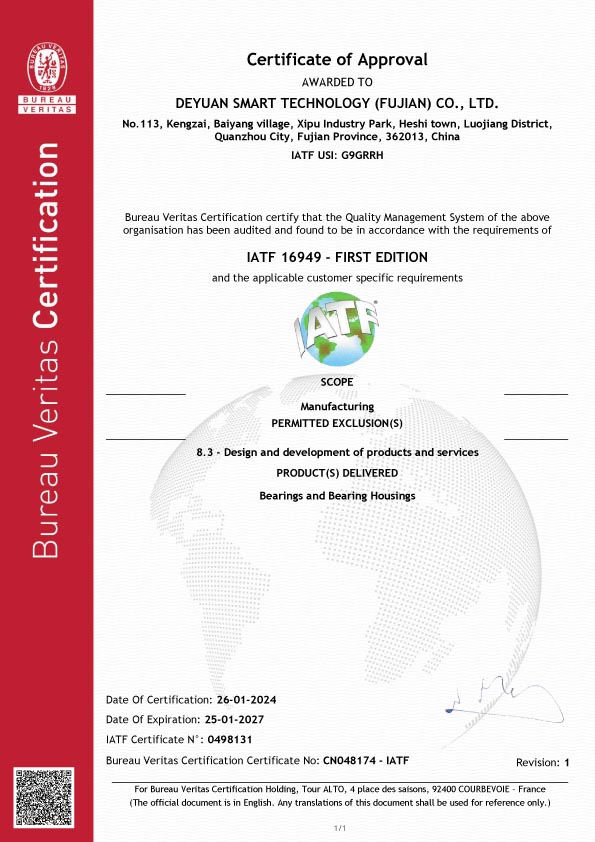
A claim of compliance is only as strong as the process evidence behind it. For clevis ends, dimensional accuracy depends on controlled production and inspection, and buyers can ask for specific, checkable proof rather than a general assurance.
LDK's applicable evidence includes:
- Quality management certification. IATF 16949 and ISO 9001 certification. The IATF 16949 scope covers manufacturing, design and development of products and services, and the delivery of bearings and bearing housings, with stated permitted exclusions.
- Environmental and safety certification. ISO 14001:2015 and ISO 45001:2018 certification covering production and relevant management activities of ball bearing units, bearing housings, and spherical plain bearings.
- Substance compliance. SGS RoHS compliance verification reports covering listed product scopes, issued against the EU RoHS Directive as amended.
- Inspection structure. Self-inspection and verification, supported by second-party and third-party audits, verification, and inspections.
- Testing capability. In-house testing that includes fatigue life, tensile strength, noise and vibration, and salt spray testing.
- Traceability and product scope. In-house production of both bearings and housings, with over 100 combinations of materials and housing types across the range.

For a buyer evaluating a clevis-end supplier, these are the artefacts worth requesting: the certificate scope, the inspection structure, and the test list. Manufacturing facilities matter too — LDK operates a 90,000 m² site with approximately 130 employees, a 12-engineer R&D team, and an annual output of 15,000,000 units. Those figures do not prove dimensional accuracy on their own, but they indicate a production environment in which a defined inspection regime can be sustained across SKUs.
What to Check Before Approving a Clevis End Supplier
For teams moving from evaluation into execution, the following checklist maps directly to the two standards discussed above.
| Check | What to confirm | Why it matters |
|---|---|---|
| Family and standard | Y (DIN 71751), CEM (DIN 71752), or CEF (DIN 71752) | Determines thread orientation and available size range |
| Thread orientation | Male for Y and CEM; female for CEF | Prevents a part that will not thread onto the rod |
| Shaft diameter | 4–16 mm (Y, CEF); 6–20 mm (CEM) | Ensures pin bore and shank match the assembly |
| Material | S235 zinc plated as standard; stainless steel 304 optional | Balances corrosion resistance against cost and lead time |
| Thread variant | Whether a non-standard thread can be produced | Needed when the mating rod is not cut to a standard pitch |
| Inspection evidence | Certification scope, audit structure, test capability | Converts a compliance claim into a verifiable process |
| Supply parameters | MOQ, lead time, monthly capacity | Determines whether the part can be re-ordered on schedule |
Future Outlook
Two forces are likely to make DIN clevis-end compliance more, not less, relevant in the coming years.
The first is the continued expansion of the rod ends and plain bearing category itself. With the global rod ends market valued at USD 1.79 billion in 2025 and Asia Pacific accounting for 42.3% of revenue, supply is going to keep broadening. As more manufacturers enter, the proportion of suppliers whose production is organised around shared dimensional standards will determine how reliable interchangeable supply actually is. Buyers will increasingly treat a standard reference as a minimum qualification rather than a differentiator.
The second is traceability. Substance regulations and documented inspection records are pushing industrial components toward the same accountability that automotive supply chains adopted years ago. Clevis ends are unlikely to remain an exception. Suppliers who already operate self-inspection alongside second-party and third-party audit structures — and who can supply RoHS verification for their product scope — are positioned to meet that expectation without retrofitting their processes.
Frequently Asked Questions
What is the main difference between DIN 71751 and DIN 71752 clevis ends?
DIN 71751 relates to the clevis-end family designated "Y", which LDK supplies with a male thread. DIN 71752 covers two families: CEM, with a male thread, and CEF, with a female thread. The standard number alone does not fully identify a part — the thread configuration and shaft diameter must also be specified.
Are Clevis End Y DIN71751 and Clevis End CEM DIN71752 interchangeable?
Not automatically. Both are male-thread clevis ends, but they belong to different standard families with different size ranges: the Y range spans shaft diameters from 4 mm to 16 mm, while the CEM range spans 6 mm to 20 mm. Substitution should be confirmed against pin diameter, thread, and shank geometry rather than the standard number alone.
What material are LDK clevis ends made from?
LDK's Clevis End Y DIN71751, Clevis End CEM DIN71752, and Clevis End CEF DIN71752 are supplied in S235 steel with zinc plating. Stainless steel 304 is available as an option, and different thread specifications can be produced on request.
How does a supplier demonstrate clevis end compliance?
Through documented process control rather than a single claim. LDK holds IATF 16949 and ISO 9001 certification and operates self-inspection alongside second-party and third-party audits, verification, and inspections. Its testing capability includes fatigue life, tensile strength, noise and vibration, and salt spray testing.
How does standard compliance simplify replacement parts management?
When a clevis end is built to a defined standard, its critical dimensions are tied to a family rather than to one manufacturer's interpretation. That reduces the number of unique part numbers a maintenance team must hold, shortens the search for a replacement when the original supplier is unavailable, and lowers the risk that a substitute will not seat against the mating pin or thread.
Does standard compliance guarantee the part is suitable for a specific application?
No. A dimensional standard fixes the interface — bore, thread, and shank geometry — so that parts interchange. It does not certify suitability for a given load, duty cycle, or corrosion environment. Those questions must be answered separately from material and treatment data, and in some cases will point to the stainless steel 304 option rather than standard zinc-plated S235.
Conclusion
DIN 71751 and DIN 71752 do not make clevis ends more sophisticated. They make them predictable. A buyer who specifies the correct family, matches the thread orientation, and confirms the shaft diameter is buying a part that can be replaced without re-engineering the joint. That predictability only holds, however, if the supplier's production and inspection processes actually enforce the standard across repeat orders — which is why compliance evidence belongs in the evaluation, alongside the catalogue page.
LDK's full product brochure, covering rod ends, spherical plain bearings, and end fittings, is available for download: LDK product brochure (PDF).