
DK630 Electric Lubrication Pump: Scenario Fit by Sector
DK630 Electric Lubrication Pump: Scenario Fit by Sector
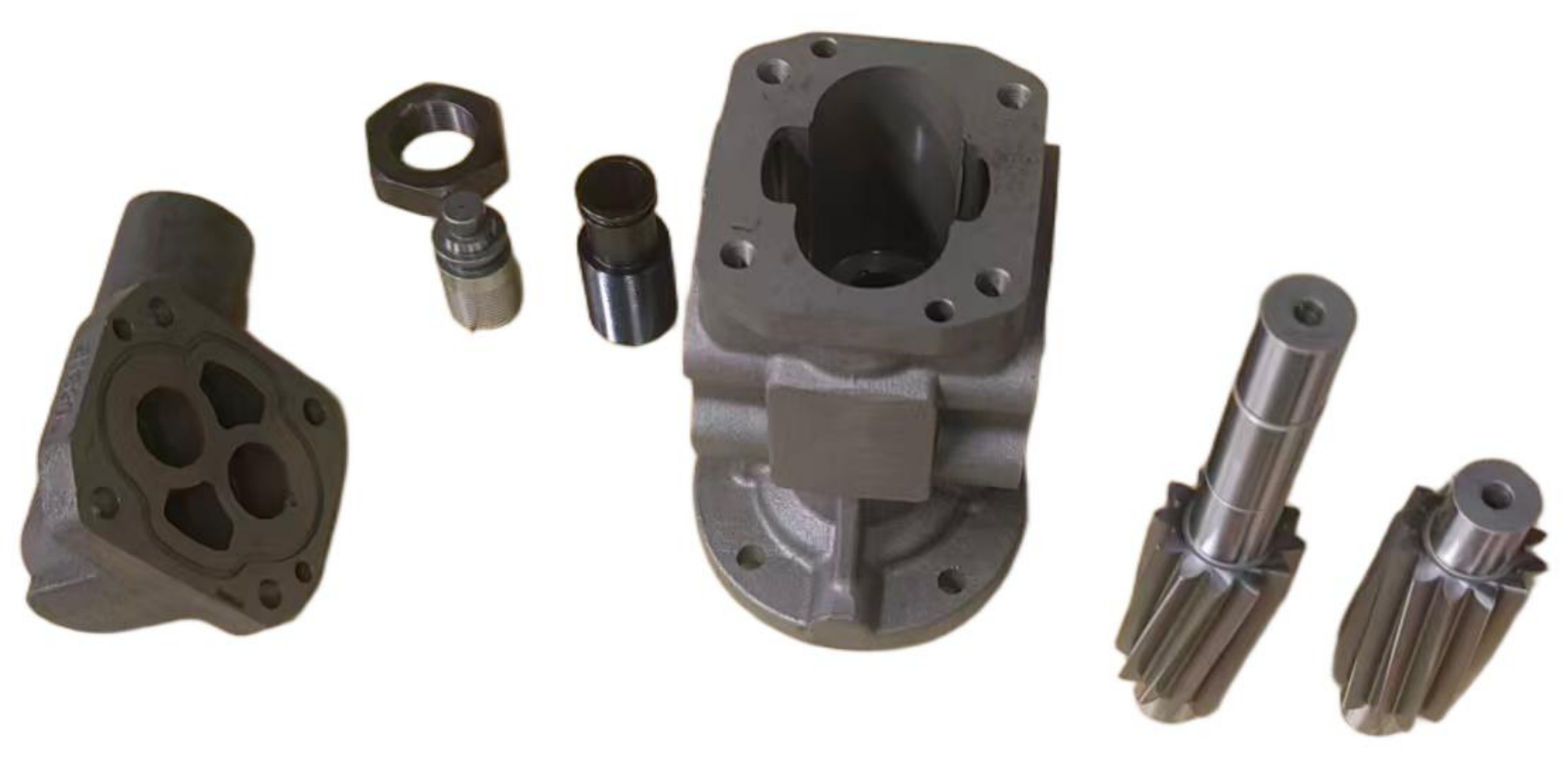
An industrial lubrication pump is usually chosen twice: once from a datasheet, and once on site, when the oil film has to hold on a machine running six days a week in heat, dust or a remote pit. The DK630 from Deo Machinery Co., Ltd. (DEO) belongs to the second decision. It is an electric lubrication pump rated at 630 cc/rev, cast in QT500 ductile iron, and driven at 950 or 1450 rpm — the three figures DEO publishes for the model. This article maps that pump to steel, construction and mining equipment, and sets out the duty-cycle, installation and acceptance points a buyer should check before committing a line to it.
The problem: an oil film that has to hold six days a week
Heavy-duty lubrication decisions come back to the same physical job. Oil must reach the friction pairs — gears, bearings, sliding rails — fast enough and often enough to form a film between moving surfaces. Without that film, metal-to-metal contact produces abrasion and friction heat; heat thins and oxidises the oil; degraded oil lubricates less effectively, and the wear rate climbs.
DEO's DK-series documentation describes the pump's function in those exact terms: continuous, stable delivery of lubricating or hydraulic oil to friction pairs, forming an oil film and reducing abrasion and friction heat. The same documentation assigns a second task — circulating hot oil out of the lubrication points and sending it to a matching oil cooler so that oil temperature stays stable.
That second task is where scenario fit becomes concrete. A steel line, a construction plant and a mine rarely differ in their need for an oil film. They differ in how much heat the circuit carries, how dirty the working environment is, how long the machine runs between stops, and how easily a maintenance team can reach the pump when something goes wrong.
DK630 specifications and what the numbers imply
The published specification is short, which makes it easy to verify against a quote or a nameplate.
| Parameter | DK630 as published by DEO |
|---|---|
| Product type | Electric lubrication pump; listed for mining equipment, construction machinery and steel-industry duty |
| Rated displacement | 630 cc/rev |
| Motor rotation speed | 950 rpm / 1450 rpm |
| Body material | QT500 ductile iron |
| Industry | Machinery and heavy industry |
| Calculated displacement rate at 950 rpm | Approximately 598.5 L/min |
| Calculated displacement rate at 1450 rpm | Approximately 913.5 L/min |
Two consequences follow. First, 630 cc/rev is a high-displacement figure for an industrial lubrication pump: the model sits at the volume end of the range, appropriate where a large circuit needs a continuous supply rather than a metered pulse. Second, the choice between 950 and 1450 rpm is a flow decision, not a preference. The same pump delivers roughly half again as much oil at the higher speed, which changes suction requirements, pipe sizing and the heat load handed to the cooler.
The DK-series platform behind the model
The DK630 sits within DEO's DK series, described in the company's documentation as a low-noise helical external gear positive displacement pump family for industrial lubrication and hydraulic auxiliary fluid transfer. Three series-level details matter when the pump is specified into a heavy-industry circuit.
- Fluid window: lubricating and hydraulic oils with good lubricity, free of solid impurities and chemically compatible with the pump materials; kinematic viscosity 12 to 20000 cSt; fluid temperature from -40 °C to 100 °C.
- Overpressure protection: a built-in relief valve with a standard setting range of 5 to 25 bar.
- Construction: transmission helical gear, driven gear, copper bushings, cast iron pump casing and end cover, rotary shaft seal, NBR/FKM sealing rings, thrust ring, positioning pins and the relief valve assembly.
The helical gear mesh is why the series is described as quieter than straight gear pumps — a workshop and operator-cabin consideration more than a performance one.
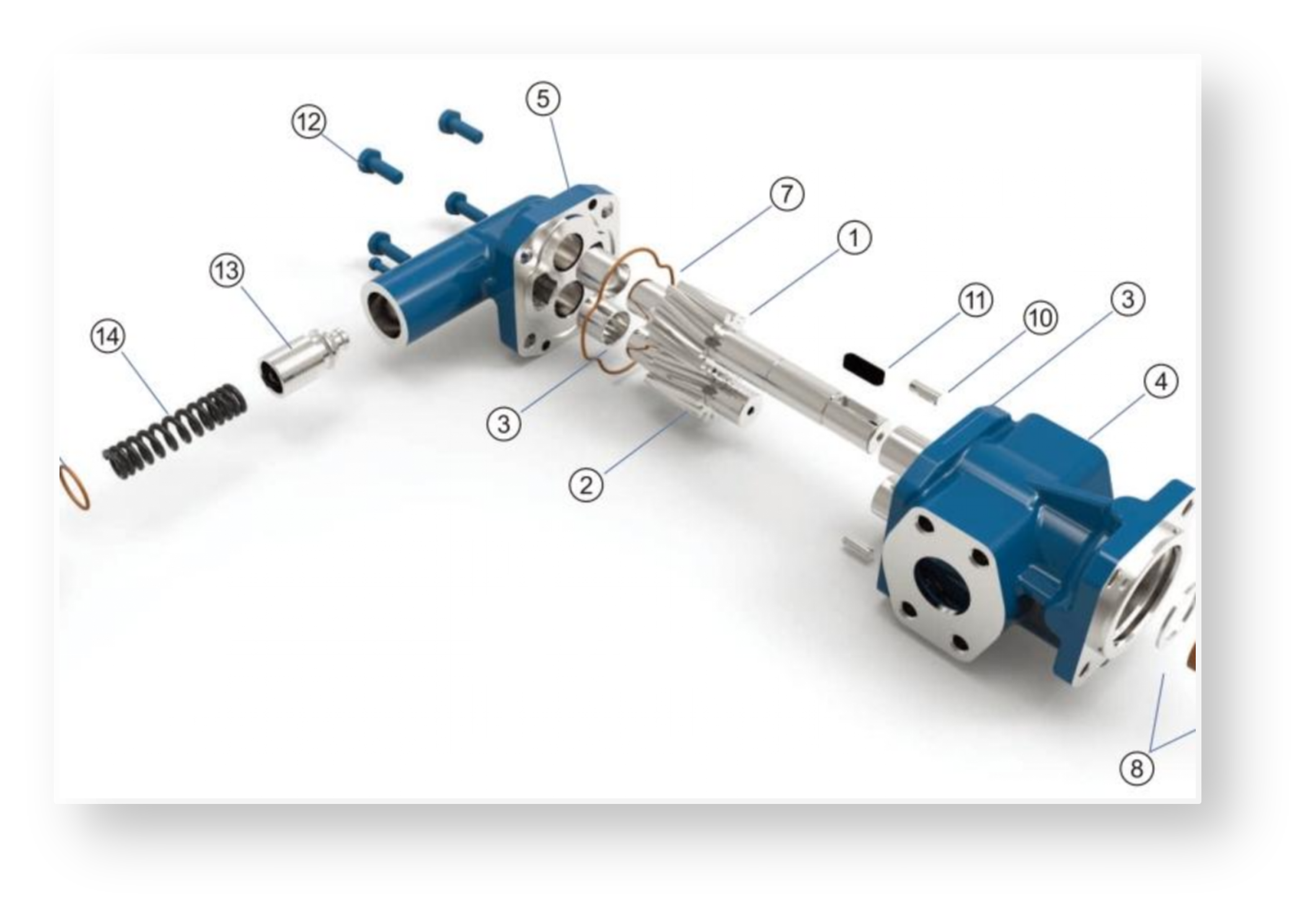
Series documentation covers more than one model, so a buyer should confirm the exact build sheet for the DK630 being ordered rather than treating every family-level value as a model-level guarantee.
Steel industry: continuous process, continuous heat
Steel plants concentrate the problem. Rolling, forging and shearing equipment run on large gearboxes, bearings and sliding surfaces under continuous load, and the lubrication circuit is expected to keep working while the line does. DEO's cooler documentation lists rolling mill lubrication stations and forging equipment among applications for cooling high-viscosity lubricating oil under continuous heavy load — a reminder that in steel the pump and the cooler are specified as one loop, not two purchases.
Three checks follow for a DK630 in this setting.
- Oil temperature at the pump inlet. The DK-series fluid window tops out at 100 °C. A circuit that returns hotter oil than that needs a cooling or bypass decision before the pump is sized, not after.
- Continuous duty. DEO documents the DK series for 24/6 operation. Steel duty rarely allows a scheduled daily stop, so the continuous rating is the relevant attribute, not peak flow.
- Flow against cooler capacity. Because the pump's job includes pushing hot oil to the cooler, a high-displacement model raises the cooler's duty as well. Moving from 950 to 1450 rpm adds roughly half again as much oil on paper, and all of it has to be cooled.
The QT500 ductile iron body is a material fact rather than a performance promise; what it changes on a steel site is the conversation about handling, mounting and inspection during rebuilds, not the flow figure.
Construction machinery: dust, dirt and inlet integrity
Construction equipment adds two variables steel does not: motion and contamination. A lubrication pump mounted on or beside mobile plant sees oil ports opened during service, top-ups from whatever container is available, and airborne dust around every breather and vent.
DEO's DK documentation treats oil cleanliness as a hard requirement rather than a recommendation: oil must be free of metal chips, sand and other solid impurities, because particle contamination scratches gear surfaces and wears bushings rapidly. On a construction site that requirement translates into practice — filtered filling, capped ports, checked breathers — rather than into a pump feature.
The second construction-specific point is inlet integrity. The documentation requires the inlet pipeline to be airtight, and forbids an inlet pipe narrower than the pump inlet port, because air ingress causes insufficient suction flow and cavitation while an undersized pipe adds restriction and pressure loss. On equipment that vibrates and flexes, hose routing and clamp intervals decide whether that requirement survives the first month of service.
Where a construction application has a small reservoir and a modest lubrication demand, 630 cc/rev may simply be more displacement than the circuit can use. That is a sizing question, addressed later in this article, not a defect of the model.
Mining equipment: remote sites and cold-start viscosity
Mining duty is defined by distance and by cold. A pump that is easy to inspect in a workshop may sit far from the nearest technician, and start-up may happen with oil at ambient temperature and at its thickest.
Two documented behaviours matter here. First, viscosity: the DK series accepts oil from 12 to 20000 cSt, but for oil above 1000 cSt the documentation advises reducing pump speed to avoid excessive suction resistance and cavitation. That makes the 950 rpm option the conservative starting point for cold, heavy oil, with 1450 rpm reserved for circuits where suction conditions are known to be good.
Second, the relief valve's role. The built-in valve provides overpressure protection against transient pressure surges that could damage piping and connected equipment. It is not a continuous bypass: the documentation warns that continuous overflow operation overheats the pump and causes early wear. If a site's normal operating mode involves oil bypassing for long periods — because a valve is stuck open, or a line is isolated during maintenance — that flow should be handled by the circuit design, not routed through the pump's internal valve.
Remote sites are also where oil is most likely to be topped up from an open container, and where a scratched gear set is most expensive to replace. Contamination control is therefore a mining procurement item, not a housekeeping detail.
Duty cycle: what 24/6 operation changes about speed selection
24/6 means 24 hours a day, six days a week. In practice that shifts attention away from peak flow and toward three steady-state conditions: oil temperature, suction quality and seal condition.
Oil temperature is the first because a continuously running circuit keeps adding friction heat to the same volume of oil. The DK-series documentation pairs oil delivery with circulation to a cooler for exactly this reason; without that second half, a continuous-duty pump becomes a heater with a gear set inside it.
Suction quality is the second because cavitation is a progressive failure rather than an event. An inlet that is marginally airtight may work at commissioning and fail months later. Lower speed reduces suction demand, which is why the documentation recommends it for very high-viscosity oil.
Speed selection therefore reads as a sequence: establish the required flow, check that the inlet can support it at 1450 rpm, and fall back to 950 rpm where viscosity, pipe length or oil temperature make suction marginal. The higher speed is the higher-output option, not the default one.
Installation and acceptance points before commissioning
Most lubrication-pump failures are installation failures discovered late. The checks below come directly from DEO's DK-series documentation and can be written into a commissioning sign-off.
| Check | Documented requirement | Failure mode if ignored |
|---|---|---|
| Inlet airtightness | Inlet pipeline must be airtight, with no air leakage | Insufficient suction flow and cavitation |
| Inlet pipe size | Inlet pipe must not be smaller than the pump inlet port | Flow restriction and pressure loss |
| Oil cleanliness | Oil free of metal chips, sand and other solid impurities | Scratched gear surfaces, rapid bushing wear |
| Rotation direction | Follow the direction marked on the pump nameplate | Seal failure and leakage |
| Dry running | Never run the pump without oil medium | Burned shaft bushings and gears |
| Relief valve duty | Transient overpressure protection only | Overheating and early wear under continuous overflow |
For the MDK pump unit variant — pump, motor and bell housing coupling supplied as one assembly — the documentation also requires bell housing and motor shaft coaxiality, which makes alignment a line item in the installation sign-off rather than an assumption.
DEO's production data lists 100% testing of pumps before shipment. That is a factory check on the pump, not a substitute for site acceptance: every item in the table above is an installation condition and cannot be verified on a test bench.
Where the DK630 stops fitting
The DK630 is a high-displacement model, and that shapes where it stops being the right answer.
- Lower flow demand. DEO's range also includes the PST180 at 180 cc/rev and the PSN100 at 100 cc/rev. Where a circuit needs a fraction of the DK630's delivery, matching displacement to demand avoids oversized piping and an oversized cooler.
- Reversing circuits. DK-series documentation specifies one marked rotation direction and warns that reverse rotation invalidates sealing. DEO lists the PST180 and PSN100 as bidirectional machines, so a circuit that must reverse flow is a different pump conversation.
- Small metered quantities. The DK630 is documented as a continuous circulation pump. Where the requirement is a small, precisely metered quantity at intervals, displacement and control method have to be matched deliberately rather than inherited from a high-flow model.
None of these is a shortcoming. They are the boundaries within which 630 cc/rev is the correct answer rather than an oversized one, and they are cheaper to establish before the purchase order than after commissioning.
Market context: automatic lubrication as a specification, not an upgrade
Two published figures help explain why buyers now evaluate pumps this way, with the caveat that both come from commercial research rather than independent measurement. A consolidated commercial research report published in 2026 puts the global lubrication system market at USD 863.88 million in 2024, and reports that 67% of newly commissioned industrial machines in that year were equipped with automatic lubrication systems. The same source projects a 6.89% compound annual growth rate for electric lubrication pumps to 2032.
Read carefully, these figures support a limited conclusion: automatic lubrication is a mainstream specification in new equipment, so the pump is increasingly selected as a system component with documented duty, cleanliness and installation requirements, rather than as a replacement part ordered when a bearing starts to complain. The growth figure is a forecast, not an observation, and none of these numbers measures demand for the DK630 or any other specific model.
Outlook
The direction of travel in the category is toward monitored, centralized lubrication. SKF's product documentation, for example, describes electrically operated pumps feeding lubricant in interval operation inside centralized systems, and 2024 academic work indexed in PubMed describes intelligent lubricating devices for machine-tool feed systems. Both indicate where system design is heading rather than what the DK630 does.
The DK630's documented role is narrower and more mechanical: continuous delivery at 24/6 duty with a built-in relief valve. A buyer who needs condition monitoring, automated fault signalling or interval metering should treat those as separate specification items and confirm them with the supplier, because the published DK630 data covers displacement, motor speed, material and duty — not control electronics.
Conclusion
For steel, construction and mining equipment, the DK630's case rests on published facts rather than adjectives: 630 cc/rev of displacement for circuits that need continuous volume, a QT500 ductile iron body, a DK-series platform documented for 24/6 duty, and installation requirements — airtight inlet, clean oil, transient-only relief — that predict whether the pump will last its first year. Match those to a site's heat load, contamination exposure and start-up viscosity, and the model is either a straightforward fit or plainly the wrong displacement. Either answer is useful before the purchase order, and neither is available from a flow curve alone.
About the manufacturer
Deo Machinery Co., Ltd. (DEO) was founded in 2010 and operates a 10,000 m² facility with 80 employees, including a 12-engineer R&D team. Its product range covers hydraulic pumps, electric lubrication pumps, centralized lubrication system pumps, oil lubrication pump systems, lubrication system oil coolers and industrial lube oil cooling systems. The company offers OEM/ODM production with a minimum order of one unit, a stated monthly capacity of 2,500 units and a 35–45 day lead time, and exports to Europe and America, Southeast Asia and Australia.
Company website: www.cndeo.com. Product and specification brochure: download the DEO brochure (PDF).
FAQ
What equipment is the DK630 electric lubrication pump intended for?
DEO lists the DK630 as an electric lubrication pump for mining equipment, construction machinery and the steel industry, within machinery and heavy industry. Its published specification is a 630 cc/rev displacement, motor speeds of 950 or 1450 rpm and a QT500 ductile iron body. That combination suits circuits that need continuous oil delivery to gears, bearings and sliding surfaces rather than small metered quantities.
How much oil does the DK630 deliver at each motor speed?
DEO publishes 630 cc/rev displacement and motor speeds of 950 and 1450 rpm. Multiplying the two gives a calculated displacement rate of about 598.5 L/min at 950 rpm and about 913.5 L/min at 1450 rpm (630 cm³ × rev/min ÷ 1000). These are geometric figures: actual delivered flow is lower because of volumetric losses, and the published model data does not state a volumetric efficiency figure, so the values belong in sizing discussions rather than in performance guarantees.
Can the DK630 run continuously in 24/6 operation?
DEO's DK-series documentation states an operation mode of 24/6 — 24 hours a day, six days a week. Continuous duty puts the emphasis on oil temperature control and on keeping the inlet airtight, since both affect how hard the pump works over long running periods. The supplied DK630 data does not include a service-life or maintenance-interval figure, so those should be confirmed with the supplier for the specific duty.
What oil condition and piping requirements apply before commissioning?
The DK documentation requires oil free of metal chips, sand and other solid impurities, because particles scratch gear surfaces and wear bushings. The inlet pipeline must be airtight with no air leakage, and the inlet pipe must not be smaller than the pump inlet port. Oil viscosity may range from 12 to 20000 cSt, with reduced pump speed advised above 1000 cSt, and fluid temperature from -40 °C to 100 °C.
What does the built-in relief valve protect, and what is it not for?
The DK series carries a built-in relief valve with a standard setting range of 5 to 25 bar, providing overpressure protection against transient surges that could damage piping and connected equipment. It is not designed as a continuous bypass: the documentation warns that continuous overflow operation overheats the pump and accelerates wear. Circuits that need sustained bypass flow require separate design provision.
Tem questões ou precisa de mais detalhes?
Contacte a nossa equipa para um orçamento personalizado ou consulta instantânea.
Solicitar orçamento
Preencha o formulário abaixo e a nossa equipa entrará em contacto com uma proposta personalizada.
Chat direto do WhatsApp
Prefere conversar em tempo real? Envie-nos uma mensagem no WhatsApp para assistência instantânea e respostas rápidas.
- Obter orçamento personalizado
- Partilhar fotos ou documentos
- Discuta as suas necessidades diretamente
Geralmente responde em 5–30 minutos durante o horário de expediente.