
DTF Printer Buyer Comparison: A Compliance Checklist
DTF Printer Buyer Comparison: A Compliance Checklist
An independent comparison of ten XF series DTF printers that starts with the only layer a buyer can verify without trusting the seller: certificate numbers, directive scope, model coverage and configuration data.
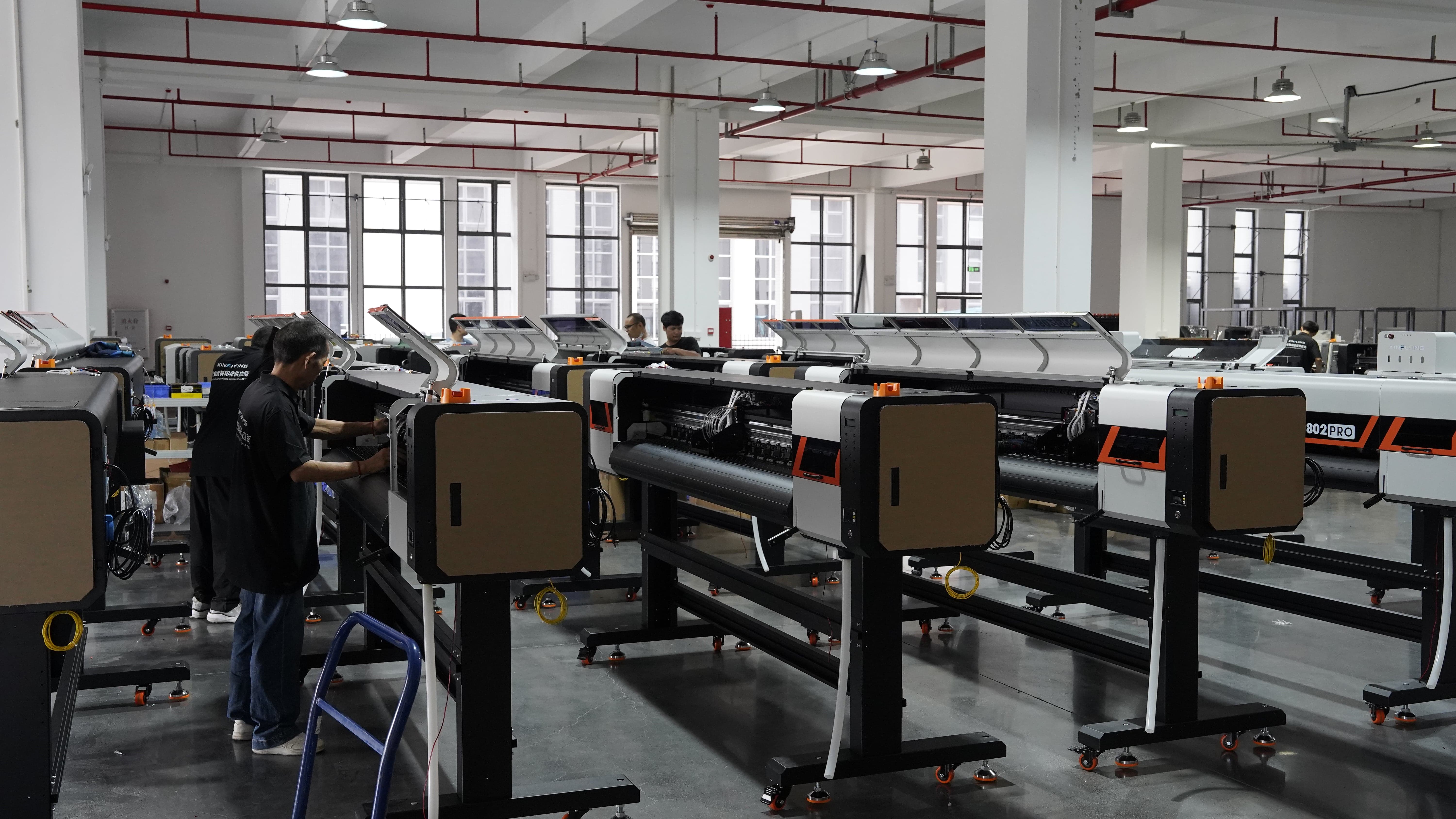
What an independent DTF printer comparison can actually verify
An unbiased DTF printer comparison cannot rank print quality, because print quality depends on the buyer's fabric, film, powder, heat press settings, ink batch and operator. What a neutral evaluator can compare is the part of the offer that already exists as documents: conformity scope, certificate numbers, harmonised standards, covered model lists, consumables certification, and the physical configuration of each machine class.
For the XF series of DTF printers, that verifiable layer contains four EU machine scopes — Low Voltage Directive (LVD), Electromagnetic Compatibility (EMC), Machinery Directive (MD) and RoHS — plus one consumables scope: OEKO-TEX® ECO PASSPORT certificate SH150194016, issued by TESTEX AG for textile printing inks and printing pastes.
Running one checklist across ten models — XF-450PRO, XF-400D, XF-702E, XF-C602, XF-C604, XF-C605, XF-F606, XF-L608, XF-F808 and XF-704E — produces something more useful than a ranking. The compliance footprint does not follow the price ladder. Entry-level and high-throughput models appear on the same certificates, which means documentation screens the manufacturer rather than ranking its models. Differentiation inside the range comes from configuration: printhead count and family, print width, rated power, environmental tolerance, machine weight and RIP support.
That is the honest finding of a side-by-side evaluation, and it changes how a buyer should use compliance evidence: as a shortlisting filter, not a scoreboard.
Why compliance evidence is easier to misread than to find
Most buyers do not fail because certificates are missing. They fail because the document in hand describes something other than the machine in the crate.
- Treating "CE" as a single document. LVD, EMC and MD are separate directives supported by separate standards and separate technical files. EMC evidence is not machinery-safety evidence, and neither of them substitutes for electrical-safety evidence.
- Reading the certificate number but not the product list. A certificate applies only when the exact model designation appears in its covered-product list.
- Applying a consumables certificate to the machine. OEKO-TEX ECO PASSPORT SH150194016 covers textile printing inks and printing pastes. It says nothing about the electrical or mechanical conformity of a printer, and machine certificates say nothing about what the printed ink transfers onto skin-contact textiles.
- Treating an older certificate as current evidence. Standard editions move. The machinery documents in this set already reference EN 60204-1:2018/A1:2025, an amendment edition that post-dates earlier EMC-focused CE certificates issued for the same product family in 2021 and 2025.
The eight-point checklist any independent buyer can run before shortlisting
- Fix the model designation before comparing anything. Write down the exact model string a supplier quotes — XF-C605 rather than "C605 series". The same string should appear on the certificate, the packing list, the invoice and the customs paperwork. Model-string mismatches are the most common reason compliant machines get held up at the border.
- List the directives your market actually requires. LVD (2014/35/EU) addresses electrical safety; EMC (2014/30/EU) addresses electromagnetic emissions and immunity; MD (2006/42/EC) addresses machinery safety; RoHS (2011/65/EU) restricts substances in electrical and electronic equipment. A European importer normally needs all four scopes evidenced.
- Match certificate scope to machine model. Request the covered-product page as a separate document and find the model string yourself, rather than accepting a covering email that only summarises it.
- Record number, issuer, issue date and validity. Those four fields are what make independent verification possible. A description alone is not evidence.
- Read the harmonised standards, including their editions. Two certificates can cite the same directive and still differ in the standards applied, and re-issued standards are a routine reason documentation is updated.
- Check the consumables chain separately. Inks and pastes carry their own certification, their own scope and their own renewal date.
- Check the manufacturing evidence underneath the certificates. The XF series documentation states that pre-shipment testing is performed on each DTF printer before delivery, and the manufacturer's quality management scope covers digital printer and ink sales.
- Confirm the specification matches your site before you rank anything. Rated power, supply current, footprint, packing mode and the permitted temperature and humidity window should be checked before price is compared.
The certificate set, read line by line
Six machine-level documents and one consumables document form the evidence base for the DTF models in this comparison. Every field below is taken from the certificate records themselves.
| Scope | Certificate number | Issuing body | Directive and standards | Issued | Validity listed |
|---|---|---|---|---|---|
| CE LVD | TQT1550D271EC | TQT (Shenzhen Tianqi Testing Technology Service Co., Ltd.) | LVD 2014/35/EU; EN IEC 62368-1:2020/A11:2020 | 2026-05-19 | to 2099-01-01 |
| CE EMC | TQT1550D270EC | TQT | EMC Directive 2014/30/EU; EN 55032:2015/A11:2020; EN 55035:2017/A11:2020; EN IEC 61000-3-2:2019+A1:2021; EN 61000-3-3:2013/A2:2021 | 2026-05-19 | to 2099-01-01 |
| CE MD | M.2026.206.C142365 | UDEM | MD 2006/42/EC; EN ISO 12100:2010; EN 60204-1:2018/A1:2025; EN ISO 12643-1:2023 | 2026-06-10 | to 2031-06-09 |
| CE MD | M.2026.206.C142385 | UDEM | MD 2006/42/EC; EN ISO 12100:2010; EN 60204-1:2018/A1:2025; EN ISO 12643-1:2023 | 2026-06-10 | to 2031-06-09 |
| CE LVD & EMC | M.2026.206.C142475 | UDEM | LVD 2014/35/EU and EMC 2014/30/EU; EN IEC 62368-1:2020/A11:2020; EN 55032:2015/A1:2020; EN 55035:2017; EN 61000-3-2:2014; EN 61000-3-3:2013 | 2026-06-11 | to 2031-06-10 |
| RoHS | M.2026.206.C142366 | UDEM | RoHS Directive 2011/65/EU; EN IEC 63000:2018; EN IEC 62321 series | 2026-06-10 | to 2031-06-09 |
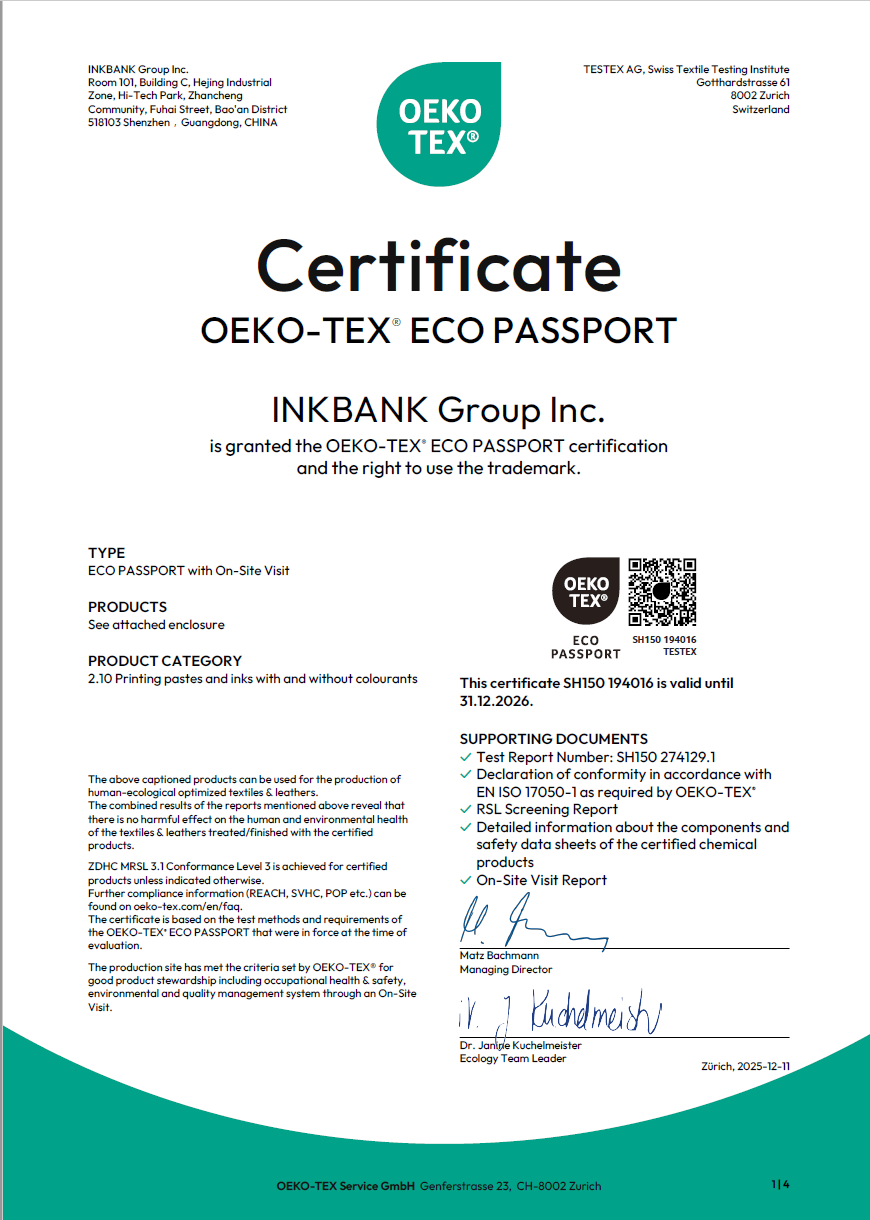
| OEKO-TEX® ECO PASSPORT | SH150194016 | TESTEX AG | OEKO-TEX ECO PASSPORT; EN ISO 17050-1; scope: textile printing inks and printing pastes | 2025-12-11 | to 2026-12-31 |
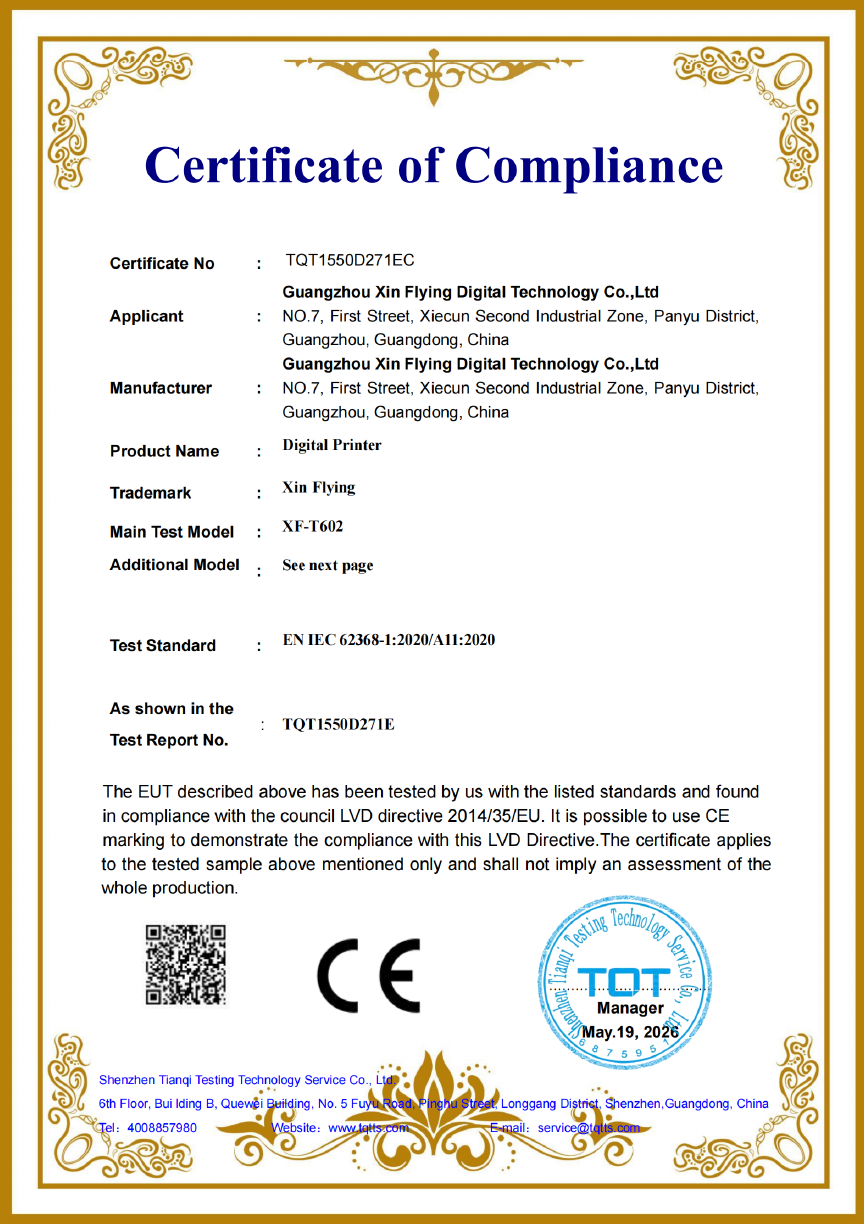
Three details in that table matter more than the rest. First, two Machinery Directive numbers appear in the same documentation set — M.2026.206.C142365 and M.2026.206.C142385 — both issued on 2026-06-10 against identical standards. An independent buyer should ask which number accompanies a specific shipment and which models it names, rather than assuming either one applies automatically. Second, the RoHS attestation carries its own number and its own validity period, ending 2031-06-09, which is a different date from the EMC and LVD documents. Third, the OEKO-TEX ECO PASSPORT entry is not a machine document: its declared scope is textile printing inks and printing pastes, so it must be tracked on its own renewal cycle.
The same evidence base also contains earlier EMC-focused CE certificates — BSTXD211021006201EC issued 2021-10-18 by BST Testing (Shenzhen) Co., Ltd., and CTICAIQ415250900815313DC issued 2025-08-12 by CTIC Testing Group (Guangdong) Co., Ltd. Both cover EN 55032 and the EN IEC 61000-3 series. They are legitimate historical evidence, but the 2026 documents are the ones that reference the current standard editions, and a buyer comparing suppliers should be able to say which set is on file.
Model by model: where the ten XF DTF models actually differ
The table below holds compliance constant and compares configuration. The final column is deliberately repetitive, because repetition is the finding: the same four machine scopes are listed for every model in the DTF range, from the 30 cm entry unit to the 80 cm eight-head machine.
| Model | Printheads | Print width | Fastest quoted speed | Rated power | Net weight | Machine scopes listed |
|---|---|---|---|---|---|---|
| XF-400D | 2× Epson i1600-A1 / XP600 | 30 cm (12") | 6PASS 4.5 m²/h | 0.5 kW; 110–220 V, 2.3 A / 4.5 A | 60 kg | LVD, EMC, MD, RoHS |
| XF-450PRO | 2× Epson i1600-A1 | 42 cm (16.5") | 6PASS 11 m²/h | 3.5 kW; 110–220 V, 16 A / 32 A | 250 kg | LVD, EMC, MD, RoHS |
| XF-702E | 2× Epson i3200-A1 | 60 cm (24") | 6PASS 13 m²/h | 0.8 kW; 110–220 V, 5 A / 10 A | 158 kg | LVD, EMC, MD, RoHS |
| XF-C602 | 2× Epson i3200-A1 | 60 cm (24") | 4PASS 16 m²/h | 1.6 kW; 110–220 V, 7.2 A / 14.5 A | 210 kg | LVD, EMC, MD, RoHS |
| XF-704E | 4× Epson i3200-A1 | 60 cm (24") | 4PASS 38 m²/h | 1.6 kW; 110–220 V, 7.2 A / 14.5 A | 162 kg | LVD, EMC, MD, RoHS |
| XF-C604 | 4× Epson i3200-A1 | 60 cm (24") | 4PASS 38 m²/h | 1.6 kW; 110–220 V, 7.2 A / 14.5 A | 180 kg | LVD, EMC, MD, RoHS |
| XF-C605 | 5× Epson i3200-A1 | 60 cm (24") | 6PASS 36 m²/h | 1.6 kW; 110–220 V, 7 A / 14.5 A | 227 + 120 kg split; 300 kg integrated | LVD, EMC, MD, RoHS |
| XF-F606 | 6× Epson i3200-A1 | 60 cm (24") | 6PASS 28 m²/h | not stated in the specification set (110–220 V, 50/60 Hz) | 171 kg | LVD, EMC, MD, RoHS |
| XF-L608 | 8× Epson i3200-A1 | 60 cm (0.6 m) | 4C4W 4PASS 42 m²/h; 5C3W 5PASS 45 m²/h | 1.2 kW; 110–220 V, 7.2 A / 14.5 A | not stated in the specification set | LVD, EMC, MD, RoHS |
| XF-F808 | 8× Epson i3200-A1 | 80 cm (31") | 4PASS 50 m²/h | 2 kW; 110–220 V, 9 A / 18 A | 440 kg | LVD, EMC, MD, RoHS |
Read across the rows and five structural differences emerge, none of which appear in the compliance column:
- Printhead count sets the class. The range runs from two printheads (XF-400D, XF-450PRO, XF-702E, XF-C602) to four (XF-704E, XF-C604), five (XF-C605), six (XF-F606) and eight (XF-L608, XF-F808). Head family also splits the range: the i1600-A1 units sit at the compact end, and every 60 cm and 80 cm model uses i3200-A1 heads.
- Print width splits the range into three groups. 30 cm, 42 cm, and then a large 60 cm cluster with the XF-F808 alone at 80 cm.
- Ink channel layout changes with head count. Two-head machines run CMYK+W; four-head machines run CMYK+CMYK+W+W; the XF-C605 lists CMYK+CMYK+CMYK+W+W; the XF-F606 lists CMYK+CMYK+CMYK+W+W+W or CMYK+CMYK+ORGB+ORGB+W+W; the XF-L608 runs water-based pigment ink in 4C4W or 5C3W layouts.
- Rated power and supply current vary more than buyers expect. The XF-450PRO is documented as an all-in-one solution with an integrated powder shaker and dryer and draws 3.5 kW with a 16 A / 32 A supply, while the 60 cm printer-only units sit between 0.8 kW and 2 kW. Electrical planning therefore differs by machine class, not by certificate scope.
- Environmental and site requirements are model-specific. Most models specify 20–30°C and 45–65% RH; the XF-F606 specifies 15–30°C and 35–65% RH; the XF-L608 specifies 20–35°C and 35–65% RH. The XF-F606 also lists a computer configuration of Windows 7 or later, 500 GB or larger drive, ATI discrete GPU, 8 GB or more RAM and an Intel i7 processor.
Two more operational details are visible only in the specification data. The XF-C605 can ship in a split packing configuration of 2200×880×750 mm plus 1610×810×1100 mm, or as an integrated 1920×1000×1650 mm unit — a real difference for warehouse access and installation planning. And the RIP baseline is not identical across the range: most models list RIIN or PrintFactory as standard with Maintop, PhotoPrint and CADlink optional, the XF-F606 lists Maintop and RIIN, and the XF-L608 lists SPIDE as standard with RIIN optional.
What each directive actually covers on a DTF printer
A checklist is only useful if the buyer understands what each document is describing. On a DTF printer, the four machine scopes describe four different things about the same piece of equipment.
LVD — the machine as electrical equipment
The LVD evidence for this range is issued under EN IEC 62368-1:2020/A11:2020 and applies to the mains input, power supply, wiring, insulation, protective earthing and heating elements. This matters because the models in this comparison are specified from 0.5 kW to 3.5 kW and draw between 2.3 A and 32 A depending on configuration. A machine rated at 16 A / 32 A and one rated at 2.3 A / 4.5 A are not interchangeable from a site-planning perspective, even if they carry the same directive coverage.
EMC — the machine as an electromagnetic neighbour
The EMC documentation cites EN 55032:2015/A11:2020 for emission limits, EN 55035:2017/A11:2020 for immunity, EN IEC 61000-3-2:2019+A1:2021 for harmonic current limits and EN 61000-3-3:2013/A2:2021 for voltage fluctuation limits. DTF printers combine stepper or servo drives, printhead driver electronics and heating elements in workshops that often run several machines on the same supply, so both emissions and immunity requirements are relevant to production stability, not only to customs.
MD — the machine as machinery
Machinery Directive documents in this set apply EN ISO 12100:2010 for risk assessment, EN 60204-1:2018/A1:2025 for the electrical equipment of machines, and EN ISO 12643-1:2023 for safety requirements covering graphic technology equipment and systems. The distinction from LVD is worth stating plainly: LVD treats the unit as a product; MD treats it as a machine with mechanical hazards, moving axes and operability requirements.
RoHS — the machine as materials
RoHS coverage is issued under Directive 2011/65/EU with EN IEC 63000:2018 as the assessment framework and the EN IEC 62321 series as the supporting test methods. It addresses restricted substances in the electrical and electronic assembly rather than performance or safety behaviour.
OEKO-TEX ECO PASSPORT — not the machine at all
Certificate SH150194016, issued by TESTEX AG and declared under EN ISO 17050-1, covers textile printing inks and printing pastes. This is the document that connects the printing workflow to what ultimately sits against skin on a finished garment. It is also the document with the shortest listed validity in the set — to 2026-12-31 — which makes it the one most likely to need attention during a multi-year production plan.
Fitting the configuration to the production scenario
Because compliance does not differentiate the ten models, scenario fit does. Documented user cases in this product family show four recurring operating profiles, and each maps to a different machine class.
- Print-on-demand and e-commerce operations. A United States print-on-demand business operates five DTF units and has used the workflow for five years, printing designs after orders arrive. The documented result is reduced inventory pressure, less dependence on external printing suppliers, faster order fulfilment and greater flexibility on customised apparel.
- Small custom apparel printing. A United States custom apparel business runs two DTF units, in operation for three years, producing customised T-shirts, hoodies, bags and other textile products with full-colour graphics — handling both small-quantity orders and repeat production.
- Transfer supply. A United States DTF transfer supplier deployed 30 units and has run the system for one year, producing transfer films with various designs, logos and graphics for downstream garment decorators, with stable continuous printing cited as the key requirement.
- Garment manufacturing integration. A garment manufacturing factory operates 20 DTF units, in use for two years, adding logos, patterns and customised graphics to finished garments before delivery to brands and distributors, and using the technology for sampling and short-run projects.
Against those profiles, the configuration ladder becomes a procurement decision rather than a specification list. The XF-450PRO, documented as an A2 all-in-one DTF solution with 2× Epson i1600-A1 printheads, an integrated powder shaker and dryer, a white ink circulation system and RIIN / PrintFactory RIP software, is positioned for startups, small custom print shops and businesses entering apparel printing. The XF-702E package, a 60 cm configuration with 2× Epson i3200-A1 printheads, an automatic powder shaker and curing system, an auto moisture retention system, a white ink circulation system and RIP support, is positioned for growing print shops, e-commerce fulfilment businesses and professional apparel customisation companies. The XF-C605 package, a 60 cm industrial configuration with 5× Epson i3200-A1 printheads, an automatic powder recycling system, smart touchscreen control, a built-in fume purifier and professional RIP software, is positioned for high-volume apparel factories and large printing service providers.
Supplier-side capability belongs in the same evaluation, because compliance documents and support capability are usually tested at the same moment — when something goes wrong. XINFLYING (Guangzhou Xin Flying Digital Technology Co., Ltd.) is a Guangzhou-based manufacturer founded in 2010 that builds DTF printers, UV DTF printers, UV flatbed printers, DTG printers and dye-sublimation printers, and states an export ratio of 80% across North America, South America, Europe, Asia, the Middle East and Africa. Its documentation lists OEM/ODM support covering product branding, machine appearance, colour, logo and packaging customisation, a stated monthly capacity of 1600+ units, lead times of 5–40 days, a minimum order quantity of 1 unit, a 20-engineer R&D team, and more than 50 engineers providing 24/7 online technical support.
Market context: why documentation-first evaluation is spreading
The commercial backdrop makes certificate discipline more valuable, not less. The global DTF printing market was valued at USD 2.7 billion in 2024 according to Grand View Research, and Dataintelo projects the DTF printer market reaching USD 5.2 billion by 2034 at a 12.5% CAGR. Dataintelo also estimates that China accounts for more than 45% of global DTF printer manufacturing capacity.
Regional and product mix explain part of the compliance pressure. Grand View Research identifies Europe as the leading regional market in 2024 with a 36.0% revenue share — a market where the four directives in this checklist apply directly. KBV Research attributes 41% of 2024 DTF printing revenue to T-shirts, the end product most exposed to skin-contact expectations, which is the domain of the OEKO-TEX ECO PASSPORT scope rather than of machine certification. Dataintelo reports that industrial DTF printers accounted for 58.3% of total revenue share in 2025, driven by throughput requirements — and industrial machines are exactly where higher rated power makes LVD and EMC evidence more consequential.
Forecast divergence is itself part of the picture, and it argues for evidence over narrative. Published growth estimates for this market include 6.0% for 2025–2030 from Grand View Research, 6.77% for 2026–2032 from 360iResearch, and 12.5% for 2026–2034 from Dataintelo. When analysts disagree by a factor of two, a buyer is better served by documents that can be checked than by projections that cannot.
Where a document-first evaluation stops working
A checklist that only lists advantages is not an evaluation. Four limits apply, and buyers should state them internally before using compliance as a shortlisting tool.
- Certification is a filter, not a ranking. Conformity documents prove that a configuration met defined requirements. They do not measure throughput, colour consistency, uptime, ink consumption or service responsiveness. A fully certified machine can still be the wrong machine for a workshop, which is why specification and support evidence must be evaluated in parallel.
- Certificates describe a tested configuration. Field changes — a different ink chemistry, an added dryer, altered power wiring, retrofitted components — can move a delivered machine outside the configuration that was tested. The buyer's obligation does not end at the purchase order; it continues through delivered configuration control.
- Consumables certification expires on its own schedule. OEKO-TEX ECO PASSPORT SH150194016 covers inks and pastes with a listed validity to 2026-12-31, while the machine-level documents run to 2031. A buyer running a multi-year programme cannot assume permanent coverage from a single file.
- In this specific range, compliance does not tell two models apart. A buyer who wants differentiation must compare printhead count, print width, rated power, environmental window, weight, packing mode and RIP support — and then test print samples against their own fabric and film.
Compared with the traditional shortlisting route — comparing headline speed, printhead count and quoted price — the document-first method costs an extra administrative step and delays nothing that matters. It replaces assumptions about "CE compliance" with a set of numbers that can be verified before a deposit is paid.
What to expect from the next round of documentation
Three developments are already visible in the records themselves. First, re-certification is running on shorter cycles than buyers assume: the LVD and EMC documents were issued in May 2026, the Machinery Directive and RoHS documents in June 2026, and the machinery file already cites the EN 60204-1:2018/A1:2025 amendment. Second, combined LVD and EMC attestations are appearing alongside single-directive certificates, which simplifies verification but makes it more important to read which standards each document actually applies. Third, consumables compliance is becoming a procurement stage of its own, driven by apparel end markets where skin-contact expectations apply to ink and paste rather than to the machine.
For buyers at the evaluation stage, the practical consequence is a shift in sequence. Shortlist on documents first — model string, certificate number, directive scope, standard edition, validity — and only then compare speed, printhead configuration and price, using samples from the shortlisted models. A checklist run in that order turns a certificate set from a filing requirement into a procurement instrument.
FAQ
Which certifications should a buyer check before importing a DTF printer?
Buyers should identify the compliance documents their destination market requires, then confirm that each document names the exact machine model. For the European Union, that normally means evidence covering electrical safety (LVD 2014/35/EU), electromagnetic compatibility (EMC 2014/30/EU), machinery safety (MD 2006/42/EC) and restricted substances (RoHS 2011/65/EU). In the XF series documentation set, CE LVD is evidenced under TQT1550D271EC, CE EMC under TQT1550D270EC, CE MD under M.2026.206.C142365 and M.2026.206.C142385, combined LVD and EMC under M.2026.206.C142475, and RoHS under M.2026.206.C142366. Each document should also carry an issuing body, an issue date and a validity period.
Does a DTF printer need CE certification for the European Union?
Electrical printing machines placed on the EU market are expected to comply with the applicable directives, and CE marking is the manufacturer's declaration of that conformity. For a buyer, the practical step is not to ask whether CE exists but to confirm that the documentation matches the machine being purchased: that the covered-product list includes the exact model string, that the harmonised standards cited are current editions, and that validity dates have not lapsed. Documentation that does not name the purchased model does not demonstrate conformity for that unit.
How can a buyer reduce the risk of receiving non-compliant DTF equipment?
Verify supplier qualifications, certificate scope, model consistency and document validity before ordering, and confirm which documents will travel with the shipment. Equally important, keep the delivered configuration aligned with the tested configuration after installation. Changes such as different ink chemistry, an added dryer, altered power wiring or third-party components can move a machine outside the scope of the tested configuration, even when the original certificate was valid at the time of sale.
Which compliance document covers DTF inks rather than the machine?
OEKO-TEX ECO PASSPORT certificate SH150194016, issued by TESTEX AG, covers textile printing inks and printing pastes under the OEKO-TEX ECO PASSPORT scheme and EN ISO 17050-1, with a listed validity ending 2026-12-31. It is separate from the CE and RoHS machine documents, applies to consumables rather than equipment, and should be tracked on its own renewal cycle when a production programme spans multiple years.
What should buyers verify beyond certification?
Print stability, machine consistency, material compatibility, technical support and spare-parts availability should be evaluated alongside conformity documents. Configuration details matter as much: printhead count and family, print width, rated power and supply current, permitted temperature and humidity range, footprint and packing mode. In this product family, quality control documentation states that pre-shipment testing is performed on each DTF printer before delivery, and the manufacturer states that more than 50 engineers provide 24/7 online technical support.
How do DTF printer configurations differ within one manufacturer's range?
They differ by printhead count and family, print width, ink channel layout, rated power, weight, environmental tolerance and RIP support. In the XF DTF range, the XF-400D is a 30 cm machine with two Epson i1600-A1 or XP600 printheads; the XF-450PRO is a 42 cm unit documented as an A2 all-in-one solution with an integrated powder shaker and dryer; several models use two to five Epson i3200-A1 printheads at 60 cm width; the XF-F808 uses eight printheads at 80 cm width with a quoted fastest speed of 50 m²/h at 4PASS; and the XF-L608 uses eight printheads with water-based pigment ink in 4C4W or 5C3W channel layouts. Because the same four compliance scopes are listed across these models, configuration — not certification — is what separates them.
Reference material: the manufacturer's product and capability brochure is available as a PDF download here. Product and company information is published at www.xin-flying.com.