
Decoding AS/NZS Type D vs. EN1424: A Road Marking Compliance Guide
Decoding AS/NZS Type D vs. EN1424: A Road Marking Compliance Guide
Glass beads are the smallest line item in most road marking budgets and one of the largest determinants of whether a marking performs after dark. In procurement, the difficulty is rarely the bead itself. It is proving that the material delivered matches the designation written into the specification. Two designations recur in enquiries from Australia, New Zealand, Europe and export intermediaries: AS/NZS Type D and EN1424.
This guide compares the two on the attributes that are documented in published product data — gradation band, base material, colour and surface finish options, application field, and how each grade is handled at the paving machine. It deliberately stops short of reproducing either standard in full. Standard documents govern chemical composition, refractive index, roundness, moisture resistance and test methodology in far more detail than any supplier datasheet can carry. What a buyer can usefully do before a tender closes is understand where the two designations diverge, where they overlap, and which evidence to request.
Why two glass bead designations create sourcing confusion
The AS/NZS prefix identifies standards developed for the Australian and New Zealand market. The EN prefix identifies European standards. A project team working across both markets can therefore end up holding two specification clauses for the same physical consumable, and assuming that a bead accepted in one jurisdiction will be accepted in the other.
That assumption is where most compliance disputes begin. Both designations describe glass beads used in road marking and road safety, and both sit inside the same broad product envelope. They divide the particle size distribution differently, and particle size distribution is the single most auditable property a buyer can check at goods-in. Other national frameworks compound the picture: AASHTO M247 governs glass beads used in traffic paints in the United States, and the UK market works to BS 6088 grades, both of which appear alongside EN and AS/NZS designations in supplier catalogues.
The practical consequence is straightforward. A single warehouse stock grade is rarely positioned to satisfy two jurisdictions without documented evidence, and buyers who assume interchangeability may receive a consignment whose gradation sits outside the band their specification actually references.
AS/NZS Type D: what the gradation band tells buyers
AS/NZS Type D glass beads, published as model TYPE D, are manufactured from recycled glass and are specified for road marking and road safety applications. The sieve band is 1700–710 μm. That places Type D at the coarse end of the glass bead spectrum.
The headline product size range for the glass bead line is 0.5 mm to 20 mm, but the designation band is far narrower. Only particles passing the 1700 μm sieve and retained on the 710 μm sieve belong in a Type D consignment. Anything finer is a different grade; anything coarser falls outside the designation entirely.
Coarse drop-on grades of this type are commonly broadcast onto freshly applied thermoplastic or paint film, where the bead must sit high enough in the binder to intercept headlight beams. That is general industry practice rather than a clause of the standard itself, and it explains why coarse bands remain in demand even as finer, higher-index products gain ground in wet-night applications.
Reference point: how Type D sits against other AS/NZS grades
Within the same published range, AS/NZS TYPE B carries an 850–75 μm sieve band and AS/NZS TYPE C a 1300–425 μm band. The three grades are not interchangeable. A specifier who writes Type D is asking for a coarser distribution than Type B or Type C delivers, and a supplier who substitutes one for another without written approval is creating an audit problem rather than solving a logistics one.
EN1424: a wider, finer-shifted European band
EN1424 glass beads in the same published product line also use recycled glass, also fall inside the 0.5 mm–20 mm product range, and are also designated for road marking and road safety. The sieve band is 1400–355 μm. Relative to AS/NZS Type D, EN1424 admits finer particles at the bottom end and excludes the very coarse fraction at the top.
EN1424 sits inside the European family of road marking material standards. For context, EN 1423:2012 is documented by CEN, the European Committee for Standardization, as the harmonized European standard for glass beads and antiskid aggregates used as drop-on materials for road markings. EN1423 and EN1424 appear as separate designations in supplier literature and in the published product range, so buyers should confirm with the specifying authority which document governs a given project rather than treating the two as synonymous.
AS/NZS Type D vs. EN1424: side-by-side comparison
| Attribute | AS/NZS Type D | EN1424 |
|---|---|---|
| Product model designation | TYPE D | EN1424 |
| Sieve / gradation band | 1700–710 μm | 1400–355 μm |
| Overall product size range | 0.5 mm – 20 mm | 0.5 mm – 20 mm |
| Base material | Recycled glass | Recycled glass |
| Colour options | Transparent / opaque / mixed | Transparent / opaque / mixed |
| Surface finish | Smooth or matte | Smooth or matte |
| Custom colour and size | Available on request | Available on request |
| Application field | Road marking / road safety | Road marking / road safety |
Table 1. Comparison based on published product data for the two designations. Standard texts govern additional properties not listed here.
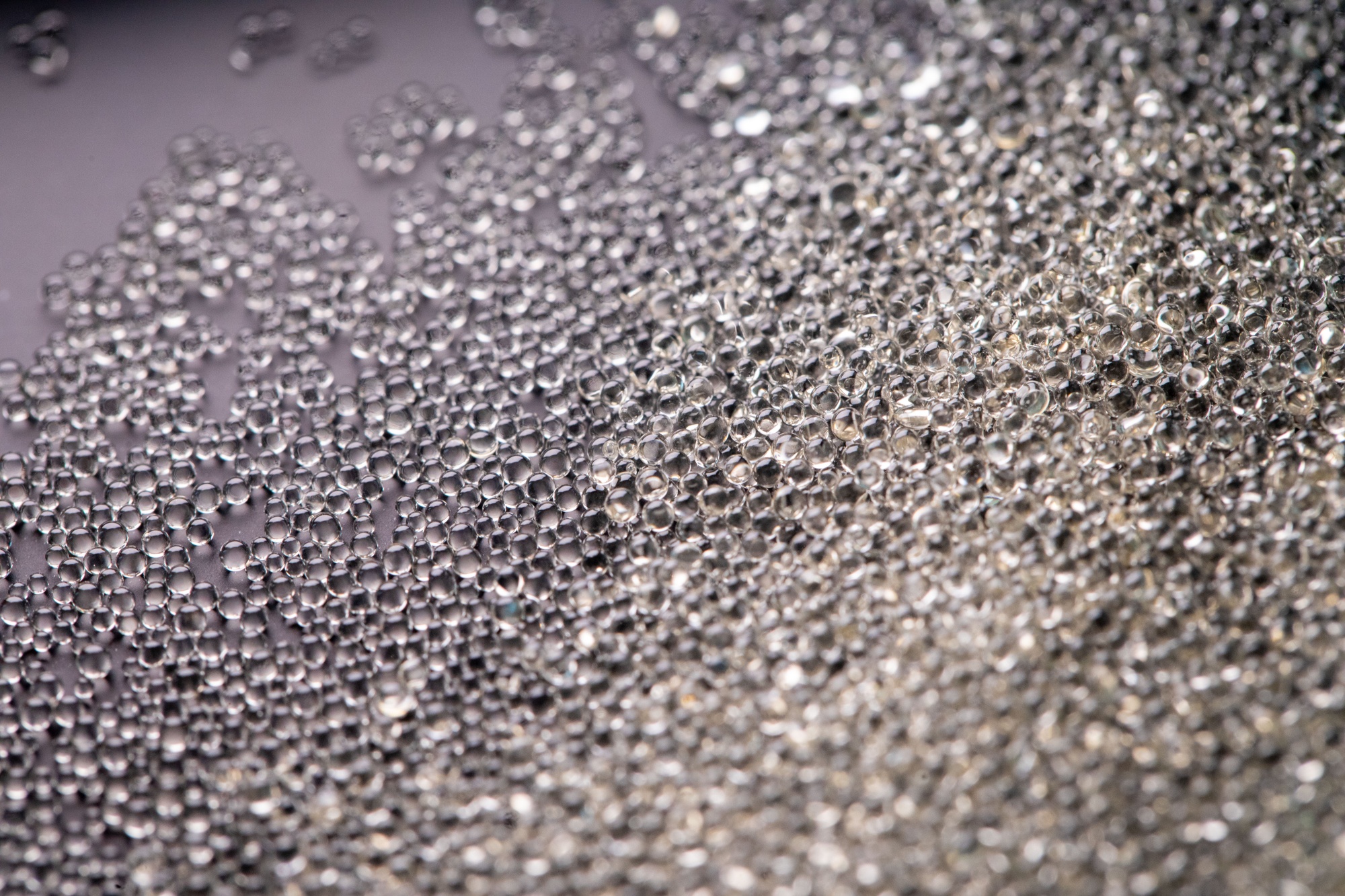
Glass bead grades are separated by sieve band. The physical difference between AS/NZS Type D and EN1424 is a matter of which sieves a particle passes and is retained on.
What both designations share
Strip away the gradation difference and the two designations look remarkably alike in published data. Both use recycled glass as the base material. Both sit inside a 0.5 mm to 20 mm product size range that also covers grinding, sandblasting and decorative bead lines. Both are offered in transparent, opaque and mixed colour options, and both can be finished smooth or matte.
Those shared attributes are not marketing decoration. They are procurement variables.
- Colour choice matters wherever a specifier uses coloured or mixed-colour beads for lane differentiation, decorative surfacing or contrast marking, rather than relying on the natural transparency of standard beads.
- Surface finish affects how beads flow through metering equipment and how they bond into the binder film. Smooth and matte finishes behave differently in bulk handling, and the choice should follow the applicator's equipment rather than habit.
- Recycled glass feedstock is a sourcing consideration, because recycled cullet varies by origin. That variability is manageable, but it has to be managed through testing rather than assumed away.
The overlap window: 1400–710 μm and why it matters
Both bands include particles between 1400 μm and 710 μm. On paper, that overlap makes a single physical product plausible for either designation. In practice it is a trap for buyers who read only the headline numbers.
A production lot deliberately narrowed to the overlap window would not reproduce the full gradation curve of either designation. It would lack the coarse fraction that Type D requires at the top end and the finer fraction that EN1424 admits at the bottom end. A consignment described as sitting between the two is therefore a third thing, not a universal bead, and it should only be accepted if the specifying authority has agreed in writing.
The overlap is still useful. It tells a buyer where to focus sampling effort and which sieve sizes a certificate must report on. A sieve analysis that stops at 710 μm cannot demonstrate Type D compliance, because the critical upper fraction is unmeasured.
How gradation affects application and retroreflection
Retroreflection depends on beads sitting at or near the surface of the marking film, receiving light from vehicle headlights and returning a portion of it toward the driver. Particle size distribution influences how deeply beads embed in the binder, how many remain exposed once the film cures, and how the marking behaves as the film wears under traffic.
Coarser distributions generally sit higher in the film and can deliver strong initial retroreflection, with the trade-off that exposed beads are also more exposed to tyre contact and eventual loss. Finer distributions embed more deeply, which changes both the initial reading and the wear curve. Neither behaviour is universally preferable. The right band depends on binder type, film thickness, traffic class and the retroreflection threshold the client has written into the contract.
Refractive index is a separate lever. The published glass bead range includes RI 1.6 beads with a 1000–180 μm scope and RI 1.7 beads with a 1180–180 μm scope, both designated for road marking and road safety. Third-party industry sources, including Swarco and Mordor Intelligence, note that high refractive index beads at RI 1.9 and above are increasingly used in all-weather markings to improve visibility in wet night conditions. Higher index and wider gradation are different decisions, and a specification should not confuse them.
How these beads are applied on site
Application data for the road marking product family describes outdoor, all-weather road paving conditions at normal temperature and pressure, with matching equipment that includes road marking machines, sand blasting machines and polishing equipment. Feeding is typically batch-mode, with beads metered into a coating or blasting process.
That matters for compliance because the machine is part of the specification chain. A bead that passes a laboratory sieve test can still underperform if the drop-on rate, gun height or binder temperature is wrong. Buyers who audit only the certificate and not the application parameters are auditing half the risk.
The wider product family also covers grinding glass beads at 600–1000 μm and 800–1200 μm scopes for polishing, and all-size grinding, sandblasting and decorative lines. For a distributor consolidating suppliers, the practical question is whether one source can hold consistent gradation across several of these designations rather than one.
Market trends shaping glass bead compliance
Three verified market signals explain why compliance documentation is becoming a harder procurement requirement rather than a formality.
- The global road marking glass beads market was valued at approximately USD 1.42 billion in 2025 and is projected to reach USD 2.31 billion by 2034, according to Dataintelo.
- Asia Pacific held a 38.7% revenue share of that market in 2025, driven by large-scale highway expansion programmes, again per Dataintelo.
- China accounted for roughly 57.4% of global glass bead exports in 2024, with total Chinese glass bead export value near USD 928 million and the UAE and India among the leading destinations, according to OEC data drawn from UN Comtrade.
Market size estimates diverge by scope. Dataintelo's figure covers road marking beads only, while other research houses publish wider valuations for all glass bead applications. Buyers should treat any single market number as scope-dependent rather than as a settled fact.
The direction of travel is nonetheless consistent: growing marking kilometres, more cross-border sourcing, and rising expectations that a supplier can produce evidence, not just product.
What compliance evidence should actually look like
A designation on a label is a claim. The following items convert it into something a buyer can defend in an audit.
- Batch sieve analysis reporting the full gradation curve, with the specific sieves relevant to the designation named explicitly.
- Roundness evidence. AASHTO M247, for example, requires at least 70% roundness for glass beads used in traffic paints, per AASHTO. Roundness is measurable and should be reported, not asserted.
- Refractive index declaration tied to the supplied grade, since RI 1.6, RI 1.7 and higher-index products are distinct inputs.
- Material origin statement confirming recycled glass content where the specification requires it.
- Colour and surface finish confirmation matching the purchase order, particularly for mixed and coloured beads.
- Consistency between the model designation and the standard referenced — the point at which most cross-jurisdiction confusion is caught.
Inside a production chain that has to hold gradation
Compliance starts upstream of the sieve. DYLAN TECHNOLOGY CO., LTD., established in 2004 and based in LangFang, China, supplies glass beads and related raw materials for the road safety industry. The company operates a 10,000 m² manufacturing facility with four production bases in Liaoning, Shanxi, Hebei and Henan provinces, employing approximately 300 staff, with an annual production capacity of 100,000 tons and a 20-engineer R&D team.
Two operational facts are directly relevant to gradation control. First, the laboratory is equipped with a CAMSIZER and an X-2600 instrument, which are used for particle size and related measurement rather than visual assessment. Second, export accounts for 95% of sales, with major markets in the EU, USA, Southeast Asia and the Middle East, and cooperative partners including ENNIS, Geveko and Swarco. A supplier shipping into several regulatory regimes has to maintain grade documentation for each, which is precisely the discipline that Type D versus EN1424 sourcing demands.
The company holds ISO9001 quality management system certification along with CE, JIS and KIS certifications, and is recognised as a provincial-level high-tech enterprise. For a buyer, the meaning of those credentials is narrower than they may appear. They evidence a managed quality system and market access. They do not replace a batch sieve certificate for the specific designation on order.

Consistent gradation between batches is the property most often tested at goods-in, and the property most often lost when feedstock changes without re-validation.
Future outlook
Three shifts are likely to shape bead procurement over the next few years. All-weather performance is driving interest in higher refractive index products, which changes what a specifier asks for even when the gradation band stays the same. Cross-border projects are making dual-designation documentation more common, so suppliers who can report cleanly against AS/NZS, EN, AASHTO and BS frameworks at the batch level will be easier to qualify. And as recycled glass becomes the default feedstock rather than a sustainability option, incoming material control will separate suppliers who can hold a gradation band from those who can only approximate it.
None of these trends removes the two most basic questions a buyer can ask. Which sieves define this designation, and what does the certificate for this batch say about them.
FAQ
- What is the main difference between AS/NZS Type D and EN1424 glass beads?
On published product data, the primary difference is the sieve band. AS/NZS Type D is a 1700–710 μm grade. EN1424 is a 1400–355 μm grade. Both are recycled-glass beads designated for road marking and road safety, and both sit inside a 0.5 mm to 20 mm product size range, but their particle size distributions are not identical. - What sieve range does AS/NZS Type D cover?
AS/NZS Type D glass beads are published with a 1700–710 μm sieve band. Particles must pass the 1700 μm sieve and be retained on the 710 μm sieve to fall within the designation. Finer grades such as AS/NZS TYPE B at 850–75 μm and AS/NZS TYPE C at 1300–425 μm are separate classifications. - What sieve range does EN1424 cover?
EN1424 glass beads are published with a 1400–355 μm sieve band, which reaches finer than AS/NZS Type D at the lower end and excludes the coarse fraction above 1400 μm. - Can one glass bead grade satisfy both AS/NZS Type D and EN1424?
The two bands overlap between 1400 μm and 710 μm, so a shared physical product is conceivable, but a lot narrowed only to that overlap would not reproduce the full gradation curve of either designation. Acceptance depends on the specifying road authority and on batch-level sieve evidence, not on the overlap alone. - What colour and surface finish options are available for these glass beads?
Published data lists transparent, opaque and mixed colour options, with smooth or matte surface finishes, for both AS/NZS Type D and EN1424. Custom colour and size are available on request, which matters for coloured and mixed-colour marking specifications. - How are these glass beads applied to road markings?
Application data describes outdoor all-weather road paving conditions at normal temperature and pressure, with matched equipment including road marking machines, sand blasting machines and polishing equipment. Feeding is typically batch-mode into a coating or blasting process, which means application parameters such as drop-on rate and binder condition affect performance alongside the bead's own gradation.
Reference material
Dylan Technology's corporate brochure, covering product designations, production bases and certification scope, is available for download: Corporate Brochure (PDF). Buyers evaluating AS/NZS Type D or EN1424 grades should request batch sieve analysis alongside any brochure material.