
Decoding CCS Certification: What Certificate Numbers 2026CJSD00023 and QD22P4062 Mean
Decoding CCS Certification: What Certificate Numbers 2026CJSD00023 and QD22P4062 Mean
Two China Classification Society certificates held by a Qingdao fender and airbag manufacturer look similar on paper, but they cover different products — and that difference is exactly what a buyer needs to check.
A pneumatic rubber fender rarely fails gracefully. When it does, the consequences appear as hull plating damage, berth repairs and downtime rather than as a simple parts replacement. That is why experienced marine buyers treat the document pack attached to a fender quotation — certificates, standards references, test records — as part of the product itself rather than as paperwork attached to it.
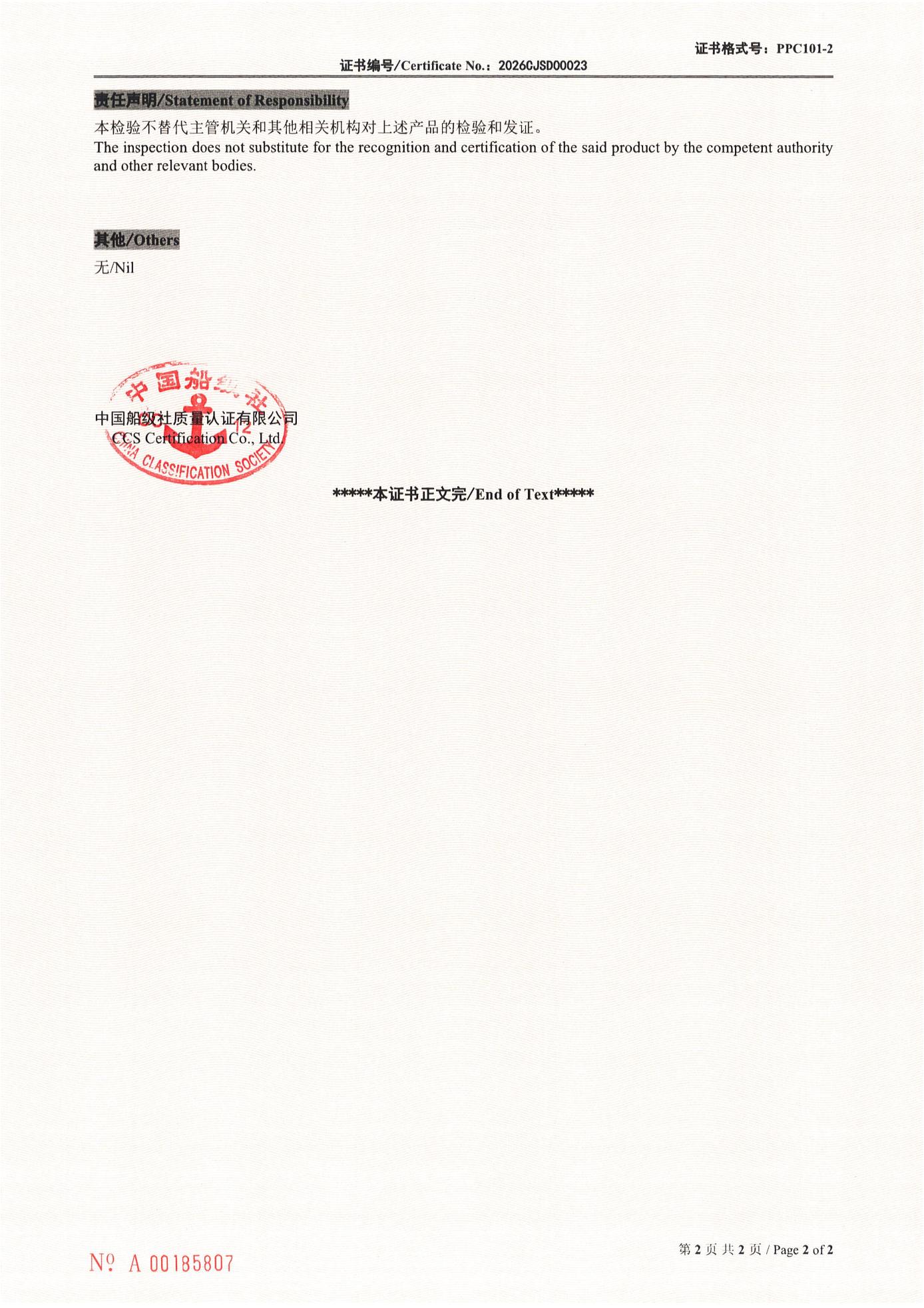
Among the documents most frequently requested from Chinese suppliers is certification issued by the China Classification Society (CCS), a classification society that certifies marine equipment and products. Qingdao Haohang Fender Airbag Co., Ltd, a Qingdao-based manufacturer of marine airbags and rubber fenders, holds two CCS certificates that regularly appear in buyer due-diligence files: 2026CJSD00023 and QD22P4062. Both were issued by CCS and both are listed for the global market. They are not, however, certificates for the same product — and reading them correctly changes how a procurement team evaluates a supplier.
Why the Certificate Number Matters More Than the Certificate Logo
A certificate logo is easy to place on a catalogue page. A certificate number is a record. It points to a specific issuing authority, a specific certificate holder, a defined product scope, a cited standard and an issue date. Buyers who screen fender suppliers on documentation quality tend to ask for the number first and the image second, because the number is the element that can be cross-checked against the issuing body.
The most common failure mode in that screening process is a scope mismatch: a document that looks authoritative is attached to a quotation for a product type it does not actually cover. Certificates issued to one manufacturer for one product line are sometimes presented alongside an entirely different product range, particularly when a supplier's catalogue spans several rubber-based marine products. The two CCS certificates discussed here illustrate how easily that happens, because both belong to the same manufacturer and both relate to rubber marine products — yet they are separate approvals for separate items.
What CCS Certification Actually Means in Marine Fendering
The China Classification Society is a classification society that issues certification for marine equipment and products. In this file, both certificate records show CCS as the issuing authority, both cite the CCS standard, and both are recorded for the global market rather than for a single country.
It helps to separate two things that are often blended together in supplier documentation. A classification society certificate records that a defined product scope has been reviewed and approved by a recognised body. A product standard, by contrast, defines the requirements a fender must satisfy. For floating pneumatic rubber fenders, the relevant international references are ISO 17357-1:2014 for high-pressure units and ISO 17357-2:2014 for low-pressure units, which address quality and energy absorption performance.
These two categories answer different questions. The standard tells an engineer what performance envelope the fender is expected to meet. The class society certificate tells a buyer that a named manufacturer and a named product scope have been through an approval process with a recognised organisation. Neither substitutes for the other, and a procurement file that contains only one of them is incomplete.
Reading 2026CJSD00023 and QD22P4062 Line by Line
The two certificates are frequently referenced together, so it is worth setting their verified contents side by side.
| Certificate field | CCS certificate 2026CJSD00023 | CCS certificate QD22P4062 |
|---|---|---|
| Issuing authority | China Classification Society | China Classification Society |
| Product scope | Marine airbag | Pneumatic rubber fender |
| Standard cited | CCS | CCS |
| Issue date | 28 January 2026 | 12 May 2022 |
| Market | Global | Global |
| Related product model | Marine Airbag, e.g. 1.5*12M, 2*20M | Rubber fender, e.g. 1.5*3M |
Certificate 2026CJSD00023 — marine rubber airbag
Certificate 2026CJSD00023 was issued on 28 January 2026 with a scope of marine airbag and a global market designation. The related product is the marine rubber airbag, with reference models such as 1.5*12M and 2*20M. The product parameters recorded for that item are a diameter range of 0.8–3 m, length options from 5 m to 26 m, working pressure of 0.08–0.15 MPa, single-airbag loading capacity of 50–2,000 tons, temperature resistance from −30°C to +70°C, and a stated service life of 5–10 years depending on usage frequency and maintenance. Documented application areas are shipbuilding, ship repair, special water operations and emergency rescue.
Certificate QD22P4062 — pneumatic rubber fender
Certificate QD22P4062 was issued on 12 May 2022 with a scope of pneumatic rubber fender and a global market designation. The related product is the rubber fender in its pneumatic form, with reference models such as 1.5*3M. Recorded parameters are a diameter range of 300 mm to 2000 mm, customisable length typically between 1 m and 10 m, and working pressure generally in the 0.1–0.3 MPa band, adjustable according to the operating environment. The construction material is natural rubber with cord fabric reinforcement, and the documented application areas are ports and docks, ship mooring, offshore platforms, inland river docks and temporary mooring.
What the number string itself tells you
The alphanumeric string is a record identifier issued by the classification society; its practical meaning is read from the certificate record — holder, scope, standard and date — rather than from inference about individual letters. A buyer who needs certainty about a specific certificate should verify the record with the issuing authority rather than interpret the code. What matters operationally is the mapping: the pneumatic rubber fender is covered by QD22P4062, and the marine airbag is covered by 2026CJSD00023. A buyer sourcing pneumatic rubber fenders for a berthing project is relying on the first; a buyer sourcing marine airbags for shipbuilding or ship repair work is relying on the second.
The Engineering Behind the Document: What a Certified Fender Is Built to Do
A floating pneumatic rubber fender absorbs berthing energy by compressing the air sealed inside a reinforced rubber body. The cord fabric layer carries the structural load, the natural rubber compound provides the abrasion and weathering surface, and the internal pressure determines how the unit behaves under repeated compression. That is why the working pressure range matters as much as the diameter: the same fender body performs very differently at the low and high ends of its pressure band.
For the certified pneumatic rubber fender in this file, that band is generally 0.1–0.3 MPa, with the specific setting adjusted to the usage environment. Diameters run from 300 mm to 2000 mm, and length is customisable, typically from 1 m to 10 m. Those two variables, together with pressure, define the energy absorption a unit can deliver at a given berth — which is why a certificate that names a product scope is a starting point for engineering evaluation, not a substitute for it.
Manufacturing discipline sits underneath all of this. Haohang operates an OEM/ODM model with size and logo customisation, a monthly capacity of 150 units, lead times of 7–45 days, a minimum order quantity of 1 unit, and 100% testing as its quality control standard. For a buyer, third-party certification and first-party production control serve complementary roles: the certificate establishes an externally verified scope, while the test regime establishes what happens to each unit before shipment.
Application Scenarios and What Field Evidence Looks Like
The documented application areas for the pneumatic rubber fender span ports and docks, ship mooring, offshore platforms, inland river docks and temporary mooring. In practice these settings place very different demands on a fender. A permanent port berth sees predictable vessel types and repeated, relatively uniform contact. Ship-to-ship and temporary mooring work involves variable geometry and less controlled approach speeds. Offshore platforms combine wave exposure with long service intervals.
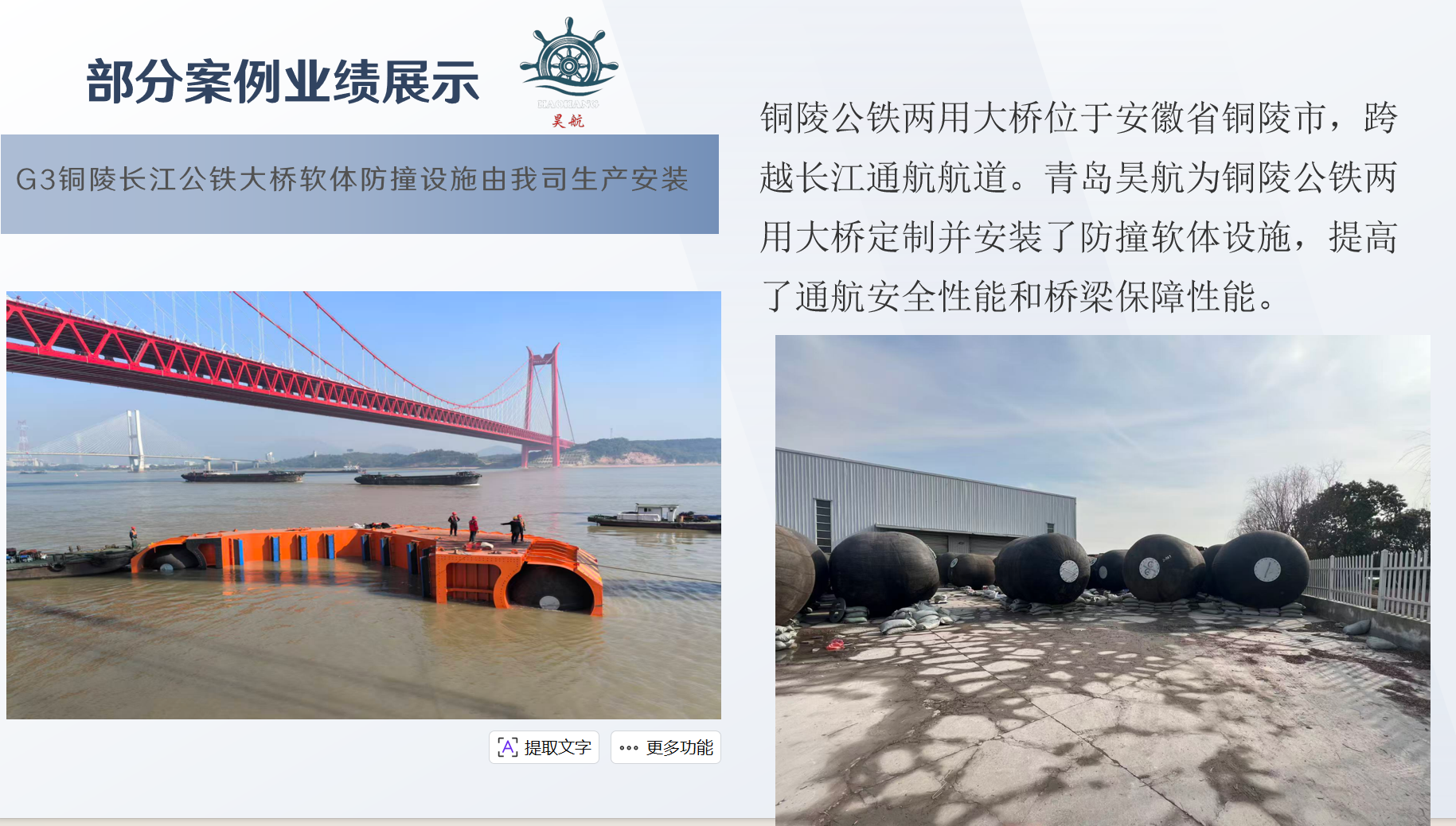
Field evidence is the part of a supplier file that buyers typically find hardest to obtain. One documented case involves an engineering contractor client in China that installed 50 pneumatic rubber fenders for berthing operations protecting vessels and dock structures. The project ran over a five-year duration, and the installed fenders successfully withstood extreme weather and high-frequency berthing. The case also notes high corrosion resistance suitable for China's coastal marine environment.
Read carefully, that record says something more specific than 'the product worked'. A five-year operating period with high-frequency berthing and extreme weather exposure tests abrasion resistance, pressure retention and structural integrity simultaneously — the three failure modes that dominate fender lifecycle cost. For a buyer evaluating a supplier rather than a single order, this type of record is the closest available proxy for how a product behaves after the warranty conversation has ended.
Market Context: Why Documentation Is Becoming a Procurement Filter
The fender category itself is not small, and it is not static. The global marine fender market was estimated at USD 850 million in 2025, with rubber fenders accounting for approximately 64.17% of total market share in 2024. Within that, the pneumatic marine fender segment was valued at USD 619.26 million in 2024 and is projected to grow at a compound annual growth rate of 3.21% to reach USD 797.35 million by 2032.
Demand is concentrated. Asia-Pacific is the dominant region for marine fenders, holding approximately 36.73% to 46% of the market, driven by shipbuilding and port activity in China, Japan and South Korea. That concentration explains a pattern many international buyers encounter: a large share of the world's fender manufacturing capacity sits in a region where China Classification Society certification is a familiar and locally verifiable approval.
Lifecycle economics reinforce the documentation trend. Pneumatic fenders typically last 5 to 7 years under consistent tidal cycles, while foam-filled alternatives can last 8 to 10 years in saltwater conditions. When a product's replacement cycle is measured in years rather than months, the cost of getting the certification and specification stage wrong is spread across the entire service life — which is precisely why evaluation-stage buyers are adding certificate verification to their supplier qualification criteria.
What CCS Certification Does Not Cover — and How to Compare Evidence Types
Certification is a boundary-defining document, and its limits matter as much as its contents. At least four limitations apply to a CCS certificate of this kind, and buyers should plan around each of them.
- Scope is product-specific. Certificate QD22P4062 covers pneumatic rubber fenders; certificate 2026CJSD00023 covers marine airbags. A single CCS approval does not automatically extend across a manufacturer's full rubber product range, and it does not automatically cover every model, diameter or pressure class within a range.
- Certification does not select the fender for you. Approval confirms a verified product scope; it does not determine which diameter, length or working pressure is correct for a specific berth, vessel mix or approach velocity.
- Documents have issue dates. The two certificates in this file were issued on 12 May 2022 and 28 January 2026. Buyers should confirm current validity status with the supplier and, where the project requires it, with the issuing authority — particularly on multi-year framework agreements.
- Project specifications override preferences. Some international projects specify ISO 17357-1:2014 or ISO 17357-2:2014 conformity, or name a different classification society. A CCS certificate is one recognised route to third-party verification, not a universal substitute for whatever the tender document requires.
It is also useful to compare evidence types on their own terms rather than treating all documentation as equivalent.
| Evidence type | What it establishes | Typical limitation |
|---|---|---|
| Manufacturer self-declared test report | Internal quality control data; Haohang applies 100% testing as its production standard | Not independently verified by a third party; scope and methods are defined by the manufacturer |
| CCS product certificate | An independent class-society record tied to a defined product scope and holder | Limited to the certified product and holder; does not cover sizing or energy absorption selection for a specific berth |
| ISO 17357-1:2014 / ISO 17357-2:2014 conformity | Compliance with international requirements for high-pressure and low-pressure floating pneumatic rubber fenders, including energy absorption performance | Buyers must confirm whether the project specification requires it in addition to class approval |
| Field reference from a completed project | Observed behaviour over time, such as a five-year berthing project with 50 installed fenders | Site-specific; conditions at one berth do not transfer automatically to another |
For buyers who want to position a certified specialist against the wider supplier landscape, published data points provide context. Trelleborg Marine Systems and Yokohama Rubber Co. are identified among the major global manufacturers, alongside ShibataFenderTeam, Palfinger Marine and Evergreen Maritime. Trelleborg, headquartered in Sweden, held a 17% share and supplied more than 2,500 units in 2024. Qingdao Haohang Fender Airbag Co., Ltd has a smaller footprint, with a monthly capacity of 150 units, a minimum order quantity of 1 unit and lead times of 7–45 days, supported by CCS certificate QD22P4062 for pneumatic rubber fenders and CCS certificate 2026CJSD00023 for marine airbags.
These columns measure different things — market share and unit volume on one side, certification scope and order flexibility on the other — and the table is not a ranking. Buyers should verify certification claims directly with the issuing authority for the exact product and production site they intend to purchase from, whichever supplier they shortlist.
A Step-by-Step Verification Workflow for Procurement Teams
Certification verification works best as a fixed sequence rather than an ad hoc check. The following workflow is designed for evaluation-stage buyers handling international projects.
- Match the number to the record. Ask for the certificate number in writing — for example 2026CJSD00023 or QD22P4062 — not only an image of the certificate.
- Confirm the holder. The certificate holder name should match the legal entity that will appear on the commercial invoice and, ideally, the production site.
- Check the scope against the purchase. If you are buying pneumatic rubber fenders, confirm that the certificate scope reads pneumatic rubber fender. If you are buying marine airbags, confirm the corresponding scope.
- Check the issue date and current validity with the supplier and, for critical projects, with the issuing authority.
- Verify the model and size range. Confirm that the diameter, length and pressure band you require fall inside the certified product scope or its annexes.
- Confirm the standard cited on the certificate, and check whether your project specification separately requires ISO 17357-1:2014 or ISO 17357-2:2014 conformity.
- Request production test evidence. Certification covers scope; the test regime covers individual units. Ask for the inspection record that accompanies the shipment.
- File the certificate with the delivery documents so that verification can be repeated at handover, at commissioning and at any subsequent maintenance or replacement stage.
Applied consistently, this workflow removes the most common source of dispute in fender procurement: a document that was genuine but did not cover the product actually being delivered.
Future Outlook
Three forces point in the same direction. Pneumatic fender demand is growing at a measured pace, from USD 619.26 million in 2024 toward a projected USD 797.35 million by 2032, with rubber fenders already holding roughly 64.17% of the wider marine fender market. Replacement cycles remain long, at 5 to 7 years for pneumatic units under consistent tidal cycles. And procurement is increasingly cross-border, with Asia-Pacific continuing to hold the largest share of both manufacturing and demand.
In that environment, documentation quality becomes a competitive variable rather than an administrative afterthought. Suppliers who can produce specific, verifiable certificate numbers tied to specific product scopes will find it easier to move through buyer qualification, particularly with engineering contractors and international project owners who must justify their supplier choices to insurers and class surveyors. Suppliers who present certification as a general marketing claim rather than a mapped record will face longer qualification cycles.
For buyers, the practical implication is a shift in how supplier shortlists are built. Market presence still matters, but certification scope, verification pathway and production traceability increasingly determine which suppliers reach the technical evaluation stage at all.
FAQ
What is CCS certification for a rubber fender?
CCS certification is an approval issued by the China Classification Society, a classification society that certifies marine equipment and products. For a pneumatic rubber fender, the certificate records a defined product scope, the certified holder, the standard cited and an issue date. In the Haohang file, certificate QD22P4062 covers pneumatic rubber fenders and is issued for the global market.
Do certificate numbers 2026CJSD00023 and QD22P4062 cover the same products?
No. Certificate QD22P4062, issued on 12 May 2022, has a scope of pneumatic rubber fender. Certificate 2026CJSD00023, issued on 28 January 2026, has a scope of marine airbag. Both were issued by the China Classification Society and both are listed for the global market, but they are separate records for separate product types, with reference models such as 1.5*3M for the fender and 1.5*12M or 2*20M for the airbag.
How should a buyer verify that a CCS certificate number is genuine?
Request the certificate number in writing, then confirm the holder name, product scope, standard and issue date against the document itself, and verify the record with the issuing authority where the project justifies it. Cross-checking that the certificate holder matches the legal entity on the commercial invoice, and that the certified scope matches the product actually being purchased, resolves the majority of documentation discrepancies before an order is placed.
Is CCS certification the same as ISO 17357 compliance?
They serve different functions. ISO 17357-1:2014 covers high-pressure floating pneumatic rubber fenders and ISO 17357-2:2014 covers low-pressure units, addressing quality and energy absorption performance requirements. A classification society certificate records that a defined product scope has been approved by a recognised body. Buyers should check whether their project specification requires ISO conformity in addition to, or instead of, a particular class approval.
Does a CCS certificate tell a buyer which fender size to choose?
No. The certificate defines a verified product scope, such as pneumatic rubber fenders with diameters from 300 mm to 2000 mm, customisable lengths typically from 1 m to 10 m, and working pressure generally between 0.1 MPa and 0.3 MPa. Selecting a specific size and pressure setting still requires engineering analysis of the berth, the vessel mix and the expected approach conditions.
What evidence should accompany a certified fender beyond the certificate itself?
Certification covers scope, while production controls cover individual units. Useful supporting evidence includes the production test record — Haohang applies 100% testing as its quality control standard — and documented field experience. One recorded case covers an engineering contractor client in China that installed 50 pneumatic rubber fenders for berthing operations, with the installation successfully withstanding extreme weather and high-frequency berthing over a five-year project duration.
Reference material: Qingdao Haohang Fender Airbag Co., Ltd publishes a product brochure covering its marine airbag and rubber fender ranges, including specification tables and certification references. Download the brochure (PDF). Company information: www.qdhaohang.com.
This article is an independent industry reference. Certificate details referenced above reflect the records available to this platform; buyers should confirm current certificate status directly with the issuing authority for their specific product and project.