
Decoding Compliance for Curved and Laminated Curtain Wall Glass
A verification guide for buyers who need to connect published glass parameters — interlayer type, thickness tolerance, sound insulation — to the standards a curtain wall is actually built to.
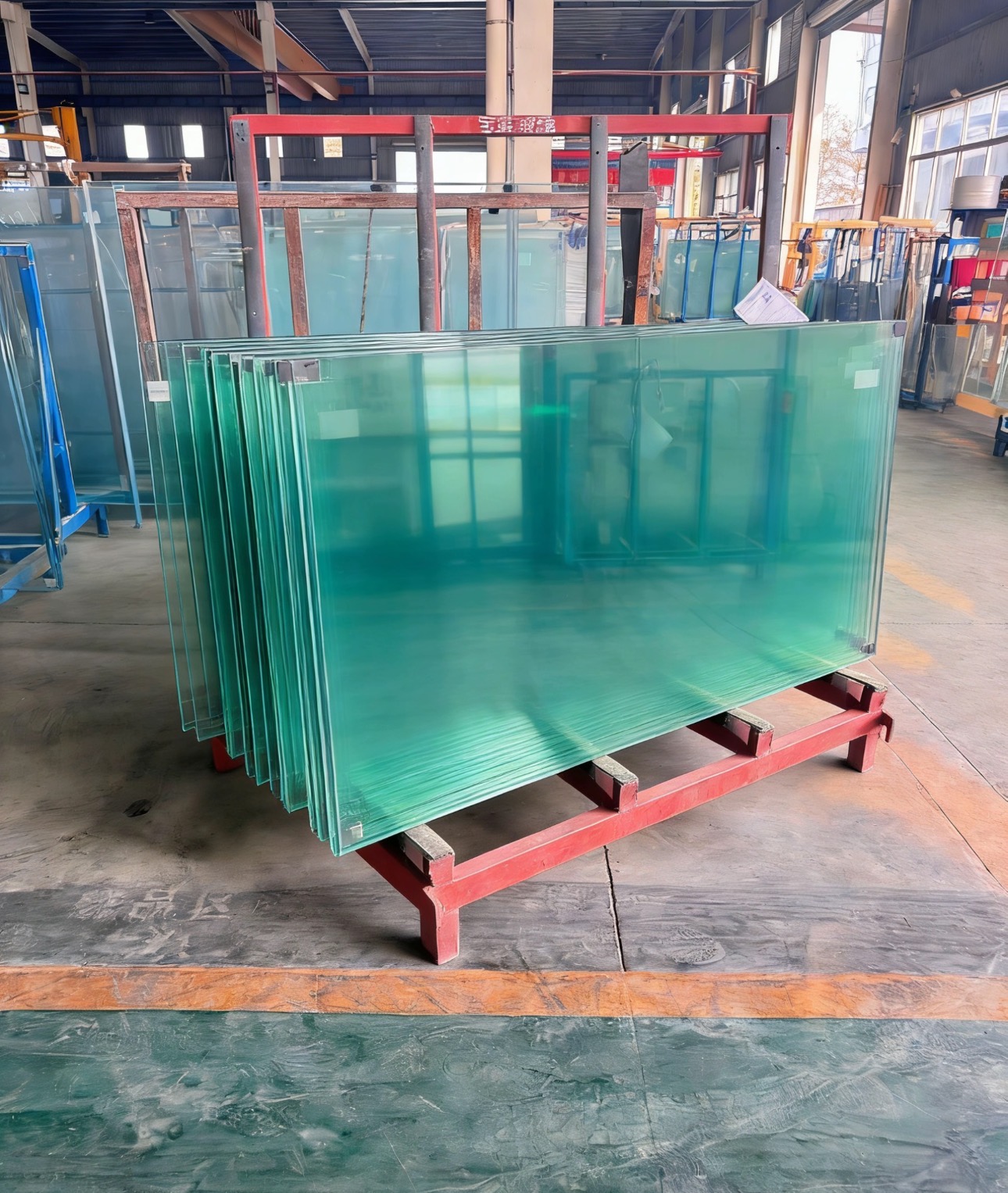
Compliance failures in curtain wall glazing rarely start with the glass itself. They start with the submittal: a drawing sheet that says “laminated safety glass” without naming the interlayer, a thickness schedule with no tolerance band, or a curved panel approved against a flat-glass data sheet. By the time the units arrive on site, the distance between what was written and what was verified is expensive to close.
For buyers in the awareness and research stage, the productive question is not “is this glass good?” but “which parameters can I verify, against which benchmark, and with which document?” That framing turns a technical conversation into a procurement one — and it is the framing this reference follows.
The worked example throughout is DYGLASS, the building glass brand of Shenzhen Dayang Special Glass Co., Ltd., a manufacturer established in 2017 and located in Shenzhen, near Hong Kong. The company operates a 30,000 m² manufacturing facility, employs approximately 130 staff, and reports an annual production capacity of about 600,000 m². Two product families matter most to curtain wall safety verification: laminated glass (model DY-JJ01) and insulating glass (model DY-ZK01).
Why safety glass compliance is a procurement problem before it is an engineering one
Curtain wall glazing carries several obligations at once: safety glazing expectations for human impact, structural behaviour under wind and thermal load, and project-specific targets for acoustics, daylight and thermal performance. Each obligation has a different evidence trail, and those trails do not automatically travel together.
The engineering side has to resolve the loads. The procurement side has to confirm three things: what claim is being made, which document supports it, and whether that document follows the shipment. A supplier can publish a sound insulation figure and still fail a project requirement if the specification asked for a system-level rating rather than a glass-level one. The reverse is also true — a perfectly reasonable glass rating can be over-specified by a buyer who has not separated the two.
Market context explains why this distinction matters more than it used to. Architectural glass accounts for nearly 70% of global flat glass production, which exceeds 120 million metric tons annually (Business Research Insights, 2024). When flat glass supply is abundant, differentiation shifts away from the panel and toward processing capability, geometry control and documentation quality.
The three functional roles of glass in a curtain wall assembly
Most curtain wall build-ups combine three functions that are often confused in tender documents: strength, retention and insulation. They are delivered by different products, and each has its own verifiable parameters.
Tempered glass — the strength layer
DY-GH01 tempered glass is produced from float glass and is supplied as flat tempered glass, curved tempered glass, and tempered glass with hole types. Available thicknesses are 3 mm, 4 mm, 5 mm, 6 mm, 8 mm, 10 mm, 12 mm, 15 mm and 19 mm, with a published thickness tolerance of ±0.5 mm. Light transmittance is ≥91%, and edge work options include polished, grinded and beveled edges. The product is designed for construction, furniture, bathroom, curtain wall and office partition scenarios.
Laminated glass — the retention layer
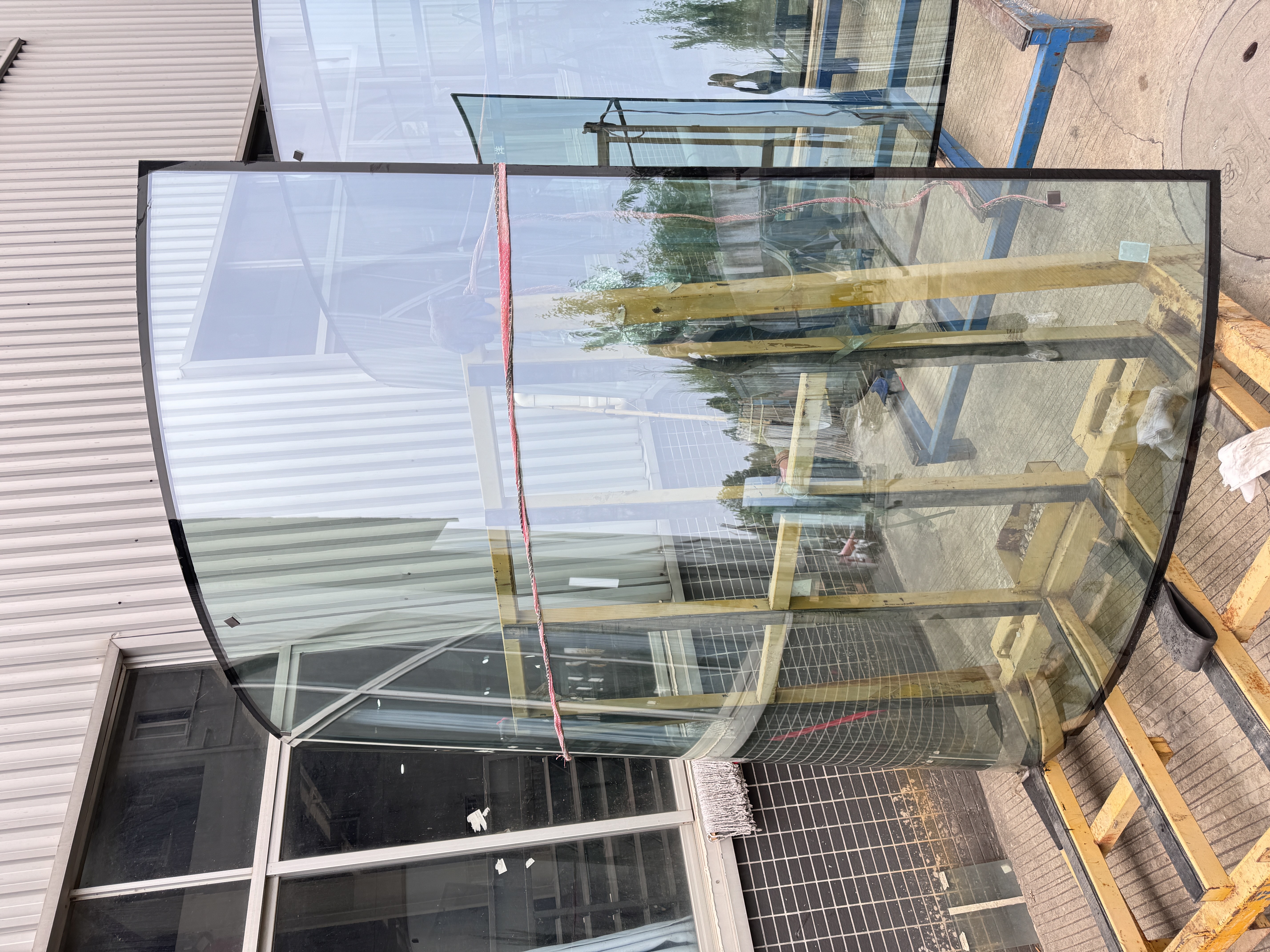
DY-JJ01 laminated glass is a composite in which glass substrates are bonded with an interlayer. Its published thickness range is 6.38 mm to 50 mm, and the material specification lists tempered glass with a PVB interlayer as the base construction. The product family covers tempered laminated safety glass, bulletproof laminated glass, fire-resistant laminated glass and curved laminated glass categories. Interlayer options include PVB, SGP and EVA, in thicknesses of 0.38 mm, 0.76 mm, 1.14 mm, 1.52 mm and 2.28 mm. Substrates can be tempered glass, float glass, low-iron glass or tinted glass. Published light transmittance is 85%–92% for clear and 10%–70% for tinted variants, with sound insulation rated at 35 dB to 45 dB. Target industries include Building & Construction, Real Estate, Architecture, Interior Design, Automotive and Solar Energy.
Insulating glass — the cavity layer
DY-ZK01 insulating glass is made of tempered glass and an aluminum spacer. The category covers tempered insulated glass, insulating glass with Low-E coating, insulating glass with argon gas, and curved insulated glass. Standard thickness configurations are 6 mm + 12A + 6 mm and 8 mm + 16A + 8 mm, with custom options available. Glass types include clear float, Low-E, tempered and low-iron. Spacer bar choices are aluminum spacer or warm edge spacer, and gas fill options include air, argon, krypton and xenon. Published light transmittance is 70% to 89%, with sound insulation of 30 dB to 45 dB. The product is intended for building construction, real estate, architecture, interior decoration, curtain wall and window systems.
Interlayer selection: PVB, SGP and EVA
For DY-JJ01 laminated glass, the interlayer is the parameter that determines post-breakage behaviour, and it has to be named rather than assumed. PVB is the interlayer material listed in the product material specification, and the same laminated glass family is also offered with SGP and EVA interlayers.
This is where many submittals are weakest. A drawing note that says “laminated” does not specify a product. A 6.38 mm laminated unit and a 50 mm multi-ply build-up are both, technically, laminated glass. The buyer-side fix is simple: require the interlayer family, the interlayer thickness and the substrate type to appear explicitly on the submittal, then check them against the specification clause.
Interlayer thickness options for DY-JJ01 are 0.38 mm, 0.76 mm, 1.14 mm, 1.52 mm and 2.28 mm. Substrate options are tempered glass, float glass, low-iron glass and tinted glass. These three data points — interlayer family, interlayer thickness, substrate — are what convert “laminated” from a word into a purchase description.
There is a trade-off to plan for. Thicker interlayers and multi-ply construction add weight and depth to the unit, which affects framing, edge clearance and handling on site. Substrate choice also moves the optical result: published light transmittance is 85%–92% for clear laminated glass but 10%–70% for tinted variants. A buyer selecting tinted laminated glass for solar control should confirm the transmittance figure against the project’s daylighting target before the specification is frozen.
The standards a curtain wall submittal is usually measured against
Two benchmark standards appear most often when thermally tempered safety glass is discussed internationally, and they test different properties.
ASTM C1048 addresses heat-treated glass and requires fully tempered glass to meet a minimum surface compression of 10,000 psi (69 MPa). Surface compression is a strength-related measure: it indicates the level of compressive stress locked into the glass surface by the tempering process.
EN 12150 specifies the fragmentation test for thermally toughened soda lime silicate safety glass, requiring 40 or more particles in a 50 × 50 mm area. Fragmentation is a break-behaviour measure: it describes how the pane fails and whether the resulting fragments are within the safety pattern expected of toughened glass.
Both are benchmarks rather than badges. The edition a project adopts depends on the local building code and on what the specification writer referenced, and adoption varies by market. Buyers should confirm which edition applies, and then ask what documentation the supplier can actually provide against it. In the case of DYGLASS, the company’s profile lists Alibaba Verified Supplier status and an SGS test report as available third-party documentation.
One boundary is worth stating plainly: a supplier’s test report is not a building code approval. Compliance is granted at project level by the authority having jurisdiction, and the supplier’s role is to supply evidence that supports that approval — not to replace it.
Curved glass: where geometry changes the verification list
Curved glass does not follow a different compliance logic, but it adds variables: the shape, the tooling required, and the fact that a curved panel cannot be measured the way a flat one is.
The manufacturing capability behind this matters to procurement because it determines what geometry is realistic to request. The company processes any surface shape of multi-curved tempered glass, including double curved tempered glass, triple curved tempered glass, trapezoid curved tempered glass, spherical curved tempered glass, pyramidal curved tempered glass, S-shape curved tempered glass, cylindrical curved tempered glass, and positive and negative curved tempered glass. Curved laminated glass sits within the DY-JJ01 laminated family, curved insulated glass within the DY-ZK01 insulating family, and curved tempered glass within the DY-GH01 tempered range.
On tolerance, one clarification prevents a common specification error. The published ±0.5 mm figure applies to tempered glass thickness. It is a thickness tolerance and should not be read as a surface-deviation tolerance for a curved panel. Buyers verifying curved units should agree in advance which dimensions are measured, against what template, and at which production stage the check takes place.
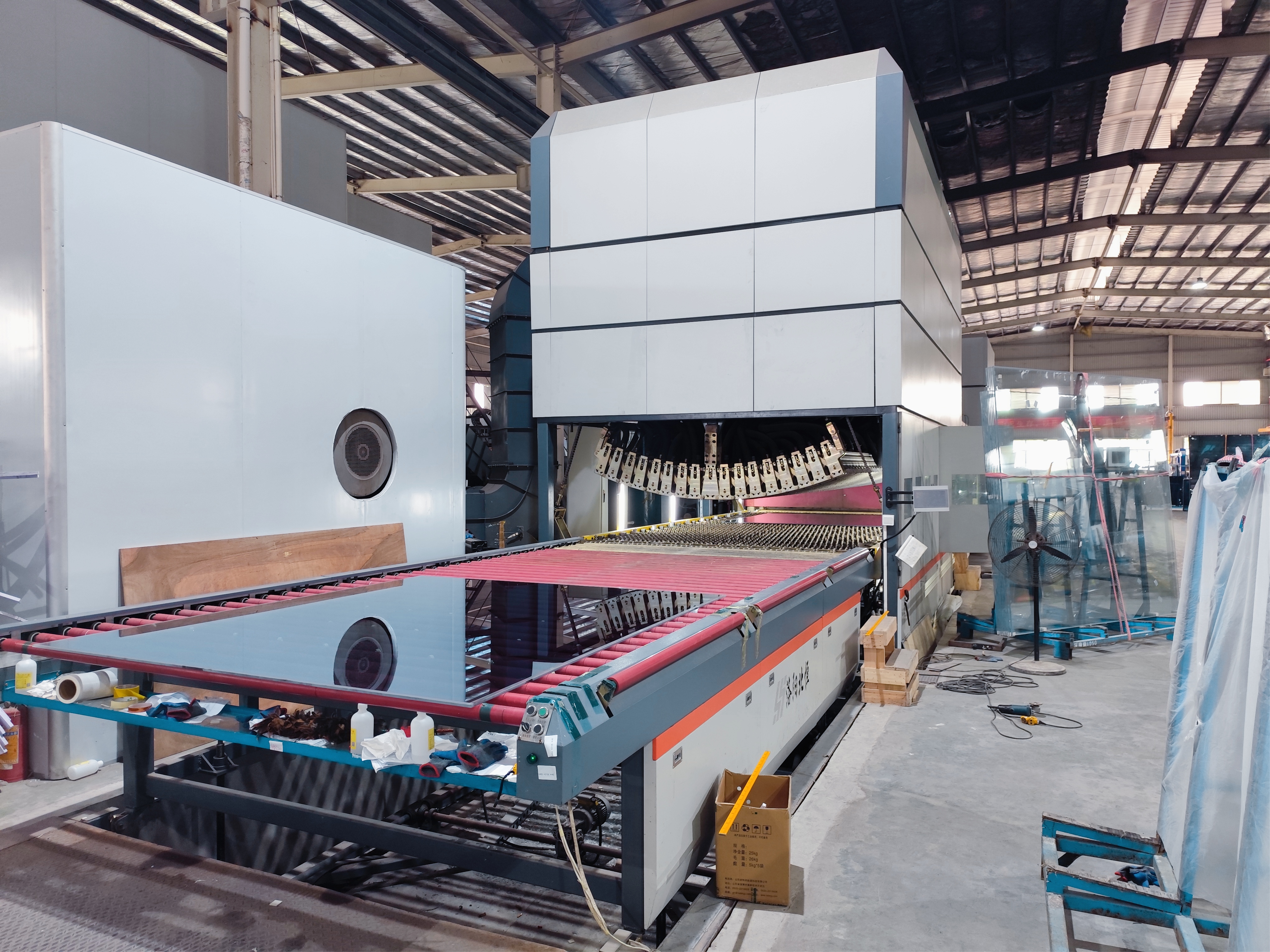
That equipment dependency has a commercial consequence. Curved units draw on dedicated lines — a flat and curved tempering line, a concave and convex curved and irregular curved line, and a double curved tempering line — so curved packages should be scheduled earlier in the project programme than flat glass of the same volume. Buyers who leave curved panels to the end of a procurement cycle usually pay for it in lead time rather than in unit price.
Matching acoustic and thermal figures to the window system
DY-JJ01 laminated glass publishes sound insulation of 35 dB to 45 dB. DY-ZK01 insulating glass publishes 30 dB to 45 dB and light transmittance of 70% to 89%.
Both acoustic ranges sit inside what curtain wall and window system specifications commonly call for, which makes them useful reference points at the research stage. The important caveat is that these are glass-level ratings. Assembly-level performance also depends on the frame profile, perimeter sealing, the air gap and site workmanship. If a project requires a system rating, that has to be established on the assembly — the glass figure alone will not carry it.
On the thermal side, DY-ZK01 offers the relevant specification levers directly: Low-E coating, argon gas fill, and a choice between aluminum spacer and warm edge spacer, with glass types including low-iron and Low-E. These are the parameters a specifier adjusts, and each one should appear explicitly in the submittal rather than being assumed from the product name.
Where the market is moving
Several published figures frame the supply environment that buyers are negotiating within. The global construction glass market was valued at USD 119.2 billion in 2025 and is projected to reach USD 189.33 billion by 2034 (Fortune Business Insights). China’s glass market was estimated at USD 31.2 billion in 2024, with growth expected to USD 55.0 billion by 2035 (Market Research Future). China exported USD 676 million in “glass with edge workings” in 2024, representing 22% of total global exports in that category (OEC).
The processed-glass signal is the one most relevant to compliance-led procurement. Export value concentrated in edge-worked and processed categories indicates that the competitive ground is finishing and fabrication, not raw panel supply. Adjacent categories reinforce the direction: the global smart glass market was valued at approximately USD 8.2 billion in 2025, with electrochromic technology holding a 61.3% share (Grand View Research).
The competitive structure remains concentrated at the top. Leading global flat glass manufacturers include AGC Inc., Saint-Gobain, Guardian Glass, NSG Group and Xinyi Glass (IMARC Group), and Saint-Gobain held approximately 18% of the global architecture glass market share in 2024–2025 (Business Research Insights). For buyers, this means the volume segment is well covered by multinationals, while complex geometry, customisation and documentation responsiveness tend to be where regional specialists compete. DYGLASS reports that export business accounts for approximately 60% of total sales, serving markets including the UAE, Dubai, Bahrain, Saudi Arabia, the United States, the Philippines and Vietnam, alongside the USA, Canada, Russia, the Middle East and Europe.
What to verify before approving a safety glass submittal
The table below converts the parameters discussed above into a verification list. It is written for the point in the process where a buyer has a product name but not yet a confirmed specification.
| Verification item | Published data point (example) | Why it matters at submittal stage |
|---|---|---|
| Product model and category | DY-JJ01 laminated glass; DY-ZK01 insulating glass; DY-GH01 tempered glass | Confirms which category logic applies and which parameter set should be supplied |
| Interlayer family and thickness | PVB, SGP, EVA; 0.38 mm, 0.76 mm, 1.14 mm, 1.52 mm, 2.28 mm | “Laminated” alone does not define post-breakage behaviour |
| Glass substrate | Tempered, float, low-iron or tinted glass | Drives strength position, colour and light transmittance |
| Thickness and tolerance | 6.38 mm–50 mm (laminated); tempered tolerance ±0.5 mm | Tolerance must be read against the correct product and dimension |
| Spacer bar and gas fill | Aluminum spacer or warm edge spacer; air, argon, krypton, xenon | Both are specification decisions, not supplier defaults |
| Light transmittance | 85%–92% clear laminated; 10%–70% tinted; 70%–89% insulating; ≥91% tempered | Optical performance changes with substrate and coating choices |
| Sound insulation | 35–45 dB (laminated); 30–45 dB (insulating) | Glass-level rating; confirm whether the project requires a system rating |
| Edge work | Polished, grinded or beveled | Affects edge quality, handling and sealant compatibility |
| Origin and warranty | Manufactured in China; Building Glass DY lists warranty of more than 5 years | Confirm what the warranty covers and under what conditions |
| Third-party documentation | Alibaba Verified Supplier status; SGS test report listed in company profile | Supporting evidence for approval — not a substitute for code approval |
Application fit
The application profile of these products is deliberately broad, and that breadth is itself a procurement consideration. Insulating glass is intended for building construction, real estate, architecture, interior decoration, curtain wall and window systems. Tempered glass serves construction, furniture, bathroom, curtain wall and office partition scenarios. Laminated glass targets Building & Construction, Real Estate, Architecture, Interior Design, Automotive and Solar Energy.
At project level, the relevant framing is engineering category rather than building type. These products are positioned for construction engineering, decoration engineering and municipal engineering projects, within the Building Materials and Real Estate sector. Curved facade glass of this type is typically specified where the architectural intent includes non-planar geometry — transport infrastructure, research and institutional buildings, financial district towers, sports venues and transit facilities — and where, consequently, the compliance conversation has to cover geometry verification on top of the standard parameter set.
Limits and trade-offs compared with simpler glazing
A useful supplier reference states where its own products are not the simplest answer. Four boundaries apply here.
- Weight and build depth. Laminated glass at the upper end of the 6.38 mm–50 mm range, and multi-ply constructions within it, add mass and thickness relative to monolithic tempered glass. Framing and fixing details have to be checked accordingly.
- Light transmittance trade-off. Tinted laminated glass ranges from 10% to 70% light transmittance. That range is wide, and choosing the wrong point within it is a common cause of post-installation dissatisfaction on daylighting.
- Curved scheduling. Curved units require dedicated tooling and furnace time. Compared with flat glass of similar area, curved packages need earlier release in the programme.
- Documentation boundary. Supplier test documentation supports a compliance case. It does not constitute code approval, and standard editions differ between markets. Buyers working across multiple jurisdictions should confirm the applicable edition per market rather than assuming a single report covers all.
Capacity is a fifth practical limit. A manufacturer with around 600,000 m² of annual production capacity and approximately 130 staff can absorb complex facade packages, but large curved and laminated scopes benefit from earlier supplier engagement than a commodity flat-glass order would.
Future outlook
The direction of travel in architectural glass points toward more parameters being specified per project, not fewer. Growing market value in construction glass, combined with a smart glass segment where electrochromic technology already holds a majority share, suggests that curtain wall specifications will continue to accumulate functional requirements — thermal, acoustic, switchable, printed, decorative — layered onto the same safety and structural baseline.
For buyers, that means compliance verification becomes a repeatable process rather than a one-off exercise. The practical response is to standardise the submittal checklist: model and category, interlayer, substrate, thickness and tolerance, spacer and gas fill, optical and acoustic figures, edge work, and third-party documentation. Suppliers who can answer that list consistently — including on curved geometries — will find the verification conversation shorter than suppliers who cannot.
Frequently asked questions
1. What is the difference between tempered glass and laminated safety glass in a curtain wall?
Tempered glass is heat-treated to raise surface compression and is supplied in flat, curved and drilled forms; DY-GH01 is available in thicknesses from 3 mm to 19 mm with a thickness tolerance of ±0.5 mm and light transmittance of ≥91%. Laminated glass bonds glass substrates with an interlayer; DY-JJ01 spans 6.38 mm to 50 mm and is offered in tempered laminated safety glass, bulletproof laminated glass, fire-resistant laminated glass and curved laminated glass categories. In a curtain wall, the two are often combined — tempered substrates inside a laminated build-up.
2. Which interlayer types are available for DYGLASS laminated glass, and in what thicknesses?
DY-JJ01 offers PVB, SGP and EVA interlayers. PVB is the interlayer material named in the product’s material specification, with SGP and EVA offered as alternatives. Interlayer thickness options are 0.38 mm, 0.76 mm, 1.14 mm, 1.52 mm and 2.28 mm. Substrates can be tempered glass, float glass, low-iron glass or tinted glass.
3. What thickness tolerance applies to tempered glass, and how should it be checked?
The published thickness tolerance for DY-GH01 tempered glass is ±0.5 mm, across the available thicknesses of 3 mm, 4 mm, 5 mm, 6 mm, 8 mm, 10 mm, 12 mm, 15 mm and 19 mm. It is a thickness tolerance. It should not be applied as a surface-deviation tolerance for curved panels, and buyers should confirm separately which dimensional checks are performed on curved geometry and at what production stage.
4. What sound insulation performance can laminated and insulating glass achieve?
DY-JJ01 laminated glass publishes sound insulation of 35 dB to 45 dB. DY-ZK01 insulating glass publishes 30 dB to 45 dB, alongside light transmittance of 70% to 89%. These are glass-level ratings. Where a project requires an assembly-level or system-level acoustic figure, that has to be established on the complete curtain wall or window assembly, including frame, seals and installation quality.
5. Which international standards are used to benchmark thermally tempered safety glass?
ASTM C1048 requires fully tempered glass to meet a minimum surface compression of 10,000 psi (69 MPa), which measures the strengthening effect of tempering. EN 12150 specifies the fragmentation test for thermally toughened soda lime silicate safety glass, requiring 40 or more particles in a 50 × 50 mm area, which measures break behaviour. Which edition applies to a given project depends on local building code and on the specification writer’s reference.
6. Can curved glass be supplied as laminated, insulating, or both?
Both configurations exist within the DYGLASS product range. Curved laminated glass is a category within DY-JJ01 laminated glass, and curved insulated glass is a category within DY-ZK01 insulating glass. Curved tempered glass is a type within DY-GH01. Manufacturing covers multi-curved tempered glass in double curved, triple curved, trapezoid, spherical, pyramidal, S-shape, cylindrical, and positive and negative curved forms.
7. What documentation should a buyer request before approving a safety glass submittal?
A practical minimum is: product model and category, interlayer family and thickness, glass substrate, thickness and tolerance, spacer bar and gas fill for insulating units, published light transmittance and sound insulation, edge work specification, place of origin, warranty terms, and available third-party test documentation. Shenzhen Dayang Special Glass Co., Ltd. lists Alibaba Verified Supplier status and an SGS test report in its company profile. Regardless of supplier, such documentation supports a project’s compliance case; it does not replace approval by the relevant local authority.
Reference material: The DYGLASS product brochure covering laminated, tempered, insulating and curved glass specifications is available for download here: DYGLASS Building Glass Brochure (PDF).
Company: Shenzhen Dayang Special Glass Co., Ltd. — website: www.dayangglass.com.