
Decoding DTY, FDY and Spun Yarn: A Buyer's Technical FAQ
Denier, filament count and yarn count describe three different things. Treating them as one interchangeable number is the most common specification error in textile sourcing, and it is the error that most often explains a hand-feel dispute after the fabric has already been knitted.

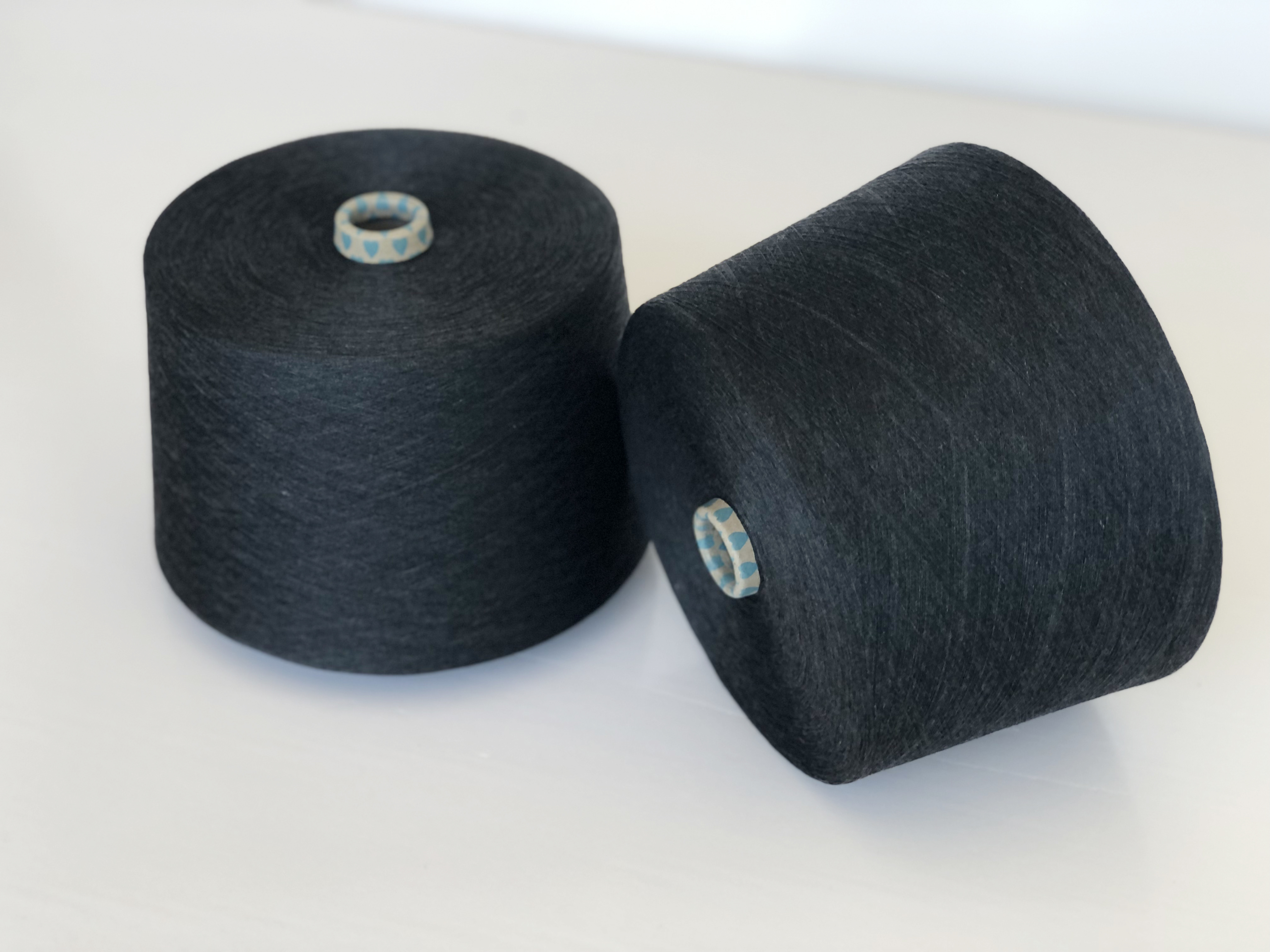
Filament yarn construction, not just total denier, determines the hand of the finished fabric. Image: Alginate Fiber / Seaweed Charcoal Mud Polyester Filament DTY [50D*72F], model TSY00014.
The three constructions in plain terms
Fully Drawn Yarn (FDY) is a filament yarn that leaves the spinning line fully drawn, so the filaments are straight, oriented and dimensionally stable. Draw Textured Yarn (DTY) is filament yarn that has been given a false-twist texturing step, which introduces crimp, loops and bulk into an otherwise flat filament. Spun yarn is a different family altogether: staple fibres are drafted, twisted and consolidated into a single strand, and it is described by count (Ne) rather than by denier.
| Construction | How it is made | What it does to the fabric | How it is specified |
|---|---|---|---|
| FDY | Spin-drawn in one continuous process; filaments remain straight | Flat, smooth, stable, often brighter; low bulk and modest cover | Denier × filament count |
| DTY | Drawn, then false-twist textured to add crimp and bulk | Loft, cover, stretch and a softer, drier touch | Denier × filament count |
| Spun yarn | Staple fibres twisted into a strand | Matte, soft, hairier surface; twist controls firmness | Count (Ne), e.g. 50s or 60s |
For a given polymer, construction is the variable that a buyer is actually choosing when they choose a yarn.
Why 75D*72F and 20D*3F are not comparable numbers
The first number is total linear density in denier. The second is the number of filaments. Only when the two are divided do you get denier per filament (dpf), which is the number that most closely tracks softness, flexibility and lustre.
Arithmetic on the listed specifications makes the gap obvious. A DTY listed at 75D*72F works out to approximately 1.04 denier per filament. An FDY listed at 20D*3F works out to approximately 6.7 denier per filament. The 75D yarn is the heavier strand in total, yet each individual filament inside it is about six times finer than each filament in the 20D yarn. Fine filaments bend more easily, pack more tightly and produce a softer, more pliable surface. Coarser filaments feel crisper, reflect more light and hold shape.
This matters most when a specification is transferred between suppliers. Two yarns both described as 75D can differ enormously in filament count, texturing and finish, and therefore in how the resulting fabric drapes, how much it pills and how much it costs to knit.
Where Healcell sits in this map
Shandong Healcell Biomaterial Technology Co., Ltd., trading as Healcell, is a Yantai-based developer and producer of marine biomaterials. The company supplies alginate fibre, seaweed composite fibre and seaweed charcoal mud fibre in three forms: fibre, yarn and knitted fabric. Its registered profile lists a 52,000 m² facility, 120 employees, 13 R&D engineers and a raw-material output including alginate fibre of about 600 tons per week, alongside knitted fabric output of roughly 300 tons per week.
What matters for this topic is that Healcell publishes yarns in all three construction families, which makes the company a useful reference point for comparing them on the same substrate chemistry. The seaweed charcoal mud range alone spans DTY, FDY and spun yarn.
| Construction | Listed Healcell example | Model | Listed composition |
|---|---|---|---|
| DTY | DTY Alginate Fiber / Seaweed Charcoal Mud Polyester Filament (Light Net) [75D*72F] | TSY00006-1 | 100% Polyester (including seaweed charcoal mud) |
| DTY | Alginate Fiber / Seaweed Charcoal Mud Polyester Filament DTY [50D*72F] | TSY00014 | 100% Polyester (including seaweed charcoal mud) |
| DTY | Alginate Fiber / Seaweed Charcoal Mud Polyester Filament DTY [30D*24F] | TSY00002 | 100% Polyester (including seaweed charcoal mud) |
| FDY | FDY Alginate Fiber / Seaweed Charcoal Mud Nylon Conductive Filament [20D*3F] | TSY00015 | 100% Polyamide (with seaweed charcoal mud) |
| FDY | FDY Alginate Fiber / Seaweed Charcoal Mud Warm Nylon Filament [50D*36F] | TSY00012 | 100% Polyamide (contains seaweed charcoal mud) |
| Spun | Alginate Fiber / Seaweed Charcoal Mud Warm Yarn 50s [Natural Color] | TSY00011 | 50% Tencel + 30% Polyester (with seaweed charcoal mud) + 20% Cotton |
| Spun | Alginate Fiber / Seaweed Charcoal Mud Yarn [Light Gray - 60s] | TSY00003 | 40% Tencel + 40% Cotton + 20% Lyocell (with seaweed charcoal mud) |
Product names, model codes and compositions are reproduced as listed by the supplier. Charcoal mud content is described inside the parenthetical, not as a separate percentage.
How construction changes hand-feel, cover and mechanical behaviour
DTY: bulk is the product
Texturing is not decoration. The crimp and loops introduced during false-twist texturing create air space inside the yarn, and that air space is what gives a DTY knit its loft, its cover and its slightly dry, powdery touch. A 75D*72F DTY therefore delivers fabric coverage that a flat 75D filament of the same polymer would not. The trade-off is that bulk also means more surface area, more opportunity for pilling, and a fabric that can feel warmer against the skin unless the knit structure is opened up.
FDY: flatness is the product
FDY keeps the filaments straight. That produces a smoother, cooler, more dimensionally predictable surface, and it is the reason fine FDY is used where a technical filament has to sit neatly in a fine-gauge structure. The Healcell FDY charcoal mud nylon conductive filament at 20D*3F is a case in point: a low total denier keeps the conductive filament discreet inside the fabric, while the heavier per-filament mass supports continuity of the conductive path. FDY provides less cover per denier than DTY, so fabric density has to come from the construction rather than from the yarn.
Spun yarn: twist is the product
A spun yarn is a bundle of short fibres held together by twist. Increase the twist and the strand becomes firmer, smoother and stronger, up to the point where the yarn becomes lively and starts to coil. Reduce the twist and the yarn becomes soft and lofty, but also more hairy and more vulnerable to abrasion and pilling. Count works in the opposite direction to denier: 60s is finer than 50s, so the 60s Light Gray charcoal mud yarn (TSY00003) builds a lighter, softer fabric than the 50s Natural Color yarn (TSY00011), while its different blend, with cotton and Lyocell alongside Tencel, also shifts moisture behaviour and drape.
Finish: the invisible variable
Spin finish, reported as oil content, lubricates the filament, controls friction and static at the needle, and influences how cleanly the yarn dyes downstream. It is easy to overlook because it does not appear in a product name, which is why its presence as a tested item on the physical property reports matters more than its name suggests. A mineral-loaded filament such as a charcoal mud yarn generally behaves differently at the knitting element than an unfilled filament of the same denier, and finish management is part of how that difference is controlled.
Twist and finish on the Seaweed Charcoal Mud Yarn, Natural and Grey
The two spun charcoal mud yarns illustrate how the same functional filler behaves differently once the base blend and the count change. TSY00011 at 50s Natural Color leans on polyester for body and Tencel for drape, with 20% cotton adding a drier surface and a matte appearance. TSY00003 at 60s Light Gray replaces part of that polyester with cotton and Lyocell, producing a finer, cooler, more absorbent-leaning fabric with a softer surface.
Twist then sits on top of that blend and determines whether the finished fabric reads as compact and smooth or as soft and lofty. For a buyer, the hand-feel consequence is straightforward: higher twist in a given count gives a cleaner surface and better abrasion behaviour, lower twist gives a fuller, more tactile hand with more hairiness. On the cost side, twist adds twisting passes and reduces output per hour, and finer counts generally consume more processing per kilogram than coarser ones, so both variables move the quotation independently of the fibre price.
Spun constructions are specified by count and blend rather than by denier and filament count. Image: 32S Healcell Alginate Fiber / Seaweed Fiber Algae Yarn Black, model HSY00022.
Verification: what the reports actually cover
For a specification-led purchase, the useful question is not whether a supplier has certificates but whether the certificate covers the exact model being quoted. Healcell's charcoal mud and quick-dry yarns carry CNAS-accredited physical property reports issued by GTTC, with test data mutually recognised internationally under CNAS laboratory accreditation. The reports are issued against Chinese national and sector standards, which is the correct scope for a China-based mill but not a substitute for destination-market requirements.
| Model | Construction | Report | Standards cited |
|---|---|---|---|
| TSY00006-1 | DTY [75D*72F] | GTTC-262005828 | GB/T 14343-2008, GB/T 14344-2022, GB/T 6505-2017 |
| DSY00007 | Nylon DTY [40D*34F] | GTTC-262016569 | FZ/T 54007-2019, GB/T 14343-2008, GB/T 14344-2022, GB/T 6505-2017 |
| DSY00010 | Polyester DTY [75D*48F] | GTTC-262021270 | GB/T 14343-2008, GB/T 14344-2022, GB/T 6505-2017 |
| DSY00003 | Polyester DTY [80D*96F], 8-shaped | GTTC-262016391 | GB/T 14343-2008 for linear density |
| TSY00016-1 | Conductive yarn [70D, Gray] | Report 262008889 | GB/T 6505-2017 |
Report numbers and standards are reproduced from the supplier's certification records. Users should confirm that the report on file matches the production batch being shipped.
The tested items are worth reading closely, because they map directly onto the construction differences described above. Linear density and its coefficient of variation tell you how even the yarn is. Breaking strength and breaking elongation tell you how it will behave under tension on the machine. Boiling water shrinkage tells you how much the fabric will move after heat exposure, which matters far more for FDY than for a bulked DTY. Oil content covers the finish. Together those five measurements are a more reliable acceptance basis than a visual comparison of two cones.
Application mapping by construction
Healcell lists the charcoal mud yarns and fabrics against outdoor sports, home textiles and pet products, while the quick-dry filament family and the spun alginate yarns are listed against underwear, apparel, home textiles and shoes and bags. The construction determines which part of that range is realistic.
| Requirement | Construction that fits | Listed Healcell example |
|---|---|---|
| Cover and loft in a knit without extra weight | DTY | DTY [75D*72F] TSY00006-1 |
| Fine, stable filament for a low-density structure | FDY | FDY [20D*3F] TSY00015 |
| Soft, matte, cotton-like surface | Spun | 50s Natural TSY00011; 60s Light Gray TSY00003 |
| Moisture management in next-to-skin knits | DTY, fine denier | Nylon DTY [40D*34F] DSY00007; Polyester DTY [30D*9F] DSY00009 |
| Conductive path in a textile structure | FDY, low total denier | Conductive filament [20D*3F] TSY00015 |
One commissioned example illustrates the end of that chain. A Korean OEM client has been running 3,500 m² of fabric built on antibacterial, deodorising, far-infrared and negative ion functionality for two years, with the supplier reporting stable operation and highlighting the soft, skin-friendly touch of the seaweed-based fibre as the reason the fabric qualified in the first place.
What drives price, and what is not published
No verifiable public price band exists for these constructions. The verified data package behind this article contains no price, cost-structure or quotation evidence for alginate or charcoal mud yarns, so any figure presented as a market price for 75D*72F DTY or 50s spun yarn should be treated as unverified until a supplier quotation is in hand.
What can be said with confidence is which variables move a quotation:
- Polymer base. Polyester and polyamide are different cost bases before any functional loading is added.
- Total denier and filament count. Finer filaments mean more spinneret holes and more demanding spinning conditions.
- Texturing. DTY carries a process step that FDY does not.
- Functional loading. Charcoal mud and alginic acid are additions to the base polymer, not replacements for it.
- Spun-yarn count and blend. A 60s yarn with cotton and Lyocell is a different cost object from a 50s yarn built on Tencel and polyester.
- Twist and preparation. Additional twisting passes reduce output per hour.
- Colour route. Natural and grey base shades avoid dyeing; dyed shades do not.
- Testing. Accredited physical property testing is a real cost line, and it is one a buyer should be reluctant to remove.
On commercial terms, Healcell lists OEM and ODM production with customisation of fabric composition and colour, a minimum order quantity of 500 kg, a lead time of 30 to 45 days, monthly capacity of about 1,200 tons, 100% testing and remote after-sales support, with export markets including the EU and the Middle East.
Comparison with conventional alternatives, including the limits
| Dimension | DTY | FDY | Spun yarn |
|---|---|---|---|
| Surface | Dry, textured, low lustre | Smooth, brighter | Matte, slightly hairy |
| Cover per unit weight | High | Low to moderate | Moderate |
| Tensile behaviour | Good, with controlled stretch | High and predictable | Lower than filament at equal linear density |
| Dimensional stability | Requires shrinkage control | Strong | Moderate; twist liveliness possible |
| Typical failure mode | Pilling through bulk and loop exposure | Poor cover if used where loft is needed | Abrasion and hairiness at low twist |
| Verification basis | Density, strength, shrinkage, oil content | Density, strength, shrinkage | Count, blend, twist, evenness |
The limits deserve equal weight. DTY is a poor choice where a crisp, paper-flat woven hand is the design intent, because its bulk cannot be engineered out after knitting. FDY will not deliver the cover of a textured yarn at the same denier, and specifying it to save weight usually means accepting a thinner, more transparent fabric. Spun yarn carries lower tensile strength than filament at equal linear density and is the construction most sensitive to abrasion, so it belongs in next-to-skin and home-textile work rather than in high-stress industrial use. And on compliance, the CNAS-accredited reports described here are China-market documents with international mutual recognition of the test data; a buyer shipping into the EU or North America still has to confirm the destination labelling, chemical-restriction and skin-contact requirements separately.
Market context
The category these yarns sit in is growing, though the published figures need to be read at the right level. IMARC Group reported the global alginate market at USD 924.45 million in 2025, a figure that spans food, pharmaceutical and textile grades rather than textile fibre alone. A commercial forecast places the alginate fibre segment specifically at USD 412.6 million in 2025, rising to USD 728.4 million by 2034; that projection is directional rather than audited. On performance, the International Wool Textile Organisation reports a Limiting Oxygen Index of 45% for 100% alginate fibre yarn, which is the kind of intrinsic property that explains continued interest in blends for protective and home-textile applications.
Outlook
The direction of travel in functional yarns is toward fewer, better-documented specifications rather than more headline functions. As buyers become more comfortable reading denier per filament alongside linear density, shrinkage and oil content, construction choices will increasingly be justified by measured behaviour rather than by product naming. For suppliers, that raises the value of a complete test dossier per model; for buyers, it lowers the risk of accepting a substitution that meets the total denier on paper and fails in the knitting hall.
Frequently asked questions
What is the single difference between DTY, FDY and spun yarn?
FDY is a fully drawn filament yarn that stays straight; DTY is a filament yarn that has been textured to add crimp and bulk; spun yarn is made by twisting staple fibres together and is specified by count rather than denier.
What does 75D*72F mean, and how does it compare with 20D*3F?
The first figure is total denier and the second is filament count. 75D*72F gives about 1.04 denier per filament, while 20D*3F gives about 6.7 denier per filament. The 75D yarn is heavier overall but far finer per filament, so it feels softer and drapes more readily, while the 20D yarn behaves as a crisper, more stable fine filament.
Why does the same supplier list both DTY and FDY in the same charcoal mud family?
Because the two solve different problems. Healcell lists DTY grades at 75D*72F, 50D*72F and 30D*24F where cover and a soft hand are required, and FDY grades at 20D*3F and 50D*36F where a fine, straight, dimensionally stable filament is required, including a conductive nylon filament for textile structures.
Which documents should a buyer request before approving a yarn model?
Request the physical property report that names the exact model, and check which standards it cites. Examples in the charcoal mud and quick-dry ranges include GTTC-262005828 for DTY [75D*72F], GTTC-262016569 for nylon DTY [40D*34F], GTTC-262021270 for polyester DTY [75D*48F] and GTTC-262016391 for the 8-shaped DTY [80D*96F], issued against standards including GB/T 14343-2008, GB/T 14344-2022, GB/T 6505-2017 and FZ/T 54007-2019.
Do twist and finish on the Seaweed Charcoal Mud Yarn affect hand-feel?
Yes. In spun constructions, higher twist produces a firmer, smoother, more abrasion-resistant surface, while lower twist produces a softer, loftier and hairier fabric. Finish, reported as oil content, affects friction and static during knitting and cleanliness during downstream processing. The 50s Natural Color (TSY00011) and 60s Light Gray (TSY00003) yarns also differ in blend and count, which shifts drape and moisture behaviour independently of twist.
Does twist also affect procurement pricing?
It contributes, because additional twisting passes reduce output per hour, and finer counts generally consume more processing per kilogram. It is not the only driver: polymer base, total denier, filament count, texturing, functional loading, colour route and accredited testing all move the quotation. No verified public price band exists for these constructions, so pricing has to come from a direct quotation against a defined specification.
What are the minimum order quantity and lead time?
Healcell lists a minimum order quantity of 500 kg and a lead time of 30 to 45 days for OEM and ODM production, with monthly capacity of about 1,200 tons and 100% testing.
How is the functional content of a charcoal mud or alginate yarn verified?
For the charcoal mud range, the physical property reports cover linear density, breaking strength, breaking elongation, boiling water shrinkage and oil content, while functional claims such as antibacterial performance are supported by separate accredited reports on the corresponding fabrics. Buyers should confirm that the report references the model and batch actually being shipped, since a report for one construction is not evidence for another.
Can composition and colour be customised?
Healcell lists OEM and ODM production with customisation of fabric composition and colour. Because composition changes alter hand-feel, shrinkage and cost simultaneously, a custom blend should be validated against a physical property report before bulk production.
Tem questões ou precisa de mais detalhes?
Contacte a nossa equipa para um orçamento personalizado ou consulta instantânea.
Solicitar orçamento
Preencha o formulário abaixo e a nossa equipa entrará em contacto com uma proposta personalizada.
Chat direto do WhatsApp
Prefere conversar em tempo real? Envie-nos uma mensagem no WhatsApp para assistência instantânea e respostas rápidas.
- Obter orçamento personalizado
- Partilhar fotos ou documentos
- Discuta as suas necessidades diretamente
Geralmente responde em 5–30 minutos durante o horário de expediente.