
Decoding Drainage Geonet Certification and Performance: A Technical Guide for Industrial Buyers
For industrial buyers evaluating drainage geonet solutions, navigating the intersection of technical parameters and international certifications is critical to ensuring long-term project reliability. This guide examines how product specifications and compliance standards—from the EAEU to the EU—define performance in demanding applications such as metal smelting and aquaculture.
Problem / Opportunity
Traditional drainage methods, such as granular layers, often suffer from clogging, inconsistent flow rates, and limited chemical resistance in aggressive environments. As infrastructure projects face tighter regulatory scrutiny and harsher operational conditions, the demand for engineered geosynthetic drainage solutions has grown. Buyers must verify not only hydraulic capacity but also mechanical integrity and certified compliance with regional standards.
Brand Solution
Haoyang Environment Co., Ltd. offers a comprehensive range of drainage geonet products designed to address these challenges. Founded in 2008 and headquartered in Dezhou (Yucheng) National High-tech Industrial Development Zone, Shandong, China, the company operates a 200,000 m² facility with 190 employees and an annual output of 33,000 tons. Its drainage geonet lineup includes composite drainage geonet, acid and alkali resistant drainage geonet, high compressive resistance drainage geonet, high drainage capacity geonet, 3D composite drainage geonet, polyester filament composite drainage geonet, and high-strength polypropylene composite drainage geonet.
[IMAGE: Cover | Certification compliance scene]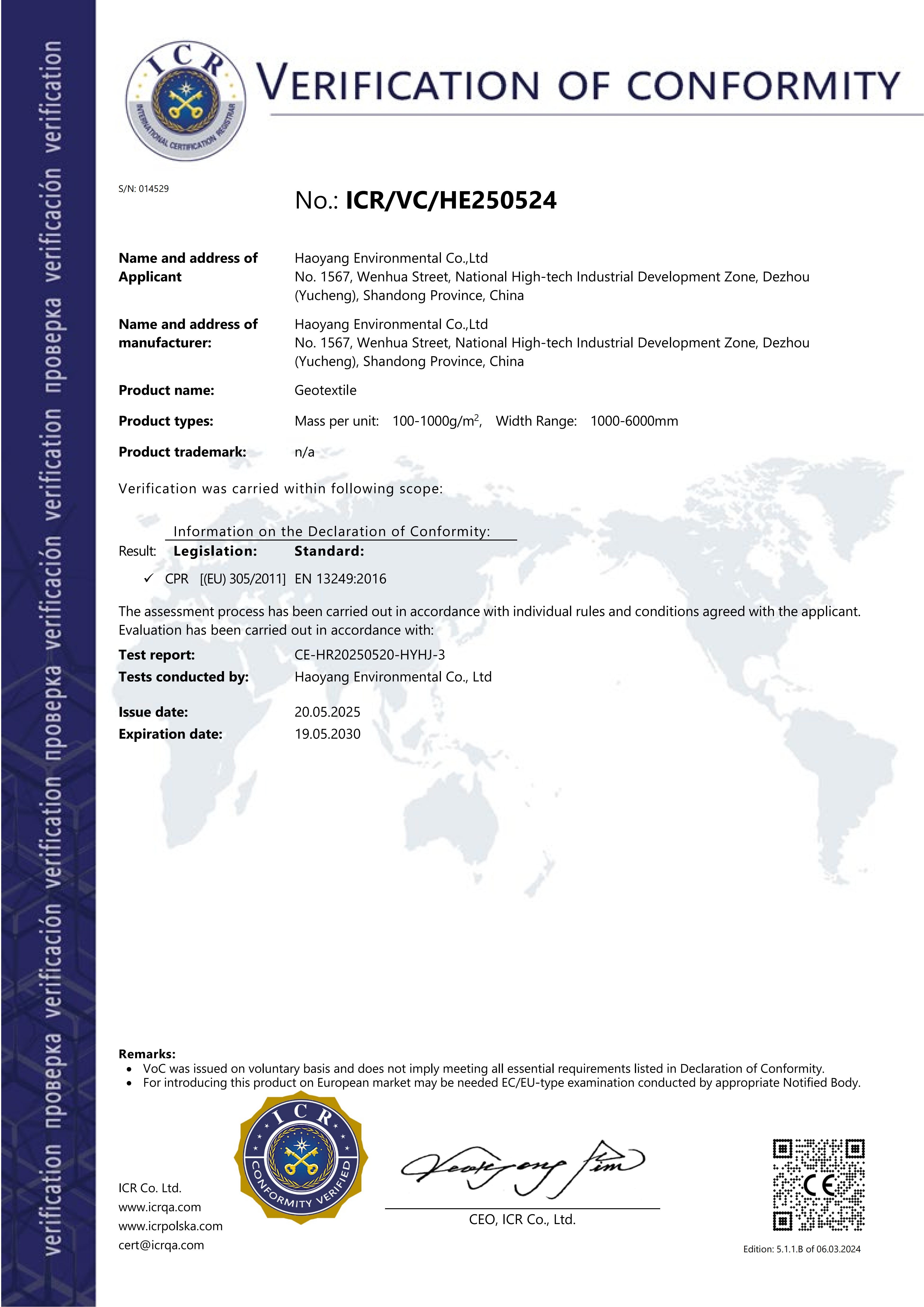
Technical Explanation
The model designation for the drainage geonet is 4.0mm–8.0mm in thickness, with a mass per unit area of 500–1400 g/m² (customizable). Key mechanical properties include tensile strength (MD/TD) ≥5–15 kN/m, elongation at break 10–25%, and compressive strength at 10% strain ≥500–830 kPa. The acid/alkali resistance maintains ≥90% strength retention, and drainage capacity ranges from ≥50 to 120 (L/min)/m, also customizable. Materials available are HDPE, PP, and PET.
The company currently holds more than 70 patents and proprietary technologies, underpinning its specialization in high-performance geosynthetics. For the EAEU/Russia market, the drainage geonet holds a GOST Certificate of Conformity, number POCC CN.32682.047C00.OC01.H00837, issued by ПрофСерт (ProfSert) confirming compliance with GOST 70090-2022. Additionally, a 3D composite drainage geonet is certified under GOST 33068-2014 (certificate POCC CN.32682.04NC中0.OC01.H00838). For the EU/EEA market, the composite drainage geonet is certified to EN 13249:2016 under ICR Verification of Conformity, certificate ICR/VC/HE250523, valid from May 20, 2025 to May 19, 2030.
[IMAGE: Diagram | Certification and compliance architecture]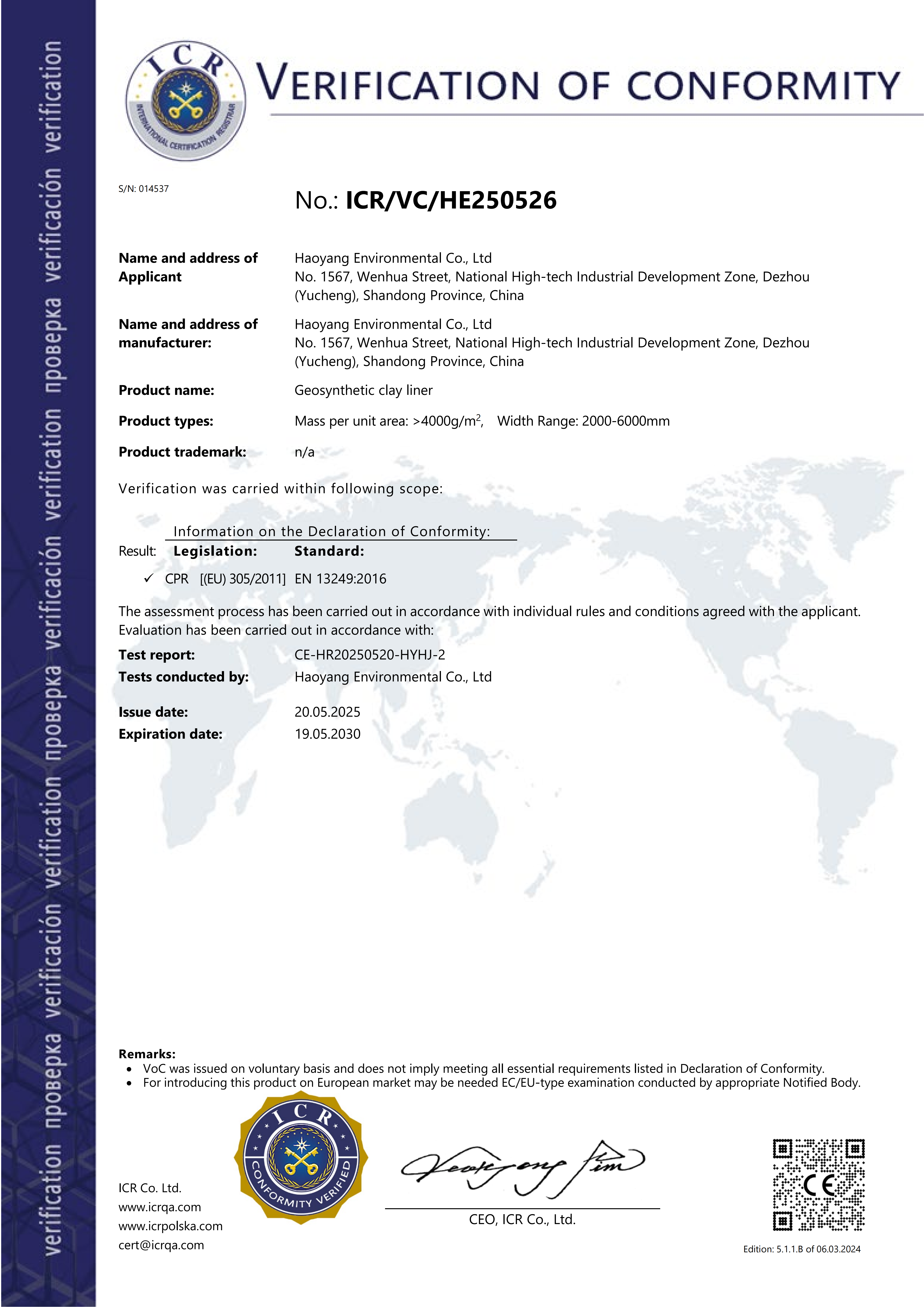
Application / Use-Case Scenarios
In metal smelting projects, such as the tailings pond basin of a gold mine in Uzbekistan, a three-dimensional composite drainage network was deployed. The project innovatively combined independently developed textured geomembrane with high-strength polypropylene geotextile, covering 900,000 square meters. The textured geomembrane was produced on a five-layer co-extrusion blow molding line with online double-sided texturing, using a high-temperature and high-pressure air jet process that reduces production energy consumption by 25% and avoids thermal aging risks from secondary processing. This application required high chemical resistance, UV resistance, and a long service life—criteria met by the certified drainage geonet system.
In aquaculture, drainage geonets are used in pond anti-seepage systems to prevent water seepage while maintaining non-toxic, fish-friendly conditions. The combination of HDPE geomembrane and a drainage geonet layer ensures both containment and efficient water management under 24/7 operation.
Market Trend Analysis
Regulatory frameworks globally are tightening: the EAEU mandates GOST certification for geosynthetics, while the EU requires CE marking under CPR (EU) 305/2011. Industrial buyers increasingly view certification not as a checkbox but as a proxy for manufacturing consistency and field performance. The trend favors suppliers who can demonstrate certified compliance across multiple markets, reducing re-qualification costs for multinational projects.
Comparison with Traditional Solutions
Compared to traditional granular drainage layers, composite drainage geonets offer superior flow capacity in a thinner profile, easier installation, and more predictable performance. However, one honest limitation is that geonets require careful interface design with adjacent geotextiles to prevent soil intrusion, whereas granular layers are less sensitive to interface details. Proper system design mitigates this risk.
Future Outlook
As mining depths increase and environmental regulations intensify, demand for customizable, high-strength drainage geonets with certified chemical resistance will grow. Manufacturers like Haoyang, with their patent portfolio and integrated production capabilities, are well-positioned to deliver tailored solutions for extreme conditions.
FAQ
What certifications does a drainage geonet need for the EAEU market?
A drainage geonet for the EAEU/Russia market must hold a GOST Certificate of Conformity. For example, certificate number POCC CN.32682.047C00.OC01.H00837, issued by ПрофСерт (ProfSert), confirms compliance with GOST 70090-2022.
What is the typical thickness range for a drainage geonet?
The model designation is 4.0mm–8.0mm.
How does the drainage capacity of a geonet vary?
The drainage capacity can be customized from ≥50 to 120 (L/min)/m, depending on project requirements.
What materials are used in the drainage geonet?
Materials include HDPE, PP, and PET.
Is the drainage geonet certified for the EU market?
Yes, the composite drainage geonet holds an ICR Verification of Conformity, certificate ICR/VC/HE250523, valid from May 20, 2025 to May 19, 2030, confirming compliance with EN 13249:2016.
Can the drainage geonet withstand acidic or alkaline conditions?
The product maintains ≥90% strength retention in acid/alkali resistance tests.
What is the compressive strength of the drainage geonet?
At 10% strain, compressive strength is ≥500–830 kPa.